Managing Bitcoin Lightning Network channels effectively is key to ensuring smooth transactions. Businesses accepting Bitcoin payments face challenges when channels lose liquidity, leading to failed payments and frustrated customers. This article explores how advanced algorithms and automation are transforming channel rebalancing, making Bitcoin payments more reliable and cost-efficient.
Key Insights:
- Payment Success Rates: New methods improve success rates by 15%–50%.
- Cost Savings: Businesses can lower capital deposits by up to 92%.
- Automation: Tools like Flash simplify liquidity management with APIs and automated processes.
- Off-Chain Solutions: Circular payments and multi-path routing reduce reliance on expensive on-chain transactions.
Quick Takeaway:
For enterprises, automated tools like Flash make Bitcoin payments easier to manage, ensuring channels remain operational without requiring technical expertise. These advancements are reshaping how businesses handle high-volume Bitcoin transactions.
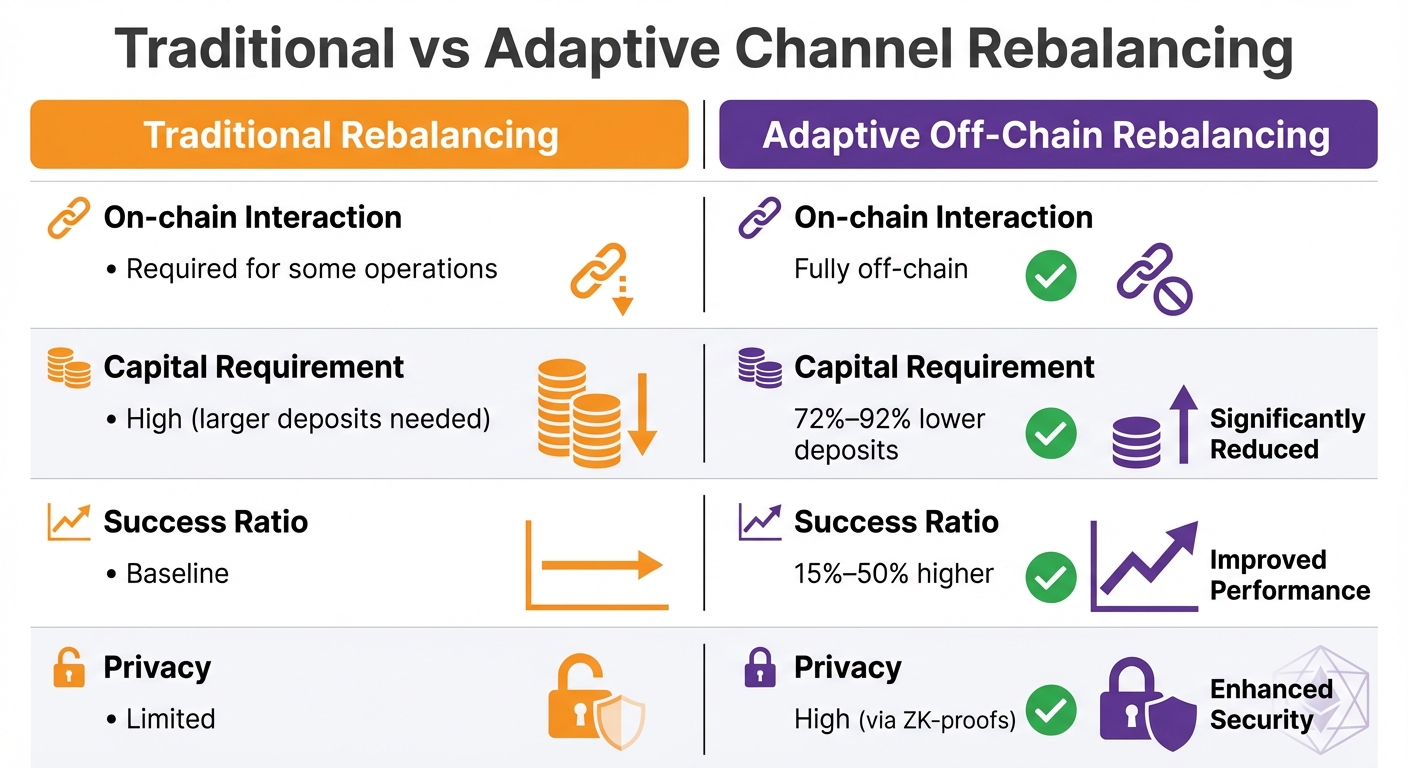
Traditional vs Adaptive Bitcoin Channel Rebalancing Comparison
Imbalance measure and proactive channel rebalancing for the lightning network
1. Adaptive Channel Rebalancing Algorithms
Adaptive channel rebalancing is reshaping how enterprise Bitcoin payments are handled. These algorithms not only improve performance but also address scalability, cost concerns, and automation - key factors for businesses adopting Bitcoin payments. Let’s break down how they’re making a difference.
Scalability
Modern rebalancing algorithms achieve scalability by keeping operations off-chain. Instead of resorting to costly on-chain transactions to open new channels when liquidity runs low, they use methods like circular payments to redistribute funds within existing channels. The Universal Channel Rebalancing (UCRb) framework takes this a step further by enabling "coin shifting" across multiple connections without ever touching the blockchain.
Proactive rebalancing has significantly improved payment success rates, boosting them from 11.2% to an impressive 98.3%. Additionally, it has increased the median payment size from zero to 0.5 mBTC. These gains are largely driven by reduced probing times.
Behind these advancements are machine learning models that predict fund distribution within channels. Unlike traditional models that assume equal distribution, these advanced algorithms outperform by around 10%. Tools like the Bimodal estimator further refine predictions by recognizing that funds often cluster at one end of a channel due to one-way payment flows.
These innovations make automated, large-scale implementations not only possible but practical.
Enterprise Adoption
For enterprises, automation is the game-changer. Rebalancing systems now monitor channels around the clock and act preemptively, eliminating the need for constant human intervention. As Stefan Dziembowski from the University of Warsaw explains, UCRb is:
A blockchain-agnostic, fully off-chain framework that ensures correct behavior among untrusted participants without on-chain interaction.
The growth of the Lightning Network’s public capacity - up over 380% since 2020 - has driven demand for these automated, enterprise-ready tools.
Privacy is another critical factor for adoption. Modern protocols incorporate zero-knowledge proofs and Pedersen commitments, ensuring that rebalancing operations remain private. This level of discretion is essential for businesses like digital banks and payment processors.
On top of operational reliability, these algorithms bring significant financial savings to the table.
Cost Efficiency
The financial benefits of adaptive rebalancing are clear: it drastically reduces the amount of Bitcoin businesses need to lock up in channels. UCRb, for instance, can cut required deposits by up to 92%. This means companies can maintain their services with far less capital tied up.
Using advanced off-chain protocols, opening and closing channels with 10 neighbors costs around 130,000 to 160,000 gas - far less than traditional on-chain methods. By reusing existing channels through rebalancing, businesses can spread their initial setup costs over longer periods.
Over time, the efficiency gains multiply. Adaptive protocols perform roughly 1.5 times better in the long run compared to short-term usage, as systems improve with continued operation.
| Feature | Traditional Rebalancing | Adaptive Off-Chain Rebalancing |
|---|---|---|
| On-chain Interaction | Required for some operations | Fully off-chain |
| Capital Requirement | High (larger deposits needed) | 72%–92% lower deposits |
| Success Ratio | Baseline | 15%–50% higher |
| Privacy | Limited | High (via ZK-proofs) |
Technological Innovation
Rebalancing has evolved to treat payments as flow problems rather than single-path transactions. Rene Pickhardt and Stefan Richter highlight this shift:
Finding the cheapest multi-part payments is an NP-hard problem considering the current fee structure and propose dropping the base fee to make it a linear min-cost flow problem.
This approach supports Multi-Path Payments (MPP), where large transactions are split across multiple channels. If one channel doesn’t have enough liquidity, the system reroutes automatically, enabling enterprise-scale transactions.
Recent updates to LND’s probability models have also improved liquidity management. These models now account for capacity-dependent factors, lowering success probabilities as payment amounts near a channel’s total capacity. Additionally, routing data is recalibrated every 7 days to ensure accuracy.
Smarter fee management is also playing a role. As Lightning contributor Bitromortac explains:
Routers charge relatively more when liquidity is scarce and they discount unused liquidity... routers indeed steer traffic by fee rate modulation.
This fee-based signaling helps algorithms make better routing decisions, ensuring liquidity is used efficiently across the network.
2. Flash Bitcoin Payment Gateway

Scalability
Flash is designed to handle a high volume of Bitcoin transactions by operating off-chain. This approach avoids the delays and congestion associated with blockchain-based operations, enabling faster transaction processing during peak times.
The gateway automates liquidity management using API-controlled thresholds. When channels near their capacity, the system automatically rebalances them, ensuring they remain operational for both incoming and outgoing traffic. This eliminates the need for manual adjustments, which can slow down enterprise workflows.
Behind the scenes, advanced pathfinding algorithms ensure payments are routed efficiently. Instead of relying on a single route, the system evaluates multiple paths simultaneously, allowing transactions to proceed smoothly even if some channels experience temporary liquidity issues.
Enterprise Adoption
Flash simplifies the complexities of the Lightning Network with a single API. Through this, businesses can send, receive, and settle payments globally in real-time, whether in Bitcoin, fiat, or stablecoins. The system abstracts the intricacies of channel management, making it easier for enterprises to adopt.
The platform also includes tools like Autoloop, which automatically manages liquidity for both inbound and outbound transactions. This ensures channels are always ready for two-way traffic without requiring dedicated staff to oversee balances. For businesses processing thousands of transactions daily, this level of automation is critical to maintaining consistent performance.
Additionally, on-demand inbound capacity allows enterprises to scale their payment processing instantly as transaction volumes increase. This eliminates the delays typically associated with opening new channels, enabling businesses to keep up with growing demand.
By automating key processes and optimizing costs, Flash ensures reliable performance for high-volume operations.
Cost Efficiency
Flash reduces operational costs by minimizing on-chain transactions. Its off-chain rebalancing framework eliminates the need for frequent blockchain interactions, which often come with high fees.
The platform uses Atomic Pedersen operations to secure balance updates. This cryptographic method ensures payments and rebalancing occur simultaneously, preventing funds from being tied up in incomplete transactions. The result is better capital efficiency, allowing businesses to maintain high transaction throughput with smaller liquidity reserves.
By cutting down on on-chain activity and improving how liquidity is used, Flash helps businesses operate more cost-effectively.
Technological Innovation
Flash employs zero-knowledge proofs to keep liquidity movements private. This ensures sensitive financial data remains confidential, safeguarding businesses from competitors while maintaining the privacy of payment flows.
The platform also supports non-custodial wallet-to-wallet payments, giving businesses complete control over their funds throughout the transaction process. These features align with the Lightning Network's principles while improving rebalancing efficiency.
Real-time analytics provide businesses with insights into their payment operations. Through detailed dashboards, companies can monitor transaction success rates, liquidity usage, and channel performance, enabling better decisions for capacity planning and network optimization - all without compromising privacy.
sbb-itb-f81ab9b
Pros and Cons
Let's dive into the practical advantages and challenges of these systems, following the earlier discussion on technical and financial benefits.
Adaptive channel rebalancing algorithms bring some clear perks but also notable hurdles. By redistributing funds off-chain, they reduce the need for on-chain transactions, which in turn lowers Bitcoin fees while keeping payment routes efficient. These algorithms also use machine learning to predict potential imbalances and initiate rebalancing at optimal times, cutting down on manual intervention.
On the flip side, traditional methods come with their own set of issues. Cumulative routing fees can eat into profitability, while circular payments may expose channel strategies. Moreover, these methods demand high technical expertise and constant monitoring, making them tough for businesses without dedicated blockchain teams.
Flash addresses many of these pain points with its automation tools and enterprise-grade infrastructure. It simplifies liquidity management through API-controlled thresholds. Additionally, its multi-path payment capability splits larger transactions across multiple channels, improving success rates and reducing the need for frequent manual rebalancing.
Here’s a quick comparison of the strengths and limitations of adaptive channel rebalancing versus Flash's approach:
| Feature | Adaptive Channel Rebalancing | Flash Bitcoin Payment Gateway |
|---|---|---|
| Scalability | High through parallel processing but limited by channel capacity. | High; leverages multi-path payments and enterprise-grade tools. |
| Enterprise Adoption | Low; requires extensive technical expertise and manual oversight. | High; features a low-code API for easier integration. |
| Cost Efficiency | Variable; influenced by routing fees and manual costs. | Optimized; offers low-cost, real-time settlement with automation. |
| Technological Focus | Relies on circular payments and atomic multi-path routing. | Prioritizes abstraction layers, fiat-to-BTC rails, and automated liquidity APIs. |
While both approaches enhance payment reliability, Flash's focus on automation and enterprise-ready infrastructure makes it a more accessible and efficient option for businesses lacking specialized blockchain teams. This comparison highlights how adaptive rebalancing and platforms like Flash are shaping the future of Bitcoin payment systems.
Conclusion
The analysis above highlights how adaptive channel rebalancing is reshaping Bitcoin payment networks by optimizing off-chain liquidity management. This approach boosts long-term performance by 1.5× and improves success rates by 15%–50%. By operating off-chain, these protocols drastically reduce the need for large deposits - by as much as 92% - addressing challenges like network congestion and high fees that have historically hindered scalability for enterprises.
Flash's gateway takes this a step further by automating adaptive rebalancing. Through API-controlled thresholds and multi-path payments, it simplifies operations and transforms network-level improvements into actionable business solutions. This aligns with the broader aim of merging advanced technical innovations with practical, user-friendly tools for enterprises.
Together, these advancements demonstrate how adaptive algorithms and Flash's automation enable efficient, high-volume transactions without requiring deep technical expertise. Experts agree that channel rebalancing is critical for sustaining the network's payment capacity and supporting its growth.
For businesses considering Bitcoin payment systems, the combination of off-chain rebalancing protocols and automated infrastructure offers a practical entry point. This approach balances performance with ease of use, making it possible for enterprises to leverage the Lightning Network's expanded capacity - over 380% growth since 2020 - without needing dedicated blockchain teams.
As the industry moves toward fully off-chain operations and AI-driven management, these systems are poised to deliver ongoing improvements in capital use, transaction reliability, and automation.
FAQs
How does adaptive channel rebalancing enhance the reliability of Bitcoin payments?
Adaptive channel rebalancing enhances the reliability of Bitcoin payments by actively redistributing liquidity across payment channels as needed. This dynamic approach helps avoid imbalances, ensuring there are enough funds available for transactions, which increases the success rate of multi-hop payments.
With real-time liquidity adjustments, businesses can benefit from smoother payment processes and fewer transaction failures, making Bitcoin a more viable option for handling payments on a global scale.
How does automation improve the management of Bitcoin Lightning Network channels?
Automation plays a key role in simplifying the management of Bitcoin Lightning Network channels by handling tasks like channel rebalancing and optimizing liquidity. With automatic rebalancing, funds in a channel are redistributed efficiently, ensuring smooth two-way transactions without the need for manual adjustments. This minimizes the chances of payment failures and boosts the success rate of transactions.
Additionally, features like dynamic fee adjustments and intelligent routing enhance efficiency by cutting costs and improving reliability. These tools not only make Bitcoin payment systems more scalable but also help businesses adopt them more easily by ensuring steady performance and reducing the complexity of operations.
How does Flash help businesses save money on Bitcoin transactions?
Flash offers businesses a way to cut costs on Bitcoin transactions through off-chain rebalancing techniques. These methods improve the liquidity of payment channels, reducing the reliance on expensive on-chain operations. The result? Lower transaction fees and faster processing times.
With streamlined payments that involve minimal fees and no intermediaries, Flash enables efficient, non-custodial wallet-to-wallet transactions. This makes it a practical and budget-friendly option for businesses accepting Bitcoin worldwide.