So, you're thinking about accepting bitcoin for your business. Good. It's way more straightforward than you might imagine.
Forget the Wall Street speculation for a moment. This is about adding a powerful tool to your payment arsenal—one that can slash your transaction fees, kill chargebacks for good, and open your doors to a truly global customer base. Think of it as a strategic upgrade to your financial plumbing.
Why Your Business Should Accept Bitcoin
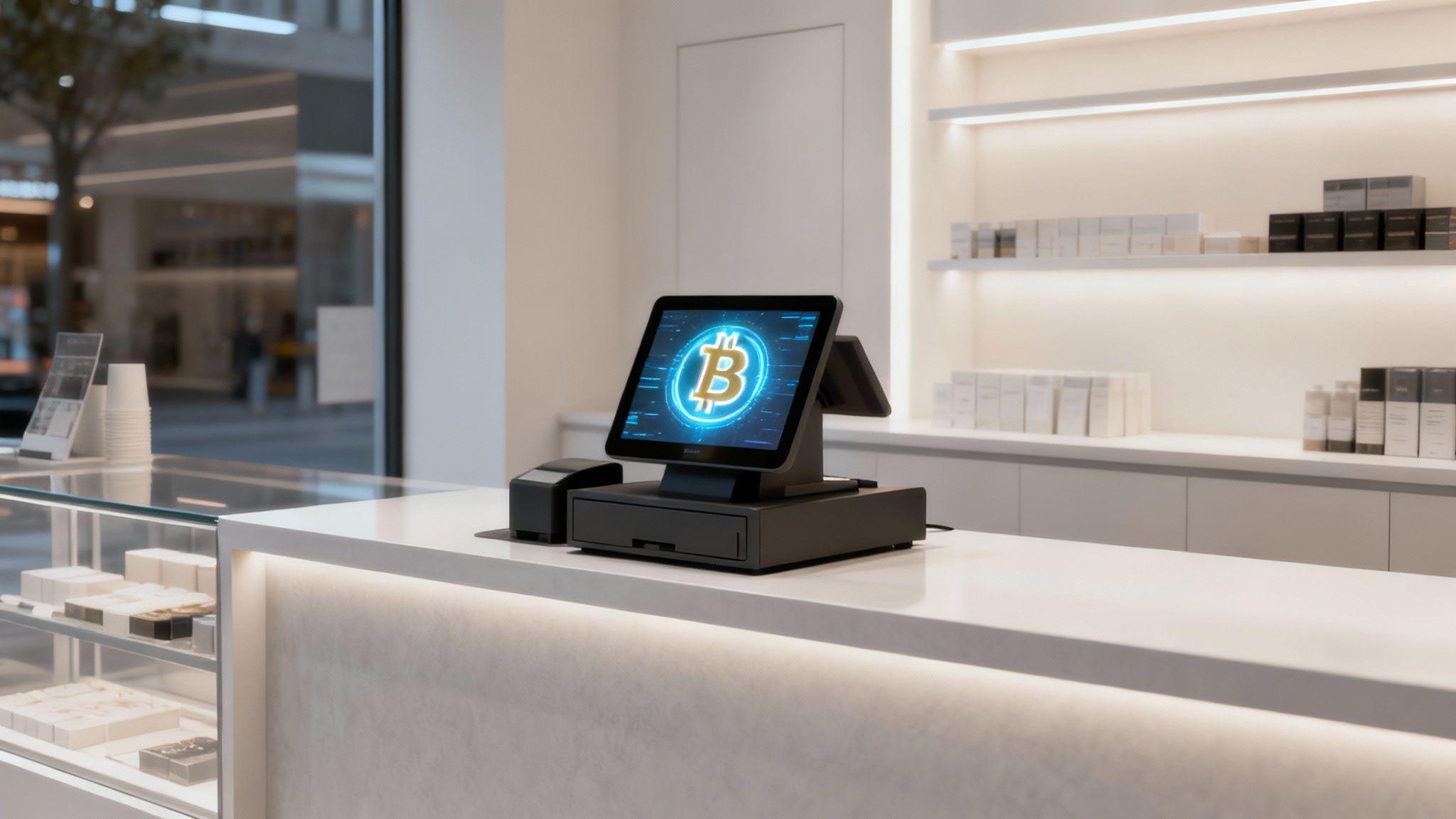
Let's cut through the noise and talk about what Bitcoin actually does for a merchant today. This isn't about chasing a trend; it's a practical business decision that hits your bottom line and makes your life easier.
The first and most obvious win is cost. Your credit card processor is quietly skimming 2% to 4% off every single sale you make. Do the math. Over a year, that's a huge chunk of your revenue gone before you even pay your suppliers. Bitcoin, running on its own peer-to-peer network, has transaction costs that are a fraction of that. You keep more of your money. It's that simple.
Eliminating Fraud and Boosting Cash Flow
Here's another big one: Bitcoin payments are final. Once a transaction is confirmed on the network, it’s done. It cannot be reversed. This means the constant headache of chargeback fraud—a nightmare for anyone selling online—is completely gone.
For businesses, this is a game-changer. No more lost revenue from fraudulent disputes or time wasted dealing with payment processors. The funds are yours, period.
This finality also means you get paid faster. No more waiting days for a bank or credit card company to settle up. Bitcoin transactions land in your wallet and are confirmed in minutes or hours, not days. That's a massive boost to your cash flow, which is the lifeblood of any business.
Reaching a Growing Global Market
Accepting Bitcoin instantly makes your business international. A customer in Tokyo can pay you as easily as someone in your own town. There are no currency conversion headaches, no international wire transfer delays, and no banks blocking payments from certain countries. It’s a borderless payment system for a borderless internet.
And this isn't some tiny niche market. The growth has been explosive. Between 2018 and 2023, global bitcoin ownership grew at a compound annual rate of about 99%. For comparison, traditional payment methods grew by around 8% in the same period. You can explore the full data on cryptocurrency ownership yourself—the trend is undeniable. Bitcoin is quickly becoming a standard part of the financial system, and the businesses that adapt first will have a serious advantage.
Choosing the Right Bitcoin Wallet for Your Business
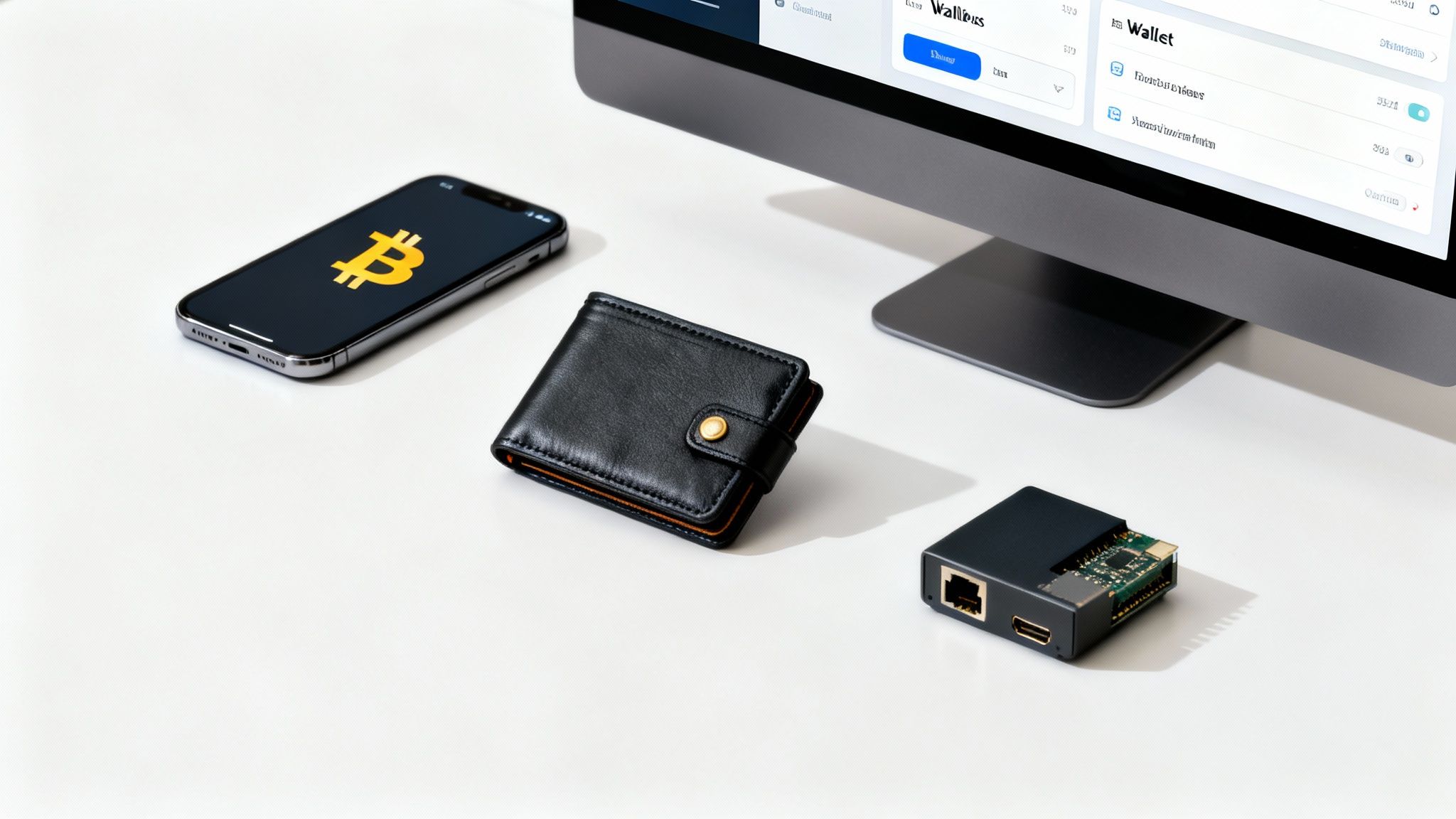
Before you can accept your first satoshi, you need a Bitcoin wallet. Think of it as your digital cash register—it’s where you’ll store, send, and receive all your Bitcoin payments. The key is picking the right one for your business, because what works for a coffee shop is completely different from what an online retailer needs.
First, let's clear up a common misconception. A Bitcoin wallet doesn't actually "store" your bitcoin like a leather wallet holds cash. Instead, it securely holds your private keys. These are the secret codes that prove you own your funds and give you the power to spend them. This is a critical point because it puts you in complete control of your money, and with that comes the responsibility for securing it.
Understanding the Main Wallet Types
To figure out which wallet you need, think about how you operate. Are you dealing with customers face-to-face all day? Or are you stacking sats from large, infrequent online sales? Your answer will point you in the right direction.
You'll mainly come across three flavors: mobile, desktop, and hardware wallets. Each one strikes a different balance between everyday convenience and iron-clad security. A busy food truck needs something fast and portable, while an e-commerce store holding a sizable balance needs something far more robust.
Let's look at how these fit into the real world.
Comparing Bitcoin Wallet Types for Your Business
Choosing a wallet is one of the first major decisions you'll make. This table breaks down the options to help you see which one aligns with your business's daily grind and security needs.
| Wallet Type | Best For | Security Level | Convenience |
|---|---|---|---|
| Mobile Wallet | Point-of-sale, in-person transactions, and small daily balances. | Good | Very High |
| Desktop Wallet | Managing regular online payments and moderate balances from a secure office computer. | High | High |
| Hardware Wallet | Securing large sums of Bitcoin, long-term savings, or "cold storage" for maximum safety. | Very High | Medium |
Ultimately, the best setup often involves using more than one type of wallet for different purposes, creating layers of security for your funds.
Matching the Wallet to Your Business
Okay, let's put this into practice.
Imagine you're running a pop-up shop at a local market. A mobile wallet on a tablet or phone is a no-brainer. You can instantly generate a fresh QR code for each customer, making checkout quick and painless. The funds are right there, ready to pay suppliers or cover other daily costs.
Now, picture an online agency that gets paid for projects in larger chunks. A desktop wallet on a dedicated office computer makes a lot of sense. It gives you more advanced tools for invoicing and tracking payments than a simple mobile app, all within a more controlled environment.
Finally, what if your business plans to hold a good portion of its earnings in Bitcoin as a long-term asset? In that case, a hardware wallet is absolutely non-negotiable. This is a small physical device that keeps your private keys completely offline, shielding them from hackers. It's like a digital vault for funds you don't need to touch often.
Your approach should be layered. Use a "hot" mobile wallet for daily transactions (like petty cash) and move larger balances to a "cold" hardware wallet for long-term security (like a bank vault).
No matter which wallet you pick, you'll be introduced to your seed phrase (also called a recovery phrase). This is a list of 12 to 24 words that acts as the master key to your entire wallet. If your phone gets stolen or your computer dies, this phrase is the only thing that can get your bitcoin back.
Write it down on paper and store it somewhere safe and offline. Never, ever save it as a photo, in a notes app, or in a cloud drive. If you lose this phrase, you lose your bitcoin. Period.
How to Fund Your Wallet and Manage Transactions
Okay, your wallet is set up. Now it's time to get some bitcoin into it. This is really the first hands-on step in getting started with bitcoin for your business, and it’s way easier than most people think. The most common route is to buy it from a reputable Bitcoin exchange.
Think of these exchanges as a bridge between the old-school banking system and the new world of Bitcoin. You'll need to set up an account, which almost always involves a Know Your Customer (KYC) process. Don't let the term intimidate you; it's just a standard identity check, a lot like opening a new bank account, to comply with financial regulations.
Once you’re verified, you can link your business bank account or debit card and make your first purchase. Here's a pro tip: after you buy, immediately withdraw the bitcoin from the exchange and send it straight to the wallet you just set up. This puts you in control of your funds, not the exchange.
Anatomy of a Bitcoin Transaction
To really get comfortable with this, you need to understand what’s happening under the hood during a transaction. It boils down to a few key parts that keep every payment secure and verifiable.
When a customer pays you, they aren't sending you a digital file. They're broadcasting a signed message to the entire network that essentially says, "I'm giving ownership of this specific amount of bitcoin from my address to this merchant's address."
Here’s what you’ll be working with:
- Bitcoin Address: This is a long string of letters and numbers that functions like a bank account number for a single transaction. For privacy reasons, you should generate a fresh, unique address for every single sale.
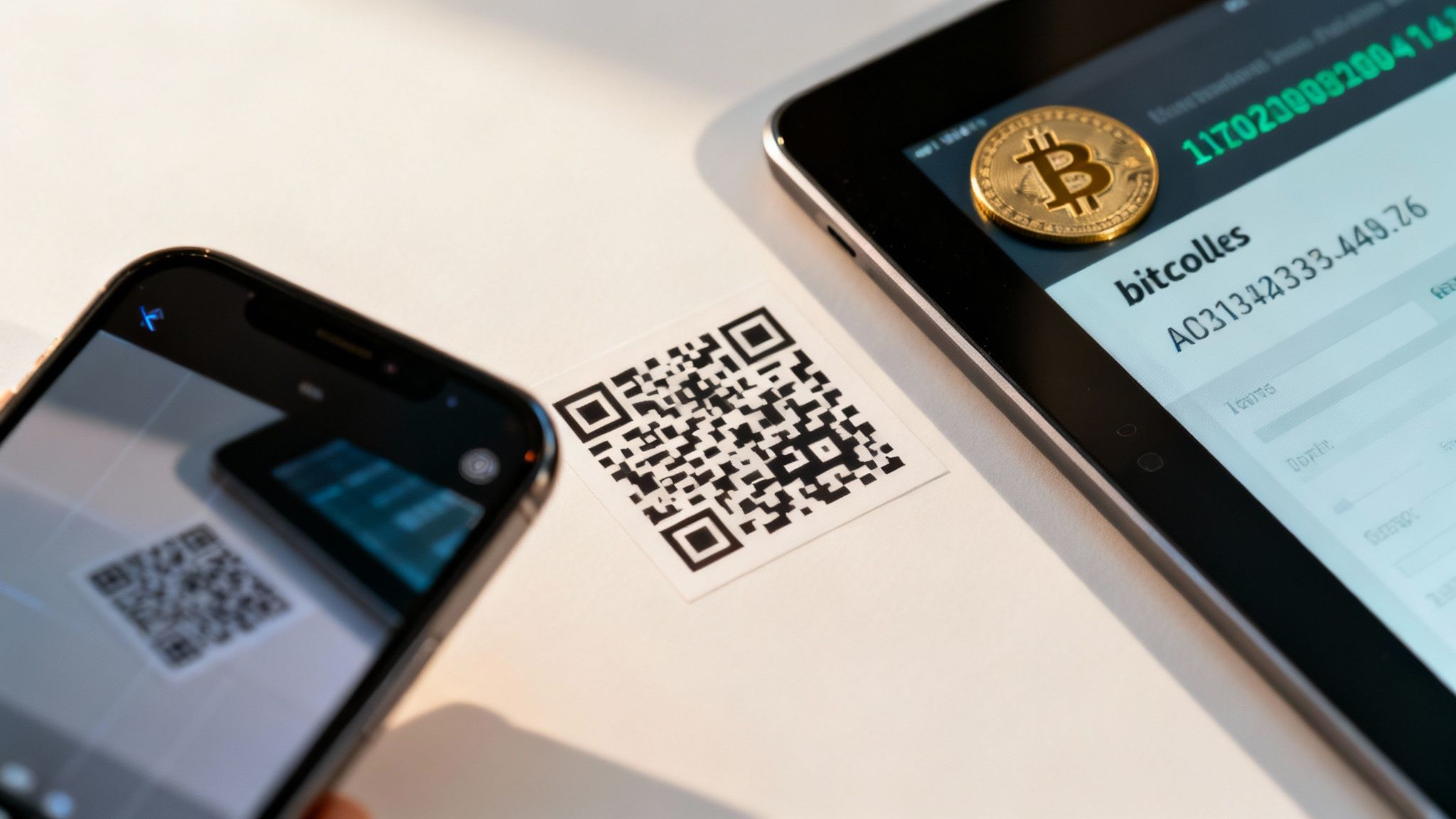
- QR Codes: The simplest way to share that long address is to generate a QR code. Your customer just scans it, their wallet populates all the details automatically, and all they have to do is hit "confirm."
- Miner Fees: This is a small fee attached to a transaction to encourage miners to include it in the next block. If the network is busy, a slightly higher fee can get your transaction confirmed much faster.
Confirmations and Tracking Your Payments
After a customer hits "send," the transaction doesn't appear instantly. First, it goes into the mempool—think of it as a waiting room for unconfirmed transactions. Miners then select transactions from the mempool and bundle them into a "block" on the blockchain. Every new block that gets added on top of that block counts as one confirmation.
For small purchases, like a cup of coffee, waiting for one confirmation is usually fine. For bigger sales, it's smart to wait for three to six confirmations. This is a common security measure to ensure the payment is final and can't be reversed.
The cool part is that you can watch all of this happen in real-time. Using a block explorer (a public search engine for the Bitcoin blockchain), you can paste in the transaction ID and see its status from unconfirmed to fully settled. This radical transparency is a core feature of the network.
This global, decentralized system is why Bitcoin adoption is so geographically widespread. You might be surprised to learn that countries like Ukraine, Moldova, and Georgia are at the top of the charts for crypto activity. Ukraine actually leads in both retail and institutional volume. You can dig into more of this data in the 2025 Global Crypto Adoption Index by Chainalysis.
Essential Security Practices for Merchants
Here’s the thing about Bitcoin: you are your own bank. This is one of its most powerful features, but it also means security is entirely in your hands. For a merchant just starting out, getting a few core security practices right isn’t just a good idea—it’s absolutely vital for protecting your business’s money.
You have to forget everything you know about traditional banking security. There are no fraud departments to call, no password resets, and no reversible payments. Bitcoin demands a new mindset, one built on self-custody and being proactive about defense. It all starts with knowing the tools and the common threats you'll face.
Hot vs. Cold Storage: A Practical Approach
The most fundamental concept in Bitcoin security is the difference between "hot" and "cold" storage. The easiest way to think about it is like your physical cash register versus a locked bank vault.
A hot wallet is connected to the internet. This makes it super convenient for day-to-day transactions but also leaves it more exposed to online attacks.
On the flip side, a cold wallet (like a hardware wallet) is kept completely offline. This makes it immune to remote hacking and is the undisputed gold standard for securing any amount of Bitcoin you don't need to access instantly. The smartest strategy for any merchant is to use both.
- For Daily Operations: Keep a small, operational balance in a mobile or desktop hot wallet for your point-of-sale transactions. Think of this as your digital petty cash drawer.
- For Long-Term Holdings: On a regular basis, sweep your profits and any larger sums from that hot wallet over to a secure hardware wallet. This is your business’s digital vault.
This layered approach drastically minimizes your risk. If your hot wallet were ever compromised, the attacker would only get away with a small fraction of your funds, leaving the bulk of your Bitcoin untouched and safe in cold storage.
Never, ever share your seed phrase or private keys with anyone, for any reason. Store your physical backup in a secure, private location. This phrase is the final master key to your funds, and anyone who has it can take your bitcoin.
Advanced Security for Businesses
As your business grows, your security needs to grow with it. A single password on a single device is a single point of failure—that's a risk you can't afford. This is where more advanced tools become critical, especially if you have multiple people who need access to company funds.
Multi-signature (multisig) wallets are a total game-changer for businesses. Instead of one signature (one private key) being enough to send a transaction, a multisig setup can require two-out-of-three, three-out-of-five, or any other combination you choose. This means no single person—or single compromised device—can move funds on their own. It’s an incredibly powerful way to prevent both internal theft and external hacks.
Beyond your wallet setup, you have to be constantly on guard against social engineering. Phishing scams are everywhere. Attackers will create fake login pages or send urgent-sounding emails pretending to be from an exchange or wallet provider, all to trick you into giving up your credentials. Always double-check website URLs and be extremely skeptical of any unsolicited message asking for your private information.
As you start accepting bitcoin payments, it's also crucial to understand the unique challenges around payment disputes. Taking the time to learn about handling crypto chargebacks can add another layer of protection for your revenue and safeguard your transactions.
Integrating Bitcoin Payments Using Flash
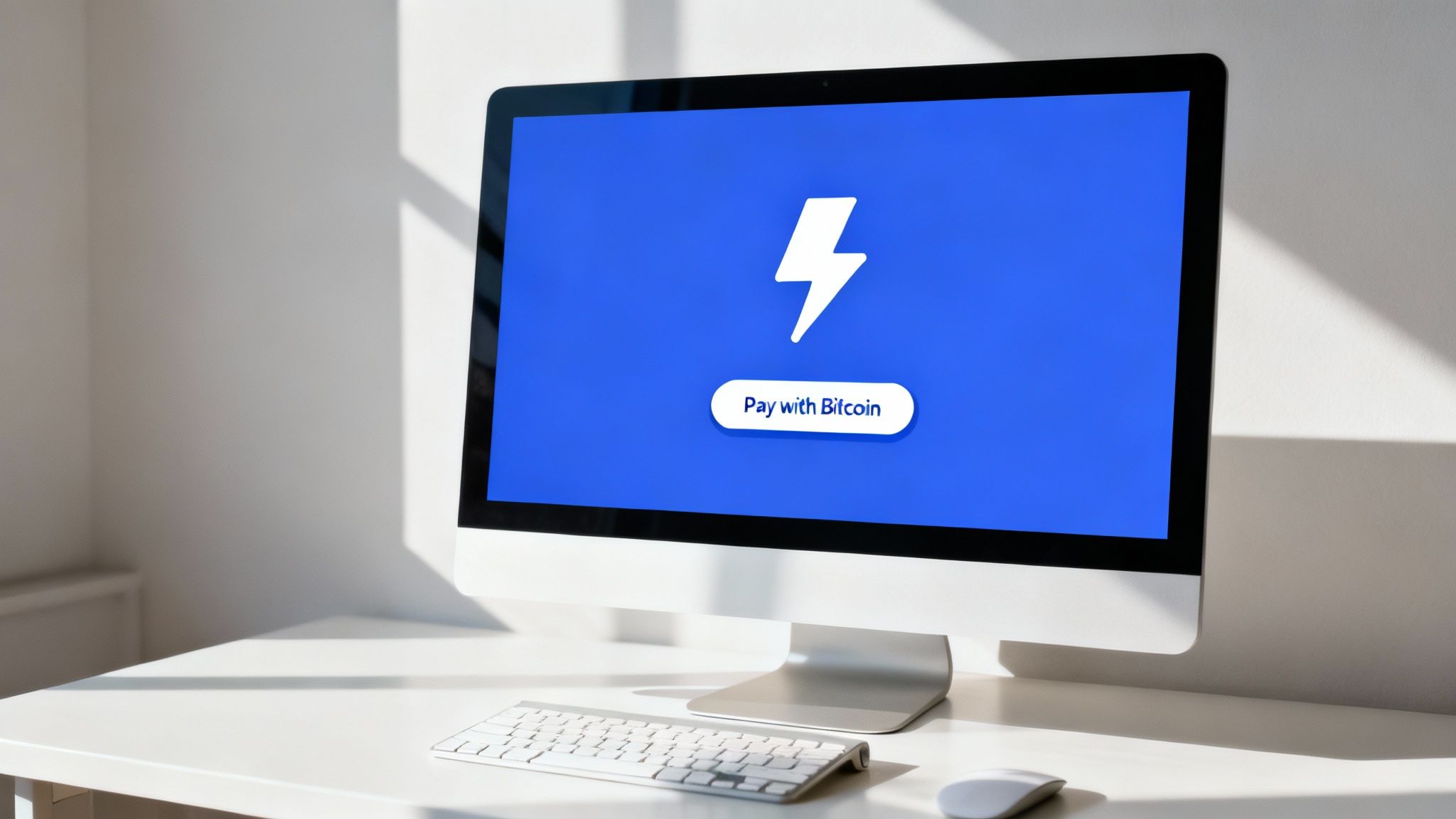
Holding Bitcoin is one thing, but actually accepting it from customers is what turns it from a simple asset into a powerful payment rail for your business. This is where you bridge the gap between having a wallet and using it in the real world. With a tool like Flash, you can make Bitcoin a practical, efficient part of your daily sales without writing a single line of code.
It all comes down to creating a smooth experience for everyone involved—you and your customers. Whether you're a freelance designer invoicing an international client or an e-commerce store adding a new checkout option, the goal is simple: make paying with Bitcoin as easy as swiping a credit card. Modern payment tools are built to handle all the technical heavy lifting, letting you focus on what you do best.
Generating Payment Links and Invoices Instantly
The most straightforward way to request a Bitcoin payment is with a payment link or a digital invoice. Think of it as a smart bill that contains everything needed to get you paid: the amount owed, your Bitcoin address, and a QR code for quick mobile scanning.
Platforms like Flash let you create these on the fly, right from an app or a simple dashboard. Picture this: a customer at your farmers market stall wants to pay with Bitcoin. You just punch in the total, and the app instantly generates a unique QR code on your tablet. They scan it, confirm the payment from their own wallet, and that’s it. Sale complete.
This method is just as effective for remote payments. If you’re wrapping up an online consultation, you can send a payment link through email or even a text message. Your client clicks the link, which takes them to a payment page with all the details, allowing them to pay from whatever Bitcoin wallet they prefer.
Leveraging the Lightning Network for Speed
One of the biggest leaps forward for Bitcoin as a payment method is the Lightning Network. This is what's known as a "layer two" solution built on top of Bitcoin, designed for near-instant transactions with incredibly low fees. For any merchant, especially one with a high volume of small sales, this is a total game-changer.
By using Lightning-enabled tools, your transactions can settle in seconds, not minutes or hours. This is perfect for point-of-sale situations where speed is everything, like selling a cup of coffee or a concert ticket.
Flash automatically uses the Lightning Network whenever possible. This means you get the best of both worlds: the speed of modern digital payments combined with the security and finality of the Bitcoin blockchain itself. This makes getting started with bitcoin not just possible, but incredibly practical for everyday business.
Managing Your Transactions and Payouts
Once a customer pays, the transaction pops up right in your dashboard. You can track incoming funds in real time, see which invoices have been settled, and get a clear overview of your balance. Having this centralized view is crucial for bookkeeping and keeping your finances organized.
Most importantly, because tools like Flash facilitate direct wallet-to-wallet transactions, you are always in full control of your money. The funds go straight from your customer's wallet to yours, cutting out the middlemen and ensuring you hold your own keys. This self-custody model is a core principle of Bitcoin, and for any serious merchant, it's non-negotiable.
Common Questions About Using Bitcoin for Business
Jumping into any new technology comes with a learning curve, and Bitcoin is no different. Every merchant I've talked to wants to get a few key questions answered before they start accepting BTC. Let's get right into the most common ones to clear things up.
The first question is almost always about price swings. Bitcoin's value can move up and down, so how do you deal with that risk?
This is a totally valid concern, but the solution is surprisingly simple. Most modern payment tools, including Flash, give you the option for instant settlement. The moment a customer pays you in Bitcoin, it can be automatically converted into your local currency. This gives you the best of both worlds: you get the benefits of accepting Bitcoin—like tiny fees and zero chargebacks—without having to worry about holding a volatile asset.
Handling Accounting and Taxes
Next up: bookkeeping. How do you actually account for Bitcoin transactions and handle taxes? The trick is to treat it just like any other asset you might own.
When you make a sale, you should record the value in your local currency at that exact moment. So, if you sell a $50 product and the customer pays in Bitcoin, you book it as a $50 sale. This keeps your records clean and straightforward for tax season.
Tax agencies typically see Bitcoin as property, not currency. This means if you decide to hold it and its value goes up or down, you could be looking at capital gains or losses. It's always a good idea to chat with a qualified accountant who gets digital assets to make sure you're staying on the right side of local rules.
The key is to track the fair market value of Bitcoin when you receive it and again when you sell or convert it. Meticulous records are your best friend here.
Processing Refunds and Returns
"But what if someone needs a refund?" This is another practical question that trips people up. Bitcoin transactions are final and can't be reversed, so you can't just "cancel" a payment.
Instead, you simply treat it as a new transaction going the other way. You'll ask the customer for their Bitcoin address and send the refund amount from your wallet to theirs.
One thing to figure out ahead of time is your refund policy. Will you refund the exact amount of Bitcoin they sent, or will you refund the equivalent value in your local currency at the time of the refund? Make this crystal clear in your terms of service to avoid any mix-ups. To get a better handle on the terminology, it helps to understand the fundamental differences between crypto coins and tokens, as this basic knowledge can make these processes much clearer.
Ready to make Bitcoin a seamless part of your business? Flash provides the tools you need to accept payments instantly, reduce fees, and reach a global audience. Get started in under a minute at .