Hosted Bitcoin mining services are losing profits due to rising transaction fees, slow payouts, and limited scalability. These issues are amplified by the 2026 Bitcoin halving, which has pushed miner earnings to historic lows. The Lightning Network offers a solution by providing faster, cheaper, and more efficient payment methods for mining payouts.
Key Challenges for Mining Payouts:
- High Fees: On-chain transactions become costly during network congestion, cutting into miner profits.
- Slow Payments: Payouts can take hours to confirm, disrupting cash flow for miners.
- Scalability Issues: The Bitcoin network struggles to handle frequent, small transactions efficiently.
How the Lightning Network Solves These Issues:
- Low Fees: Lightning payments cost fractions of a cent, even for frequent micropayments.
- Instant Settlements: Transactions are processed in milliseconds, improving cash flow.
- High Scalability: Capable of handling millions of transactions per second, ideal for large mining pools.
Mining pools like Braiins and platforms like Flash have already transitioned to Lightning-based payouts, showing its effectiveness. By integrating Lightning Network tools, mining services can reduce costs, speed up payouts, and handle high transaction volumes efficiently.
Bottom Line: The Lightning Network isn't just an upgrade - it's becoming essential for mining operations to stay competitive in 2026.
Problems with Traditional Mining Payout Systems
High Transaction Fees
When the Bitcoin network gets congested, transaction fees skyrocket, cutting into the already slim margins of mining services. These fees aren't tied to the dollar amount being sent but are instead based on the transaction's data size in bytes. This means sending $10 can cost the same as sending $10,000, as long as the transaction size is identical. For mining operations managing payouts to hundreds or thousands of clients, this can be a serious drain on resources.
Another factor driving up fees is the reuse of addresses. Mining services that repeatedly send payouts to the same addresses create larger, more complex transactions, which further inflate costs. This inefficiency compounds the financial strain on mining operations, especially during periods of high network activity.
And it's not just about the fees - delays in settlements add yet another layer of difficulty.
Slow Settlement Times
Bitcoin's average 10-minute block time can stretch into hours during network congestion, leaving miners waiting for their earnings. For businesses operating on razor-thin margins, these delays disrupt cash flow, making it harder to cover essential expenses like electricity bills and equipment maintenance. Miners are left in limbo, unable to access funds they need to keep their operations running smoothly.
Manual processes, such as transaction approvals and signing, add further delays to on-chain payouts. To combat this, NiceHash introduced a solution in May 2024: fully automated Lightning Network payouts. These allow miners to receive their earnings every four hours directly to external Lightning addresses, bypassing the delays of on-chain transactions. Nico Smid highlights the advantage:
On-chain Bitcoin transactions can take from minutes to hours to confirm, depending on network conditions. Lightning payouts, however, are almost instant, allowing miners to access their earnings more quickly.
This shift not only reduces delays but also addresses broader scalability challenges.
Scalability Limitations
The Bitcoin mainnet wasn't built to handle frequent, high-volume microtransactions. Mining pools that need to process thousands of small payouts face a tough choice: either batch payouts, which delays payments for smaller miners, or absorb high fees that can make payouts almost worthless.
In March 2025, Braiins Mining Pool showcased a better way. Partnering with Voltage, they processed over 1,000 daily payouts using the Lightning Network, leading to a 20% month-over-month increase in Lightning payout volumes. Eli Nagar, CEO of Braiins, explained:
Lightning payouts have completely changed the way miners receive their earnings. Rather than waiting for on-chain transactions, our miners are now getting instant, frictionless payouts every single day.
Graham Krizek, CEO of Voltage, emphasized the broader potential:
how Lightning enables real-world, high-volume transactions at an unprecedented scale.
These examples demonstrate how traditional systems fall short and why more agile, scalable solutions are essential for the mining industry's future.
Lightning Network Bitcoin Pool Mining Payout Setup - No Fee Bitcoin Mining Withdrawal Setup Guide
How Lightning Network Improves Payment Distributions
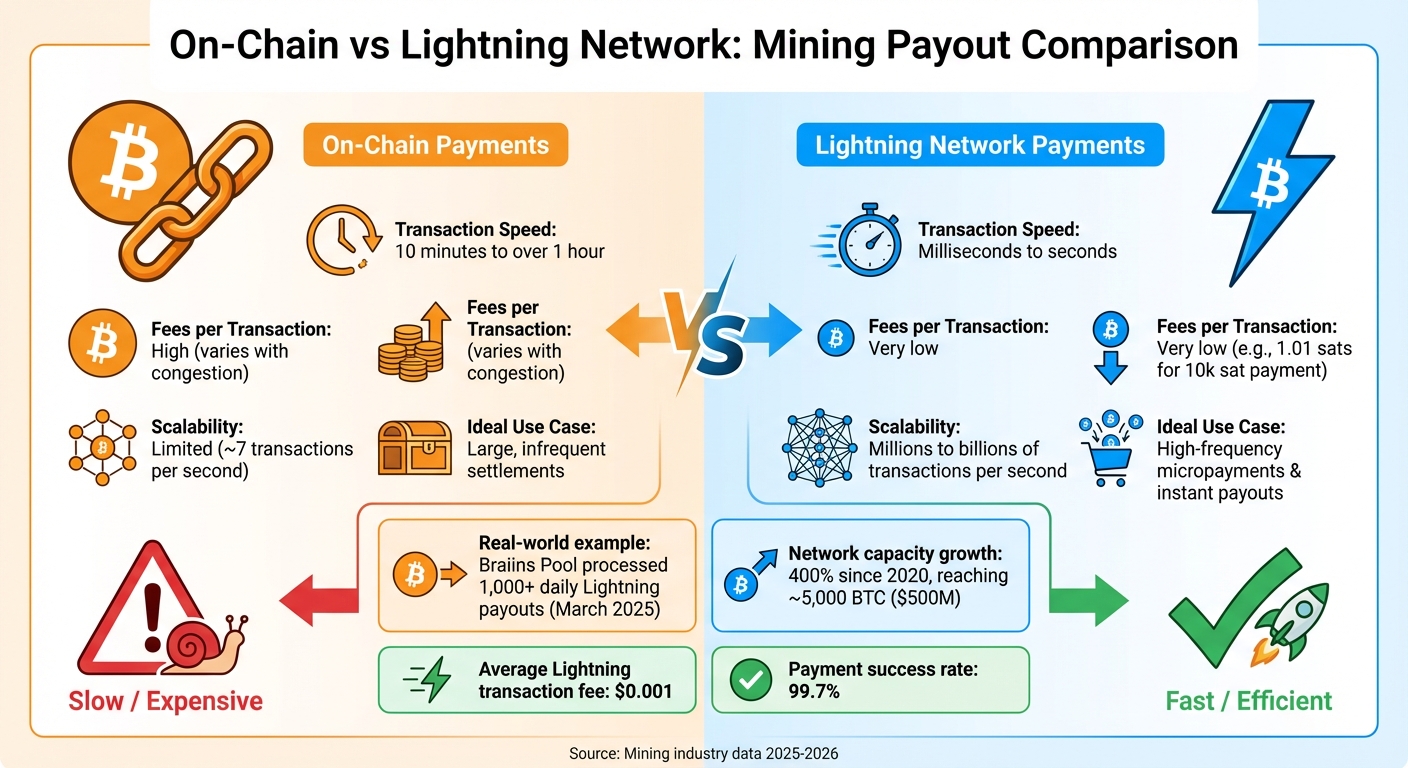
Lightning Network vs On-Chain Bitcoin Payments Comparison for Mining Payouts
The Lightning Network addresses some of Bitcoin's long-standing challenges, like high transaction fees and scalability issues, offering a practical solution for hosted mining services.
Lightning Network Basics
The Lightning Network operates through off-chain channels, which allow two parties to interact without constantly involving the Bitcoin blockchain. These channels are created using a 2-of-2 multisignature transaction on the Bitcoin network. Once the channel is set up, the participants can update their balances as many times as needed without broadcasting every change to the main blockchain . This approach significantly reduces congestion on the network and enables mining services to handle a large volume of payouts efficiently.
Security is a key feature of the Lightning Network, achieved through Hashed Timelock Contracts (HTLCs). These contracts ensure payments are atomic, meaning they either go through entirely or fail completely . For example, if a mining pool sends a payout, the recipient must provide a secret preimage matching a specific hash within a set timeframe. If the recipient doesn’t meet the deadline, the funds automatically return to the sender. This mechanism allows payments to securely pass through multiple nodes without requiring trust in any intermediary .
With these technical foundations, the Lightning Network offers mining services both efficiency and reliability.
Benefits for Hosted Mining Services
Lightning payments are almost instantaneous and come with extremely low fees, making them ideal for frequent, small payouts. This is a significant improvement over on-chain transactions, which can take anywhere from 10 minutes to over an hour to confirm . For instance, routing a 10,000-satoshi payment on the Lightning Network incurs a fee of just 1.01 satoshis.
The network’s scalability is another standout feature. While Bitcoin’s base layer can handle about seven transactions per second, the Lightning Network can theoretically process millions to billions of transactions per second. This scalability eliminates the need for mining services to choose between delaying payouts by batching them or paying high fees for individual transactions.
On-Chain vs. Lightning Network Comparison
Here’s a quick look at how the Lightning Network stacks up against traditional on-chain payments:
| Metric | On-Chain Payments | Lightning Network Payments |
|---|---|---|
| Transaction Speed | 10 minutes to over 1 hour | Milliseconds to seconds |
| Fees per Transaction | High (varies with network congestion) | Very low |
| Scalability | Limited (~7 transactions per second) | Millions to billions of transactions per second |
| Ideal Use Case | Large, infrequent settlements | High-frequency micropayments and instant payouts |
This comparison clearly shows why the Lightning Network is a game-changer for hosted mining services, offering both speed and cost-efficiency for payment distributions.
sbb-itb-f81ab9b
Setting Up Lightning Network Distributions with Flash
Flash's Non-Custodial Payment Solutions
Flash is a self-custodial, peer-to-peer gateway that allows funds to be sent directly to your wallet. It operates with minimal service fees, which are automatically processed through a background wallet transaction.
The platform offers several key tools, including "Flashes" (flexible tools for one-time or variable payments), subscription management for recurring payouts, and public APIs for custom integrations. Mining services can also attach external user identifiers like IDs, emails, or npubs to checkout URLs, enabling transactions to be directly linked to specific backend user accounts. This feature eliminates the manual reconciliation issues often associated with traditional payout systems.
Integration Steps for Mining Services
- Connect Your Wallet: Link a compatible Lightning wallet to maintain full custody of your funds.
- Set Up Payments: Use the Flash web app to create subscription plans or Flashes, setting parameters for recurring or one-time payments for mining services.
- Add User Data: Include user-specific information (like backend user IDs) in checkout URLs to automate payout tracking for miners.
- Integrate APIs: Implement the Flash Subscription API into your mining dashboard and configure webhooks to receive live updates on payment status and settlement.
- Streamline Rewards: Use the peer-to-peer protocol to send mining rewards directly, avoiding on-chain congestion and high transaction fees.
With a 99.7% payment success rate and average transaction fees of just $0.001, the Lightning Network offers a reliable and cost-efficient solution for mining payouts.
Custom Dashboards for Enterprise Management
Flash's web app provides a centralized platform for managing operations at scale. Mining CFOs can track subscription plans, manage public API keys, and oversee enterprise-level workflows. The platform's public APIs allow you to design custom payout processes that integrate seamlessly with your internal accounting systems and miner management software. This is especially valuable for operations handling hundreds or thousands of payouts daily.
Automated fee processing further simplifies accounting by removing manual tasks. This level of transparency lets finance teams accurately predict costs without worrying about hidden fees or delays caused by intermediaries.
CFO Guide to Lightning Network Payout Optimization
The Lightning Network offers a fast and cost-effective way to handle transactions, and CFOs can take full advantage of this by employing strategic wallet setups and automation tools. These approaches allow mining services to maximize the Lightning Network's potential, aligning with the goals of enterprise-level payout systems.
Setting Up Lightning Wallets
When choosing a Lightning wallet, consider platforms like LND, Core Lightning (CLN), and Eclair to match your operational needs. LND is ideal for enterprises needing advanced tools, while Core Lightning works well for setups with lower power requirements and pruned Bitcoin nodes.
Lightning nodes operate using a two-tier wallet system: an on-chain hot wallet for funding channels and off-chain channels for handling payments. This setup requires a robust backup strategy for both layers. For example, LND offers seed backups for on-chain funds and static channel backups for off-chain recovery. Make it a priority to back up your on-chain hot wallet seed immediately, as recovering off-chain funds requires additional mechanisms beyond the seed.
To simplify management, tools like Ride The Lightning (RTL) provide user-friendly web dashboards for channel management, transaction monitoring, and node health checks - eliminating the need for command-line expertise. Start with 10–15 stable peer connections and gradually expand to 30–50 channels across different regions. As of early 2025, the Lightning Network's public capacity reached approximately 5,000 BTC (around $500 million), marking a 400% growth since 2020.
Security should be a top priority. Deploy Watchtowers to monitor the blockchain and prevent fraudulent channel closures. Additionally, tools like "charge-lnd" can automate routing fee adjustments as liquidity changes, helping maintain profitable outbound capacity without manual intervention.
Using BTCPay Server for Automated Payouts
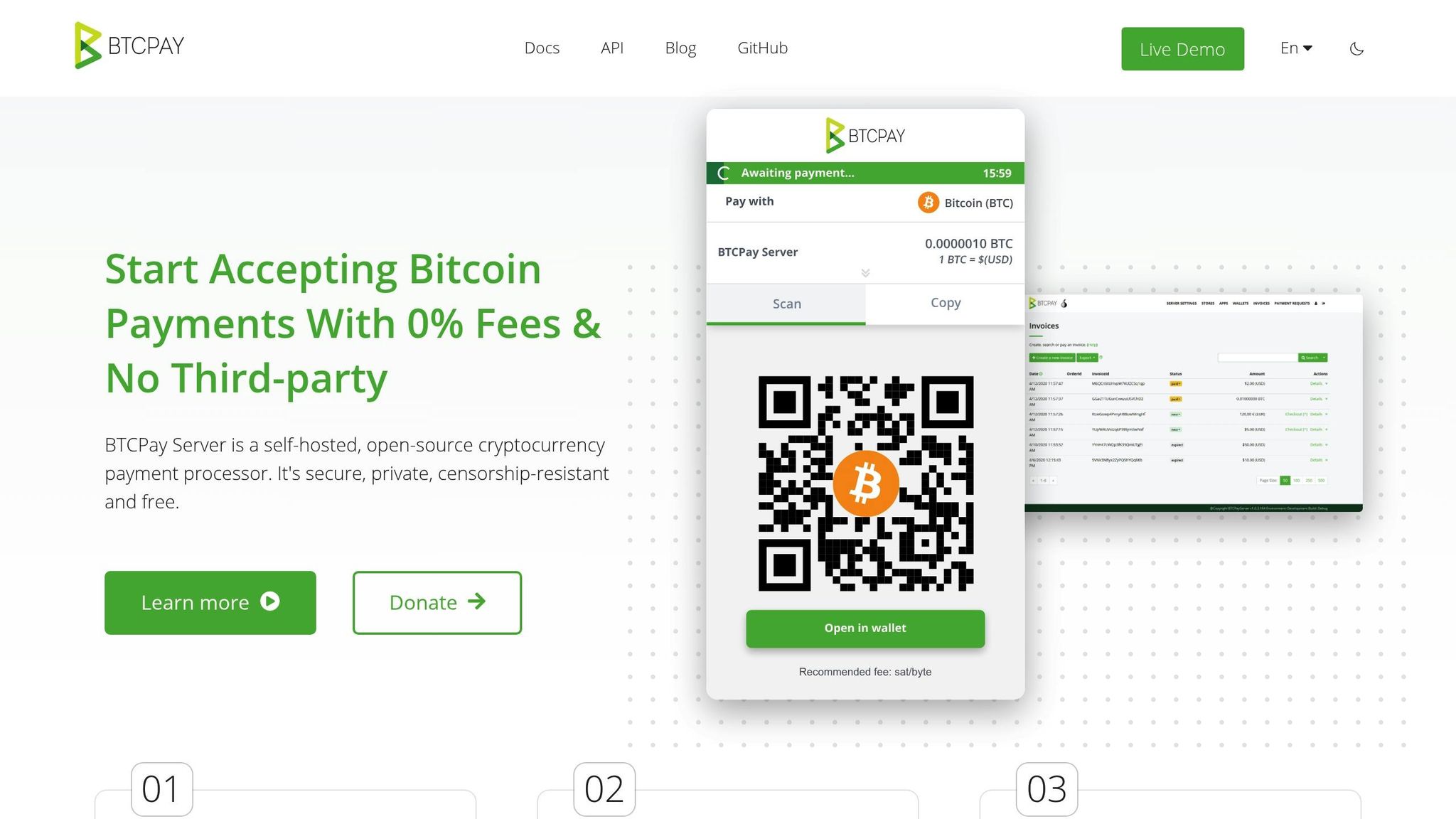
BTCPay Server is a powerful tool for automating payouts. You can deploy it via Docker on a VPS (e.g., Digital Ocean for $10–$70/month), use one-click cloud hosting services like LunaNode (~$10/month), or self-host on a BeeLink mini PC with a 2TB SSD (~$300).
The platform’s Pull Payments and Payouts features allow mining services to create claimable payment links for miners or send funds directly. Using the Greenfield API, you can automate distributions based on mining rewards. To ensure smooth operations, maintain outbound capacity by opening channels with reliable peers or leveraging Lightning Service Providers (LSPs) for rebalancing.
Keep an eye on your Bitcoin full node’s synchronization status, as the Lightning node cannot function until the blockchain data is fully up to date. If storage space is an issue, Core Lightning offers better support for pruned Bitcoin nodes compared to other implementations. It’s also worth noting that BTCPay Server charges no processing fees - your only costs are the standard Bitcoin network fees for opening and closing channels.
Hybrid Payment Models: On-Chain and Lightning
Combining automated distributions through BTCPay Server with a hybrid payment model can further streamline fee management and boost efficiency.
For example, use threshold-based routing: process smaller, frequent payouts via Lightning while handling larger settlements on-chain. Braiins Pool, for instance, offers free Lightning payouts, but on-chain payouts under 0.005 BTC come with a fee of 0.0001 BTC. Their Lightning payout limits range from a minimum of 1 satoshi to a maximum of 0.005 BTC, with Lightning settlements confirmed in minutes compared to the 1–2 hours required for on-chain transactions.
Lightning payouts can also be used to cover expenses, which replenishes inbound channel capacity and reduces the need for opening new channels. For on-chain payments, batching multiple payouts into a single transaction can significantly reduce network fees. Tools like Lightning Loop or Autoloop can automatically swap off-chain funds for on-chain funds as channels approach capacity. Additionally, configuring Pull Payments to let recipients choose between on-chain or Lightning distributions adds flexibility to your operations.
With a well-maintained Lightning infrastructure, payment success rates can range from 96.5% to 99.6%.
Conclusion
The Lightning Network is reshaping how mining payouts are managed. By cutting down on high fees, enabling instant settlements, and supporting micropayments, it addresses many of the inefficiencies tied to traditional on-chain distributions. This is especially critical in a landscape where mining margins hit historic lows in early 2026, making cost savings and streamlined operations more important than ever.
The benefits of this technology are already evident. In March 2025, the Braiins mining pool reached 1,000 daily Lightning payouts, marking a 20% month-over-month increase. According to CEO Eli Nagar, Lightning payouts provide instant, seamless payments, fueling consistent growth. This success demonstrates that mining operations can scale Lightning infrastructure to handle large volumes of transactions without sacrificing reliability.
Flash builds on these advantages by offering a secure, automated platform tailored to the Lightning Network. With non-custodial payment solutions, Flash allows mining services to implement Lightning-based payouts while retaining full control over their private keys. Its custom dashboards empower CFOs to track transaction flows, manage channel liquidity, and create hybrid payment strategies - blending on-chain settlements for larger treasury movements with Lightning for frequent miner payouts.
FAQs
How does the Lightning Network make mining payouts faster and more efficient?
The Lightning Network transforms mining payouts by offering instant transactions with extremely low fees. Traditional on-chain payments often come with delays and higher costs, but the Lightning Network handles payouts off-chain, enabling much faster settlements while keeping expenses down.
This system is especially advantageous for mining pools and hosted services. It makes smaller payouts feasible by avoiding the hefty transaction fees that usually come with Bitcoin payments. By utilizing the Lightning Network, mining services can handle payments more efficiently, cut down operational costs, and deliver a more seamless experience to their users.
What are the biggest challenges with traditional Bitcoin mining payouts?
Traditional Bitcoin mining payouts come with several hurdles that can make the process less efficient and profitable. For starters, every payout is processed directly on the Bitcoin blockchain, which means settlement times can be frustratingly slow. During periods of heavy network traffic, it’s not uncommon for transactions to take 1–2 hours - or even longer - to finalize.
On top of that, transaction fees are both high and unpredictable. For smaller payouts, these fees can eat into earnings significantly, making the process even less appealing for miners working with limited resources.
Another sticking point is the minimum payout thresholds set by many mining pools. These thresholds can delay miners from accessing their funds, leaving them more vulnerable to Bitcoin’s price swings and complicating their cash flow planning. To make matters worse, reconciling these on-chain payouts with internal financial records isn’t straightforward. Since Bitcoin addresses are pseudonymous, tracking and accounting for payments can become a headache, increasing the risk of mistakes and compliance issues.
All these factors combined make traditional on-chain payouts a challenging option for businesses looking for smoother, more cost-efficient solutions.
Why should hosted mining services adopt the Lightning Network for payouts?
The Lightning Network offers mining services a way to process payouts quickly and at a lower cost, sidestepping the delays and hefty fees associated with traditional on-chain Bitcoin transactions. This approach is becoming increasingly valuable as network congestion and transaction costs grow.
By leveraging the Lightning Network, mining services can scale their payment systems to handle larger volumes with ease. Payments are distributed instantly and with minimal fees, streamlining operations and improving the overall experience for recipients. It's a practical solution for businesses managing frequent mining payouts.