CFOs managing Bitcoin for their companies face challenges that go beyond basic wallets. Custom wallets provide tailored solutions, offering advanced security, real-time oversight, and cost-effective transaction processing. These wallets enforce company policies, such as requiring multiple approvals for payments or using timelocks for recovery keys, while integrating seamlessly with existing financial systems.
Key benefits include:
- Enhanced Security: Features like multisig, role-based access, and MPC reduce risks.
- Improved Control: Real-time dashboards, spending policies, and wallet tiers ensure transparency.
- Cost Savings: Faster, cheaper Bitcoin transactions compared to traditional banking.
Platforms like Flash further simplify treasury operations with non-custodial setups, Lightning Network support, and tools for compliance and governance. By using these wallets, CFOs can securely manage Bitcoin treasuries while reducing fees and improving efficiency.
The Building of Bitcoin Treasury Companies
Benefits of Custom Wallets for Treasury Management
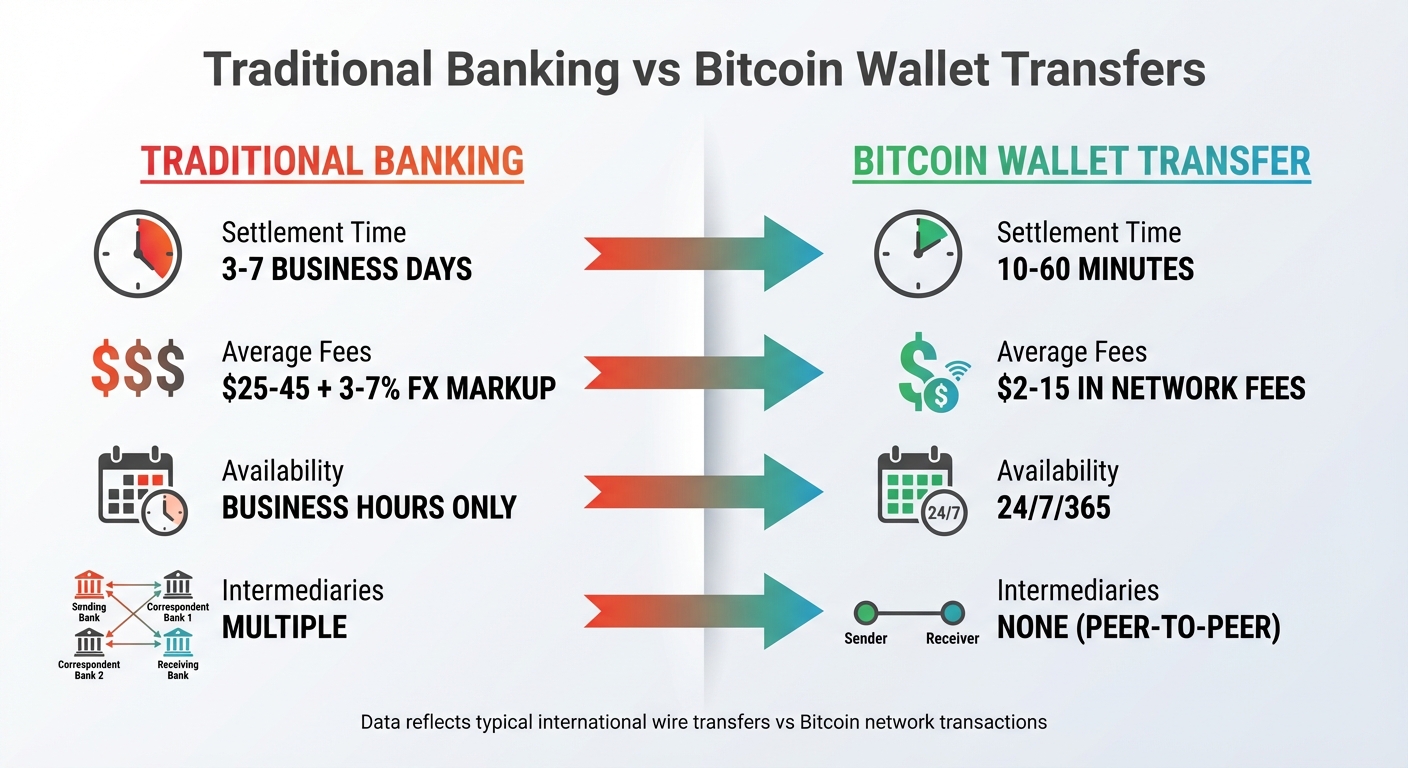
Bitcoin vs Traditional Banking: Treasury Transaction Comparison
Custom wallets provide CFOs managing Bitcoin assets with three primary advantages: better security, greater visibility and control, and cost savings.
Security Features
Custom wallets significantly enhance security by leveraging advanced techniques like multisig and MPC (multi-party computation). Multisig requires multiple unique keys for added transparency on-chain, though it carries higher fees. On the other hand, MPC breaks a single key into shares, offering the appearance of a single signature while reducing fees.
Role-based access control (RBAC) further strengthens security by allowing precise role assignments, such as initiator, approver, or view-only access. This aligns with internal controls and supports SOC 1 compliance. Some platforms go a step further by offering veto keys, enabling specific executives to block transactions regardless of other approvals. Yehuda Lindell, Cryptography Team Leader at Coinbase, highlights the advantages of MPC:
"The classic self-custody model where the users themselves hold and protect their private keys is extremely burdensome... MPC is able to provide the best of both worlds, achieving the usability and security of an exchange without sacrificing on self custody."
With these security measures in place, CFOs gain not only protection but also immediate visibility into their transactions.
Visibility and Control
Custom wallets come equipped with real-time dashboards that log every deposit and withdrawal, allowing CFOs to track balances and activity as they happen. This visibility also enables enforcement of spending policies, such as transaction limits, approved address allowlists, and tiered approval workflows based on payment size.
Organizations can also use wallet tiering to align security with transaction needs. For example:
- Hot wallets: Ideal for quick, automated transactions.
- Warm wallets: Offer policy-controlled access for routine operations.
- Cold wallets: Provide offline storage for long-term reserves.
This layered approach ensures that security measures match the frequency and value of transactions, while maintaining operational flexibility.
The combination of real-time oversight and streamlined processes also leads to significant cost reductions compared to traditional banking methods.
Cost Efficiency and Instant Settlements
Bitcoin wallet transfers are faster and cheaper than traditional banking. Unlike banks, which charge fees ranging from 3% to 7% for currency exchange plus wire charges, custom wallets eliminate intermediaries. Bitcoin transactions typically settle in 10 to 60 minutes, compared to the 3 to 7 business days required for international wire transfers. Fees for Bitcoin network transactions range from $2 to $15.
| Transaction Characteristic | Traditional Banking | Bitcoin Wallet Transfer |
|---|---|---|
| Settlement Time | 3–7 business days | 10–60 minutes |
| Average Fees | $25–45 + 3–7% FX markup | $2–15 in Bitcoin network fees |
| Availability | Business hours only | 24/7/365 |
| Intermediaries | Multiple (sending, receiving, correspondent) | None (peer-to-peer) |
For instance, Siemens issued a €60 million bond in early 2023 directly on the Polygon blockchain, achieving settlement in just two days - much faster than traditional bond issuance timelines. Similarly, Bitcoin wallets enable instant global transactions with minimal fees and no intermediaries.
The 24/7 operation of these wallets allows CFOs to adopt a "just-in-time" approach to capital management. By quickly moving idle cash into yield-generating assets instead of letting it sit in low-interest bank accounts, companies can reduce cash drag and improve overall treasury performance.
How to Set Up Custom Wallets with Flash

Getting Started with Flash
To start, establish a treasury policy approved by your board. This policy should outline acceptable assets, spending limits, and dual-control workflows. Once governance is in place, setting up Flash becomes a straightforward process.
Flash leverages Nostr Wallet Connect (NWC) technology, which links your external wallets directly to its payment processing tools. Since Flash is fully non-custodial, it never holds your funds. Instead, Bitcoin transfers go straight from your customers to your connected wallet. Supported wallets include Flash Wallet (mobile), Coinos (desktop), and Alby (browser-based).
| Step | Action | Details |
|---|---|---|
| 1 | Verify Compatibility | Check that your wallet supports Nostr Wallet Connect (NWC) technology. |
| 2 | Retrieve NWC String | Find the unique NWC string in your wallet's settings or integration menu. |
| 3 | Create Flash Wallet | In the Flash dashboard, select "Create New Wallet" and opt for "Nostr Wallet Connect". |
| 4 | Link Wallet | Input the NWC string into Flash to link your wallet. |
| 5 | Verify Connection | Conduct a small test transaction to confirm funds are received directly in your wallet. |
The NWC string serves as a secure link between your wallet and Flash. Treat this string with care, as it enables payments without exposing sensitive private keys. Always test the connection with a small amount before scaling up transactions. This setup simplifies wallet management while giving CFOs instant access to funds.
Flash Custom Wallet Features
Flash isn't just a setup tool - it’s an all-in-one solution for managing Bitcoin treasuries. It supports the Lightning Network, enabling quick, low-cost settlements. This is perfect for frequent transactions and micropayments. Julien Bouvier, Head of Marketing at Flash, puts it simply:
"Flash integrates revenue management with direct wallet transactions."
The platform offers flexible modules tailored to different needs, including recurring billing for subscriptions, automated paywalls for digital products, and mobile Point-of-Sale systems for retail. Developers can tap into full API documentation for custom integrations, while businesses seeking simplicity can use no-code tools like widgets and payment links that embed seamlessly into websites or invoices.
Flash’s dashboard provides real-time tracking of all transactions, assisting with treasury reconciliation. Unlike traditional processors, there are no delays. While invoicing is free, Flash charges a 1.5% transaction fee for payment processing.
Standard Wallets vs. Flash Custom Wallets
Flash custom wallets stand out from standard Bitcoin wallets by offering faster settlements, a non-custodial structure, and features tailored for businesses.
| Feature | Standard Processors | Flash Custom Wallets |
|---|---|---|
| Transaction Fees | 1% | 1.5% |
| Settlement Time | 1–3 business days | Near-instant |
| Custody Model | Often custodial/intermediary | Non-custodial (Wallet-to-wallet) |
| Security | Multi-sig, PCI DSS, 2FA | Direct wallet-to-wallet, NWC-based |
| Integration | Varies by provider | Streamlined with plugins for major platforms |
Olivia Carter, Marketing and Bitcoin Expert at Flash, highlights its key advantage:
"Flash offers direct wallet-to-wallet Bitcoin transactions, which reduces fees and maximizes security."
With instant settlements and a non-custodial model, CFOs can access funds without waiting for traditional banking systems to process payments. The cryptocurrency payment app market is expected to hit $1.26 billion by 2025, growing at a 20.9% CAGR, with merchant adoption projected to double to 15,000 businesses by early 2025.
This setup not only simplifies operations but also strengthens governance and compliance capabilities.
sbb-itb-f81ab9b
Governance and Compliance for Custom Wallets
Setting Up Governance Policies
Creating a solid governance framework is essential for managing Bitcoin treasury operations. Start by developing a board-approved treasury policy that outlines acceptable assets, spending limits, and authorized individuals for handling funds. Think of this as the rulebook for your Bitcoin operations.
A key component of governance is segregation of duties. Implement a "request-approve-sign" workflow, similar to traditional wire transfers, where the person requesting a transaction cannot also approve or sign it. As Gilbert Saldana, also known as mrBlockchainMan, aptly states:
"The greatest threats in this space are not failures of technology, but failures of human process and oversight."
To manage risk effectively, establish wallet tiers - hot, warm, and cold wallets - each with specific spending limits based on transaction size, counterparties, and timeframes. This layered approach ensures that funds are allocated based on risk tolerance.
Address whitelisting is another vital step. By allowing transactions only to pre-approved Bitcoin addresses, you reduce the risk of unauthorized transfers. Additionally, set up formal procedures for updating key elements like spending limits, authorized signers, and wallet routing. Every change should be fully auditable to maintain transparency.
For U.S. companies, compliance with FASB ASU 2023-08 is critical. This rule requires crypto assets to be measured at fair value, with changes reported directly on the income statement. Your governance framework should support accurate cost-basis tracking for each transaction to meet these requirements.
These measures form the backbone of a strong compliance strategy, which can be further streamlined using Flash's dedicated tools.
Flash's Compliance Tools
Flash complements robust governance policies with tools designed to simplify regulatory compliance. Its non-custodial architecture ensures that funds move directly between wallets, eliminating intermediary risks. Meanwhile, the real-time dashboard logs each payment with internal IDs and business purposes, making tracking seamless.
Role-based access controls are another key feature, ensuring that only authorized individuals can approve and execute transactions. For those requiring fast settlements, Flash supports the Lightning Network, providing instant transfers and an immutable audit trail.
For organizations managing large Bitcoin reserves, Flash's transaction tracking integrates easily with crypto accounting software. This integration not only speeds up closing your books but also ensures accurate daily reporting of your treasury activities.
Risk Management and Best Practices
Building on the security and compliance measures discussed earlier, CFOs also need to tackle operational risks effectively.
Managing Risks in Bitcoin Treasury
Bitcoin transactions are irreversible, so accuracy is critical - every payment must be correct on the first try. To reduce risk, use multisig setups (e.g., 2-of-3 or 3-of-5 configurations) and maintain stringent key management practices. This includes using dedicated, airgapped hardware and creating encrypted, geographically dispersed backups. As Taurus highlights:
The cold wallet infrastructure must only prevent unauthorized transactions; it can tolerate failure, but backups cannot. Backups must always work now and decades from now.
To avoid regulatory pitfalls, incorporate sanctions screening - such as OFAC checks - into your transaction workflows before broadcasting any payment. Another smart move is to spread treasury funds across multiple addresses with uneven balances to make total reserves less obvious. Additionally, limit internal knowledge of who holds signing keys. Only essential personnel should know the identities of key holders. Vary the timing and location of signing ceremonies, and avoid discussing sensitive topics via SMS or email.
These steps create a strong framework for managing risks and pave the way for a structured rollout of treasury operations.
Phased Implementation Approach
Once risk management protocols are firmly in place, a phased approach to treasury implementation is the next step. Start by drafting a board-approved policy that defines wallet tiers, spending limits, and authorized signers before deploying any technology. MicroStrategy’s phased approach - beginning with small allocations and gradually increasing limits after successful trials - proved successful by 2024.
Begin with pilot transactions using small balances. This allows you to test workflows, settlement timelines, and reconciliation processes without exposing significant funds. As controls are validated through consistent testing and clean audits, transaction limits can be increased incrementally. Flash’s non-custodial architecture and real-time dashboard simplify this phase, offering clear tracking of payments with internal IDs and documented business purposes.
Finally, conduct regular drills, such as annual recovery tests and tabletop exercises, to ensure backups remain functional and your team is prepared to handle scenarios like compromised signers. These proactive measures keep your treasury operations resilient and ready for growth.
Conclusion
Custom wallets give CFOs the tools to manage Bitcoin treasuries with confidence, combining secure storage, real-time oversight, and automated compliance. Platforms like Flash enhance security by eliminating single points of failure while allowing finance leaders to retain full control of their private keys. With Flash's non-custodial setup, transactions occur directly between wallets, offering near-instant settlements without the delays or fees associated with traditional banking.
To get started, establish a board-approved policy outlining wallet tiers, spending limits, and authorized signers. Leverage Flash's Lightning-enabled infrastructure for transactions requiring speed and low fees - offered at a competitive 1.5% - and use cold storage for safeguarding long-term reserves. Flash's API and no-code widgets make it easy to integrate with existing ERP systems, streamlining reconciliation and ensuring audit-ready reporting without disrupting current workflows.
This approach not only boosts operational efficiency but also positions CFOs to stay ahead of industry trends. With 66% of institutional investors planning to increase their digital asset allocations within five years, acting now offers a clear competitive edge. Flash's compliance features, such as sanctions screening and role-based access controls, meet regulatory demands, while its real-time dashboard provides the visibility treasury teams need to make informed decisions.
The shift toward programmable money and infrastructure-focused strategies is transforming the treasury landscape. As PYMNTS highlights:
Enterprise-grade wallets are becoming key plumbing for CFOs who care about auditability, controls and seamless integration with existing finance systems.
Flash provides a secure, efficient, and scalable solution for Bitcoin treasury management, creating a foundation that evolves with your business needs.
FAQs
How do custom wallets improve security for managing Bitcoin in corporate treasuries?
Custom wallets play a key role in boosting security for Bitcoin treasury management by addressing risks such as theft and unauthorized access. A popular feature in these wallets is multisignature (multisig) technology. This setup requires multiple private keys - stored in separate locations - to approve any transaction, ensuring that a single compromised key won’t endanger the entire treasury.
Another valuable feature is role-based permissions, which let CFOs or other decision-makers assign specific transaction rights to team members. This helps enforce internal policies and keeps fund movements tightly controlled. Many custom wallets also provide self-custody options with recovery protocols, giving organizations a safety net to access their assets even if a service provider becomes unavailable.
By integrating tools like multisig, role management, and recovery mechanisms, custom wallets deliver a secure and reliable way to manage Bitcoin holdings.
What benefits does Flash's non-custodial setup offer CFOs for managing Bitcoin treasuries?
Flash's non-custodial setup puts control and security directly in the hands of CFOs by letting them manage their own private keys. This approach reduces dependence on third parties, cutting down on counterparty risk while ensuring digital assets stay both secure and easily accessible.
On top of that, CFOs can adjust wallet configurations to fit their organization’s unique requirements. Whether it’s setting spending limits or aligning with compliance standards, this flexibility makes treasury management more streamlined and aligned with business objectives.
How can CFOs seamlessly integrate Flash's custom wallets into their financial systems?
CFOs can seamlessly incorporate Flash's custom wallets into their financial systems using the platform's tools to securely manage Bitcoin wallets. The process begins with confirming compatibility with Nostr Wallet Connect technology. From there, they retrieve the wallet's unique connection string and conduct small test transactions to ensure everything is set up correctly. Once integrated, these wallets can be directly linked to treasury systems, enabling efficient transaction management and real-time access to funds.
Flash also provides custom integration options to fit into existing financial workflows, including payment processing, reconciliation, and reporting. With Flash’s API, CFOs can automate various processes, maintain full control over their Bitcoin treasury, and adhere to internal policies and regulations. This approach simplifies treasury management by combining the security and flexibility of non-custodial Bitcoin wallets with strong financial oversight.