So, you're ready to get a Bitcoin wallet address. Fantastic. Think of this address as your unique, digital P.O. Box for the crypto world. Anyone with this address can send you Bitcoin, but only you—the person holding the private key—can open that box and access what's inside.
The first thing you need to do is pick a wallet. This is probably the most critical decision you'll make at the outset, as it sets the stage for how you'll manage your security and control your funds.
Custodial vs. Non-Custodial Wallets
Your journey starts with a choice between two main types of wallets: custodial and non-custodial. Each has its own set of trade-offs, and what's right for you really depends on your comfort level with technology and responsibility.
Custodial Wallets: These are the wallets you typically get on a cryptocurrency exchange. When you sign up, the exchange holds onto your private keys for you. It's incredibly convenient and a great starting point for beginners because you don't have to worry about the technical nitty-gritty of key management.
Non-Custodial Wallets: This category includes software wallets on your phone or computer, as well as physical hardware devices. With these, you are the only one in control of your private keys. This gives you absolute ownership over your crypto, but it also means you're 100% responsible for keeping it safe.
The path you pick directly influences how you'll get and use your wallet address. With over 400 million crypto users around the globe, this isn't a minor detail. For perspective, a single custodial cold wallet at a major exchange like Binance can hold roughly 1.25% of Bitcoin's entire circulating supply. You can dig into more stats like this in the latest Bitcoin wealth distribution report.
When you use a custodial service, getting an address is usually as simple as creating an account and clicking "Deposit." They handle the rest.
To help you decide, here's a quick breakdown of what you're signing up for with each option.
Custodial vs. Non-Custodial Wallets at a Glance
This table should help you quickly see the differences and choose the right wallet type for your needs.
| Feature | Custodial Wallet (e.g., Exchange) | Non-Custodial Wallet (e.g., Software/Hardware) |
|---|---|---|
| Private Key Control | The exchange or service holds your keys | You hold your own keys |
| Ease of Use | Very beginner-friendly; similar to online banking | Requires more technical know-how |
| Security Responsibility | The service is responsible for security | You are 100% responsible for security |
| Recovery | Usually has a "forgot password" feature | If you lose your seed phrase, your funds are gone |
| Getting an Address | As easy as logging in and finding "Deposit" | You generate it directly within your wallet software |
| Best For | Beginners, traders, and those prioritizing convenience | Long-term holders, and users who want full control |
Ultimately, the choice comes down to a classic trade-off: convenience versus control.
Key Takeaway: Your choice between a custodial and non-custodial wallet is the single most important decision when starting. It's a trade-off between convenience and complete control.
For most people just dipping their toes in, a custodial wallet on a reputable exchange provides a gentle and forgiving introduction to the world of crypto. You can always move to a non-custodial solution later as you get more comfortable.
If you're just dipping your toes into the world of crypto, the easiest on-ramp for getting a wallet address is almost always a major cryptocurrency exchange. The whole experience is designed to feel familiar, a lot like using a modern online banking app.
Getting started is pretty straightforward. You'll need to create an account and go through a standard identity check, usually called Know Your Customer (KYC). After you’re approved, just head over to your portfolio or wallet section within the platform. Look for an option like "Deposit" or "Receive," pick the crypto you want—in this case, Bitcoin (BTC)—and the exchange will generate a unique address just for you.
Here's a look at what a typical exchange dashboard might look like.
You can see how different cryptocurrencies are listed, each with its own set of options. Tucked away in there is where you'll find the specific address for making a deposit.
The Convenience and Custody Tradeoff
The big win here is convenience. You don't have to worry about the technical nitty-gritty of security or managing keys; the exchange handles all of that behind the scenes. But this ease of use comes with a massive trade-off: you don't actually control the private keys for your address. The exchange holds them for you, which is why we call these custodial wallets.
There's a well-known saying in crypto that's worth remembering: "Not your keys, not your coins." When you use an exchange, you're placing your trust in them to keep your assets safe.
This setup is perfectly fine for beginners or people who trade frequently, but it's not without its risks. The explosion in active users—Bitcoin is now approaching 887,000 daily active addresses, while networks like TRON are seeing a staggering 2.9 million—has also made these platforms a prime target for hackers. In the first half of 2025 alone, a whopping $2.17 billion was stolen from crypto platforms, a stark reminder to stick with reputable exchanges. You can dig deeper into these numbers in a recent crypto crime mid-year update from Chainalysis.
So, when you're ready to receive some Bitcoin, be meticulous. Copy the entire address the exchange gives you. A pro tip I always follow is to double-check the first four and last four characters of the address after you paste it somewhere. It’s a simple habit that can save you from a costly mistake.
If you're serious about taking full control of your Bitcoin, generating an address from your own private wallet is the only way to go. This is what people mean by "self-sovereignty"—it's you and your keys, with no third party in the middle who can freeze or lose your funds.
Whether you opt for a software wallet on your phone like BlueWallet or a physical hardware device like a Ledger, the fundamental process is the same. You're in charge.
The image above gets to the heart of it. Your private key is the true source of power. It mathematically creates your public key, which in turn generates your public wallet address—the one you share to get paid. This direct chain of command is precisely why keeping your private key a secret is the most important rule in crypto.
When you first fire up a new private wallet, it will give you a unique seed phrase, usually a list of 12 or 24 words. Think of this phrase as the master key to your entire crypto life.
Critical Tip: Your seed phrase is everything. Write it down. Stamp it into a piece of metal. Store it somewhere safe and offline where no one else will find it. Never, ever type it into a computer or take a picture of it. If you lose it, your Bitcoin is gone. If someone else finds it, your Bitcoin is their Bitcoin.
Getting Your First Address
Once you've secured that seed phrase, the hard part is over. Your wallet is set up and ready to use.
Finding your Bitcoin address is usually dead simple. Just look for a button labeled "Receive" or "Deposit." The wallet software will immediately show you your address, almost always with a handy QR code so people can just scan it with their phone.
- Software Wallets (e.g., MetaMask, BlueWallet): After you download the app and go through the setup, the first thing you'll do is write down and confirm your seed phrase. Once that's done, an address is automatically created for you.
- Hardware Wallets (e.g., Trezor, Ledger): These little physical gadgets offer the best security you can get. You'll plug it into your computer, follow the on-screen instructions to initialize it, and—you guessed it—write down the seed phrase it provides.
One of the coolest features of a proper Bitcoin wallet is the ability to generate a new address for every single transaction. This is a massive privacy win. Instead of giving out the same address over and over, which allows anyone to easily trace your entire financial history on the blockchain, you can create a fresh one each time.
Just head back to that "Receive" section in your wallet whenever you need a new one. It’s a simple click that makes a huge difference.
Using Your New Wallet Address With Confidence
Okay, you've got your new wallet address. Now the fun part begins. Getting comfortable using it means understanding what you’re looking at and, more importantly, building some smart, safe habits from day one. This unique string of characters is your public key to receiving funds, so it pays to treat it with respect.
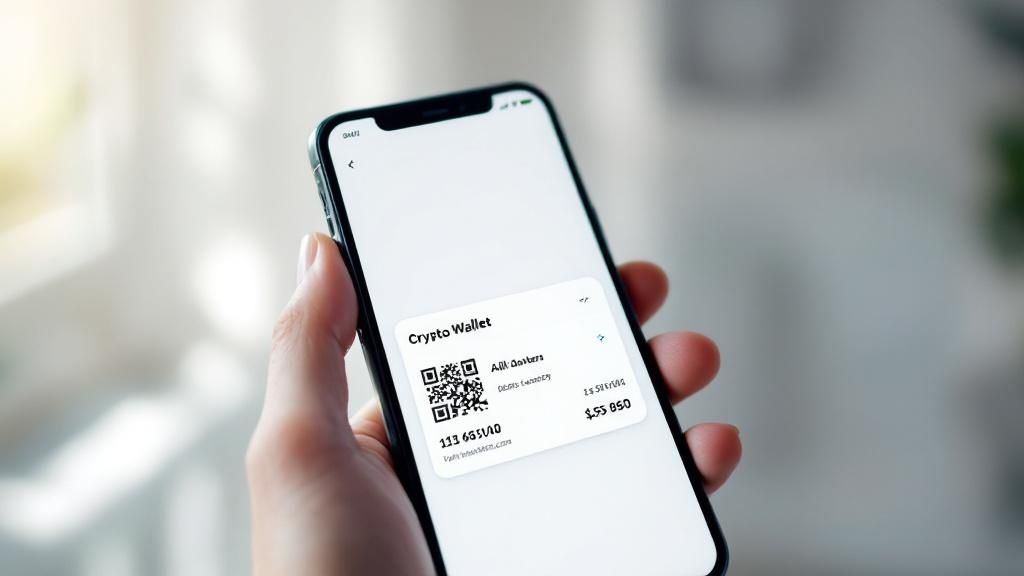
I get it—at first, all crypto addresses look like a random jumble of letters and numbers. But there are subtle clues. Different blockchains have their own distinct address formats. For instance, a native Bitcoin address will often start with "bc1," while an Ethereum address typically kicks off with "0x." Spotting these little differences is your first line of defense against accidentally sending funds to the wrong kind of wallet.
The Anatomy of a Safe Transaction
Here’s the most important habit you can possibly build: always, always verify an address before you hit send. Scammers use a sneaky trick called "address poisoning," where they send a tiny, almost worthless amount of crypto to your wallet from a lookalike address. Their goal is to get their fraudulent address into your transaction history, hoping you'll copy it by mistake later on.
This isn't some rare, theoretical attack. It's surprisingly common. One study found nearly 48,000 of these poisoning transactions over just an 18-month period. Scammers are literally betting on you not checking the full address string.
To keep your funds safe, make this your non-negotiable routine:
- Check the whole thing: Always verify the entire address, not just the first few and last few characters.
- Trust the copy button: Manually typing an address is just asking for trouble. Use your wallet’s built-in copy function and paste it directly where it needs to go.
- Send a test transaction: For any large or really important transfer, send a tiny amount first. Wait for it to arrive safely before you commit the full sum. It's a small step that can save you a massive headache.
Practical Do’s and Don’ts
Think of these as the ground rules for handling any crypto address. Simple, but effective.
What you should do:
- Do use your wallet’s address book feature. Save addresses you use often to avoid copying and pasting every single time.
- Do generate a fresh address for new transactions whenever possible. It’s a simple way to boost your financial privacy.
- Do explore real-world uses for your address. For instance, you could use it for e-commerce checkouts, like with a Solana Pay integration for Shopify.
What you should never do:
- Don't ever share your private keys or seed phrase. Ever. This is the master key to your funds.
- Don't trust an address sent to you in an email or DM without verifying it through another channel.
- Don't blindly copy an address from your transaction history. Always double-check it belongs to the right person.
Stick to these simple, practical habits, and you'll be able to navigate the world of crypto transactions securely and without the stress.
Avoiding Common Wallet Address Mistakes
Getting your wallet address is the easy part. Learning how to use it safely is where the real work begins. I've seen a few simple, avoidable mistakes cause major headaches for people, so let's walk through how to sidestep the most common errors from the get-go.
The single costliest mistake? Sending a cryptocurrency to an address that wasn't built for it. Think of it like trying to send a package to a P.O. Box that only accepts letters—it's just not going to get there. Sending Bitcoin (BTC) to an Ethereum (ETH) address, for example, will almost certainly result in the permanent loss of your funds. Always, always double-check that the receiving address matches the coin you're sending.
Another frequent snag is transaction fees. These aren't optional tips; they're what you pay network validators to get your transaction processed and confirmed. If you cheap out and set the fee too low, your transaction can get stuck in limbo for hours or even days before it eventually fails. Most modern wallets suggest a good fee, so it's usually best to stick with their recommendation.
The Dangers of Phishing and Address Scams
Beyond technical slip-ups, you have to stay sharp against social engineering and phishing scams. These attacks are all about tricking you into voluntarily sending your funds to a thief. A classic tactic is a scammer trying to convince you to reveal your private keys or seed phrase, which is like handing over the keys to your entire crypto vault.
A particularly nasty and growing scam is address poisoning. Here’s the playbook:
- The Lookalike: A scammer creates a wallet address that looks almost identical to one you've used before, matching the first and last few characters.
- The Bait: They send a tiny, nearly worthless amount of crypto from their lookalike address to your wallet. This action plants their fraudulent address right in your transaction history.
- The Trap: The next time you need to send funds, you might quickly copy an address from your history, assuming it's the right one. If you grab their poisoned address by mistake, your money is gone.
This isn't just a theoretical risk. One analysis uncovered nearly 48,000 potential address poisoning transactions over just an 18-month period. Scammers are banking on you being in a hurry and not checking the full address string.
The fix is simple but crucial: Always verify the entire address before you hit "confirm." Making that a habit is one of the single best things you can do to protect your assets and navigate the crypto world safely.
Frequently Asked Questions About Wallet Addresses
When you're just getting your sea legs with Bitcoin, a few questions always seem to surface. Getting straight answers without the technical jargon can make all the difference. Let's tackle some of the most common ones I hear from people new to crypto.
One of the first things newcomers ask is if they are stuck with just one address for their wallet. The short answer? Not at all.
Can I Have More Than One Wallet Address?
Absolutely. In fact, you can generate a virtually endless number of them. Most modern wallets are designed to let you create multiple receiving addresses, all managed from a single account.
This isn't just a neat feature; it's a fundamental practice for maintaining your privacy. Using a fresh address for every incoming transaction makes it significantly harder for outside observers to link your financial activities together on the public blockchain. Think of it like using a different, single-use email alias for every online service you sign up for—it keeps your core identity protected.
Another point of confusion I see often revolves around security. We're all conditioned to guard our financial information closely, so the idea of sharing a wallet address can feel a bit strange at first.
It's completely safe to share your public wallet address. That’s precisely what it's designed for—to be given out so people can send you Bitcoin. It’s like sharing your bank account number for a direct deposit; someone can put money in, but they can't take money out.
What you must never, under any circumstances, share is your private key or seed phrase. That’s the master key to your entire wallet. Sharing it is like handing someone a signed blank check and the keys to your safe. Keep it secret, keep it safe.
What If I Send Crypto to the Wrong Address?
This is the question that keeps new users up at night, and for good reason. The reality of blockchain is stark: transactions are final and irreversible. If you send Bitcoin to the wrong address, those funds are almost certainly gone for good.
There's no "undo" button, no fraud department to call, and no bank that can reverse the charge. This is the trade-off for having a decentralized financial system without intermediaries. It puts the responsibility squarely on you, the user.
That sounds scary, but protecting yourself is just a matter of building good habits.
- Always double-check every character. Don't just glance at the first and last few characters of an address. Verify the whole thing.
- Send a small test amount first. When sending a large sum, it's smart to first send a tiny, insignificant amount (like a dollar's worth). Wait for it to be confirmed before sending the full amount.
- Use the copy-paste feature. Never, ever type an address by hand. A single typo can send your funds into the digital void. Copy it directly from the source.
Adopting these simple practices from day one is the single best way to protect your assets and navigate the world of Bitcoin with confidence.
Ready to accept Bitcoin payments directly and securely? Flash provides wallet-to-wallet payment software that connects you to customers without intermediaries, KYC, or high fees. Get started in under a minute.