So, what is Bitcoin mining, really? At its heart, it's the engine that powers the entire Bitcoin network. You can think of it as a global, competitive race where participants, known as miners, act like digital accountants. They all rush to solve a complex cryptographic puzzle, and the first one to crack it gets to update Bitcoin's public ledger with the latest batch of transactions.
For their effort, the winning miner is rewarded with brand-new bitcoin. This is how new coins are created and enter circulation.
What Is Bitcoin Mining and Why Is It So Important?
Without mining, Bitcoin simply wouldn't work. It's the very backbone that keeps the network secure and functional. Miners perform a decentralized, global job that allows the currency to run smoothly and predictably—all without a central bank or any single authority calling the shots.
This process handles two critical jobs at once:
- Creating New Bitcoin: Miners receive a reward of newly minted bitcoin. This reward is the core incentive that encourages people to dedicate their computing power to securing the network.
- Verifying Transactions: When a miner solves the puzzle, they get the right to gather a list of recent transactions into a "block" and add it to the blockchain (the public ledger). This action validates those transactions, locking them in place and preventing anyone from trying to spend the same money twice.
The Foundation of Digital Trust
The real magic behind mining is a clever system called Proof-of-Work (PoW). It's the consensus mechanism that allows a worldwide network of complete strangers to agree on the state of the ledger without needing to trust one another. How? By forcing miners to expend real-world resources—namely, electricity and powerful computing hardware.
This "proof of work" makes it incredibly expensive and difficult for a bad actor to cheat the system. To tamper with past transactions, they would need to redo all the work that has already been done, which is a practically impossible task.
The network also has a built-in regulator. The difficulty of the cryptographic puzzle automatically adjusts roughly every two weeks to ensure a new block is added about every 10 minutes, no matter how many miners join or leave. This steady pace means mining requires more and more computing horsepower and electricity over time to earn the same reward, which is why miners are always seeking more efficient hardware. You can dig into the detailed numbers on Bitcoin's global energy consumption over at Statista.com.
Key Takeaway: Bitcoin mining isn't just about making new coins. It's the security model that makes the whole network trustworthy, ensuring every transaction is legitimate and the blockchain remains an unchangeable record of history.
To help tie these ideas together, the table below offers a quick snapshot of the core concepts we'll be exploring. Think of it as a handy cheat sheet for the key terms and their roles in the mining process.
Key Components of Bitcoin Mining at a Glance
This table summarizes the core concepts involved in the Bitcoin mining process.
| Component | Purpose | Analogy |
|---|---|---|
| Proof-of-Work | The security mechanism that requires miners to solve a difficult computational puzzle. | A global race to find the single winning lottery ticket. |
| Blockchain | The public, distributed ledger that contains the history of all transactions. | A shared digital accounting book that can't be erased. |
| Block Reward | The new bitcoin and transaction fees paid to the successful miner. | The prize money and commission for winning the race. |
| Mining Difficulty | A self-adjusting measure that keeps block creation time consistent. | Making the puzzle harder or easier depending on how many people are playing. |
Understanding these four components is the first step to truly grasping how Bitcoin works under the hood. They are the interlocking pieces that create a secure, decentralized financial network.
The Engine Room of Bitcoin: Proof of Work Explained
At the very core of Bitcoin mining, you'll find a mechanism called Proof-of-Work (PoW). This isn't just some tech buzzword; it's the security model that keeps the network honest and decentralized. You can think of PoW as a massive, globe-spanning lottery where miners are all competing to find one very specific winning number.
Their lottery tickets aren't paper slips but lightning-fast computational guesses. The "winning number" they're hunting for is a unique digital fingerprint known as a hash. This intense competition is the engine that validates every transaction and secures the entire blockchain.
What Is a Hash and How Does SHA-256 Work?
To really get what miners are doing, you first have to understand the concept of a hash. A hash is simply a fixed-length string of numbers and letters spit out by a special cryptographic algorithm. Bitcoin uses an algorithm called SHA-256 (Secure Hash Algorithm 256-bit).
Think of it like a digital blender. No matter what you toss in—a single word or an entire book—the blender always produces a smoothie of the exact same size. SHA-256 works in a similar, but much more precise, way:
- It’s a One-Way Street: You can easily generate a hash from some data, but it's virtually impossible to work backward and figure out the original data from the hash alone.
- It’s Deterministic: The same input will always produce the exact same hash, every single time. No exceptions.
- The Avalanche Effect: Change even a single character in the input—add a comma, fix a typo—and the resulting hash will be completely different and unrecognizable.
This process is the bedrock of how bitcoin mining works. Miners bundle up all the latest transaction data for a new block, add a few other bits of information, and run the whole thing through SHA-256 to create its unique hash.
The Great Guessing Game: The Role of the Nonce
This is where a lot of people get tripped up. Miners aren't sitting around solving complex calculus problems. They are actually playing a brute-force guessing game at an unimaginable speed.
Their goal is to find a hash that starts with a certain number of zeros. The network might say, "We need a hash that looks like 00000000000000000001a2b3c...." Since they can't change the transaction data, miners add a tiny, variable piece of data to the block called a nonce (which is just short for "number used once").
Then, the race begins. It’s a simple but incredibly intensive loop:
- Take the block's data and combine it with a nonce (starting at 0).
- Run it through the SHA-256 algorithm to generate a hash.
- Check if the hash meets the target (does it have enough leading zeros?).
- If not, add 1 to the nonce and try again.
A miner's specialized hardware performs this loop billions, or even trillions, of times every second. The very first miner to stumble upon a nonce that produces a valid hash wins. They get to add the new block to the blockchain and claim the reward.
The Digital Lottery: A miner's entire job boils down to finding that one "golden nonce" that, when combined with the block's data, creates a winning hash. This colossal computational effort is the "work" in Proof-of-Work.
Keeping the Rhythm: Mining Difficulty Explained
So, what happens if thousands of new, powerful miners suddenly join the network? Wouldn't blocks get found much faster than the intended 10-minute interval? Bitcoin's protocol has an elegant, built-in solution for this: mining difficulty.
The difficulty is a network-wide setting that dictates just how hard it is to find a valid hash. It automatically adjusts itself every 2,016 blocks—which works out to about every two weeks—to keep the average block time hovering right around 10 minutes.
- If blocks are found too fast (say, every 8 minutes), the difficulty goes up. This means the target hash now requires even more leading zeros, making it much harder to find.
- If blocks are found too slow (say, every 12 minutes), the difficulty goes down. The target becomes easier to hit, and miners can find a valid hash more quickly.
This self-regulating mechanism is brilliant. It ensures the creation of new bitcoin stays on a predictable schedule and that the network's security remains solid, no matter how many miners are competing or how powerful their machines get. This steady rhythm is the very heartbeat of the Bitcoin network.
The Evolution of Mining Hardware from Laptops to ASICs
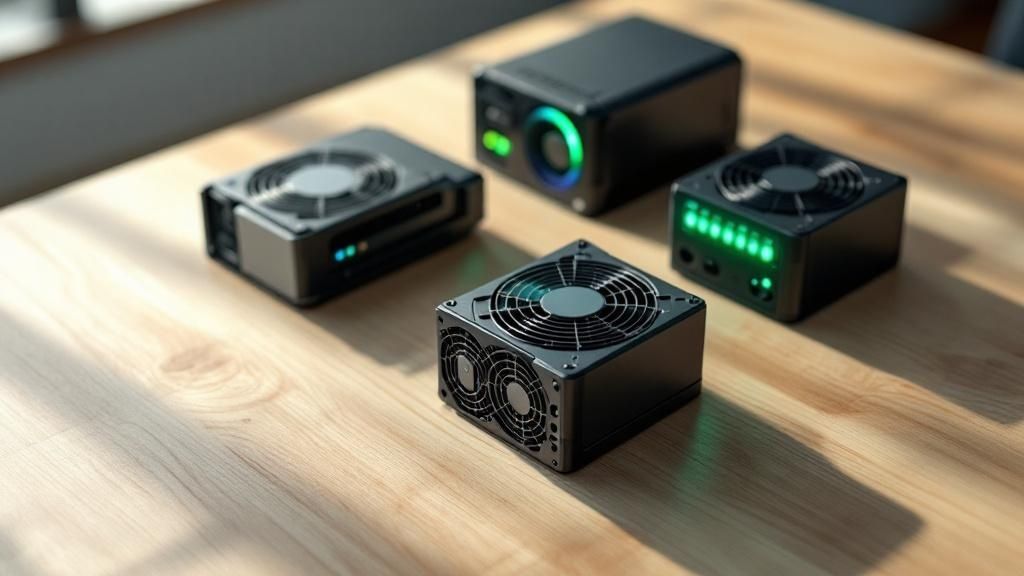
The history of Bitcoin mining reads like a relentless hardware arms race. What started as a hobby anyone could do on a standard computer has exploded into a highly specialized, capital-intensive industry. The entire evolution was fueled by one simple goal: to cram more SHA-256 calculations into every second than the competition.
To really get how modern Bitcoin mining works, you have to understand this progression. The romantic days of casually earning bitcoin on a home PC are long gone. Now, it's all about powerful, purpose-built machinery where each new generation makes the last one obsolete almost overnight.
The Dawn of CPU Mining
Back in Bitcoin's earliest days, starting in 2009, mining was a pretty straightforward affair. Satoshi Nakamoto’s original vision was "one CPU, one vote," a democratic ideal where anyone could just download the Bitcoin software and use their computer's Central Processing Unit (CPU) to search for new blocks.
A standard laptop was all it took. Because the network was so small, your everyday computer had a reasonable shot at finding a block and earning the reward. But CPUs are generalists—the brain of a computer, designed to juggle lots of different tasks. They were never optimized for the single, repetitive calculation that mining demands, and this inefficiency left the door wide open for something better.
The Rise of the GPU
By 2010, clever miners figured out that Graphics Processing Units (GPUs) were way, way better at mining. These are the chips built to render the complex graphics in video games, and their architecture is perfect for parallel processing—handling thousands of simple tasks all at once. It was a perfect match for the brute-force guessing game of Bitcoin mining.
A single high-end GPU could easily outperform dozens of CPUs, delivering a huge leap in hashing power. This shift slam-dunked the CPU era and marked the first real turning point in the hardware arms race. Mining was no longer a background task for your laptop; it was time to build dedicated rigs loaded with graphics cards.
A Brief Stop at FPGAs
The next, albeit brief, step in the evolution was the Field-Programmable Gate Array (FPGA). Think of these as a step up from GPUs. They could be configured at the hardware level to do one specific thing exceptionally well—in this case, SHA-256 hashing. This gave them an edge in both performance and energy efficiency over GPUs.
Their time in the sun was short, though. While they were a smart bridge technology, FPGAs were a pain to program and were quickly overshadowed by an even more specialized solution that was just around the corner.
Key Takeaway: The path from general-purpose CPUs to task-specific GPUs and FPGAs showed a clear trend. To stay competitive, miners needed hardware built exclusively for hashing. This paved the way for the current industry standard.
The final and most disruptive leap in mining technology came from machines designed to do one thing and one thing only.
The ASIC Revolution
Today, all serious Bitcoin mining happens on Application-Specific Integrated Circuits (ASICs). The name says it all. An ASIC is a chip engineered from the ground up to execute a single algorithm: SHA-256. These machines don't run an operating system, you can't browse the web on them, and they definitely won't play games. They just hash—trillions of times per second.
This single-minded purpose makes them exponentially more powerful and energy-efficient than anything that came before. When the first ASICs hit the market in 2013, they completely changed the game. In an instant, all GPU and FPGA mining operations became obsolete and unprofitable.
This hardware progression boils down to a critical trade-off between power and specificity:
| Hardware Type | Hash Rate | Power Consumption | Cost |
|---|---|---|---|
| CPU | Very Low | Low | Low |
| GPU | Medium | High | Medium |
| FPGA | High | Medium | High |
| ASIC | Extremely High | Optimized for Hashing | Very High |
This arms race has completely redefined the economics of mining. Success today demands massive capital investment in the latest ASICs and, crucially, access to incredibly cheap electricity. It’s what pushed mining out of the realm of hobbyists and into the global, industrial-scale business it is today.
Understanding How Bitcoin Mining Pools Work
Back in Bitcoin's early days, you could mine a block on a laptop. Not anymore. As the network has exploded in value and complexity, the chances of a lone miner finding a block have become astronomically small. It's like buying a single lottery ticket and expecting to hit the Powerball jackpot. While technically possible, it’s a losing game.
This is where mining pools come into play. They’re the real-world answer that lets smaller miners not just participate, but actually earn a steady income. Instead of going it alone against massive industrial operations, you're collaborating with thousands of other miners across the globe.
The Power of Collaboration
Think of a mining pool like a lottery syndicate. One person buying a ticket has a tiny chance of winning. But if a thousand people pool their money to buy a thousand tickets, their collective odds of winning something shoot way up. When they do win, they just split the prize money fairly among everyone who chipped in.
A Bitcoin mining pool runs on the exact same principle. Everyone in the pool combines their hash rate—their raw computational power—to tackle the puzzle of finding the next block as one massive, unified entity. This collective muscle dramatically increases the likelihood of solving the cryptographic puzzle and snagging the block reward.
When the pool finds a block, the reward (currently 3.125 BTC plus transaction fees) is shared among all the members. This simple but powerful idea transforms mining from a high-stakes gamble into a predictable, consistent way to earn Bitcoin.
From Guesses to Shares
So how does a pool track who did what? It would be a total waste of energy for every miner to be crunching the exact same numbers. Instead, the pool operator gives each miner a slightly easier, but still challenging, version of the puzzle to solve.
The solutions to these mini-puzzles are called shares. A share is basically a hash that, while not tough enough to solve a block on its own, acts as proof that a miner is actively putting their hardware to work. It’s their ticket stub, proving they contributed.
Miners submit these shares back to the pool as proof of work. The pool operator uses this stream of shares to see exactly how much hashing power each member is contributing. Eventually, by sheer luck, one of these shares will also happen to be the golden ticket that solves the entire block, and the pool wins the reward.
Key Takeaway: By submitting shares, miners prove their contribution to the pool's total hash rate. The more shares you submit, the bigger your slice of the pie when the pool finds a block.
Payout Models and Predictable Income
Once a block is found, the rewards need to be divided fairly. Pools use different payout models, but one of the most popular for its stability is Pay-Per-Share (PPS).
The PPS model is designed to give miners total peace of mind. With this system, the pool pays you a fixed, calculated rate for every valid share you submit, whether the pool finds a block that day or not. The pool operator takes on all the risk.
Here’s the breakdown and why it's so appealing:
- Guaranteed Payouts: You earn a predictable income based purely on your hash rate. No more feast or famine.
- No Luck Involved: Your earnings aren't tied to the pool's luck. The operator absorbs the risk of a long dry spell.
- Operator Fees: To cover this risk and provide a stable service, the pool operator takes a small fee from the earnings.
This model is a game-changer. It strips away the frustrating element of luck and provides a consistent revenue stream, making it viable for hobbyists and small-scale miners to play a meaningful—and profitable—role in securing the Bitcoin network.
Bitcoin mining has come a long way from its early days as a niche hobby. Forget tinkering on a home computer; today, it’s a serious, multi-billion-dollar global industry. This is a high-stakes game where success boils down to a tight equation of cost versus reward.
The goal is brutally simple: mine bitcoin for less than it’s worth on the open market.
This entire business rests on three constantly shifting pillars. A miner's ability to turn a profit is a direct result of how well they can juggle these critical variables.
Key Factors Driving Mining Profitability
Out of all the factors, one stands head and shoulders above the rest: the cost of electricity. Powering an army of ASICs is an incredibly energy-hungry process. A few cents per kilowatt-hour can easily be the difference between making money and bleeding it. This is precisely why the world’s largest mining operations are clustered in regions with access to some of the cheapest power on the planet.
Next up is hardware efficiency. The mining world is locked in a relentless hardware arms race. Newer, more powerful ASICs are constantly being rolled out, making older models obsolete almost overnight. A miner’s hash rate—how many guesses their machine can make per second—and its energy consumption (joules per terahash) are what really drive the bottom line. Better hardware simply means more bitcoin for the same energy cost.
Finally, the price of Bitcoin itself is the ultimate wildcard. Miners pay their bills (electricity, hardware) in regular fiat currency, but their revenue comes in BTC. When the price of Bitcoin soars, even inefficient operations can suddenly become profitable. But when the market takes a nosedive, miners with high operating costs feel the squeeze, big time. The overall market mood also plays a huge part in how much is invested in mining; you can get a good feel for this by checking the Fear Greed Index for the crypto market.
Geographic Hotspots and Economic Strategy
This obsessive hunt for cheap energy has created a fascinating geographical map of the mining industry. Operations naturally flock to countries and regions that offer a powerful mix of cheap electricity, friendly government rules, and a stable environment for investment.
- Access to Surplus Energy: Places with tons of hydroelectric, geothermal, or even stranded natural gas are goldmines for large-scale mining farms.
- Supportive Regulations: Countries with clear legal rules and no punishing taxes on digital assets are magnets for major mining corporations.
- Cool Climates: It might seem like a small thing, but cooler weather can significantly slash the massive costs of cooling thousands of red-hot ASIC machines.
A fantastic real-world example of this economic strategy is Pakistan's ambitious plan. They aimed to dedicate 2,000 megawatts of surplus energy, mostly from underused coal plants, to power Bitcoin mining and AI data centers. At the time, this move was projected to generate up to 17,000 BTC a year—worth about $1.8 billion. It shows just how seriously nations are starting to look at mining as a powerful economic engine. Of course, the plan also raised eyebrows and concerns from international groups about the country's domestic energy stability.
This global chase for efficiency and cheap power isn't just about individual companies making a buck; it’s a core force shaping the entire Bitcoin network. It connects the tech to the real world, shifting the conversation from abstract code to global economics. These economic incentives are what motivate miners to pour billions into hardware, securing the network and, ultimately, keeping the whole Bitcoin ecosystem humming.
Bitcoin's Energy Debate and Its Sustainable Future
You can't have an honest conversation about how Bitcoin mining works without tackling its most controversial subject: energy consumption. The whole point of Proof-of-Work is to be resource-intensive—that's what makes the network so tough to attack. But this high energy use has kicked off a fierce debate about Bitcoin's environmental impact.
The electricity demand is real and it's big. Recent studies show that crypto mining and AI data centers are carving out a significant and growing piece of the global electricity pie. This is a major point of contention, but it's only half the story. The important questions aren't just about how much energy is used, but what kind and where it comes from.
In response, the mining industry is making a major pivot toward sustainability. It's not driven by altruism, but by the same cold, hard economic logic that has always guided it: the relentless hunt for cheap power.
The Push Toward Green Energy
The old story that all Bitcoin mining is dirty is just that—old. Miners have a powerful economic incentive to find the absolute cheapest electricity on the planet. And more often than not, the cheapest power sources are now renewable. This has created a surprisingly natural partnership between mining operations and green energy producers.
We're seeing this trend play out in a few key ways:
- Harnessing Renewables: Big mining farms are smartly planting themselves next to hydroelectric dams, solar farms, and wind turbines. These places often produce more power than the local grid needs, especially during off-peak hours. Miners can swoop in and buy that excess power for next to nothing.
- Mitigating Gas Flaring: The oil and gas industry often burns off, or "flares," natural gas that's too difficult or expensive to transport. It's a massive waste of energy that pollutes the atmosphere. Mobile Bitcoin mining units can be dropped right on-site to convert that otherwise wasted gas into value.
- Grid Stabilization: Miners can act as a shock absorber for power grids. When public demand for electricity spikes, they can power down their machines to free up capacity. When there's a surplus, they power back on. This helps balance the grid and makes it easier to integrate intermittent renewable sources like wind and solar.
The global map of mining power is drawn by these energy economics. By mid-year, the United States had become the world's top mining hub, claiming about 36% of the global hashrate. States like Texas and Wyoming are magnets for investment, thanks to their abundant and cheap wind and solar energy. Russia is next in line with around 16%, powered by its vast reserves of natural gas and hydropower. For a deeper look at where miners are setting up shop, check out this breakdown of the top 10 Bitcoin mining countries in 2025 on hashrateindex.com.
A Nuanced Global Perspective
The energy debate isn't a simple black-and-white issue. It's a complex global puzzle shaped by geography, economics, and constant innovation. While concerns about energy use are completely valid, the industry is actively demonstrating that it can be a powerful catalyst for renewable energy development.
By chasing down stranded or surplus energy, miners aren't just slashing their own costs—they're creating a solid business case for building new green energy projects that might not have been viable otherwise. This transforms miners from simple energy consumers into crucial economic partners for the renewable sector.
This evolving relationship is key. It shows that Bitcoin's high energy consumption, while a definite challenge, also presents a unique opportunity. As the industry matures, the simple pursuit of profit continues to steer it toward a more sustainable and economically integrated future, completely redefining its role in the global energy landscape.
Common Questions About Bitcoin Mining
As we've pulled back the curtain on how Bitcoin mining really works, a few practical questions always seem to pop up. Let's tackle some of the most common ones to connect the dots between the technical side and what it means in the real world.
Is Bitcoin Mining Still Profitable for Individuals?
For most people, the short answer is no—at least not if you're trying to go it alone from your garage. The days of solo mining Bitcoin on a home PC are long gone. The industry is now dominated by massive, publicly-traded companies with warehouses full of powerful, specialized ASIC hardware and access to incredibly cheap electricity. The competition is just too intense.
But that doesn't mean individuals are completely shut out. The best way to get involved is by joining a mining pool. This lets you combine your computer's hashing power with thousands of others worldwide. Instead of trying to win the lottery by finding a block yourself, you earn a consistent, proportional share of the rewards the pool finds. Profitability still comes down to your hardware's efficiency and your electricity costs, but pooling makes earning some Bitcoin a realistic goal.
What Happens When All 21 Million Bitcoins Are Mined?
This is a fantastic question that gets to the heart of Bitcoin's long-term design. The very last Bitcoin is projected to be mined sometime around the year 2140. Once that happens, the block reward—the new bitcoin created with each block—will drop to zero forever.
So, what's the incentive for miners to keep securing the network? Their income will shift entirely to transaction fees. These are the small fees users attach to their transactions to get them confirmed and added to the blockchain. The system was designed so that as the block reward diminishes over time, the network's usage and the value of transaction fees should rise, giving miners a powerful financial reason to stick around.
A Future Powered by Fees: The shift from block rewards to transaction fees isn't an accident; it's a built-in economic evolution. It's designed to ensure that long after the last bitcoin is minted, miners are still highly motivated to verify transactions and pour resources into protecting the network's integrity.
Can I Mine Bitcoin on a Phone or Laptop?
While you could technically run mining software on a regular phone or laptop, it's completely pointless from a practical standpoint. You will not earn anything. The processing power of a consumer device is like bringing a squirt gun to a firefighter's convention—it's just a tiny fraction of what's needed to compete against the global network of specialized ASIC miners.
Trying to mine on your laptop would just crank up your electricity bill, cause the device to overheat, and risk doing permanent damage to your hardware—all for virtually zero chance of ever earning a reward. Modern Bitcoin mining is a professional's game that absolutely requires dedicated, high-performance equipment to even have a seat at the table.
Beyond the nitty-gritty of mining, many people are also curious about Bitcoin's bigger role in the financial world, including how Bitcoin's value compares to traditional assets like gold. Understanding this context helps paint a complete picture of Bitcoin's place in the modern economy.
Ready to accept Bitcoin payments and tap into a global customer base? With Flash, you can launch secure, wallet-to-wallet Bitcoin payments in under a minute. Our platform offers instant settlements, minimal fees, and no KYC, empowering your business to thrive in the digital economy.
Get started today and see how easy it is to grow with Flash.