Learning how to accept Bitcoin payments is a lot easier than you might think, and it opens up your business to a massive, global market. For most merchants, you can get this done in under a minute using modern tools. It really boils down to picking a digital wallet or payment processor, hooking it into your sales system, and adding it as a checkout option for your customers.
Why Your Business Should Accept Bitcoin Now
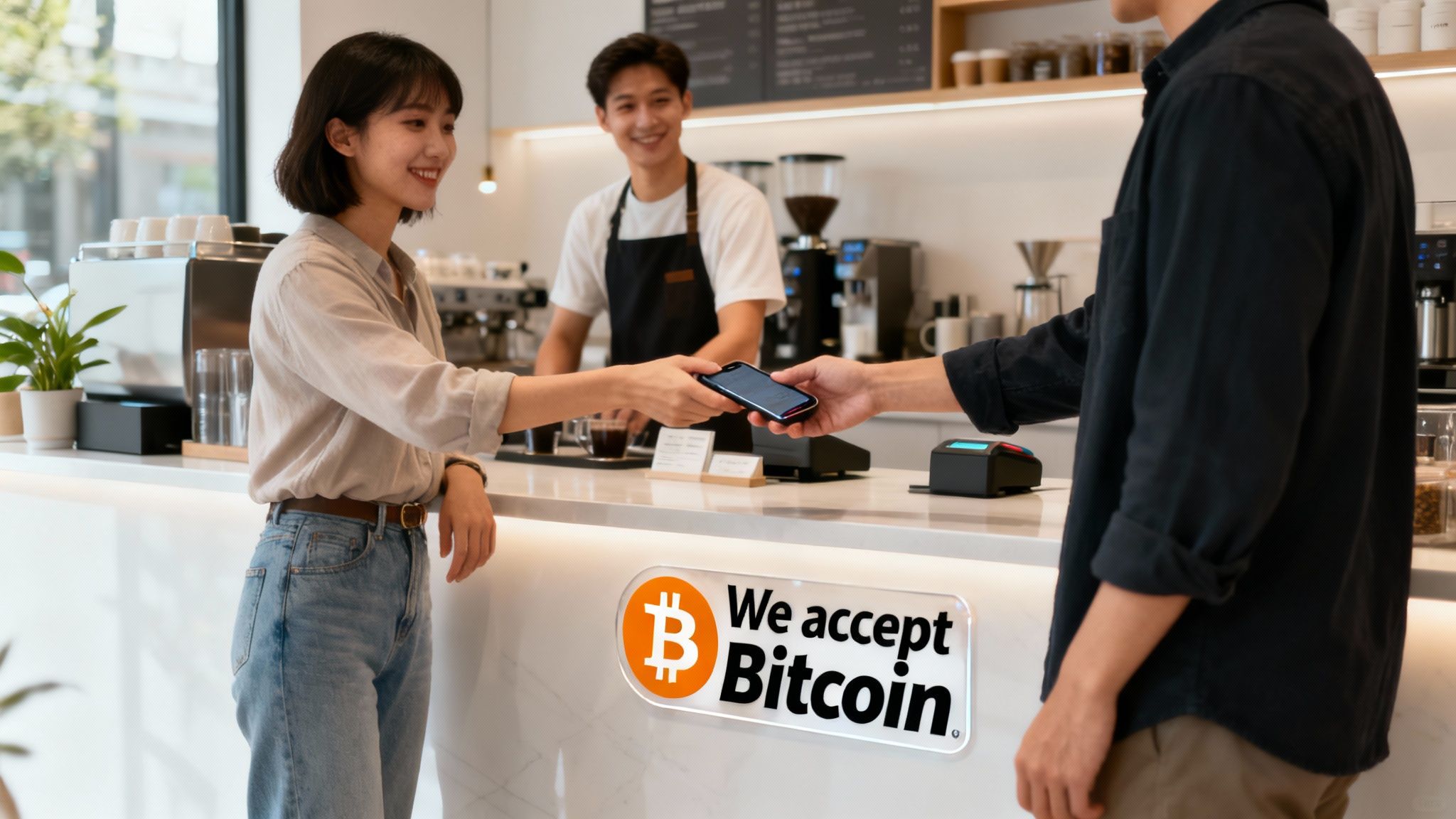
Before we jump into the "how-to," let's talk about the "why." Accepting Bitcoin isn't just some gimmick for tech nerds anymore; it’s a smart business move with real financial upside. This isn't about speculating on prices—it's about beefing up your bottom line and getting your business ready for the future.
One of the biggest wins right off the bat is tapping into a whole new base of motivated customers. The number of people holding Bitcoin has exploded. As of 2025, somewhere between 480 to 500 million people around the world own some Bitcoin. That number jumped by over 100 million between 2023 and 2025 alone. That's a huge pool of potential buyers actively looking for places to spend their sats. You can dig into more of the ownership stats over at bleap.finance.
Slashing Fees and Eliminating Chargebacks
Let's be honest, traditional payment methods eat into your profits. Credit card processors skim anywhere from 2% to 4% off every single transaction. It doesn't sound like much, but it adds up fast. Bitcoin transactions, on the other hand, usually have much, much lower fees, meaning more of your hard-earned cash stays in your pocket.
"When a coffee shop or retail store can accept Bitcoin Payments... they enjoy instant access to funds and get to keep more of their revenue by avoiding credit card fees and chargebacks.” — Miles Suter, Bitcoin Product Lead at Block, Inc.
Even better, Bitcoin payments are final. Once they're confirmed, they can't be reversed. This completely wipes out the nightmare of fraudulent chargebacks, a massive headache and expense for any merchant, especially online. When you get paid in Bitcoin, the funds are yours. Period.
To put it in perspective, let's break down how Bitcoin stacks up against the old guard.
Bitcoin Payments vs Traditional Credit Cards
| Feature | Bitcoin Payments | Traditional Credit Cards |
|---|---|---|
| Transaction Fees | Typically below 1% or fixed low cost | 2% - 4% + per-transaction fee |
| Chargeback Risk | None. Payments are irreversible. | High. A constant source of lost revenue. |
| Settlement Speed | Near-instant to a few minutes | 2-3 business days (or longer) |
| Global Access | Borderless. Anyone, anywhere can pay. | Restricted by country, bank, and card network. |
| Customer Privacy | No sensitive personal data shared | Requires name, address, card number, CVV. |
| Setup Complexity | Often just a few clicks | Lengthy application and approval process. |
The differences are pretty stark. Choosing Bitcoin isn't just about adding another payment button; it's about fundamentally upgrading your financial operations.
Gaining a Competitive Edge
When you start accepting Bitcoin, you're sending a message. It shows your brand is innovative, forward-thinking, and in tune with a tech-savvy crowd that values things like privacy and financial freedom. It’s a powerful marketing move that can set you apart from the competition and get people talking. From online stores to the local cafe down the street, businesses are already cashing in on the benefits:
- Global Reach: Instantly take payments from anyone on the planet without dealing with currency conversions or cross-border fees.
- Faster Settlement: Forget waiting days for bank transfers to clear. Bitcoin payments are often settled and available much quicker.
- Customer Privacy: Offering a way to pay that doesn't force customers to hand over sensitive financial info builds serious trust and appeals to a growing number of privacy-conscious buyers.
At the end of the day, learning how to accept bitcoins is an investment in your business's efficiency, security, and growth. It opens the door to new customers while solving some of the oldest problems in traditional finance.
Choosing the Right Bitcoin Wallet for Your Business
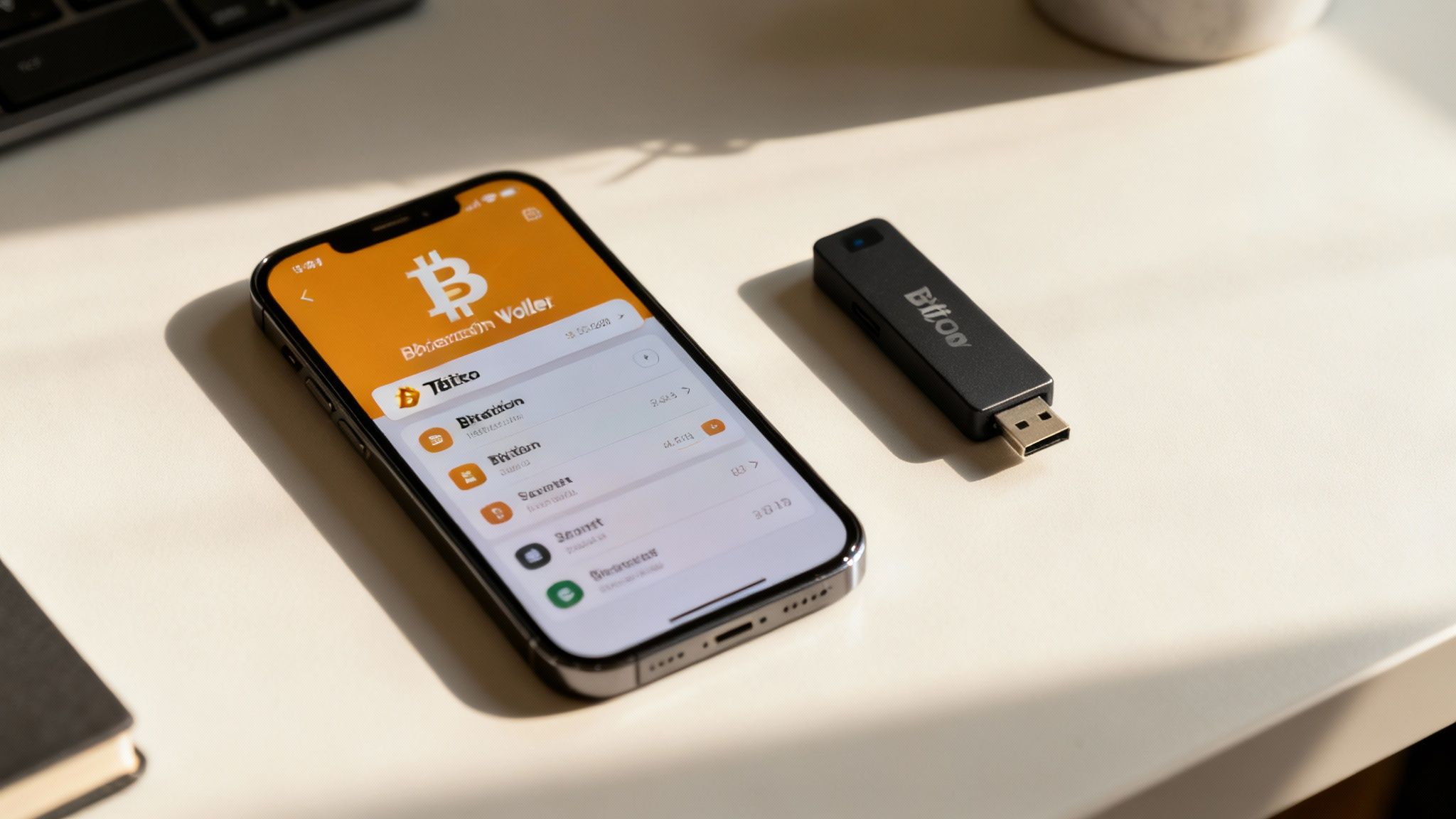
Before you can accept a single satoshi, you need a digital cash register. In the world of Bitcoin, that’s your wallet. Honestly, this is the most important foundational step for any business getting into Bitcoin, since your choice here dictates how you receive, store, and manage your funds.
Let's clear one thing up first. A wallet doesn't "hold" your bitcoin like a leather wallet holds cash. What it actually does is securely store your private keys—the secret codes that prove you own the funds and give you the power to spend them. Lose those keys, and your bitcoin is gone. Forever. That's why picking the right wallet is a critical decision about both security and your day-to-day workflow.
For businesses, wallets generally fall into two main camps, each with a different job depending on your sales volume and how much security you need.
Software Wallets: Your Digital Till
Software wallets are just apps that run on your computer or smartphone. You'll often hear them called "hot wallets" because they’re connected to the internet, which makes them incredibly convenient for daily transactions. If you run a coffee shop or an online store with a steady flow of sales, a software wallet is your front-line tool.
Their biggest advantage is speed and simplicity. A customer scans a QR code on your phone or desktop screen, and the payment kicks off instantly. That kind of smooth experience is vital for keeping checkout lines moving and preventing abandoned online carts.
For a business, the perfect wallet is one your staff can pick up in minutes. It needs to feel as intuitive as a standard point-of-sale system, generating new payment requests with just a couple of taps.
But that always-online nature comes with a security trade-off. Anything connected to the internet is, in theory, exposed to remote attacks like malware or hacking. That’s why software wallets are best for holding smaller, operational amounts of bitcoin—think just enough for a day's or a week's worth of business. It’s the same logic as not leaving thousands of dollars in a physical cash register overnight.
Hardware Wallets: Your Secure Vault
When it comes to securing larger amounts of bitcoin—your profits, your savings, or hefty customer payments—a hardware wallet is non-negotiable. These are small, physical devices that look a bit like a USB drive and store your private keys completely offline. We call this cold storage, and it's the gold standard for security.
Because the keys never touch an internet-connected computer, they're completely immune to online threats. You sign transactions right on the device itself, so even if the computer you plug it into is riddled with viruses, your funds stay safe. It's the digital equivalent of a bank vault.
The process has a few extra steps compared to a software wallet, so it's not ideal for those rapid, in-person sales. But for locking down the bulk of your earnings, its robust protection is unmatched. The smartest strategy for most businesses is a hybrid approach.
- Software Wallet (Hot): Use this for daily transactions at your point-of-sale or on your e-commerce site. Think of it as your business "checking account."
- Hardware Wallet (Cold): This is for long-term storage of accumulated profits. It's your "savings account" or company vault.
Essential Features for a Business Wallet
When you start comparing options, you need to look past the basics for features designed for a business environment. The right tool will make your operations smoother, more secure, and way easier to manage.
A killer feature to look for is multi-signature, or "multi-sig," capability. This requires two or more private keys to authorize a single transaction, acting as a powerful internal control. For example, you could set up a 2-of-3 signature wallet where any two of three business partners must approve a transaction, preventing any single person from moving funds on their own.
Another absolute must-have is a solid backup and recovery system. Any good wallet will give you a recovery phrase (usually 12 or 24 words) during setup. This phrase is the master key to all of your funds. Guard it with your life. Store multiple copies in secure, offline locations. This is your only lifeline if your device gets lost, stolen, or fried.
Using a Payment Processor for Easy Integration
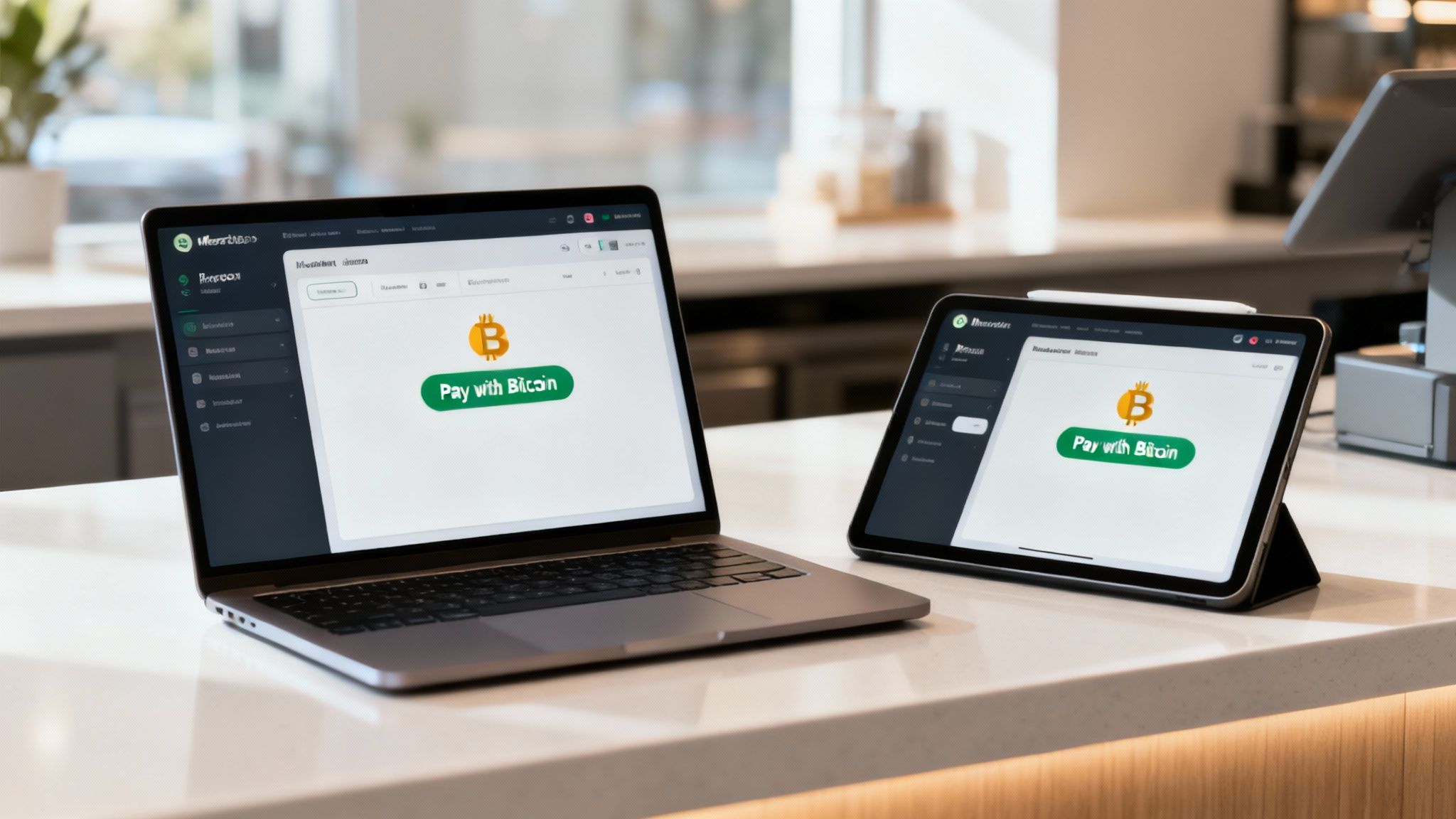
This screenshot from Flash shows just how simple it is to turn any mobile device into a Bitcoin point-of-sale terminal. The whole point is speed and clarity, letting you generate payment requests in seconds without needing a technical background.
While managing your own wallet gives you ultimate control, let's be realistic. For the vast majority of businesses, a dedicated Bitcoin payment processor is the fastest, safest, and most practical way to get started. These services are the bridge between your customer's Bitcoin wallet and your business bank account, handling all the technical heavy lifting behind the scenes.
Think of it as your automated Bitcoin-to-cash converter. A customer pays in Bitcoin, and the processor instantly converts it to your local currency—like USD or EUR—and drops it right into your bank account. This one feature is a total game-changer for most merchants.
It completely removes the headache of Bitcoin's price volatility. You don't have to become a market analyst or worry about a payment's value dropping before you can use the funds. You price your goods in your local currency, you get paid in your local currency, and the processor handles the rest.
How Bitcoin Payment Gateways Work
At its core, a Bitcoin payment gateway works a lot like the credit card processors you already know, but with some serious perks. When a customer hits "Pay with Bitcoin" at checkout, the gateway springs into action.
It generates a unique payment request that includes the exact amount of Bitcoin needed (calculated at the current exchange rate) and a one-time address for the customer to send the funds. This usually pops up as a simple QR code they can scan with their phone's wallet app.
The gateway then watches the Bitcoin network for the payment. Once the transaction gets confirmed—which is often nearly instant—it notifies both you and the customer that everything went through. From there, the service handles the conversion and sends the money to your bank account on your chosen schedule, whether that's daily, weekly, or monthly.
The growth of these services has been a huge driver for merchant adoption. By 2025, various platforms have helped over 100,000 merchants worldwide accept Bitcoin seamlessly. It's the easy integration, instant conversion to fiat, and fraud protection that make it so appealing. For a deeper dive, check out the latest insights from Chainalysis.
Seamless Integration with Your Existing Tools
Honestly, one of the biggest selling points for using a processor is how easily it plugs into the software you're already using. Whether you're running a busy e-commerce site or a brick-and-mortar shop, there's almost certainly a simple integration waiting for you.
- E-commerce Platforms: For giants like Shopify, WooCommerce, or BigCommerce, adding a Bitcoin option is often as easy as installing an app from their marketplace. It’s usually a few clicks, you plug in your account details, and you’re live.
- Point-of-Sale (POS) Systems: In a physical store? Many processors offer dedicated POS apps that run on a tablet or smartphone. Your cashier just enters the sale amount, and the app generates the QR code for the customer to scan.
- Payment Buttons and Links: Even if you don't have a full online store, you can still get paid in Bitcoin. Most services let you create simple payment buttons or links to embed on a website, send in an email, or even share on social media.
For merchants looking for examples, there are guides available, like the Solana Pay Shopify integration, which shows just how plug-and-play modern payment solutions can be.
The goal of a good payment processor is to make accepting Bitcoin feel no different than accepting a credit card. For the merchant, the experience should be seamless, secure, and require minimal new training for staff.
This level of integration means you can be up and running in minutes, not weeks. No need to bring in developers or get a Ph.D. in how the Bitcoin network operates.
Understanding Fees and Settlement
Of course, this convenience isn't free, but the costs are often much better than what you're used to with traditional payments. Bitcoin processors typically charge a flat transaction fee, usually around 1%. Compare that to the 2-4% (plus other random fees) that credit card companies often charge.
Here’s a quick look at what to expect:
| Feature | Details |
|---|---|
| Transaction Fee | A small percentage of the sale, typically 1%. |
| Settlement Time | Funds are usually batched and sent to your bank in 1-2 business days. |
| Conversion Rate | The exchange rate is locked in the moment of sale, protecting you from price swings. |
| No Chargebacks | Bitcoin transactions are final. This means chargeback fraud is completely eliminated. |
This straightforward fee structure makes bookkeeping so much easier. You know exactly what you’ll pay on every single sale, without navigating the confusing mess of interchange fees, assessment fees, and monthly charges common in the credit card world. And because Bitcoin payments are irreversible, once a sale is made, that money is yours for good.
Accepting Bitcoin Payments Directly to Your Wallet
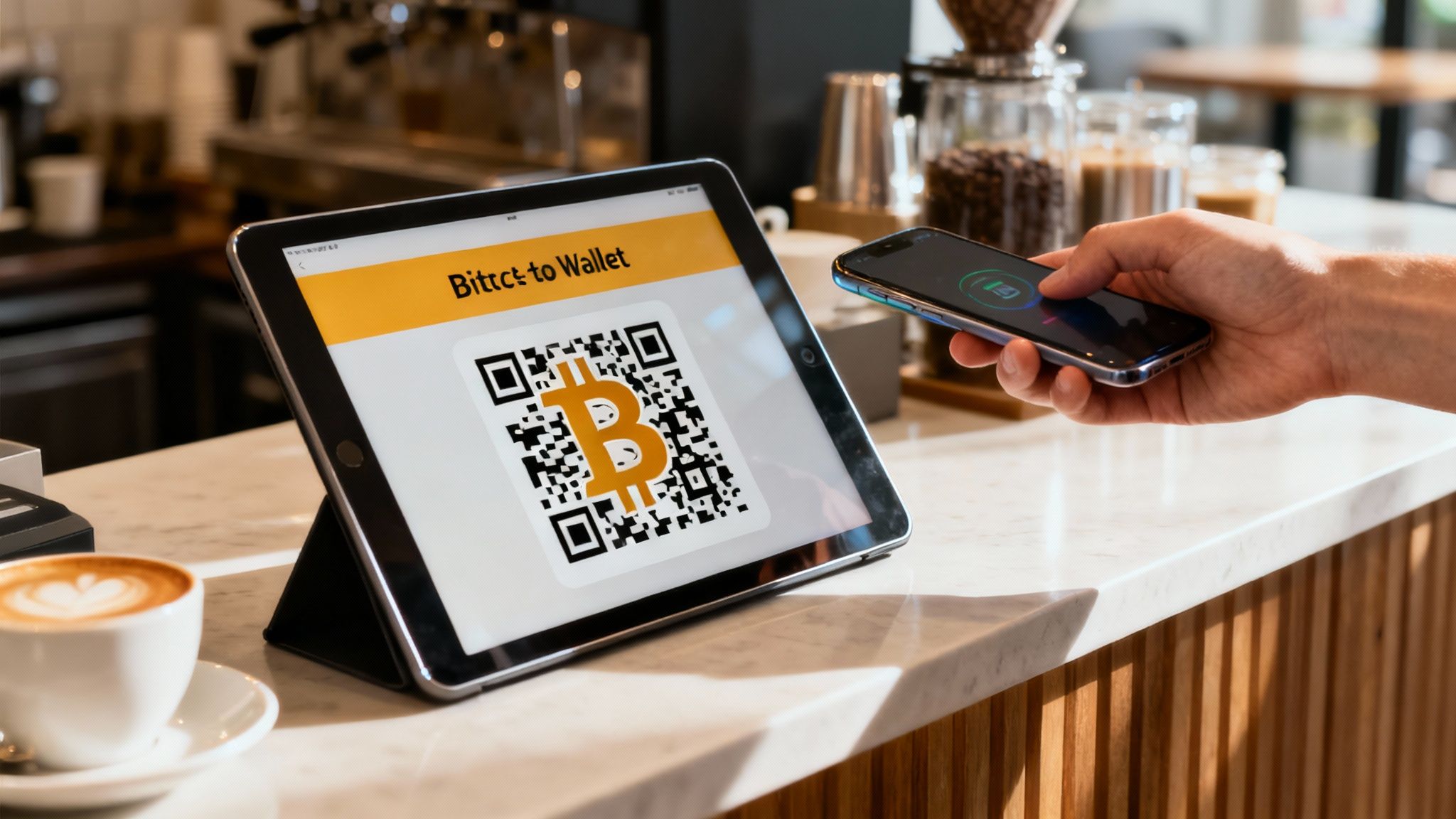
While payment processors offer a simple on-ramp, some businesses want a more hands-on approach. Accepting Bitcoin payments directly into your own wallet gives you complete control over your funds, cuts out third-party fees, and builds true financial self-sufficiency.
This is the purest form of peer-to-peer digital cash.
This path isn't about running complex server software; it’s about using your business wallet effectively. You become your own bank, which comes with both powerful advantages and critical responsibilities. The key is managing the process in a way that's secure for you and completely seamless for your customers.
The Core Principle: One Address, One Transaction
The single most important practice when accepting Bitcoin directly is to never reuse a Bitcoin address. You must generate a fresh, unique address for every single sale, whether it's online or in person. This isn't just a suggestion—it's absolutely essential for both privacy and good bookkeeping.
Reusing an address creates a public link between all your customers. Anyone can look up that address on a public block explorer and see every single incoming transaction, tying different payments and customers together. That's a huge privacy failure for both you and your clients.
Think of a new Bitcoin address as a unique invoice number for each sale. It isolates the transaction, making it simple to track which payment corresponds to which order. This practice is fundamental to accepting Bitcoin securely and professionally.
Generating a new address for each payment is a standard feature in any reputable business wallet. With just a couple of taps, you can create a new payment request, ensuring each transaction remains distinct and private. This keeps your accounting clean and protects everyone's financial information.
Pricing Your Goods and Services
When you’re not using a processor to auto-convert to fiat, you need a solid strategy for pricing. Since Bitcoin's value constantly fluctuates against currencies like the US dollar, displaying a static BTC price on your products just isn't practical.
The best approach is to price your items in your local currency and let your wallet app generate the payment request at the point of sale. The app will automatically calculate the exact amount of Bitcoin needed based on the real-time exchange rate.
It’s a straightforward workflow:
- Enter the Sale Amount: In your wallet app, type in the total purchase price in your local currency (e.g., $25.00).
- Generate the Payment Request: The wallet instantly converts this amount to the current Bitcoin equivalent and displays it with a QR code.
- Customer Scans and Pays: Your customer scans the QR code with their wallet, confirms the details, and sends the payment.
This process ensures you receive the correct value for your goods at the moment of the transaction, effectively neutralizing short-term price swings at the checkout.
Managing the In-Person and Online Checkout Flow
The direct-to-wallet method works smoothly for both physical and digital storefronts. The core action is the same: presenting a unique payment request to the customer.
For a brick-and-mortar store, your smartphone or tablet running a wallet app becomes your point-of-sale terminal. The cashier enters the total, the app generates a QR code on the screen, and the customer scans it to pay. It’s as fast as tapping a credit card.
For an e-commerce website, you can manually create these payment requests. After a customer places an order, you can generate a QR code and address, then email it to them or display it on the final checkout page. The customer then completes the payment from their own device.
Verifying Payments and Handling Confirmations
Once a customer sends a payment, you need to watch for it to arrive. Most software wallets will show an "unconfirmed" or "pending" transaction within seconds. This initial notification is often good enough for small, low-value purchases, like a cup of coffee.
For larger sales, you really should wait for at least one confirmation from the Bitcoin network. A confirmation means the transaction has been included in a block, making it far more secure and irreversible. This process typically takes about 10 minutes but can vary. Any good business wallet will clearly show you the number of confirmations a transaction has.
The growing global infrastructure has made Bitcoin more accessible than ever. The number of Bitcoin ATMs has expanded to 72 countries and territories as of February 2025, lowering the barrier to entry for small businesses and customers alike. This worldwide network, supported by increasing regulatory clarity, helps reinforce Bitcoin as a legitimate payment method. You can learn more about this global expansion from recent Statista findings.
Running a Tight Ship: Managing Your Bitcoin Operations
Getting that first Bitcoin payment notification feels great, but what happens next is what really matters. Taking the payment is just step one. Turning this new revenue stream into a real asset for your business means managing those funds professionally and securely.
This comes down to building solid internal processes. We're talking about everything from bookkeeping to training your team. You need to handle Bitcoin with the same care and diligence you give to every other part of your business. It’s not just about having a wallet; it’s about having a plan.
With a few smart practices, you can protect your earnings, keep your books clean, and make sure your customers feel confident paying you in Bitcoin from the get-go.
Your Security Playbook
Let's get one thing straight: when it comes to your business's Bitcoin, you are the bank. Your private keys and recovery phrases are the keys to your digital vault. Their security is entirely on you, and you need to take that responsibility seriously.
A simple yet powerful strategy is to run a hybrid wallet system.
Think of it like a cash register and a safe. Use a "hot" software wallet on your phone or POS system for the day-to-day transactions. This is your digital cash drawer. Then, at the end of each day or week, you sweep the larger amounts into an offline "cold" hardware wallet. This is your vault, keeping the bulk of your funds safe from online threats.
To really lock things down, add these habits to your routine:
- Guard Your Recovery Phrase Like Gold: Write down the recovery phrase for your hardware wallet and store multiple physical copies in different, secure locations (think a safe at home and a safe deposit box). Never, ever store it digitally. No photos, no cloud drives, no password managers.
- Password Discipline: Use a strong, unique password for your software wallet and any related accounts. Don't recycle passwords from other services.
- Enable 2FA: If a service offers two-factor authentication (2FA), use it. An authenticator app adds a critical layer of protection that SMS-based 2FA just can't match.
Keeping the Books Clean for Tax Time
While Bitcoin operates on its own network, it doesn't get a pass from the tax man. In most places, digital assets are treated as property, and you need to keep meticulous records. This isn't just good business sense; it's a legal must-do.
Every transaction is a potential taxable event. This includes receiving a payment from a customer and converting your Bitcoin back into local currency. You have to record the fair market value of the Bitcoin in your local currency at the precise moment of each transaction.
The easiest way to think about it is like a foreign currency transaction. For every payment, log the date, the amount of Bitcoin you received, and what it was worth in dollars (or your local currency) at that exact time. This gives you a crystal-clear paper trail.
Thankfully, you don't have to do this manually. Most good wallets and payment processors like Flash let you export detailed transaction histories. These reports are your best friend for tracking income and calculating capital gains or losses when it's time to file.
Get Your Team Ready for Bitcoin Questions
Your frontline staff are the face of your business, and their ability to handle a Bitcoin transaction smoothly has a huge impact on the customer's experience. A well-trained team can answer basic questions, guide a customer through the payment, and make the whole process feel professional, not experimental.
The training doesn't need to be a deep dive into blockchain technology. Just stick to the practicals:
- How to create a bill: Walk them through generating a payment request in your app. Show them how to input the sale amount to bring up the QR code for the customer.
- How to spot a successful payment: Make sure they know what the confirmation screen looks like. Briefly explain the difference between a transaction that's been broadcast and one that's fully confirmed, and what your store's policy is (e.g., waiting for one confirmation).
- How to handle basic questions: Arm them with simple, clear answers for common questions like, "So how does this work?" or "Is it instant?"
When your team is confident, it prevents awkwardness at the checkout counter and shows customers you’ve properly integrated this new payment option.
Set a Clear Policy for Customers
Transparency builds trust, and this is especially true with Bitcoin. Because Bitcoin transactions are final and irreversible, you absolutely need a clear, public policy for returns and refunds.
Decide how you'll handle them. Will you refund the exact Bitcoin amount originally paid? Or will you refund the local currency value of the item at the time of the return? There are pros and cons to both, so pick one and stick to it.
Post this policy where customers can easily find it—on your website's FAQ page and maybe even as a small sign near your point of sale. A little bit of clarity upfront can prevent major headaches and disputes later, making sure your Bitcoin journey is a smooth one.
When you start looking into Bitcoin payments, a few questions always pop up. It's completely normal. I talk to business owners every day who are curious but have some very practical concerns about how it all works in the real world.
Let's cut through the noise and tackle the big ones. Getting these answers straight is the key to feeling good about making the move.
How Do I Handle Bitcoin's Price Volatility?
This is the big one. It's almost always the first question I get. No one wants to make a $100 sale only to find out it's worth $90 by the time they check their account. The good news is, you don't have to deal with that at all.
The cleanest solution is to use a Bitcoin payment processor. It completely automates the process and takes the risk off your plate. When a customer pays you in Bitcoin, the service can instantly convert it into your local currency, whether that's USD, Euros, or something else.
The price is locked in the second the transaction happens. You price your products in dollars, you get paid in dollars—minus a tiny fee. All the volatility risk is handled by the processor, not you.
This setup gives you the best of both worlds. You get to tap into all the benefits of accepting Bitcoin—like lower fees and zero chargebacks—without ever holding a volatile asset yourself (unless you actually want to).
What Is the Best Way to Manage Refunds?
This is where you need a clear policy. Bitcoin transactions are final. There's no "reverse" button like with a credit card payment. That finality is a huge plus for avoiding fraud, but it means you have to be intentional about how you handle returns.
Generally, you have two solid options. Your choice really just comes down to what's simplest for you and your customers.
- Refund in Local Currency: This is the most common approach. If a customer paid the equivalent of $100, you refund them $100. It’s straightforward, predictable, and mirrors the process everyone is already used to with traditional payments.
- Refund in Bitcoin: The other option is to return the exact amount of Bitcoin they sent, like 0.0015 BTC. The catch is that the dollar value of that Bitcoin might be higher or lower than when they first paid. It could work out in their favor or against them.
Most businesses I know stick with refunding in the local currency. It's just easier for everyone to understand. Whatever you decide, just make sure your refund policy is posted clearly on your site.
What Are the Tax Implications of Accepting Bitcoin?
Taxes are a crucial piece of the puzzle for any business, and adding Bitcoin doesn't change that. In the U.S. and many other countries, tax agencies like the IRS treat Bitcoin as property, not currency.
This distinction is important. It means you have to keep good records. For every sale, you need to log the fair market value of the Bitcoin in your local currency at the moment you received it. That number is your revenue for that transaction.
Now, if you decide to hold onto the Bitcoin and its value goes up or down before you cash it out, that creates a separate taxable event—a capital gain or loss. This is another area where using a payment processor that automatically converts Bitcoin to cash can make your life much, much easier. It simplifies your accounting down to just tracking income.
Tax laws are notoriously tricky and change from place to place. I always tell merchants to talk to a qualified tax professional who gets digital assets. They'll give you advice that's specific to your business and make sure you're staying compliant.
Ready to start accepting Bitcoin in under a minute? Flash provides the tools you need to connect directly with customers, offering instant, secure, and low-fee payments without ever holding your funds. Get started with Flash today.