Building a Bitcoin treasury can help businesses protect against inflation, diversify assets, and access global liquidity. Companies can accumulate Bitcoin through three main methods:
- Buying: Purchase Bitcoin directly via exchanges or OTC desks for immediate access. Requires upfront capital but offers scalability.
- Mining: Invest in hardware and energy to generate Bitcoin. Demands significant infrastructure and expertise but can lower acquisition costs.
- Earning: Accept Bitcoin as payment for goods or services. This is a low-cost option that grows reserves organically.
Each approach has trade-offs in cost, complexity, and risk. For example, mining requires high initial investment, buying depends on market conditions, and earning relies on sales volume. Many businesses combine these methods to balance risk and growth.
Quick Comparison:
| Method | Cost to Start | Risk Factors | Scalability | Best For |
|---|---|---|---|---|
| Buying | High upfront | Market volatility | High | Companies with strong cash flow |
| Mining | Very high upfront | Hardware, energy costs | Moderate | Firms with energy advantages |
| Earning | Low | Bitcoin price fluctuations | Low to moderate | Small-to-medium businesses |
Get started by defining a clear treasury policy, addressing risks like volatility and security, and selecting the method that aligns with your business goals.
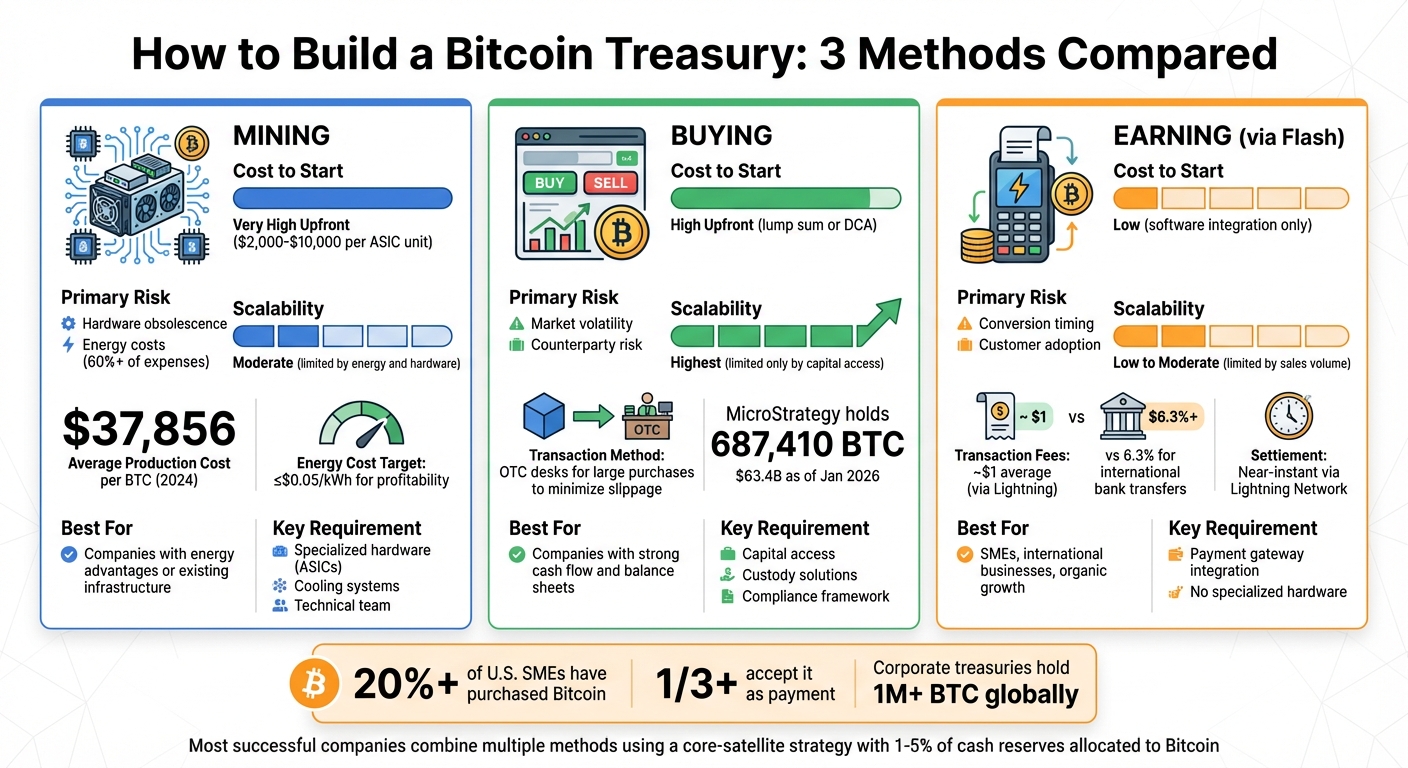
Bitcoin Treasury Methods Comparison: Mining vs Buying vs Earning
Differentiation Among Bitcoin Treasury Strategies
Mining Bitcoin for Your Treasury
Mining Bitcoin serves a dual purpose: it validates transactions on the network and generates newly minted coins, along with transaction fees. For enterprises, this can directly contribute to their treasury. However, this approach requires a substantial initial investment and ongoing operational expertise.
Hardware and Infrastructure Needs
To mine Bitcoin effectively, enterprises rely on Application-Specific Integrated Circuits (ASICs), which are specialized for Bitcoin's SHA-256 algorithm. A popular example is the Antminer S19 Pro, which delivers around 110 TH/s while consuming 3,250 watts of power. Prices for these machines range between $2,000 and $10,000 per unit, and new models can have a failure rate of up to 5% upon arrival.
In addition to acquiring miners, enterprises need robust infrastructure. Cooling systems are critical to keep the hardware within safe operating temperatures, which requires tailored electrical systems and cabling. Many companies opt for modular data centers, repurposed industrial facilities, or custom-built spaces to house their operations.
Managing thousands of machines demands a skilled team of on-site technicians and advanced management software. It's also essential to stock spare parts - like fans, power supplies, and control boards - since the return process for faulty equipment can take weeks.
Once your hardware and infrastructure are in place, the next step is to evaluate operational costs and potential returns.
Calculating Costs and Returns
Electricity is the largest operating expense, often accounting for more than 60% of total costs. On average, mining companies pay about 4.5¢ per kWh for energy. To maintain profitability in a volatile market, aim for electricity costs of $0.05/kWh or less.
"Energy is your largest operating cost, often more than 60% of total expenses, and even a fraction of a cent difference in electricity pricing can determine whether your operation thrives or struggles."
For example, a 3,250-watt ASIC miner running at $0.05/kWh would cost approximately $1,423.50 annually in electricity alone. Add depreciation (typically over three years), maintenance, and labor to calculate the total cost per Bitcoin mined. Following the 2024 halving, institutional miners reported an average production cost of $37,856 per Bitcoin.
Profitability in mining is closely tied to "Hashprice", which represents daily revenue in USD per terahash. To determine your break-even point, divide your daily electricity costs by the hashrate of your mining equipment. Even with a 95% uptime, facilities lose about 438 hours of potential mining time annually, which directly affects revenue and treasury growth.
Legal and Compliance Requirements
Running a mining operation also involves navigating regulatory and legal hurdles. In the U.S., this includes understanding energy markets, securing construction permits, and adhering to operational compliance standards. States with deregulated energy markets - such as Texas, Pennsylvania, and Ohio - offer flexibility by allowing companies to negotiate Power Purchase Agreements (PPAs) directly with energy providers. In contrast, regulated markets have fixed rates set by government agencies, which can limit cost-saving opportunities.
"Choosing the right location is the single most important decision in building a profitable Bitcoin mining facility."
- Compass Mining
The permitting process depends on your deployment model. Modular data centers may need to meet specific local codes, while custom-built facilities often face longer and more complex approval timelines. If you’re sourcing power "behind the meter" from natural gas, additional steps like gas analysis and dedicated oversight of power generation are required.
Recent changes in accounting rules also impact Bitcoin mining operations. As of January 2025, the Financial Accounting Standards Board (FASB) allows companies to record mining rewards at market value each quarter. Additionally, implementing AML (Anti-Money Laundering) and KYT (Know-Your-Transaction) services can help monitor transactions for any risky or non-compliant activities. These measures are vital for safeguarding your treasury and ensuring regulatory compliance.
Buying Bitcoin on Exchanges
Acquiring Bitcoin through regulated exchanges or OTC desks is one of the quickest ways to build a treasury. However, large transactions require careful planning to reduce price slippage and ensure secure custody. This method works well alongside strategies like mining or earning Bitcoin, but it doesn’t demand the specialized hardware or energy infrastructure that mining does.
How to Execute Large Bitcoin Purchases
When it comes to buying large amounts of Bitcoin, using standard exchange order books isn’t ideal. A large market order can drive up prices significantly - a phenomenon known as "slippage" - and might alert other traders to your intentions. Instead, OTC desks or eOTC platforms are better suited for these transactions, offering deeper liquidity and tighter spreads.
To execute large purchases effectively, follow these steps:
- Conduct pre-trade checks, such as position limits and sanctions screening.
- Choose trading venues based on their liquidity and pricing.
- Perform post-trade reconciliation to confirm receipt of the Bitcoin.
A notable example is MicroStrategy Inc., the first publicly traded company to adopt Bitcoin as its primary treasury reserve asset. Under the leadership of then-CEO Michael Saylor and CFO Andrew Kang, the company initially invested over $1 billion in Bitcoin using regulated brokers and custodians for trade execution. By late 2024, MicroStrategy had accumulated more than 226,000 BTC, with its stock significantly outperforming the S&P 500 over the subsequent four years.
"The progress made in the accounting and regulatory landscape has made it easier and more transparent for corporations to adopt digital asset as a strategic treasury reserve asset." - Andrew Kang, CFO, MicroStrategy Inc.
When selecting exchanges or OTC providers, focus on platforms regulated as qualified custodians under recognized banking laws, such as New York Banking Law or OCC approval. These providers hold your assets in trust, keeping them separate from their operational funds. Additionally, review SOC 1 and SOC 2 reports to verify their internal controls and security practices.
Next, let’s explore how to secure your Bitcoin holdings effectively.
Custody and Security Methods
After purchasing Bitcoin, securing it should be your top priority. Even advanced platforms can be vulnerable to attacks, as demonstrated in February 2025 when Bybit lost $1.5 billion worth of Ethereum to hackers. A sound custody strategy eliminates single points of failure.
Many enterprises rely on a tiered wallet system to balance security with operational needs:
- Cold Vaults: Offline, geographically distributed storage for long-term reserves that are rarely accessed.
- Warm Wallets: Online storage that requires multiple approvals for regular settlements.
- Hot Wallets: Automated solutions with strict low-value limits for daily operations, monitored continuously.
For added security, consider using multi-signature (multisig) or Multi-Party Computation (MPC) technology. A common setup, such as 2-of-3 multisig, requires two out of three authorized parties to approve a transaction, striking a balance between security and usability.
Providers like BitGo, which secures over $100 billion in reserve assets globally, offer up to $250 million in insurance from Lloyd’s of London for assets stored in their trust structures. When choosing a custody provider, ensure they hold certifications such as SOC 1 Type II, SOC 2 Type II, ISO 27001, and CCSS Level III. Additionally, implement segregation of duties by separating roles like payment requester, approver, and signer to prevent unauthorized transactions. Store hardware wallets and seed phrases in different secure locations and regularly conduct recovery drills to ensure readiness.
Tax and Liquidity Considerations
Purchasing Bitcoin comes with immediate tax and accounting responsibilities. Keep track of each Bitcoin lot’s cost basis and acquisition date, and use specific identification to document disposals. This helps you avoid the default FIFO (First In, First Out) method. If you plan to trade frequently, establish standing instructions for tax lot identification and maintain detailed, lot-level records to meet audit requirements.
Starting with fiscal years beginning after December 15, 2024, FASB ASU 2023-08 requires certain crypto assets to be measured at fair value, with changes reflected in net income. This introduces volatility to financial statements but also provides greater transparency for shareholders and auditors.
"A corporate digital asset treasury strategy can strengthen public and private company balance sheets and increase shareholder value for the long term." - Phong Le, President and CEO, MicroStrategy Inc.
Managing liquidity is equally important. In June 2025, Standard Chartered reported that if Bitcoin’s price fell below $90,000, half of all corporate Bitcoin treasuries could face significant losses. To mitigate this risk, maintain sufficient cash reserves outside of your Bitcoin holdings to cover operational costs and unexpected expenses.
Finally, ensure that any platform you use complies with the Travel Rule, which mandates sharing originator and beneficiary information for virtual asset transfers. Incorporate robust AML (Anti-Money Laundering) and KYT (Know-Your-Transaction) measures to screen for risky or non-compliant activities. Together, these tax and liquidity strategies form a comprehensive approach to managing your Bitcoin treasury.
Earning Bitcoin Through Payments with Flash

This approach adds to mining and purchasing by transforming everyday transactions into a way to grow your treasury. Businesses can naturally build their Bitcoin reserves by accepting payments in Bitcoin, without needing upfront investment or specialized tools.
How to Set Up Flash for Bitcoin Payments
Flash is a non-custodial payment gateway, meaning your business retains full control of its funds through direct wallet-to-wallet transactions. Unlike traditional payment processors that hold your Bitcoin, Flash removes intermediaries entirely.
Setting up Flash is straightforward, thanks to its no-code tools that cater to various business models:
- For eCommerce: Add payment widgets directly to your checkout process or create shareable payment links.
- For physical stores: Use Flash's POS app to turn any mobile device into a Bitcoin terminal.
- For SaaS providers: Manage recurring billing cycles with subscription modules.
- For content creators: Restrict premium content access behind Bitcoin paywalls.
Flash leverages the Lightning Network, enabling near-instant settlements and much lower fees compared to on-chain transactions. With this system, businesses can connect to over 500 million Bitcoin users worldwide without requiring customer KYC, simplifying onboarding and boosting privacy. For more tailored needs, Flash offers detailed documentation and integration support to adapt to specific operational setups.
Once the system is in place, the next step involves converting your Bitcoin revenue into secure treasury holdings.
Converting Payment Revenue to Treasury Holdings
After starting to accept Bitcoin payments, you’ll need a strategy to turn that revenue into long-term reserves. One effective method is setting up automated sweeps to periodically transfer Bitcoin from operational "hot" wallets into secure cold storage. This approach reduces cyber risks while steadily building your treasury.
Bitcoin transactions settle within minutes, offering better capital efficiency and 24/7 liquidity without depending on traditional banking hours. By bypassing the correspondent banking system - which often involves multiple intermediaries and fees averaging 6.3% for international transfers - Bitcoin provides a cost-effective alternative. For instance, as of February 2025, Bitcoin transaction fees averaged just over $1.
To handle price volatility, consider the 4% rule: maintain Bitcoin exposure at around 4% of your total portfolio and rebalance quarterly. Keep operational hot wallets limited to small amounts (e.g., $300 or less) and transfer surplus funds into cold storage. This strategy not only safeguards your holdings from cyber threats but also protects them from the devaluation of fiat currencies, given Bitcoin's capped supply of 21 million coins.
Advantages of Accepting Bitcoin Payments
Accepting Bitcoin payments provides more than just cost savings - it also offers strategic benefits for treasury management. By using a non-custodial model, you eliminate counterparty risk. Holding your own keys means you're not reliant on the stability of banks or third-party processors that could freeze accounts or mishandle funds. This aligns with Bitcoin's core principles of decentralization and financial independence, turning routine transactions into a way to grow your reserves.
As of October 2025, corporate treasuries globally held over one million BTC, valued at more than $120 billion. In the U.S., over 20% of small and medium-sized businesses have purchased Bitcoin for their operations, and more than one-third accept it as payment. Bitcoin’s 60-day volatility index has also dropped significantly, standing at just 1.58% as of February 25, 2025, compared to 7.05% in April 2020 - making it increasingly practical for treasury management.
sbb-itb-f81ab9b
Comparing Mining, Buying, and Earning
Let’s break down the key differences between mining, buying, and earning Bitcoin to help guide treasury decisions. Each method comes with its own set of trade-offs in terms of cost, complexity, and scalability. Buying offers the quickest way to accumulate Bitcoin, limited only by access to capital. For instance, Strategy (formerly MicroStrategy) held 687,410 BTC - worth about $63.4 billion as of January 2026. Mining, on the other hand, demands significant upfront investment in hardware and infrastructure, along with ongoing electricity costs, but it can yield Bitcoin at a potentially lower cost. Meanwhile, earning Bitcoin through payments requires minimal capital, relying instead on software integration, and scales with sales volume.
Each approach also comes with distinct cost structures. Buying involves paying market prices, exchange fees, and potential slippage on large orders, though institutional OTC desks can help minimize these costs. Mining requires hefty capital expenditures for equipment and ongoing costs for energy and maintenance. Earning, by contrast, is often the least expensive to implement and can even save money compared to traditional payment systems. For example, Bitcoin transaction fees averaged just over $1 as of February 2025, compared to the 6.3% average for international bank transfers.
Here’s a quick look at how the methods stack up:
Pros and Cons of Each Method
| Method | Capital Requirement | Primary Risk | Scalability | Best For |
|---|---|---|---|---|
| Buying | High (lump sum or DCA) | Market volatility & counterparty risk | Highest; limited only by capital access | Rapid treasury growth; companies with strong balance sheets |
| Mining | Very high (infrastructure/ASICs) | Operational risk & hardware obsolescence | Moderate; limited by energy and hardware | Companies with energy advantages or infrastructure |
| Earning | Low (software integration) | Conversion timing & customer AML | Lowest; limited by sales volume | SMEs seeking organic growth; international businesses |
Buying is ideal for companies with access to debt or equity markets since it allows for immediate scalability. However, the downside is exposure to price volatility, which can complicate debt repayment if purchases are financed through convertible bonds. Mining gives businesses some control over production costs but comes with high operational risks, such as hardware obsolescence and the need to sell Bitcoin to cover electricity bills during price drops. Earning requires little upfront investment and integrates with existing operations, but timing risks arise when converting received payments into long-term holdings.
Security needs also differ across methods. Buying often involves third-party custodians with insurance coverage of up to $250 million. Mining necessitates self-custody solutions, such as multisig wallets, to secure frequent payouts. Earning typically involves a mix of hot wallets for receiving payments and cold storage for treasury reserves.
"If a taxpayer obtains bitcoin through mining, they must recognize income in the amount of the fair market value in U.S. dollar terms of the bitcoin received on the date of receipt."
- Jeff Vandrew, Head of Legal at Unchained
This tax treatment differs from the capital gains applied to purchased Bitcoin, adding another layer of consideration when deciding on a strategy.
Combining Multiple Approaches
A balanced approach that combines these methods can help manage risk while optimizing treasury performance. Many businesses adopt a "core-satellite" strategy, blending methods to balance liquidity and cost.
The right mix depends on the company’s business model. For instance, companies with surplus cash might focus on direct purchases, while using revenue to add incremental Bitcoin holdings. Energy-intensive businesses with access to low-cost power could mine Bitcoin while taking advantage of OTC desks to buy during market dips. The key is to establish a clear treasury policy, approved by the board, that defines allocation percentages, spending limits, and rebalancing triggers. Companies often aim to maintain Bitcoin exposure at around 1–5% of total cash reserves, with quarterly reviews.
Implementation Steps and Risk Management
Building a Bitcoin treasury requires a carefully structured plan that balances ambitious goals with solid risk management. Start by drafting a board-approved treasury policy. This document should detail asset types, allocation limits, key personnel responsibilities, and triggers for rebalancing assets. It should also outline your strategy - whether you’ll focus on mining, purchasing, earning, or a mix - and specify what percentage of cash reserves or net income you’re prepared to commit. For small-to-medium businesses, the median allocation hovers around 10% of net income, though many begin with smaller percentages during initial pilot phases. Following these steps will help ensure your Bitcoin treasury can withstand market fluctuations.
Getting Started and Board Approval
Securing executive support starts with a detailed plan that highlights long-term benefits while addressing concerns like volatility, custody, and regulatory challenges. Drawing on case studies from early adopters can help demonstrate successful treasury strategies.
A phased rollout approach works best. Begin with policy and governance, then move into pilot operations with minimal exposure - typically 1–3% of net income - and only scale up after thorough testing. Incorporate your chosen accumulation method, whether it’s mining, buying, or earning, into this phased plan to align operations with your broader strategic goals. Many companies adopt a concise 90-day roadmap divided into foundation, scaling, and optimization phases.
Once board approval is in place, formalize compliance and reporting frameworks to strengthen your treasury’s integrity.
Compliance and Reporting Requirements
With board approval secured, establish strict compliance and reporting protocols. U.S. companies must adhere to financial reporting standards and regulatory requirements. Under FASB ASU 2023-08, effective for fiscal years starting after December 15, 2024, Bitcoin will be measured at fair value, with changes reflected in net income. This replaces the previous "impairment-only" model, allowing firms to mark assets up to market value rather than only recording losses. Public companies holding Bitcoin must disclose their holdings in 10-K filings. As of February 2025, 80 publicly traded companies collectively held 632,381 BTC, valued at $55.89 billion.
To maintain compliance, implement KYB, KYC, OFAC screening, and adhere to the Travel Rule. Use a crypto sub-ledger to track cost basis, acquisition dates, and transaction IDs (TXIDs), ensuring accurate financial reporting and tax filings. For tax purposes, the "specific identification" method is recommended, as it allows you to document the purchase date, time, and price of each unit, optimizing tax outcomes.
Managing Custody, Volatility, and Liquidity Risks
Beyond compliance, effective risk management is essential for custody, market volatility, and liquidity. Use multi-signature (multi-sig) wallet configurations and a tiered wallet system: hot wallets for operations, warm wallets with quorum controls, and cold wallets for reserves. If relying on third-party custodians, ensure they hold SOC 1 Type II, SOC 2 Type II, and ISO 27001 certifications, and verify that they offer insurance coverage - some providers cover up to $250 million for assets in storage or transit. Regularly conduct recovery drills for encrypted, distributed backups and incident response.
To manage volatility, keep 6–12 months of operating expenses in fiat currency, ensuring payroll and vendor payments remain unaffected by Bitcoin price swings. A June 2025 report from Standard Chartered warned that if Bitcoin fell below $90,000, half of corporate Bitcoin treasuries would be at a loss. Regular rebalancing and spending limits can help mitigate overexposure. For liquidity, maintain access to multiple trading venues and institutional OTC desks to handle large transactions with minimal market impact. While Bitcoin offers 24/7 liquidity, large-scale liquidations can still affect market conditions, making diversified trading options essential.
"Risk-taking is an essential part of innovation. But if you're going to take risks, you better know the downside."
- Jack Welch, Former CEO, General Electric
Finally, implement strict user permissions and transaction limits within your treasury platform. Establish dual control and segregation of duties so that transaction requests, approvals, and sign-offs involve different individuals. With these measures in place, your Bitcoin treasury can strike the right balance between growth opportunities and institutional-grade risk controls.
Conclusion
Building a Bitcoin treasury is a deliberate decision that demands a close look at your company's goals, risk appetite, and operational strengths. Whether your approach involves mining Bitcoin, buying it outright, or earning it through business activities, each path offers unique benefits tailored to different business models. For instance, energy-intensive firms might gravitate toward mining, while cash-heavy companies could quickly expand their holdings through direct purchases. On the other hand, businesses that interact directly with consumers can turn everyday transactions into Bitcoin assets by accepting payments via Flash.
The most effective strategies often blend these methods. Recent trends highlight how top public companies have accumulated large Bitcoin reserves, reflecting a growing institutional interest. Take Block, for example. In May 2024, the company announced plans to reinvest 10% of its Bitcoin-related gross profits into buying more Bitcoin for its treasury. This shows how earning Bitcoin through payments can complement direct purchases, creating a well-rounded and resilient strategy.
Flash simplifies Bitcoin payments, enabling businesses to grow their holdings naturally while keeping full control of their assets. Its wallet-to-wallet, non-custodial structure ensures that funds remain in your hands from the moment they’re received. This system supports strong governance and effective risk management.
To move forward, secure board approval with a clear treasury policy that outlines allocation limits, custody solutions, and compliance measures. Start small - test with a modest allocation - and scale up only after confirming your processes are solid. With thoughtful governance and a diversified strategy, a Bitcoin treasury can do more than hedge against inflation - it can reinforce your company's resilience in an increasingly digital economy.
The real question isn't whether Bitcoin has a place in corporate treasuries, but which method of accumulation aligns best with your financial goals and operational capabilities.
FAQs
What risks should businesses consider when creating a Bitcoin treasury?
Building a Bitcoin treasury involves navigating several risks that businesses need to evaluate carefully:
- Price volatility: Bitcoin's value is known for its sharp ups and downs, which can significantly affect the dollar value of your holdings compared to more stable assets like cash or bonds.
- Regulatory uncertainty: The rules surrounding digital assets are still taking shape. This evolving legal environment can lead to compliance hurdles, added reporting requirements, or even legal exposure.
- Security concerns: Managing private keys or using third-party custodians comes with risks like theft, hacking, or accidental loss. To mitigate these, robust security measures - such as multi-signature wallets and cold storage - are crucial.
- Tax and accounting challenges: In the U.S., Bitcoin is treated as property for tax purposes. This classification brings complications, including the need for capital gains tracking, impairment testing, and meticulous record-keeping.
- Liquidity issues: Converting Bitcoin to U.S. dollars in a pinch can be expensive or time-consuming. Additionally, integrating Bitcoin into your existing treasury systems may require specialized tools and adjustments.
By recognizing these risks and planning accordingly, businesses can better determine whether Bitcoin aligns with their financial goals and operational capabilities.
What’s the best way for a company to build a Bitcoin treasury: mining, buying, or earning?
To determine the right approach, a company needs to start by clearly outlining its financial goals. Are you aiming to maintain liquidity, protect against inflation, or venture into a new asset class? Once that’s clear, take into account key factors such as available capital, risk tolerance, regulatory obligations, and the expertise within your team.
Mining requires a hefty initial investment in hardware, along with ongoing expenses for energy and maintenance. However, it gives you the ability to generate Bitcoin in-house. Buying is the most straightforward route, offering immediate access to Bitcoin through regulated platforms, though it comes with the challenge of price fluctuations. Earning Bitcoin by accepting it as payment integrates seamlessly with existing operations, allowing you to build a Bitcoin reserve without upfront costs. That said, it hinges on customer demand and can introduce operational challenges.
By carefully weighing costs, risks, and how well each option aligns with your strategy, your company can opt for a single method or a mix of approaches to achieve its financial goals.
What steps should a company take to securely manage Bitcoin in its treasury?
To manage Bitcoin securely within a corporate treasury, begin by establishing a formal treasury policy. This policy should clearly define asset limits, approval workflows, and documentation standards to maintain oversight and ensure audit readiness.
Adopt a tiered custody strategy to balance accessibility and security:
- Use hot wallets for daily transactions.
- Reserve warm wallets for short-term liquidity needs.
- Store long-term reserves in cold storage.
Each wallet should incorporate multi-signature or dual-control protocols to minimize the risk of unauthorized access.
If institutional custody is your choice, partner with a qualified custodian that provides secure storage solutions, insurance coverage, and compliance certifications. For self-custody, rely on hardware-based cold storage, distribute private key backups across multiple secure locations, and routinely test recovery processes to ensure they work as intended.
Strengthen your security framework by actively monitoring for cyber threats, conducting thorough due diligence on counterparties, and complying with relevant regulations, such as the Travel Rule. These steps collectively build a secure and resilient Bitcoin treasury for your organization.