Ready to turn your Bitcoin into real-world stuff? It all comes down to three things: getting a wallet to hold your Bitcoin, putting some Bitcoin in it, and finding places that will actually take it. It sounds more complicated than it is, but once you get the hang of it, you'll be converting digital assets into your morning coffee in no time.
Your First Steps to Buying with Cryptocurrency
Jumping into Bitcoin payments for the first time can feel a little intimidating, almost like you're learning a new skill. But trust me, once you nail down the basics, it becomes second nature. We're focusing on Bitcoin here simply because it's the OG—the most widely accepted cryptocurrency out there, which means you have the best shot at actually spending it.
Think of this section as your pre-flight check. Before we get into the nitty-gritty details later on, it’s super helpful to understand the entire process from start to finish. Seeing the big picture makes all the smaller, more technical steps click into place.
To make this even clearer, here’s a quick rundown of the core stages you'll go through.
Core Steps for Your First Bitcoin Purchase
| Stage | Key Action | Why It's Important |
|---|---|---|
| 1. Secure a Wallet | Choose and set up a non-custodial Bitcoin wallet. | This puts you in full control of your funds, like having cash in your own pocket instead of in a bank. |
| 2. Fund Your Wallet | Buy Bitcoin from an exchange and transfer it to your personal wallet. | You can't spend what you don't have. This step moves your Bitcoin from the exchange to your secure wallet. |
| 3. Find a Merchant | Locate an online or physical store that accepts Bitcoin payments. | This is the fun part—finding where you can use your Bitcoin to buy actual goods and services. |
Getting these three pieces right is the foundation for every single purchase you'll make with Bitcoin.
The Three Pillars of Bitcoin Purchasing
At its core, spending Bitcoin isn't magic. It's a simple, repeatable process built on three key pillars. Each one supports the next, and getting them right from the start is your ticket to a hassle-free experience.
- Getting a Wallet: Your Bitcoin wallet is just what it sounds like—a digital place to store your Bitcoin. It’s an app on your phone or computer that lets you send payments. The crucial difference from a bank account? You’re in complete control.
- Acquiring Bitcoin: Once the wallet is set up, you need to fill it. Most people do this by buying Bitcoin on a reputable exchange using regular money and then sending it over to their personal wallet.
- Finding a Merchant: The final piece of the puzzle is finding businesses ready to take your Bitcoin. This is getting easier every day, with more online stores and local shops popping up with a "Bitcoin Accepted Here" sign.
By focusing on these three areas—your wallet, your funds, and your merchant—you create a simple framework for every purchase. Mastering this sequence is the most critical part of spending your Bitcoin safely and effectively.
Choosing and Setting Up Your Bitcoin Wallet
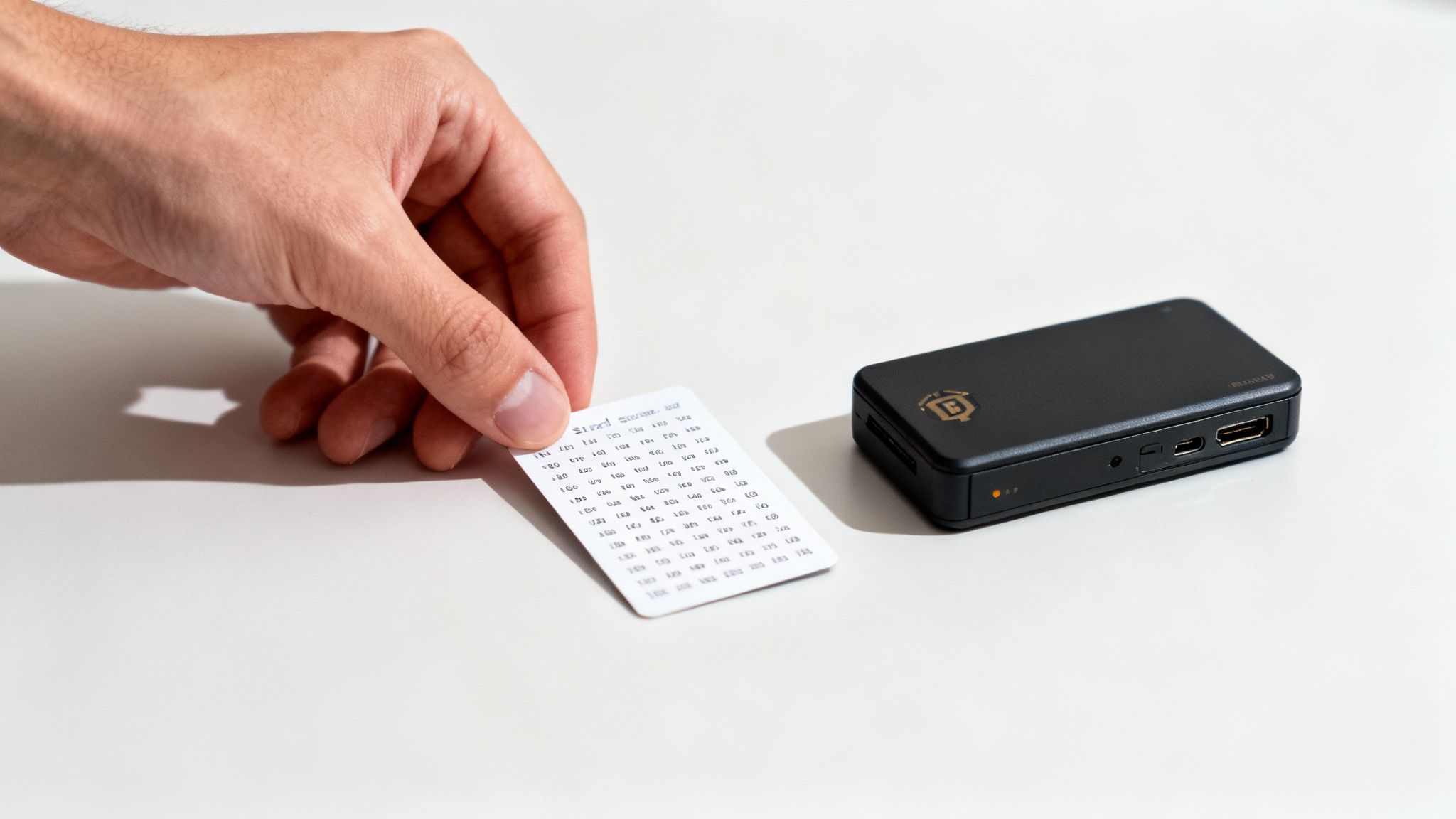
Before you can spend a single satoshi, you need a wallet. Think of it as your personal bank vault and debit card rolled into one—it's the digital home for your Bitcoin and the tool you'll use for every transaction.
Picking the right wallet is probably the most critical decision you'll make at this stage. It all boils down to one fundamental choice: custodial versus non-custodial.
A custodial wallet is where a third party, like a crypto exchange, holds your private keys for you. It's convenient, sure, but it's like leaving your cash in someone else's safe. A non-custodial wallet, on the other hand, gives you exclusive control over your keys. That means you, and only you, have access to your Bitcoin.
For anyone serious about using Bitcoin for payments, a non-custodial wallet is the only way to go. It embodies the core principle of Bitcoin: self-sovereignty. You are your own bank, and no one can freeze or access your funds without your permission.
Selecting Your First Non-Custodial Wallet
For beginners, the easiest entry point is a software wallet you can install right on your phone or computer. These strike a great balance between security and everyday convenience, making them perfect for spending.
When you’re looking at different options, focus on wallets that are:
- Bitcoin-Only: Wallets that stick exclusively to Bitcoin are often simpler and more secure. They cut out the noise and potential risks that come with supporting hundreds of other digital assets.
- User-Friendly: You want an intuitive interface. It should be easy to see your balance, send a payment, and check your transaction history without getting lost in confusing menus.
- Well-Reviewed: Go with a wallet that has a solid, long-standing reputation in the Bitcoin community. Check that it's still being actively developed and has good support.
After you've picked one, the setup is pretty straightforward. You'll download the app from the official website or your device's app store, install it, and then choose to "Create a new wallet." This next step is the most important part of the entire process.
Securing Your Seed Phrase
During the setup, your wallet will generate a unique seed phrase, which is just a list of 12 or 24 random words. This phrase is the master key to all of your Bitcoin. If your phone gets lost, your computer dies, or you forget your password, this phrase is the only way to get your funds back.
Imagine your seed phrase is the only map to a hidden treasure chest. If you lose the map, the treasure is gone forever. There is no "forgot password" link to click.
Here’s exactly how to handle it:
- Write It Down: Use a pen and paper. Write the words down, in the exact order they appear. Double-check them.
- Store It Securely: Put this piece of paper somewhere safe and private. Think of a fireproof safe or another location where it won't be damaged or found by anyone else. Some people make two copies and store them in different secure places.
- Never Store It Digitally: This is the big one. Do not take a screenshot of it. Don't save it in a text file, email it to yourself, or store it in a password manager. Any digital copy is a target for hackers.
Once you’ve safely backed up your seed phrase, your wallet is ready to go. You now have a secure, self-controlled digital wallet prepared to receive and send Bitcoin.
How to Actually Acquire Bitcoin
So, you've got your secure, non-custodial wallet all set up and ready to go. The next step? Actually getting some Bitcoin into it.
The most straightforward and popular route for this is through a cryptocurrency exchange. These are just online marketplaces where you can swap your regular money—dollars, euros, etc.—for Bitcoin.
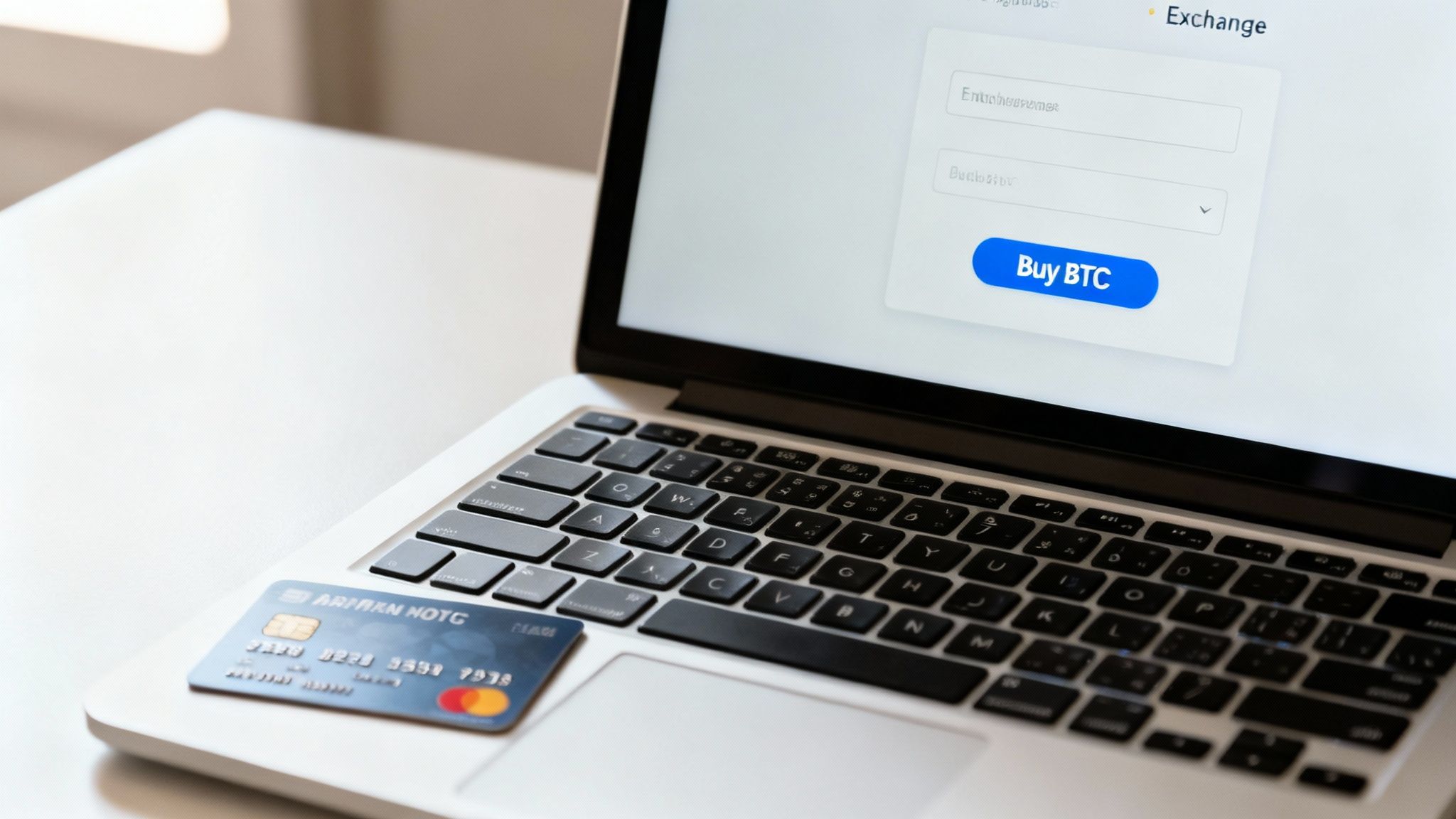
Think of an exchange as a temporary stopover. It's the place you go to make the trade, but it's absolutely not where you want your Bitcoin to live permanently. The end goal is always to move the coins you buy off the exchange and into the personal wallet you just created. That's how you gain full control.
Choosing a Trustworthy Bitcoin Exchange
You wouldn't just hand your bank details to any random website, and the same caution applies here. Not all exchanges are built the same, and since you'll be linking your bank account and verifying your identity, picking a platform with a solid reputation is non-negotiable.
Here’s a quick checklist for vetting an exchange:
- Rock-Solid Security: Look for platforms that insist on security features like two-factor authentication (2FA). A clean track record with no major hacks is a huge plus.
- Transparent Fees: Exchanges make money by charging fees on your purchases. Good ones are upfront about their costs, which are usually a small percentage of your transaction. No surprises.
- A Clean Interface: As someone new to this, you don't need complicated trading charts and a hundred different options. You want a simple, clean platform that makes the buying process feel easy.
Once you’ve settled on an exchange, you'll go through a standard account setup. This will include an identity check known as Know Your Customer (KYC). You'll likely need to upload a photo of your driver's license or passport. This is a normal regulatory step for any legitimate financial service.
From Exchange to Your Personal Wallet
After your account is approved and you've linked a payment method (like a debit card or bank transfer), you're ready to buy your first bit of Bitcoin. But don't pop the champagne just yet. Leaving your Bitcoin on the exchange is risky—it's like buying gold but leaving it in the dealer's vault. It isn't truly yours until you hold it.
The most critical step in this process is withdrawing the Bitcoin from the exchange to your non-custodial wallet. This is the moment you take true ownership of your funds, moving them from a third-party's control into your own.
To make the transfer, you'll find the "Withdraw" or "Send" section on the exchange. From there, you'll select Bitcoin and paste in the receiving address from your personal wallet app. Always, always double-check the address character-by-character before hitting send. A typo here can send your funds into the void forever.
Are There Other Ways to Buy Bitcoin?
Exchanges are the go-to, but they aren't the only game in town. You might have seen Bitcoin ATMs, which are physical kiosks where you can buy Bitcoin using cash or a debit card.
They're convenient, for sure, but that convenience comes at a steep price. Bitcoin ATMs are notorious for their high fees, sometimes tacking on as much as 15-20% to your purchase. For that reason alone, most people find that sticking to a reputable online exchange is a much more cost-effective way to get started.
Making Your First Purchase with Bitcoin
Alright, you've got your wallet funded and you're ready to go. This is the exciting part—actually spending your Bitcoin. The checkout process is a bit different from punching in your credit card number, but once you do it once, you'll see how straightforward and secure it really is.
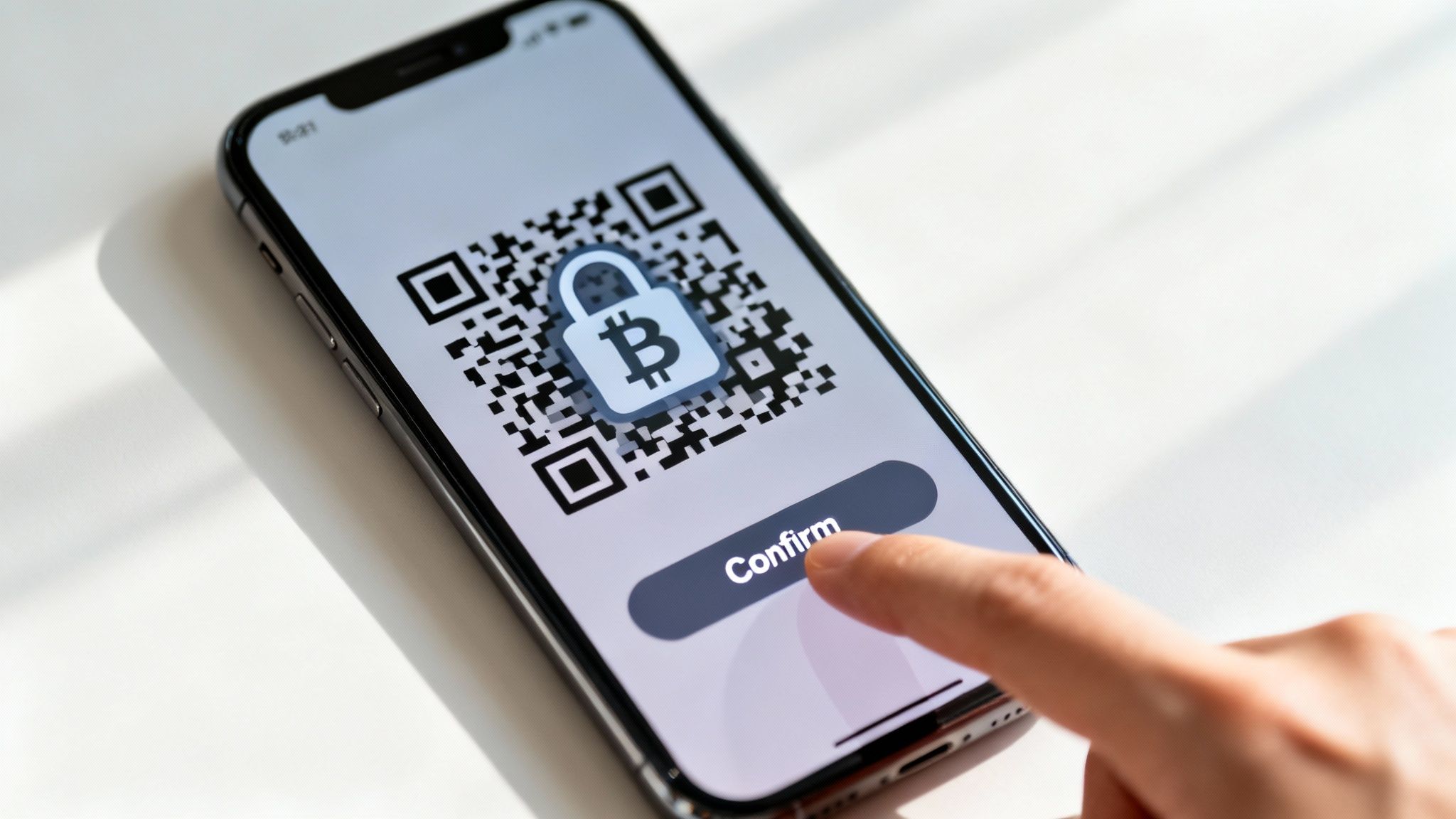
When you're ready to pay on a merchant's site, you'll hit the "Pay with Bitcoin" button. Instead of a credit card form, the site will generate a payment request. This usually shows up in two forms at the same time: a scannable QR code and a long string of letters and numbers, which is the Bitcoin address.
This single request has everything your wallet needs to know: the exact amount of Bitcoin to send and precisely where it needs to go.
From Checkout to Confirmation
Sending the payment is designed to be dead simple. The easiest way is to just whip out your phone, open your mobile wallet, and scan the QR code right off your computer screen. This action automatically populates the recipient's address and the exact payment amount, which completely removes the chance of a typo.
If you're using a desktop wallet, you can copy the Bitcoin address and paste it into the "send" field, along with the correct amount. Here's a pro tip I can't stress enough: always, always double-check the first few and last few characters of the address after you paste it. Make sure they match perfectly. Once you hit send, that transaction is on its way and there's no calling it back.
We're seeing a massive wave of mainstream adoption for crypto payments, largely thanks to clearer regulations and big institutions getting on board. Not long ago, the global crypto market cap blew past the $4 trillion mark for the first time. Think about that—it shows the sheer scale of digital assets out there. Market data suggests that somewhere between 40 to 70 million people are now actively using crypto, which is a jump of about 10 million from last year. The total number of crypto owners worldwide? A whopping 716 million. You can get more insights on the state of crypto from the team at a16z crypto.
Understanding Fees and Wait Times
So you've sent your Bitcoin. Don't expect it to show up instantly like an email. It has to be confirmed by the Bitcoin network first. This is where two key ideas come into play: network fees and confirmation times.
Picture the Bitcoin network as a busy highway. Your transaction is a car trying to merge into traffic. The network fee (sometimes called a miner fee) is the toll you pay to get your transaction bundled into the next "block" of transactions being officially recorded.
Your wallet is smart enough to suggest a fee based on how jammed the network is at that moment. Here’s the breakdown:
- Higher Fee, Faster Confirmation: In a hurry? You can choose to pay a slightly higher fee to jump the queue.
- Lower Fee, Slower Confirmation: If time isn't critical, a lower fee will work just fine, but your transaction might take a bit longer to go through.
Most merchants will wait for a certain number of confirmations before they consider your payment final—usually somewhere between one and six. This is their way of making sure the payment is locked in and can't be reversed. On average, a single confirmation takes about ten minutes, so you might have a short wait. It's a totally normal part of how the network keeps every single transaction secure. You can usually watch its progress in your wallet or by using a public block explorer.
Essential Security Habits for Every Transaction
When you start buying things with Bitcoin, you quickly realize you’re not just a user—you're also your own head of security. Unlike a bank that can reverse a fraudulent charge, Bitcoin transactions are final. This puts all the power, and all the responsibility, squarely in your hands.
That might sound a little intimidating, but good security is really just a series of simple, repeatable habits. The real goal is to make these practices second nature for every single transaction you make.
The most powerful principle in Bitcoin is summed up in a simple phrase: "Not your keys, not your coins." If a third party holds your private keys, you're trusting them with your money. True ownership means holding your own keys in a non-custodial wallet.
Your Pre-Transaction Security Checklist
Before you ever hit that "send" button, just pause. Take a breath and run through a quick mental checklist. Scammers rely on you being in a hurry, so taking a few extra seconds is your absolute best defense. This simple habit can be the difference between a successful purchase and a lost payment.
Think of it like looking both ways before crossing the street. It’s a small, reflexive action that prevents a huge mistake.
Here are the non-negotiables:
- Double-Check the Address: This is the golden rule. Meticulously verify the first four and last four characters of the recipient's Bitcoin address. Malicious software can actually swap a copied address with a scammer's, so this quick visual check is crucial.
- Confirm the Amount: Make absolutely sure the amount you're sending is what the merchant requested. A misplaced decimal point can be a very costly error.
- Question Urgency: Be immediately suspicious of any message, email, or offer that creates a sense of panic. Scammers often pressure you into acting fast before you have a chance to think clearly.
Spotting Common Bitcoin Scams
Scammers are always dreaming up new ways to part people from their Bitcoin, but their tactics usually fall into a few familiar categories. Phishing attacks, for instance, use fake emails or websites that look like legitimate services to trick you into revealing your sensitive info.
Another common trick is the "giveaway" scam, where a fraudster promises to double any Bitcoin you send them. Just remember, if an offer seems too good to be true, it absolutely is. No legitimate organization will ever ask you to send them Bitcoin with the promise of sending more back.
And finally, your seed phrase is the master key to your entire wallet. Never, ever share it with anyone, for any reason. A legitimate company, wallet provider, or support agent will never ask for it.
Consumer confidence is a huge driver of crypto adoption. We're seeing geopolitical events and new regulations speed things up considerably. For instance, actions like the U.S. government establishing a Strategic Bitcoin Reserve and appointing SEC leaders with a more favorable view on digital assets have greatly increased interest. This growing regulatory clarity removes barriers for more merchants to start accepting cryptocurrency. You can find more insights on the state of crypto from the team at Gemini.
Still Have Questions? Let's Clear Things Up.
Even after you get a few Bitcoin purchases under your belt, some questions are bound to pop up. The world of Bitcoin is always moving, and it's smart to stay curious. Let's tackle a few of the most common head-scratchers that trip up beginners.
Think of this as your quick-reference FAQ for the real world of spending Bitcoin. We'll get into why some payments feel like they’re stuck in limbo, how you get your money back when transactions are permanent, and the tax stuff you absolutely need to know.
Why Is My Bitcoin Transaction Taking Forever?
So you've hit "send," but the merchant is still waiting. What gives? This is a super common scenario, and it almost always comes down to two things: network congestion and miner fees.
Picture the Bitcoin network as a massive highway. Every transaction is a car trying to merge. The miner fee you pay is your toll—a higher toll gets you in the express lane, while a low one can leave you stuck in rush hour traffic. When everyone is trying to send transactions at once, that highway gets jammed, and confirmation times stretch out.
Most modern wallets are pretty good at suggesting the right fee, but if you manually set it too low during a busy period, your payment might be sitting on the on-ramp for a while before it gets picked up and confirmed in a block.
How Do Refunds Even Work With Bitcoin?
This is a big one. A core, unchangeable feature of Bitcoin is that all transactions are final and irreversible. Once it's sent, it's gone. There's no "chargeback" button to hit like with a credit card. So, how on earth do you get a refund?
It all comes down to the merchant's policy and their willingness to work with you. If you need to return something, they have to start a completely new transaction, sending the Bitcoin back to you. You'll need to give them a fresh receiving address from your wallet. It’s a manual, cooperative process, which really drives home the point of only doing business with reputable companies you trust.
It's crucial to understand that a Bitcoin refund is a separate, new payment sent from the merchant to you. You'll need to provide them with a fresh receiving address from your wallet to get your funds back.
Do I Really Have to Pay Taxes When I Spend Bitcoin?
In a word: probably. This is where a lot of people get caught off guard. In many places, including the United States, Bitcoin is treated as property, not currency, for tax purposes. This means that simply spending your Bitcoin can be a taxable event.
Here’s how it works: when you buy something, you are technically "selling" your Bitcoin for the fair market value of that good or service. If your Bitcoin has gone up in value since you first got it, you’ve just realized a capital gain, and the tax man might want his cut.
For example, say you bought some Bitcoin at $50,000. Later, you use it to buy something worth $60,000. In the eyes of the IRS, you just made a $10,000 capital gain. This is why keeping clean records of when you acquire and spend your Bitcoin is non-negotiable.
This tax reality is just one sign of how mainstream crypto is becoming. We're seeing a huge surge in global adoption, especially in emerging markets. Just look at the United States—in the first seven months of last year, crypto transaction volume shot up by a staggering 50%, blowing past USD 1 trillion. That's a clear signal that people are shifting to digital assets for real-world payments. The team at TRM Labs has a great report digging into these adoption trends if you want to learn more.
Ready to accept Bitcoin payments at your business? Flash provides the most secure, decentralized, and user-friendly tools to get you started in under a minute. Explore our solutions at paywithflash.com and join the future of commerce.