So, you're ready to turn your Bitcoin into cash. It's not a one-size-fits-all process. The right move for you boils down to what you care about most: Is it lightning-fast speed, rock-bottom fees, keeping your information private, or iron-clad security?
The path you choose really matters. A day trader zipping in and out of positions has completely different needs than a merchant who's just started accepting Bitcoin for their products. This first decision shapes everything that follows—how much you'll pay, how quickly you'll get your money, and how much personal info you'll need to hand over.
Choosing the Right Way to Cash Out Your Bitcoin
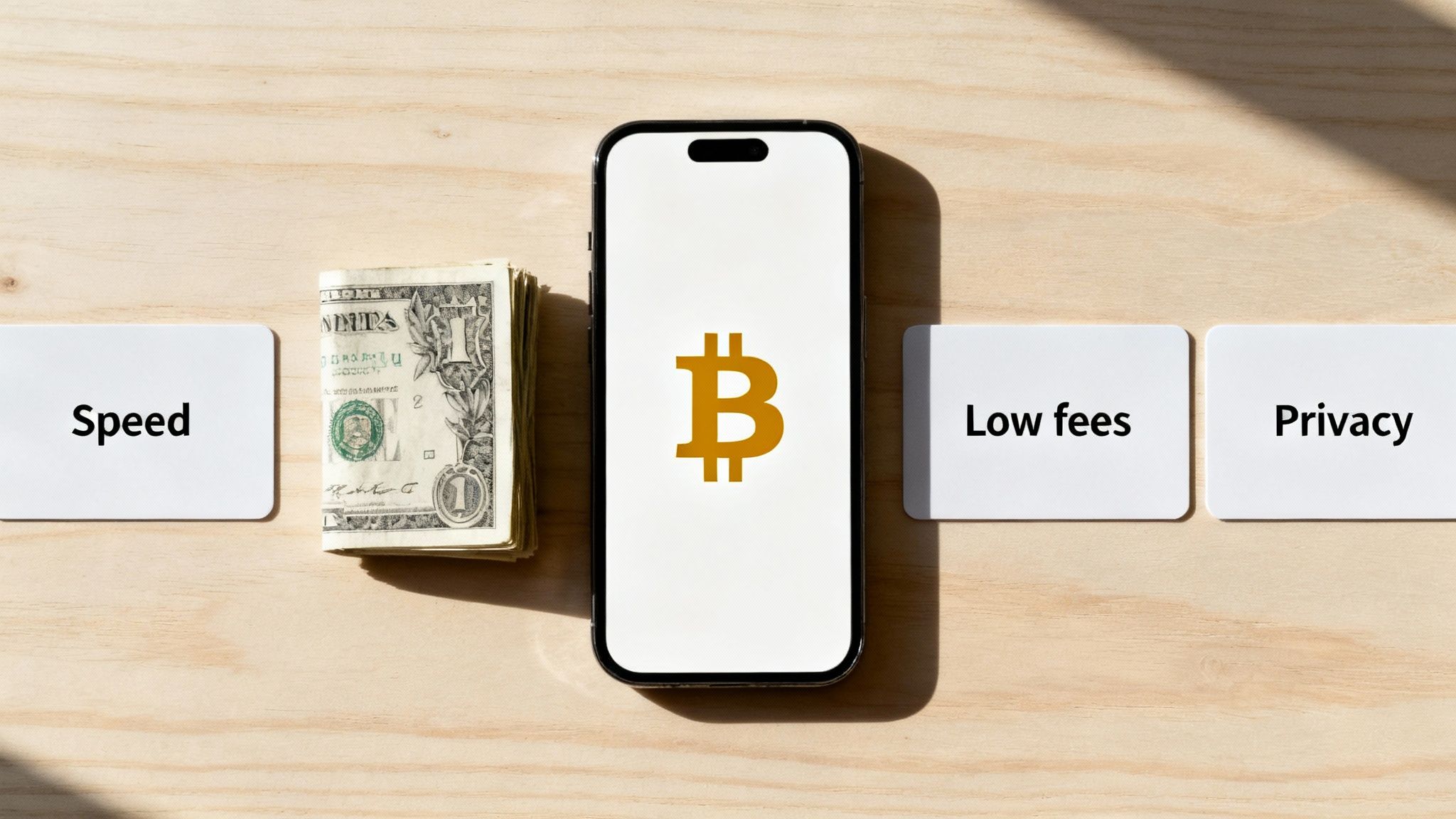
Before you do anything, take a second to figure out your main goal. Are you in a rush and need cash in hand within the hour? Or are you moving a larger amount where shaving off even a fraction of a percent in fees could mean saving a serious chunk of change?
What works for one person might be a terrible fit for another. The Bitcoin world is packed with options, and understanding the trade-offs is key.
Key Factors to Consider
Let's break down the main ways people cash out their Bitcoin. Each has its own set of pros and cons.
- Centralized Exchanges (CEXs): These are the big names you've heard of, acting as a trusted middleman. They're usually the best starting point for beginners because they’re user-friendly and have plenty of buyers and sellers, meaning you can move your funds easily.
- Peer-to-Peer (P2P) Platforms: Think of this as a direct marketplace connecting you with another person who wants to buy your Bitcoin. This route often gives you more payment options (like bank transfers, cash deposits, or even gift cards) and can be more private.
- Bitcoin ATMs: Nothing beats these for raw speed. If you need physical cash right now, an ATM is your best bet. They’re perfect for small, quick transactions, but be prepared—they usually come with the highest fees in the game.
- Bitcoin Debit Cards: This is cashing out on the go. You load your card with Bitcoin, and then you can spend it anywhere that accepts regular debit cards. Every swipe is essentially a tiny cash-out transaction.
- Over-the-Counter (OTC) Desks: This is the white-glove service for the big players. If you're moving a large sum, typically over $100,000, an OTC desk gives you a private, dedicated service so your massive trade doesn't send ripples through the market price.
A Quick Comparison of Bitcoin Cashing Out Methods
To make things easier, here’s a table that breaks down the key features of the main ways to cash out Bitcoin. It should help you quickly see which option might be the best fit for your specific situation.
| Method | Best For | Typical Speed | Privacy Level | Fee Structure |
|---|---|---|---|---|
| Centralized Exchanges | Beginners, high liquidity, large amounts | 2-5 business days | Low (requires KYC) | Low (0.1% - 1.5%) |
| Peer-to-Peer (P2P) | Flexibility, privacy, varied payment methods | A few minutes to a few hours | Moderate to High | Variable (set by seller) |
| Bitcoin ATMs | Instant cash, small amounts, convenience | Instant | High (often no KYC for small amounts) | High (7% - 20%) |
| Bitcoin Debit Cards | Everyday spending, convenience | Instant | Low (requires KYC) | Varies (conversion & withdrawal fees) |
| OTC Desks | High-volume trades (>$100k), price stability | 1-3 business days | High (private transactions) | Low, fixed percentage |
Ultimately, the table highlights the core trade-off: convenience and speed often come at the cost of higher fees and lower privacy. Think about your priorities and use this as a guide to narrow down your choices.
Aligning Your Method with Your Needs
Your specific circumstances will point you to the right solution. For example, an individual investor who's been holding for years might be perfectly happy to use a centralized exchange. The lower fees are a huge plus, and they probably don't mind the verification process or waiting a few days for the funds to hit their bank account.
A merchant, on the other hand, is in a totally different boat. They get Bitcoin payments every day and need a smooth, reliable way to turn that into cash to run their business. For them, a direct wallet-to-wallet payment processor is a game-changer, letting them skip the hassle of third-party platforms entirely.
Think of this guide as your roadmap. We’re about to dive deep into each of these methods, giving you the practical, real-world knowledge you need to pick the path that aligns perfectly with your goals.
Using Centralized Exchanges to Convert Bitcoin to Fiat
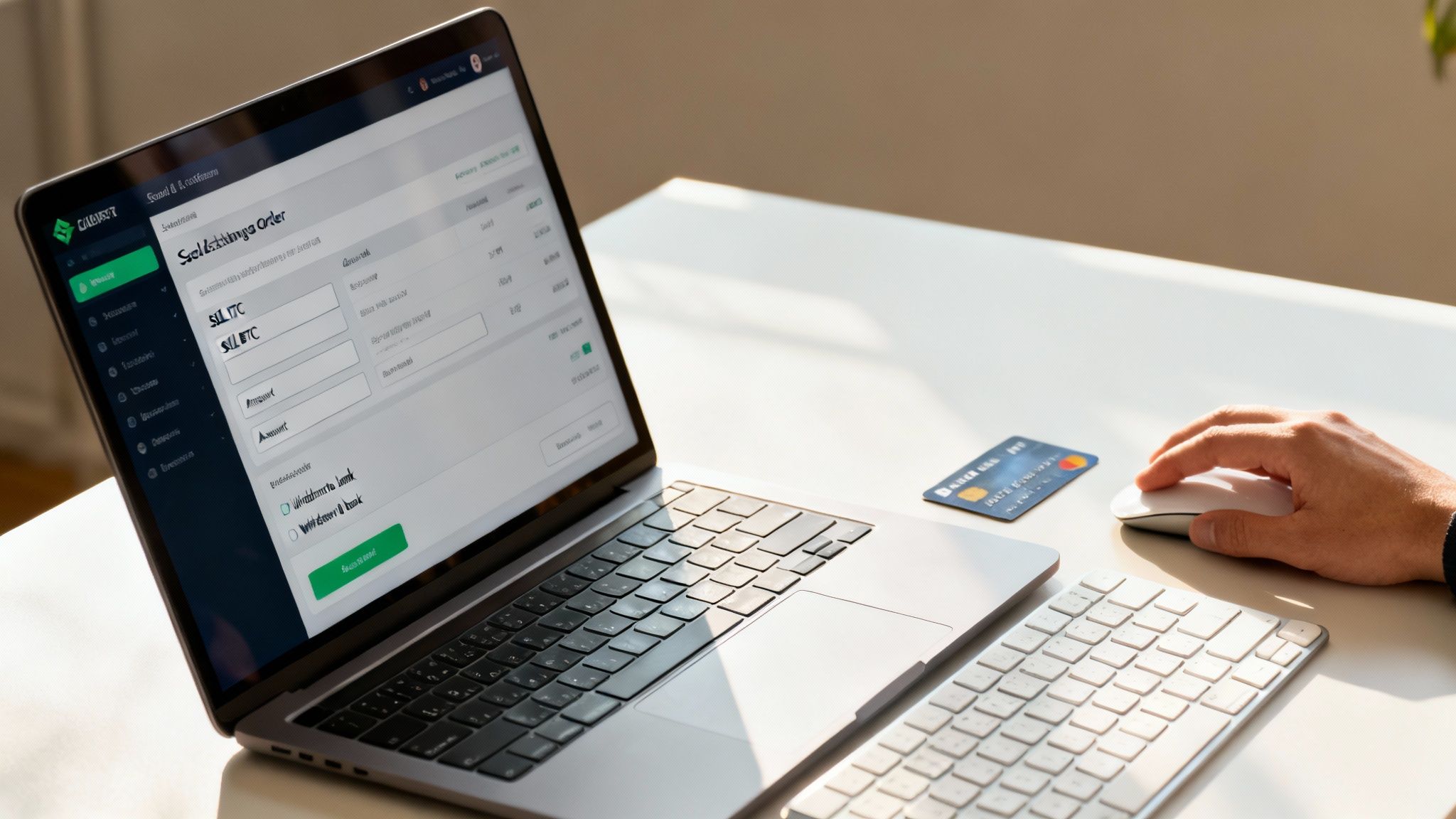
For most folks, centralized exchanges (CEXs) are the go-to on-ramp and off-ramp for Bitcoin. They're the most familiar and direct way to turn your Bitcoin back into traditional currency, or fiat. Think of them as a financial hub where buyers and sellers meet, creating a highly liquid market. In simple terms, you can almost always find someone ready to trade at the going rate.
Their popularity comes down to one thing: a user-friendly design that feels a lot like your online banking or stock trading app. This familiarity makes the whole process less intimidating, especially if you aren't a seasoned Bitcoin pro. But this convenience isn't free—it comes with some serious trade-offs you need to get your head around first.
The Standard Cashing Out Process
Getting your money out through a CEX always follows a few key stages. The buttons and menus might look a little different from one platform to the next, but the core journey is basically the same everywhere.
First up, you have to create an account and complete the mandatory Know Your Customer (KYC) verification. This means handing over personal ID documents like a driver's license or passport, and often something to prove your address. Exchanges aren't being nosy for fun; they're required to do this to comply with Anti-Money Laundering (AML) laws.
Once your account gets the green light, you'll need to link a bank account. This is where your cash will land after you sell your Bitcoin. You’ll typically provide your bank's routing and account numbers for an ACH or wire transfer.
From Your Wallet to Your Bank
With all the admin out of the way, you can get to the main event. Here’s how it usually plays out:
- Deposit Bitcoin to the Exchange: Inside your exchange account, you'll generate a unique Bitcoin deposit address. You then send the Bitcoin you want to sell from your personal wallet—the one where you control the private keys—to that address. Pro tip: always, always double-check the address before hitting send.
- Place a Sell Order: After the transaction gets confirmed on the blockchain, the Bitcoin will pop up in your exchange wallet. From there, you just head over to the trading section and place a sell order, swapping your BTC for your local currency, whether that’s USD, EUR, or GBP.
- Withdraw Fiat Funds: The last piece of the puzzle is to initiate a withdrawal. You’ll move the fiat balance from your exchange account to your linked bank account. Depending on the method and your bank, these transfers usually take anywhere from 1 to 5 business days to clear.
This flow is pretty straightforward, but it brings a massive risk to the surface—the second your Bitcoin lands on an exchange, it's no longer truly yours.
The old crypto adage, "not your keys, not your coins," is everything here. When you transfer Bitcoin to a CEX, you are trusting them completely. This custodial risk means your funds are vulnerable to exchange hacks, government freezes, or even the exchange going bust.
The Hidden Costs of Convenience
While CEXs offer a simple path to cash out, you have to weigh the downsides. The convenience they offer comes at a price, both in terms of control and your personal privacy.
- Loss of Self-Custody: This is the big one. You hand over control of your Bitcoin. The exchange holds the private keys, making you totally dependent on their security and operational honesty.
- Privacy Concerns: Mandatory KYC links your real-world identity directly to your Bitcoin activity. This data is stored by the exchange and can be shared with government agencies.
- Security Risks: Centralized exchanges are massive targets for hackers. Security has gotten better over the years, but major exchange hacks and failures are a painful, recurring part of Bitcoin's history.
For many, these platforms are a necessary evil—a practical tool for turning Bitcoin back into fiat. They provide the deep liquidity needed to handle large sell orders without tanking the market price. Just be smart about it. View them as a temporary bridge, not a permanent home for your assets. The best practice is to only move your Bitcoin onto the exchange when you’re ready to sell, and pull your cash out the moment the trade is done.
Beyond Exchanges: P2P Platforms, Bitcoin ATMs, and Debit Cards
While centralized exchanges get the job done, they're far from the only game in town. In fact, some powerful alternatives exist that offer unique advantages in flexibility, speed, and even privacy.
If you prioritize direct interaction or need a wider array of payment methods, it's smart to look beyond the standard exchange model. Whether you need physical cash right now or just want to spend your Bitcoin like any other currency, there are specialized tools built for exactly that.
Peer-to-Peer (P2P) Platforms: The Direct Marketplace
Think of Peer-to-Peer (P2P) platforms as a digital classifieds board where you connect directly with individuals who want to buy your Bitcoin. Instead of selling into a huge, anonymous order book, you browse offers from other users and pick the one that works best for you. This direct approach gives you a level of control you just won't find on a typical exchange.
The real magic of P2P is the sheer variety of payment methods available. Buyers might offer to pay you through:
- Bank Transfers: The classic, straightforward option.
- Cash Deposits: Where the buyer physically deposits cash into your bank account.
- Payment Apps: Using popular services like PayPal, Venmo, or Cash App.
- Gift Cards: Trading your Bitcoin for a specific retail gift card.
This versatility makes P2P a fantastic choice if you need funds delivered in a non-traditional way. To keep everyone safe, these platforms use an escrow system. When you accept a trade, your Bitcoin is locked in a secure, neutral holding account. Only after you confirm that you've received the payment is the Bitcoin released to the buyer, which drastically cuts down the risk of getting scammed.
Bitcoin ATMs: Instant Cash, but at a Price
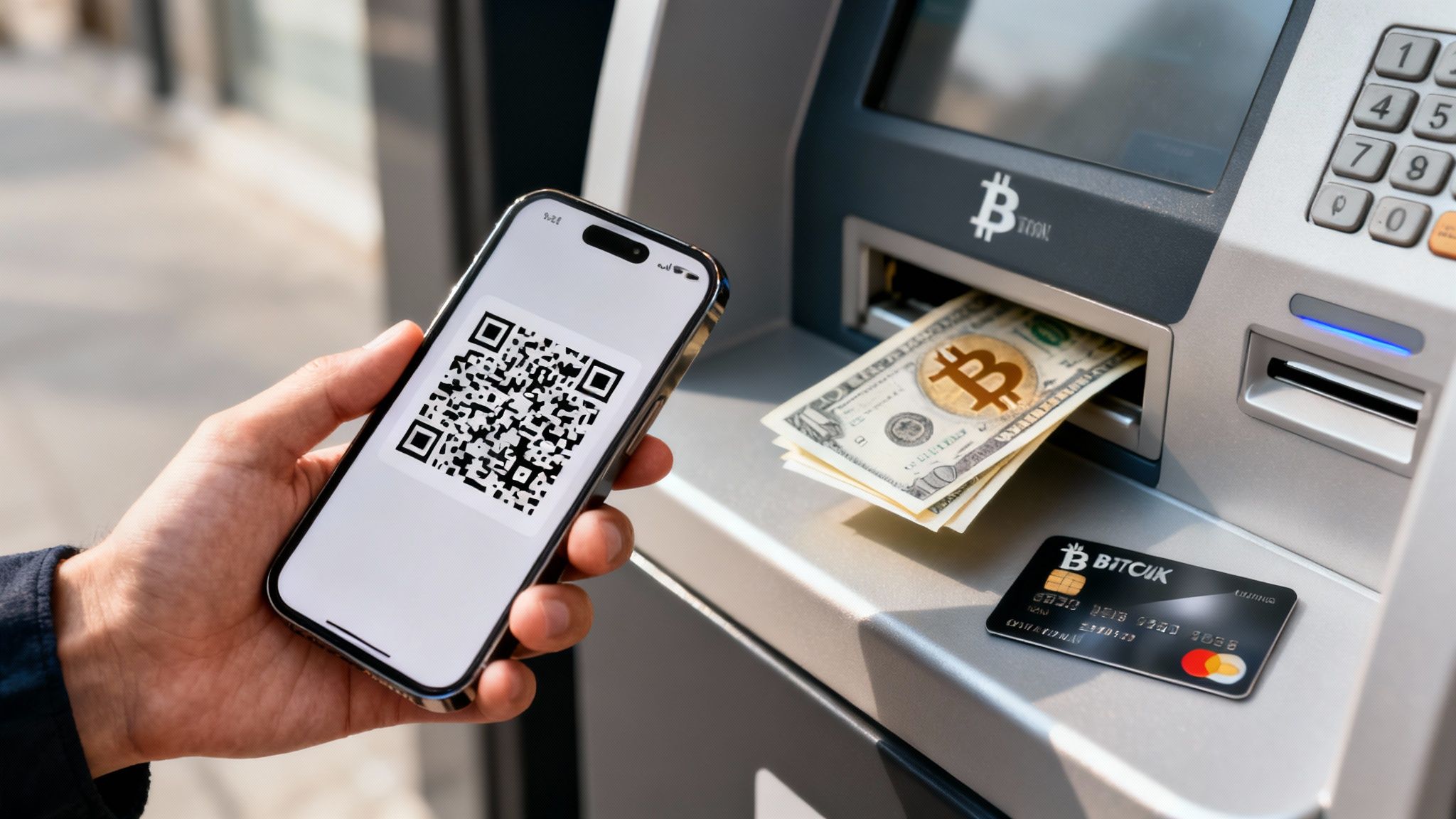
For pure, unadulterated speed, nothing beats a Bitcoin ATM. If you need physical cash in your hand right now, these machines are the most direct route. The process is remarkably simple—scan a QR code from your mobile wallet, and moments later, the machine spits out crisp banknotes. It feels pretty futuristic the first time you do it.
This convenience is perfect for small, urgent transactions. Imagine you're traveling and need local currency fast; a Bitcoin ATM can be a lifesaver. But that speed comes with a hefty price tag.
Bitcoin ATMs are notorious for their high fees, which can run anywhere from 7% to over 20%. This makes them completely impractical for cashing out large amounts. For small sums where speed is the only thing that matters, though, they're an invaluable tool.
Another key factor is privacy. Many ATMs have transaction limits below which they don't require strict ID verification, offering a more private way to cash out compared to the mandatory KYC on centralized exchanges. Just be aware that their availability is still mostly limited to major cities, so you might have to hunt one down.
Bitcoin Debit Cards: Spending Bitcoin in the Real World
Bitcoin debit cards offer a totally different way to think about "cashing out." Instead of converting a lump sum of Bitcoin to fiat, these cards let you spend your Bitcoin directly at the point of sale.
Every time you swipe, tap, or enter your card details online, the card provider instantly converts just enough Bitcoin to fiat to complete the purchase. This essentially turns every transaction into a micro cash-out event. You can use these cards anywhere that accepts Visa or Mastercard, making your Bitcoin spendable at millions of stores worldwide. It's the perfect way to integrate Bitcoin into your daily financial life, from buying groceries to paying bills.
Of course, there are a few things to keep in mind. You'll need to complete a full KYC process to get a card, just like with an exchange. You also need to pay close attention to the fee structure, which can include conversion fees, monthly maintenance charges, and ATM withdrawal fees. And remember, using a Bitcoin debit card means you're trusting a third party to hold your funds, which reintroduces a degree of custodial risk.
How to Navigate Security Risks and Avoid Costly Scams
The moment you decide to cash out your Bitcoin, you paint a giant target on your back. It's a fact of life in this space. Scammers love moments of transition—they thrive on the excitement and potential confusion that comes with turning digital assets into cold, hard cash.
Protecting yourself isn't just about having a strong password. It requires a completely different mindset, a proactive one.
These bad actors are creative, constantly cooking up new schemes to get you to hand over your funds. Their tactics are designed to create a false sense of trust or a sudden, panicked urgency, pushing you to act before you’ve had a chance to think things through. Spotting their game is the first real line of defense.
Spotting Common Impersonation Scams
One of the oldest and most effective tricks in the book is impersonation. Scammers will build incredibly convincing copies of legitimate exchange websites, support chats, or even social media profiles to draw you into their trap.
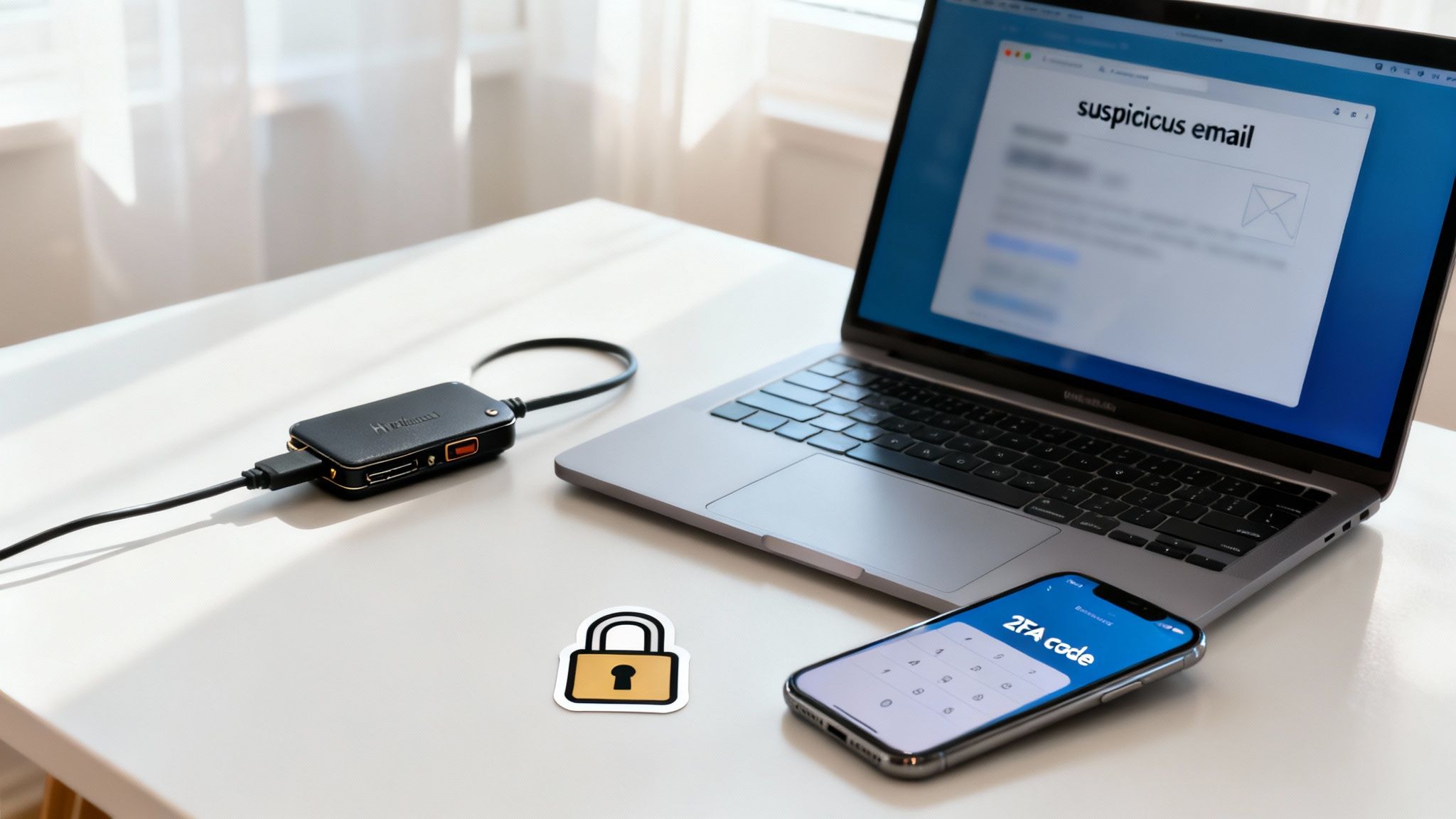
You might get a phishing email that looks exactly like an official alert from an exchange, warning of a "security breach" and telling you to log in right now through their link. Of course, that link doesn't go to the real site. It goes to a perfect clone designed for one purpose: to steal your username and password.
Crypto scams have exploded, with thieves making off with staggering sums. This is largely fueled by sophisticated impersonation tactics that trick people into 'cashing out' through fake platforms. Authorities have even flagged billions lost to crypto ATM scams, where victims are coached into sending their crypto directly to a scammer’s address. For a deeper dive, the 2026 Chainalysis report has some eye-opening data on these crime trends.
Here's the golden rule, and it's non-negotiable: Never, ever click on links from unsolicited emails or DMs. Always open a new browser tab and manually type in the official URL of the exchange. This one simple habit thwarts the vast majority of phishing attacks.
Another classic move is the fake support agent. They'll pop up in a chat or on social media, offering to "help" you with a stuck withdrawal. Sooner or later, they’ll ask for your private keys or seed phrase. Legitimate support will never ask for this information. Period.
Essential Security Habits to Adopt
Building a real defense isn't about finding one magic tool. It's about layering simple, smart security practices into your daily routine. Think of it as creating friction for attackers—the more obstacles you put in their way, the more likely they are to give up and move on.
- Enable Two-Factor Authentication (2FA): This is table stakes. Turn on 2FA for every single crypto account you own. Use an authenticator app like Google Authenticator or, even better, a physical security key. Stay away from SMS-based 2FA; it's notoriously vulnerable to SIM-swapping attacks.
- Use a Hardware Wallet: If you're serious about Bitcoin, this is not optional. A hardware wallet keeps your private keys completely offline, period. It's physically impossible for an online hacker to get to them. Only move your funds to an exchange right when you're ready to sell.
- Double-Check Every Address: When you're sending Bitcoin, paranoia is your friend. Triple-check the recipient's address character by character. One mistake, and your funds are gone forever. There’s even malware that can hijack your clipboard, replacing the address you copied with the attacker’s. Visually confirm it before you hit send.
Why Non-Custodial Solutions Are Safer
Ultimately, your security comes down to one simple question: who controls your keys?
When you leave your funds on a centralized exchange, you are trusting them to keep your assets safe. This is a custodial solution. You're a guest in their house.
A non-custodial approach, on the other hand, means you—and only you—hold the private keys. This is the entire point of Bitcoin: self-sovereignty. Using a personal hardware wallet or a non-custodial tool like Flash for business payments ensures no third party can freeze, seize, or lose your funds. You have absolute control. That's the most powerful security feature there is.
Cashing Out Bitcoin Revenue as a Merchant
If you're a merchant accepting Bitcoin, turning that digital revenue into cash for your business is a whole different ballgame than it is for an individual investor. You’re not just trying to take profits; you're building a reliable, efficient pipeline to manage your earnings without throwing a wrench in your daily operations.
The old way of doing things—like sending your daily sales to a centralized exchange—just adds friction and risk you don't need. You're constantly moving funds, trusting them to someone else's custody, and bracing for potential delays. Thankfully, there's a much more direct route now, built around modern, non-custodial payment processors that put you firmly in the driver's seat.
The Wallet-to-Wallet Advantage
The idea is breathtakingly simple: cut out the middleman. A modern Bitcoin payment processor like Flash lets you accept payments directly into your own secure business wallet. The funds never land on a third-party server, which means they are 100% yours from the moment the sale is made.
This wallet-to-wallet method is a massive leap forward for merchants. Here’s why:
- You Keep Full Control: The money goes straight from your customer's wallet to yours. This completely sidesteps the custodial risk of exchanges, which can get hacked, go belly-up, or freeze your account with zero warning.
- Instant Settlement: Payments settle on-chain almost immediately. No more waiting days for a deposit to clear or for a withdrawal to finally hit your bank account.
- Dramatically Simplified Accounting: Your books just got a lot cleaner. Instead of a messy trail across various exchange accounts, you have a direct, auditable record of transactions flowing into one wallet that only you control.
This direct path gives you the freedom to decide exactly how and when you want to cash out your Bitcoin, entirely on your own terms.
How This Looks in the Real World
Let's break down what this actually looks like for a couple of different businesses.
Imagine a digital content creator selling online courses. They can plug in a paywall that takes Bitcoin for subscriptions. Every time a customer pays, the Bitcoin is sent right to the creator's hardware wallet. They can let that revenue stack up and then pick the perfect time to convert a chunk to cash for business expenses, dodging daily transfer fees and security nightmares.
Or think about a local coffee shop. The owner can use a point-of-sale (POS) app on a tablet that spits out a unique QR code for each latte. A customer scans it, pays with their mobile wallet, and the payment is confirmed in seconds—landing directly in the shop's wallet. Just like that, they've opened up a new payment channel for a global customer base without needing traditional card processors.
Building Your Off-Ramp Strategy
Once the Bitcoin is sitting safely in your own wallet, you can start planning your cash-out strategy. Instead of just reacting to daily sales, you get to be proactive. Many merchants I've worked with choose to convert funds on a weekly or monthly schedule, moving only what they need to cover payroll, rent, and other operational costs.
The big takeaway here is that you're no longer stuck on a third party's timeline. You can watch the market, pick a good time to sell, and use whatever off-ramp works best for you—whether that’s a P2P platform for flexibility or an OTC desk for a large conversion.
While some transaction volumes have hit trillions, a lot of that is just trading noise. For merchants focused on Bitcoin, direct, decentralized solutions are simply a better way to cash out. This infrastructure gives you instant, 24/7 settlement—something traditional cross-border payments can only dream of—and lets you tap into millions of Bitcoin users without KYC hurdles.
For any business cashing out Bitcoin revenue, getting the right payment infrastructure in place is non-negotiable. It's worth looking into dedicated high-risk merchant account solutions that are built for industries facing unique payment hurdles. This self-sovereign approach is what gives you the ultimate power to manage your revenue securely and on your own schedule.
Understanding Your Tax and Legal Obligations
Figuring out how to cash out your Bitcoin is only half the battle. The other, arguably more important half, is making sure you stay on the right side of the law. Let’s be clear: in almost every country, selling Bitcoin for fiat currency is a taxable event.
Ignoring your tax obligations is a recipe for disaster. It can lead to painful audits, hefty fines, and legal headaches you really don't want to deal with.
The moment you hit "sell," you trigger either a capital gain or a capital loss. The calculation itself is pretty straightforward: it’s the difference between what you sold your Bitcoin for and what you originally paid for it (your cost basis). That profit is exactly what tax agencies like the IRS are looking at.
Capital Gains: Short-Term vs. Long-Term
The amount of tax you’ll owe often hinges on one crucial detail: how long you held onto your Bitcoin before selling. This distinction can make a huge difference to your final tax bill.
Short-Term Capital Gains: If you held your Bitcoin for one year or less, your profit is usually taxed at your standard income tax rate. This is almost always the higher of the two rates.
Long-Term Capital Gains: If you held your Bitcoin for more than one year, you’ll likely qualify for a much lower, more favorable tax rate. Think of it as a small reward from the government for being a long-term investor rather than a short-term trader.
Keeping meticulous records is absolutely non-negotiable. You need to track the date you bought your Bitcoin, its value at the time, the date you sold it, and the final sale price. Without these records, accurately calculating what you owe is next to impossible.
The Importance of Compliance and Record-Keeping
Regulatory scrutiny isn’t going away; it’s intensifying. As governments get more sophisticated at tracking Bitcoin transactions, proper reporting becomes more critical than ever. This is one area where direct Bitcoin payment solutions can actually simplify things. Wallet-to-wallet transactions create a much cleaner, more direct audit trail compared to the tangled web of moving funds through multiple exchanges.
Disclaimer: The information here is purely for educational purposes and should not be taken as financial or tax advice. Tax laws are incredibly complex and change depending on where you live.
It is essential that you consult a qualified tax professional who genuinely understands the Bitcoin space. They can offer advice tailored to your specific financial situation and make sure you’re fully compliant with all local laws.
When it comes to taxes, knowing how to prepare for tax season is just as important as knowing the best way to sell your assets. An expert will help you navigate the rules and, most importantly, avoid costly mistakes.
Common Questions About Cashing Out Bitcoin
When you're ready to turn your Bitcoin into cash, a few questions always pop up, whether you're a seasoned hodler or just starting out. Getting straight answers is key to cashing out your Bitcoin safely and without any nasty surprises.
What’s the Absolute Fastest Way to Cash Out Bitcoin?
If you need physical cash in your hand right now for a smaller amount, a Bitcoin ATM is hard to beat. Just be prepared for some pretty steep fees.
For larger sums, your best bet is usually a centralized exchange where you’re already verified. Once you sell, the funds typically land in your bank account within 1-3 business days. Merchants using direct payment tools, on the other hand, get instant settlement into their own wallet, giving them the freedom to decide when and how they want to off-ramp.
Can I Really Cash Out Bitcoin Without Paying Taxes?
In most parts of the world, cashing out Bitcoin is a taxable event. When you sell your Bitcoin for fiat currency (like USD or EUR), it's typically treated as the sale of a capital asset. This means you could be on the hook for capital gains taxes.
Trying to skip out on taxes is not a good idea and can lead to serious penalties. Your best move is always to chat with a tax professional who understands Bitcoin to figure out what you owe.
Don't forget: The responsibility for tracking and reporting your gains or losses is all on you. Keeping detailed records isn't just a good habit—it's often a legal requirement.
How Can I Cash Out Bitcoin Without ID Verification?
If privacy is your main concern, some Peer-to-Peer (P2P) platforms and Bitcoin ATMs might let you cash out without jumping through strict ID verification (KYC) hoops.
However, these options almost always come with lower transaction limits and much higher fees. You gain some privacy, but it comes at a cost. For merchants, non-custodial payment processors offer a great alternative, allowing them to accept Bitcoin directly from customers without KYC and maintain full control over their funds and off-ramping strategy.
Ready to accept Bitcoin payments directly, cutting out the middlemen? Flash gives you secure, non-custodial payment tools so you control your revenue from the moment of sale. Start accepting wallet-to-wallet Bitcoin payments in minutes at .