So, you've got Bitcoin and now you need to turn it back into regular money. The most common route is to sell your Bitcoin on a crypto exchange or a peer-to-peer (P2P) platform. From there, you just transfer the cash—like USD or EUR—straight to your bank account.
But that's not the only way. You can also use a Bitcoin ATM to pull out physical cash or even spend your crypto directly using a Bitcoin debit card. Each option strikes a different balance between speed, fees, and privacy.
A Practical Guide to Cashing Out Your Bitcoin
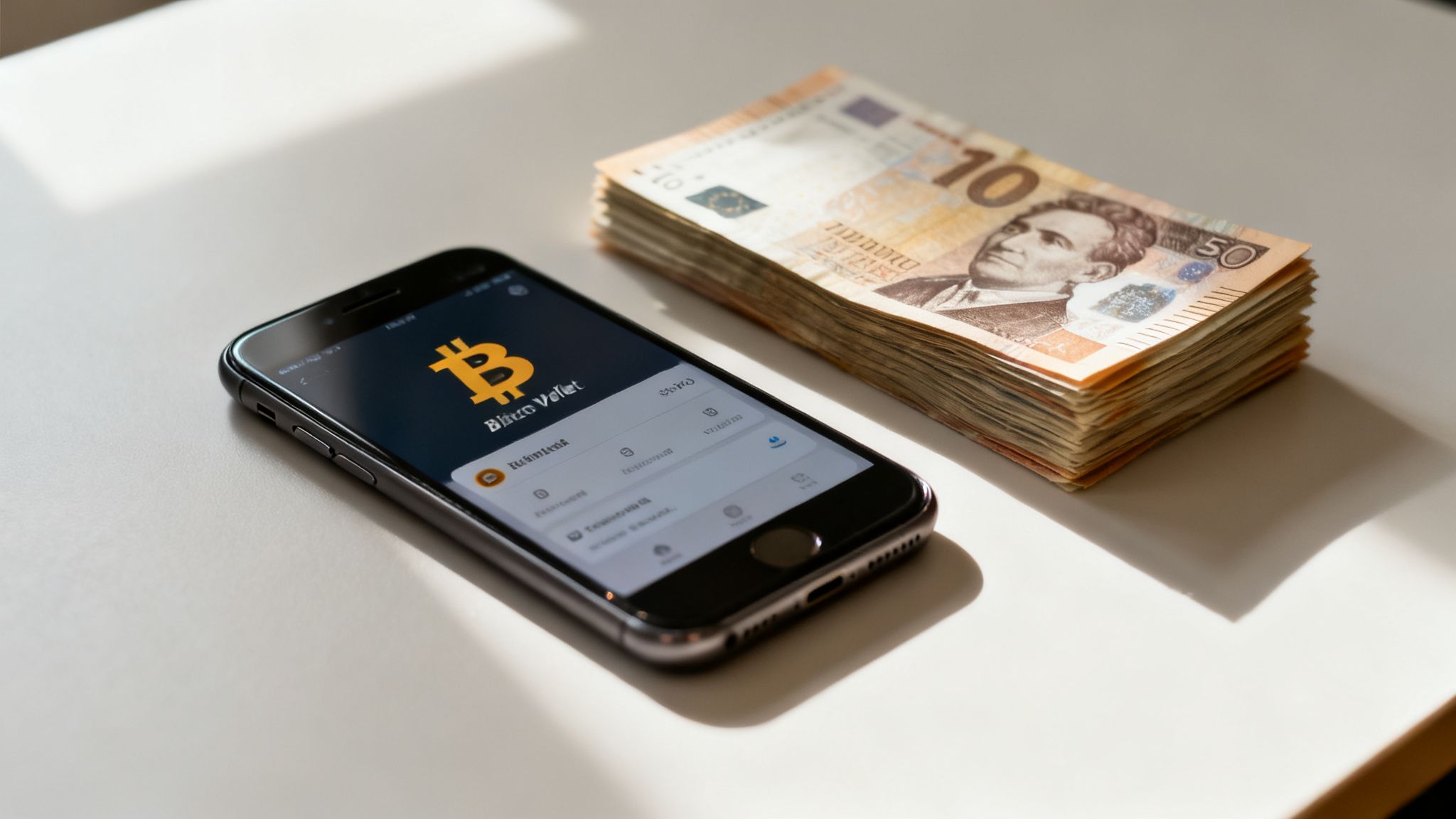
Welcome to your no-nonsense guide for turning Bitcoin into cash you can actually spend. Whether you're a merchant who just got paid in BTC, a creator selling digital goods, or just someone looking to take profits, this is for you. Knowing how to efficiently cash out is a crucial skill for anyone managing digital revenue.
We're going to walk through the most reliable and secure methods out there—from the big-name exchanges to P2P platforms and Bitcoin debit cards. Forget the dense jargon; you'll get clear, actionable advice you can use right away.
Why Your Cash-Out Strategy Matters
Figuring out the best way to convert your Bitcoin isn't just about getting money from point A to point B. It's a strategic decision that directly hits your bottom line. The path you choose impacts everything from how fast you get your money to how much you pay in fees and what personal info you have to share.
Here’s what you really need to weigh up:
- Speed: How fast do you need the cash? Some methods are almost instant, while others can take a few business days to clear.
- Cost: Fees can swing wildly between platforms. If you're not paying attention, they can take a serious bite out of your profits.
- Privacy: Different services demand different levels of your personal data, from full-blown KYC (Know Your Customer) verification to virtually none at all.
- Volume: The amount you're cashing out matters, too. Some services have daily or weekly limits that might not work for larger conversions.
For any business accepting Bitcoin, getting these conversion flows right is fundamental to managing cash flow. A smart off-ramping strategy means you can access your revenue when you need it, without losing a chunk of it to fees or waiting games.
This guide will help you navigate these choices, explaining not just how to do it, but why you might choose one method over another. Once you understand the trade-offs, you can pick the perfect path for your specific needs. Let's get this process mastered.
Choosing the Right Way to Convert Bitcoin to Cash
When it's time to cash out your Bitcoin, the big question isn't if you can, but how. The best path forward depends entirely on your priorities. Are you looking for speed, low fees, or privacy? You can’t always have all three.
Every method comes with its own trade-offs:
- Speed: How quickly do you need the cash in your bank account? Is it an emergency, or can you wait a few days for a better rate?
- Fees: How much of your profit are you willing to give up for convenience? Fees can range from a fraction of a percent to double digits.
- Privacy: How much personal information are you comfortable sharing? Some methods are anonymous, while others require full KYC (Know Your Customer) verification.
Let's break down the most common ways to turn your BTC into spendable fiat and see how they stack up against each other.
Bitcoin Cash-Out Method Comparison
To get a clearer picture, here’s a side-by-side comparison of the most popular methods for converting Bitcoin to cash. I’ve evaluated them based on the key factors we just discussed: speed, fees, privacy, and their ideal use case.
| Method | Average Speed | Typical Fees | KYC Requirement | Best For |
|---|---|---|---|---|
| Centralized Exchanges | 1–3 days | 0.1%–0.5% | Full | High-volume merchants |
| Peer-to-Peer Marketplaces | Minutes–hours | 0.5%–2% | Varies | Privacy-focused sellers |
| Bitcoin ATMs | Minutes | 5%–10% | None–Optional | Walk-up cash needs |
| Bitcoin Debit Cards | Instant | 0.5%–1.5% | Full | Everyday purchases |
As you can see, there’s a clear give-and-take. If you want lightning-fast cash from an ATM, you'll pay for it in fees. If you're a high-volume merchant, the low fees of an exchange are worth the KYC process and slower withdrawal times. Now, let’s explore what using each of these looks like in the real world.
Centralized Exchanges (CEX)
Think of centralized exchanges like Coinbase or Kraken as the foreign currency desks of the Bitcoin world. You go there to sell your Bitcoin for fiat currency, like USD or EUR. They offer deep liquidity, meaning you can sell large amounts without drastically affecting the price, and their fees are usually the lowest around.
The catch? They require full identity verification, which can sometimes take a few days to get approved. But for serious sellers, it's a small price to pay for security and low costs.
"For high-volume merchants, exchanges hit the sweet spot between speed and cost." – A merchant who sells BTC daily
Real-World CEX Scenario
Imagine you own a small online store and you've started accepting Bitcoin. At the end of each day, you have a small pile of BTC from sales. By sending these daily batches to an exchange, you can convert them to fiat and initiate a bank transfer. This keeps your cash flow steady and predictable.
A pro tip is to schedule your withdrawals to align with your bank's cutoff times. This can often shave a full day off the settlement process.
Instant Fiat Off-Ramps
The game has changed a lot in the last few years. What used to be a multi-day waiting game for bank transfers is getting faster. Thanks to intense competition and blockchain upgrades, some exchanges now offer near-instant withdrawals to your bank or debit card. It’s not quite universal yet, but the trend is definitely toward speed.
Peer-to-Peer Marketplaces
If you're looking for more control and privacy, peer-to-peer (P2P) platforms like Bisq or Paxful are your go-to. Here, you're not selling to an exchange; you're selling directly to another person. You get to set your own price and choose from a wide array of payment methods, from bank transfers and PayPal to gift cards and even cash deposits.
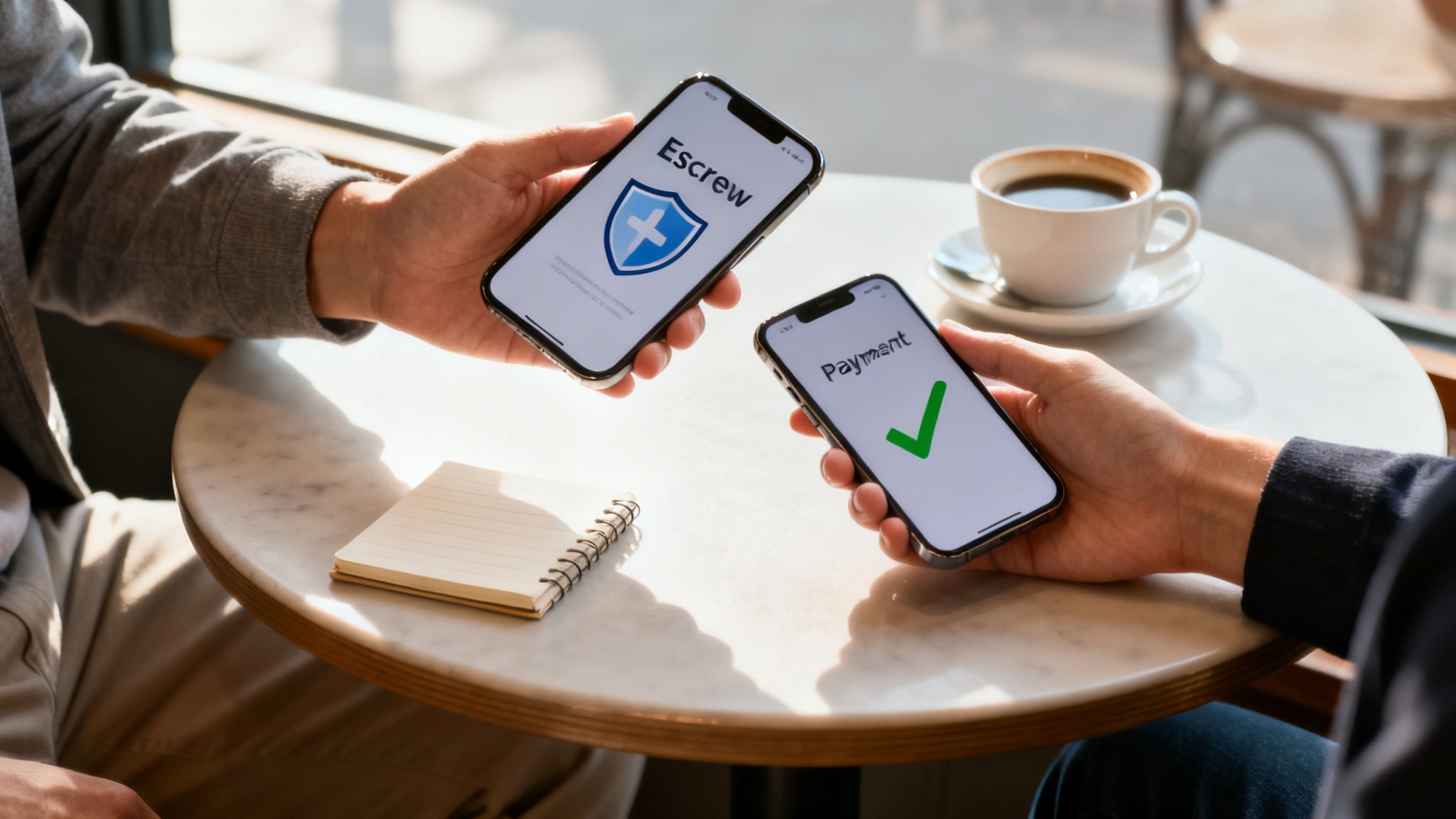
The platform acts as an escrow service, holding the Bitcoin until you confirm the buyer has paid. It’s a great system, but it requires a bit of vigilance.
- Always vet your buyers. Check their trade history and user ratings to avoid potential scams.
- Use the escrow. Never, ever release your Bitcoin until you have confirmed the funds have fully cleared in your account.
To make smarter decisions about when to cash out, you need to keep a close eye on market trends. A great way to do this is to master your CoinMarketCap watch list and set alerts for your price targets.
Bitcoin ATMs and Debit Cards
For pure, unadulterated convenience, nothing beats Bitcoin ATMs and debit cards.
Bitcoin ATMs are the quickest way to turn digital coins into physical cash. Just scan a QR code from your wallet, and crisp bills pop out. The convenience comes at a steep price, though—fees can easily hit 10% or more. For small, urgent needs, it can be a lifesaver.
Bitcoin debit cards, on the other hand, let you spend your Bitcoin just like cash at any place that accepts Visa or Mastercard. The card automatically converts your BTC to fiat at the moment you swipe, usually for a fee between 0.5%–1.5%. Most cards require full KYC, but they make spending your Bitcoin incredibly seamless.
Decision Checklist
Feeling overwhelmed? Don't be. Just walk through this simple checklist to find your perfect match.
- How fast do I need the money? Does my fee tolerance match that speed?
- Am I okay with providing my ID, or is privacy the top priority?
- How much am I selling? Does the platform have enough liquidity for my volume?
- What are my tax reporting obligations, and how will this method help (or hinder) that?
- Is the market favorable right now? Should I set a specific price (limit order) or sell at the current rate (market order)?
Run through these questions, and the right path will become much clearer. Before you commit to a large transaction, always run a small test withdrawal first. This helps you validate the actual fees and timing without risking a large sum.
Common Mistakes To Avoid
I've seen people make the same few mistakes over and over. Avoid them, and you'll be ahead of the curve.
- Chasing the absolute highest price without considering that slow withdrawals might mean you miss that price entirely.
- Ignoring the fine print on an exchange, only to get hit with hidden commission or withdrawal fees.
- Forgetting about bank holidays and transfer cutoff times, which can delay your fiat payout by days.
- Getting sloppy with security. When you move funds to an exchange to sell, you are your own last line of defense. Double-check addresses and secure your private keys.
Planning ahead and running a small test transaction is the best way to avoid any nasty surprises.
Next Steps and Support
Start small. Pick a method that looks promising and test it with just a few hundred dollars' worth of Bitcoin. See how it feels, what the real-world fees are, and how long it actually takes.
For merchants using Flash, you can integrate wallet-to-wallet payment flows that keep you in full control of your funds, completely avoiding the custody risks that come with holding funds on an exchange.
And finally, always document every sale—date, amount in BTC, and the final fiat value. Your future self (and your accountant) will thank you come tax season.
Consistency in your approach reduces errors and maximizes returns.
You’re now equipped to choose the ideal way to cash out your Bitcoin based on your unique needs. Next, we'll walk through the specific steps for selling on a centralized exchange.
Using a Centralized Exchange to Sell Bitcoin
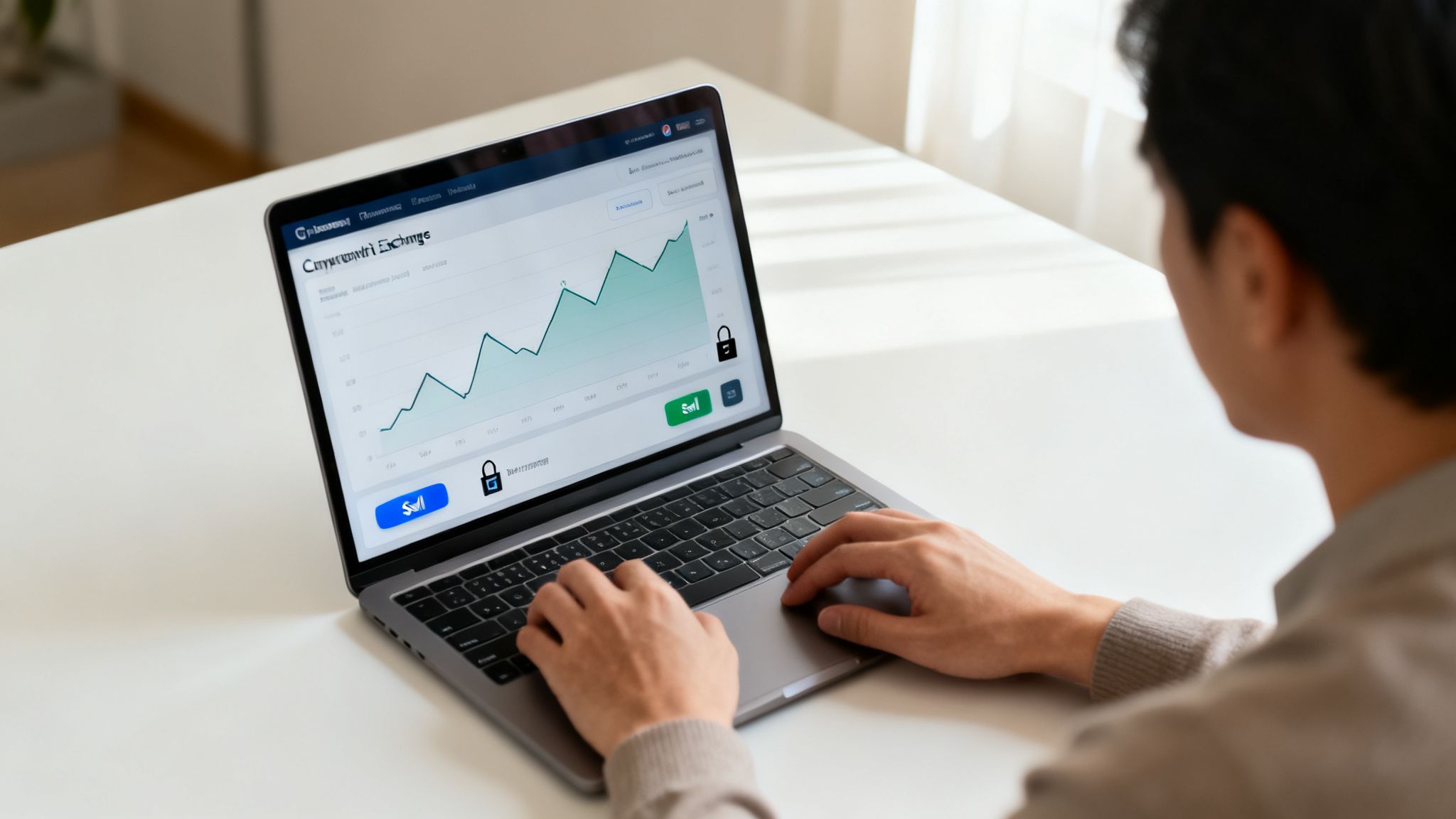
For merchants and creators who handle regular Bitcoin payments, centralized exchanges are the most direct and well-trodden path back to fiat. Think of them as the digital equivalent of a foreign currency exchange booth you'd find at an airport, just for your Bitcoin. They’re built to handle large volumes, meaning you can sell without causing massive price slips.
This is the go-to method for any business that needs low fees, solid security, and a reliable bridge to the traditional banking system. Sure, it involves a few more clicks than a Bitcoin ATM, but the savings and dependability make it the professional standard.
Setting Up Your Exchange Account
Before you can sell a single satoshi, you need a verified account on a reputable exchange. The process is pretty standard but requires some paperwork to comply with global financial regulations. The main hurdle here is completing the Know Your Customer (KYC) verification.
To get through KYC, you'll usually have to submit:
- A government-issued photo ID (a driver's license or passport works).
- Proof of your address, like a recent utility bill or bank statement.
- Sometimes, a quick selfie holding your ID to prove you're really you.
This whole process is a mandatory anti-money laundering (AML) measure for almost any platform that touches the banking system. It might feel a bit invasive, but it’s actually a good sign—it means the exchange is playing by the rules, which adds a layer of legitimacy and security. Getting approved can take anywhere from a few hours to a couple of days.
Transferring Bitcoin from Your Wallet
Once your account is verified, it’s time to move your Bitcoin from your personal, non-custodial wallet over to the exchange. This is where you need to be extra careful.
Log in to your exchange account and look for the "Deposit" option for Bitcoin (BTC). The exchange will generate a unique deposit address just for your account. This long string of characters is your destination.
Security Tip: Always copy and paste the full address. Never, ever try to type it manually. Once you paste it into your wallet's "send" field, double-check the first and last four characters to make sure they match perfectly. A typo here is irreversible—your Bitcoin will be gone for good.
It's always a good idea to send a small test transaction first. Moving a tiny amount confirms everything is working correctly before you commit to sending the full balance.
Placing Your Sell Order
After your Bitcoin deposit gets confirmed on the blockchain and shows up in your exchange account, you’re ready to sell. Head over to the trading pair for Bitcoin and your local currency (like BTC/USD, for example). You’ll generally have two main ways to sell.
Understanding Order Types:
- Market Order: This is the "sell it now" button. It executes your sale instantly at the best available market price. It's perfect when speed is more important than squeezing out every last cent.
- Limit Order: This option gives you full control. You set the exact price you're willing to sell at. Your order will only go through if the market price hits your target. This is the way to go if you have a specific price in mind and you’re not in a hurry.
For a business cashing out daily revenue, a market order is usually the most practical choice to get the job done quickly. If you're looking to maximize the return on a larger sum, a limit order offers a more strategic approach.
Withdrawing Cash to Your Bank
The last leg of the journey is moving the cash from your exchange account to your bank. Before you can do this, you'll need to link your bank account by providing your account and routing numbers.
Once that’s set up, you can initiate a withdrawal. Just keep a few things in mind:
- Withdrawal Fees: Exchanges charge for fiat withdrawals. This could be a flat fee or a percentage of the amount.
- Processing Times: A standard bank transfer can take 1-3 business days to land in your account. Some exchanges offer faster wire transfers, but they usually cost more.
- Withdrawal Limits: Most exchanges impose daily or monthly withdrawal limits. If you’re a high-volume merchant, make sure the exchange’s limits won't become a bottleneck for your operations.
Follow these steps, and you'll have a reliable, cost-effective system for turning your Bitcoin into cash, ensuring your business revenue is always accessible.
Taking Control with Peer-to-Peer (P2P) Platforms
If you're someone who prefers privacy and direct control over their assets, then Peer-to-Peer (P2P) platforms are a powerful alternative to centralized exchanges. Instead of selling your Bitcoin to a massive corporation, P2P marketplaces connect you directly with another person who wants to buy it. It’s a method that feels much closer to Bitcoin's original vision—a direct, person-to-person financial system.
This approach is particularly compelling for merchants and creators who live by the mantra of self-custody. On a P2P platform, you're the one in the driver's seat. You get to set your own price, pick from a huge menu of payment methods, and deal directly with the buyer, all while your Bitcoin stays secure.
How P2P Actually Works
The heart of any legitimate P2P platform is its escrow service. Think of it as a neutral holding pen. When a trade kicks off, your Bitcoin is locked in this escrow. The buyer sends their fiat payment directly to you, and only once you've confirmed the money has landed safely in your account do you release the Bitcoin.
This simple system is brilliant because it protects everyone involved:
- For you, the seller: It stops a buyer from taking your Bitcoin before they've paid.
- For the buyer: It guarantees you can't just take their cash and vanish.
This escrow mechanism is the bedrock of trust that makes P2P a genuinely viable way to cash out. It turns what could be a risky handshake deal into a structured, safe transaction.
Creating Your Own Sell Offer
The real magic of P2P platforms is the ability to call the shots. When you post a "sell" ad, you can customize the fine print to attract exactly the kind of buyer you're looking for.
- Set Your Price: You can list a fixed price or let it float based on the market rate, maybe adding a small premium. If you’re not in a rush, you can often get a better price than you would on an exchange.
- Choose Payment Methods: Want to get paid via a specific bank transfer, a digital wallet app, or something else? You decide. The more options you offer, the bigger your pool of potential buyers.
- Define Trade Limits: You can set minimum and maximum amounts you’re willing to sell in a single trade, which is great for managing your cash-out strategy.
By tailoring your offer, you’re creating a bespoke selling experience that fits your needs perfectly, whether you're cashing out a small payment or liquidating a larger holding.
The flexibility is the key benefit of P2P. Unlike the rigid, one-size-fits-all model of a centralized exchange, you can negotiate terms and use payment methods that bigger platforms won't touch. This gives you far more control over the entire process.
Vetting Buyers and Dodging Scams
The direct nature of P2P trading means you need to do a little more homework. Your best defense is to carefully check out potential buyers. Every decent platform has a reputation system where users leave feedback on past trades.
Before you agree to any trade, always look at the buyer's profile for a few key things:
- Positive Feedback: A long history of successful trades is a massive green flag.
- Account Age: An account that's been active for a while is generally more trustworthy than one created yesterday.
- Verification Status: Many platforms offer optional ID verification, which adds another layer of confidence.
The absolute golden rule of P2P is this: never, ever release your Bitcoin from escrow until you have confirmed the payment has fully cleared in your own account. Scammers are notorious for sending fake payment receipts or using payment methods they can reverse later. Always log in to your bank or payment app yourself to see that the funds are really there and settled. Stick to this one rule, and you’ll sidestep the vast majority of potential headaches.
Getting Instant Liquidity with Bitcoin ATMs and Debit Cards
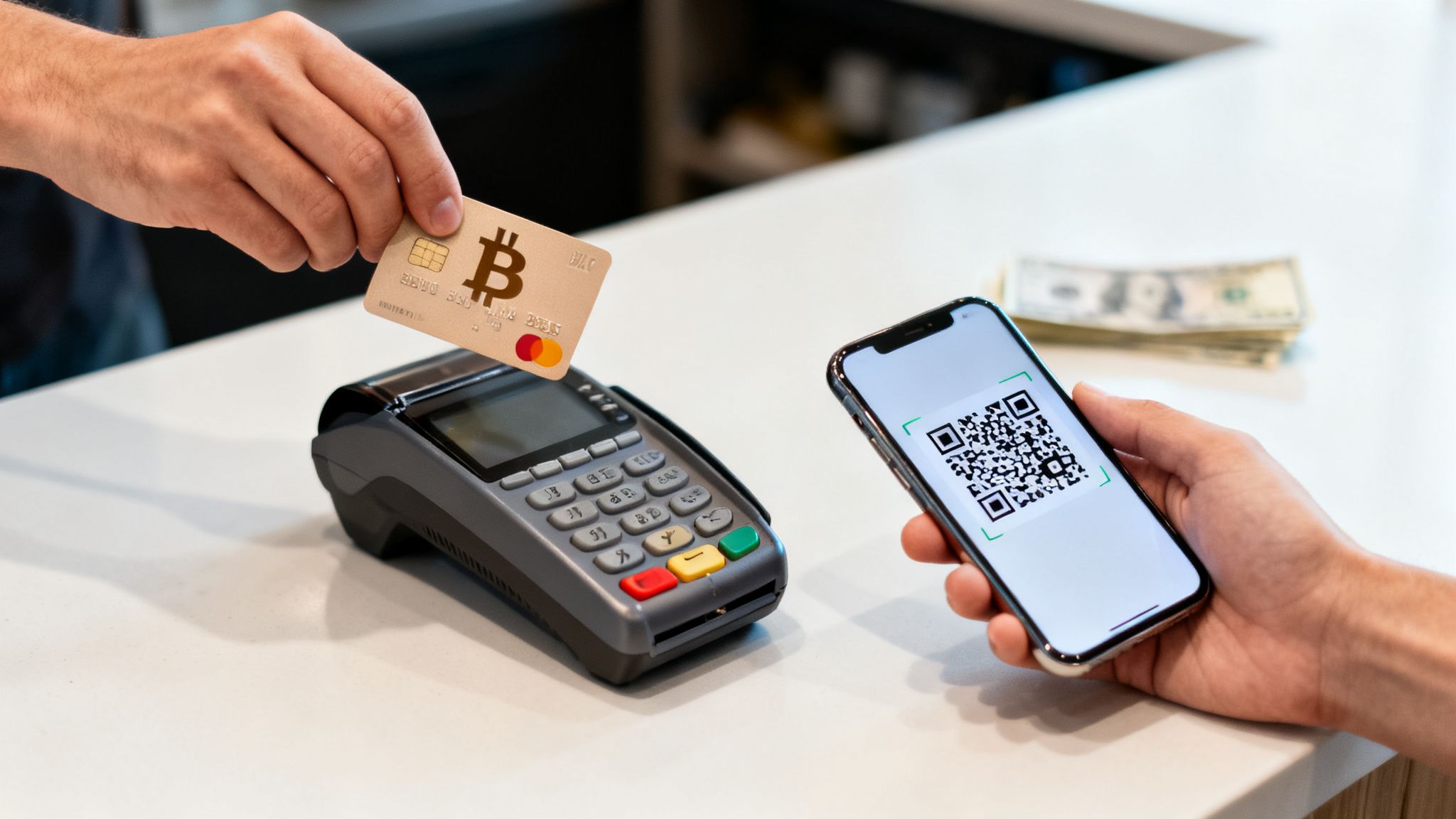
Sometimes, you need to turn your Bitcoin into spendable cash, and you need it now. Waiting days for a bank transfer just won’t work. For those moments, Bitcoin ATMs and debit cards are your fastest options, acting as a direct bridge from your digital wallet to the physical world.
These methods are all about speed and convenience. Centralized exchanges and P2P platforms are great for larger, planned conversions. But when you just need to buy a coffee or cover an unexpected bill without a fuss, these instant liquidity tools are exactly what you're looking for.
Using a Bitcoin Debit Card
A Bitcoin debit card works almost exactly like the bank card already in your wallet. You top it up with Bitcoin, and you can spend it anywhere that accepts standard debit cards.
The real magic is what happens behind the scenes. When you swipe or tap, the card provider instantly converts just enough BTC into fiat to complete the transaction.
The main draw here is how seamlessly it fits into daily life. You don't have to pre-sell your Bitcoin before you go shopping; the conversion happens on the fly. This is a game-changer if you want to truly "live on" Bitcoin without constantly managing conversions.
For merchants and creators, having a Bitcoin debit card offers a quick way to spend business revenue without routing it through a traditional bank account first. It streamlines expenses and keeps your operations fluid.
How to Cash Out with a Bitcoin ATM
Bitcoin ATMs are the most direct route from digital assets to physical cash. Think of them as a reverse vending machine: you send in Bitcoin, and paper money comes out. It’s a simple, walk-up solution that doesn’t even require a bank account.
The process is usually dead simple:
- Find an ATM: Use an online map to locate a Bitcoin ATM near you.
- Start the Sale: Choose the "Sell Bitcoin" option on the screen.
- Send Your Bitcoin: The ATM shows a QR code. Scan it with your wallet app and send the exact amount of BTC you want to sell.
- Grab Your Cash: Once the transaction is confirmed on the blockchain (usually pretty quick), the machine dispenses your cash.
This method can take just a few minutes from start to finish. But that convenience comes at a very steep price.
The Trade-Off: Speed vs. Fees
While ATMs and debit cards are champions of speed, they are almost always the most expensive ways to cash out your Bitcoin.
Bitcoin ATM fees are notoriously high, often ranging from 7% to over 15% of your transaction. Debit cards are a bit better, but you still have to watch out for conversion fees, monthly charges, or withdrawal limits.
You are paying a significant premium for that instant access. For a small, urgent need, that cost might be worth it. But if you're cashing out larger amounts or doing it regularly, the fees will eat into your funds fast. In those cases, exchanges or P2P platforms are the smarter financial choice.
The good news is that the need for these middlemen is shrinking as more businesses adopt direct Bitcoin payments. The whole ecosystem is shifting. Data shows nearly 40% of U.S. retailers now accept digital currency at the point of sale, and 84% of merchants expect crypto payments to be commonplace within five years. You can discover more about this rapid merchant adoption and see just how quickly direct spending is becoming a reality.
Understanding Tax Obligations When You Sell Bitcoin
Getting your Bitcoin cashed out is a great feeling, but it's only half the job. The other, less exciting half, is squaring up with the taxman.
Regulators in most countries are watching Bitcoin transactions closely, and selling Bitcoin for fiat currency is almost always a taxable event. Getting this wrong can lead to some hefty penalties, so it's a step you absolutely can't afford to skip.
This isn't just for day traders, either. If you're a merchant or creator getting paid frequently in Bitcoin, wrapping your head around the tax side of things is crucial for clean books and staying compliant.
Capital Gains Tax on Bitcoin
Here’s the deal: when you sell Bitcoin for more than you originally paid for it, that profit is usually considered a capital gain. Tax authorities like the IRS in the US don't see Bitcoin as currency; they see it as property. That means you owe tax on the appreciation in value from the moment you got it to the moment you sold it.
To figure out how much you owe, you need two numbers:
- Cost Basis: The original price of the Bitcoin in your local currency when you acquired it. For merchants, this is the fiat value on the day a customer paid you.
- Sale Price: The amount of fiat you got when you cashed out.
The difference between those two is your capital gain (or loss). To really get a handle on this, it's worth understanding exactly when Capital Gains Tax (CGT) applies to your Bitcoin sales. Seriously, meticulous records aren't just a good idea—they're non-negotiable.
The Importance of Meticulous Record-Keeping
You can't manage what you don't measure. For every single transaction—whether you're receiving a payment or cashing out—you have to keep a detailed log.
Your records for each transaction should include:
- Date of Acquisition: When you received the Bitcoin.
- Cost Basis: The fiat value at that exact time.
- Date of Sale: When you cashed out.
- Sale Price: The fiat value you received from the sale.
- Fees Paid: Any transaction or exchange fees involved.
Disclaimer: This information is purely for educational purposes and isn't financial or tax advice. Tax laws are complex and vary wildly from one place to another. Always talk to a qualified tax professional to figure out your specific obligations.
Having this data ready makes tax season infinitely less painful. If you're a business handling dozens of Bitcoin payments a week, investing in Bitcoin tax software or an automated tracker is a no-brainer. It will save you countless hours and ensure your numbers are spot-on when you hand them over to your accountant.
Got Questions About Selling Your Bitcoin? We've Got Answers.
When you start accepting or holding Bitcoin, sooner or later, you’ll need to turn it into cash. This process often sparks a few common questions, especially for merchants and creators who are new to the game. Let's clear up some of the most frequent queries so you can off-ramp your Bitcoin with confidence.
What Is the Fastest Way to Cash Out Bitcoin?
If you need physical cash in your hand right now, your best bets are Bitcoin ATMs and Bitcoin debit cards. An ATM lets you swap BTC for cash in minutes, and a debit card makes your Bitcoin spendable at any checkout counter by converting it on the spot.
But speed comes at a price. Both of these options tend to have much higher fees than other methods. If you're looking for a balance, some centralized exchanges offer "instant withdrawal" services that can hit your bank account within hours. Your standard bank transfer, however, will usually take about 1-3 business days to land.
Can I Cash Out Bitcoin Without KYC Verification?
Yes, it's definitely possible to cash out Bitcoin without going through a full Know Your Customer (KYC) identity check, but you'll need to stick to more decentralized routes. The most popular paths here are Peer-to-Peer (P2P) marketplaces and certain Bitcoin ATMs.
On P2P platforms, you're dealing directly with another person, and for smaller amounts, ID verification often isn't required. Similarly, many Bitcoin ATMs have transaction limits—stay under the threshold, and you won't need to scan your ID. While these methods offer more privacy, they demand extra caution to steer clear of scams.
The trade-off for privacy is almost always a higher risk. If you're using a P2P service, always make sure you have independently confirmed the payment has landed in your account before you even think about releasing your Bitcoin from escrow.
How Are Taxes Calculated When Cashing Out Bitcoin?
This is where things can get tricky, and it’s a two-part process.
First, when you receive Bitcoin as payment, its value in your local currency at that moment is counted as income. Simple enough. But a second, separate taxable event happens when you sell that Bitcoin for cash.
If the price of Bitcoin went up between when you got it and when you sold it, you likely owe capital gains tax on that profit. To figure this out, you need to know two key numbers:
- Your cost basis: The fiat value of the Bitcoin when you first acquired it.
- The sale price: The fiat value you got when you cashed it out.
Your capital gain (or loss) is simply the difference between the two. This makes meticulous, consistent record-keeping an absolute must for staying on the right side of the law. I can't stress this enough: always chat with a qualified tax professional to get advice tailored to your specific situation and location.
Ready to accept Bitcoin payments directly from your customers' wallets, with no middlemen or painful fees? Flash gives merchants the tools to integrate seamless, non-custodial Bitcoin payments in under a minute. Start accepting global payments today at .