Turning your Bitcoin into US dollars might seem daunting, but it really just comes down to a few solid methods. Let's cut through the noise and look at exactly how you can convert your crypto into cash, securely and without any fuss. We'll cover the most reliable paths, from big-name centralized exchanges to the instant gratification of a Bitcoin ATM.
Your Guide to Cashing Out Bitcoin
If you're a merchant accepting Bitcoin, figuring out how to convert that crypto to USD is a critical business decision. A clear off-ramp strategy gives you total control over your revenue. You can manage cash flow, pay suppliers, and cover all your operational costs in your local currency. Without a plan, you risk getting hit with delays or unexpectedly high fees.
This process of turning digital assets into spendable cash is what we call "off-ramping." Think of it as the exit ramp from the crypto highway back onto the familiar roads of the traditional financial system. Each method strikes a different balance between speed, cost, and convenience. Your best choice depends entirely on what you need—whether that’s instant access to cash or the lowest possible fees for large amounts.
Comparing Common Conversion Methods
To make the right call for your business, it helps to see all your options laid out. The most popular routes include centralized exchanges, known for their deep liquidity; peer-to-peer (P2P) platforms that connect you directly with buyers; and specialized tools like Bitcoin ATMs for when you need physical cash right now.
Choosing the right off-ramp isn’t just about getting the best exchange rate. It’s about matching the method to your business's rhythm and financial goals. A high-volume e-commerce store has very different needs than a freelancer who gets paid in crypto every now and then.
Before we get into the nuts and bolts, it can be helpful to understand the wider context of cryptocurrency use. This guide will give you a clear roadmap so you can confidently pick the off-ramp strategy that works for you.
Here’s a quick look at how the most common Bitcoin-to-USD conversion methods stack up against each other.
Bitcoin to USD Conversion Methods at a Glance
This table breaks down the key differences in speed, fees, and ideal use cases for the most popular off-ramps.
| Method | Average Speed | Typical Fees | Best For |
|---|---|---|---|
| Centralized Exchanges | 1-5 business days | Low (0.1% - 1.5%) | High-volume, secure conversions where immediate access isn't critical. |
| Peer-to-Peer (P2P) | Minutes to hours | Varies by user | Getting flexible payment options and potentially better rates. |
| Bitcoin ATMs | Instant | High (7% - 20%) | Quick access to small amounts of physical cash. |
Each path has its place. A centralized exchange is your go-to for large, non-urgent conversions, while an ATM is perfect for grabbing a small amount of cash on the go.
Using Centralized Exchanges for Fiat Conversion
For most people and businesses trying to figure out how to convert crypto to USD, centralized exchanges (CEXs) are the most well-trodden path. Think of them like a stock brokerage but for digital assets—they provide a structured, high-liquidity environment to sell your Bitcoin for dollars. Their entire business is built around making this process as smooth as possible, which is why they’re often the first port of call for merchants managing Bitcoin revenue.
The biggest draw of a CEX is its deep pool of buyers and sellers. This high liquidity means you can pretty much always sell your Bitcoin at a fair market price without tanking the price, which is a massive deal for businesses handling a steady flow of transactions.
Getting Started with an Exchange
Before you can off-ramp, you have to create and verify an account on a reputable exchange like Coinbase or Kraken. The process is straightforward but does require you to hand over some personal or business info due to strict regulations.
You'll start by signing up with an email and a strong password. But to unlock the ability to actually sell for fiat, you must complete the Know Your Customer (KYC) process. This is a non-negotiable step for any compliant exchange operating in the United States.
KYC verification usually means providing:
- Personal Identification: A government-issued photo ID like a driver's license or passport.
- Proof of Address: A recent utility bill or bank statement with your name and address.
- Social Security Number: This is required for tax reporting.
For a business account, the paperwork is a bit heavier. Expect to provide articles of incorporation, an EIN, and details about the business owners. It can feel a little invasive, but this is all in the name of preventing fraud and complying with Anti-Money Laundering (AML) laws.
Pro Tip: Get your documents scanned and ready to go before you even start the sign-up process. Sometimes the verification is automated and takes minutes, but if it needs a manual review, it could take a day or two. Being prepared is the best way to speed things up.
Transferring Bitcoin to the Exchange
Okay, so you're verified. The next move is getting your Bitcoin from your personal or business wallet (like the one you'd use with a service like Flash) onto the exchange. This is where you need to be extra careful.
Inside your exchange account, look for a "Deposit" or "Receive" option. This will generate a unique Bitcoin wallet address tied directly to your account. This is where you'll send the funds.
Crucial Security Check: Always double—or even triple—check the wallet address before you hit send. One wrong character and your Bitcoin is gone forever, sent into the digital void with no undo button. A good habit is to copy and paste the address, then visually confirm the first four and last four characters match up between your wallet and the exchange.
Once you send the transaction from your wallet, you have to wait for it to be confirmed on the Bitcoin network. This can take anywhere from ten minutes to over an hour, all depending on how busy the network is. The exchange will let you know when the deposit hits your account.
Executing the Sale and Understanding Fees
With your Bitcoin sitting in your exchange account, you're ready to pull the trigger. Head over to the trading section and find the BTC/USD pair. You'll see a few different ways to place an order, but the two you'll use most are market orders and limit orders.
- Market Order: This sells your Bitcoin immediately at the best price available at that exact moment. It's fast and easy, but you have less control over the final sale price.
- Limit Order: This lets you set the exact price you’re willing to sell at. Your order will only go through if the market hits your target price.
Exchanges make their money on trading fees, often broken down into maker and taker fees. A "taker" places a market order that gets filled instantly, literally "taking" liquidity off the books. A "maker" places a limit order that isn't filled right away, "making" liquidity for the market. Taker fees are usually a bit higher. For merchants looking to shave off costs, using limit orders can lead to small but meaningful savings over hundreds of transactions.
Withdrawing Your USD to a Bank Account
You're on the home stretch. The final step in converting your crypto to USD is getting that cash into your bank account. After the sale, the US dollars will show up in your exchange's fiat wallet. From there, you can kick off a withdrawal.
First, you'll need to link your bank account by providing your account and routing numbers. The two main ways to get your money out are:
- ACH Transfer: This works just like a standard direct deposit. It's usually free, but it's not instant—expect the funds to land in your account in 1-3 business days.
- Wire Transfer: This is the express option, often arriving the same day. That speed comes at a price, though, typically costing between $25 and $35.
Before you do anything, make sure you've enabled Two-Factor Authentication (2FA) on your account. Using an app like Google Authenticator adds a vital layer of security that protects your funds from being accessed by anyone else. It's a simple step, but it's one of the most effective ways to keep your assets safe.
Exploring P2P Platforms and OTC Desks
Centralized exchanges are the go-to for many, but they're far from the only game in town when you need to convert crypto to USD. If you're dealing with larger volumes or just want more direct control, Peer-to-Peer (P2P) platforms and Over-the-Counter (OTC) desks are powerful alternatives. These methods take you out of the public order books and into a world of direct negotiation and specialized service.
Think of a P2P platform as a marketplace, connecting you directly with other people who want to buy your Bitcoin. Instead of placing a sell order and hoping an exchange's engine fills it, you can browse listings from other users or post your own. You set your price and, crucially, your preferred payment methods.

The Mechanics of Peer-to-Peer Trading
The real magic of P2P is the massive range of payment options. You can get paid via direct bank transfer, Zelle, PayPal, or even arrange for an in-person cash deposit. This kind of flexibility is a lifesaver for merchants and individuals who prefer not to link a traditional bank account to a crypto exchange.
But how do you trust a total stranger? P2P platforms solve this with an escrow system. When you accept a trade, your crypto is automatically moved into a secure, neutral holding account managed by the platform. It's locked up tight. Only after you confirm that the buyer's cash has safely landed in your account do you authorize the platform to release the crypto to them.
This escrow feature is a two-way street for security:
- For You (The Seller): You're safe from buyers who might try to ghost you after claiming they've paid. Your crypto doesn't move an inch until you give the green light.
- For The Buyer: They know the crypto is real and secured in escrow before they send a single dollar. This prevents sellers from taking the money and disappearing.
Because you're dealing directly with people, reputation is everything. Every P2P platform has user profiles with ratings, trade history, and feedback. My advice? Stick with users who have a long, positive track record. Someone with a 99% positive feedback score over hundreds of trades is infinitely more trustworthy than a new account with zero history.
Navigating Over-the-Counter Desks for Large Volumes
Now, let's talk big money. If you're a business, a fund, or just an individual looking to off-ramp a substantial amount—think $100,000 or more—using a regular exchange is a terrible idea.
Placing a massive sell order on a public market will almost certainly cause slippage. That's the painful moment when the size of your own order pushes the market price down while you're selling. You end up getting a much worse price than you anticipated, simply because your own trade spooked the market.
This is precisely the problem that Over-the-Counter (OTC) desks were created to solve. An OTC desk offers a private, white-glove service for executing these large "block trades." Instead of battling a public order book, you negotiate a fixed price directly with a dedicated trader.
An OTC desk isn't a marketplace; it's your direct counterparty. They give you a single, firm price for your entire crypto position. You can take it or leave it. This completely sidesteps the risk of slippage and gives you absolute price certainty on huge transactions.
The whole process is highly personalized. You'll work with an account manager who handles everything from price negotiation to final settlement, ensuring the trade is executed quickly and, most importantly, discreetly.
The main benefits of using an OTC desk are clear:
- Price Certainty: You lock in one price for your whole stash upfront, eliminating market risk.
- Deep Liquidity: These desks have access to huge pools of capital and can absorb massive orders without flinching.
- Privacy: Your trade never hits a public exchange, so the market doesn't see your move and react to it.
- Better Costs: While there are fees, they are often far more competitive than the combined trading fees and slippage you'd suffer on an exchange for a large order.
OTC services aren't for your average trade; their minimums often start in the six-figure range. But for any merchant or business regularly converting significant crypto revenue, they are the most professional and cost-effective way to get into USD.
Bitcoin ATMs and Crypto Debit Cards for Instant Access
Exchanges and P2P platforms are great when you can plan your conversions, but what about when you need cash right now?
Whether it's an unexpected expense or you just want to pay for lunch, two tools are perfect for bridging the gap between your Bitcoin and the physical world: Bitcoin ATMs and crypto debit cards. These methods are all about speed, giving you a direct line to your USD without waiting on a bank transfer.
Cashing Out on the Spot with a Bitcoin ATM
When you absolutely need physical cash in your hand, a Bitcoin ATM is the fastest way to get it. These machines look and feel like regular ATMs, but instead of connecting to a bank, they let you sell your Bitcoin for US dollars in minutes.
You’ve probably seen them popping up in more places. With thousands now scattered across cities worldwide, they're becoming a genuinely accessible option when you need quick liquidity.
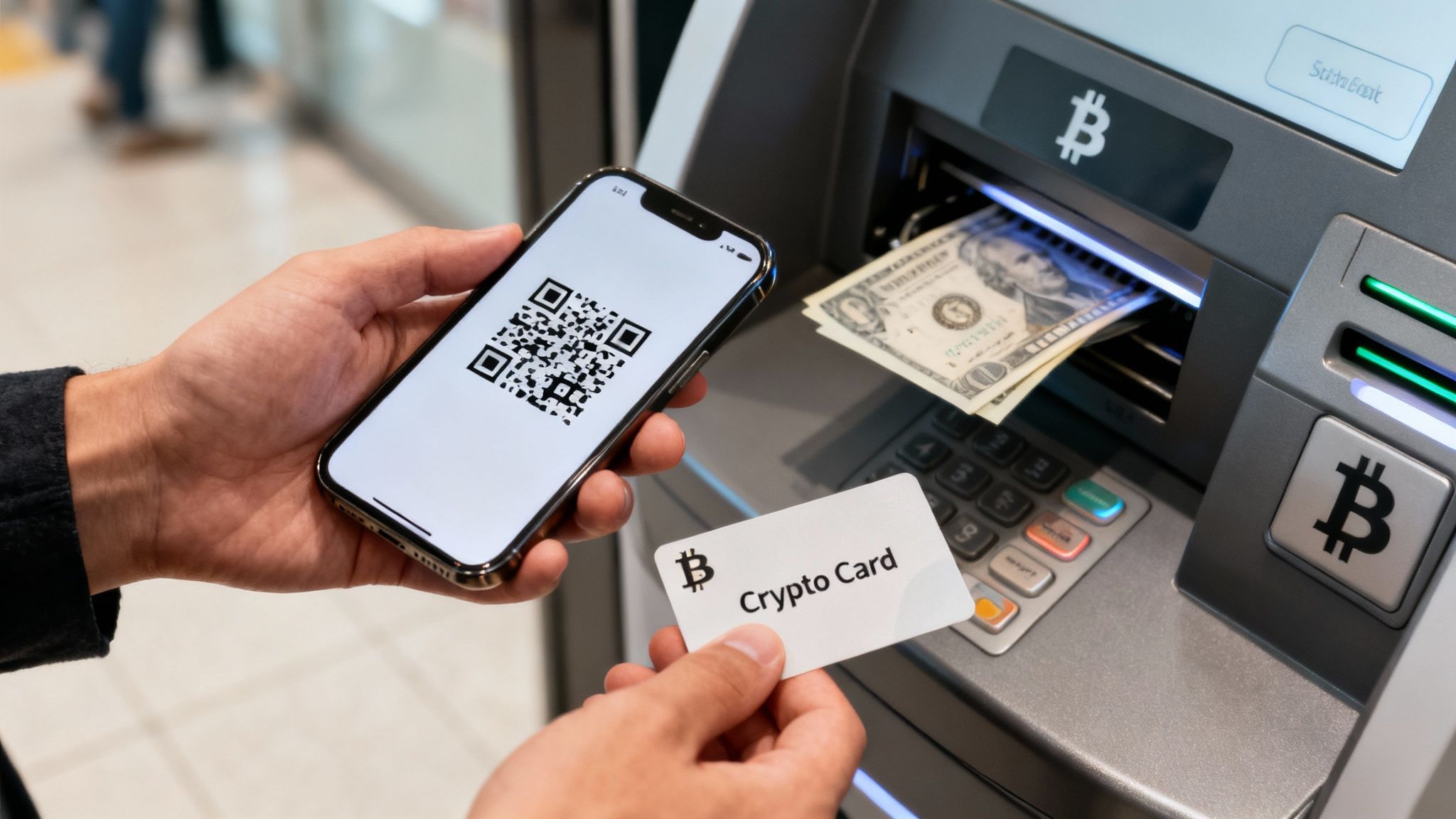
The whole process is built for speed. You don't need an exchange account, and there's no waiting around for bank processing. It's just you, your mobile wallet, and the machine.
Here's how a typical withdrawal plays out:
- First, you'll use an online map to find a nearby Bitcoin ATM that supports selling.
- At the machine, you’ll choose the "Sell Bitcoin" option and tell it how much cash you want.
- The ATM then shows you a QR code. Just scan it with your mobile wallet to send the right amount of BTC.
- You'll hang out for a few minutes while the Bitcoin network confirms the transaction, which usually takes about 10 to 30 minutes.
- Once it's confirmed, the machine dispenses your cash. Done.
But this convenience comes at a steep price. Bitcoin ATM fees are notoriously high, often anywhere from 7% to a whopping 20%. They also have pretty strict withdrawal limits, usually capping you at a few thousand dollars per day. They're best for small, urgent needs—not for off-ramping business revenue.
Think of a Bitcoin ATM as the convenience store of crypto off-ramps. It’s perfect when you need cash immediately and are willing to pay a premium for that speed. It’s not where you’d do your weekly grocery shopping.
Spending Your Bitcoin Directly with a Debit Card
For day-to-day spending, a crypto debit card is a much more practical—and cheaper—solution. These cards look and work just like a normal Visa or Mastercard, but instead of drawing from a bank account, they're linked directly to your crypto holdings.
This creates a seamless bridge for converting crypto to USD right at the point of sale. When you swipe your card to buy coffee or pay a supplier, the card provider instantly sells just enough of your Bitcoin to cover the purchase in dollars. The merchant gets paid in fiat, and you've just spent your Bitcoin without ever having to manually convert it.
This is an especially powerful tool for merchants using a non-custodial service like Flash to accept Bitcoin. You can load business revenue onto the card and use it for operational costs, creating a neat, self-contained financial loop.
The benefits here are pretty clear:
- Instant Spending Power: Use your Bitcoin anywhere that takes major credit or debit cards.
- Lower Fees: Conversion fees are way lower than ATMs, usually hovering around 1-2%.
- Incredible Simplicity: No logging into an exchange, placing a sell order, and waiting. The conversion is automatic and happens in the background.
These cards are fundamentally changing how we think about Bitcoin, turning it from a long-term asset into a liquid, spendable currency. They offer one of the simplest answers to converting crypto to USD for daily life, making your digital assets as useful as the cash in your wallet.
How Stablecoins Can Streamline Your Conversions
While selling Bitcoin directly for USD on an exchange is the most obvious route, there's a smarter, more strategic move that experienced traders often use, especially when the market gets choppy. This is where stablecoins come in.
Think of them as a crucial bridge in your crypto-to-fiat journey. They give you a way to lock in your profits without having to immediately send your cash to a traditional bank account.
Essentially, a stablecoin is just a digital version of the US dollar. When you sell your Bitcoin for a USD-backed stablecoin, you're swapping a volatile asset for one that’s price-stable. This move shields your capital from Bitcoin's notorious price swings, all while keeping your funds agile and ready for whatever you decide to do next.
The Strategic Pause
The biggest win here is stability. Instead of rushing to pull cash out and into your bank, converting to a stablecoin gives you some breathing room. You can sit back, watch the market, and plan your next move without the nagging worry that a sudden price crash will wipe out your gains.
This method also comes with some practical perks over an immediate fiat withdrawal:
- Much Faster Settlement: Swapping Bitcoin for a stablecoin on an exchange is almost instant. That’s a world away from the 1-3 business days an ACH transfer to your bank can take.
- Often Lower Fees: Trading fees for crypto-to-crypto pairs (like BTC to a stablecoin) are frequently cheaper than the fees for trading crypto directly to fiat.
- Keeps You Agile: Your funds stay within the crypto ecosystem, ready to be sent to another platform or redeployed in the market with almost no delay.
This approach is like creating a holding pattern for your capital. It's a secure parking spot where your funds are pegged to the dollar, just waiting for your command to make the final leap into your bank account.
A Powerful Bridge to Fiat
Stablecoins have become the go-to infrastructure for moving value between the crypto and traditional financial worlds. This isn't some niche concept anymore; it's a massive, fully-functioning system.
The explosive growth alone tells you how reliable this bridge has become. Stablecoin transaction volume shot up by 83% in a single year, hitting over $4 trillion in just the first seven months. By September, the monthly adjusted volume had swelled to roughly $1.25 trillion, which shows you just how mature this off-ramp pathway has become. You can dig into more of this data on TRM Labs.
For a merchant, this method is a game-changer for cash flow. You can convert daily Bitcoin revenue into a stablecoin, building up a stable, dollar-equivalent balance. When it's time to pay suppliers or cover business costs, you just perform a single, larger withdrawal to your bank. It simplifies your accounting and cuts down on transaction clutter.
This two-step process—selling Bitcoin for a stablecoin, then selling the stablecoin for USD—gives you an incredible mix of stability, speed, and strategic flexibility. It’s a more sophisticated way to manage your off-ramp, putting you in far greater control than a direct-to-bank approach ever could. By adding this one simple step, you're much better equipped to navigate your conversion from crypto to USD like a pro.
Navigating Tax and Security Responsibilities
Cashing out your Bitcoin for USD isn't just a simple swap. It’s a move that brings some serious legal and security responsibilities you absolutely can't afford to ignore.
Any time you sell crypto for dollars, the IRS generally views it as a taxable event. That means the transaction could result in a capital gain or loss, and either way, you have to report it.
Think of it like any other business activity—good record-keeping is non-negotiable. You’ll need to track the date, the exact USD value at the time of the sale, and any fees you paid for every single transaction.
Staying Compliant with Tax Obligations
If you're an active merchant, trying to track hundreds—or thousands—of transactions manually is a recipe for a headache. This is exactly why specialized crypto tax software has become a must-have tool. These platforms link up with your wallets and exchanges, automatically pulling in your transaction history to calculate your gains and losses for you.
Keeping meticulous records isn't just about staying out of trouble with the taxman; it's about smart financial management. When you track everything accurately, you get a real picture of your profitability and avoid nasty surprises come tax season.
It’s crucial to get a firm grip on what your local tax authorities expect. While aimed at a UK audience, resources like the HMRC guidance on cryptoasset taxes offer a solid framework that can provide helpful context no matter where you're based.
The United States is, by far, the world's biggest hub for cashing out crypto. USD-based conversions accounted for over $2.4 trillion in total volume, which is nearly four times higher than the next country on the list. For merchants, this deep market means better exchange rates and plenty of ways to off-ramp. But it also highlights just how important proper reporting has become.
Protecting Your Funds During Conversion
Beyond taxes, your personal security habits are your last and most important line of defense. The crypto world is, unfortunately, full of scammers trying to get their hands on your funds.
Here are a few essential security habits to build:
- Double-Check Every Address: When sending Bitcoin to an exchange, always, always verify the wallet address. A common scam uses malware that swaps the address you copied with the scammer's. Check the first few and last few characters to be sure.
- Beware of Phishing: Scammers are experts at creating fake login pages for popular exchanges to steal your credentials. Never click on suspicious links. Always go directly to the exchange's website or use a trusted bookmark.
- Use Secure Platforms: Stick with well-known exchanges and platforms with a long history of solid security. Make sure you enable every security feature they offer, especially two-factor authentication (2FA).
Ultimately, your own diligence is what matters most. The deep liquidity in the U.S. market offers a relatively safe playground, but no platform can protect you from a mistake you make on your end. Treat every transaction with caution.
Common Questions About Cashing Out Crypto
Turning your crypto into dollars is a common goal, but the process often comes with a few recurring questions. Let's tackle some of the most frequent things we hear from merchants and individuals looking to off-ramp their Bitcoin safely and efficiently.
What’s the Absolute Fastest Way to Convert Bitcoin to USD?
This really depends on what you mean by "fast."
If you need physical cash in your hand right now, nothing beats a Bitcoin ATM. You can often have US dollars within 30 minutes, but be prepared for some pretty steep fees for that convenience.
If you just need instant spending power, a crypto debit card is your best bet. It works just like a regular debit card, converting your Bitcoin to dollars at the exact moment you swipe, tap, or click.
And if your goal is getting funds into your bank account, selling on a major exchange and requesting a wire transfer is the quickest route. Wires can sometimes land the same day. An ACH transfer will save you some money on fees, but it's slower, typically taking 1-3 business days to clear.
Can I Really Convert Bitcoin to USD Without KYC?
The short answer? Not really, at least not for any meaningful amount.
Your options for cashing out Bitcoin without going through a Know Your Customer (KYC) identity check are incredibly limited and usually come with very low transaction caps.
You might find some peer-to-peer (P2P) traders or the odd Bitcoin ATM that will let you swap a very small amount without a full ID check. But these are becoming rare and can carry much higher risks. For any serious volume, and especially for business transactions, every legitimate and secure off-ramp is going to require identity verification. It's how they comply with anti-money laundering regulations.
How Can I Keep My Fees as Low as Possible When Cashing Out?
Minimizing fees is all about doing a little homework.
Start by comparing the fee schedules on a few different centralized exchanges. You need to look at two numbers: the trading fee (what it costs to sell your BTC) and the withdrawal fee (what it costs to send the resulting USD to your bank). A pro tip: using a "limit order" instead of a "market order" can often get you a lower "maker" fee on the trade itself.
On P2P platforms, there might not be a direct fee, but the exchange rate you get from the buyer is often less competitive. Always do the math to see what you'll actually end up with. For very large transactions, an OTC desk will almost always get you the best final price because they help you avoid slippage—the price drop that can happen when a large sell order hits the open market.
As a merchant, accepting Bitcoin shouldn't be a headache. With Flash, you can accept direct wallet-to-wallet Bitcoin payments instantly with no intermediaries, KYC, or chargebacks. You can get started in under a minute at .