Alright, let's get you set up with your first crypto wallet. Before you can stack any sats or receive your first Bitcoin, you need a wallet address. It's a crucial first step, but it's easy to get tangled up in the terminology right out of the gate.
So, let's clear things up. Think of your wallet as the secure program that holds your funds and your address as the specific spot where people can send you crypto. Mixing these two up is a classic beginner's mistake, but getting this distinction down is your real entry ticket into the world of Bitcoin.
And you're in good company. The crypto space is booming, with the number of identity-verified users now soaring past 430 million worldwide. This isn't some niche hobby anymore. As more people jump in, knowing the fundamentals—like how to create and manage a wallet address—becomes absolutely essential. You can dive deeper into this global adoption trend and its market impact to see just how big this is getting.
Wallet vs. Address: The Core Difference
Let's break it down simply: your wallet holds the keys, and your address receives the coins.
Crypto Wallet: This is the software (on your phone or computer) or a physical hardware device you use to interact with the blockchain. Its main job is to protect your private keys—the secret codes that prove you own your crypto and give you the power to spend it.
Wallet Address: This is a long string of letters and numbers that your wallet generates. It's completely public and safe to share. You can post it, email it, or text it to anyone who wants to send you funds. It’s like your bank account number or IBAN, but for the digital age.
Here's a helpful way to think about it: Your wallet is like your entire email account (e.g., your Gmail or Outlook). Your wallet address is your specific email address (e.g., [email protected]). You share your email address to get messages (coins), but you’d never, ever share your account password (private key).
To get started, you need to pick a wallet. They come in a few different flavors, each offering a unique mix of convenience and security.
Quick Comparison of Common Wallet Types
Choosing the right wallet really depends on what you plan to do. Are you a daily trader, a long-term holder, or just dipping your toes in? This table breaks down the main options to help you decide.
| Wallet Type | Best For | Security Level | Ease of Use |
|---|---|---|---|
| Software (Mobile/Desktop) | Daily use, frequent trading, and small amounts | Medium | High |
| Hardware (Physical Device) | Long-term holding and large amounts | High | Medium |
| Web (Browser-Based) | Quick access and interacting with dApps | Low | High |
For most newcomers, a software wallet on your phone or desktop is the perfect starting point. It strikes a great balance, giving you enough security for your first transactions while being incredibly user-friendly. Once you start accumulating a significant amount, you can—and should—look into upgrading to a hardware wallet for maximum security.
Alright, let's get this sorted. Choosing the right wallet is your first real fork in the road on your crypto journey, and it all boils down to what you plan to do with your assets. Before you even touch a "create wallet" button, you need to decide what kind of wallet actually fits your life.
There's no single "best" wallet—just what's best for you.
Are you planning to be an active user, maybe grabbing coffee or paying for things online? Or is your game plan more about long-term investing, locking down your Bitcoin for years? Your answer will point you toward either a software wallet or a hardware wallet.
Convenience vs. Security: The Fundamental Trade-Off
This is the core dilemma you'll face. It's a constant balancing act.
Software wallets, often called "hot wallets," are just apps on your phone or computer. Because they're always connected to the internet, they’re incredibly convenient for everyday transactions.
- Mobile Wallets: Perfect if you're out and about. Think of using a wallet like Exodus or Muun on your phone to instantly pay a merchant. Super slick.
- Desktop Wallets: Better suited for folks who manage their crypto from a main computer. They usually pack more features, which is great for active traders or power users.
But that convenience comes with a catch. Being online, even with top-notch security, introduces a tiny bit of risk. And that’s where the other side of this trade-off shines.
The Fort Knox Approach: Hardware Wallets
When it comes to holding for the long term or securing a serious amount of value, nothing—and I mean nothing—beats a hardware wallet.
These are small, physical devices that keep your private keys completely offline. This is what we in the space call "cold storage."
A simple way to think about it: A software wallet is your everyday billfold you carry in your pocket. A hardware wallet, like a Ledger or Trezor, is your personal bank vault at home. You wouldn't walk around with your life savings in your back pocket, right? The same logic applies here.
Hardware wallets are the undisputed gold standard for security. Why? Because transactions are signed on the device itself. Your private keys never, ever touch your internet-connected computer or phone. This makes them virtually immune to online hacks like malware and phishing scams.
So, the choice is yours: do you prioritize easy, daily access, or do you need fortress-grade security?
Understanding the Tech That Keeps Your Wallet Safe
Before you can confidently create and use a Bitcoin address, it helps to peek under the hood and see what’s actually going on. It all boils down to your private key, a secret string of numbers and letters that acts as the one and only master key to your Bitcoin.
This key is everything. It's the only thing that can sign off on transactions and prove you own your funds. Keep it secret, keep it safe.
From this all-important private key, a corresponding public key is generated through a one-way mathematical process. The magic here is that it's simple to create the public key from your private one, but it's virtually impossible to do the reverse.
Think of it like baking a cake. You can easily follow a recipe to mix flour, eggs, and sugar into a delicious cake. But you can never, ever un-bake that cake to get your original ingredients back. Your private key is the recipe; the public key is the finished cake.
This one-way street is the bedrock of Bitcoin's security. It means you can share derived information without ever exposing the secret key that controls your money.
From Public Key to Your Shareable Address
The journey doesn't end with the public key. To create the actual wallet address—the string you give to people so they can pay you—your public key goes through a couple more transformations.
It gets "hashed" twice using powerful cryptographic functions, first SHA-256 and then RIPEMD-160. This process shortens and further secures the key, ultimately producing your final Bitcoin address.
This multi-step encoding makes trying to guess a private key a fool's errand. The odds are about one in 2^256—a number so vast it's larger than the estimated number of atoms in the known universe. With today's technology, a brute-force attack is simply not on the table. If you want to dive deeper, you can explore the crypto wallet market and its security principles.
So, to put it simply: your private key is the only part of this entire system that you must protect. Everything else, from your public key to your shareable address, is born from it but can never lead back to it.
Alright, theory is great, but let's get our hands dirty. I'm going to walk you through setting up your very first wallet address using a popular software wallet as an example.
The cool thing is, this process is pretty much the same across most good non-custodial wallets. Once you've done it once, you'll have the confidence to set up any reputable wallet out there.
First things first: always, always download the wallet software directly from the official source. That means their actual website or the official app store (Apple App Store or Google Play). If you're looking at a mobile wallet like Muun or a desktop one like Sparrow, never, ever click a link from a random forum or social media post. Scammers are experts at creating convincing fake sites to snatch your info.
Generating Your Wallet and Recovery Phrase
Once you have the legitimate app installed, fire it up. It will immediately guide you to create a new wallet. Pay close attention now, because this is the single most important moment of the entire setup. You're about to generate your 12 or 24-word recovery phrase, often called a seed phrase.
This isn't just a password. This phrase is the master key that unlocks every address and all the funds your wallet will ever hold.
Most wallets start with a simple, clean screen like this, giving you a clear choice to create a new wallet or restore an existing one.
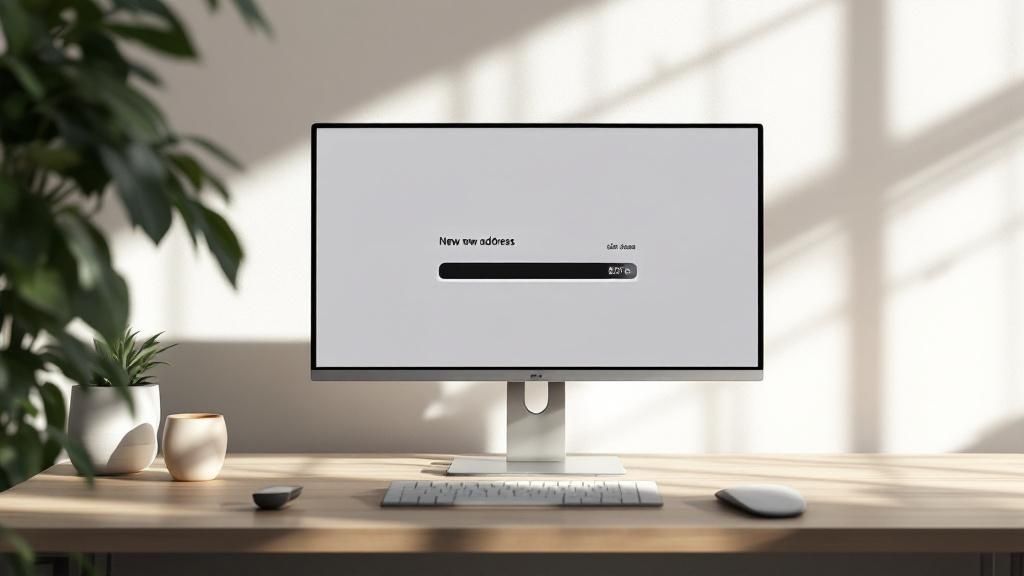
The app will then show you your unique list of words, usually one at a time. Your job is to physically write these words down, in the exact order they appear, on a piece of paper. I'm serious. Don't take a screenshot. Don't save it in a notes app or a text file. And for the love of Satoshi, don't email it to yourself. Any digital copy is a sitting duck for hackers. A physical copy, stored safely offline, is the only way to go.
Crucial Takeaway: Think of your recovery phrase as your ultimate lifeline. If your phone gets stolen or your laptop dies, this phrase is the only way to get your wallet and your Bitcoin back on a new device. If you lose the phrase, you lose your funds. Forever. There's no "Forgot Password?" link here.
Securing Your Phrase and Finalizing the Setup
After you've carefully written down your phrase, the wallet will give you a quick test. This is to make sure you didn't mess up. It might ask you to type all the words back in order or confirm which word was number 7, for instance. This simple step saves countless people from the heartache of a typo locking them out of their own money.
Pass the test, and you're in! Your wallet is now live and ready for action.
You can now pop over to the "Receive" or "Deposit" section to find your first Bitcoin address. It's that long, jumbled string of letters and numbers. This is the public address you can safely share with anyone who wants to send you bitcoin.
For some extra peace of mind and to level up your security game, here's what I recommend:
- Make Multiple Copies: Write down at least two physical copies of that recovery phrase.
- Store Them Securely: Keep those copies in completely separate, secure, and non-digital locations. A fireproof safe at home is a great start. Stashing the second copy at a trusted family member's house is even better.
Mastering Wallet Security and Best Practices
Getting a Bitcoin wallet address is just the first step on your journey. The real work—and what separates the seasoned pros from the novices—is protecting your crypto for the long haul. This isn't just about picking a strong password; it's about adopting a security-first mindset.
Your primary mission is to make your private keys as difficult for hackers to reach as possible. This is where the concept of "air-gapped" storage comes into play. An air-gapped device is one that has never, and will never, touch the internet. It creates a physical moat around your keys, stopping remote attacks in their tracks. This is the exact strategy that major exchanges use to protect billions of dollars worth of assets.
Expert Insight: Think about how massive exchanges handle their funds. They generate their main wallets on specialized hardware or computers that are completely offline. This isolates the private key creation process from any online threats. They then create a system of multiple addresses—using secure cold wallets for the bulk of their funds and smaller hot wallets for day-to-day transactions. You can dive deeper into how the biggest players secure their vast holdings on Cointelegraph.
Advanced Tools for Better Protection
As your crypto stack grows, your security measures should level up too. Luckily, the wallet technology available today has some powerful features built right in to help you stay protected.
Multi-Signature (Multisig) Wallets: Picture a bank vault that requires several different keys to open. That's a multisig wallet. It requires two or more private keys to authorize a single transaction. This setup is fantastic for businesses or families sharing funds, as it means no one person—or one stolen phone—can move the money alone.
Hierarchical Deterministic (HD) Wallets: The good news is that most modern wallets are already HD wallets. This clever tech lets your wallet generate a virtually endless stream of new public addresses, all from your single master recovery phrase. Getting into the habit of using a fresh address for every transaction you receive is a huge win for your privacy. It makes it incredibly difficult for snoops on the blockchain to connect the dots and track your entire financial history.
In the end, it all comes back to that timeless crypto mantra: "not your keys, not your coins."
When you use a hardware wallet, set up multisig for shared funds, and take advantage of HD features for privacy, you're not just following best practices—you're actively enforcing this golden rule. These habits are your best defense against phishing, malware, and even physical theft, ensuring you and only you remain in control of your digital wealth.
Common Questions About Wallet Addresses
As you start your journey into self-custody, it's natural for a few questions to pop up. Let's tackle some of the most common ones I hear, so you can move forward with a bit more clarity.
Can I Have Multiple Wallet Addresses?
Not only can you, but you absolutely should. Think of it as a fundamental privacy practice.
Most modern wallets today are Hierarchical Deterministic (HD). This just means they can generate a nearly endless supply of new addresses all from that single recovery phrase you wrote down. Using a fresh, new address for every single transaction you receive makes it significantly harder for outsiders to connect the dots and trace your entire financial history on the blockchain.
What’s the Difference Between a Wallet Address and a Private Key?
This is a crucial distinction. Your wallet address is like your bank account number—it’s public. You can share it with anyone who needs to send you Bitcoin.
Your private key, on the other hand, is the secret password to that account. It’s what you use to sign transactions and prove you own the funds. It is the key to your crypto vault.
Never, ever share your private key. Giving it to someone is the digital equivalent of handing them your bank card and PIN. They gain total, irreversible control of your funds.
What Happens if I Lose My Phone or Computer?
This is where that piece of paper (or metal plate) with your 12 or 24-word recovery phrase becomes your lifeline. If your device is lost, stolen, or simply breaks, that phrase is all you need.
You can simply install a compatible wallet on a new device, enter your recovery phrase, and regain full access to all your Bitcoin. This is why writing it down and storing it securely offline is the single most important step in securing your assets.
Ready to accept Bitcoin payments directly and securely? Flash provides merchants with powerful, low-code tools for instant, wallet-to-wallet transactions. Eliminate intermediaries and tap into a global customer base by visiting .