Getting a crypto wallet address for your business is probably way simpler than you think. Just picture it as a unique account number for your digital cash—it’s just a string of letters and numbers used to send and receive funds globally.
This guide will walk you through picking the right wallet, generating an address, and making sure your assets are secure.
Your First Step Into the Crypto Economy
Jumping into the world of cryptocurrency payments all starts with one thing: a wallet address. For a merchant, this isn't just some technical detail; it's your gateway to a huge, and growing, customer base that actually prefers to pay with digital assets like Bitcoin. Learning how to create a wallet address is the first real move you can make to bring your payment options into the modern era.
This simple string of characters immediately unlocks some serious benefits for your business. It lets you:
- Accept payments from anyone, anywhere on the planet, without having to rely on traditional banks as middlemen.
- Tap into a market of over 500 million Bitcoin users who are actively searching for businesses that accept their currency.
- Give customers more flexibility at checkout, which is a proven way to boost conversion rates and build loyalty.
At its core, your wallet address is like a digital mailbox for money. When a customer wants to pay you in Bitcoin, they send it to your unique address. The transaction gets logged on the public blockchain, and the funds land directly in your wallet. Simple as that.
A crypto wallet address is your public-facing ID for getting paid. It's totally safe to share, but the private keys that control those funds must always stay secret. Think of it this way: you can share your bank account number, but you’d never share your online banking password.
This guide is here to cut through the noise and demystify the whole process. We’ll walk you through choosing a wallet that actually fits your business needs, show you the practical steps to generate your first address in minutes, and cover the essential security practices you need to protect your digital assets.
Let's get started.
Choosing the Right Wallet for Your Business
Not all crypto wallets are created equal, and that’s especially true when your business is on the line. Before you even think about generating a Bitcoin address, you need to pick the right foundation. This choice will directly shape your security, day-to-day convenience, and how you manage your funds.
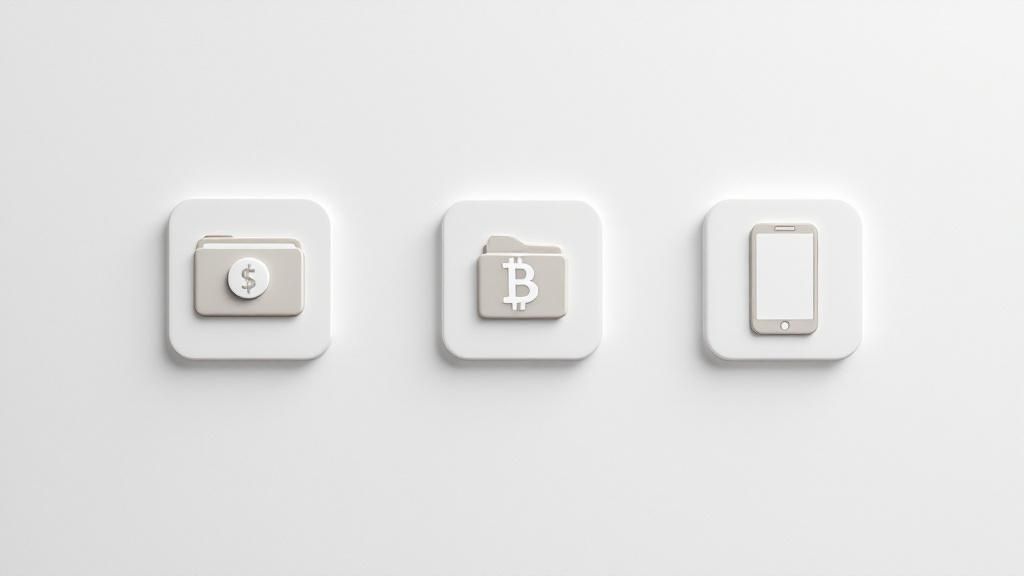
For merchants, the options really boil down to three main categories: software, hardware, and custodial. Each has its place, and understanding the trade-offs is everything.
Security Versus Convenience
First up are software wallets, often called "hot wallets." These live on your computer or phone. Think of them as your daily cash register—perfect for handling frequent, smaller transactions because they're always online and accessible. The flip side? That same internet connection makes them more vulnerable than offline alternatives.
On the other end of the spectrum, you have hardware wallets. This is a physical device, kind of like a specialized USB drive, that keeps your private keys completely offline. It’s your business's secure vault, ideal for holding larger sums of Bitcoin that you don’t need to touch every day. It offers iron-clad security but isn't built for rapid, on-the-go payments.
Then there are custodial wallets, which are typically offered by cryptocurrency exchanges or other third-party services. With these, someone else holds your private keys for you. While this might seem simpler, it introduces a serious risk: you're trusting another company not to lose or freeze your funds. For any business that values control and ownership, a non-custodial option is almost always the smarter move.
Many businesses I've worked with land on a hybrid approach. They'll use a mobile software wallet for daily point-of-sale payments and sweep the bulk of their earnings into a hardware wallet for long-term, secure storage. It’s the best of both worlds.
To help you decide, here's a quick breakdown of how these wallet types stack up for a business.
Comparing Wallet Types for Merchants
This quick comparison should help you decide which wallet type best fits your security and convenience needs.
| Wallet Type | Best For | Security Level | Convenience |
|---|---|---|---|
| Software (Hot) | Frequent, smaller transactions; daily operations; point-of-sale systems. | Medium | High |
| Hardware (Cold) | Long-term storage of large amounts; securing company treasury. | High | Low |
| Custodial | Beginners or those prioritizing convenience over control (not typically recommended for businesses). | Low (Depends on Custodian) | High |
Ultimately, your choice depends on your business model—your transaction volume, security standards, and operational workflow should guide your decision.
The global surge in crypto adoption makes this choice more critical than ever. The number of Blockchain.com wallets, for instance, exploded from almost nothing in 2011 to over 100 million by late 2022. You can dig into the growth of crypto wallet users on Statista.
This isn't just a niche trend; it shows that millions of individuals and businesses are now part of this ecosystem. Picking the right wallet from the start ensures you’re set up for success as you begin accepting Bitcoin.
Generating Your First Bitcoin Address
Alright, you've picked out a wallet. Now for the fun part: creating your first address so you can actually start accepting Bitcoin. This might sound a little technical, but trust me, modern wallets do all the heavy lifting. It's surprisingly simple.
We'll walk through the typical flow using a mobile software wallet as an example, since that's what most people start with.
First things first: download your chosen wallet only from the official app store (Google Play, Apple App Store) or directly from the developer's website. Steer clear of third-party links—they're often traps.
Once you open the app, it will walk you through creating a new wallet. This is the moment you'll be given your seed phrase. Stop everything and back this up securely before you do anything else. With that handled, you're ready to roll.
Finding the "Receive" Button
To get a new address, you just need to find a button or tab that says "Receive" or maybe "Deposit." Tapping it instantly generates a brand new, unique address just for you.
You don't need to be a cryptographer to understand what's happening. The wallet is handling complex math in the background, creating a public-private key pair and using hashing algorithms to derive your address. Most modern wallets use what's called a hierarchical deterministic (HD) structure, which means that one seed phrase can generate a virtually endless stream of new addresses. This is a huge win for your financial privacy. If you're curious about the deep tech, you can learn more about the technical side of Bitcoin addresses on Chainalysis.com.
Sharing Your Address With Customers
Once the address is on your screen, you'll generally have two easy ways to share it:
- The QR Code: This is your best friend for in-person payments. A customer just points their wallet's camera at your screen, scans the code, and your address is instantly loaded into their app. No fuss.
- The Copy Button: For online invoices, emails, or integrating with a payment gateway like Flash, this is what you'll use. It's a one-tap button that copies the long string of characters to your clipboard, ready to paste.
Here's the number one mistake I see new merchants make: trying to type out a wallet address by hand. Don't do it. Ever. A single typo—mistaking a '1' for an 'l' or an 'O' for a '0'—will cause the funds to be sent into the digital void, lost forever. Crypto transactions are final. Always use the copy function or the QR code.
That’s really all there is to it. With these simple steps, you're officially equipped to accept your first Bitcoin payment. The whole process is designed to be intuitive so you can focus on what you do best: running your business.
Wallet Security Is Business Security
Once you've set up a wallet and generated an address, you've essentially become your own bank. This is incredibly empowering, but it also comes with one non-negotiable responsibility: securing your assets. The absolute most important part of this is protecting your seed phrase, sometimes called a recovery phrase. Think of it as the master key to your funds—if you lose it or someone steals it, your money is gone. Forever.
The only truly safe way to back up your seed phrase is to keep it completely offline. Seriously. Write it down on a piece of paper or, even better, etch it onto a small metal plate designed for this purpose. Then, store that physical copy somewhere extremely safe. We're talking about a fireproof safe, a safety deposit box at a bank, or maybe even split between multiple secure locations.
Whatever you do, don't store it digitally. This is where so many people go wrong, so please avoid these common—and costly—mistakes:
- Never take a screenshot of your seed phrase on your phone or computer.
- Do not save it in a password manager or a notes app, no matter how convenient it seems.
- Avoid uploading it to a cloud drive like Google Drive, Dropbox, or iCloud.
Any device that connects to the internet is a potential vulnerability. By keeping your seed phrase physically offline, you completely eliminate the risk of hackers or malware getting their hands on it.
Protect Your Business and Customer Privacy
Beyond just guarding your seed phrase, another critical security habit is how you handle your wallet addresses. Modern wallets have a powerful feature that lets you generate a brand-new, unique address for every single payment you receive. This isn't just a cool trick; it's a fundamental tool for protecting your business's financial privacy.
Think about it: when you reuse the same address for every customer, anyone can look it up on the public blockchain and see your entire transaction history. This could expose your sales volume, payment frequency, and other sensitive business data to competitors, disgruntled employees, or anyone else who knows where to look.
Generating a new address for each payment is like giving every customer a unique invoice number instead of using "INVOICE-001" for everyone. It neatly compartmentalizes each transaction, making it impossible for one customer to peek at another's payment history.
This practice is essential for maintaining confidentiality. You’d be surprised how many people still don't do this. In fact, research from 2022 showed that around 50% of Bitcoin outputs were still being sent to previously used addresses, a habit that drastically undermines privacy on the network. You can dig into more of these stats in this deep dive on Bitcoin address reuse from BitMEX's blog.
By using fresh addresses for every payment, you not only protect your own operational security but also show your customers that you take their privacy seriously. It’s a simple step that builds trust and reinforces your brand's integrity.
Putting Your Wallet Address to Work
You've got your secure address—now for the fun part. It's time to connect it to your payment system and actually start accepting Bitcoin. This is where the theory becomes real money for your business.
For most merchants, this means plugging the address into a payment processor, your online store, or even a point-of-sale device.
Integrating With Your Payment Gateway
Most modern payment platforms, including Flash, make this process incredibly simple. You'll usually find a "Payouts" or "Receiving Address" section somewhere in your merchant dashboard.
From there, it's as easy as selecting Bitcoin as your crypto of choice and pasting your public wallet address into the field. This tells the system exactly where to send the funds every time a customer pays you.
Getting your wallet address displayed and integrated correctly is crucial. It’s a lot like understanding the role of a website as a digital storefront—it's the public-facing entry point for your customers' money.
Pro Tip: Before you hit "save," always, always double-check the first and last few characters of the address you just pasted. This one tiny habit can save you from a very costly typo and ensures your payments land exactly where they should.
Once you’ve saved it, that’s it. Your business is officially ready to accept Bitcoin payments. You've successfully built the bridge from setting up a wallet to growing your revenue.
Common Questions About Wallet Addresses
Diving into the world of crypto payments always kicks up a few questions. That's completely normal. Getting straight, practical answers is the key to feeling confident as you set up your wallet and get ready to use it for your business. Let's walk through some of the most common things merchants ask.
Can I Use One Address for All Transactions?
Technically, you can. But you absolutely shouldn't. It's a huge privacy misstep.
Think of it this way: reusing the same address is like giving everyone a window into your bank account. Anyone can look it up on the public blockchain and see every single payment coming in, which could easily expose your sales volume and other business details you'd rather keep private.
The best practice—and what most modern wallets are designed for—is to generate a fresh, unique address for every single transaction. It’s a simple step that massively boosts the financial privacy for both you and your customers, keeping each payment neatly firewalled from the others.
What Happens If I Lose My Seed Phrase?
This is the big one, so listen up. If you lose your seed phrase, you will lose access to all the crypto in that wallet if you ever get locked out of your device. Full stop. There’s no "forgot password" link, no customer support line to call for a reset. You are your own bank.
Your seed phrase is the only key to your vault. It’s the one and only way to restore your wallet on a new phone or computer. This is why backing it up securely—ideally offline and in more than one physical location—is the single most important thing you will do. Without it, your funds are gone for good.
Do I Need Different Wallets for Different Coins?
It really depends on the wallet you pick. These days, many of the best wallets are multi-currency, which means they can hold Bitcoin, Ethereum, and a whole bunch of other coins all in one convenient app. Some wallets, however, are built to specialize in just one, like Bitcoin.
When you're shopping around for a wallet, make sure you check which cryptocurrencies it supports. You want to be sure it lines up with what you plan to accept. Using a good multi-currency wallet can make your life a lot easier, letting you manage a variety of digital assets without having to jump between a half-dozen different apps.
Ready to bring secure, direct Bitcoin payments to your business? With Flash, you can start accepting wallet-to-wallet transactions in less than a minute. No middlemen, minimal fees, just pure peer-to-peer payments. Get started with Flash today.