Ready to accept your first Bitcoin payment? The first thing you'll need is your wallet address. Think of it as your personal Bitcoin account number—it's the unique string of characters you'll give to customers so they know exactly where to send the funds.
Understanding Your Bitcoin Wallet Address
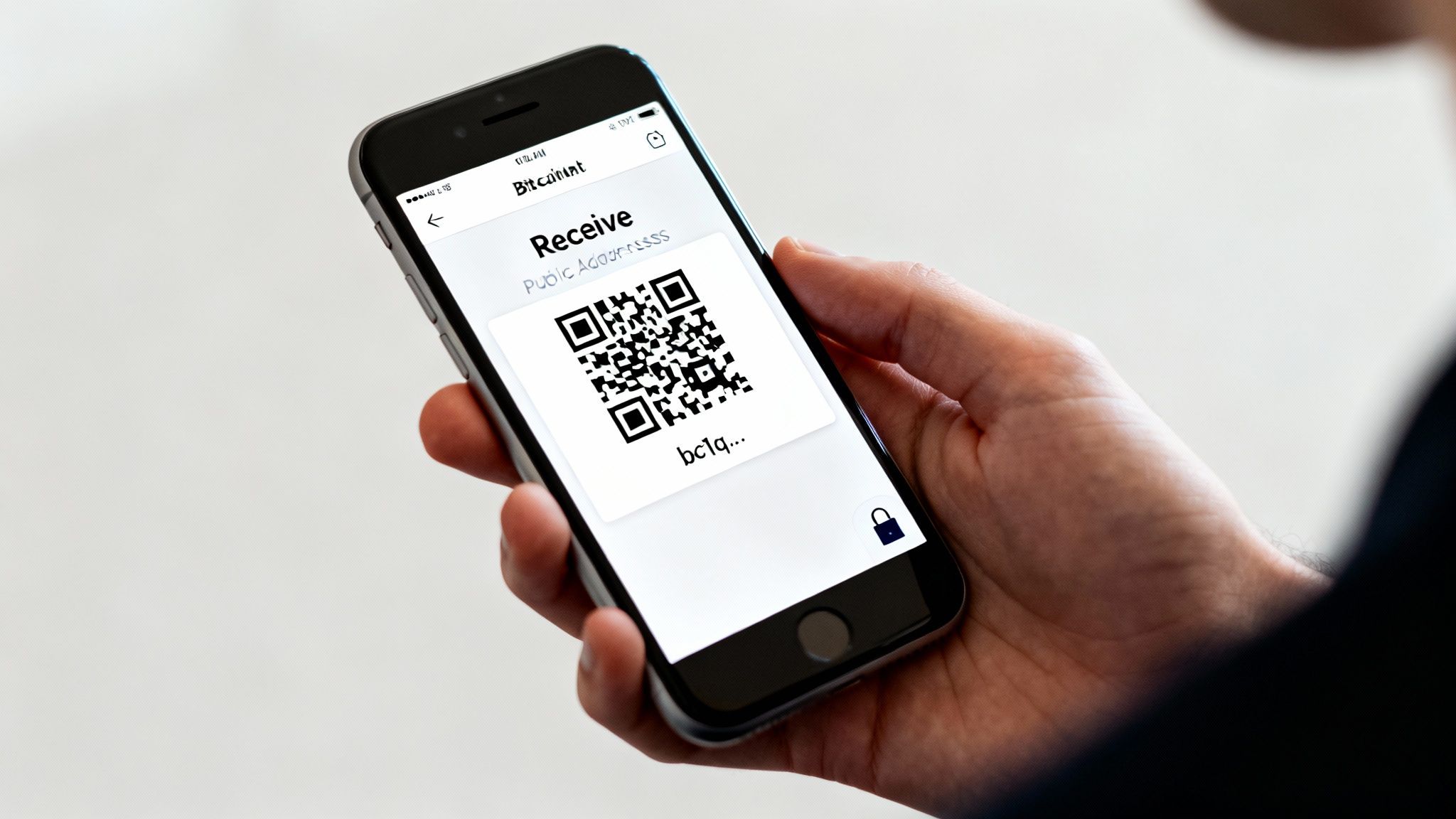
Before we jump into how to find your address, let's quickly cover what it is. A Bitcoin wallet address is a long string of letters and numbers, usually between 26 and 35 characters, that is generated from your wallet's public key. It's specifically designed to be shared openly.
Now, this is where a critical distinction comes in. Your public address is completely different from your private key. Getting these two mixed up is one of the costliest mistakes you can make in crypto.
Here's the simple breakdown:
- Public Address: Safe to share. This is what you give to customers so they can send you Bitcoin.
- Private Key (or Seed Phrase): Keep this secret at all costs. Sharing it is like handing over the keys to your entire vault.
Every time you share your public address, you're telling the Bitcoin network where a payment should be sent. For any merchant, this is the absolute cornerstone of accepting direct, peer-to-peer digital payments.
Why Your Address Matters for Business
Finding and using your crypto wallet address is your ticket to a massive, global market. We're talking about over 820 million active crypto wallets out there. And with user-friendly "hot wallets" making up 78% of usage, customers are primed for quick, easy transactions. Check out more stats on crypto wallet adoption.
Imagine you're using Flash, our Bitcoin payment software that lets you connect directly with customer wallets without us ever touching the funds. You can generate a fresh Bitcoin address in seconds through our point-of-sale app or a custom widget, instantly ready to accept payments from this huge pool of users.
For a business, a Bitcoin address isn't just a technical detail; it’s a gateway to a new customer base. It enables you to offer a fast, global, and low-fee payment option that appeals to a growing demographic of tech-savvy consumers.
Modern Bitcoin wallets also boost your privacy by generating a new, unique address for every single transaction you receive. While funds sent to an old address will still land in your wallet just fine, using a fresh one each time makes it much harder for outsiders to track your business's sales history on the public blockchain.
This is a best practice that professional payment tools like Flash handle automatically, giving you top-notch security and privacy without any extra effort.
To help you get comfortable with the terminology, here's a quick reference table covering the key concepts you'll encounter as a merchant.
Bitcoin Wallet Address Key Concepts for Merchants
| Term | What It Means for Your Business | Key Takeaway |
|---|---|---|
| Public Address | The "account number" you share with customers to receive payments. | Share it freely. This is how you get paid. |
| Private Key | The secret "password" that gives you access to spend your funds. | Never, ever share this with anyone. |
| QR Code | A scannable, visual version of your public address. | Makes it easy for customers with mobile wallets to pay you quickly. |
| Address Reuse | Using the same public address for multiple transactions. | Avoid this for better privacy. Professional tools generate new addresses automatically. |
Understanding these basics ensures you can manage your Bitcoin payments securely and professionally, building trust with your customers and protecting your revenue.
Finding Your Address in Different Bitcoin Wallets
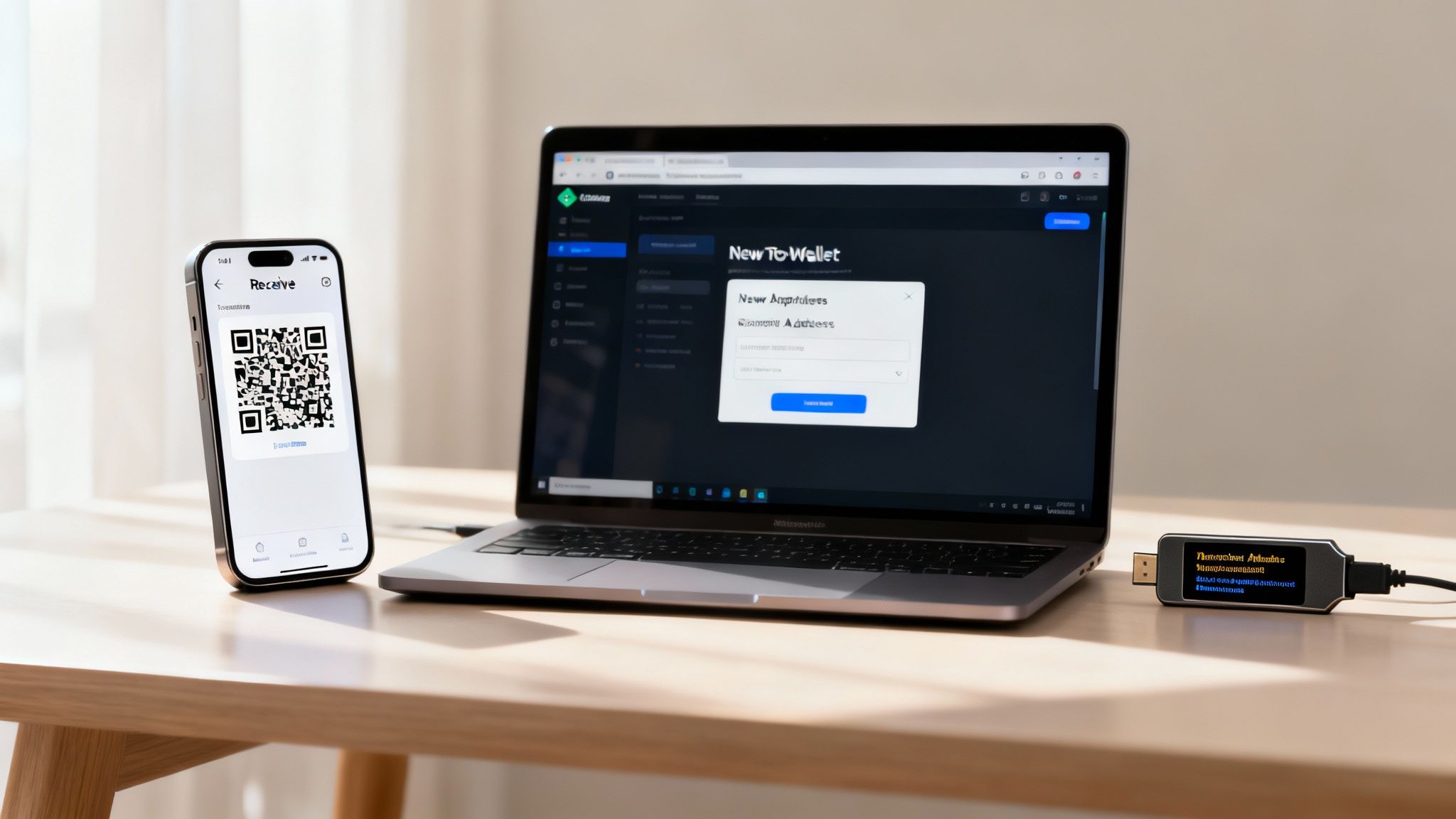
Knowing what a wallet address is is one thing; knowing where to find it when a customer is standing in front of you, ready to pay, is another entirely. The exact steps will feel a bit different depending on your wallet, but the core idea is always the same.
You're looking for an option to "Receive" or "Deposit" funds. Let's walk through how this looks on the most common types of Bitcoin wallets that merchants use every day.
Each wallet is designed for a specific purpose, whether that's lightning-fast mobile payments or iron-clad security for your savings. But they all share a common goal: making it simple and obvious to generate a new address to get paid.
Locating Your Address on a Mobile Wallet
Mobile wallets are perfect for merchants on the move. Think pop-up markets, food trucks, or even just accepting a payment at a customer's table. Speed and simplicity are the name of the game here, and finding your address is usually a two-tap process.
To get your receiving address, you just need to:
- Open your wallet app and look for a button labeled "Receive," "Deposit," or sometimes just a simple down-arrow icon.
- Tapping this button will instantly pull up a fresh Bitcoin address and its matching QR code.
- Your customer can then scan this QR code with their own mobile wallet, which pre-fills all the payment details for them. It’s that quick.
For a broader overview that covers more than just Bitcoin, this guide on how to find your crypto wallet address is a great resource. It complements the specific steps we're covering here.
The QR code is your best friend in a retail setting. It contains all the necessary payment information, completely eliminating the risk of someone mistyping a character in a long, complex address.
Generating an Address on a Desktop Wallet
Desktop wallets are the workhorses for managing business finances, making them ideal for e-commerce stores, service providers, and anyone sending out invoices. While generating an address is just as easy as on mobile, you get a few more tools for record-keeping.
Most desktop clients have a prominent "Receive" tab right on the main screen. Clicking it generates a new address, but here's where it gets useful for business: you can often add a label or description. Think "Invoice #1234" or "Sale - May 15." This little step makes reconciling your accounts later on a whole lot easier.
Pro Tip: Always generate a new address for every single invoice or sale. This is a fundamental privacy practice. It prevents customers—or anyone else snooping on the public blockchain—from easily linking different payments back to your business.
Verifying Your Address on a Hardware Wallet
For merchants who are holding a significant amount of Bitcoin, a hardware wallet is non-negotiable. It's the gold standard for security because it keeps your private keys completely offline, where no online threat can reach them. Finding your address involves one extra step, but it’s arguably the most important one.
You'll connect your hardware wallet to your computer and open its companion app.
- Inside the app, you’ll click the "Receive" button to start the process.
- An address will pop up on both your computer screen and on the tiny screen of the hardware wallet itself.
- You must carefully compare the two addresses to confirm they are identical.
This verification step is your shield against malware. A clever virus on your computer could try to trick you by swapping your real address with an attacker's address on the screen. By confirming it on the physical device, you guarantee the funds are going to a wallet that you, and only you, control.
A Quick Guide to Bitcoin Address Formats
As you start pulling up receive addresses in your wallet, you'll quickly notice they don't all look the same. One might start with a '1', another with a '3', and a third with 'bc1q'. This isn't a bug—it's a feature, showcasing Bitcoin's evolution over the years.
Understanding these different formats is super helpful for making sure customer payments land smoothly in your wallet without any hiccups. The format tells you what kind of technology is under the hood, which has a real impact on transaction speed and, more importantly, the network fees you and your customers pay.
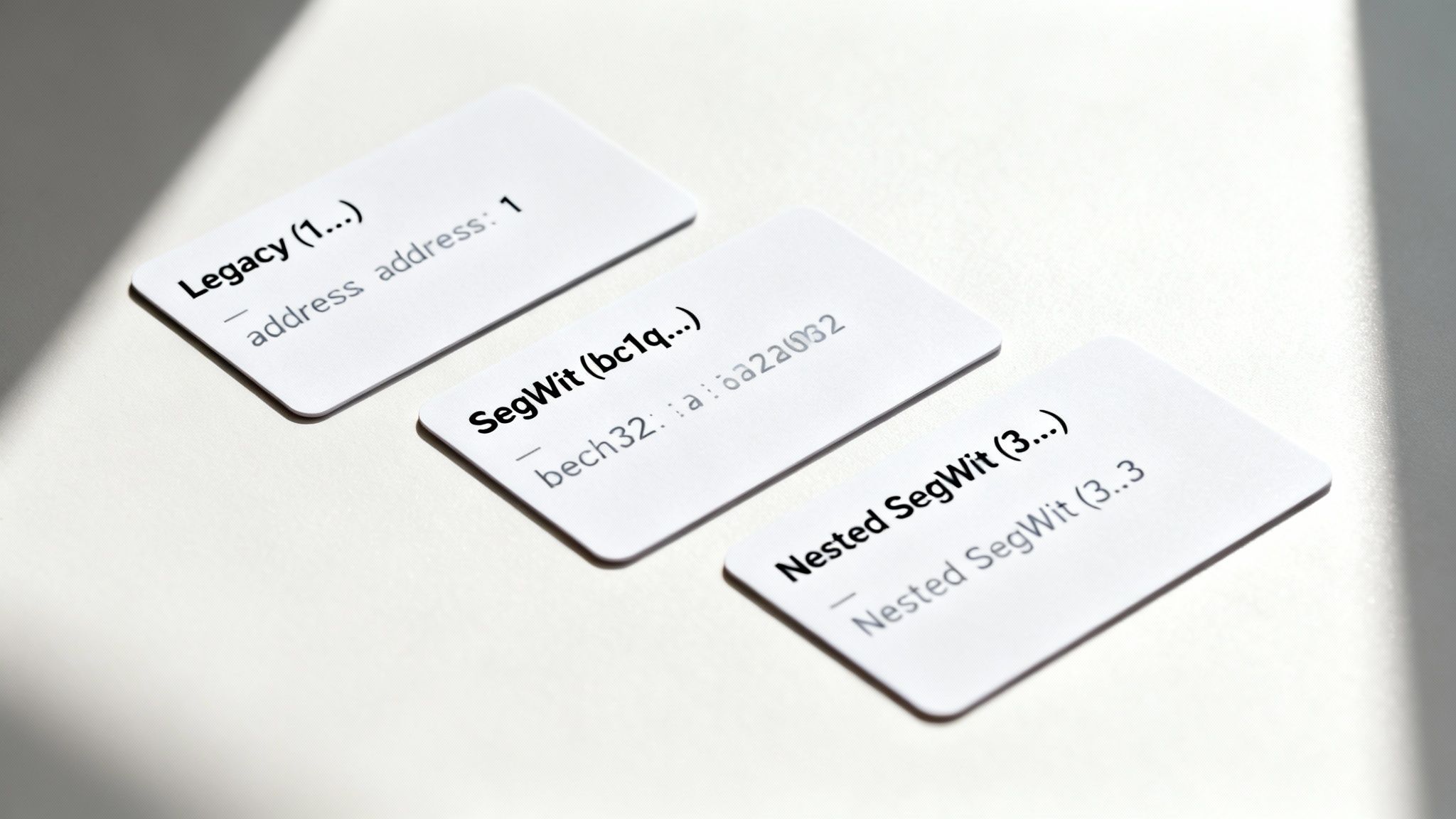
While most modern wallets are smart enough to handle these differences automatically, knowing the basics can save you a headache if you ever need to troubleshoot a payment.
The Original: Legacy Addresses
First up are the originals, the Legacy addresses. These are also known by their technical name, Pay-to-Public-Key-Hash (P2PKH), and they're a dead giveaway because they always start with a '1'.
Think of these as the classic model. They’re the OG blueprint for Bitcoin transactions and have the unique advantage of being compatible with literally every Bitcoin wallet and service ever created. If it says "Bitcoin," it supports Legacy.
But that universal compatibility comes with a tradeoff. Transactions using these addresses are bulkier data-wise, which means they cost more in network fees and can take a bit longer to confirm. You'll still see them around, especially with older wallets, but they're not the most efficient choice anymore.
The Bridge: Nested SegWit Addresses
Next, we got an upgrade with Nested SegWit addresses, also called Pay-to-Script-Hash (P2SH). You can spot these easily because they always start with a '3'.
This format was a really clever solution to help the network transition to newer tech. It essentially "wrapped up" the benefits of SegWit (which we'll get to next) into a format that older, non-upgraded wallets could still understand and send to. This backward compatibility was a game-changer for a smooth network-wide upgrade.
Using a Nested SegWit address is a big improvement, dropping transaction fees by roughly 25-35% compared to a Legacy address. It’s a great middle-ground, offering solid efficiency and broad compatibility.
The Modern Standard: Native SegWit (bech32)
Finally, we arrive at the current gold standard: native SegWit addresses, technically known as bech32. These look totally different, as they always start with "bc1q".
Bech32 is the most efficient format available today. It was designed from the ground up to strip out unnecessary data from transactions, making them as small and lightweight as possible. The result? The lowest possible fees and the fastest confirmation times.
A transaction using a bech32 address can be up to 40% cheaper than the same one using a Legacy address. That's a huge saving.
For any business accepting Bitcoin, pushing customers toward bech32 is the smartest move you can make. It saves everyone money and helps the entire network run more efficiently. It's exactly why modern payment tools like Flash default to this format—it just delivers the best performance, period.
Alright, you've figured out how to find your crypto wallet address. The next skill to master is sharing it safely. This isn't just about protecting your funds—it's about guarding your privacy and making sure every payment your business receives is secure and verifiable.
A few simple habits can make all the difference.
The single most important practice is to generate a new, unique address for every single transaction. I know it can seem easier to just reuse an old one, but doing that creates a public trail on the blockchain. Anyone can look up that address and see every payment ever sent to it, giving them a clear window into your business's revenue and transaction history.
Luckily, modern wallets are designed to prevent this. They automatically create a fresh address each time you hit "Receive." Think of it like using a different invoice number for each sale—it keeps your financial records separate, private, and much harder for competitors or malicious actors to analyze.
The Double-Check Rule
Before you ever send an address to a customer or confirm a payment, get into the habit of a quick visual check. Human error is a very real risk when you're dealing with long strings of random characters. One tiny mistake can send funds into a black hole, and as we know, Bitcoin transactions are irreversible.
Here's a simple but effective technique: just verify the first four and last four characters of the address.
- Example: If your address is
bc1qxy2kgdygjrsqtzq2n0yrf2493p83kkfjhx0wlh, you'd just confirmbc1q...and...0wlh.
This check takes less than five seconds and drastically reduces the chances of a costly typo. When a customer scans one of your QR codes, ask them to do the same quick check on their end before they hit send. This mutual verification builds trust and protects both of you.
Security isn't just about complex technology; it's about disciplined habits. The small act of verifying an address on-device or double-checking characters is one of the most powerful and effective security measures you can take.
Verify on Device: A Hardware Wallet Essential
If you're using a hardware wallet for maximum security—and you should be for any significant amount—there's one step you must never skip: verifying the address on the physical device itself.
When your wallet's companion software shows you a receive address on your computer screen, your hardware wallet will display the exact same address on its own trusted screen. You have to physically look at the device and confirm the characters match what you see on your computer.
This critical step protects you from "man-in-the-middle" attacks, where malware on your computer could try to trick you by swapping in an attacker's address on your monitor. Because the hardware device is isolated from your computer, its screen is the ultimate source of truth.
The global surge in crypto adoption makes these security practices more important than ever. The APAC region, for example, saw its on-chain activity grow 69% year-over-year, pushing total transaction volume from $1.4 trillion to $2.36 trillion. This growth is a huge reason merchants must master finding and using wallet addresses securely. To help businesses tap into this market, Flash provides user-friendly tools that generate a Bitcoin address instantly through our mobile POS app or payment links, connecting you directly and securely to customer wallets. You can discover more insights into global crypto adoption in this report.
Using Merchant Tools to Manage Bitcoin Payments
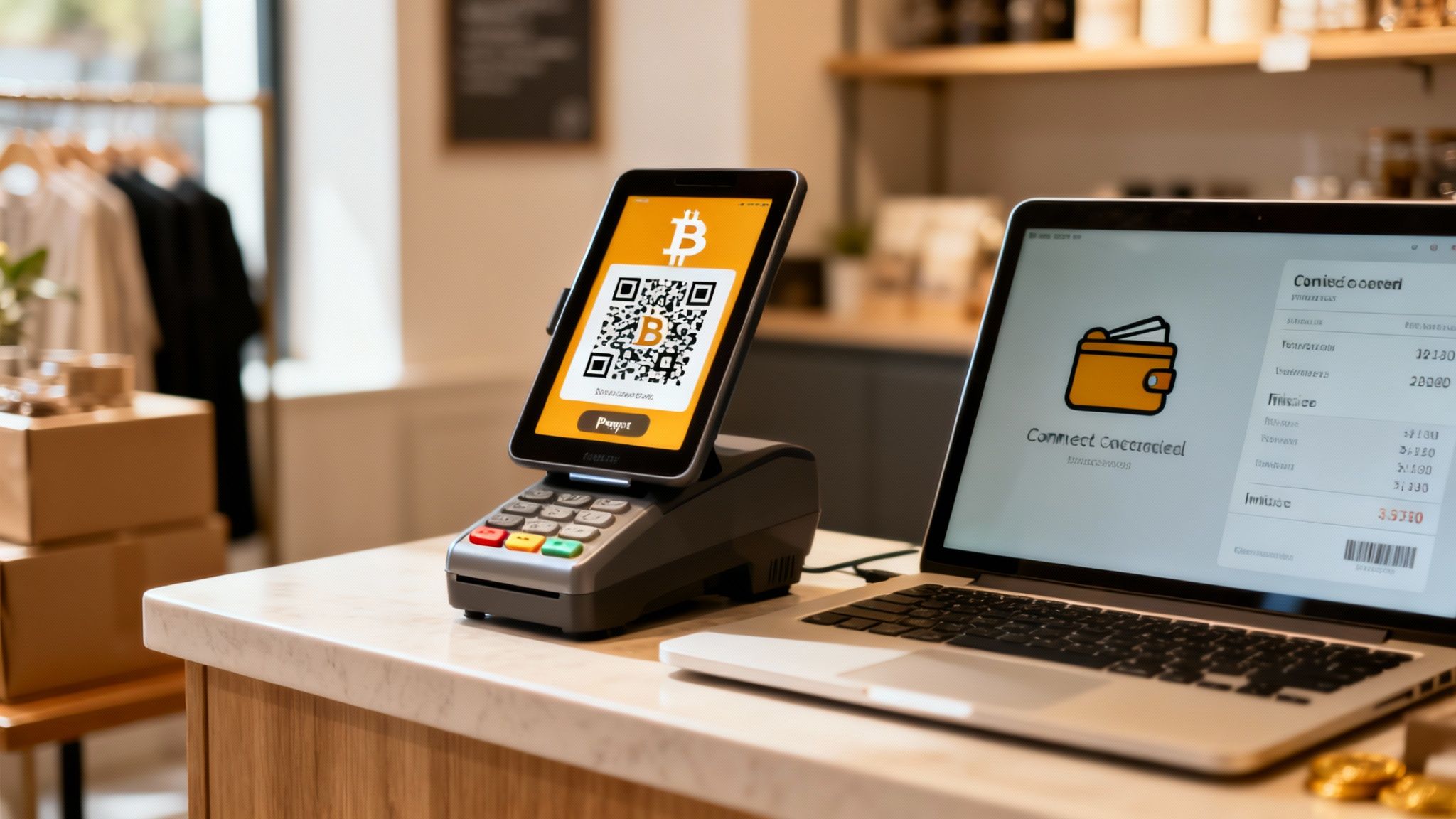
Knowing how to find your crypto wallet address is one thing, but for a business, that’s just the starting line. Manually copying and pasting addresses for every single sale is tedious, wide open to costly errors, and simply won't work once you start to grow.
This is where the real efficiency kicks in—integrating your wallet into a proper sales process with dedicated merchant tools.
Platforms like Flash completely change the game here. Instead of treating each Bitcoin payment as a one-off manual task, these tools plug directly into your wallet. They automate the heavy lifting of generating fresh, unique addresses for every payment, whether it's for a payment link, a point-of-sale QR code, or a button on your website.
This is the move that takes your business from just accepting Bitcoin to professionally managing it. It smooths out the entire process for you and your customers, creating a secure and seamless checkout every time.
The Perks of Automated Address Management
The biggest win here is the direct, wallet-to-wallet nature of the transaction. When a customer pays you through a system like Flash, the funds go straight from their wallet to yours. No middlemen holding your money. This means you get instant settlement and keep 100% control over your funds the second a payment is confirmed.
This kind of automation also bakes in best practices without you even having to think about it.
- Beefed-Up Privacy: A brand new address is created for each sale, which stops snoops from tracking your revenue on the public blockchain.
- Fewer Errors: Using QR codes and payment links gets rid of the risk of customers sending funds to a mistyped address—a simple mistake that can be irreversible.
- Cleaner Books: When each transaction is tied to a specific invoice or order, tracking sales and reconciling payments becomes a whole lot easier.
Putting It All Together for Your Business
With Bitcoin's active addresses averaging nearly 887,000 daily in recent years, there's a huge and engaged user base ready to pay with BTC. This steady drumbeat of activity shows just how important it is for merchants to have a simple, reliable way to find and use their wallet addresses.
Tools like Flash are built specifically for Bitcoin supporters, letting you generate an address in seconds with zero coding. You can turn any device into a payment terminal for instant, low-fee transactions.
For a merchant, the final step isn’t just finding an address—it's building a professional payment system around it. Automating address generation and management is what makes accepting Bitcoin a scalable and secure part of your business strategy.
Ultimately, integrating a payment processor is about more than just convenience. It's also a key part of how you improve your overall e-commerce customer experience. When the payment process is slick and professional, it builds customer trust and encourages them to come back for more.
Your Top Questions About Bitcoin Addresses, Answered
Jumping into Bitcoin payments always sparks a few questions, especially for merchants who are new to the game. Getting these details right is the key to feeling confident when you're finding your wallet address and handling customer payments.
Let's walk through some of the most common queries we hear from business owners to clear up any confusion. Understanding this stuff doesn't just make your life easier—it protects your money and your privacy.
Should I Use the Same Bitcoin Address for Every Payment?
While you technically can, you absolutely shouldn't. Reusing a Bitcoin address is strongly discouraged for privacy reasons. Every time you use an address, it creates a public breadcrumb trail on the blockchain. Anyone can follow that trail and link every single payment back to your business.
Think of it this way: you wouldn't use the same invoice number for every sale. It would be a messy, insecure nightmare.
Modern Bitcoin wallets are built to automatically generate a fresh, unique address for every transaction. This isn't a bug; it's a core privacy feature. Merchant tools like Flash handle this for you automatically, so you're always following best practices without even thinking about it.
What Happens If a Customer Sends Bitcoin to the Wrong Address?
This is the scary one, so it's important to be clear: Bitcoin transactions are final and irreversible. Once they're sent, they're gone. There's no bank, no support line, and no central authority that can reverse the payment. In nearly every case, funds sent to a wrong address are lost forever.
This is exactly why accuracy is mission-critical. Using tools that generate a QR code is one of the best ways to sidestep this problem, as it kills the risk of a customer making a typo. Always advise your customers to double-check the first few and last few characters of the address before they hit send.
Is My Bitcoin Wallet Address Public or Private?
Your Bitcoin wallet address is public information. It's completely safe to share. Think of it like your bank account number—you have to give it to someone for them to pay you. An address is derived from your public key and is designed to be shared openly.
What you must guard with your life is your private key. This is the ultimate secret that gives you—and only you—the power to spend the funds in your wallet. Never, ever share your private key or your 12-24 word seed phrase with anyone, for any reason.
Why Does My Wallet Give Me a Different Address Every Time?
If you see a new address pop up every time you go to receive a payment, that's a great sign! It means your wallet is working exactly as it should be to protect your privacy.
This feature is standard in all modern Bitcoin wallets. Your wallet can generate a virtually infinite number of receiving addresses, all tied back to your single master key. Any funds sent to any of these addresses—whether it's the first one you ever saw or the one you just generated—will land safely in your wallet balance. This constant rotation keeps your business's financial history private from prying eyes on the blockchain.
Ready to make Bitcoin payments a breeze for your customers? With Flash, you can generate payment links and QR codes in an instant. Connect directly to your wallet with no middlemen and rock-bottom fees. Get started with Flash today.