Getting your hands on a Bitcoin wallet address is your ticket to the network, and it's a lot simpler than most people think. The easiest way to understand an address is to think of it like an email address, but for money—it's a unique string of characters you share with others to receive Bitcoin. This guide will walk you through how to generate one safely and with confidence.
Your First Step Into the World of Bitcoin
A Bitcoin wallet address is the public key you need for anyone to send you funds. It’s a long string of letters and numbers, often shown as a QR code for easy scanning, that you can safely share with anyone. When someone wants to send you Bitcoin, they simply use this address as the destination.
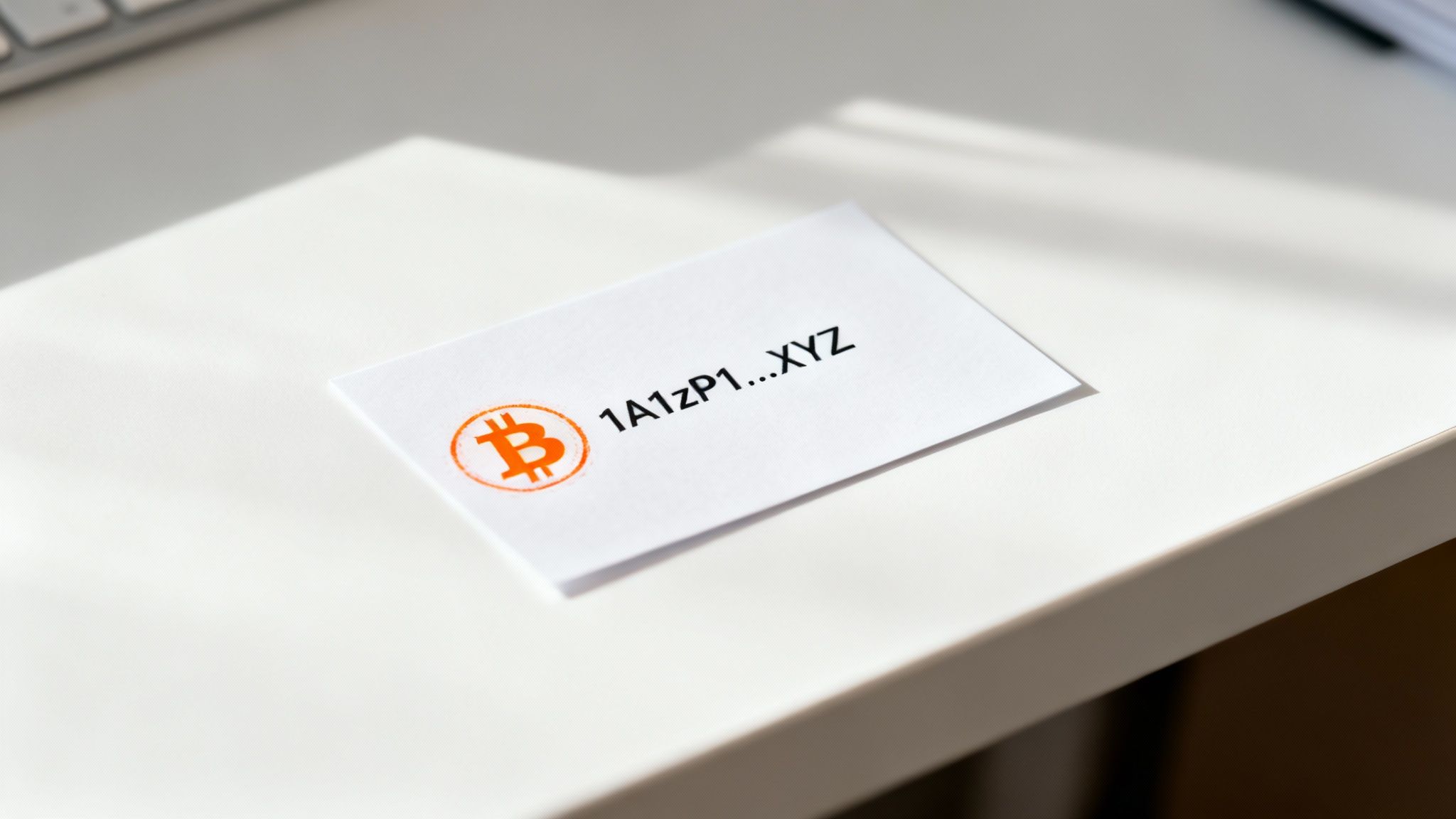
What's happening behind the curtain is all based on some clever cryptography. To get a wallet address, your wallet software first creates a pair of cryptographic keys: a private key and a public key.
- Private Key: This is your secret. It’s the digital equivalent of a vault key, proving you own your Bitcoin and giving you the power to spend it. You must never share this with anyone. Ever.
- Public Key: This is mathematically derived from your private key. It's used to generate the public addresses you can safely share with the world.
This two-key system has been the backbone of Bitcoin since day one. Interestingly, while there are over 460 million Bitcoin addresses that have held a balance at some point, it's estimated that only about 25 million are actively used by individuals as of 2025. This just goes to show that most users manage multiple addresses for privacy and security.
Choosing Your Wallet Type
Before you can generate an address, you need to choose a wallet. The right one for you really comes down to your needs and how you plan to use Bitcoin. They generally fall into four main categories, each with its own trade-offs between convenience and security.
Quick Guide to Bitcoin Wallet Types
To help you decide, here’s a quick rundown of the main wallet types, what they're best for, and their general security level.
| Wallet Type | Best For | Security Level | Ease of Use |
|---|---|---|---|
| Mobile | Everyday spending, on-the-go payments | Medium | Very High |
| Desktop | Frequent use, advanced features | Medium-High | High |
| Hardware | Long-term savings, large amounts | Very High | Medium |
| Exchange | Trading, easy onboarding | Low | Very High |
This table should give you a good starting point. If you’re just dipping your toes in, a mobile or exchange wallet might be easiest. But for serious, long-term holding, nothing beats a hardware wallet.
Once you've made your choice and set up your wallet, you might be curious to delve deeper into the world of cryptocurrency and explore what else is out there.
So, before you can even think about getting a Bitcoin wallet address, you have to pick the wallet itself. This is a bigger deal than it sounds—it really dictates how you'll use your Bitcoin, forcing you to find the right balance between easy access and rock-solid security.
The big question is, what are you trying to do? Are you just looking to buy a coffee, or are you trying to secure your life savings for the long haul? Each wallet type is built for a different job.
The good news is that setting up a wallet is easier than ever. In 2025, a staggering 716 million people around the world are expected to own some crypto. But here's the interesting part: the number of people actually using it daily is way smaller. Bitcoin, for instance, saw about 887,000 active addresses per day in late 2024.
This tells us that while a lot of people are holding, a much smaller group is transacting regularly. If you plan on being in that second group, your wallet choice becomes critical. You can dig into more crypto user stats over on Statista.com.
Mobile Wallets for Daily Use
For everyday stuff, you just can't beat a mobile wallet. These are apps on your phone that put your Bitcoin right at your fingertips, making them perfect for paying on the go. Think buying a coffee, grabbing lunch, or splitting a dinner bill with friends.
It’s best to think of it like the cash in your physical wallet—perfect for small, quick transactions, but you wouldn’t walk around with your entire net worth in there. Since your phone is always online, mobile wallets are known as "hot wallets," which means there's a small but very real security risk.
Pro Tip: When you're picking a mobile wallet, do yourself a favor and stick to well-known, reputable options that are Bitcoin-only. It seriously cuts down on the complexity and the number of things that can go wrong, which is often a problem with multi-coin wallets.
Desktop Wallets for Power Users
If you handle most of your Bitcoin business from a laptop or desktop, a desktop wallet is a fantastic middle-ground. You install it directly on your Mac, Windows, or Linux machine, and they usually come packed with more advanced features than you'd find on mobile.
For example, a desktop wallet might give you more control over your transaction fees, a detailed transaction history, or even the ability to run your own full Bitcoin node for ultimate privacy. Just like mobile wallets, they're also "hot wallets," so your computer's security—strong passwords, antivirus software—is non-negotiable.
Hardware Wallets for Ultimate Security
When we start talking about securing a serious amount of Bitcoin, hardware wallets are the undisputed kings. These are small, physical gadgets that keep your private keys completely offline in what's called cold storage.
This complete separation from the internet is their superpower.
- Transactions are signed on the device itself, meaning your private keys never even touch your internet-connected computer.
- They're essentially immune to computer viruses and malware that could otherwise drain a mobile or desktop wallet.
- You need a PIN and a physical button press to approve any transaction, adding a powerful real-world layer of defense.
If you're holding Bitcoin as a long-term investment, a hardware wallet isn't just a good idea—it's essential. It's the difference between stuffing cash under your mattress and locking it away in a bank vault.
Exchange Wallets for Beginners
Last but not least, we have exchange wallets. If you buy Bitcoin on a major exchange, they automatically give you a wallet address. This is what’s known as a custodial wallet, which is a nice way of saying the exchange holds your private keys for you.
While this is definitely the simplest way to get started, it’s also the least secure. You're putting all your trust in a third party, which flies in the face of the core Bitcoin ethos: "not your keys, not your coins." These wallets are fine for active trading or holding tiny amounts, but any Bitcoin you care about should be moved to a wallet where you control the keys.
Alright, let's walk through getting your very first Bitcoin wallet address. This is the fun part where theory becomes reality. We'll use a common mobile Bitcoin wallet as our example, but you'll find the experience is pretty much the same across most good non-custodial wallets.
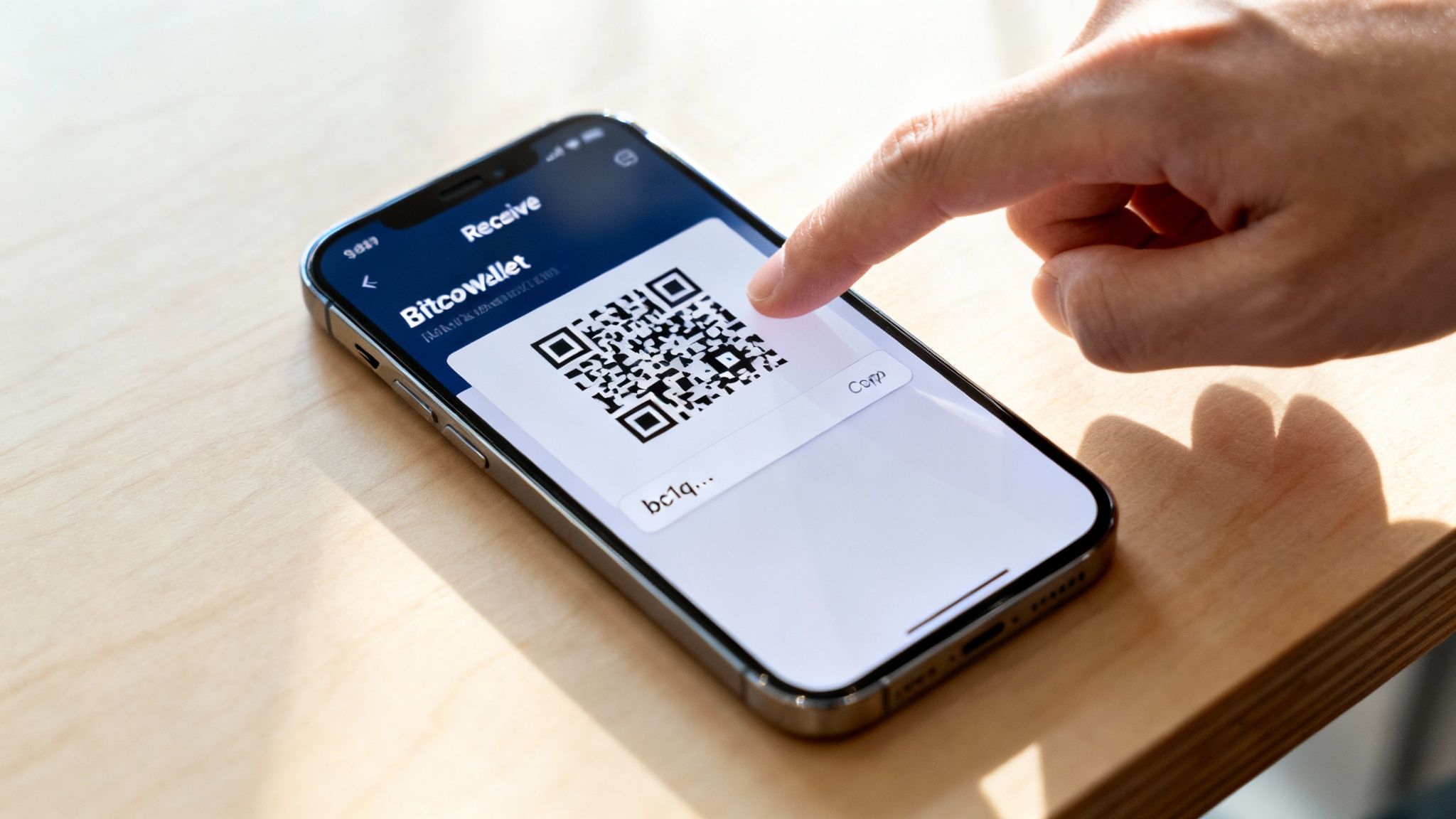
First thing's first: you need to download the official app. Go straight to the Apple App Store or Google Play Store—never download from a third-party site. I always make a point to double-check the developer's name to make sure I'm not getting a malicious knock-off. Once it's installed, you'll see two options: "Create a new wallet" or "Restore an existing wallet." You’re starting fresh, so you’ll tap "Create."
Your Most Important Security Check
Pay close attention here. This next step is, without a doubt, the single most critical moment in your entire Bitcoin journey. The wallet is about to show you a sequence of 12 or 24 words. This is your recovery phrase, often called a seed phrase.
Think of this phrase as the master key to every single bitcoin your wallet will ever hold.
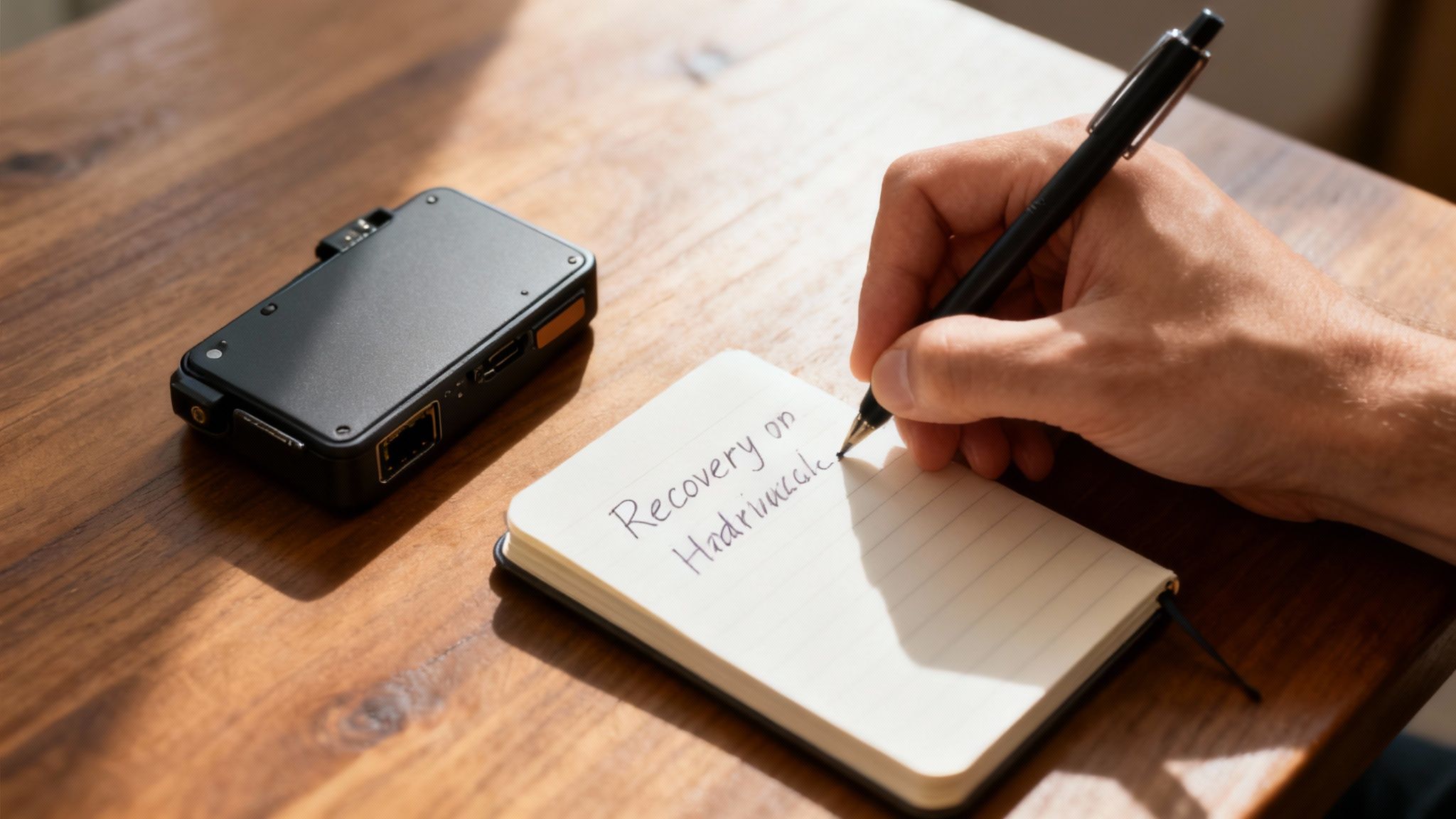
- Write it down on paper. Get a pen and physically write the words down. Do not take a screenshot. Do not save it in a text file or your notes app. Ever. Digital copies are a hacker's dream.
- Store it somewhere safe. This piece of paper needs a secure, private home where it won't get lost, damaged, or seen by anyone else.
- Never, ever share it. No legitimate company, developer, or support agent will ever ask you for these words. If someone asks, they are trying to steal your funds. Period.
To make sure you've done this correctly, the wallet will prompt you to confirm your backup, usually by asking you to re-enter the words in the right order. This is a crucial sanity check before you move on.
A common rookie mistake is to just blow past this step. Don't. If you lose your phone or it breaks, this phrase is the only thing that gives you access to your Bitcoin on a new device. Without it, your funds are permanently gone.
Finding and Sharing Your Address
With your wallet set up and your recovery phrase safely stored, you're ready to find your address. This is usually dead simple. Just look for a big, obvious button that says "Receive."
Tapping it will generate your first Bitcoin address and show you two ways to share it:
- A long string of text: This is the full address. You can tap a "Copy" icon to put it on your clipboard, ready to paste into an email or a message.
- A QR code: This is a scannable, visual version of the same address. It’s perfect for in-person payments or when you want to share it quickly from your screen.
Anyone sending you Bitcoin can either scan the code or paste the text address into their wallet. The QR code is fantastic because it eliminates any chance of a typo—a simple mistake that could otherwise send funds into the void. It’s a clean, effective, and secure way to share your public address and get paid.
Decoding Different Bitcoin Address Formats
When you first start getting into Bitcoin, you’ll quickly notice that not all wallet addresses look the same. This isn't a glitch in the matrix; it's a sign of Bitcoin's evolution. Understanding the different address formats is crucial for transacting smoothly and, more importantly, saving a little money on fees.
Think of it like this: an old landline number and a modern mobile number can both connect a call, but they're built differently and offer different features. It's the same with Bitcoin addresses. They all get the job done, but the newer ones bring some serious advantages to the table.
The Classic: Legacy Addresses
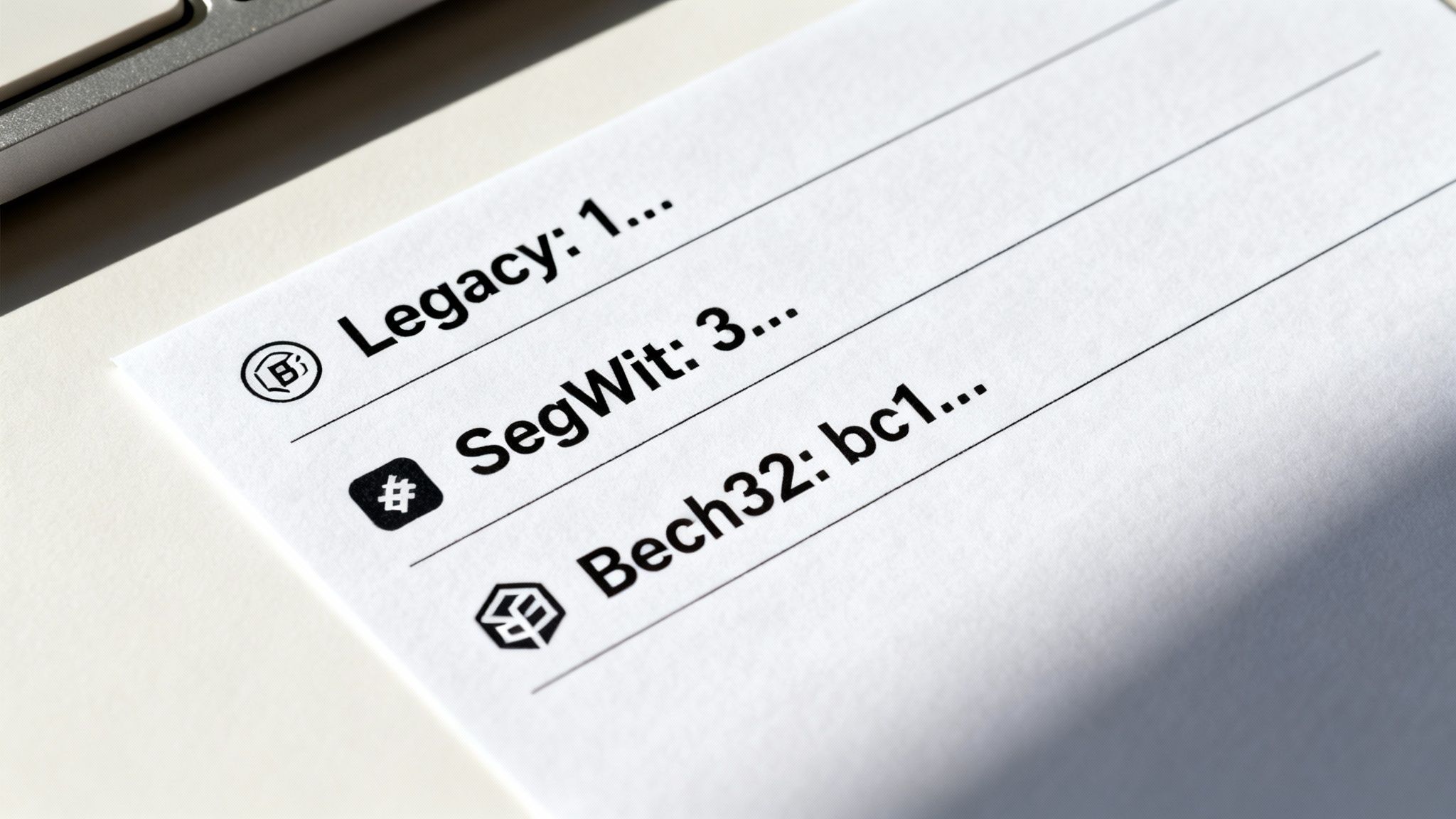
The OG Bitcoin address format is called Legacy, or Pay-to-Public-Key-Hash (P2PKH). These are dead easy to spot because they always begin with the number '1'.
While they are the original standard and compatible with virtually every wallet and service out there, they're also the least efficient. Transactions coming from these addresses take up more block space, which means the person sending the funds ends up paying higher network fees.
The Upgrade: SegWit Addresses
Next on the scene were SegWit addresses, also known as Pay-to-Script-Hash (P2SH). You'll know one when you see it because it starts with the number '3'.
This was a massive leap forward. The introduction of Segregated Witness (SegWit) technology made transactions lighter and more efficient, which helped lower fees and improve the network's overall capacity. You'll still see this format used by many older wallets and exchanges.
The Modern Standard: Bech32
Today, the gold standard is the Native SegWit or Bech32 format. These are unmistakable, as every single one starts with "bc1".
Bech32 is really the best of all worlds, and here's why:
- Lowest Fees: These addresses are the most space-efficient, meaning transactions sent to or from them cost significantly less in network fees.
- Better Error Detection: The format has built-in typo detection. If you accidentally mistype a character, the wallet is much more likely to flag it as an invalid address, saving you from sending your bitcoin into the digital void.
- Improved Readability: They're case-insensitive (always lowercase), which makes them way easier to read and copy without making a mistake.
A simple rule of thumb: whenever you have the choice, always generate and share a Bech32 address. It saves the sender money, has built-in safety nets, and is simply the smartest option available.
A Quick Note on Lightning Addresses
You might also come across something that looks exactly like an email address, for example, [email protected]. This is a Lightning Network address. It's important to know that this isn't a typical on-chain Bitcoin address.
Instead, it’s an identifier used for receiving instant, near-zero-fee payments over the Lightning Network, which is a second layer built on top of Bitcoin. While it's used for Bitcoin payments, it works differently. For regular transactions that get recorded on the main blockchain, you'll always be dealing with one of the formats starting with '1', '3', or 'bc1'.
Keeping Your Bitcoin Address and Funds Safe
Getting a wallet address is the easy part. The real work is protecting the Bitcoin that gets sent to it. Once you have a handle on generating addresses, picking up a few essential security habits is non-negotiable if you want to keep your funds secure. To really do this effectively, it pays to understand the various methods for Bitcoin storage.
One of the first habits you should adopt is to avoid reusing addresses. Every time you use an address, you link transactions together on the public blockchain. This creates a breadcrumb trail that can seriously compromise your financial privacy. Luckily, modern wallets solve this by automatically generating a fresh address for every incoming transaction—a feature you should always have enabled.
This practice of generating new addresses isn't just for individuals; large entities do it too, to manage and diversify their holdings. As of 2025, one massive institutional cold wallet holds nearly 250,000 BTC, but there are over 13 million Bitcoin addresses with balances between 0.01 and 1 BTC. This shows a huge diversification in how people are holding their sats. On the flip side, it's estimated that around 3 million BTC are lost forever simply due to inaccessible private keys.
Verifying Before You Send
A disturbingly common tactic used by malware is to hijack your clipboard. You copy what you think is the correct Bitcoin address, but when you paste it, the malware swaps it with the attacker's address. It happens in a split second, and if you aren't paying attention, your funds are gone for good.
There's a simple defense against this: always double-check the address.
- Verify the first few characters (e.g.,
bc1q...). - Verify the last few characters (e.g.,
...xyz9).
This quick "bookend" check is usually all it takes to spot if the address has been maliciously altered. It takes just a few seconds but can save you from a catastrophic loss.
For larger amounts, I always recommend sending a small test transaction first. Send a tiny amount, wait for it to arrive safely, and only then send the full balance. It's a small inconvenience for massive peace of mind.
The Golden Rule of Self-Custody
No matter what wallet you use or how you generate your address, one rule stands above all others. It’s the single most important principle in all of Bitcoin and the key to true financial sovereignty.
Never, under any circumstances, share your private key or your recovery phrase.
Your recovery phrase is the master key to all your funds. Anyone who has it can access and spend your Bitcoin from anywhere in the world. No legitimate company, developer, or support agent will ever ask for it. If someone does, they are trying to steal from you.
Write it down, store it offline, and keep it incredibly secure. Your financial autonomy depends on it.
Common Questions About Bitcoin Wallet Addresses
Diving into Bitcoin can bring up a lot of questions, especially around something as fundamental as your wallet address. It's totally normal. Getting a handle on these basics is the key to using Bitcoin confidently and, more importantly, safely. Let's clear up some of the most common things people wonder about.
Can I Have More Than One Bitcoin Wallet Address?
Yes, and you absolutely should. In fact, it's not just a good idea—it's how modern Bitcoin wallets are designed to work. For every payment you receive, your wallet should generate a brand-new, unique address.
Think of it as a crucial privacy shield. If you use the same address over and over, you're essentially posting your entire transaction history for the world to see on the public blockchain. Using a fresh address each time makes it incredibly difficult for anyone to link payments together and track your financial activity. The best part? All these addresses are managed by your single 12 or 24-word recovery phrase, so you don't have to worry about a management nightmare.
What Happens If I Send Bitcoin to the Wrong Address?
This is the nightmare scenario for every Bitcoiner, and for good reason. Bitcoin transactions are irreversible. Once you hit send, there's no going back. If you accidentally send funds to the wrong address—even if you're just off by a single character—that Bitcoin is likely gone for good.
There's no customer support line to call or "undo" button to click. The only slim chance of recovery is if you somehow know the owner of that incorrect address and they're honest enough to send it back. This is precisely why you must double-check every single address before confirming a transaction. A common best practice is to verify the first four and last four characters. It's a simple habit that can save you from a very costly mistake.
Being your own bank is empowering, but it comes with responsibility. That extra five seconds you spend verifying an address is the most valuable insurance you have. Always take the time.
Is It Safe to Share My Bitcoin Wallet Address?
Absolutely. Your public wallet address is designed to be shared. It's the information people need to send you money, just like your email address or bank account number. You can post it on your website, send it in a message, or show someone the QR code without any risk.
The real danger is in what you must never share: your private key or your recovery phrase. These are the keys to your kingdom. Anyone who gets their hands on this information gains complete control of your funds and can drain your wallet instantly. Guard them with your life, keep them offline, and never, ever give them to anyone.
Does My Wallet Address Ever Expire?
Nope. A Bitcoin address, once generated, is valid forever. It will always be linked to your wallet's keys and can receive funds indefinitely, whether it's tomorrow or ten years from now.
While it's a best practice for privacy not to reuse old addresses for new payments, you never have to worry about them "going bad." They remain a permanent, valid destination on the Bitcoin network. This means if someone finds an address you used years ago and sends a payment, it will still land securely in your wallet.
Ready to accept Bitcoin payments at your business without the hassle? Flash provides merchants with powerful, easy-to-use tools to accept Bitcoin directly from customers, wallet-to-wallet. Get started in under a minute with no KYC and tap into a global customer base. Learn more and set up your business at .