So, you're holding Bitcoin and want to turn it into actual cash you can spend. You've got a few solid options, and the best one really depends on what's most important to you—speed, cost, convenience, or privacy.
We're going to walk through the main ways to cash out, from the most common platforms to the quickest in-person methods.
Your Guide to Cashing Out Bitcoin
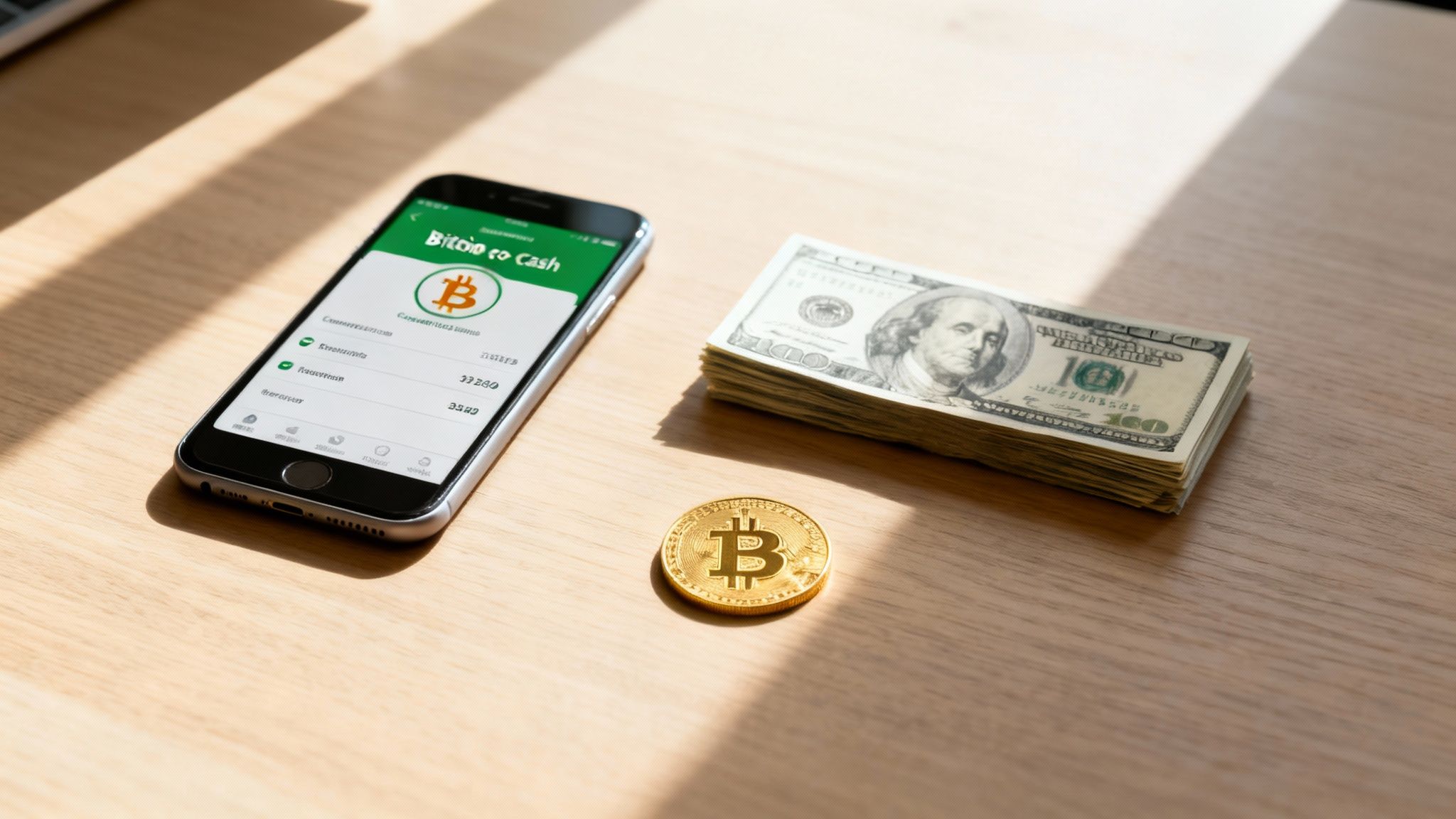
Knowing how to get Bitcoin to cash is a fundamental skill for any holder. Maybe you're a long-term investor ready to take some profits, or perhaps you're a merchant who accepts BTC and needs to pay the bills in your local currency. The process can seem a bit intimidating at first, but it really just boils down to a handful of core strategies.
If you're looking for a simple, straightforward way to sell larger amounts, a big, well-known centralized exchange is usually your best bet. These platforms are built for this exact purpose, making it easy to sell your Bitcoin and withdraw the funds directly to your bank account. The trade-off? You'll almost certainly have to verify your identity (KYC).
Key Conversion Pathways to Consider
On the flip side, maybe you value privacy and a more hands-on approach. In that case, a peer-to-peer (P2P) marketplace might be right up your alley. These platforms connect you directly with buyers, opening the door to flexible payment methods, including old-school, in-person cash deals.
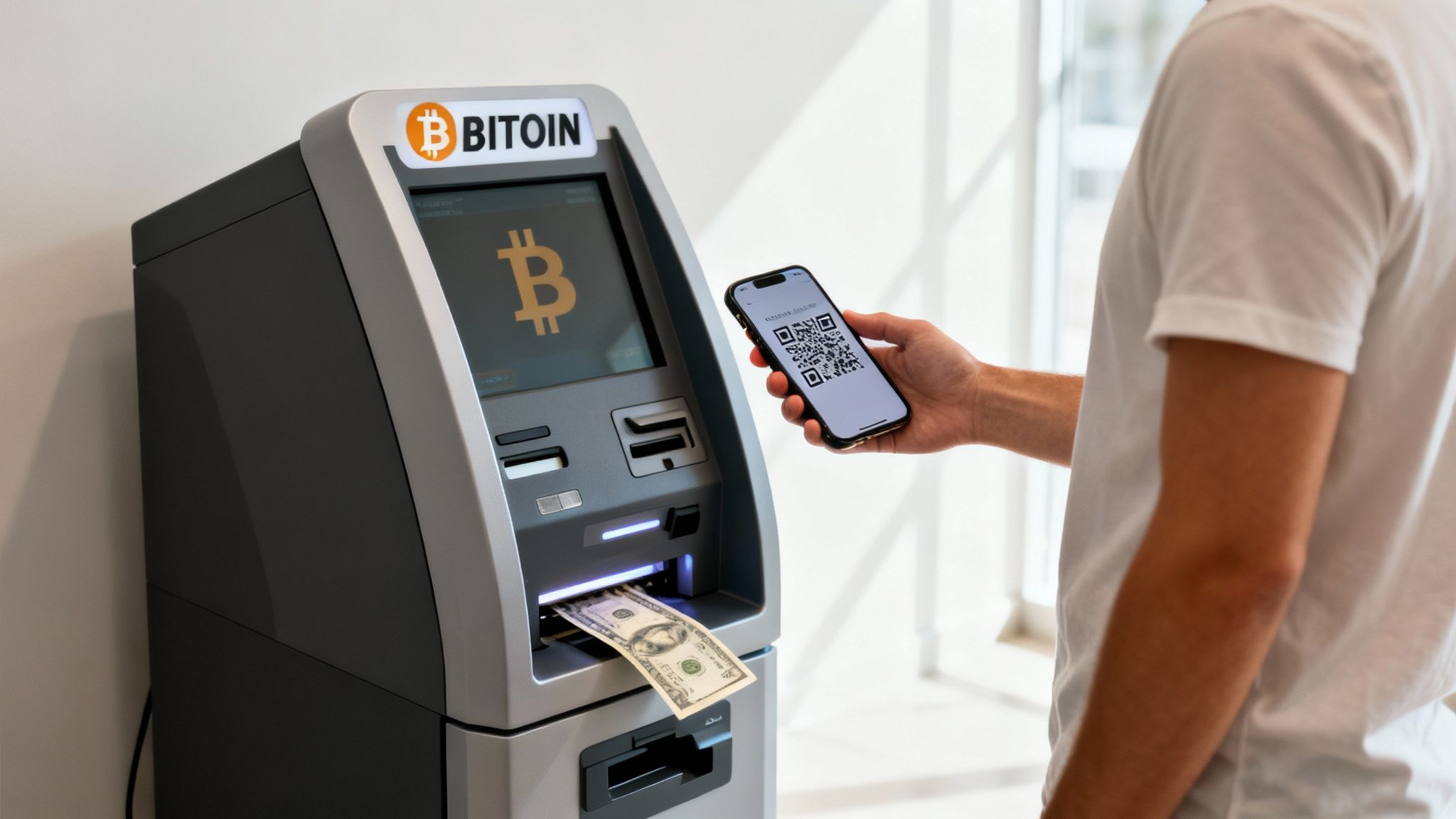
And for those moments when you just need cash right now? Nothing beats the speed of a Bitcoin ATM. They work a lot like regular ATMs: you send your Bitcoin to a QR code on the screen and walk away with physical cash. The convenience comes at a price, though, as their fees are typically higher than other methods.
As you explore your options, keep an eye out for platforms offering robust asset conversion solutions. The right service acts as a secure and efficient bridge, connecting your digital holdings to your bank account with minimal fuss.
The decision to cash out is personal and strategic. It could be driven by market conditions, personal financial goals, or the simple need for liquid funds. The key is to have a clear plan before you initiate a transaction.
Ultimately, this guide is your map. We'll dive deep into each method, covering the step-by-step process and the pros and cons you'll encounter. Armed with this knowledge, you can confidently navigate the conversion process and make choices that align perfectly with your financial goals.
Comparing Popular Bitcoin to Cash Methods
To make things even clearer, let's break down the main options in a simple table. This gives you a quick snapshot of what to expect from each method.
| Method | Average Speed | Typical Fees | Privacy Level | Best For |
|---|---|---|---|---|
| Centralized Exchanges | 2-5 days | Low (0.1% - 2%) | Low (KYC required) | High liquidity, large amounts, ease of use. |
| P2P Marketplaces | Minutes to hours | Varies (0% - 1%) | Medium to High | Privacy, flexible payment methods, user control. |
| Bitcoin ATMs | Instant | High (7% - 20%) | High (often no KYC for small amounts) | Quick cash, convenience, small transactions. |
| Bitcoin Debit Cards | Instant | Moderate (top-up & transaction fees) | Low (KYC required) | Everyday spending, seamless conversion. |
| OTC Desks | 1-3 days | Negotiable (spread-based) | Low (KYC required) | Very large trades ($100,000+), price stability. |
Each pathway has its place. An exchange is great for planned profit-taking, while an ATM is perfect for grabbing some cash for the weekend. Choosing the right one is all about matching the tool to the task at hand.
Using Centralized Exchanges to Convert Bitcoin
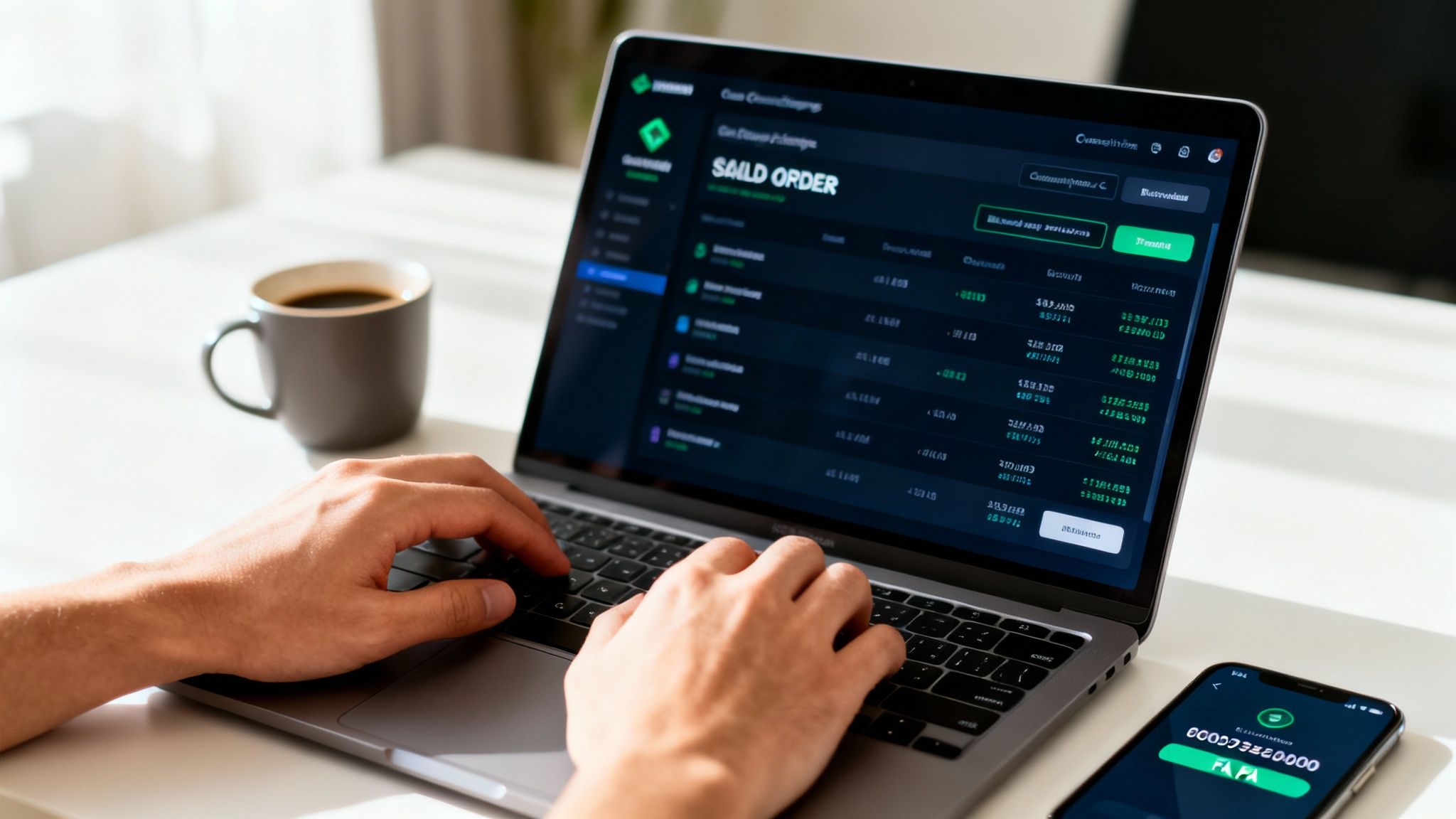
For most people, centralized exchanges are the most straightforward and recognizable path for turning Bitcoin into cash. Think of them as the crypto equivalent of a stock brokerage. They serve as a trusted middleman, creating a regulated and secure marketplace where buyers and sellers can meet.
Their biggest strength is liquidity. These platforms are built to handle massive trading volumes, meaning there's almost always a buyer ready when you want to sell. This ensures you can cash out at a fair market price without having to wait or accept a bad deal.
Your First Steps on an Exchange
Before you can sell anything, you'll need to get your account set up and locked down. The initial part is easy—just sign up with an email and create a strong, unique password.
But because these are regulated financial companies, you can't remain anonymous. You’ll have to complete a Know Your Customer (KYC) process. This is a mandatory identity check. Typically, you'll be asked for:
- A government-issued ID (like a driver's license or passport).
- Proof of your address (a recent utility bill or bank statement usually works).
- A quick selfie to prove you're the person in the ID photo.
Sharing this much personal data can feel a bit invasive, but KYC is a critical tool against fraud and helps keep the platform secure for everyone. Once you're verified, the last essential step is to enable two-factor authentication (2FA). This adds a crucial security layer, requiring a code from your phone to log in or withdraw funds.
From Your Wallet to Your Bank Account
Once your account is ready, cashing out your Bitcoin involves a few key moves. First, you've got to get your Bitcoin from your personal wallet—wherever it is—onto the exchange.
The exchange will give you a unique Bitcoin deposit address. You'll copy this string of characters and paste it into the "send" field of your own wallet. Always double-check this address. Triple-check it, even. A single mistake here could mean your funds are lost forever.
After the transaction confirms on the blockchain, which can take anywhere from a few minutes to an hour, the Bitcoin will appear in your exchange account. Now you can place a sell order. You generally have two choices: a market order, which sells immediately at the best available price, or a limit order, where you set a specific price you’re willing to sell at.
Once your Bitcoin is sold, the cash (USD, EUR, etc.) will show up in your account balance. The final step is to withdraw it to your linked bank account. This last leg of the journey usually takes 1-5 business days to complete.
Weighing the Pros and Cons
Centralized exchanges offer a pretty compelling deal, but it's important to understand the trade-offs. Their user-friendly interfaces and deep liquidity make them great for beginners and serious sellers alike.
The primary benefit of an exchange is its reliability and structure. You're operating within a regulated framework that offers a degree of protection and predictability you won't find with more informal methods.
However, that structure comes at the cost of privacy, thanks to the mandatory KYC. You're also trusting a third party to hold your crypto during the process, which introduces what's known as custodial risk.
Finally, keep an eye on the fees. Exchanges charge for both the trade itself (usually a small percentage) and the cash withdrawal. While generally low, these costs can add up, so always check the fee schedule before you commit.
This method's popularity is no surprise. Recent reports show that about 28% of American adults own cryptocurrency, with Bitcoin leading the pack. This growing user base depends on accessible platforms to manage their assets, making centralized exchanges a vital part of the ecosystem. You can dig deeper into the numbers in this comprehensive cryptocurrency consumer report.
Peer-to-Peer Platforms and Bitcoin ATMs
If uploading your driver's license to a massive corporation doesn't sit right with you, or you just need cash faster than a bank transfer can deliver, you're not out of options. Peer-to-peer (P2P) platforms and Bitcoin ATMs are solid alternatives. They step outside the traditional exchange model, giving you more control, privacy, and speed—but they come with their own set of rules.
Think of P2P marketplaces as the Craigslist for Bitcoin. Instead of selling to a huge, faceless company, you're dealing directly with another person. This opens up a whole new world of flexibility for getting your cash.
How P2P Marketplaces Work
P2P platforms are essentially a bulletin board of buyers. People post offers detailing how much Bitcoin they want, the price they'll pay, and most importantly, how they'll pay. You can scroll through these listings to find a trade that works for you.
The variety of payment methods is a major draw. Buyers might offer:
- Bank transfers for a standard cash-out experience.
- Payment apps like Cash App or Venmo for a quick digital settlement.
- In-person cash exchanges for the ultimate level of privacy.
To make sure nobody gets ripped off, these platforms use an escrow service. When you accept a trade, your Bitcoin gets locked in this neutral holding account. The Bitcoin is only released to the buyer after they've sent the payment and you’ve confirmed you received it. This simple system stops either party from disappearing with the money.
When you're picking a buyer, their reputation is everything. Look for profiles with a high number of successful trades, glowing feedback, and a long history on the site. A trader with a proven track record is far less likely to cause a headache than a brand-new account with zero history.
A huge plus for P2P trading is the ability to negotiate. You aren't stuck with a fixed market rate; you can find buyers offering a premium, especially for in-demand payment methods.
This whole process puts you in the driver's seat, making it a great way to cash out on your own terms. It just requires a bit more diligence than using a big exchange.
The Speed and Simplicity of Bitcoin ATMs
For those moments when you need physical cash right now, nothing comes close to a Bitcoin ATM. These machines are built for one thing: fast, simple transactions. The whole experience feels a lot like using a regular ATM.
You’ll walk up and select the option to sell Bitcoin. The ATM then shows you a QR code and an exact amount of BTC to send from your wallet. Scan the code with your phone's wallet app and hit send.
Once the transaction gets enough confirmations on the network—which can often take less than 15 minutes—the machine spits out your cash. It’s the perfect fix for turning a bit of Bitcoin into pocket money on the spot.
But this convenience comes at a steep price. Bitcoin ATM fees are notoriously high, often chewing up 7% to 20% of your transaction. You're paying a serious premium for the speed and relative anonymity these machines offer. Many ATMs also have pretty low transaction limits, especially if you haven't gone through any ID verification.
Privacy vs. Price: A Necessary Trade-off
Both P2P platforms and Bitcoin ATMs offer way more privacy than your typical centralized exchange. For a small withdrawal at an ATM, you often don't have to provide any personal info at all. On P2P sites, you can find traders willing to meet up for a cash deal, leaving no digital paper trail tied to your identity.
This privacy is a huge selling point, but it's balanced by the downsides. Higher fees are the most obvious trade-off, but you also take on more personal responsibility for security. When you're dealing directly with an individual, especially for an in-person trade, you have to be extra vigilant about scams and your own safety.
Ultimately, the choice comes down to what you value most. If you need instant cash and don't mind paying for the privilege, a Bitcoin ATM is your best friend. If you prioritize privacy and payment flexibility and are willing to put in the work to vet your trading partner, a P2P platform gives you a powerful and unique way to cash out.
Advanced Strategies for Cashing Out Large Amounts
When you're dealing with a serious amount of Bitcoin, the usual cash-out methods just don't cut it. Trying to sell a large position on a regular exchange is a recipe for price slippage—where the price drops as your order fills, leaving you with way less cash than you planned. On top of that, you'll inevitably hit daily or monthly withdrawal limits, turning a single transaction into a week-long headache.
This is where the pros turn to more sophisticated tools. These strategies are built for moving significant sums without spooking the market or getting tangled in red tape.
Over-the-Counter Trading for High-Volume Sales
If you need to sell a major block of Bitcoin—think $100,000 or more—Over-the-Counter (OTC) trading is the way to go. Forget public order books. An OTC desk is a private broker that connects you directly with institutional buyers ready to absorb large volumes.
The whole process is different. Instead of watching your sell order get chipped away on an exchange, you negotiate a single, fixed price with the OTC desk for the entire lot. It’s a game-changer for a few key reasons:
- Price Certainty: You lock in one price for the whole sale. No slippage. What you agree on is what you get.
- Privacy: The trade happens off the books. It doesn't show up on public exchanges, so it won’t trigger a market panic or alert other traders to a big sell-off.
- White-Glove Service: OTC desks offer a high-touch experience, walking you through every step of the settlement.
Think of OTC trading like selling a rare piece of art. You wouldn't just throw it on eBay; you'd go through a private auction house to ensure you get the best price without causing a stir. That's what OTC desks do for Bitcoin.
Naturally, this isn't for your average transaction. OTC desks have steep minimums and are designed for institutional players, high-net-worth individuals, and crypto-native businesses. The fees are also handled differently, typically baked into the price spread rather than charged as a separate commission.
Using Bitcoin Debit Cards for Everyday Spending
On the complete opposite end of the spectrum, we have a tool that lets you spend your Bitcoin like cash without ever formally "cashing out": the Bitcoin debit card. These cards are linked directly to your Bitcoin wallet but work just like the Visa or Mastercard in your pocket.
When you swipe your card at a store or pay for something online, the card provider instantly sells just enough Bitcoin to cover the purchase in the local currency (like USD or EUR). It's a brilliantly simple way to use your Bitcoin for daily life, from grabbing a coffee to paying your bills.
The biggest win here is pure convenience. You skip the entire exchange-to-bank-account process. Your Bitcoin effectively becomes spendable cash anywhere major cards are accepted. Of course, that convenience isn't free. Be prepared for various fees, which can include monthly charges, top-up fees, or commissions on each transaction.
Thinking about the bigger picture can help inform when and how to convert your Bitcoin. Updated market models suggest that if Bitcoin captures just 1% of the total global monetary asset pools, its price could climb past $104,000 per BTC. More bullish scenarios, which see Bitcoin absorbing 2% of the global M2 money supply and 5% of gold's market cap, put the forecast closer to $189,000. You can dive deeper into how these Bitcoin market models are constructed. These numbers, rooted in real adoption trends and fixed supply, underscore why picking the right cash-out method at the right time is so critical.
A Merchant's Playbook for Bitcoin Payments
For businesses, accepting Bitcoin is more than just a new payment option; it opens your doors to a global customer base and signals you're a forward-thinking brand. But once that BTC payment hits your wallet, the real work begins. How do you turn that digital currency into cash to cover payroll, rent, and inventory?
Your strategy really boils down to your business's cash flow needs and your stomach for price volatility.
Merchants generally take one of two paths. The first is a straight shot: immediate conversion to your local fiat currency. This is all about stability and predictable revenue. The second path is a bit more adventurous—holding the Bitcoin as a corporate asset, treating it like an investment with the potential for long-term growth. Each approach demands a completely different set of tools and a distinct operational flow.
The Instant Conversion Strategy for Stable Cash Flow
If your business runs on tight margins, you can't afford to gamble. You need the €100 from today's sale to be worth €100 tomorrow. In this scenario, holding a volatile asset like Bitcoin is a non-starter, which is where Bitcoin payment processors become absolutely essential.
Think of these services as the bridge between your customer's Bitcoin wallet and your company's bank account. It’s a pretty slick process:
- You generate an invoice: You create an invoice in your local currency, say, $50.
- The customer pays in BTC: The payment processor shows your customer the equivalent Bitcoin amount at the current exchange rate, usually with a simple QR code to scan.
- You get instant cash: The moment the payment is confirmed on the network, the processor automatically converts the Bitcoin into your chosen currency and sends it straight to your account.
This setup completely shields you from Bitcoin's notorious price swings. The risk is offloaded to the payment processor, which handles the conversion and charges a small fee for the convenience. It’s by far the most straightforward way to accept Bitcoin without the headache of managing it.
Holding Bitcoin on Your Balance Sheet
On the flip side, some businesses are choosing to keep some or all of their Bitcoin payments. This move transforms a simple sale into a strategic investment in a completely new asset class. The main driver here is the potential for appreciation—the BTC you get from a sale today could be worth a whole lot more down the road.
Of course, this strategy brings its own set of complexities:
- Accounting and Reporting: You'll need to meticulously track the cost basis of the Bitcoin at the time of each transaction for tax purposes. Get friendly with your accountant.
- Secure Custody: Storing corporate assets isn't like holding a few bucks in a personal wallet. This requires robust security, often involving multi-signature wallets or professional custody solutions to protect against theft.
- Volatility Risk: This is the big one. The value of your holdings can swing wildly, which can have a major impact on your balance sheet.
The decision to hold Bitcoin is really a bet on its future value. It's a strategy best suited for businesses with strong cash reserves that can afford to treat BTC payments as a long-term investment rather than immediate operational cash.
We're seeing growing confidence in this approach. Recent data shows that merchants are holding onto about 25.9% of all Bitcoin payments they receive, the highest rate since 2022. While the majority of payments are still cashed out to fiat—primarily euros (52.9%)—this shift shows that more businesses are starting to see Bitcoin as a viable corporate asset. You can dig into more of these eleven years of Bitcoin payment trends to see the full picture.
For businesses getting comfortable with Bitcoin, it's also worth looking at how the underlying technology is shaking things up elsewhere. For instance, some traditional finance tools are now leveraging blockchain for invoice factoring to make managing receivables more transparent and efficient. It’s a great example of how this tech is creating new opportunities far beyond simple payments.
Whether you convert instantly or hold for the long term, integrating Bitcoin requires a clear playbook tailored to your financial goals.
Navigating Taxes and Security When You Sell
Turning your Bitcoin into cash involves more than just hitting the "sell" button. If you want the process to be both profitable and painless, you have to nail two critical things: security and taxes. Get either one wrong, and you could face lost funds or an unwelcome notice from the tax authorities.
Think of security as your first line of defense. Before you even consider selling, especially if it’s a significant amount, you need to be certain your Bitcoin is locked down. For most serious holders, this means using a hardware wallet. It keeps your private keys completely offline, far away from the reach of online hackers.
Protecting Your Transaction
When you’re finally ready to move your Bitcoin to an exchange or a buyer, precision is your best friend. Always double-check—no, triple-check—the recipient's wallet address before you confirm the transaction. One wrong character can send your funds into a black hole with absolutely no way to get them back.
You also have to stay sharp to avoid phishing scams. These are fraudulent emails or copycat websites designed to look legitimate, tricking you into handing over your login details or private keys.
Here’s how to stay safe:
- Bookmark your trusted sites: Never click on links from emails you weren't expecting. Go directly to the sites you use.
- Check the URL: Make sure the website address is spelled correctly and starts with HTTPS.
- Use strong passwords and 2FA: A unique, complex password combined with two-factor authentication (2FA) is one of the most powerful security setups you can have.
Understanding Your Tax Obligations
Let’s get this out of the way: in most countries, selling Bitcoin for a profit is a taxable event. The moment you sell your BTC for more than you paid, that profit is generally considered a capital gain. Ignoring this reality can lead to painful penalties and back taxes later on.
The second you sell your Bitcoin, you've likely created a tax liability. Keeping detailed records of your purchase price, date, sale price, and any fees isn't just a good habit—it's absolutely essential for filing your taxes correctly.
Calculating your capital gain is pretty simple on paper. It’s your sale price minus your cost basis (what you originally paid for the Bitcoin, plus any fees). If you held the Bitcoin for more than a year, you could qualify for a lower long-term capital gains tax rate. If you held it for less than a year, the profit is typically taxed at your normal income rate.
Good record-keeping is non-negotiable here. You need to track every single transaction, including the dates and the value in your local currency at the time of the trade. This paper trail will be your savior during tax season, allowing you to file with confidence. If you're dealing with complex transactions or just feel out of your depth, spending a little money on a tax professional who gets crypto is a very smart move.
So, you're thinking about turning your Bitcoin into cash. It's a common step, but a few questions always seem to pop up right when you're ready to make a move. Getting a handle on these ahead of time makes the whole thing feel less daunting.
Let's walk through some of the most common things people ask.
What Is the Fastest Way to Convert Bitcoin to Cash?
If you need physical cash in your hand, like, right now, nothing is faster than a Bitcoin ATM. You can walk up, scan a QR code, and have cash in hand in under 15 minutes. An in-person P2P trade works just as quickly—once you meet the buyer, the deal is done.
Bitcoin debit cards are another lightning-fast option. They convert your BTC to fiat the instant you swipe the card at a store. Selling on an exchange is fast on the platform side, but the final step of getting it into your bank account is where the delay happens. Expect that withdrawal to take 1-5 business days to clear.
The takeaway: For instant spending power, ATMs and debit cards are your best bet. If you're moving a larger sum and can wait a few days, an exchange is the more practical and cost-effective route.
Can I Cash Out Bitcoin Without Revealing My Identity?
While true, complete anonymity is incredibly hard to achieve, some methods offer way more privacy than others.
A Bitcoin ATM is a solid option if you're cashing out a small amount that flies under the radar of their identity verification limits. Another great route is a P2P marketplace that connects you with someone for an in-person cash trade. These deals leave a minimal digital trail tied back to you.
Just remember, these more private methods almost always come with a price—usually in the form of much higher fees. You also need to be extra cautious to stay safe during in-person meetups.
Do I Owe Taxes When I Sell My Bitcoin?
In most places, the answer is a straightforward yes. Selling your Bitcoin for cash is considered a taxable event. If you made a profit on the sale (meaning you sold it for more than you paid for it), that profit is a capital gain, and you'll likely owe taxes on it.
This is why good record-keeping is non-negotiable. You need to track your purchase price (your cost basis), sale price, the dates of the transactions, and any fees you paid. All this info is crucial for calculating what you owe. When in doubt, it's always smart to talk to a tax professional who gets the crypto space.
Ready to accept Bitcoin payments at your business without the hassle of KYC or high fees? With Flash, you can start accepting wallet-to-wallet Bitcoin payments in under a minute, connecting you directly with customers worldwide. Find out how to get started at .