Dipping your toes into Bitcoin comes down to a few core moves: getting a handle on the basics, setting up a digital wallet, and making that first purchase. It's a clear path for individuals and an absolute game-changer for merchants wanting to connect with a global audience.
Think of it like opening your first online bank account, but this time, you're the one fully in charge.
Your First Steps into the World of Bitcoin
Jumping into Bitcoin doesn't have to be some intimidating, overly technical ordeal. It’s way more approachable than most people think, whether you’re just looking to hold some as a personal asset or you want to wire it into your business. My goal here is to slice through the jargon and give you a practical, step-by-step roadmap.
At its core, Bitcoin is just decentralized digital money. That means no bank, government, or central authority is pulling the strings. It’s all about peer-to-peer transactions, anywhere in the world. For a lot of us, this is a massive shift in how we view money and ownership.
What to Expect on Your Journey
If you're an individual, your journey starts with empowerment. Seriously. You're about to learn how to take genuine ownership of your money by setting up a Bitcoin wallet that only you can control. After that, we'll walk through exactly how to buy your first bit of Bitcoin without getting tripped up.
For merchants, the upside is immediate. Accepting Bitcoin opens your doors to a fresh, tech-savvy customer base and can dramatically slash your transaction fees compared to the old-school payment networks. I’ll show you just how easy it is to get set up and start accepting Bitcoin, sometimes in a matter of minutes.
The big idea is simple: Bitcoin gives you control. Whether you're an individual trying to secure your savings or a business owner reaching new markets, the concepts of self-sovereignty and direct transactions are what it's all about.
This guide will demystify the entire process, building your confidence one step at a time. Before we get into the nitty-gritty of wallets and exchanges, let’s zoom out. The checklist below gives you a clean snapshot of what's involved for both personal use and business integration.
Your Bitcoin Starter Checklist
This table offers a quick-glance summary of the essential actions for personal use and business integration when you get started with Bitcoin.
| Action | For Individuals | For Merchants |
|---|---|---|
| Understand the Basics | Learn what Bitcoin is and why self-custody matters. | Recognize the benefits of lower fees and a global reach. |
| Set Up a Wallet | Choose and install a secure, non-custodial wallet. | Select a reliable payment solution for transactions. |
| Acquire Bitcoin | Buy your first Bitcoin from a reputable source. | Set up a payment gateway or Point-of-Sale system. |
| Secure Your Assets | Back up your seed phrase and store it safely offline. | Implement secure checkout and funds management practices. |
| Start Transacting | Send or receive a small test transaction to get comfortable. | Begin accepting payments and managing Bitcoin revenue. |
This checklist breaks down the journey into manageable pieces. As we move through the guide, we'll expand on each of these points, giving you the practical details you need to get started with confidence.
Choosing Your First Bitcoin Wallet
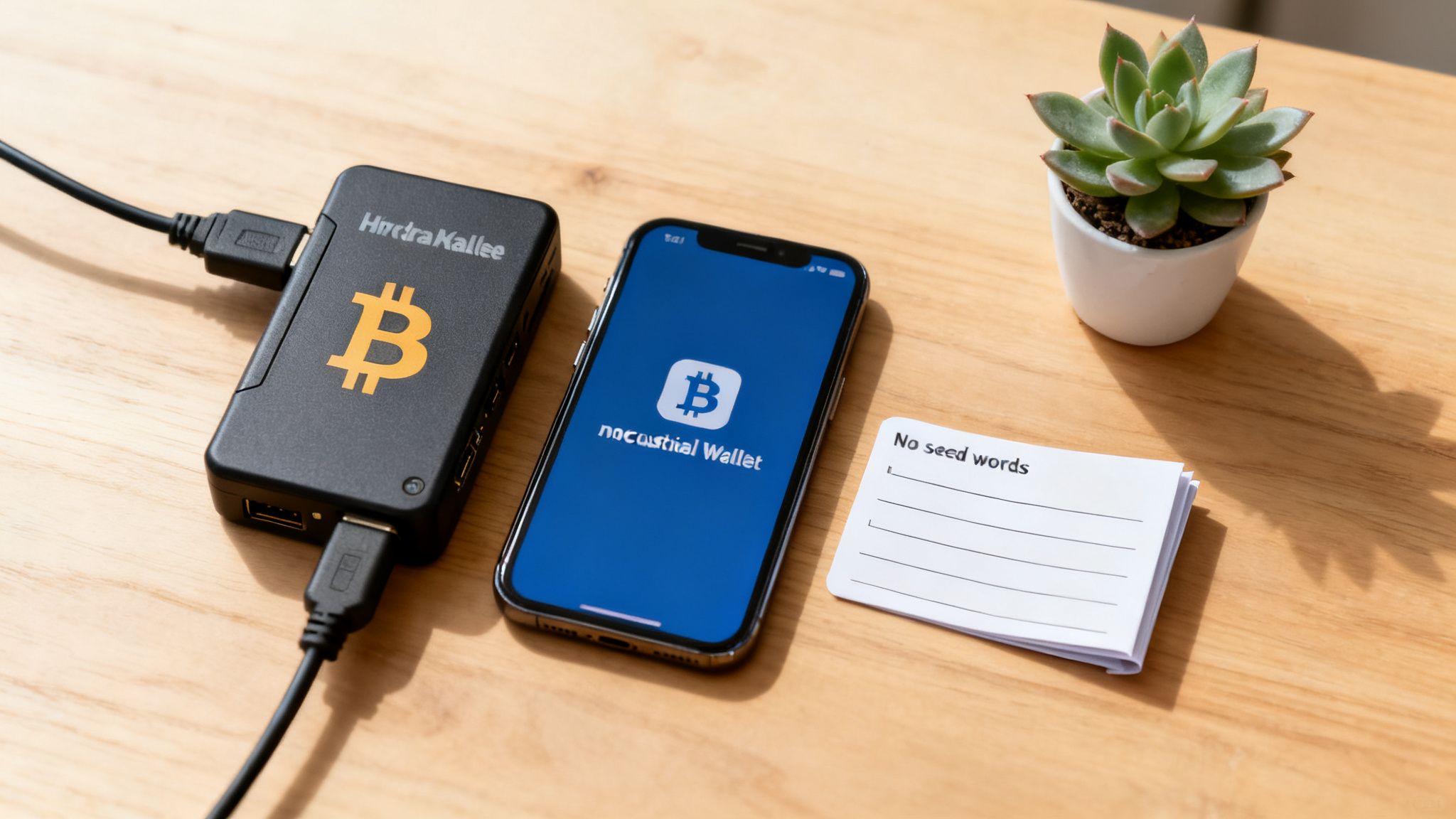
Think of your Bitcoin wallet as more than just an app. It's your personal vault, your digital passport to the network. It functions a bit like your bank account but with one massive, game-changing difference: you're the only one who can access it.
Picking the right one is arguably the most important decision you'll make when you first step into the world of Bitcoin. This is where the idea of true ownership really clicks. With a traditional bank, you’re trusting someone else to hold your money. With Bitcoin, you can hold it yourself—which is the entire point.
Custodial vs. Non-Custodial: The Only Choice That Matters
When you start looking around, you'll quickly run into two main types of wallets: custodial and non-custodial.
A custodial wallet is where a third party, usually an exchange, holds your private keys for you. It might seem convenient, but it goes against the very principle of Bitcoin. If you don't control the keys, you don't really own the Bitcoin. Simple as that.
A non-custodial wallet (also called a self-custody wallet) puts you in complete control. You manage your own private keys, meaning no one can freeze, seize, or lose your funds without your permission. This is how you achieve true financial sovereignty.
Key Takeaway: You'll hear this a lot in the Bitcoin community: "Not your keys, not your coins." For anyone serious about owning Bitcoin, a non-custodial wallet is the only real path forward. It comes with a bit more responsibility, but the security and freedom you gain are more than worth it.
Your Private Keys and Seed Phrase, Explained
So what are these "keys" everyone keeps talking about? Let's break it down with a simple analogy.
Your public key is like your bank account number—you can share it with anyone who wants to send you money. Your private key, on the other hand, is like your password and PIN combined. It’s the secret code that signs transactions and proves you actually own the bitcoin you're trying to spend.
Losing your private key means losing your funds forever. To stop that from happening, modern wallets give you a seed phrase (or recovery phrase) during the setup process. This is just a list of 12 or 24 random words.
This seed phrase is the master key to your entire wallet. If your phone gets stolen or your laptop dies, you can use these words to restore full access to your Bitcoin on any new device.
Selecting the Right Non-Custodial Wallet
Choosing a non-custodial wallet really boils down to your personal needs and how you plan to use your Bitcoin. Here are the main things to think about:
- Security: Does the wallet have a solid track record? Is the code open-source? An open-source wallet allows the community to inspect it for any vulnerabilities.
- Ease of Use: Is the interface intuitive? A good wallet should make it easy to send, receive, and check your transaction history without getting confused.
- Platform: Do you need a mobile wallet for paying on the go, or a desktop wallet for managing things at home? There are fantastic options for iOS, Android, macOS, Windows, and Linux.
The growth in this space has been staggering. Back in 2009, when Satoshi Nakamoto mined the very first block, it was a niche experiment. Today, there are an estimated 106 million Bitcoin owners worldwide, who have created over 200 million wallets. That shows a massive interest in self-sovereignty.
As you explore your options, it's interesting to look at new innovations like AI-Driven Web3 Wallets to see where the technology is headed. For now, though, I'd recommend focusing on a reputable, Bitcoin-only wallet to keep things simple and avoid unnecessary risks.
Once you install it, your first and most critical task is this: write down your seed phrase and store it somewhere safe and offline. Not on your computer, not in an email. Physical and offline.
How to Buy Your First Bitcoin Securely
Alright, your non-custodial wallet is set up, and you’ve hidden your seed phrase somewhere safe and offline. Now for the exciting part—actually getting your hands on some Bitcoin. This is where the old financial world meets the new.
Our goal here isn’t just to buy Bitcoin. It's to buy it securely and, most importantly, move it into your own custody right away.
For most beginners, the clearest path is through a reputable Bitcoin exchange. Think of it like a digital currency brokerage where you can trade your dollars, euros, or other local currency for BTC.
But there’s a critical rule you need to burn into your memory: an exchange is for buying, not for storing. Leaving your Bitcoin on an exchange is the single biggest—and most costly—mistake newcomers make. It completely defeats the purpose of Bitcoin by reintroducing a third party you have to trust with your money.
Vetting a Reputable Platform
Choosing where to make your first purchase is a huge deal. Not all platforms are built the same, and your top priorities must be security and reliability. Here’s what I look for when evaluating an exchange:
- Bitcoin-Only Focus: I’m always a bit wary of platforms that list hundreds of different digital assets. Companies that focus exclusively on Bitcoin tend to have a clearer mission and a better user experience, without the distractions and added risks of other unproven coins.
- Strong Security Track Record: How long have they been around? Have they suffered any major hacks? A platform with a multi-year history of protecting user funds is a massive green flag.
- Transparent Fee Structure: The fees for buying, selling, and—most importantly—withdrawing your Bitcoin should be crystal clear. If you have to dig through pages of fine print to find them, that’s a red flag.
- Regulatory Compliance: A trustworthy platform plays by the rules and complies with financial regulations in the regions it serves. This isn't just about red tape; it's about accountability.
Once you’ve picked one, you’ll need to create an account. This typically involves identity verification, often called Know Your Customer (KYC). While Bitcoin itself is pseudonymous, these regulated on-ramps are required by law to know who’s using their services.
Pro Tip: The very first thing you should do after creating your account is enable two-factor authentication (2FA). It adds a crucial security step, usually requiring a code from an app on your phone, making it much harder for anyone to access your account. Don't skip this.
From Purchase to Self-Custody
Let’s walk through what a first purchase might look like. Say you’ve signed up for a solid exchange and you're ready to buy $100 worth of Bitcoin.
First, you’ll link a payment method, like a bank account or debit card. Then, you'll execute the trade. The exchange will show you the current BTC price and exactly how much Bitcoin your $100 gets you. You hit confirm, and voilà—the Bitcoin appears in your exchange wallet.
But you're not done yet.
Now comes the most important step of all: moving that Bitcoin into your personal, non-custodial wallet. This is the move that makes you a true owner. You'll find the "withdraw" option on the exchange, and it will ask for a receiving address. You'll generate a fresh one from your self-custody wallet and paste it in.
Always double-check the address character by character before hitting send. Seriously. One wrong letter, and your funds could be gone forever.
After you confirm the withdrawal, you’ll have to wait a little bit for the transaction to be confirmed on the Bitcoin network. Soon enough, you'll see the BTC arrive in the wallet that you control.
Congratulations. You've just securely bought your first Bitcoin and taken full ownership.
Accepting Bitcoin Payments as a Merchant
Alright, you've got your own Bitcoin. Now for the fun part—bringing it into your business. Learning how to get started with Bitcoin payments isn't just a cool gimmick; it's a strategic move that plugs you into a global, tech-savvy customer base and can seriously slash your overhead.
For way too long, merchants have been at the mercy of traditional payment systems. They're slow, expensive, and packed with middlemen taking a cut. Bitcoin completely flips that script, enabling direct, peer-to-peer transactions from your customer's wallet straight to yours.
What does that mean in practice? Faster settlement times, way lower fees than credit card processors, and the complete elimination of chargeback fraud. When a Bitcoin payment is confirmed, it's done. Final. If you've ever wasted time and money fighting a disputed charge, you know how big of a deal that is.
The Power of Direct Wallet-to-Wallet Transactions
The real game-changer here is cutting out the middleman. With a solution like Flash, you aren't using a custodial processor that holds your funds hostage. Instead, the Bitcoin flows directly from your customer’s non-custodial wallet into your business’s non-custodial wallet.
This direct model gives you some serious advantages:
- Instant Settlement: Forget waiting days for your money to clear. Bitcoin payments settle right on the network, giving you much faster access to your cash.
- Zero Intermediaries: No banks, no processors, no third-party accounts holding your funds. This direct link reduces risk and makes your accounting a whole lot simpler.
- Enhanced Customer Privacy: You’re not forcing your customers through a clunky KYC (Know Your Customer) process just to buy a product. They can maintain their privacy, a huge plus for many in the Bitcoin community.
This approach gives you total control over your revenue from the second a sale is made. It’s the business equivalent of self-custody. That old saying, "not your keys, not your coins," applies to your business funds, too.
Finding the Right Solution for Your Business Model
Not too long ago, setting up Bitcoin payments was a nightmare for anyone who wasn't a developer. Today, modern tools have made it incredibly simple, and most don't require you to write a single line of code. The trick is to pick a solution that actually fits how you operate, whether you're running an online store, a physical shop, or a subscription service.
A freelance graphic designer, for example, could use a simple, shareable payment link to bill clients anywhere on the planet. They generate a link, shoot it over in an email, and the client pays directly from their wallet. The whole thing takes just a few seconds.
Thinking about how to get started with Bitcoin as a merchant? The beauty lies in its flexibility. A coffee shop can use a mobile point-of-sale (POS) app, while an e-commerce store can embed a payment button, and a SaaS company can automate recurring billing.
This adaptability means businesses of every shape and size can get in on the action. We're seeing a massive shift in how money is viewed, with a significant number of institutional investors now involved in Bitcoin. For retailers and creators, tools like Flash make it trivial to add Bitcoin payment widgets to a website or automate subscriptions without any intermediaries. This connects you directly to a rapidly expanding global user base. You can discover more about global Bitcoin adoption and its market impact to see the full picture.
Practical Integration Options for Every Merchant
Let's break down how this looks in the real world.
For eCommerce and Online Creators
If you sell digital goods or run an online shop, a no-code payment button will be your best friend. It’s a simple three-step process:
- Sign up for a service like Flash, which seriously takes less than a minute.
- Generate a payment button or widget for your product.
- Copy and paste the little code snippet into your website builder—it works with WordPress, Shopify, Squarespace, you name it.
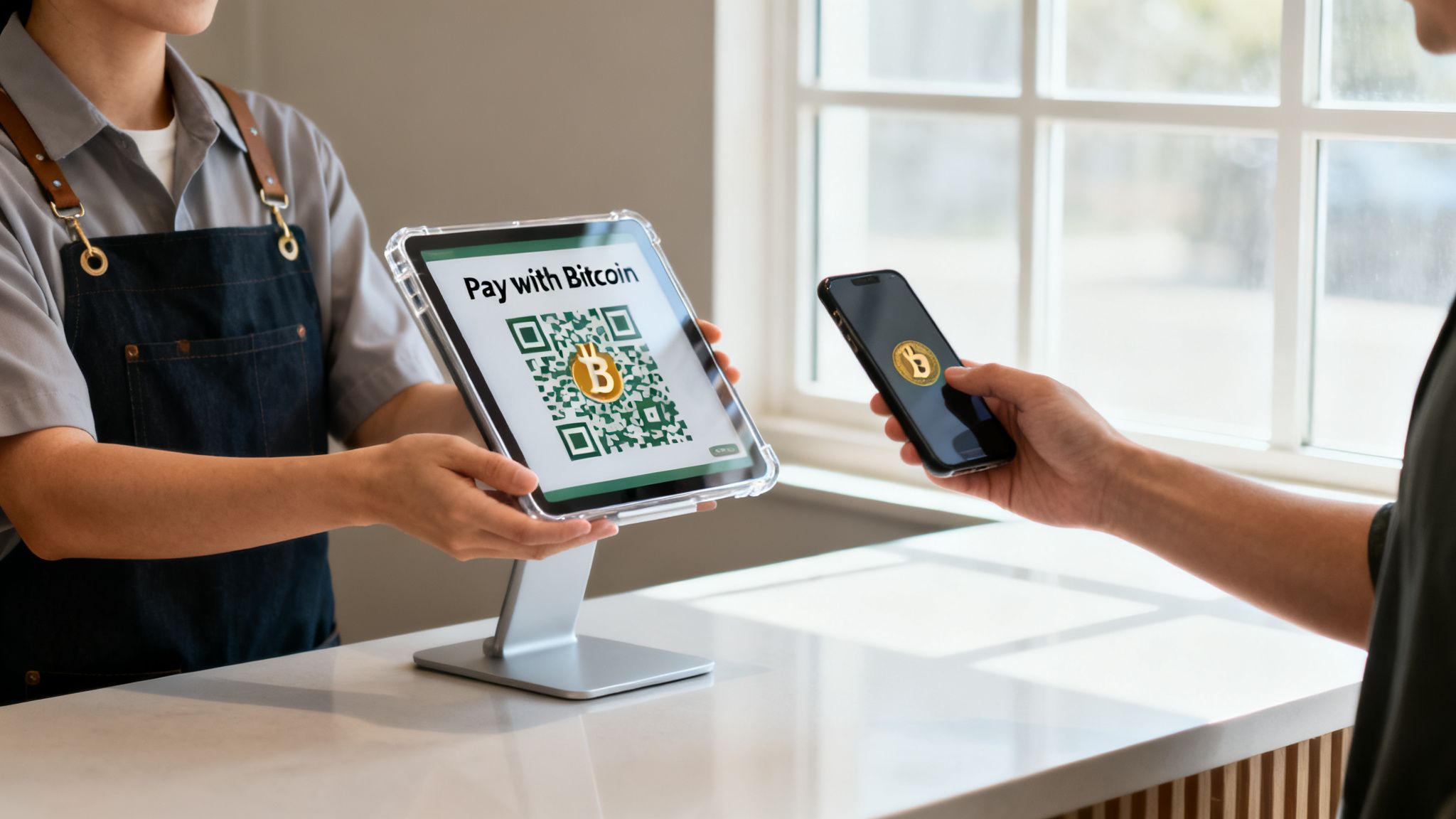
When a customer clicks "Pay with Bitcoin," a QR code pops up. They scan it, send the payment, and the funds go straight to you. Easy.
For Brick-and-Mortar Stores
For a physical retail spot, a mobile Point-of-Sale (POS) terminal is the answer.
- You can just use an app on a tablet or smartphone you already own.
- When a customer is checking out, you type in the sale amount in your local currency (like USD or EUR).
- The app instantly converts it to the current Bitcoin price and generates a unique QR code for that specific sale.
- The customer scans, pays, and you get an instant confirmation on your screen.
For Subscription-Based Businesses
Automating recurring payments is another killer feature. You can set up subscription plans that automatically invoice your customers in Bitcoin, creating a reliable revenue stream without the high fees that come with recurring credit card charges.
This is perfect for SaaS products, membership sites, or paid newsletters. By connecting directly to your customers' wallets, you create a billing cycle that is both seamless and efficient.
Managing Volatility and Enhancing Security
So you've bought your first bitcoin. Now what? A successful journey isn't just about buying and holding; it’s about confidently navigating two of Bitcoin's most talked-about traits: its price swings and the absolute need for ironclad security.
Let's get straight to the point: Bitcoin's price moves. A lot. This volatility is a natural feature of a new, global asset finding its footing. Instead of letting it intimidate you, the key is to have a clear strategy that matches your goals.
Strategies for Taming Price Volatility
For anyone looking to hold Bitcoin for the long haul, one of the most effective and stress-reducing strategies is dollar-cost averaging (DCA). It's a classic for a reason.
The idea is simple. Forget trying to "time the market" and buy at the absolute bottom—a game that even seasoned traders rarely win. Instead, you commit to buying a fixed dollar amount of Bitcoin on a regular schedule. Think $50 every Friday or $100 on the first of every month.
When the price is high, your money buys a bit less Bitcoin. When the price dips, that same amount buys you more. Over time, this smooths out your average purchase price, takes the emotion out of buying, and turns market jitters into a predictable routine.
For merchants, volatility is a different beast. You price your goods in your local currency but might get paid in one that fluctuates. Thankfully, modern payment tools offer some elegant solutions.
- Instant Conversion: Many payment processors, like Flash, let you automatically convert Bitcoin payments into your local currency the moment the transaction happens. This locks in your revenue and completely removes price risk.
- Hold a Percentage: Some businesses choose to keep a small slice of their Bitcoin earnings as BTC, treating it like a long-term asset, while cashing out the rest to cover day-to-day costs.
The most important takeaway is to have a plan. Whether you're an individual using DCA or a merchant using instant conversion, a deliberate strategy transforms volatility from a source of anxiety into a manageable variable.
Building Rock-Solid Bitcoin Security Habits
Security isn’t a one-and-done setup; it's an ongoing practice. Once you get the basics down, mastering these habits will protect your assets for years to come.
Your seed phrase is the master key to your funds. If your phone gets lost or your laptop dies, those 12 or 24 words are the only way to get your Bitcoin back. Storing it correctly is non-negotiable.
This image shows the different kinds of Bitcoin wallets, giving you a quick visual on how security levels can vary based on your choice.
As you can see, hardware wallets provide the highest level of security by keeping your keys completely offline, which is the gold standard for serious, long-term storage.
Essential Security Practices You Can't Skip
- Offline Backups Are King: Never, ever store your seed phrase digitally. Not in a password manager, not in your email drafts, and definitely not in a cloud document. Write it down on paper or stamp it into metal, then store it somewhere safe and private.
- Watch Out for Scams: Be incredibly skeptical of anyone online offering to "double your Bitcoin" or asking for your seed phrase. No legitimate service will ever ask for your recovery words. Scammers love to impersonate support agents on social media or send convincing phishing emails.
- Get a Hardware Wallet: If you accumulate an amount of Bitcoin you wouldn't be comfortable losing, it's time to graduate to a hardware wallet. These little devices keep your private keys totally offline, making it virtually impossible for hackers to get to them through an internet connection.
By combining a smart strategy for volatility with bulletproof security habits, you create a foundation of resilience. This approach allows you to engage with the Bitcoin network confidently, knowing that you are truly in control of your financial future.
As you start wrapping your head around using and accepting Bitcoin, a few questions inevitably surface. It's totally normal. Think of this as your quick-reference guide for those "what if" moments that pop up for everyone at the beginning.
Let's cut through the noise and tackle these common questions head-on.
Do I Need to Buy a Whole Bitcoin?
Absolutely not. This is probably the biggest myth that keeps people on the sidelines.
A single Bitcoin is divisible down to 100 million tiny units. The smallest unit is called a satoshi (or a "sat" for short). Think of it like a dollar being made up of 100 cents, but on a much grander scale. You can buy $20 worth, $50 worth, or whatever amount makes sense for you. This incredible divisibility means Bitcoin is accessible to anyone, no matter the price of a full coin.
Is It Too Late to Start with Bitcoin?
It’s easy to look at the price charts and think the ship has sailed. But focusing only on the price misses the much bigger story: global adoption.
From a worldwide perspective, we're still in the very early innings. Every single day, more people, businesses, and even major financial institutions are starting to understand its long-term value. The network just keeps getting stronger and more secure.
Instead of trying to time the market (a losing game), focus on learning the technology. Getting your feet wet now still puts you way ahead of the curve.
Consider this: The internet was around for years before Google and Amazon turned it into a daily utility for billions. Many experts see Bitcoin in a similar phase right now. The foundation is solid, and the real-world uses are just starting to take off.
How Do I Handle Bitcoin Taxes?
This is a critical one for both individuals and businesses, and the answer depends entirely on where you live. Tax laws for Bitcoin vary wildly, so your first step is always to check your local regulations.
In many places, like the United States, Bitcoin is treated as property, not currency. This is a key distinction.
- For Individuals: If you sell, trade, or spend Bitcoin for more than you paid for it, that's typically a taxable event (think capital gains).
- For Merchants: When a customer pays you in Bitcoin, you record the revenue based on its fair market value in your local currency at that exact moment.
Meticulous record-keeping is non-negotiable. For every transaction, you need the date, the amount in BTC, and its value in your currency at the time. Since this can get complex fast, I always recommend talking to a qualified tax professional who has actual experience with Bitcoin in your area. They can give you advice that fits your specific situation.
What Happens If I Lose My Seed Phrase?
I’ll be blunt, because this is the most important question here: if you lose the seed phrase to your self-custody wallet, your Bitcoin is gone. Forever.
There's no "Forgot Password" link. No customer service number to call. When you hold your own keys, you are the bank. That 12 or 24-word phrase is the one and only master key to your funds.
This is exactly why we've hammered on the importance of secure, offline backups throughout this guide. Your responsibility is to protect that phrase as if it were the keys to a vault holding your life savings—because that's precisely what it is. Store it safely, keep it in more than one place, and never, ever show it to anyone.
Ready to join the global economy and accept Bitcoin payments with zero intermediaries? At Flash, we make it simple for merchants to integrate secure, wallet-to-wallet Bitcoin transactions in under a minute. Get started for free today.