Accepting Bitcoin is more than just a novelty; it’s a strategic move to future-proof your business with a payment technology built for the digital age. It lets you slash transaction fees, eliminate chargebacks, and tap into a rapidly expanding global customer base. Forget the speculation—the real value is in the practical advantages it brings to your business right now.
Why Your Business Should Start Accepting Bitcoin
So, you're thinking about how to get started with bitcoins for your business? The conversation usually gets bogged down in price charts and dense jargon. Let's cut through that noise. For merchants, accepting Bitcoin isn't just about grabbing a piece of a new market; it's about gaining a real competitive edge with a fundamentally better payment system.
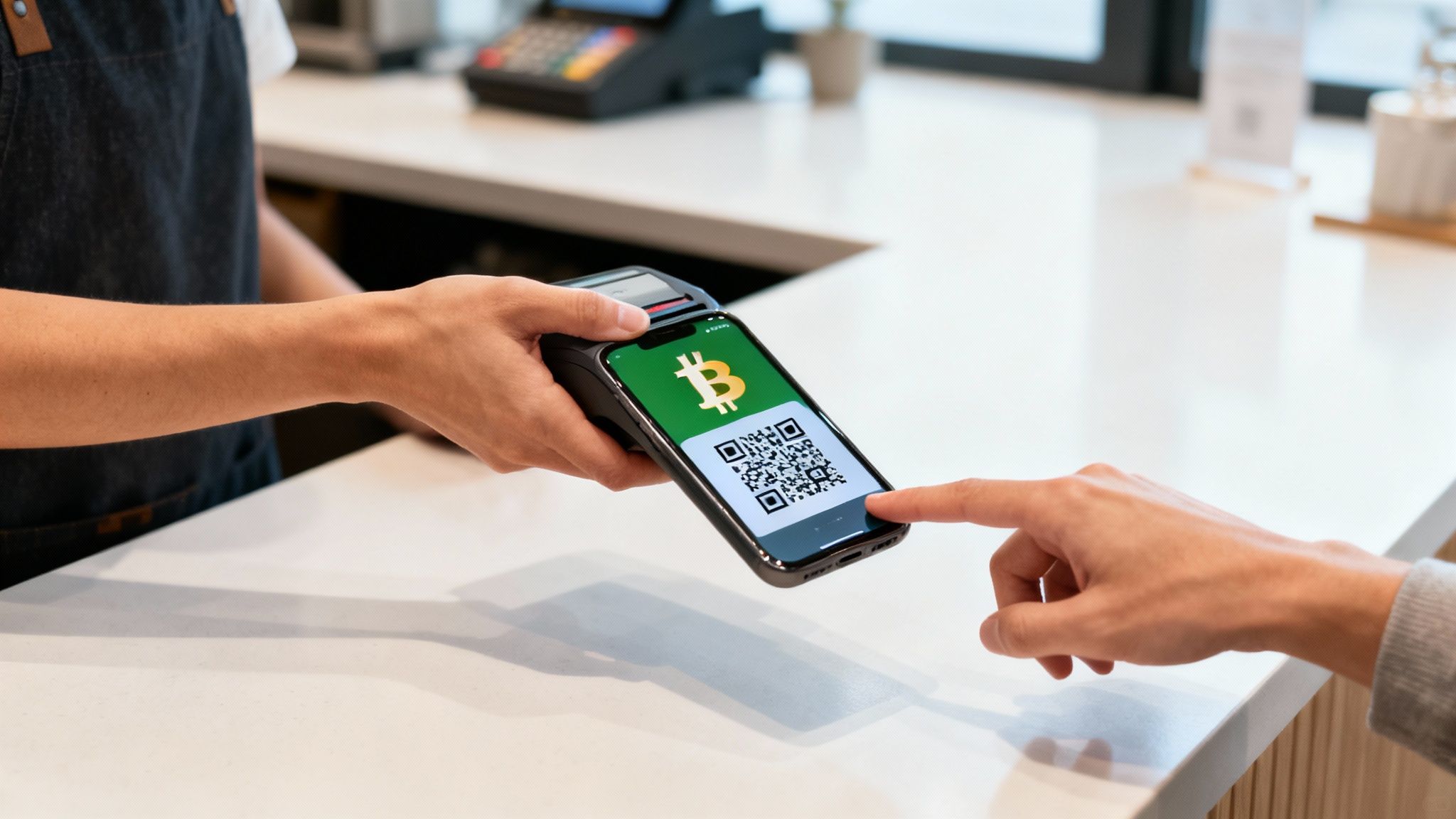
Unlike the traditional payment rails that depend on a long line of middlemen, Bitcoin enables direct, wallet-to-wallet transactions. This peer-to-peer model delivers tangible benefits that go straight to your bottom line.
- Drastically Lower Fees: Credit card processors routinely skim 2-3% off every single transaction. Bitcoin network fees are often a fraction of that, meaning more of your hard-earned revenue stays in your pocket.
- Zero Chargebacks: Bitcoin payments are final. Once a transaction is confirmed, it's irreversible. This simple fact completely wipes out the risk of fraudulent chargebacks—a headache that costs merchants a fortune every year.
- Instant Settlement: Payments land directly in your wallet almost instantly. No more waiting days for funds to clear. This is a game-changer for your business's cash flow.
- Global Reach: Bitcoin doesn't care about borders. You can accept payments from anyone, anywhere on the planet, without the hassle of currency conversion fees or navigating international banking hurdles.
The core advantage for any business is simple: Bitcoin puts you back in control of your money. It removes the gatekeepers, reduces operational friction, and opens your business to a global, digitally-native audience.
A Growing and Engaged Market
Adopting Bitcoin isn't just a tech upgrade; it's about connecting with a dedicated and rapidly expanding user base. Honestly, this market is becoming too big to ignore.
The wider digital asset market has seen explosive growth, jumping from around $2.2 trillion in 2021 to a projected $3.8 trillion in 2025. An increase of nearly 73% like that isn't just a trend; it's a massive shift in mainstream adoption and institutional interest. You can find more insights on the crypto market outlook on SVB.com. For merchants, this growth trajectory means a much larger pool of potential customers ready and willing to spend Bitcoin.
This isn't just about numbers on a screen, either. It represents real people—tech-savvy consumers, international clients, and privacy-conscious individuals who actively prefer to pay with Bitcoin. By offering it as a payment option, you send a clear signal that your business is forward-thinking and understands their values. That alone can be a powerful way to stand out.
Choosing the Right Bitcoin Wallet for Your Business
Your Bitcoin wallet is the cornerstone of your entire setup. Think of it as your digital vault and point-of-sale terminal rolled into one. Getting this choice right from the start is absolutely critical. The first big decision you'll make is whether to go with a custodial or a non-custodial wallet—a choice that fundamentally defines your control, security, and financial independence.
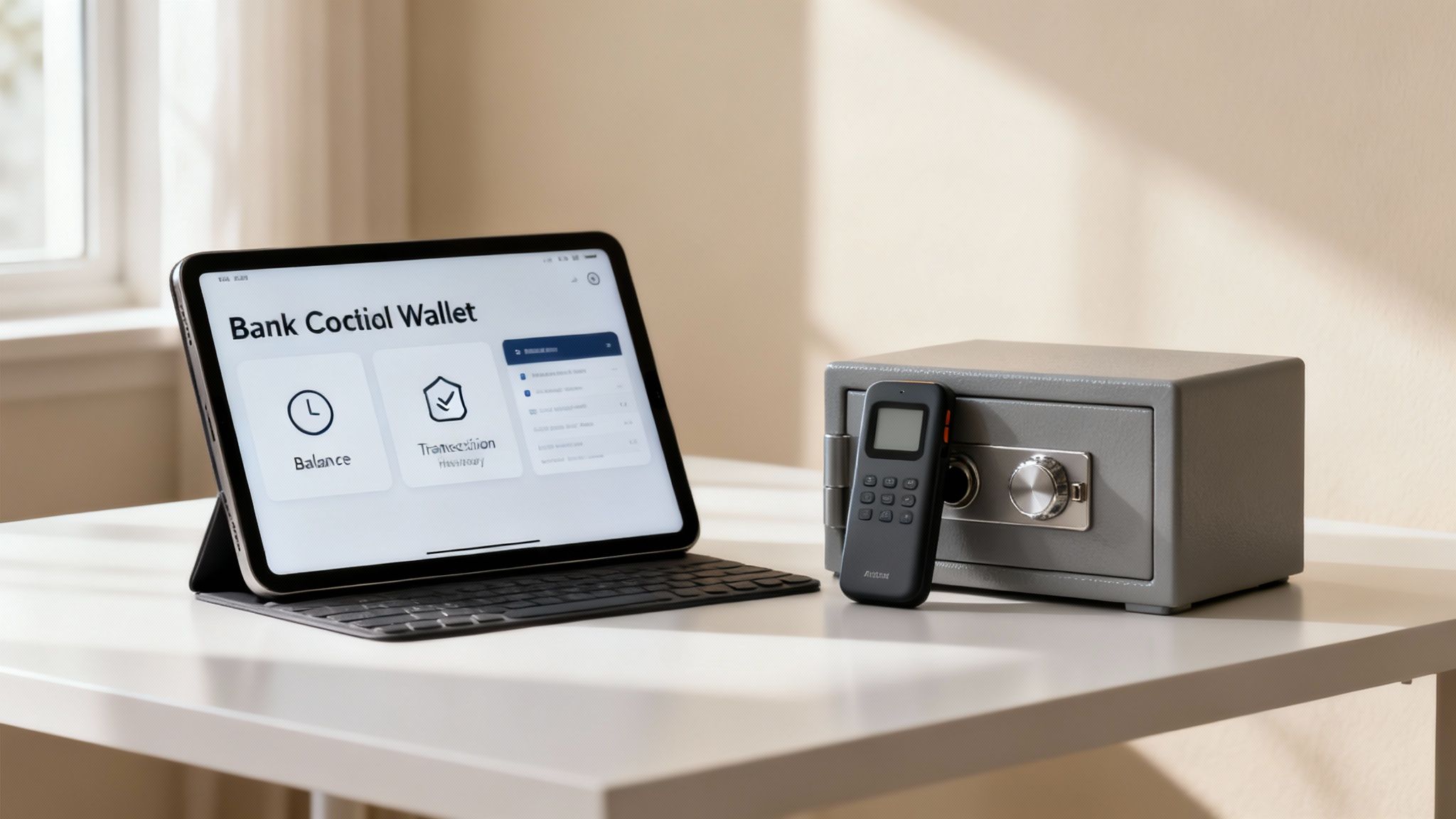
Here's a simple way to look at it. A custodial wallet works a lot like a traditional bank account. A third-party service, usually an exchange, holds onto your Bitcoin for you. This might feel convenient because they handle the technical stuff, but it comes with a huge catch: you don't actually own your funds. You're trusting them to keep your assets safe and give you access when you ask for it.
On the other hand, a non-custodial wallet is like having a physical safe in your office. You hold the keys. You and you alone. This is what gives you complete sovereignty over your money, which is the whole point of Bitcoin in the first place. For any business owner, this isn't just a nice feature; it's a strategic advantage that completely removes counterparty risk.
Custodial vs. Non-Custodial Bitcoin Wallets: A Merchant's Quick Guide
Understanding the line between these two wallet types is the most important concept to nail down as you get started with Bitcoin. To help you see what each option means for your day-to-day operations, here’s a quick comparison.
| Feature | Non-Custodial Wallet (Your Keys) | Custodial Wallet (Third-Party Keys) |
|---|---|---|
| Asset Control | You have 100% control over your funds. No one can freeze or seize them. | A third party controls your funds. They can freeze accounts or limit withdrawals. |
| Security | You are responsible for securing your private keys—superior protection if done right. | You're relying on the custodian's security, which can be a target for large-scale hacks. |
| Transaction Fees | You only pay the base Bitcoin network fee, which is often much lower. | The custodian may add their own service fees on top of network fees. |
| Privacy | Transactions are pseudonymous. No need to hand over personal data to set up. | Requires Know Your Customer (KYC) identity verification, linking your business to all transactions. |
| Access to Funds | Immediate access, anytime. Your funds are always available to send or receive. | Access can be delayed by withdrawal policies, maintenance, or other restrictions. |
For most merchants, the advantages of a non-custodial wallet are impossible to ignore. It aligns perfectly with Bitcoin's core values of self-sovereignty and censorship resistance. By holding your own keys, you erase the risk of a third-party service failing, getting hacked, or just changing its rules on you without warning.
The core takeaway for any business is this: with a non-custodial wallet, you are your own bank. This responsibility brings unparalleled freedom and security, putting you firmly in control of your revenue stream without needing permission from anyone.
Why Self-Custody Is a Game-Changer for Business
Opting for a non-custodial wallet isn't just a technical preference; it's a business decision that directly strengthens your operational resilience. Picture a scenario where your custodial service suddenly freezes withdrawals due to regulatory pressure or an internal glitch. Your business funds would be trapped, maybe for days or even weeks. That’s a risk that simply doesn't exist with a non-custodial setup.
Even better, taking direct wallet-to-wallet payments with a non-custodial solution like Flash streamlines your accounting and cuts down on overhead.
- No Intermediaries: Payments flow directly from your customer's wallet to yours. Done.
- Reduced Compliance: Without a third party holding funds, you sidestep complex custodial regulations.
- Instant Settlement: Revenue is yours the moment the transaction confirms, which is a massive boost for cash flow.
Ultimately, by taking full ownership of your Bitcoin, you're not just accepting a new payment method—you're building a more robust and independent financial foundation for your business. It’s the difference between renting a storefront and owning the entire building.
Securing Your Bitcoin Assets from Day One
Alright, you've picked a non-custodial wallet. That's the first and biggest step towards true financial sovereignty. Now comes the part where you take on the responsibility that comes with it: security.
When you hear "be your own bank" in the Bitcoin world, it’s not just a catchy phrase—it’s the literal truth. Protecting your funds is entirely on you. There's no customer service line to call if you mess up.
Unlike your bank, which can reset a forgotten password, Bitcoin has no safety net. If you lose your private keys—the secret code that proves you own your funds—that Bitcoin is gone. Vanished. Forever. This is why your "seed phrase" is the most important piece of information you will ever handle.
Your Seed Phrase: The Master Key to Your Fortune
When you create a new non-custodial wallet, it spits out a unique seed phrase, sometimes called a recovery phrase. This is a list of 12 or 24 simple English words in a very specific order.
Think of this phrase not as a password, but as the master key. It can recreate your entire wallet—and all the private keys within it—on any compatible device, anywhere in the world.
This is an incredibly powerful backup system. If your phone gets dropped in a lake or stolen, you just download a new wallet, punch in your seed phrase, and boom—all your funds are right back where you left them. But the strength of this system depends entirely on how you protect those words.
Securing your seed phrase is the single most critical thing you'll do. A lot of newcomers trip up here, treating it like just another password. It’s not.
Common Seed Phrase Storage Mistakes to Avoid:
- Screenshots: Taking a photo of your seed phrase is a terrible idea. If your phone or cloud photos get hacked, your keys are compromised.
- Digital Files: Saving it in a text file, a notes app, or on Google Drive is just asking for trouble. These are prime targets for thieves.
- Emailing it to Yourself: Never, ever send your seed phrase over email or any messaging app. These channels are not secure.
Let me be crystal clear: your seed phrase must never touch the internet or any internet-connected device after it's been generated. Write it down. Store it offline. Period.
Practical and Resilient Offline Storage Methods
So, what’s the right way to store it? The goal is to protect it from two things: digital theft and physical damage like fire, floods, or even just the ink fading on a piece of paper over time. Paper is a start, but it's fragile.
For any serious business, you need to think bigger.
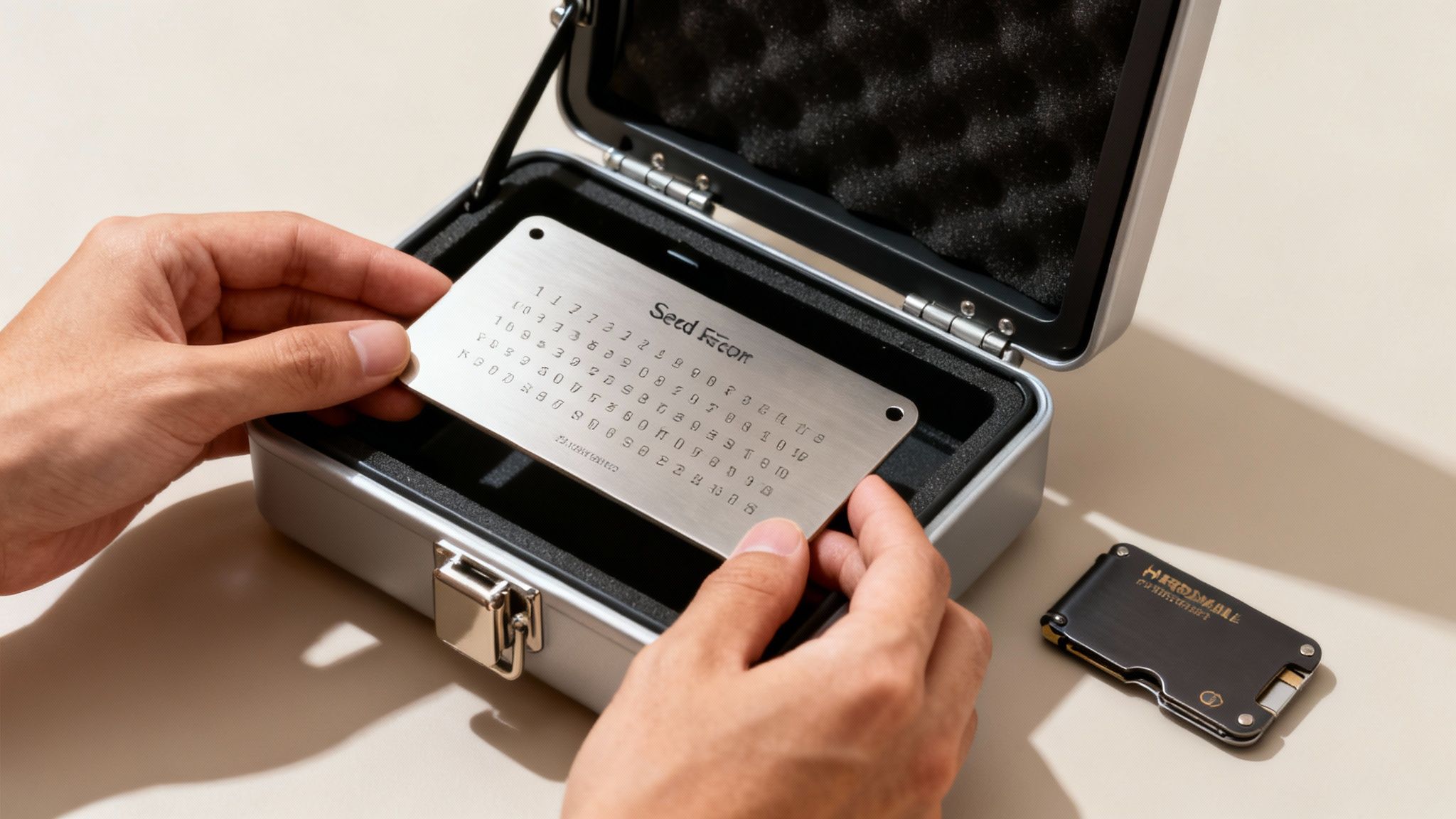
- Metal Plate Storage: Get your seed phrase stamped or etched onto a metal plate—stainless steel or titanium are great options. These things are designed to survive fires, floods, and pretty much anything else you can throw at them.
- Fireproof and Waterproof Safes: Storing your backup (whether on paper or metal) inside a quality safe adds a serious layer of physical security.
- Multiple Secure Locations: Don't put all your eggs in one basket. Create two or three physical copies and store them in different, secure locations. This way, a fire at your office doesn't wipe out your only backup.
Leveling Up Your Security with a Hardware Wallet
A software wallet on your phone is a fantastic entry point, but if your business is handling any significant amount of bitcoin, you need to graduate to a hardware wallet.
This is a small physical device built for one purpose: keeping your private keys completely offline and isolated from internet-based threats.
A hardware wallet signs transactions internally, on the device itself. This means even if your computer is crawling with viruses, your private keys never leave the safety of the hardware. It's like having an impenetrable vault for your digital keys.
For any serious operation, a hardware wallet isn't just a good idea—it's a necessary investment in your peace of mind.
Getting Some Bitcoin in Your Wallet
Alright, you've got your secure, non-custodial wallet set up. Now it’s time for the exciting part—actually putting some Bitcoin into it. This can feel like the biggest hurdle for newcomers, but I promise it's more straightforward than it seems.
The most common on-ramp is buying Bitcoin on a trusted exchange and then sending it to the wallet where you hold the keys.
Think of an exchange as a digital currency brokerage. It's a regulated spot to swap your regular currency for Bitcoin. But the mission isn't complete once you buy. The crucial final step is withdrawing that Bitcoin from the exchange to your personal wallet. This is what it means to "be your own bank"—moving the funds from their control to yours.
Acquiring Your First Bitcoin
So, how do you get that first bit of digital gold? It’s a simple two-step dance: buy it on an exchange, then send it home to your wallet.
Here’s the typical flow:
- Pick a Reputable Exchange: Go with a well-known, regulated Bitcoin exchange that serves your country. These platforms are designed to make the process easy for first-timers.
- Verify Your Identity: To keep things above board with financial regulations, you'll go through a quick Know Your Customer (KYC) check. This usually just means uploading a photo of your ID.
- Make the Purchase: Connect your bank account or debit card and buy as much or as little Bitcoin as you'd like.
- Withdraw to Your Wallet: This is the most important part. Start a withdrawal on the exchange, and paste in a "receive" address generated by your non-custodial wallet. Always, always double-check the address before hitting send.
Moving your Bitcoin off an exchange and into your own wallet is non-negotiable. It removes counterparty risk—the danger that the exchange could fail or freeze your assets. Exchanges are for buying and selling. Your personal wallet is for holding.
What's Happening Under the Hood?
Now that you have Bitcoin, let's pull back the curtain on how it actually moves. Every transaction is just a transfer of value from one Bitcoin address to another, all recorded publicly on the blockchain for anyone to see.
A Bitcoin address is that long string of letters and numbers your wallet generates. It acts like an account number for receiving funds. Best practice? Your wallet can create a fresh, unique address for every single payment you receive. This is a massive boost for your financial privacy.
When you send Bitcoin, you're signing a digital message that tells the whole network, "I'm authorizing X amount of Bitcoin to move from my address to this other address." This message is picked up by miners, who bundle it into a "block" of transactions. Once that block is confirmed, your transaction is permanent and can't be reversed.
This isn't just a niche activity anymore. Big players are taking notice, which should give merchants confidence. In Q3 2025 alone, 172 publicly traded companies held Bitcoin, a figure that shot up 40% in a single quarter. These corporations now hold about one million Bitcoin on their balance sheets, proving its legitimacy. You can find more on the powerful trend toward corporate Bitcoin adoption at Trakx.io.
Verifying a Transaction
One of Bitcoin's killer features is its transparency. You don't have to take anyone's word that a payment was sent—you can check it yourself.
Every transaction gets its own unique ID, called a TXID. You can copy this TXID and paste it into a block explorer, which is basically a search engine for the Bitcoin blockchain.
A block explorer will show you everything:
- The sending and receiving addresses
- The precise amount of Bitcoin sent
- The number of confirmations the transaction has
A confirmation happens every time a new block is added to the chain after yours. Most merchants consider a payment final after 3-6 confirmations, which usually takes anywhere from 30 to 60 minutes.
Lastly, there's the network fee. Every transaction includes a small fee paid to the miners who secure the network. As the sender, you set this fee. A higher fee gets you faster confirmation, while a lower one might mean waiting a bit longer. Thankfully, most modern wallets do the work for you, suggesting the perfect fee based on how busy the network is.
Accepting Bitcoin Payments Instantly with Flash
Alright, this is where the rubber meets the road. You’ve got your non-custodial wallet sorted and your keys are secure, which is the essential groundwork for getting started with Bitcoin. Now it’s time to plug that foundation directly into your business, and thankfully, tools like Flash make this leap surprisingly simple.
This is the moment you go from just holding Bitcoin to using it for real-world commerce, accepting payments straight from a customer's wallet to yours.
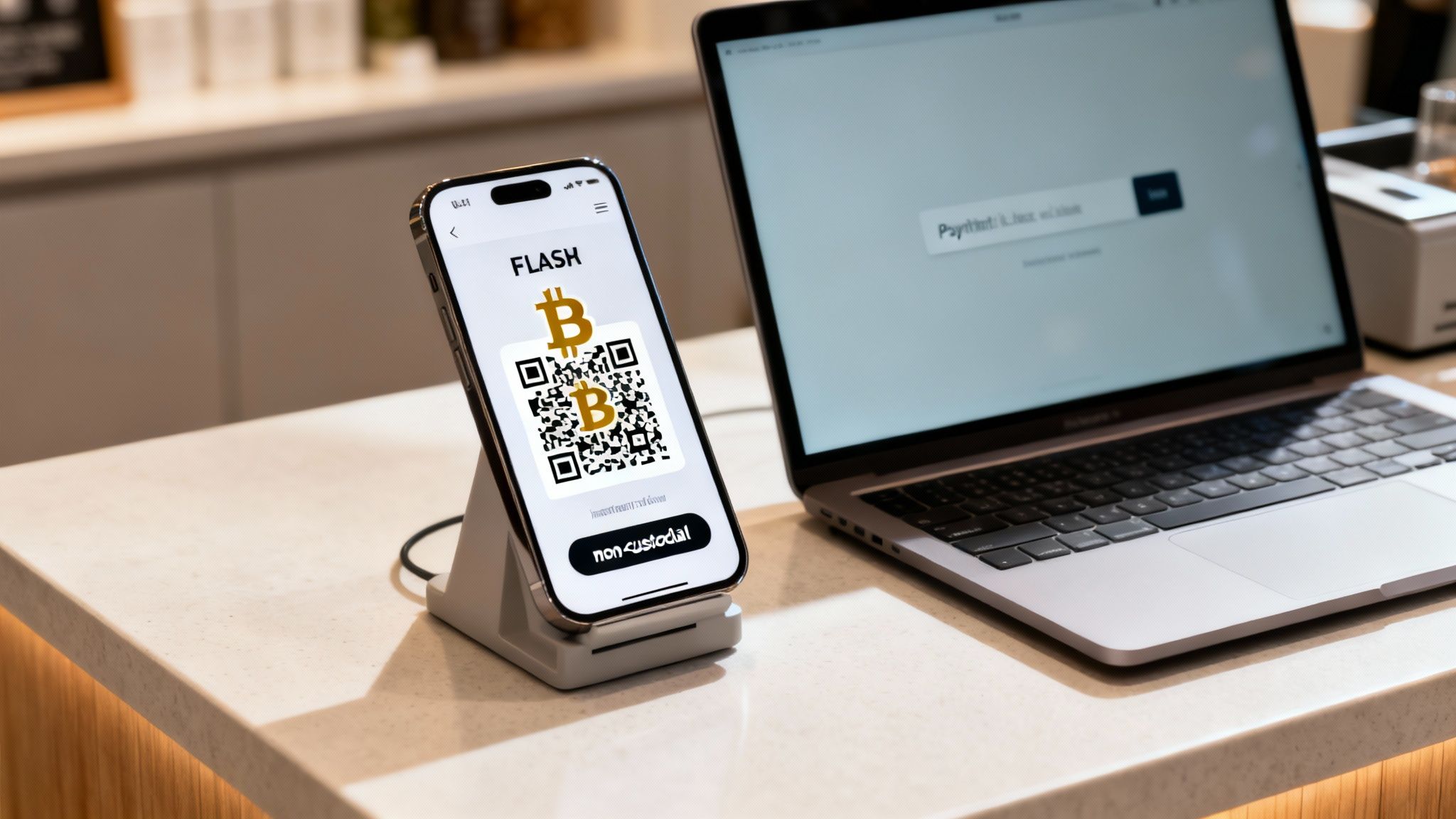
The whole point is to cut out the middlemen. With a direct, non-custodial payment solution, there’s no third-party processor delaying your settlement or taking a huge cut. You can forget about lengthy KYC procedures just to get paid. It’s pure peer-to-peer commerce, and you can be up and running in minutes.
This isn't some fringe idea anymore. The market is shifting under our feet. Recent data shows that nearly 40% of U.S. retailers are now accepting digital currency. For many of these businesses, Bitcoin drives over 26% of their total sales, and 72% have watched their crypto sales grow in the last year alone. You can dig into these numbers yourself over at PayPal's newsroom on mainstream crypto adoption.
Turning Any Smartphone into a Bitcoin Terminal
If you run a brick-and-mortar shop, the biggest question is always, "How do I physically take the payment?" The good news? You don't need any special, expensive hardware. A simple point-of-sale (POS) app can turn any smartphone or tablet you already own into a dedicated Bitcoin terminal.
Picture this: a customer at your coffee shop wants to pay with Bitcoin. You just punch their total into the app, and it instantly generates a unique QR code. They scan it, approve the payment from their wallet, and that's it—the funds are sent directly to you. It's clean, fast, and feels familiar to anyone who’s ever used Apple Pay or another digital wallet.
The advantages here are immediate:
- Zero Hardware Costs: Use the phones and tablets you already have.
- Total Mobility: Take payments at the counter, at a table, or even at a weekend market stall.
- Dead Simple: The interface is built for speed, so you won't hold up the line.
A mobile POS app lets you get your entire staff onboard in minutes. The process is so intuitive there's practically no training needed, making it one of the fastest ways to start accepting Bitcoin at a physical location.
Effortless Integration for E-Commerce
For online stores, getting set up is even more straightforward. You can forget about wrestling with complex APIs or hiring a developer. Modern Bitcoin payment tools offer no-code solutions that you can get running in just a few minutes, no matter your technical comfort level.
Before you can accept Bitcoin online, you need to integrate payment gateway functionality into your site. With the right tools, this becomes a simple copy-and-paste job instead of a month-long project.
For instance, you can create customizable payment links or buttons. Generate a link for a specific product, then drop it into an email, a social media post, or right onto your product page. When a customer clicks, they’re whisked away to a secure payment page to complete the transaction. No coding, just a few clicks in a dashboard.
Tools for Creators and Subscription Businesses
The power of accepting Bitcoin goes way beyond simple one-off sales. If you're a content creator, run a SaaS business, or sell online courses, you know that recurring revenue is everything. This is where automated tools really shine.
Bitcoin-native paywalls and subscription modules let you monetize your work with ease. You can set up different access tiers, manage your subscribers, and automate the entire billing cycle—all settled in Bitcoin. This instantly opens your business to a global audience that might not have a credit card but is deeply engaged in the Bitcoin economy.
Because these tools are non-custodial, you always keep full ownership of your revenue. The money flows straight to your wallet, never sitting in a third-party account. It gives you complete financial control and dramatically improves your cash flow. Whether you're selling a newsletter, a course, or software access, you can build a sustainable business model that meets your customers where they are.
Navigating Bitcoin Taxes and Compliance
Alright, let's talk about the less glamorous side of accepting Bitcoin: taxes and compliance. It's an exciting step to bring Bitcoin into your business, but doing it professionally means handling the financial backend correctly. This isn't financial advice—you should always talk to a qualified pro for that—but more of a heads-up on the practical side of managing your Bitcoin transactions responsibly.
The first thing you have to wrap your head around is how tax authorities, like the IRS in the U.S., view Bitcoin. They don't see it as a currency. They see it as property. This one distinction changes everything and has massive tax implications for your business.
Why Bitcoin Is Often Treated as Property
When you think of Bitcoin as property, you realize that every time you touch it for business, it's likely a taxable event. When a customer pays you in Bitcoin, the fair market value of that Bitcoin at that exact moment is your revenue. It's no different than if they'd paid you in dollars.
Here’s where it gets tricky. If you hold onto that Bitcoin and its value goes up before you sell it or use it to pay a supplier, that profit is a capital gain, and it gets taxed separately. If the value drops, you might have a capital loss, which has its own set of rules.
The most important takeaway here is that meticulous record-keeping is absolutely non-negotiable. Every single transaction—receiving a payment, cashing out to dollars, paying an expense—needs to be logged with the date, the amount, and its fair market value in your local currency at the time it happened.
Actionable Tips for Staying Organized
Trying to track all this by hand in a spreadsheet will become a nightmare, especially as your sales grow. Luckily, you don't have to. Modern tools are built to handle this without you spending hours on admin work.
- Use Bitcoin-Focused Accounting Software: Find accounting platforms that can plug directly into your Bitcoin wallet or import your transaction history. This automates a ton of the record-keeping and cuts down on human error.
- Generate Reports Regularly: Don't wait until tax season is looming to get your books in order. Pull monthly or quarterly reports on all your Bitcoin activity. This helps you keep things clean and spot any issues early on.
- Keep Business and Personal Funds Separate: This is basic business hygiene, but it's critical with Bitcoin. Use a dedicated wallet for your business's Bitcoin, completely separate from your personal holdings. It makes accounting and tax reporting infinitely simpler.
Getting your tax situation managed properly is a huge part of learning how to get started with Bitcoin for your business. If you ever find your business facing penalties related to bitcoin tax reporting, knowing about procedures like an IRS Form 843 Abatement can be a lifesaver.
Ultimately, staying organized and getting expert advice lets you operate smoothly and responsibly. That way, you can focus on what really matters: growing your business with this incredible new payment tool.
Frequently Asked Questions About Using Bitcoin
Here are some of the most common questions merchants ask when they're thinking about diving into Bitcoin. Let's clear them up with some straightforward answers.
Do I Need to Be a Tech Whiz to Use Flash?
Absolutely not. This is probably the biggest myth holding businesses back.
Tools like the Flash point-of-sale app and our payment link generator were built with business owners in mind, not developers. You don't need to write a single line of code or get bogged down in the technical weeds of how the Bitcoin network operates.
Seriously, if you can use a smartphone or copy and paste a link, you're more than qualified. The entire system is designed to be intuitive. You can jump into a simple dashboard, create payment requests, and track your sales in minutes. It's a completely no-code setup, which means you can be up and running, ready for your first Bitcoin payment, faster than you can brew a cup of coffee.
How Do I Protect My Business from Bitcoin's Price Swings?
Volatility is a real and valid concern. No one wants their hard-earned revenue to evaporate because of a market dip. But with direct payment tools, you're in the driver's seat when it comes to managing this risk.
The secret sauce is instant settlement.
Because every payment lands directly in your wallet, you have immediate control. You can decide to convert that Bitcoin into your local currency the moment it arrives by using an exchange. This move alone completely sidesteps any exposure to price swings. It gives you total flexibility—hold Bitcoin as an asset if you like, or instantly cash out to lock in your revenue. The choice is yours.
Your business never has to be exposed to Bitcoin's price movements for more than a few minutes. Instant settlement means you decide whether to hold or convert, putting you in complete control of managing volatility risk.
What Does It Really Cost to Accept Bitcoin?
When you put the numbers side-by-side, the savings are hard to ignore. Traditional credit card processors are notorious for chipping away at your profits, typically skimming 2-3% off every single transaction. That adds up fast.
When you accept Bitcoin through a non-custodial wallet, you cut out those middlemen entirely. The only cost you'll see is the Bitcoin network fee, which is a small amount paid to miners for processing the transaction on the blockchain.
For most payments, especially larger ones, this fee is just a fraction of what the card companies charge. By getting rid of the intermediaries, you simply keep more of your own money.
Ready to slash your transaction fees and reach a global audience? With Flash, you can start accepting secure, direct Bitcoin payments in under a minute. Get started with Flash today.