Deciding to build your own payment gateway is a massive undertaking. You're not just writing code; you're committing to building a secure, compliant, and always-on financial system from the ground up. This means defining the architecture, crafting a solid API, handling all the transaction logic, and signing up for long-term maintenance.
The payoff? Complete control over your fees and user experience. But it's a path that demands serious investment in development talent and a relentless focus on security.
Should You Build a Custom Bitcoin Gateway?
The idea of a custom Bitcoin payment gateway is alluring. It whispers promises of total autonomy, significant cost savings, and a checkout experience tailored perfectly to your brand. Before you jump into the deep end of development, it's crucial to pause and ask the big question: Is this really the right move for my business?
This isn't just a technical decision. It's a strategic one, where you have to weigh some pretty substantial benefits against some equally substantial challenges.

The Allure of Full Control
Let's be honest, the biggest carrot is ditching third-party transaction fees. For any business pushing serious volume, these fees can feel like a slow bleed on your profit margins. A custom gateway flips this script, turning a recurring operational expense into a one-time (albeit large) development cost. Over the long haul, this can translate into saving hundreds of thousands of dollars.
Beyond the raw numbers, owning your payment stack gives you unparalleled freedom. You can design the entire checkout flow to perfectly match your brand and obsessively optimize the user experience. You're no longer boxed in by someone else's templates or restrictions, which can have a direct, positive impact on your conversion rates.
Then there's security. With a custom gateway, you tailor the security measures to your specific risk profile. You get to decide everything—from how you generate Bitcoin addresses to the exact number of confirmations required to mark a transaction as complete. You're not just hoping a third-party's security is good enough; you are in the driver's seat.
Weighing the In-House Development Challenges
While the benefits are tempting, the road to your own payment gateway is paved with obstacles. The initial development cost is the first major hurdle. Building a truly secure, production-ready system isn't a weekend project. It requires a skilled team with deep expertise in both fintech and the unique quirks of Bitcoin's architecture. That's a serious upfront investment.
And the work doesn't stop at launch. A payment gateway is a mission-critical piece of infrastructure that demands constant attention and maintenance. This includes:
- Applying security patches: The threat landscape never sleeps, and your gateway needs to stay one step ahead.
- System monitoring: You need 24/7 monitoring to guarantee uptime and catch suspicious activity the moment it happens.
- Infrastructure updates: Technology evolves, and the components of your gateway will need regular upgrades to stay current and secure.
Finally, you can't overstate the complexity of securing financial systems. You are now solely responsible for protecting your users' funds and data. A single security flaw could lead to catastrophic financial loss and do irreparable damage to your brand's reputation.
The decision to build isn't just a technical one; it's a strategic one. It requires a long-term commitment to maintaining a secure, compliant, and reliable financial service that becomes a core part of your business operations.
Making an Informed Decision
Ultimately, the choice between building and integrating boils down to your business's scale, resources, and long-term goals.
Deciding whether to build a custom payment gateway or integrate a third-party solution is a pivotal choice. Each path has distinct implications for cost, control, and complexity. To help you weigh the options, here's a side-by-side comparison of the key factors.
Build vs Integrate A Payment Gateway
| Factor | Building Your Own Gateway | Integrating a Third-Party Service |
|---|---|---|
| Initial Cost | High. Requires significant investment in development, infrastructure, and expertise. | Low. Minimal upfront costs, often just integration and setup fees. |
| Time to Market | Slow. Months or even years of development and testing. | Fast. Can be integrated and live within days or weeks. |
| Ongoing Maintenance | High. You are responsible for all security, updates, and monitoring. | None. The provider handles all maintenance, security, and updates. |
| Transaction Fees | None. You only pay for network fees and operational costs. | Recurring. You pay a percentage or flat fee on every transaction. |
| Customization | Total Control. Tailor the user experience and features to your exact needs. | Limited. You are constrained by the provider's features and templates. |
| Security & Compliance | Your Full Responsibility. You must manage all security protocols and PCI compliance. | Handled by Provider. Leverages their expertise and existing certifications. |
| Scalability | Self-Managed. You must architect and manage infrastructure to handle growth. | Managed by Provider. Scales automatically to handle transaction volume. |
As the table shows, building your own gateway offers the ultimate control but at a significant cost in time, money, and ongoing responsibility. Integrating a service is the faster, simpler path, but it comes with recurring fees and less flexibility.
The global payment gateway market was valued between USD 26.7 billion and USD 35.17 billion in 2024 and is projected to skyrocket, showing the immense opportunity here. You can dig into more market insights on Straits Research.
For companies with the transaction volume to justify the investment, a proprietary solution can be a powerful competitive advantage. But for many businesses, a service like Flash, which offers a non-custodial solution without the development headache, provides the ideal balance of control and convenience.
Architecting Your Payment Gateway
Alright, you've made the call to build. Now comes the critical part: laying the foundation. A well-designed architecture is the blueprint for a payment gateway that's not just functional, but also secure, scalable, and reliable. Get this right, and you've got a smooth-running system. Get it wrong, and you're signing up for a future of technical debt and late-night operational fires.

Since we're focusing on Bitcoin, our design needs to be laser-focused on direct wallet-to-wallet transactions. The whole point is to build an efficient, resilient structure that can juggle payment requests, keep an eye on the blockchain, and send real-time updates back to the merchant without breaking a sweat.
Breaking Down the Core Components
A modern payment gateway isn't one giant, clunky application. It's much smarter to think of it as a team of specialized services working in concert. This modular, microservices-style approach makes the system far easier to build, debug, maintain, and scale down the road.
Here are the essential players on your team:
- Secure API Layer: This is your front door. It’s the public-facing part that takes in payment requests from merchants, makes sure they're legit, and hands back a unique Bitcoin address and payment details.
- Transaction Processor: This is the engine room. Its main job is to talk to the Bitcoin network—either through your own full node or a trusted third-party API—and watch for payments hitting the addresses it has generated.
- Database: This is the system's brain, or at least its memory. It holds onto all the vital info: payment addresses, invoice data, transaction statuses (pending, confirmed, failed), and merchant details.
- Notification Service: Think of this as the messenger. As soon as the Transaction Processor confirms a payment is locked in on the blockchain, this service pings the merchant’s system with the good news, usually via a webhook.
It's absolutely crucial to think about the scale of this from day one. As you map out your architecture, leaning on solid IT project management best practices will keep the development cycle structured and prevent things from going off the rails.
Designing for High Availability and Fault Tolerance
Let's be clear: your payment gateway is mission-critical infrastructure. Downtime isn't just a technical glitch; it's lost sales and shattered customer trust. This means designing for high availability and fault tolerance isn't a "nice-to-have"—it's a non-negotiable requirement.
High availability is about making sure your gateway stays up even when individual parts fail. The classic way to do this is with redundancy. For example, run multiple copies of your API layer behind a load balancer. If one server dies, traffic just gets rerouted to the healthy ones. No drama.
Fault tolerance is about the system's ability to take a punch without going down for the count. You need to isolate components so that a bug in your Notification Service doesn't cascade and crash the entire payment pipeline.
A key architectural principle I've learned is to assume failure is inevitable. Don't design a system to prevent every possible issue. Instead, design it to handle failures gracefully when they happen, making sure the core ability to process payments is always protected.
The Flow of a Bitcoin Transaction
So, how do all these pieces work together in the real world? Let’s trace a typical payment from start to finish:
- A merchant’s checkout page hits your API Layer with a request to create a new invoice for, say, $50.
- The API generates a fresh, single-use Bitcoin address, figures out the current BTC equivalent, and saves everything in the Database with a 'pending' status. It then sends the payment details back to the merchant.
- The Transaction Processor immediately starts watching the Bitcoin network for any activity at that specific address.
- Once a payment is detected, the processor doesn't just accept it blindly. It waits for a set number of network confirmations (maybe just one for small amounts) to be sure the transaction is irreversible.
- After it's confirmed, the processor updates the status in the Database from 'pending' to 'complete'.
- That status change is the trigger for the Notification Service, which fires off a secure webhook to the merchant’s server, letting them know the order is paid and they can ship the goods.
This decoupled design ensures each component does one job and does it well, making the whole system more robust and far easier to manage. The global demand for these kinds of seamless systems is exploding. The payment processing market is expected to hit roughly USD 198 billion by 2032, a staggering jump from its 2022 valuation. This is exactly why building your own gateway to control your slice of that pie is such a powerful move.
Designing a Secure and Usable API
Think of your API as the front door to your entire payment gateway. It's the handshake between a merchant's e-commerce platform and your system, the single point of contact for creating and managing every payment. I've seen firsthand how a well-designed API can make integration an absolute breeze for developers. But a clunky, confusing one? It's a one-way ticket to a mountain of support tickets and frustrated potential customers.

The real goal here is to build a clean, RESTful API that feels intuitive. It needs to be powerful enough for all the nuances of Bitcoin transactions but simple enough that a developer can grasp it in minutes. That means sticking to standard HTTP methods and crafting clear, resource-oriented URLs that just make sense.
Defining Essential API Endpoints
Good news: for a Bitcoin payment gateway, you don't need a sprawling, complex API with dozens of endpoints. You can nail the core functionality with just two primary endpoints that elegantly handle the entire payment lifecycle, from creation to confirmation.
POST /payments: This is where it all begins. A merchant hits this endpoint to kick off a new transaction. Your gateway springs into action, generating a unique, single-use Bitcoin address, grabbing the current exchange rate to calculate the precise BTC amount, and sending that info back.GET /payments/{txid}: After creating an invoice, the merchant needs to know what's happening. This endpoint is their window into the payment's status. They query it with a unique transaction ID, and your API tells them if the payment is still pending, confirmed, or if the timer ran out.
This simple two-endpoint design gives a merchant everything they need to weave your gateway into their checkout flow. It’s the foundation for building a system that truly answers the question of how to make your own payment gateway without overcomplicating things.
Structuring Requests and Responses
When it comes to the data your API is slinging back and forth, clarity is everything. Keep it simple with straightforward JSON payloads. This ensures developers aren't wasting time trying to parse convoluted data structures.
For instance, a request to create a payment could be as minimal as this:
{
"amount_usd": "99.99",
"order_id": "ORDER-12345",
"callback_url": "https://mystore.com/webhook/payment-update"
}
In return, your gateway's response should be a clean, predictable package with everything the merchant needs to show their customer:
{
"txid": "unique_transaction_identifier",
"btc_amount": "0.00150000",
"payment_address": "bc1q...",
"status": "pending",
"expires_at": "2024-10-26T10:30:00Z"
}
The key players here are btc_amount, payment_address, and the initial status. This payload gives the merchant's system exactly what it needs to move forward.
A great API anticipates the developer's needs. The response shouldn't just provide data; it should provide the right data in a format that minimizes the work the developer has to do on their end.
Implementing Non-Negotiable Security Practices
Let's be blunt: a usable API is completely worthless if it isn't secure. You're handling money, so security isn't just a feature—it's the absolute bedrock of your entire system. If you were dealing with credit cards, you'd be living and breathing a practical guide to PCI compliance. While Bitcoin is a different beast, that same rigorous, security-first mindset is non-negotiable.
Here are the security layers you must build in from day one:
- API Key Authentication: Every single request to your API needs to be authenticated. No exceptions. Each merchant gets a unique, secret API key that they must include in their request headers. This is your first line of defense, ensuring only authorized parties can even talk to your gateway.
- Enforce TLS Encryption: All communication must, without question, be encrypted using HTTPS (TLS). This is what prevents man-in-the-middle attacks, where a bad actor could intercept and mess with payment data as it flies across the internet. Make this a hard-and-fast rule.
- Implement Rate Limiting: You have to protect your gateway from being hammered into oblivion, whether by a malicious denial-of-service (DoS) attack or just a buggy script gone wild. Rate limiting is your shield, capping the number of requests a single user can fire off in a given period. This keeps your servers stable and responsive for everyone.
By weaving a clean, logical design together with these foundational security measures, you’ll build an API that developers actually enjoy using—and one that stands as a fortress protecting your infrastructure and your merchants' funds.
With your architecture mapped out and a secure API ready to go, it’s time to build the engine. This is the part of your gateway that actually talks to the Bitcoin network, turning your blueprint into a living, breathing piece of financial infrastructure.
Getting this logic right is the entire ballgame. It's how your system will generate payment requests, watch for incoming funds, and confidently tell a merchant, "Yep, you've been paid."
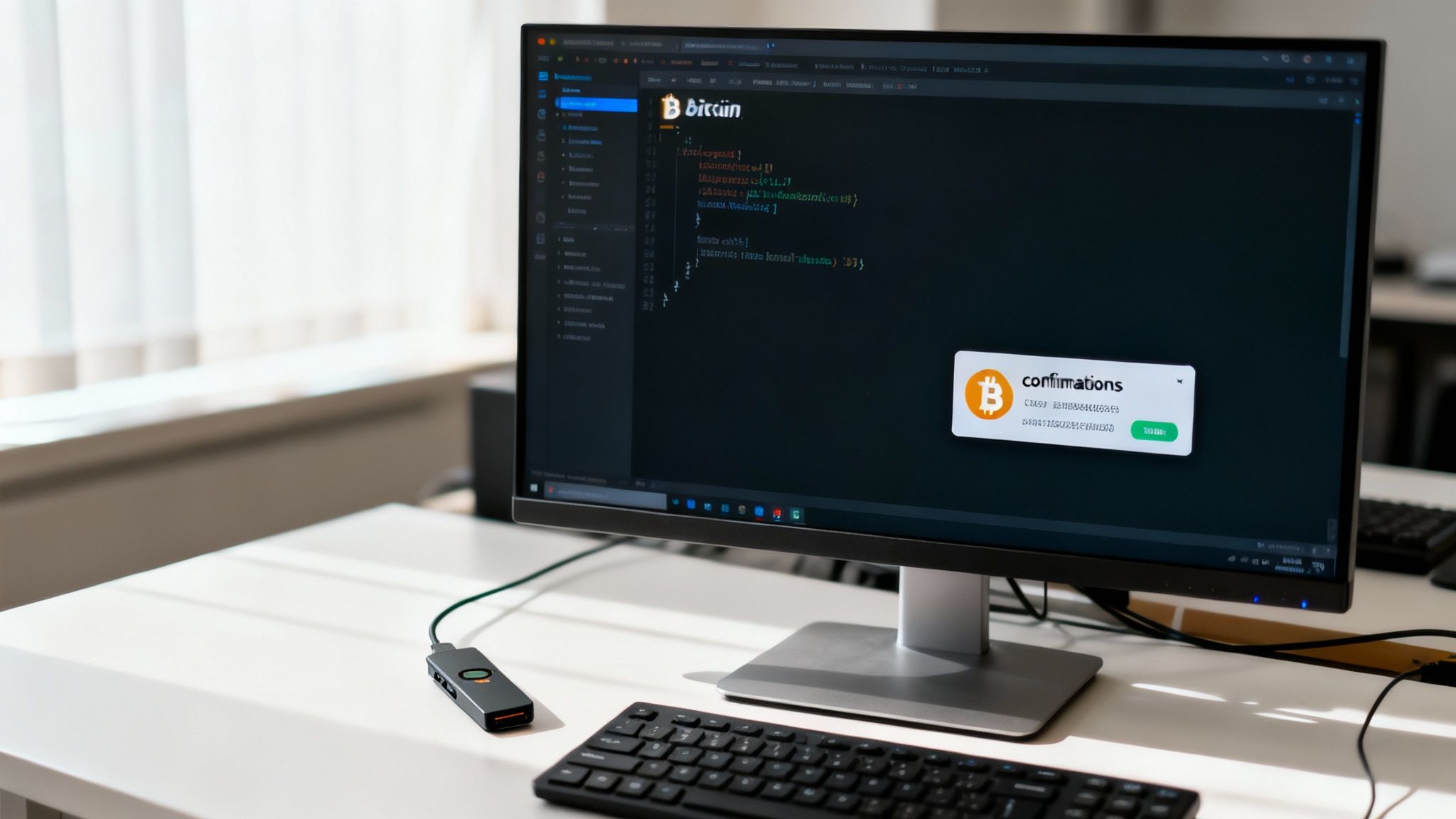
Generate Unique, Single-Use Addresses
First rule of Bitcoin club: never reuse addresses. This isn't just a suggestion; it's a fundamental security and privacy practice. Every time a merchant creates an invoice, your gateway needs to generate a completely new Bitcoin address for that one transaction.
Why is this so important? Two huge reasons:
- Privacy: It stops blockchain snoops from easily connecting multiple payments back to the same customer or merchant.
- Clarity: It kills any payment confusion. When BTC lands in a unique address, you know with 100% certainty which invoice it settles. Reconciliation becomes dead simple.
The standard way to do this is with a Hierarchical Deterministic (HD) wallet. This lets you generate a near-infinite stream of addresses from one master seed, keeping your key management sane and secure.
Watch the Blockchain for Incoming Payments
Okay, you've given the customer a fresh address. Now what? Your gateway has to become a hawk, watching the Bitcoin network for that payment to show up.
You've got two main ways to pull this off: run your own full node or plug into a third-party block explorer API.
Running your own Bitcoin node is the purist's choice—and for good reason. It’s the gold standard for security and privacy, giving you a direct, trustless view of the blockchain. The trade-off? It’s a beast to set up and maintain.
Using a block explorer API is the easier route. Services like Blockstream.info or Mempool.space have already done the hard work of indexing the blockchain and offer simple APIs to check on an address. It's convenient, but you're now relying on someone else's infrastructure.
Either way, the job is the same: your system needs to constantly check if a transaction sending the right amount of BTC to your generated address has hit the network.
I’ve learned from experience that the choice between a full node and an API isn't just technical; it's a risk assessment. For a production-grade gateway handling significant volume, the sovereignty and reliability of running your own node are almost always worth the investment.
Understand Confirmations and Prevent Double-Spends
Just seeing a transaction broadcast to the network isn't enough. It's not "real" money until it's been mined into a block and buried under a few more blocks. This is the whole concept of confirmations.
A transaction with zero confirmations is just floating in the mempool. It's vulnerable to being reversed in a "double-spend" attack. Your logic must be patient and wait for enough confirmations before you mark that invoice as paid.
Here's a good rule of thumb:
- 1 Confirmation: Good enough for low-value digital goods where speed matters most.
- 2-3 Confirmations: The sweet spot for most e-commerce sales. A great balance of speed and security.
- 6+ Confirmations: The industry standard for big-ticket items. At this point, a reversal is practically impossible.
Your system should flip the payment status from "pending" to "confirming" on the first sight of the transaction, and then to "complete" only when your confirmation threshold is met.
Handle Network Fees and Stay Non-Custodial
Finally, don't forget about network fees. These are the tolls paid to miners to get a transaction included in a block. When your system eventually needs to consolidate funds from many payment addresses, it will have to calculate and attach the right fee to get the transaction processed in a timely manner.
And most importantly, this whole process should follow non-custodial principles. Your gateway software manages addresses and watches the blockchain, but the private keys controlling the actual funds must live somewhere else—ideally offline and completely disconnected from your web servers. This is your ultimate safety net. If your gateway gets hacked, the bitcoin itself remains untouchable.
As you're building this out, keep the global picture in mind. The Asia-Pacific region has exploded into the fastest-growing market for payment gateways, fueled by over 90% mobile connectivity. This is creating a massive opportunity for low-cost, mobile-first solutions. You can dig into the numbers in this market research report.
From the Sandbox to Production: Deployment and Long-Term Care
Building a payment gateway is one thing; making sure it runs perfectly, day in and day out, is a whole different beast. This isn't just a side project. It's the financial backbone of your business, a mission-critical piece of infrastructure where a single bug or moment of downtime means lost sales and shattered trust.
That's why a practical, disciplined strategy for testing, deployment, and maintenance isn't just a nice-to-have—it's non-negotiable. The journey doesn't stop when the code is committed. In many ways, it's just getting started. Now, you have to prove it works under pressure and build a plan to keep it that way for years to come.
Leveraging Bitcoin Testnet for Risk-Free Testing
Before a single real transaction hits your gateway, you need to put it through its paces in a safe environment. This is exactly what Bitcoin's testnet was designed for. Think of it as a parallel blockchain that functions just like the real one but uses a worthless form of bitcoin. It lets you run exhaustive, end-to-end tests without risking a single satoshi of actual funds.
Your testing phase needs to be methodical. You're not just checking if it works; you're trying to break it. Your goal is to simulate every possible scenario your gateway might face in the wild.
- Successful Payments: This is the happy path. Does your gateway correctly generate an address, detect an incoming payment, wait for the right number of confirmations, and fire off the success webhook?
- Underpayments: What happens if a user accidentally sends less than they should? Your system has to catch this, mark the invoice correctly, and have a clear process for handling the gap.
- Overpayments: On the flip side, what if a customer sends too much? You need logic to handle this scenario gracefully.
- Expired Invoices: If a payment doesn't arrive in time, does the system properly invalidate the invoice and free up the address?
Thorough testing on the testnet is your single best defense against launching a buggy system. It's where you hunt down the edge cases and harden your logic before real money is on the line.
Best Practices for Production Deployment
Moving from the testnet to a live production environment is a huge leap. Your deployment strategy must be built around security, stability, and recoverability above all else. This is the moment you graduate from a development project to a live financial service.
When you deploy a payment gateway, you are making a promise of reliability to your merchants. Your deployment checklist should be built around upholding that promise, with automated backups and secure key management treated as absolute fundamentals, not afterthoughts.
Secure key management is everything. The private keys that control your funds must be stored on a dedicated, hardened server that is completely isolated from your public-facing web servers. Never, ever store private keys on the same machine as your API.
Next, build in redundancy from the start. Use load balancers to distribute traffic across multiple application instances. Set up automated, regular database backups that get stored in a secure, off-site location. You have to assume something will go wrong eventually and be ready to recover quickly and completely.
The Discipline of Ongoing Maintenance
Your work is never truly done. A payment gateway demands constant vigilance to stay secure and reliable. This ongoing maintenance is the discipline that separates professional-grade infrastructure from hobbyist projects.
You'll want a robust monitoring and logging system in place from day one. You need real-time alerts for any system errors, performance issues, or suspicious activity. Detailed transaction logs aren't just for debugging; they're essential for financial audits and providing top-notch support to your merchants.
Finally, have a crystal-clear process for applying security updates. The software libraries you use, your server's operating system, and even the Bitcoin Core software itself will all have regular updates. You need a plan to test and roll out these patches promptly to shield your gateway from emerging threats. This long-term commitment is a core part of learning how to make your own payment gateway that can actually stand the test of time.
Frequently Asked Questions
When you're building a payment system from the ground up, especially with something like Bitcoin, you're going to have questions. A lot of them. Getting your head around these challenges is a huge part of the journey. Here are some of the most common ones I see developers and businesses run into, along with some straight answers.
How Do I Handle Bitcoin Price Volatility?
This is the big one. Bitcoin's price moves, and you can't let your merchants get caught on the wrong side of a swing. The only real way to handle this is to lock in the BTC-to-fiat exchange rate the instant a customer decides to pay.
When they hit "checkout," your system needs to ping a reliable price feed, grab the current rate, and calculate the exact BTC amount. But that's only half the story. You have to put a timer on it. Set a short payment window—15-30 minutes is pretty standard—where that rate is guaranteed. If the customer doesn't send the payment in time, the invoice expires. Simple as that. They’ll have to start over with a fresh, updated rate, and the merchant is protected from any price drops.
What Are the Essential Security Measures?
Security isn't a feature you tack on at the end; it’s the entire foundation. If you get this wrong, nothing else matters. There are a few absolute, non-negotiable layers of protection you need:
- HTTPS/TLS Encryption: Every single API call, without exception, must be encrypted. This is basic stuff, but it’s critical for stopping man-in-the-middle attacks.
- Server Hardening: Lock down your server and database like Fort Knox. Assume someone is actively trying to get in at all times.
- Isolated Key Management: This is a big one. Never, ever store private keys on your public-facing web server. Your wallets need to live on a separate, hardened server or, even better, a hardware security module (HSM).
- Unique Address Generation: Create a fresh, unique Bitcoin address for every single invoice. Reusing addresses is a privacy nightmare and an accounting mess waiting to happen.
- Robust Logging: You need to log everything and have monitoring in place. When something looks fishy, you need to know about it immediately, not after the damage is done.
Security in a payment gateway isn't a feature; it's the foundation. A compromise on any of these fundamental layers puts the entire system and your users' funds at risk.
What Level of Bitcoin Network Confirmations Should I Wait For?
The right answer here really depends on what's being sold. How many confirmations you wait for is a trade-off between speed and risk, and your gateway should let merchants configure this.
A good tiered approach usually works best:
- 1 Confirmation: This is often fine for low-value digital goods or a cup of coffee. The risk of a double-spend is low, and speed is what matters.
- 2-3 Confirmations: This is a great middle-ground for most typical e-commerce sales. It strikes a good balance, giving you solid security without making the customer wait forever.
- 6+ Confirmations: For high-value transactions—think cars, real estate, or large B2B payments—this is the gold standard. Once a transaction has six confirmations, it’s considered practically irreversible.
Do I Need to Run My Own Full Bitcoin Node?
Look, you can use a third-party API to check the blockchain, but for any serious, production-ready system, running your own full Bitcoin node is highly recommended. I'd almost say it's required.
When you run your own node, you're not trusting anyone. You have your own authoritative copy of the blockchain to verify transactions against. This gives you a massive boost in security, privacy, and reliability. Relying on a third-party API introduces a central point of failure and means you're leaking your customers' transaction data to someone else. It's a bit more work upfront, but for any business that's serious about building a resilient payment gateway, the investment is absolutely worth it.
Ready to accept Bitcoin payments without the complexities of building and maintaining your own gateway? Flash provides a non-custodial, wallet-to-wallet solution that gets you up and running in minutes. Eliminate intermediaries, reduce fees, and tap into a global user base with our secure, easy-to-integrate tools. Learn more and get started at .