When it's time to turn your Bitcoin into cash, you generally have three main routes: a centralized crypto exchange, a peer-to-peer (P2P) marketplace, or a Bitcoin ATM. Each path offers a different mix of speed, cost, and convenience, and the best one really depends on what you need in the moment.
Your Quickest Paths to Cashing Out Bitcoin
Deciding how to sell your Bitcoin for cash usually boils down to your priorities. Are you hunting for the absolute best price? Do you need the money in your bank account now? Or is having direct control over the deal more your style?
The most well-trodden path is through a centralized exchange. Think of platforms like Coinbase or Kraken as the secure bridges connecting the crypto world back to your traditional bank. They offer deep liquidity, which just means you can almost always sell your Bitcoin instantly at a fair market price.
Then there are peer-to-peer (P2P) platforms, which offer a more direct, hands-on approach. On these marketplaces, you're not selling to the exchange; you're connecting directly with another person who wants to buy. This gives you way more control over the price and how you get paid.
The Main Cashing Out Strategies
Every method for converting Bitcoin to fiat cash has its pros and cons. Your choice will hinge on what matters most to you—whether that’s raw speed, privacy, or squeezing every last dollar out of your sale.
Here’s a quick breakdown of what you're looking at:
- Centralized Exchanges: These are your go-to for reliability and handling both small and large sales. It's a structured, regulated environment where you sell your Bitcoin and withdraw the funds straight to your verified bank account.
- Peer-to-Peer (P2P) Platforms: This route is all about flexibility. You set your own price and pick from a huge menu of payment methods, from bank transfers to services like PayPal or even in-person cash meetups. It’s perfect for custom-tailoring a sale.
- Bitcoin ATMs: When you need physical cash in your hand right now, nothing beats an ATM. It’s the fastest way to get bills, but that convenience usually comes at the cost of higher fees and lower transaction limits.
To help you decide at a glance, here’s a quick comparison of the main methods.
Comparing Bitcoin Cashing Out Methods
This table gives you a quick summary of the primary ways to sell Bitcoin for cash, highlighting their key features to help you choose the best fit.
| Method | Best For | Typical Speed | Key Consideration |
|---|---|---|---|
| Centralized Exchange | Reliability, large amounts, and ease of use. | 1-5 days to reach your bank account. | You'll need a verified account (KYC). |
| P2P Marketplace | Flexibility on price and payment methods. | Minutes to hours, depending on the buyer. | Requires more vigilance to avoid scams. |
| Bitcoin ATM | Instant physical cash in hand. | Instant. | Fees are often high (7-12%). |
Ultimately, the right method is the one that fits your specific situation.
By understanding these core options, you can confidently pick the strategy that aligns with your financial goals, whether that means getting cash today, locking in the best possible rate, or keeping your transaction more private.
Using Centralized Exchanges to Convert Bitcoin to Cash
For most people, centralized exchanges are the most obvious on-ramp and off-ramp when it comes to Bitcoin. Think of platforms like Coinbase or Kraken. They function a lot like the established financial hubs you're already used to, acting as a familiar bridge between your Bitcoin and your bank account.
This makes the whole process feel structured and less intimidating.
There’s a good reason these platforms are so popular: liquidity. It’s a crucial concept. High liquidity simply means there's a huge pool of buyers and sellers at any given moment. You can sell your Bitcoin almost instantly at a fair market price without single-handedly crashing the price.
This reliability is why they're the go-to for so many, especially if you're cashing out for the first time or moving a significant amount. The entire experience is designed to be pretty straightforward, walking you from depositing your BTC to seeing the dollars land in your bank.
Getting Started on a Centralized Exchange
First things first, you need to pick a reputable exchange that actually operates in your country. Look for one with a solid reputation for security and customer support. Once you've made your choice, the setup is a lot like opening a new bank account online.
You'll have to go through a Know Your Customer (KYC) verification. This is a non-negotiable regulatory step. You’ll upload personal ID documents, like a driver's license or passport, to prove you are who you say you are. It might feel a bit invasive, but KYC is what helps keep the platform secure for everyone by preventing fraud and money laundering.
After you're verified, you’ll link a withdrawal method—almost always your traditional bank account. You'll input your account and routing numbers, and the exchange will usually make a tiny test deposit just to confirm everything is connected correctly.
The Practical Steps to Cashing Out
Alright, with your account set up and verified, you're ready to get your Bitcoin off your personal wallet and onto the exchange.
- Find Your Exchange Deposit Address: Log in to your exchange account, go to your Bitcoin wallet, and look for a "Deposit" or "Receive" button. The platform will give you a unique Bitcoin address tied to your account. Think of this address like your bank account number—it’s where the funds need to go.
- Send Bitcoin from Your Personal Wallet: Now, open the personal Bitcoin wallet you control. Start a "Send" transaction and very carefully copy and paste the exchange's deposit address into the recipient field. Always double-check the address. Seriously. One wrong character, and your Bitcoin could be gone forever.
- Wait for Confirmation: Once you hit send, you have to wait for the Bitcoin network to confirm the transaction. This can take a few minutes or up to an hour, depending on how busy the network is. Your exchange will let you know when the deposit has cleared and the funds are ready to trade.
These exchanges are the dominant players for a reason. In a recent quarter, top centralized exchanges handled an incredible $5.1 trillion in spot trading volume. Their massive scale, deep liquidity, and user-friendly withdrawal systems make them the largest venues globally for turning Bitcoin into cash.
Pro Tip: Send a small test transaction first. Before you move your entire stash, transfer a tiny amount of Bitcoin to the exchange. It’s a simple way to confirm the address is correct and the process works, potentially saving you from a very costly mistake.
Placing Your Sell Order
Once your Bitcoin is sitting in your exchange account, it's time to sell it for cash. You typically have two main choices here.
- Market Order: This is the quickest and easiest option. A market order tells the exchange to sell your Bitcoin immediately at whatever the current best price is. It’s perfect if you just want to get it done fast.
- Limit Order: This gives you more control. You set a specific price you're willing to sell at, and the order will only go through if the market hits your target. This is the way to go if you have a specific price in mind and don't mind waiting.
As soon as your sell order is filled, the cash value will pop up in your account's fiat balance. The last step is withdrawing that money to your linked bank account. This final leg of the journey usually takes 1 to 5 business days, depending on the exchange and your bank.
It’s also worth remembering that these exchanges operate in a complex world. They're constantly navigating tricky relationships with traditional banks, which can sometimes affect their services. There’s a lot of reporting on the challenges faced by major centralized exchanges like Binance in maintaining access to traditional banking systems, and understanding this context helps paint a more complete picture of the ecosystem you're using.
Exploring Peer-to-Peer Platforms for Direct Sales
If the structured world of a centralized exchange feels a bit too rigid, peer-to-peer (P2P) platforms offer a compelling, hands-on alternative. Think of them as specialized marketplaces that cut out the institutional middleman, connecting you directly with individuals who want to buy your Bitcoin. This approach puts you firmly in the driver's seat.
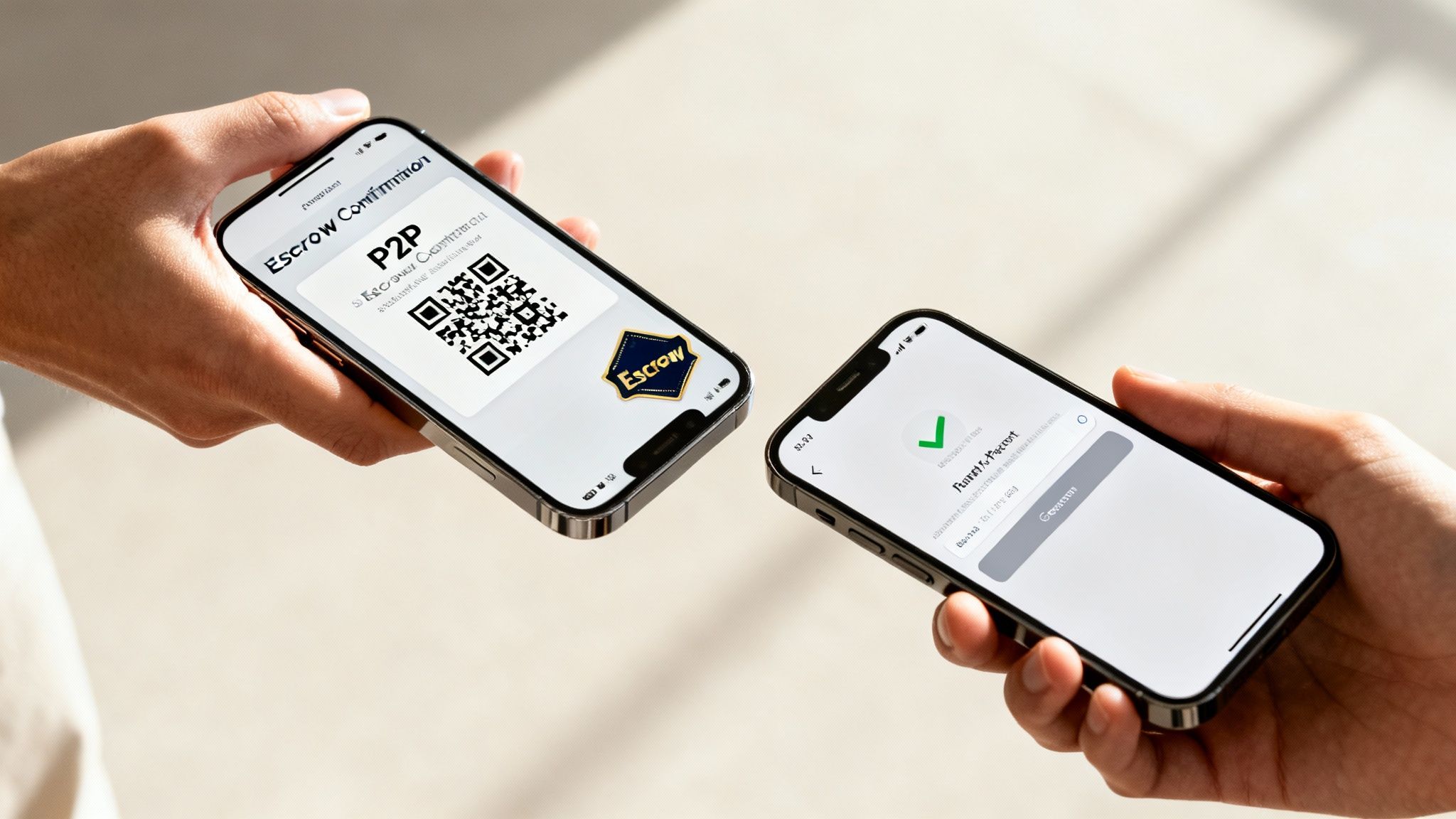
It’s a bit like a Craigslist or eBay, but just for Bitcoin. Instead of selling to a faceless corporation, you create your own sales offer, detailing your terms. Interested buyers then respond directly to you, giving you significant control over the most important parts of the deal.
Gaining Control Over Price and Payments
One of the biggest draws to P2P selling is the power to set your own price. You aren’t just a price-taker, forced to accept whatever the market offers that second. You can list your Bitcoin at the current market rate, slightly below it for a quicker sale, or even command a premium.
Why would someone pay more than the market rate? It often boils down to convenience. Buyers in regions with limited exchange access, or those wanting to use niche payment methods not supported by major exchanges, are often willing to pay a bit extra for a direct, flexible deal.
This flexibility extends directly to how you get paid. Your options are way broader than a simple bank withdrawal.
- Direct Bank Transfers: The classic, straightforward transfer from their account to yours.
- Payment Apps: Services like PayPal, Zelle, or Venmo are incredibly common for near-instant settlement.
- In-Person Cash: For those prioritizing privacy, you can arrange a secure, in-person cash exchange.
- Gift Cards: It might sound strange, but some buyers will even trade gift cards from major retailers for your Bitcoin.
This variety lets you tailor the entire sale to your specific needs, making it a powerful way to get cash for your Bitcoin on your own terms.
How P2P Escrow Protects Your Sale
Of course, trading directly with a stranger online brings up a big question: trust. This is where the platform's escrow service becomes absolutely critical. It’s a built-in security blanket that protects both you and the buyer from getting ripped off.
Here’s a quick rundown of how it works:
- A buyer accepts your offer and starts the trade.
- You then transfer the agreed-upon Bitcoin from your wallet into the platform's secure escrow account. The crypto is now held by a neutral third party.
- The buyer sees the Bitcoin is safely in escrow and sends the payment to you using your chosen method (e.g., bank transfer).
- Once you confirm the cash has landed in your account, you "release" the Bitcoin from escrow. The platform then sends it to the buyer.
This system guarantees the buyer can't run off with your Bitcoin without paying, and you can't take their money without releasing the coins. It's the essential layer of security that makes the whole thing work.
By using an escrow system, P2P platforms effectively solve the trust problem. The Bitcoin is held securely until you have confirmed receipt of the cash, removing the risk of the buyer failing to pay after you've sent your crypto.
Best Practices for a Secure P2P Sale
While escrow provides a strong safety net, your own diligence is still your best defense. Selling on a P2P platform isn't just about clicking a "sell" button; you're actively choosing a trading partner.
Before you finalize any deal, take a minute to vet the other person. Reputable P2P marketplaces give you user profiles packed with crucial info. Look for traders with a high reputation score, a long history of completed trades, and plenty of positive feedback. A brand-new account with zero history is a potential red flag.
And a golden rule: always communicate through the platform's official messaging system. This creates a record of your entire conversation in case a dispute pops up. Never move the chat to an outside app where the platform's support team can't see what’s happening. By being selective and a little cautious, you can make your P2P experience both profitable and secure.
Using Bitcoin ATMs for Instant Physical Cash
When you absolutely, positively need to turn your Bitcoin into physical cash right now, few methods can touch the speed of a Bitcoin ATM. Forget waiting days for a bank transfer from an exchange to clear. These machines are built for one thing: instant conversion.
This makes them the perfect tool for those moments when time is the only thing that matters.
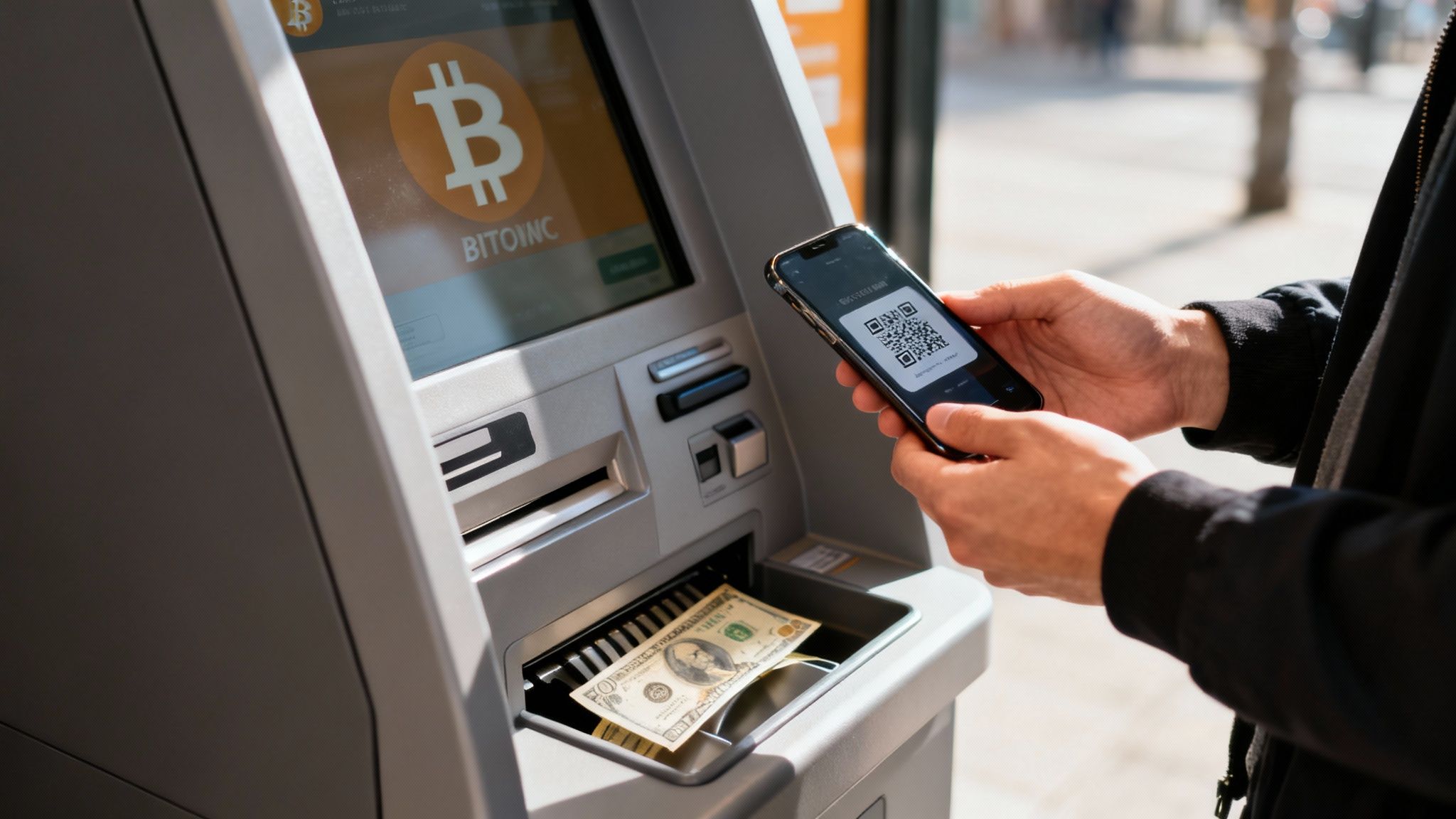
It helps to think of it like a regular cash machine, just running in reverse. Instead of putting in a card to get cash out, you send Bitcoin from your phone to the machine, and it spits out physical bills. The whole thing is usually over in a few minutes, giving you a direct bridge from your digital assets to cash in your hand.
How to Find and Use a Bitcoin ATM
First things first, you need to find one. The good news is the global network has exploded, with thousands of machines active all over the world. Your best bet is to use a dedicated tracker like Coin ATM Radar to find the closest one to you.
Once you’re standing in front of the machine, the process is pretty intuitive:
- Look for the "Sell Bitcoin" option. Most ATMs let you buy and sell, so make sure you’re on the right screen.
- Tell it how much cash you want. You’ll type in the amount of local currency you need, and the machine will show you how much Bitcoin that equals at its current exchange rate.
- Get the QR code. The ATM will generate and display a unique QR code. This is the wallet address you'll be sending your Bitcoin to.
- Send the Bitcoin. Just open your mobile wallet, scan the QR code from the ATM's screen, double-check the amount, and hit send.
- Wait a few minutes, then grab your cash. As soon as the transaction gets a confirmation or two on the Bitcoin network (which doesn't take long), the machine will dispense your money.
It’s this simple, bank-free process that makes Bitcoin ATMs so powerful for anyone needing quick, direct access to their funds.
The Real Costs of Convenience
That incredible speed comes with some serious trade-offs, and you need to go in with your eyes wide open. The convenience of a Bitcoin ATM is paid for with much higher fees and worse exchange rates than you'll find anywhere else.
Be prepared for transaction fees that can range from 7% to as high as 20%. This is a world away from the sub-1% fees you’d pay on a major exchange. You're paying a massive premium for an instant, in-person service, and the pricing reflects that.
On top of the fees, these machines have pretty low transaction limits. You’ll often be capped at withdrawing a few hundred or maybe a few thousand dollars at a time. This makes them completely unsuitable if you're trying to cash out a large position.
At the end of the day, a Bitcoin ATM is a specialized tool. It’s far from the cheapest way to sell your Bitcoin, but when you need physical cash in your pocket now, it's one of the best and fastest options you’ve got.
Managing Volatility with Stablecoins During a Sale
One of the biggest headaches when cashing out Bitcoin is the market's infamous volatility. You might hit "sell," but by the time the money actually lands in your bank account days later, a price crash could mean you get way less than you expected.
This is where getting strategic with stablecoins can be a total game-changer.
Think of a stablecoin as a temporary parking spot for your money. It's a digital currency pegged 1:1 to a stable asset, usually the U.S. dollar. By swapping your Bitcoin into a stablecoin like USDC or USDT first, you essentially lock in its value at that exact moment. It’s a simple move that acts like an insurance policy against a market nosedive while your transaction is processed.
The Two-Step Process for a Stable Sale
This whole strategy boils down to splitting the cashing-out process into two distinct parts: moving from a volatile asset to a stable one, and then moving from that stable asset into your bank account. It gives you a massive amount of control and peace of mind, especially with larger sums where even a small dip can cost you thousands.
The idea is to time your Bitcoin sale perfectly, then just hold that value steady in a stablecoin until you’re ready to pull it out. You’re decoupling your market risk from the often painfully slow bank transfer process. It turns a stressful waiting game into a predictable financial move.
Here’s how it typically plays out on an exchange:
- Swap Bitcoin for a Stablecoin: Instead of selling Bitcoin directly for USD, you place an order to trade it for a stablecoin like USDC. This is almost always instant, securing your capital at the current market price right away.
- Withdraw the Stablecoin to Cash: Now that your funds are safely parked, you can start the withdrawal to your bank account whenever you want. If Bitcoin’s price tanks an hour later, it doesn't matter to you—your value is already preserved.
This intermediate step is the key. By pausing your funds in a stablecoin, you separate the act of selling Bitcoin from the act of moving cash to your bank, insulating yourself from any market chaos that might happen in between.
Why Stablecoins are a Critical Bridge to Fiat
You really can't overstate how important stablecoins have become for selling Bitcoin. They are the essential bridge connecting the wild world of Bitcoin to the stability of traditional fiat money. Their massive adoption is proof of this.
The sheer volume is mind-boggling. Stablecoins recently handled $46 trillion in transactions in a single year, a jump of 106% from the year before. This explosion highlights their vital role, with the top stablecoins processing billions every day. This widespread use means there's deep liquidity, making it easy to convert large sums from Bitcoin to a stablecoin and then to cash without a hitch. For a deeper dive into this trend, check out the crypto adoption insights from Chainalysis.
Practical Considerations for This Method
While this is a powerful strategy, there are a few things to keep in mind to make sure it all goes smoothly.
First, double-check that your exchange supports the trading pairs you need, like BTC/USDC. Most major platforms do, but it never hurts to confirm.
Also, be aware of the fees. You’ll likely pay a small trading fee for the BTC-to-stablecoin swap and maybe another fee for the final cash withdrawal. But honestly, these small costs are often nothing compared to the potential losses from a major market downturn.
This technique is particularly useful if you aren't in a desperate rush for the cash but want to lock in your gains at a specific price. It lets you strategically exit a Bitcoin position without being held hostage by slow banking timelines.
Essential Checks Before You Sell Your Bitcoin
A successful sale is a well-prepared one. Before you rush to convert your holdings, taking a moment for a few critical checks can save you from costly errors, unexpected tax bills, and security risks.
Think of this as your pre-flight checklist before turning your Bitcoin into cash.
This isn't about perfectly timing the market—that's a fool's errand. It's about making a strategic, informed decision. By getting a handle on your tax obligations and sharpening your security habits, you can sell with confidence.
Understand Your Tax Obligations
The second you sell Bitcoin for cash, it becomes a taxable event in most countries. Governments typically view Bitcoin as property, meaning you’ll likely owe capital gains tax on any profit you’ve made. Ignoring this is a recipe for serious financial penalties down the road.
To figure out what you owe, you need to know your cost basis. This is simply the original price you paid for the Bitcoin you're selling, including any fees. The difference between your selling price and your cost basis is your capital gain (or loss).
- Cost Basis: The total amount you spent to acquire your Bitcoin, including the price and any transaction fees.
- Capital Gain: The profit you make from the sale (Sale Price - Cost Basis).
For example, say you bought 0.1 BTC for $4,000 and later sold it for $6,500. Your capital gain is $2,500. That's the amount subject to tax. Keeping meticulous records of your purchase dates and prices is absolutely essential for accurate reporting.
Key Takeaway: Always treat a Bitcoin-to-cash transaction as a taxable event. Track your purchase history carefully to calculate your cost basis and accurately determine your capital gains. This is how you stay compliant with local tax laws.
Reinforce Your Security Habits
When money is moving, scammers are always watching. Before you initiate any transfer, it’s time to double-down on security. A few simple habits can protect you from devastating losses when you decide how to sell your Bitcoin for cash.
The most critical step is verifying wallet addresses. Every single time. When sending Bitcoin to an exchange or a P2P escrow, triple-check the recipient address. A common scam involves clipboard-hijacking malware that quietly replaces the address you copied with the scammer's address just before you paste it.
Also, stay vigilant against phishing attempts. You might get emails or messages that look like they're from your exchange, asking you to click a link to "verify" your sale. Don't do it. Never click links from unsolicited messages; always navigate directly to the official website yourself. Your financial security depends on this level of paranoia.
Got Questions About Selling Your Bitcoin?
When you're ready to cash out your Bitcoin, a few questions always seem to pop up. Let's tackle the common ones so you can sell your Bitcoin for cash with confidence.
One of the first things people want to know is how long it all takes. The honest answer? It really depends on the path you choose. If you're standing in front of a Bitcoin ATM, you'll have physical cash in your hand almost instantly. A peer-to-peer (P2P) sale can often be wrapped up in just a few minutes or hours, depending on the buyer.
On the other hand, if you're pulling funds from a major exchange to your bank account, you'll need a bit more patience. That process typically takes anywhere from 1-5 business days to clear.
How Much Does It Cost to Sell Bitcoin?
The fees for selling Bitcoin can be all over the map. Generally, centralized exchanges are your most wallet-friendly option. They usually charge a small percentage—often well under 1%—for the trade itself and then a minor fee for the bank withdrawal. P2P platforms can sometimes have lower fees, but remember, the final price is negotiated directly with the seller.
Bitcoin ATMs are a different beast altogether. They are, by a long shot, the most expensive way to sell.
For the sheer convenience of getting instant cash from an ATM, expect to pay a hefty premium. Fees can range from a steep 7% to over 15%. You're paying for that immediate, in-person settlement that doesn't require a bank.
Are Bitcoin Sales Taxable?
Yes, they absolutely are. In most countries, selling Bitcoin for fiat cash is considered a taxable event. Any profit you make from the sale—the difference between your buying and selling price—is typically treated as a capital gain. This is why keeping meticulous records of your purchase price (your cost basis) is so important for calculating what you owe.
Before you even think about selling, you need to get a handle on the tax rules. For example, it’s vital to understand what Capital Gains Tax is in Australia or the equivalent laws where you live. When in doubt, talking to a tax professional is always the smartest move to make sure you're staying compliant.
As for security, the safest bet is almost always a well-known, reputable centralized exchange that has a proven history of protecting its users. While P2P platforms can be secure, especially with escrow services, they put more of the responsibility on you. You have to be diligent in checking out your trading partners to steer clear of potential scams.
Ready to accept Bitcoin payments at your business? With Flash, you can launch wallet-to-wallet Bitcoin transactions in under a minute. Our tools connect you directly to the Bitcoin network, ensuring you receive instant payments with minimal fees and no KYC requirements. Join the growing economy and start accepting Bitcoin today by visiting .