When it comes to storing your crypto, everything boils down to one simple, powerful idea: taking full control of your private keys. This isn't just a best practice; it's the entire point. The gold standard for doing this is called self-custody—pairing a hardware wallet with a bulletproof, offline backup of your seed phrase.
This is the only way to guarantee your Bitcoin is truly yours, safe from the kinds of horror stories you hear about all too often.
Why You Can’t Afford to Get Bitcoin Storage Wrong
Learning to store your Bitcoin safely isn't about memorizing technical jargon. It's about a fundamental shift in how you think about money. In the old world, banks were responsible for your funds. With Bitcoin, you are the bank. It's an empowering idea, but it means the buck stops with you. Security is entirely in your hands.
The core principle is brutally simple: if you don't control the private keys, you don't actually own the Bitcoin. When you leave your coins on an exchange, you're trusting someone else to hold them for you. What you have is an IOU, not the asset itself. This introduces a massive point of failure, turning that exchange into a giant, glowing target for hackers.
The Problem with "Convenience"
Leaving Bitcoin on an exchange is like storing gold bars in a public locker where someone else holds the master key. Sure, it's convenient for quick trades, but you're exposed to a whole world of risks you can't control. We're talking about massive hacks, sudden freezes on withdrawals, or the exchange itself going belly-up.
The crypto industry is littered with cautionary tales. The need for proper storage has become painfully obvious as the hacks get bigger and more frequent. In the first half of one year alone, over $3.1 billion vanished into thin air from various attacks. The biggest culprit? Issues with access control, which accounted for nearly 60% of the losses. You can get a deeper look at these security breakdowns on dig.watch.
The phrase "not your keys, not your coins" is more than just a catchy slogan. It’s the first and most important rule of Bitcoin security. True ownership means you—and only you—have the private keys needed to move your funds.
Taking Back Control with Self-Custody
This entire guide is built on the foundation of self-custody. We're going to walk you through a clear, no-nonsense path to achieving total control over your Bitcoin. By moving your funds from an exchange to your own hardware wallet, you eliminate the single greatest risk in crypto: trusting someone else with your money.
Making that switch—from trusting a company to trusting your own solid setup—is the most critical step you can take. It’s the difference between being a passenger in the financial system and sitting in the driver's seat.
Let's start by looking at the different ways you can store your Bitcoin and figure out which one is right for you.
Before we dive into the nitty-gritty of hardware and software, it's helpful to see the main storage options at a high level. Each method comes with its own trade-offs between convenience and security.
Key Bitcoin Storage Methods at a Glance
| Storage Method | Security Level | Best For |
|---|---|---|
| Hardware Wallet | Very High | Long-term holding (HODLing) and securing large amounts. |
| Software Wallet | Medium | Frequent, smaller transactions and daily use on mobile or desktop. |
| Exchange Wallet | Low | Active trading and buying/selling Bitcoin (not for storage). |
| Paper Wallet | High (if done right) | Deep cold storage, but now largely outdated and risky for beginners. |
This table gives you a quick snapshot, but the devil is in the details. While software wallets and even exchanges have their place for specific, short-term uses, our focus here is on building a fortress. And for that, nothing beats a hardware wallet. The following sections will show you exactly how to build your personal Bitcoin vault, starting with choosing the right tools for the job.
Choosing Your Fortress with Hardware Wallets
When you decide to get serious about self-custody, the conversation always leads to hardware wallets. These small, physical devices are the gold standard for securing Bitcoin for one simple reason: they solve the single biggest vulnerability in digital security by keeping your private keys completely offline.
Don't think of a hardware wallet as just another gadget. It’s a specialized vault, a fortress built for one purpose—to protect the secret that gives you control over your Bitcoin.
This offline approach, what we call cold storage, is their superpower. Your computer and smartphone are constantly exposed to a battlefield of malware, viruses, and clever phishing attacks. A hardware wallet creates an "air gap," an impenetrable barrier between your private keys and the chaotic online world. Even if your computer is completely compromised, your funds remain untouchable.
How Hardware Wallets Create an Offline Shield
The magic of a hardware wallet is in its focused design. It's a purpose-built computer that only knows how to do a few cryptographic functions, and it does them exceptionally well. It generates your private keys, locks them away in a protected chip, and signs transactions without those keys ever seeing the light of day.
Let’s walk through a real-world scenario to see how this plays out:
- You decide to send some Bitcoin. You’ll start the transaction on your computer or phone using a companion app.
- The unsigned transaction data is sent to your hardware wallet. Your private keys never leave the device. This is the crucial part.
- You then physically check the transaction details—the exact amount and the recipient's address—on the wallet's own trusted screen. This step is non-negotiable, as it ensures malware on your PC hasn't secretly swapped the destination address.
- Once you’ve confirmed everything looks right, you physically press a button on the device to approve it. The wallet signs the transaction internally and sends only the secure signature back to your computer.
- The now-signed transaction is broadcast to the Bitcoin network.
Notice that at no point in that process were your keys exposed to an internet-connected device. Your computer only ever handled public data and the final signature. A hacker could be watching your screen and still be completely powerless to steal your funds.
A hardware wallet's main job is to let you verify and sign transactions with confidence, knowing your private keys are isolated from online dangers. The physical screen and buttons are your direct, incorruptible interface with your funds.
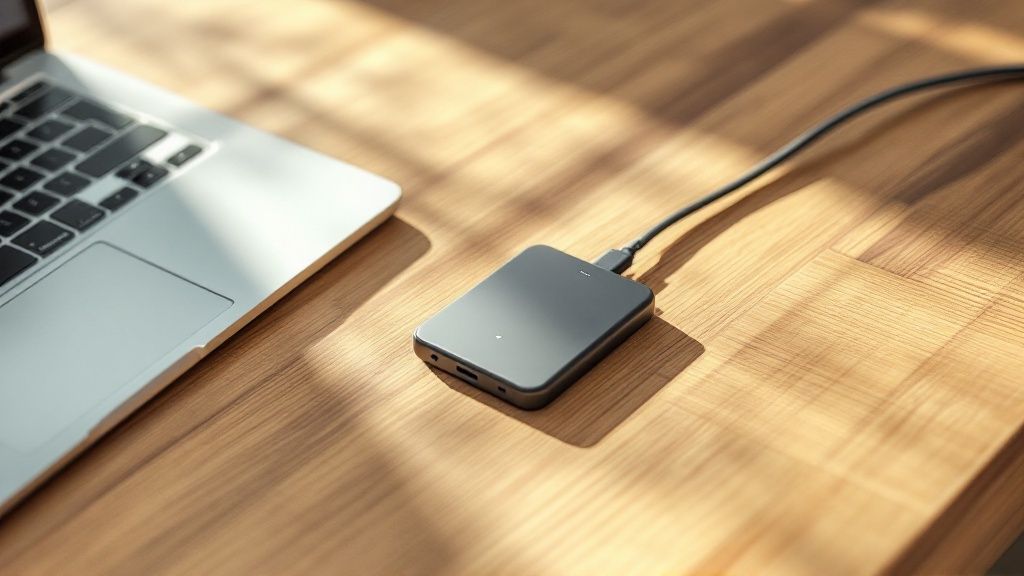
Here's a look at a typical hardware wallet.

They often look like a simple USB stick, but don't be fooled. Inside that compact case is highly specialized security technology designed to be your personal digital vault.
Features That Truly Matter
It’s easy to get lost in the marketing noise when picking a hardware wallet. But instead of focusing on brands, you need to understand the core technology that makes a device genuinely secure. There are a few non-negotiable features.
- Secure Chip: This is a tamper-resistant microprocessor, the heart of the wallet. It’s where your private keys are stored and protected from both physical and software attacks. Think of it as a tiny Fort Knox inside your device.
- Trusted Display: A physical screen on the wallet itself is absolutely essential. It lets you independently verify transaction details (like the recipient address and amount) before you give your final approval. This is your defense against "man-in-the-middle" attacks where malware on your computer tries to trick you.
- Physical Buttons: This might seem low-tech, but it’s an incredibly powerful security feature. Requiring a physical button press to confirm a transaction means a remote hacker simply cannot authorize sending your funds. It demands your direct, physical consent.
These three elements work in concert to create a truly secure signing environment. And people are catching on. Driven by security concerns, cold wallet ownership among retail investors has surged, showing a 34% increase year-over-year. You can dig into the data behind this trend in this comprehensive analysis from CoinLaw.io.
Moving your Bitcoin to a hardware wallet isn't just a security upgrade—it's a fundamental step toward achieving true financial sovereignty.
Mastering Your Seed Phrase: The Ultimate Backup
If your hardware wallet is the fortress, then your seed phrase is the one and only master key. This isn't just a password or a PIN you can reset; it is your Bitcoin. This humble string of 12 or 24 simple words is your ultimate lifeline, giving you the power to resurrect your entire wallet on any compatible device if your primary one is ever lost, stolen, or smashed to pieces.
Getting this right is the single most important lesson in self-custody. Seriously. Everything else you do to protect your Bitcoin is secondary to how you handle this phrase. One slip-up here, and every other security measure you’ve put in place becomes completely useless.
The Offline Generation Ritual
Treat the moment you generate and record your seed phrase with the gravity of handling a state secret. It needs to happen entirely offline, in a private space, far away from any prying eyes or digital ears.
Your shiny new hardware wallet will walk you through this process. As it spits out the words, you must write them down—physically, with a pen and paper. This is absolutely not the time to look for a digital shortcut.
Here are the non-negotiables for this ritual:
- No Digital Devices: Get your phone, laptop, webcam, and even that smart speaker out of the room. Malicious software is literally designed to hunt for these phrases.
- Private and Secure Location: Do this by yourself. Lock the door, close the curtains. You want total privacy.
- Verify, Verify, Verify: I can't stress this enough. Double-check every single word and its specific order. A single misspelling or a swapped word will render the entire backup worthless. Most hardware wallets force you to confirm the phrase before finishing the setup—don't rush this step.
This initial setup is your golden opportunity to create a perfect, uncompromised backup from the very beginning.
Common and Catastrophic Mistakes
The horror stories of lost Bitcoin are almost always stories of poorly managed seed phrases. People make simple, understandable mistakes that have utterly devastating consequences. Learning from their pain is the cheapest education you'll ever get in crypto.
The cardinal sin of Bitcoin security is saving your seed phrase digitally. A screenshot, a text file in a cloud drive, or a photo on your phone is like taping the master key to your vault right on the front door.
Specialized trojans and malware are constantly scanning devices for anything that even remotely looks like a seed phrase. The moment they find one, it's game over. Your funds will be siphoned out in minutes, and there's absolutely nothing you can do about it.
To keep your Bitcoin safe, you need to know what not to do. The table below breaks down the safe and unsafe ways to handle your seed phrase.
Seed Phrase Storage Do's and Don'ts
| Practice | Do (Safe Method) | Don't (Unsafe Method) |
|---|---|---|
| Recording | Write it on physical paper or stamp it into metal, completely offline. | Taking a photo, typing it into a notes app, or saving it as a text file. |
| Storage | Store the physical backup in a secure, private location like a fireproof safe. | Storing it in an email draft, a cloud service like Dropbox, or a password manager. |
| Sharing | Never share it with anyone, under any circumstances. No one needs it to help you. | Giving it to a "support agent," family member, or entering it on a website. |
Avoiding these digital traps is non-negotiable if you're serious about learning how to store cryptocurrency safely. Once generated offline, your seed phrase should never, ever touch an internet-connected device again.
Building an Indestructible Backup
Paper is a good starting point, but let’s be honest—it’s fragile. It can be easily destroyed by fire, water, or just fade into illegibility over time. For long-term, resilient storage, you need an upgrade. This is where metal seed storage solutions come into play.
These are usually small steel plates or capsules designed for you to stamp or engrave your seed phrase into a material that can survive extreme conditions. Think of it as forging a backup that can withstand a house fire or a flood—disasters that would instantly turn your paper backup into ash or pulp.
Why go to this extreme? Because your Bitcoin is meant to be generational wealth. Your storage plan needs to reflect that long-term vision.
Key advantages of metal storage include:
- Fire Resistance: Steel plates can typically withstand temperatures far above a standard house fire (over 1,300°C or 2,500°F).
- Waterproof: They are completely immune to water damage, mold, and corrosion.
- Durability: They resist physical degradation and can't be easily torn or damaged.
Creating this durable backup is the final step in truly mastering your seed phrase. Once your words are stamped into steel and stashed away securely, you've built a genuinely robust recovery system that protects your Bitcoin against both digital and physical threats, securing your assets for whatever the future holds.
Implementing Advanced Security Protocols
Got your hardware wallet and a durable backup of your seed phrase? Great. You've already built a security setup that puts you in the top tier of Bitcoin holders.
But as your holdings grow, you might start thinking about adding even more layers to your defense. It's time to explore some advanced protocols. These aren't just for super-technical experts; they're accessible tools that can dramatically ramp up your resilience against sophisticated threats.
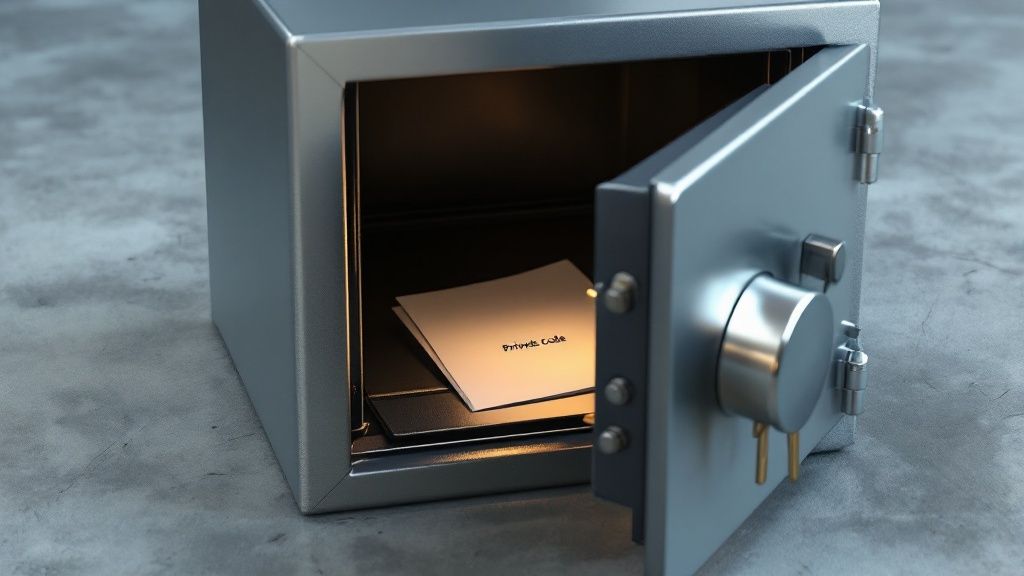
Think of your standard 24-word seed phrase as a master key to a single vault. It's incredibly secure, but it's still a single point of failure. If someone finds that key, they can open the vault. Advanced protocols change this dynamic entirely by adding new locks and requiring multiple keys to get to your funds.
Unlocking the Power of a Passphrase
One of the most powerful—and most misunderstood—features supported by most hardware wallets is the passphrase, often called the "25th word."
This isn't just an extra word tacked onto your existing 24-word seed. It's an entirely separate secret that, when combined with your seed phrase, creates a completely new and unique wallet.
Let's break that down. Your original 24-word seed phrase still accesses your primary wallet. But that same seed phrase plus your secret passphrase (like "blue-ocean-77," for example) unlocks a different wallet. You can create an infinite number of these hidden wallets, each tied to a unique passphrase.
This creates a powerful security model with a couple of key benefits:
- Plausible Deniability: You can keep a small, decoy amount of Bitcoin in your primary wallet (the one accessed by the 24 words alone). If you're ever forced to reveal your seed phrase, you can give up the one that leads to the decoy funds, keeping your main stash hidden and secure in the passphrase-protected wallet.
- Protection Against Seed Phrase Theft: If someone physically finds your steel plate backup, they still can't touch your real funds without the passphrase. This is critical: you should never write down your passphrase with your seed phrase. It should only exist in your memory or be stored in a completely separate, secure location.
A passphrase effectively splits your master key into two parts. One part is the physical seed phrase backup, and the other is the secret you hold in your mind. An attacker needs both to succeed, which drastically reduces your risk.
A word of warning, though. Setting up a passphrase is a serious step. If you forget it, there is no way to recover it, and the funds in that hidden wallet will be gone forever. My advice? Start by practicing with small amounts until you are completely comfortable with the process.
Demystifying Multi-Signature Wallets
As you go deeper down the rabbit hole of how to store cryptocurrency safely, you'll inevitably hear the term multi-signature, or "multisig." It might sound complex, but the idea is actually pretty simple. A multisig wallet is like a bank's safe deposit box that needs two different keys, held by two different people, to be opened.
A standard Bitcoin wallet is single-signature; just one private key is all you need to sign off on a transaction. A multisig wallet, on the other hand, requires signatures from multiple private keys before any funds can be moved.
A very common setup is a "2-of-3" multisig wallet. This just means you create a wallet controlled by three separate private keys, but you only need any two of them to sign a transaction.
Here’s a practical example of how you might set this up:
- Key 1: Stored on your main hardware wallet that you keep at home.
- Key 2: Stored on a second hardware wallet, maybe in a bank safe deposit box.
- Key 3: Stored on a third hardware wallet held by a trusted family member or your lawyer.
With this structure, no single point of failure can compromise your funds. A thief who steals your hardware wallet from your house can't do anything without one of the other keys. If you lose one key, no big deal—you can still access your funds using the other two.
This approach offers an incredible level of security, but it definitely comes with more complexity in setup and management. Multisig is generally what I recommend for individuals or businesses securing significant holdings, as it provides robust protection against theft, loss, and even personal duress.
Building Your Daily Security Habits
Getting your hands on a hardware wallet and a steel backup is a massive leap forward, but that’s not where the story of storing Bitcoin safely ends. Far from it. Real, lasting security is forged in the fire of consistent, mindful daily habits. Just like locking your doors at night, certain practices need to become pure muscle memory every single time you interact with your Bitcoin.
Think of these habits as your frontline defense against the human element of security—the simple slip-ups and clever cons that can dance right past the most expensive tech setups.
The stats paint a pretty stark picture of why this matters so much. A recent mid-year report from Chainalysis revealed that over $2.17 billion had been swiped by hackers and scammers. That pace puts the industry on track for a potential $4.3 billion loss for the full year, a huge jump from previous years. This isn't just a background threat; it’s a clear and present danger that makes daily vigilance completely non-negotiable.
Verifying Every Transaction Address
If you take only one thing away from this guide, let it be this. This is the single most critical habit you will ever develop. Before you hit ‘send’ on any amount of Bitcoin—I don’t care if it’s a fraction of a cent—you have to meticulously verify the recipient's address.
There's a nasty type of malware out there called a "clipper" that just waits. It monitors your clipboard, and the second you copy a legitimate address, it swaps it with an attacker's address. You paste it, think everything is fine, and send your funds into a black hole.
This is where your hardware wallet’s trusted display becomes your best friend.
- Copy the recipient's address and paste it into your wallet software as you normally would.
- Now, look down at your hardware wallet. The transaction details will appear on its physical screen.
- Carefully compare the address on your computer screen with the one shown on your hardware wallet. Every single character must match. No exceptions.
Only after you've done this physical check should you approve the transaction. That simple, five-second action completely neutralizes clipper malware.
Spotting and Sidestepping Phishing Scams
Phishing is just the digital evolution of the classic con artist. Scammers will go to incredible lengths to impersonate legitimate companies—exchanges, wallet providers, or even our team here at Flash—all to trick you into giving up your seed phrase or sending them your Bitcoin.
Let this be burned into your memory: No legitimate company will ever, EVER ask for your seed phrase. It is yours, and yours alone. Anyone asking for it is a scammer. 100% of the time.
Keep your guard up for these all-too-common attacks:
- Fake Update Emails: You get an urgent email telling you to update your wallet software by clicking a link. That link goes straight to a clone website designed to steal your credentials. Always go directly to the official source to download updates.
- Malicious Browser Extensions: Scammers cook up fake browser extensions that promise nifty features but are secretly designed to swipe your keys or redirect transactions. Stick to extensions from verified, highly-trusted developers.
- "Support" Scams: You post a question on a public forum like Reddit or Telegram, and minutes later you get a direct message from someone claiming to be from "official support." They'll be helpful at first, but eventually, they'll ask for your seed phrase to "fix" the problem. Block them on the spot.
Embracing Transactional Hygiene
Beyond just dodging scams, a couple of proactive habits can seriously level up both your security and your privacy.
First, think about using a dedicated, clean device for all your Bitcoin activity. This could be an old laptop you've completely wiped and use for nothing else—no random web browsing, no email, just Bitcoin transactions. By isolating your transactions, you shrink the potential attack surface for malware down to almost zero.
Second, make it a habit to generate a new Bitcoin address for every single payment you receive. This is a fundamental privacy practice. When you reuse addresses, you make it trivially easy for anyone on the planet to trace your entire transaction history on the public blockchain. Most modern wallet software, including ours at Flash, can do this automatically for you. It costs nothing and is one of the most powerful things you can do to protect your financial privacy.
Your Top Bitcoin Security Questions, Answered
Even when you think you've got your security locked down, there are always those nagging questions that can sow a little doubt. When you're figuring out how to store your Bitcoin, a few of the same concerns pop up over and over again.
Let's cut through the noise and tackle these head-on. Getting a solid grasp on these fundamentals is what separates the novices from those who can confidently manage their own Bitcoin.
What's the Real Difference Between a Hot and a Cold Wallet?
This is probably the single most important concept to get right in all of Bitcoin storage. It's not about brand names or fancy features—it boils down to one simple thing: internet connectivity.
Hot Wallets: Think of these as software on your phone or computer. They're always online, which makes them incredibly convenient for small, quick payments. It's like the cash you'd keep in your pocket. But that constant internet connection is also their biggest weakness, leaving your private keys exposed to all sorts of online threats like malware and phishing attacks.
Cold Wallets: These are hardware devices that keep your private keys completely offline. They only briefly connect to a computer when you need to sign and send a transaction, and even then, the keys never leave the device. This "air gap" is why they are the undisputed champion for storing any significant amount of Bitcoin long-term.
A simple way to think about it: your hot wallet is for spending, and your cold wallet is your savings vault.
Can My Hardware Wallet Itself Be Hacked?
It’s a fair question, and one you should be asking. The short answer is: it's extremely unlikely. These aren't tiny little computers like your smartphone; they are highly specialized security devices built for one job only—protecting your keys. This single-minded focus dramatically reduces their "attack surface."
Their whole security model is designed to be safe even if you plug it into a computer that's riddled with viruses.
The magic of a hardware wallet is that it acts as a secure "signing" device. It gets the transaction details from your computer, you verify everything on the wallet's own trusted screen, and then it signs the transaction internally. Only the signed approval goes back to the computer, never your keys.
This is why those little screens and physical buttons are so critical. A hacker could completely take over your laptop, but they can't reach through the screen and physically press the "confirm" button on your device. That physical step is a simple but powerful roadblock against remote theft.
What Happens If the Hardware Wallet Company Goes Bust?
This fear actually highlights one of the most beautiful parts of Bitcoin's design. Your coins are not stored on the device, nor are they tied to the company that made it. Your Bitcoin lives on the blockchain, and your access to it is controlled by one thing: your seed phrase.
That 12 or 24-word phrase you wrote down is the universal master key to your funds. It's generated using an open industry standard called BIP-39, which nearly every wallet company uses.
So, if your device gets smashed, lost, or the manufacturer disappears overnight, you don't lose a thing. You just buy a new hardware wallet from any other trusted brand, select the "recover wallet" option during setup, and punch in your original seed phrase. Instantly, your new device will have full access to all your funds. Your seed phrase is the ultimate backup, ensuring you are never dependent on any single company for your financial sovereignty.
At Flash, we believe in empowering merchants with the tools to accept Bitcoin payments securely and directly, without intermediaries. Our platform facilitates wallet-to-wallet transactions, giving you complete control over your funds while opening your business to a global customer base. Start accepting Bitcoin in under a minute and join the future of commerce. Learn more at .