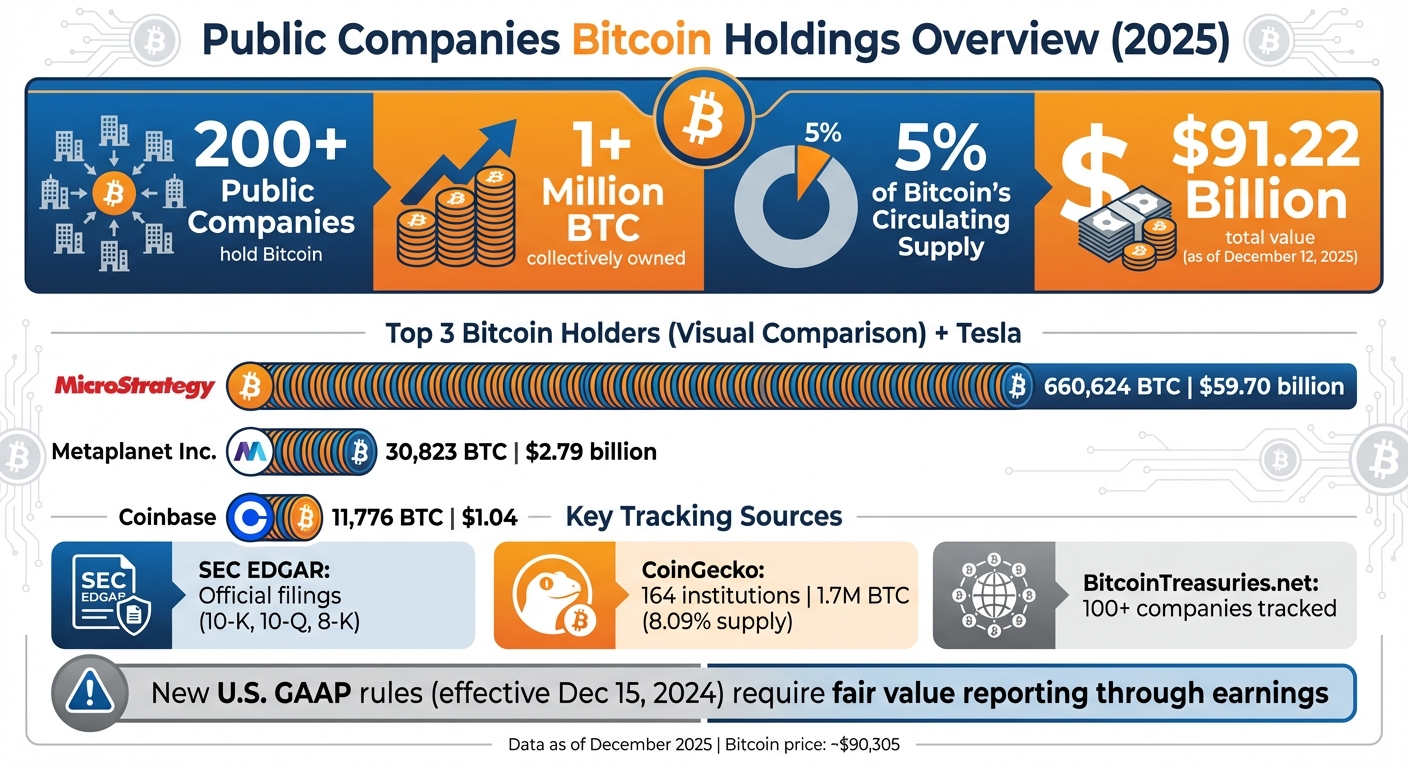
Over 200 public companies hold Bitcoin, collectively owning more than 1 million BTC (around 5% of Bitcoin’s circulating supply). This equates to $91.22 billion as of December 12, 2025. Monitoring these holdings helps CFOs and decision-makers benchmark strategies, understand adoption trends, and refine treasury policies.
Key Ways to Track Bitcoin Holdings:
- SEC Filings: Use the SEC’s EDGAR system to review company reports like 10-K, 10-Q, and 8-K for verified Bitcoin data.
- Specialized Platforms:
- CoinGecko: Tracks 164 institutions holding 1.7 million BTC (8.09% of total supply). Offers a Treasury Data API for real-time updates.
- BitcoinTreasuries.net: Lists over 100 companies with Bitcoin holdings, including acquisition costs and current values.
- Bitbo.io/treasuries: Breaks down holdings by companies, ETFs, and countries, with verified sources.
Practical Steps:
- Cross-check data from platforms with SEC filings for accuracy.
- Convert BTC holdings to USD using current prices (e.g., $90,305/BTC on December 13, 2025).
- Organize data into a dashboard with metrics like total BTC, USD value, and profit/loss.
Key Examples:
- MicroStrategy: Holds 660,624 BTC, valued at $59.70 billion.
- Tesla: Owns 11,509 BTC, worth $1.04 billion.
- Coinbase: Reports 11,776 BTC in its treasury.
By combining reliable data sources with tools like Flash for payment tracking and analytics, companies can manage Bitcoin exposure effectively while staying informed about market trends.
Public Companies Bitcoin Holdings Statistics and Top Holders 2025
How to track BTC, ETH and SOL treasury companies #bitcoin #solana #ethereum
Where to Find Bitcoin Holdings Data
If you're looking to track Bitcoin holdings accurately, the first step is knowing where to find reliable information. Public companies are required to disclose this data, and the best sources are SEC filings and specialized tracking platforms that compile this information. As of December 12, 2025, public companies collectively hold about 1,009,690 BTC, valued at $91.22 billion. Staying on top of this data is crucial for financial planning and analysis. Start by reviewing SEC filings and official company announcements for verified details.
SEC Filings and Company Announcements
The SEC's EDGAR system is the go-to resource for verified Bitcoin holdings data. Public companies disclose their digital asset positions through filings like annual reports (10-K), quarterly reports (10-Q), and current reports (8-K). Bitcoin holdings are often listed under categories like "Investment in Bitcoin, at fair value" in the financial statements.
For example, in July 2025, Trump Media & Technology Group Corp. revealed a $2 billion investment in Bitcoin and Bitcoin-related securities through an amended SEC filing. Similarly, Coinbase’s latest 10-Q filing reported 11,776 BTC in its treasury, valued at nearly $1.3 billion. These filings are often supplemented by official press releases, which provide timely updates between quarterly reports, especially for major acquisitions or sales.
Bitcoin Treasury Tracking Platforms
In addition to SEC filings, several platforms specialize in consolidating Bitcoin holdings data for easy access.
- CoinGecko tracks holdings for 164 institutions, accounting for 1,698,603 BTC - or 8.09% of Bitcoin's total supply. It provides details such as total Bitcoin held, acquisition costs, current value, and recent activity. For developers or analysts, CoinGecko also offers a Treasury Data API for integration.
- BitcoinTreasuries.net lists over 100 public companies with Bitcoin treasuries. The platform includes details like ticker symbols, locations, and the number of Bitcoin held.
- Bitbo.io/treasuries breaks down Bitcoin holdings by public companies, private companies, ETFs, and even countries. A "Filings & Sources" column flags entries verified through official documentation.
Most of these platforms offer free access to basic data, while premium features, such as CoinGecko Premium or Messari Lite, start at $10 per month.
How to Evaluate Data Quality
Not all data sources are created equal, so it's essential to assess their reliability. Platforms referencing SEC filings should be your top choice. Always cross-check significant holdings against a company's latest SEC filing and at least one other reputable source.
Data update frequency is also critical, especially in a volatile market. Platforms that refresh daily are ideal for real-time decision-making, while weekly or monthly updates might work for long-term strategies. Transparency in methodology is equally important - trustworthy platforms will clearly outline how they collect, verify, and present their data, including any limitations or delays in their reporting. Accurate and up-to-date information is key to making informed treasury decisions.
How to Track Bitcoin Holdings: Step-by-Step
Once you've identified reliable sources for Bitcoin holdings, follow this practical process to gain accurate insights that can inform treasury decisions.
Finding Companies with Bitcoin Holdings
Start with platforms like bitcointreasuries.net and CoinGecko, which provide detailed lists of public companies holding Bitcoin. These lists often include ticker symbols and reported Bitcoin holdings. As of September 2025, over 200 companies reported Digital Asset Treasury (DAT) strategies, with more than 190 focusing specifically on Bitcoin holdings.
You can refine your search using platform filters to sort by industry, geographic location, or Bitcoin strategy. For example, companies like MicroStrategy (holding 660,624 BTC valued at roughly $59.70 billion), Tesla (11,509 BTC worth about $1.04 billion), and Metaplanet Inc. (30,823 BTC valued at approximately $2.79 billion) showcase different approaches, from aggressive accumulation to steady treasury management.
Confirming Holdings and Converting to USD
To ensure accuracy, cross-check reported holdings using multiple sources, such as SEC filings (e.g., 10-K, 10-Q, or 8-K reports) and reputable tracking platforms. Convert Bitcoin holdings into USD using the current market price - approximately $90,305 as of December 13, 2025 - while keeping in mind Bitcoin's inherent price volatility. Many tracking platforms cite "Filing" as their data source, but you can verify this through the SEC's EDGAR system. Look for holdings categorized as "Investment in Bitcoin, at fair value" in financial statements.
New U.S. GAAP rules, effective for fiscal years starting after December 15, 2024, require companies to report crypto assets at fair value through earnings. This change enhances transparency by reflecting current market prices but also introduces volatility into financial reports.
When calculating USD values, anchor the conversion to a specific date and time to account for Bitcoin's rapid price fluctuations. For example, in July 2025, CleanSpark sold 575.97 BTC at an average price of $112,351. Once verified, organize this data into a centralized system for easy reference.
Creating a Tracking Dashboard
Bring all the key metrics together in a centralized dashboard. Include fields such as company names, ticker symbols, total BTC holdings, current USD values, acquisition costs, and profit & loss calculations. Advanced dashboards might also track metrics like market-value Net Asset Value (mNAV) and the percentage of Bitcoin's total supply held.
Automating updates can save time and improve accuracy. For instance, the CoinGecko Treasury Data API allows you to integrate live data into your dashboard for real-time tracking. As of December 13, 2025, CoinGecko reports 164 institutions holding 1,698,603 BTC valued at $154 billion, representing 8.09% of Bitcoin's total supply.
Finally, establish a regular verification schedule. Cross-check your dashboard data with official company filings at least quarterly, or more often for companies actively buying or selling Bitcoin. Adding an "Activity" field to log recent acquisitions or sales can help you keep the data current and relevant over time.
sbb-itb-f81ab9b
Analyzing Bitcoin Holdings for Financial Planning
After collecting accurate data on Bitcoin holdings, the next step is turning that information into actionable treasury decisions. This involves identifying the strategies companies use for Bitcoin, evaluating the risks tied to these digital assets, and using those insights to shape your treasury policies. Start by classifying companies based on their approach to Bitcoin to better align your strategy with industry benchmarks.
Categorizing Companies by Bitcoin Strategy
Not all companies approach Bitcoin in the same way. For instance, Bitcoin-first treasury firms, like MicroStrategy, make Bitcoin a central element of their business model. As of June 2025, MicroStrategy held over 582,000 BTC. On the other hand, traditional companies often include Bitcoin as part of a broader, diversified treasury strategy. Meanwhile, Bitcoin mining companies accumulate digital assets as a natural output of their operations. Comparing these approaches helps you benchmark your diversification strategy against industry standards.
By August 2025, 102 publicly traded companies collectively held 1,001,861 BTC, valued at roughly $112.9 billion. This represented 4.77% of Bitcoin’s total supply. Additionally, the U.S. BITCOIN Act of 2025 has introduced a more structured regulatory framework, shaping the way U.S.-based firms adopt Bitcoin.
Once you've categorized strategies, it's crucial to evaluate the risks Bitcoin poses to your balance sheet.
Measuring Bitcoin Risk and Balance Sheet Impact
Bitcoin’s well-known volatility makes risk assessment critical. For example, it saw losses of 64% in 2022 and 74% in 2018, but also hit an all-time high of $111,814 in March 2025. This level of fluctuation can significantly impact financial statements, especially under the Financial Accounting Standards Board (FASB) rules that require fair value measurement through earnings. These rules take effect for fiscal years starting after December 15, 2024.
To prepare, conduct scenario analyses to understand how Bitcoin price drops of 30%, 50%, or even 70% could affect your balance sheet. Use these insights to gauge your board's risk tolerance and ensure your auditors are comfortable with valuation practices. Implement strong internal controls to manage the risks associated with digital assets, aligning with the SEC's disclosure requirements.
With a clear understanding of both strategy and risk, you can integrate these findings into your treasury policy.
Applying Holdings Data to Treasury Policy
Use the data you've gathered to define your treasury allocation targets. For instance, if companies in your sector typically allocate 2–5% of total assets to Bitcoin, this range can serve as a starting point for your policy discussions. Develop key performance indicators (KPIs) tailored to Bitcoin-first treasury strategies to complement traditional financial metrics.
Additionally, consider how Bitcoin payment flows are managed operationally. Companies accepting Bitcoin for goods or services often adopt specific policies, such as immediate conversion to USD, holding assets for a set period, or maintaining target Bitcoin balances. Analyzing these trends can help you refine your own funding strategies and capital formation methods.
Before committing capital to Bitcoin holdings, establish clear policies, robust governance structures, and effective internal controls to manage these assets responsibly.
Using Flash for Bitcoin Payment Operations
Leverage your treasury expertise to simplify Bitcoin payment processes with Flash. This non-custodial, wallet-to-wallet gateway makes it easy to integrate Bitcoin payments directly into your treasury operations.
Managing Bitcoin Exposure with Flash
Flash allows you to set clear Bitcoin exposure targets that align with your treasury policy. By establishing thresholds for Bitcoin holdings as a percentage of total assets, you can ensure consistent risk management while still accommodating Bitcoin payments. This strategy helps you strike a balance between operational flexibility and the allocation goals you’ve identified by analyzing public company holdings.
Monitoring Payments with Flash Analytics
With Flash's real-time analytics, you can keep a close eye on Bitcoin transactions and payment volumes. These insights empower you to make informed decisions quickly, backed by up-to-date data.
Simplifying Reporting with Flash
Flash's built-in reporting tools pull together transaction data and create executive summaries, making it easier to conduct strategic reviews and present key insights.
Conclusion
Keeping track of public companies' Bitcoin holdings is a key task for CFOs and financial decision-makers. Globally, over 100 public companies collectively hold 1,076,034 BTC in their treasuries, offering valuable insights into how market leaders are shaping their Bitcoin strategies. As of December 12, 2025, these holdings represented $64.00 billion in value, accounting for 3.374% of Bitcoin's total supply.
Understanding these trends is essential for strategic treasury management. Bitcoin's volatility and its influence on balance sheets demand close attention. Take MicroStrategy, for instance - its 660,624 BTC holding, valued at $59.688 billion, resulted in an unrealized profit of $10.399 billion during the period. This example highlights how a well-executed Bitcoin strategy can significantly impact financial performance and market perception.
By leveraging reliable data sources like SEC filings and employing systematic analysis, you can benchmark your treasury strategy against industry leaders and stay ahead of emerging trends. Notably, new U.S. GAAP rules, effective after December 15, 2024, mandate marking crypto assets to fair value through earnings, improving financial transparency.
For those navigating Bitcoin integration, Flash offers non-custodial payment tools designed to align with treasury policies. Whether you're setting exposure limits, tracking real-time transactions, or producing executive reports, Flash provides the resources to stay in control while engaging with the Bitcoin economy. Use these tools and insights to refine your approach to digital assets and strengthen your overall strategy.
FAQs
How can I confirm the Bitcoin holdings of public companies?
To verify the Bitcoin holdings of public companies, begin by using reliable blockchain explorer tools. These tools allow you to check transaction details and wallet activity directly on the blockchain. Next, cross-reference this data with multiple trusted sources to confirm its accuracy. For deeper insights, consider using blockchain analysis tools to study transaction patterns, which can help validate ownership and track activity. This method ensures you’re working with accurate and reliable data, which is crucial for making informed financial decisions.
Which tools provide real-time updates on Bitcoin holdings of public companies?
StrategyTracker offers real-time updates on the Bitcoin holdings of public companies, with data refreshed about every 15 minutes. This tool is built to keep financial professionals informed, delivering dependable and timely insights to support data-driven decision-making.
How can SEC filings help track a company’s Bitcoin holdings?
SEC filings offer a clear and detailed look into a company’s Bitcoin holdings. These disclosures serve as a dependable way to verify how much Bitcoin a publicly traded company owns, shedding light on their investment strategies and how they incorporate Bitcoin into their treasury assets.
Studying this data allows financial decision-makers to evaluate potential market impacts, compare strategies across companies, and better understand emerging trends in corporate Bitcoin adoption.