Getting started with a crypto wallet is simpler than you might think. At its core, you just need to pick a wallet, set it up, and—this is the most important part—securely back up your secret recovery phrase. After that, you'll use a unique address to receive Bitcoin and the recipient's address to send it, much like how email works.
Your First Step into the Bitcoin Economy
Welcome to the world of Bitcoin. Think of a crypto wallet as your personal digital vault, a secure spot to hold and manage your bitcoin. It's the one tool you absolutely need to participate in the growing Bitcoin economy.
This guide will cut through the noise and show you how to use a crypto wallet, focusing on the concepts that actually matter for getting started with confidence. We'll cover everything from choosing your first wallet to making your first transaction.
Custodial vs. Non-Custodial Wallets
The first, and most critical, decision you'll make is understanding the difference between custodial and non-custodial wallets. This choice determines who is truly in control of your Bitcoin.
- Custodial Wallets: These are managed by a third party, like a crypto exchange. They're convenient, sure, but you don’t hold the private keys. That means you're trusting someone else with your funds.
- Non-Custodial Wallets: With these wallets, you hold your own private keys. You have complete ownership and absolute control over your Bitcoin. It's the difference between storing cash in a bank and keeping it in a safe at home where only you know the combination.
This distinction is everything because real financial freedom in the Bitcoin world comes from controlling your own keys.
A non-custodial wallet is all about self-sovereignty. The principle is simple but powerful: "Not your keys, not your coins." When you hold your own keys, you and only you can access and move your Bitcoin.
Why Now Is the Perfect Time to Learn
There's never been a better time to learn how to use a crypto wallet. This isn't some niche tech for hobbyists anymore; it's rapidly becoming a core part of the global financial system. The global crypto wallet market was valued at over USD 12.59 billion and is on track to hit an incredible USD 100.77 billion by 2033.
That explosive growth is fueled by more than 560 million users around the world, proving that a huge slice of the population is already on board. You can find more market insights over at grandviewresearch.com. These numbers aren't just stats; they show that wallets are becoming a mainstream financial tool.
In this guide, we'll walk you through every step, making sure you have the knowledge to manage your digital finances securely and confidently. Let’s dive in.
Choosing and Setting Up Your First Bitcoin Wallet
This is where the rubber meets the road. Picking the right wallet is your first real step into taking full control of your Bitcoin. The best choice for you comes down to one simple question: what are you going to do with your funds? Are you planning on spending it day-to-day, or are you looking to save it for the long haul?
Think of it this way: you wouldn't walk around with your entire life savings stuffed in your pocket. The same logic applies here. You shouldn't keep all your Bitcoin in a wallet built for daily coffee runs. Different tools have different jobs, and getting this right from the start is the key to managing your Bitcoin securely and without headaches.
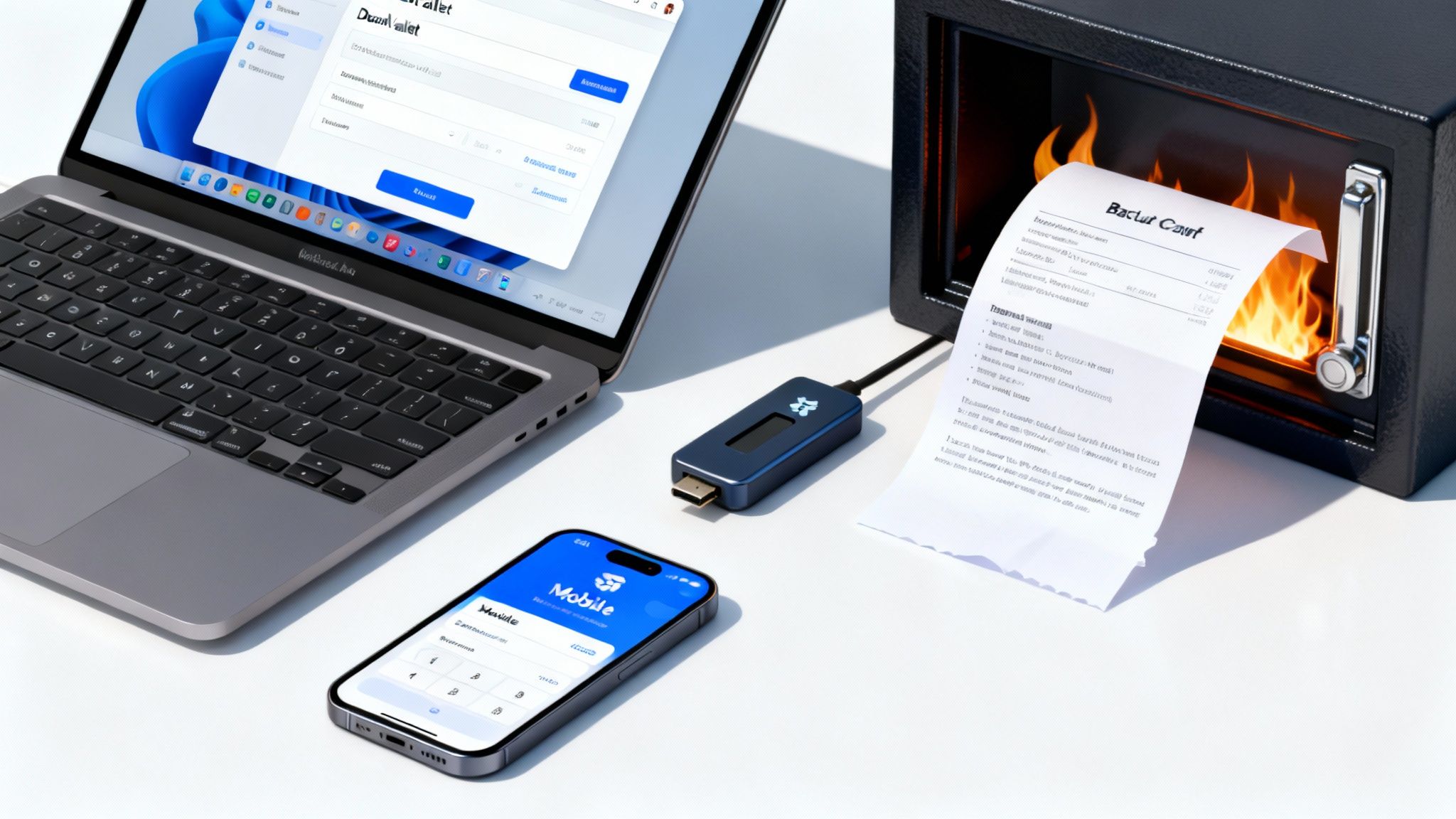
Matching the Wallet to Your Needs
The world of Bitcoin wallets can seem huge, but nearly every option fits into one of three main categories. Each one strikes a different balance between convenience and security, making them perfect for certain situations but not others.
Let's look at the main types so you can figure out what works for your life.
Before we dive into the specifics of each wallet type, here’s a quick overview to help you see how they stack up against each other. This table should give you a good starting point for deciding which direction to go.
Bitcoin Wallet Types At A Glance
A comparison of the three main types of Bitcoin wallets to help you choose the best fit for your security and convenience needs.
| Wallet Type | Best For | Security Level | Convenience |
|---|---|---|---|
| Mobile Wallet | Everyday spending, small amounts, on-the-go transactions | Good | High |
| Desktop Wallet | Managing larger amounts from a secure computer | Better | Medium |
| Hardware Wallet | Long-term saving, securing significant funds | Best | Low |
Each wallet type has its place. For a beginner just getting their feet wet, a mobile wallet usually offers the best blend of usability and security. It's the perfect training ground for learning the ropes in real-world scenarios.
A Practical Walkthrough: Setting Up a Mobile Wallet
Alright, let's get our hands dirty and set up a non-custodial mobile wallet. The process is pretty much the same across most of the good wallet apps and will only take you a few minutes.
First thing's first: head to the official App Store or Google Play Store. I can't stress this enough—be absolutely certain you're downloading the real app from the actual developer. There are plenty of fakes out there designed to steal your funds.
Once it's downloaded, open the app and look for an option like "Create a new wallet." The app is now going to generate your secret recovery phrase, which you might also see called a seed phrase. This is, without a doubt, the most important piece of information you will ever get from your wallet.
Your recovery phrase, usually 12 or 24 words long, is the master key to all your Bitcoin. Anyone who gets their hands on it can access your funds. On the flip side, if you lose your phone, this phrase is the only thing that will let you get your wallet back on a new device.
The app will show you these words and tell you to write them down in the exact order they appear. Do it. Grab a pen and a piece of paper. Never, ever take a screenshot or save them in a text file on your computer.
Securing Your Secret Recovery Phrase
Your wallet is only as secure as this phrase. If you store it digitally—in a cloud drive, an email draft, or as a photo—you're leaving the door wide open for hackers. They are constantly scanning for these digital breadcrumbs.
Instead, you need a physical, offline storage solution. Something safe from thieves, fires, and floods.
Here’s how the pros do it:
- Fireproof Safe: A small, fire-resistant safe in your home is a great, accessible option.
- Bank Deposit Box: For an extra layer of off-site security, you can store a copy in a bank vault.
- Metal Plate: Some people go a step further and etch their seed phrase onto a small steel plate to make it indestructible.
This might feel like overkill, but trust me, it's not. With violent crimes like "wrench attacks"—where criminals physically threaten people for their keys—on the rise, keeping the location of your recovery phrase a secret is critical. Don't tell anyone where it is.
After you've written down and secured your phrase, the wallet app will probably quiz you to make sure you have it right. Once you confirm the words, that's it. Your wallet is set up and ready to go. You now have a secure, self-controlled Bitcoin wallet, putting you in the driver's seat.
Mastering Essential Wallet Security Practices
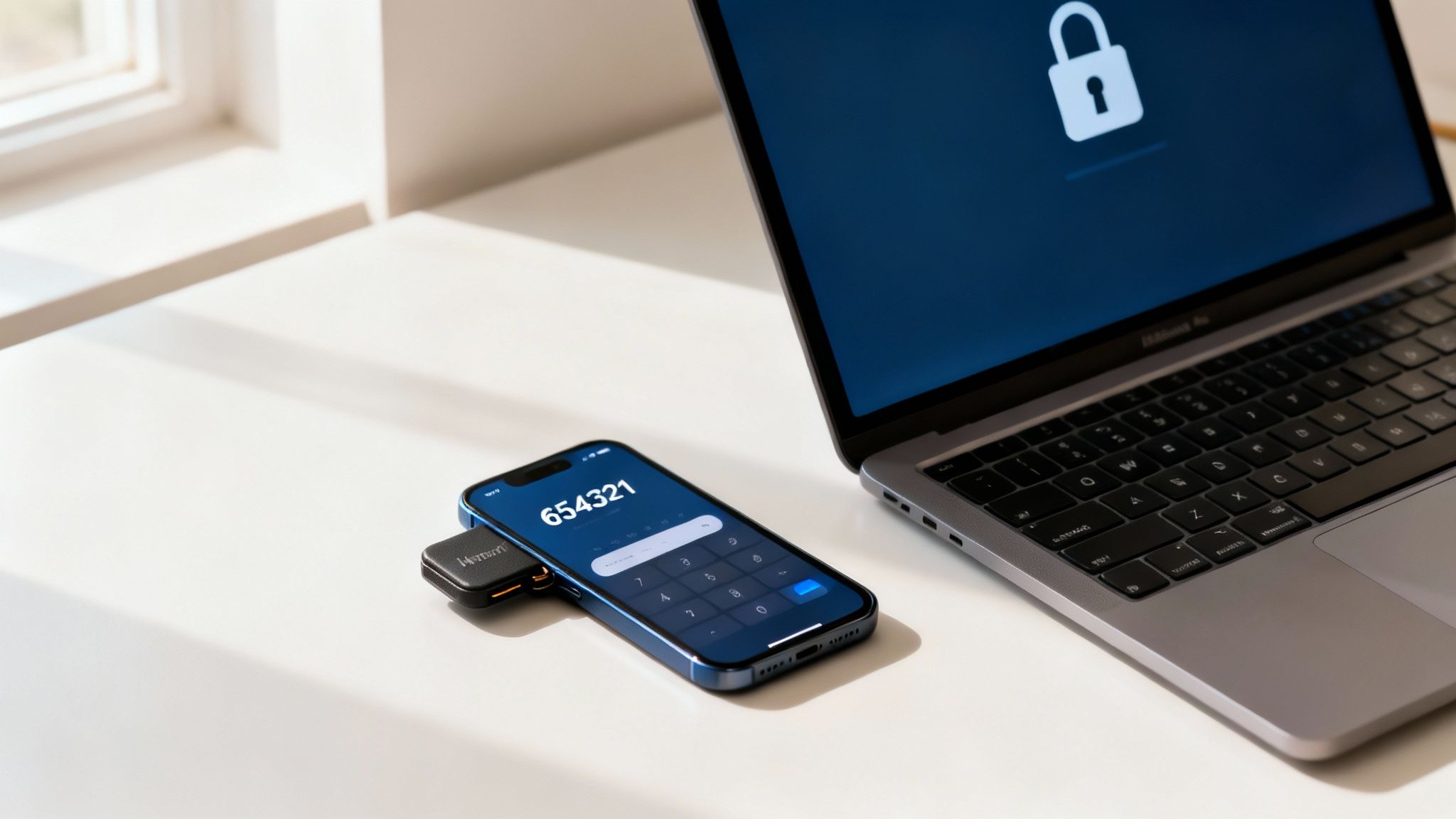
Keeping your secret recovery phrase under wraps is the first rule of Bitcoin security, but it's not the last. Real security is about building layers of defense. When you hold your own Bitcoin, you are your own bank, and that means you need to think like a bank vault designer.
The goal isn't just to have one strong lock; it's to make it so difficult for a thief to get to your funds that they'll give up and go somewhere else. It means moving beyond just hiding a piece of paper and building a robust security posture covering your software, online habits, and physical environment.
Adding Layers to Your Digital Fortress
The first layer beyond your recovery phrase is the device your wallet lives on. Your phone or computer is the gatekeeper, so it needs to be locked down tight.
This starts with the basics: keeping your wallet software and your device's operating system up to date. Updates aren't just for shiny new features; they often contain critical patches for security holes. Running old software is like leaving a window unlocked. Reputable wallet developers are constantly releasing updates to stay ahead of new threats, so install them as soon as they're available.
Next up is Two-Factor Authentication (2FA). Many wallet apps let you require a second code to authorize a transaction, usually from an app like Google Authenticator or Authy. It's a simple step that can stop an attacker cold, even if they somehow get your device's password.
Think of 2FA as a double-check. Even if a thief steals your car keys (your password), they can't start the engine without the second secret code from your 2FA app. It’s a minor inconvenience for a massive security boost.
Recognizing and Avoiding Common Threats
The biggest threats in crypto often don't come from super-complex hacks. They come from simple deception. Scammers are masters of social engineering, and you need to be able to spot their traps from a mile away.
- Phishing Scams: These are the fake emails, texts, or social media messages that look like they're from a service you trust. They’ll try to create a sense of panic, claiming your wallet is compromised and you need to "verify" your recovery phrase on a phony website. Let me be clear: Never type your seed phrase into any website for any reason. Ever.
- Malware and Spyware: Sneaky software can hide in fake apps or email attachments. A particularly nasty type is the "clipboard hijacker," which watches for you to copy a Bitcoin address. When you paste it into your wallet, the malware silently swaps it with the attacker's address. Always, always double-check the first and last few characters of any address before you hit send.
Upgrading to Advanced Security with Multisig
For businesses or individuals holding a significant amount of Bitcoin, a standard single-signature wallet just doesn't cut it. This is where multisignature (multisig) wallets change the game. A multisig wallet requires more than one key to sign off on a transaction, providing a massive upgrade in security.
Think of it like a bank's safe deposit box that requires two keys to open—one held by you, one by the bank manager.
A common setup is "2-of-3" multisig. This creates three separate private keys and requires any two of them to move funds. You could keep one key on your phone, one on your laptop, and a third stored completely offline.
This setup delivers some serious benefits:
- Theft Prevention: An attacker now has to compromise two of your devices instead of just one. That's exponentially harder.
- Redundancy: If you lose one of your keys—say, your phone breaks—you haven't lost your Bitcoin. You can still access your funds with the other two keys.
- Shared Control: For a business, this is a must. You can distribute keys among partners, ensuring no single person can unilaterally move company funds.
Putting these practices into action transforms your wallet from a simple digital pocket into a secure vault. It's all about being proactive, staying vigilant, and using the incredible security tools Bitcoin offers to protect your wealth.
Sending and Receiving Bitcoin with Confidence
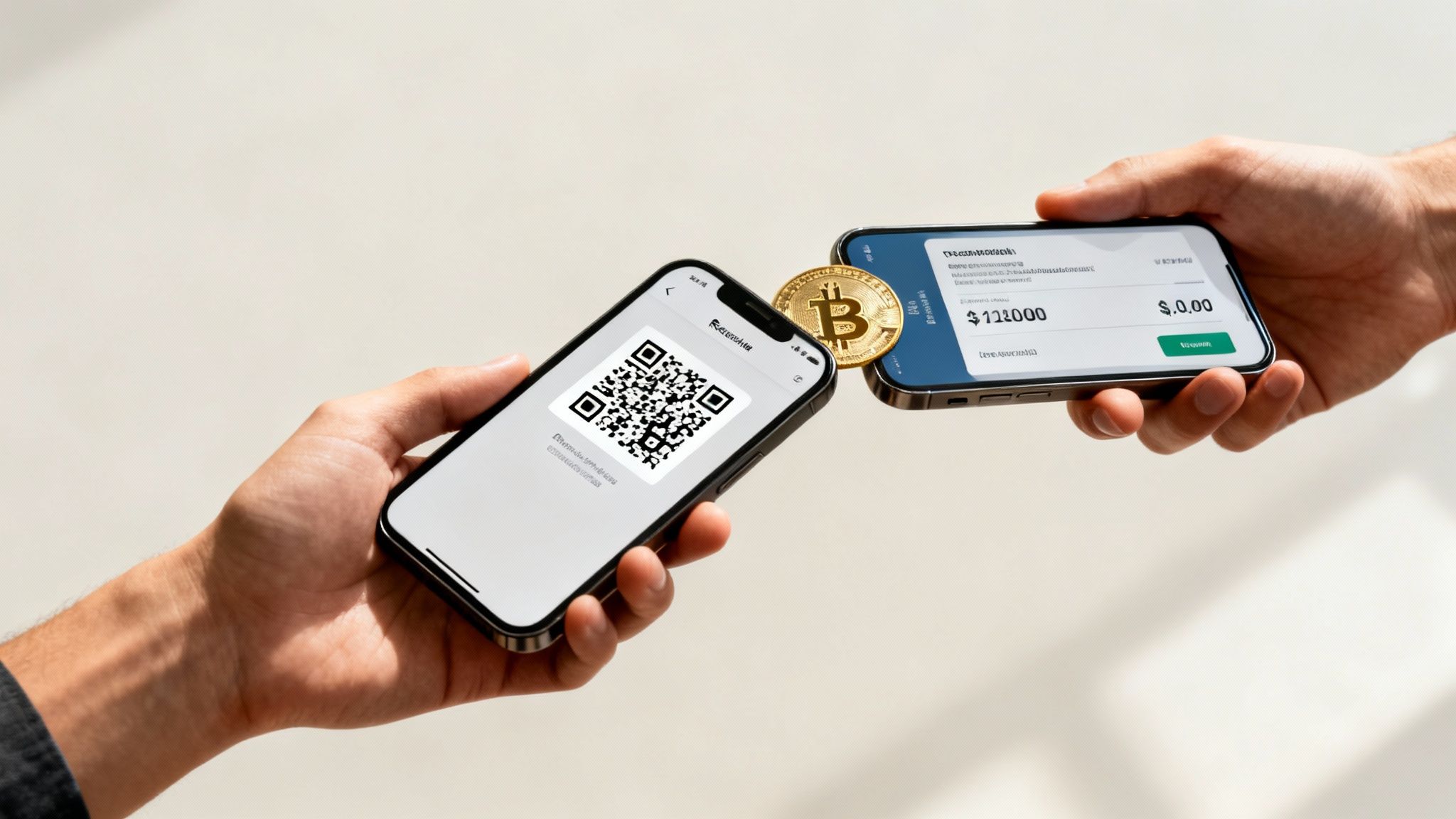
Alright, your wallet is set up and secured. Now for the fun part—actually putting it to work. This is where the magic of Bitcoin really clicks, freeing you from the slow, clunky world of traditional banking.
That first transaction can feel a little intimidating, I get it. But once you see how it works, you'll realize just how simple it is. Let's walk through a real-world example to get you comfortable.
How to Receive Bitcoin Payments
Imagine you're a freelance designer who just wrapped up a project for an international client. They want to pay you in Bitcoin. Simple. To get paid, you just need to give them your Bitcoin address.
Think of it as an email address, but for money. It’s a long string of letters and numbers that your wallet generates just for this transaction. Most modern wallets also create a QR code, which is even easier for the sender.
Here’s all you have to do:
- Open your Bitcoin wallet app.
- Tap on the "Receive" or "Request" button.
- Your app will show you a brand-new, unique Bitcoin address and a QR code.
- Copy that address to your clipboard or just send a screenshot of the QR code to your client.
That's it. Your client scans that code or pastes the address into their wallet, and the payment is on its way. It's a secure, one-way street; sharing your public address only lets people send you Bitcoin. It never gives them access to your funds.
Sending Bitcoin to Another Wallet
Now let's flip the script. You need to pay a supplier or maybe just send some sats to a friend. The process is just as straightforward, but it demands your full attention to make sure the money goes to the right place.
In your wallet, you'll hit the "Send" button. This usually brings up a screen with three key fields.
- Recipient's Address: This is where you paste the Bitcoin address you received. Better yet, if they sent you a QR code, just use your phone's camera to scan it. This eliminates any chance of a typo.
- Amount: Type in how much Bitcoin you want to send. Most wallets let you switch between BTC and your local currency (like USD), which is a lifesaver when you need to send an exact dollar amount.
- Transaction Fee: This is a small fee that goes to Bitcoin miners for processing your transaction. We’ll dig into this next.
Crucial Tip: Always double-check—or even triple-check—the recipient's address before you hit send. Bitcoin transactions are irreversible. If you send funds to the wrong address, there's no bank to call and no way to get it back. I always confirm the first and last few characters to be safe.
Understanding Bitcoin Transaction Fees
When you send Bitcoin, you attach a small "miner's fee." This fee acts as an incentive for the global network of computers (minors) to prioritize your transaction and add it to the next block on the blockchain.
Don't worry, your wallet will handle the complicated parts. It will suggest a fee based on how busy the network is at that moment. You'll usually see a few options:
- Low Priority: Cheaper, but your transaction could take a while to confirm. Good for non-urgent payments.
- Medium Priority: The standard fee. You can expect a confirmation in about 10-30 minutes.
- High Priority: Costs a bit more, but your transaction gets pushed to the front of the line.
For most day-to-day stuff, the standard fee works perfectly. Having control over the speed and cost of your transaction is one of the powerful features you get with a self-custody wallet.
Tracking Your Transaction on a Blockchain Explorer
Once you send your Bitcoin, you can watch its journey across the network in real-time using a blockchain explorer. It’s like a public package tracker for every Bitcoin transaction. Your wallet will give you a transaction ID (TXID) after you send the payment.
You can copy that TXID and paste it into a popular explorer like mempool.space. You’ll see everything:
- The status of your transaction (e.g., "unconfirmed" or "confirmed").
- How many confirmations it has received from the network.
- The sending and receiving addresses involved.
After a transaction gets a handful of confirmations, it's considered final and irreversible. This radical transparency is a core part of what makes Bitcoin so trustworthy. You know, with certainty, that your payment went through.
The scale of this is mind-boggling. Bitcoin alone processed over $1.2 trillion in inflows over a recent 12-month period, as highlighted in a report from a16zcrypto.com. Every one of those transactions was powered by a wallet, just like the one you just set up.
Alright, once you've gotten the hang of sending and receiving Bitcoin for personal use, you'll probably start to see its massive potential for business. For anyone selling something—merchants, creators, entrepreneurs—a Bitcoin wallet is way more than just a digital piggy bank. It’s your direct on-ramp to a global customer base.
This is where the magic happens. You can connect your personal, non-custodial wallet to business tools and start accepting payments, all while keeping 100% control over your money. Forget waiting days for bank transfers to settle or getting tangled up in complicated processor agreements. With the right setup, you can be up and running, accepting Bitcoin in just a few minutes.
Real-World Applications for Merchants
Jumping into Bitcoin payments doesn't mean you have to tear down your existing business operations and start from scratch. Modern tools are built to slide right into what you're already doing, whether you're selling coffee on a street corner or digital art online.
For physical, brick-and-mortar shops, the go-to setup is usually a point-of-sale (POS) app. Picture this: a customer is ready to check out. You just pull up a POS app, like the one from Flash, on a tablet or phone and generate a QR code for the exact amount. The customer scans it with their wallet, and the money zips directly from their wallet to yours. It's instant, and there’s no middleman.
If your business is online, you've got even more flexibility:
- Payment Links: You can create a simple, shareable link for a specific product or service. Post it on social media, pop it into an email invoice, or embed it right on your website. Easy.
- Customizable Widgets: Want a dedicated "Pay with Bitcoin" button on your checkout page? No problem. These widgets give customers a clear, straightforward option to pay with crypto.
- Subscription Modules: If you run a service with recurring payments, you can automate Bitcoin billing. This creates a steady stream of income flowing directly into your wallet.
The Tangible Benefits of Wallet-to-Wallet Payments
Switching to a direct, wallet-to-wallet payment system gives you some serious advantages over traditional finance and even the custodial crypto processors out there. When a customer pays you, the Bitcoin lands straight in your non-custodial wallet. Only you can touch it.
This direct model brings some game-changing benefits to your business:
- Near-Instant Settlement: Credit card payments can take days to actually clear and hit your account. Bitcoin transactions are confirmed on the network and are usable in your wallet, often in a matter of minutes.
- Dramatically Lower Fees: Old-school payment processors can skim 2-3% (or more!) off every single transaction. Bitcoin network fees are usually just a tiny fraction of that, which means you keep more of your hard-earned revenue.
- Zero Chargebacks: Bitcoin transactions are final. This completely wipes out the risk of fraudulent chargebacks—a massive headache and cost center for many merchants.
- Enhanced Customer Privacy: Since you aren't collecting and storing sensitive credit card details, you reduce your compliance burden and offer your customers a much more private way to pay.
By accepting Bitcoin directly, you're essentially opting out of a financial system that's often slow, expensive, and full of restrictions. You reclaim full financial sovereignty, get faster access to your capital, and build a more direct relationship with your customers.
Tapping into a Global Market
Integrating Bitcoin isn't just about making your operations more efficient—it's a strategic play to unlock a huge and expanding global market. Crypto adoption is on a tear, and that represents a massive opportunity for businesses willing to adapt.
There are over 560 million crypto users worldwide, and mobile wallet usage has jumped 20% globally. By setting up a Bitcoin wallet for your business, you're plugging directly into this global, decentralized economy with tools that can get you started in minutes. You can dig into more of the data on this growing user base in Triple-A's research.
This is a market that traditional payment systems are notoriously bad at serving. Bitcoin has no borders. You can accept a payment from someone anywhere in the world just as easily as you can from a customer standing right in front of you. No cross-border fees, no currency conversion nightmares, and no banks getting in the way to block a transaction. You show a QR code, they pay. It’s a powerful way to expand your reach and connect with a new generation of consumers who value speed, privacy, and control.
Got Questions About Your Bitcoin Wallet?
Even when you feel like you've got the hang of things, questions will inevitably pop up. That’s perfectly normal. Getting comfortable with the finer points of Bitcoin security, how transactions work, and privacy is what separates a beginner from someone who can confidently manage their own money.
Let's walk through some of the most common questions people have when they first start using a Bitcoin wallet. Nailing these down will give you a lot more peace of mind.
What Happens If I Lose My Phone or Computer?
This is usually the first thing people worry about, and for good reason. But the answer is actually one of Bitcoin's most powerful features. If you're using a non-custodial wallet and—this is the critical part—you've backed up your 12 or 24-word recovery phrase, your bitcoin is completely safe.
Think of the phrase as the master key to your funds, not the device itself.
If your phone breaks or gets stolen, you just download the same wallet app on a new device. During the setup, you'll see an option like "restore" or "import." Punch in your recovery phrase, and your wallet will reappear with your full balance, exactly as you left it. This is why we stress that protecting that phrase is job number one.
How Long Does a Bitcoin Transaction Take?
A typical Bitcoin transaction usually gets its first confirmation in about 10 minutes. That's the average time it takes for miners to add a new block to the blockchain.
For larger, more important payments, it's common for merchants or exchanges to wait for three to six confirmations (so, roughly 30-60 minutes). This gives them near-absolute certainty that the transaction is final and can't be reversed.
The fee you attach to your transaction also plays a big role. When the network is busy, a higher fee gives miners an incentive to include your transaction in the next block sooner. If you need something faster for small, everyday buys—like a coffee—the Bitcoin Lightning Network is the go-to solution for payments that settle in seconds.
Can I Use More Than One Bitcoin Address?
Yes, and you absolutely should. In fact, it's a fundamental best practice for protecting your financial privacy.
Modern wallets are called Hierarchical Deterministic (HD) wallets. This is a fancy way of saying they can generate a nearly infinite number of new receiving addresses, all controlled by your single recovery phrase.
By using a fresh address for every payment you receive, you make it incredibly difficult for outsiders to connect your transactions on the public blockchain. Your wallet does this automatically, so you don't have to juggle anything. It just shows you one total balance.
Is It Safe to Use a Wallet on Public Wi-Fi?
The short answer? It's best to avoid it if you can.
While a well-built wallet encrypts your sensitive data and your private keys should never leave your device, public networks are just inherently risky. An attacker on the same network could try to pull off a "man-in-the-middle" attack, where they intercept your connection or try to trick your wallet into sending funds to their address instead of your intended recipient's.
It’s a low-probability event with good software, but the risk isn't zero.
For the best security, stick to networks you trust. Your phone's cellular data or your private home Wi-Fi are much safer bets. This ensures your transaction has a more secure path from your device to the rest of the Bitcoin network.
Ready to integrate secure, direct Bitcoin payments into your business? Flash provides the tools you need to connect your wallet for POS, payment links, and subscriptions in minutes. Start accepting borderless payments today at .