To really get a handle on using a Bitcoin wallet, you need to understand three core pieces: a special password called a recovery phrase, a public address for receiving funds, and a private key for sending them. Think of it as your own digital vault. You're the only one with the key, giving you complete and direct control over your Bitcoin.
Why Merchants Need a Dedicated Bitcoin Wallet
Before we jump into the "how," it’s way more important to grasp the "why." For any merchant, a dedicated, non-custodial Bitcoin wallet is so much more than a novel way to take payments. It's a strategic tool that can fundamentally improve your business operations.
This isn't just about tacking another payment processor onto your checkout page. It's about plugging into a global, decentralized payment network where you essentially become your own bank. That shift puts you squarely in the driver's seat, offering a level of financial autonomy that traditional systems simply can't match.
Slashing Costs and Eliminating Fraud
One of the first things you'll notice is the dramatic drop in transaction fees. Traditional credit card processors routinely skim between 2% to 4% off every single transaction, which bites directly into your profits. Bitcoin network fees, on the other hand, aren't percentage-based and are often significantly lower, especially for larger payments.
Better yet, Bitcoin payments completely wipe out the risk of chargeback fraud. Since Bitcoin transactions are final and irreversible, a customer can't claw back a payment after the fact. This is a massive win for businesses, especially those operating online. It saves you money and eliminates the administrative nightmare of fighting fraudulent disputes.
For a merchant, chargebacks aren't just a loss of revenue; they represent a system where you are presumed guilty until proven innocent. Bitcoin flips that script, putting finality and certainty back into your sales process.
Gaining True Financial Sovereignty
When you use a non-custodial wallet, you hold the private keys to your Bitcoin. This might seem like a small detail, but its implications are huge. It means no third party—not a bank, not a payment processor—can freeze your account, block a transaction, or take your funds. You have direct, sovereign control over your money.
This level of control gives your business some serious advantages:
- Instant Settlement: Forget waiting days for funds to clear. Bitcoin payments are confirmed directly on the network, usually within minutes.
- Global Reach: You can accept payments from anyone, anywhere on the planet, without worrying about currency conversions or cross-border payment headaches.
- Enhanced Privacy: By using a new address for each transaction, you can better protect your business's financial data from being easily tracked on the public blockchain.
Ultimately, learning your way around a Bitcoin wallet is a critical skill for any modern merchant. It unlocks better security, slashes your operational costs, and gives you the financial freedom you need to thrive in a competitive market.
Choosing the Right Bitcoin Wallet for Your Business
Alright, let's talk wallets. Before you can even think about accepting Bitcoin, you need to decide where you're going to put it. This is a critical first step, and the right choice depends entirely on how your business operates day-to-day. Not all wallets are built the same, but for merchants, they boil down to two main types: hot wallets and cold wallets.
Think of a hot wallet like your cash register. It’s software on your phone or computer that’s always connected to the internet, ready to go. These are built for speed and convenience, perfect for handling a steady stream of customer payments, whether that's at your coffee shop counter or through your online store.
A cold wallet, on the other hand, is your business's vault. These are usually small, physical hardware devices that you keep completely offline. Their sole purpose is to securely store larger amounts of Bitcoin that you don’t need for immediate business—think of it as your digital safe for weekly profits or long-term savings.
Deciding Between Daily Use and Secure Storage
The difference between these two isn't just technical; it's fundamental to your operational security. A busy cafe needs the quick-draw speed of a hot wallet to keep the line moving. But an online consultant who gets paid in larger, less frequent chunks would be wise to move those funds into the Fort Knox-level security of a cold wallet as soon as possible.
The numbers back this up. In 2025, hot wallets—because they’re just so easy to use—make up about 78% of all crypto wallets in use. But security is clearly on people's minds. Cold wallets, the go-to for long-term holders, account for the other 22%, and hardware wallet sales jumped by 31% in 2025 as more people looked to protect their funds from online threats. If you're interested in digging deeper, you can find more wallet adoption statistics on coinlaw.io.
For most merchants, the answer isn’t picking one over the other. The smart play is to use both. Keep a hot wallet for your daily transactions and then regularly sweep the profits into a cold wallet for safekeeping.
This hybrid strategy gives you the best of both worlds. You get the agility you need to serve customers effectively and the heavy-duty security required to protect the money you've earned. Nailing this workflow is a cornerstone of managing your business’s Bitcoin responsibly.
Hot Wallet vs Cold Wallet A Merchant's Comparison
To really spell it out, let’s compare them side-by-side from a business owner's perspective. Understanding these differences will help you decide which tool to use for which job.
| Feature | Hot Wallet (e.g., Mobile/Desktop) | Cold Wallet (e.g., Hardware) |
|---|---|---|
| Connectivity | Always online and connected to the internet. | Completely offline, only connecting briefly to sign transactions. |
| Primary Use Case | Ideal for daily customer payments, quick transfers, and managing small balances. | Best for securing large sums of Bitcoin and long-term savings. |
| Security Level | Good for everyday use but more vulnerable to online threats like malware or phishing. | Extremely high security, as private keys never touch an internet-connected device. |
| Convenience | Highly convenient, allowing for fast and easy access to funds anytime. | Less convenient for frequent use, as it requires physical access to the device. |
Ultimately, your choice depends on balancing accessibility with security. A hot wallet keeps your business fluid, while a cold wallet ensures your profits are protected for the long haul. Using them together is how you build a resilient financial system for your business.
Your Hands-On Guide to Wallet Setup and Security
Alright, you've picked the right kind of Bitcoin wallet for your business. Now it's time to get it set up. This part is pretty simple, but it comes with a level of personal responsibility that traditional banking just doesn't prepare you for. You're in charge, which means you're also the one responsible for keeping it safe.
The entire process hinges on one thing: your recovery phrase.
When you first set up your wallet, it will generate a unique list of 12 or 24 simple words. This isn't just another password; it's the master key to your Bitcoin. If your phone gets lost or your computer dies, this phrase is the only thing that will get your funds back on a new device.
Securing Your Master Key
Let's quickly break down the key terms. Your private key is the hidden password that signs off on transactions, proving you own the Bitcoin. You’ll probably never even see it. Your public address is like a bank account number—totally safe to share with customers.
The recovery phrase? It's the ultimate backup that can regenerate both of them from scratch.
Here is the single most important rule you need to live by:
- Write the recovery phrase down on paper. Do not screenshot it. Don't save it in a text file, an email draft, or your cloud drive. Just don't.
- Store it somewhere offline and truly secure. Think a fireproof safe at home or a secure deposit box. Some people even go as far as engraving it onto a metal plate to guard against fire or water damage.
- Never, ever share it with anyone. No legitimate support team or wallet company will ever ask you for your recovery phrase. Anyone who does is trying to steal your money.
Your recovery phrase is the final line of defense for your business's revenue. Treating it with the seriousness it deserves from day one is the most important security practice you will ever adopt. Digital storage is a vulnerability; physical, offline storage is your fortress.
The move toward self-custody is catching on because it puts the power back where it belongs—with you. The decentralized crypto wallet market, valued at a whopping USD 2.34 billion in 2024, is projected to climb to USD 2.93 billion by 2025. This isn't just a niche trend; it shows a real hunger for asset sovereignty, the very principle you're embracing when you secure your own recovery phrase. You can find more insights on this market trend on einpresswire.com.
Adding Layers of Protection
Once you’ve got your recovery phrase safely tucked away offline, you can focus on the daily-use security layers for the wallet app itself. These are your everyday defenses against someone getting unauthorized access to the device your wallet lives on.
Any decent wallet app will make you set up a strong PIN code or password during installation. Make sure it's something unique that you don't use anywhere else.
For an even stronger defense, you should look into 2FA. Understanding the safety of 2-Factor Authentication is a game-changer for wallet security. Many wallets have this built-in, requiring a second check from another device before letting you do anything important, like sending funds.
By combining a physically secured recovery phrase with strong app-level defenses, you're building a seriously robust security system for your business's Bitcoin. It’s a proactive setup that protects your funds from both digital hackers and physical device loss, giving you the peace of mind to transact with confidence.
Putting Your Bitcoin Wallet to Work in Your Business
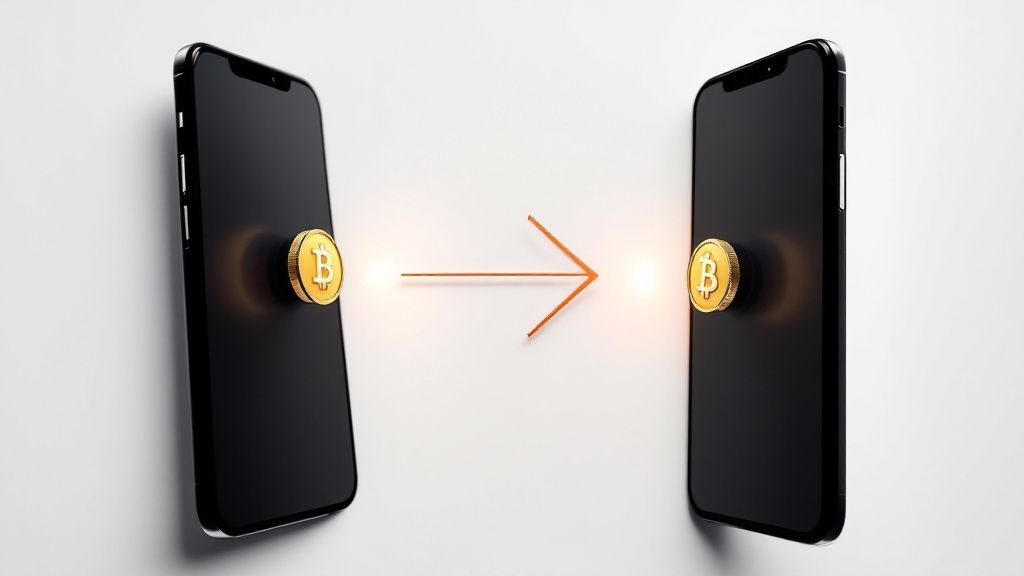
Alright, your wallet is set up and your recovery phrase is tucked away safely. Now for the fun part: putting it to work. Using a Bitcoin wallet in your business isn't just about holding funds; it's about mastering the flow of money. That means getting comfortable with both accepting payments from customers and sending funds out, whether to suppliers or into your own long-term savings.
Let's walk through the mechanics of transacting with Bitcoin, starting with the most important part of any business—getting paid.
Accepting Customer Payments Securely
Here’s the single most important rule for accepting Bitcoin: generate a fresh, unique address for every single invoice. Seriously, every time.
Think of a Bitcoin address like a one-time-use invoice number. If you reuse an address, you're creating a massive privacy leak. Anyone can look up that address on the public blockchain and see every payment you've ever received to it, right down to your total balance. It's like publishing your bank statement for the world to see.
Thankfully, you don't have to manage this manually. Modern point-of-sale tools, like the ones we've built here at Flash, automate this process completely. When a customer is ready to pay, the software generates a new invoice with a brand-new Bitcoin address and a simple QR code. Your customer scans the code, sends the payment, and you're done. This simple practice is the bedrock of financial privacy in the Bitcoin world.
Sending Bitcoin with Confidence
You'll also find yourself needing to send Bitcoin—maybe you're paying a supplier, an employee, or just moving profits into your secure cold storage vault. The process itself is straightforward, but it demands your full attention. Why? Because Bitcoin transactions are irreversible. There's no customer support line to call, no "undo" button.
When you're sending funds, make these habits second nature:
- Always Double-Check the Address: This is where costly mistakes happen. Don't ever type out an address by hand. Use your device's copy-and-paste function, and even then, visually confirm the first few and last few characters of the pasted address match what the recipient gave you. A quick glance can save you a fortune.
- Send a Small Test Transaction First: For any significant payment, this is non-negotiable. Send a tiny amount—just a few dollars' worth of Bitcoin—to the address first. Wait for the recipient to confirm they've received it before you send the full amount. It’s a simple check that can prevent a catastrophic loss.
- Set an Appropriate Transaction Fee: Your wallet will suggest a network fee, sometimes called a "miner fee." This fee is what incentivizes miners to include your transaction in the next block. If a payment is urgent, you can bump up the fee for faster confirmation. If it's not time-sensitive, like moving funds to your own vault, you can choose a lower fee to save a bit on costs.
Mastering the art of sending Bitcoin really just comes down to meticulous habits. The network doesn't know you made a mistake; it only follows instructions. Taking an extra 30 seconds to verify an address or send a quick test transaction is the single best investment you can make in your operational security.
Essential Habits to Protect Your Business Funds
Getting your wallet set up correctly is just the starting line. The real work—and the real security—comes from the consistent, daily habits you build around it. As a merchant, protecting your hard-earned revenue means understanding how to use your Bitcoin wallet securely, day in and day out.
This might sound like a heavy responsibility, but it really just boils down to a few core practices. Think of it as a daily security checklist. These are simple actions that, when done consistently, create a powerful defense against anyone trying to get their hands on your funds. And it all starts with the device your wallet lives on.
Fortifying Your First Line of Defense
Your wallet app is only as secure as the phone or computer it's installed on. The first thing you should do is set a strong, unique password for the wallet itself. Then, immediately enable any biometric locks available, like a fingerprint or face scan. This simple step creates an instant barrier if your device ever gets lost or stolen.
But physical access isn't the only threat. You have to stay vigilant against the countless online scams specifically designed to trick you out of your Bitcoin. Scammers are clever, and their tactics are always changing.
Some of the most common schemes we see merchants fall for include:
- Fake Support Emails: You get an official-looking email, supposedly from your wallet provider, with an urgent warning to "verify" your account. They’ll ask you to click a link or, even worse, provide your recovery phrase. No legitimate company will ever ask for your recovery phrase.
- Malicious Software Updates: Scammers create convincing pop-ups or fake websites that perfectly mimic official wallet update notifications. Clicking them installs malware designed to find and steal your private keys.
- Phishing Invoices: A scammer sends you a bogus invoice with a QR code, hoping you’ll scan it in a rush and accidentally send them money.
The core lesson here is simple but profound: you are your own bank now. That also means you are your own head of security. There’s no 1-800 number to call, no central authority to reverse a fraudulent transaction, and no way to recover stolen funds. Every security decision rests entirely on your shoulders.
This shift to self-custody is part of a massive global trend. The crypto wallet market is valued at an impressive USD 19.03 billion for 2025, a huge jump from USD 14.39 billion in 2024. This isn't just numbers on a page; it shows a real, growing demand for secure, user-controlled wallets as more people use digital assets for actual transactions. You can read more about the growing crypto wallet market on researchandmarkets.com.
Adopting a "Zero Trust" Mindset
When it comes to your business's Bitcoin, the safest mindset you can adopt is one of "zero trust." Be skeptical of every unsolicited message. Verify software updates directly from the official app store or website—never from a pop-up or link. And always, always treat your recovery phrase like the ultimate secret it is.
By embedding these habits into your daily workflow, you transform your wallet from a simple app into a secure vault for your business. It's what allows you to operate with confidence in the world of decentralized payments.
Got Questions About Your Bitcoin Wallet?
Even after you've got the basics down, a few questions always pop up when you start using a Bitcoin wallet for your business. Let's tackle the most common ones so you can operate with confidence.
What's This Recovery Phrase and Why Should I Care?
Think of your recovery phrase (sometimes called a seed phrase) as the master key to your entire Bitcoin wallet. It's a list of 12 to 24 words that lets you restore your wallet and get your funds back if your phone gets lost or your computer crashes.
This phrase is everything. Write it down on a piece of paper—never on your computer or phone—and stash it somewhere safe offline. Anyone who finds this phrase can take your Bitcoin, so treat it with the same seriousness you'd give the keys to your business vault.
Is It Okay to Reuse a Bitcoin Address for Different Customers?
Absolutely not. You should never reuse a Bitcoin address.
Reusing an address is a huge privacy leak. It lets anyone on the internet see every payment ever sent to that address, along with your total balance. It's like handing every customer a detailed copy of your bank statement.
The gold standard is to generate a fresh, unique address for every single transaction. Modern merchant tools, like the ones we've built at Flash, handle this for you automatically. This keeps your financial details—and your customers'—private.
What If I Accidentally Send Bitcoin to the Wrong Address?
This is the scary one: Bitcoin transactions are irreversible.
Once you send a payment and it's confirmed on the blockchain, it's gone. There's no "undo" button and no one to call for a refund. If you send funds to the wrong address, they're almost certainly lost for good unless you happen to know the owner and can convince them to send it back.
That’s why you have to double—or even triple—check the address before you hit send. The best habit is to always copy and paste the address, then visually confirm the first few and last few characters to make sure it's an exact match. A few extra seconds of caution can save you a massive headache.
Ready to bring seamless, secure Bitcoin payments to your business? With Flash, you can start accepting wallet-to-wallet payments in under 60 seconds. Our decentralized tools put you in complete control of your money, without the outrageous fees. Explore Flash's merchant solutions today.