Got some Bitcoin and need to turn it into cash? Good news—you've got options.
Most people go through a centralized crypto exchange. This usually means sending your Bitcoin to the exchange, selling it for your local currency like dollars or euros, and then transferring that money to your bank account. You could also use a peer-to-peer (P2P) platform to sell directly to another individual, or just find a Bitcoin ATM for instant cash.
Your Guide to Cashing Out Bitcoin
Each path from Bitcoin to cash comes with its own set of trade-offs. Speed, fees, and privacy all play a big role. The best method for you really depends on what you value most: getting your money right away, paying the lowest fees, or keeping your personal details private.
We'll walk through exactly what you need to know about transaction costs, platform limits, and the security measures you can't afford to ignore. The goal is to get your funds from the blockchain to your bank account safely and without any nasty surprises.
Comparing Your Main Options
So, what are the big three ways to cash out? Each has its pros and cons. A centralized exchange like Coinbase or Kraken offers solid security and pretty low fees, but you'll have to verify your identity. P2P platforms give you more flexibility and privacy but can carry higher risks. Bitcoin ATMs? They’re the fastest by far, but also the most expensive.
Honestly, it often comes down to a simple trade-off between speed, cost, and privacy. Figuring out your priority before you start will save you a lot of headaches later.
As the crypto market has matured, these services have become much more reliable. On major exchanges, the process is now quite slick. You convert your Bitcoin to fiat currency (like USD or EUR) and then withdraw it. On average, you can expect fees between 0.1% and 0.5% of the amount, or sometimes a flat fee from $5 to $25. You can stay updated on market trends over at CoinDesk.
To make it easier, here’s a quick look at how these methods stack up against each other.
Bitcoin Withdrawal Methods at a Glance
This table breaks down the key differences between the most common ways to convert your Bitcoin into cash.
| Method | Average Speed | Typical Fees | Privacy Level |
|---|---|---|---|
| Crypto Exchange | 2-5 Business Days | 0.1% - 1.5% | Low |
| Peer-to-Peer (P2P) | Varies (Hours to Days) | 1% - 5% | Medium to High |
| Bitcoin ATM | Under 15 Minutes | 7% - 20% | Medium |
Choosing the right option means matching one of these profiles to what you need right now. If you're in a jam and need cash immediately, the steep fees of a Bitcoin ATM might be worth it. But for a larger, planned withdrawal, you're probably better off with the lower costs of an exchange.
Getting Your Bitcoin Ready for Withdrawal
Before you even think about hitting that "withdraw" button, there's a bit of groundwork you need to lay. This isn't just about shuffling coins around; it's about making sure your money lands in your bank account safely, quickly, and without any nasty surprises.
For most platforms, your very first stop is the Know Your Customer (KYC) process.
Think of KYC as the digital version of showing your ID at a bank. It's a non-negotiable step for any regulated exchange, thanks to Anti-Money Laundering (AML) laws. It might feel like a hassle, but it's there to prevent fraud and keep the platform operating above board—which ultimately protects you.
What to Prepare for Verification
To get through KYC, you'll need to submit clear images of a few key documents. The whole point is to prove you are who you claim to be.
Have these on hand before you start:
- A Government-Issued Photo ID: Your driver's license, passport, or a national ID card will do the trick. Just make sure it hasn't expired.
- Proof of Address: This is usually a recent utility bill (water or electricity), a bank statement, or even a credit card statement. The name and address absolutely must match what’s on your photo ID.
- A Clear Selfie: Some exchanges want to see your smiling face. You might have to take a live photo of yourself, sometimes holding your ID or a piece of paper with the current date written on it.
This verification can take anywhere from a few minutes to a couple of days. My advice? Get it done long before you actually need the cash. Don’t wait until you're in a rush.
I’ve seen people get stuck for days just because their ID photo was a bit blurry or their utility bill was a month too old. Take your time, find some good lighting, and double-check the platform's specific requirements. It'll save you a ton of frustration.
Understanding the Fees Involved
The price you see for Bitcoin on the screen is never what you'll get in your bank account. Various fees get skimmed off the top along the way, and it’s critical to understand them so you know what to expect. You'll typically run into two main types.
First up is the Bitcoin network fee, often called the miner fee. This is what you pay to the miners who process and confirm transactions on the blockchain. This fee isn't fixed; it goes up and down depending on how congested the network is.
Second, you've got the exchange withdrawal fee. This is the platform's cut for handling the sale and transfer to your bank. These fees can be a flat rate (like $10) or a percentage of your total withdrawal (say, 1%). Always check the fee schedule before you commit.
Locking Down Your Account with 2FA
Finally, and this is non-negotiable, you must enable two-factor authentication (2FA) before you move a single satoshi. Think of it as your account's last line of defense. If a hacker somehow gets your password, 2FA stops them in their tracks by requiring a second, time-sensitive code from another device—usually your phone.
Using an app like Google Authenticator or Authy is far more secure than getting codes via SMS. With these security measures firmly in place, you’re ready to move forward and turn that crypto into cash.
Cashing Out Through a Crypto Exchange
When you're ready to turn your Bitcoin into cash, the most well-trodden path is through a centralized crypto exchange. Think of platforms like Coinbase, Kraken, or Binance. They act as a trusted middleman, giving you the tools to sell your BTC for fiat currency (like USD, EUR, or GBP) and then move that money to your bank account.
While it’s the go-to method for many, it's not a single-click affair. The process has a few distinct stages, and each one needs your full attention. Let's walk through the entire flow, from getting your Bitcoin onto the exchange, making the sale, and finally, cashing out.
Moving Your Bitcoin to the Exchange
The first move—sending Bitcoin from your personal wallet to the exchange—can feel a bit nerve-wracking. This is where you hold your own keys, and precision is everything.
You'll start by logging into your exchange account and navigating to the "Deposit" or "Fund" section. Once you select Bitcoin (BTC), the platform will generate a unique deposit address just for your account. This long string of characters is your target.
Now, open your personal wallet (whether it's a hardware wallet or a mobile app) and start a "Send" transaction. You'll need to carefully copy the exchange's deposit address and paste it into your wallet's recipient field.
Pro Tip: I always recommend sending a small test amount first. Before you move a large sum, send something tiny—like $10 worth of BTC. Wait for the exchange to confirm it has arrived safely in your account. Once you see it, you can send the rest with confidence. It’s a simple step that completely removes the anxiety of a large transaction going astray.
Placing the Sell Order
Once your Bitcoin lands in your exchange account—which can take anywhere from 10 minutes to over an hour depending on how busy the network is—it's time to sell. You're swapping your BTC for fiat currency, and exchanges give you a couple of ways to do it.
- Market Order: This is the straightforward choice. You're telling the exchange to sell your Bitcoin immediately at the best price available right now. It's fast and guarantees the sale goes through, though you don't control the exact price.
- Limit Order: This option gives you more control. You set a specific price you're willing to sell at. Your order will only go through if the market hits your target price. This is great if you think the price might nudge up and you're not in a rush.
For most people just looking to cash out, a market order is the simplest and most effective option. You’ll see the estimated cash amount you'll receive before you confirm the sale.
Withdrawing Cash to Your Bank
With your Bitcoin sold, you now have a fiat balance (like USD) sitting in your exchange account. The final step is getting that cash into your bank. Head over to the "Withdraw" section, select your currency, and choose your linked bank account as the destination.
This is where you'll need a bit of patience. Standard ACH transfers can often take 2-5 business days to clear. Some exchanges offer faster methods like wire transfers or withdrawals to a debit card, which can be quicker but might come with higher fees.
If you're dealing with international banks, understanding smarter expat banking practices can save you from surprise fees or delays from your financial institution. It pays to be prepared.
Alternative Ways to Get Your Cash
If the rigid structure and lengthy verification processes of traditional exchanges don't quite fit your needs, don't worry. You have other powerful options. Stepping outside the world of centralized platforms opens up methods that put a premium on privacy, speed, or unique payment types, giving you far more control over how you turn your Bitcoin into cash.
Two of the most popular routes are peer-to-peer (P2P) platforms and Bitcoin ATMs. Each serves a different purpose and comes with its own distinct set of pros and cons, which are important to weigh before you jump in.
Using Peer-to-Peer Platforms
Think of peer-to-peer services like Bisq or Paxful as a digital marketplace where you sell your Bitcoin directly to another person. Instead of dealing with the exchange as a middleman, you browse listings from buyers or create your own sale offer, specifying your price and how you want to get paid.
The biggest advantage here is flexibility. You’ll find buyers willing to pay you through all sorts of methods:
- Direct bank transfers
- Payment apps like PayPal or Zelle
- Gift cards
- Even in-person cash meetups
This direct connection often translates to more privacy, as many P2P platforms don't enforce the same strict KYC (Know Your Customer) rules you'll find on major exchanges. But that freedom comes with a major trade-off. You're dealing directly with another individual, which naturally increases the risk of getting scammed. It's absolutely crucial to use platforms that have a solid escrow service and reputation system built in.
When you're on a P2P service, always vet the buyer. Look at their trade history and feedback score. Someone with hundreds of positive reviews is a much safer bet than a brand-new account with no track record. And never, ever release your Bitcoin from escrow until you have confirmed the cash is securely in your possession.
The Bitcoin ATM Option
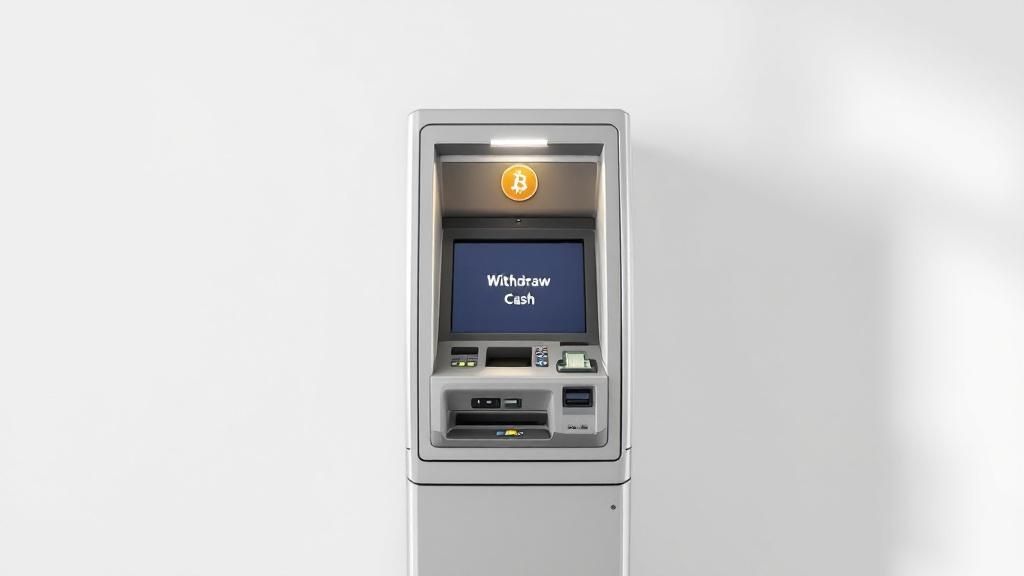
When you just need cash, and you need it now, nothing beats a Bitcoin ATM. These are physical machines, just like the ones you use for your bank account, that let you sell Bitcoin and walk away with cash in hand, often in just a few minutes. It's a remarkably simple process, perfect for those moments when you need funds immediately.
You just use an online map to find a machine near you, tell it you want to sell BTC, and then scan a QR code with your mobile wallet to send your coins. As soon as the transaction gets confirmed on the blockchain—which usually doesn't take long—the machine dispenses your cash.
This convenience, however, comes at a steep price. Bitcoin ATM fees are notoriously high, frequently ranging from 7% to over 20% of your transaction. You're paying a massive premium for the speed and relative privacy. While you might need to show an ID for larger amounts, smaller withdrawals can often be done with just a phone number.
Beyond the crypto world, understanding the mechanics of general currency conversion to cash can offer a wider perspective. Every method for turning one asset into another, digital or not, comes with its own set of rules, costs, and benefits.
Avoiding Common Withdrawal Problems
Knowing how to turn your Bitcoin into cash is one thing. Actually having it go smoothly is another entirely. I’ve seen it happen countless times: a user goes to make a withdrawal, only to have their transaction hit an unexpected snag.
These issues are rarely technical glitches. More often than not, they’re triggered by the very security and compliance protocols designed to protect the financial system.
For instance, a sudden, large withdrawal can raise a red flag with an exchange, prompting a manual review that temporarily freezes your funds. It’s not necessarily a sign that you did something wrong—it's the platform taking extra precautions. The best way to sidestep this headache is to plan ahead, especially when dealing with significant amounts.
Sidestepping Delays and Freezes
One of the most common hold-ups I see is incomplete account verification. Maybe you completed the basic KYC process a year ago, but now you’re trying to cash out a much larger sum. The platform will almost certainly require enhanced verification, which could mean submitting updated documents or a new selfie.
To avoid getting stuck in compliance limbo right when you need the cash, follow these practical steps I’ve learned over the years:
- Verify Fully Before You Need To: Don't wait. As soon as you sign up for a new platform, go through every single level of account verification they offer. Get it out of the way early.
- Start Small: If you're new to an exchange or haven't used it in a while, your first move should be a small test withdrawal. This confirms your bank connection works as expected and starts building a positive transaction history.
- Whitelist Your Bank Account: Many exchanges have a security feature that lets you pre-approve, or "whitelist," a specific bank account for withdrawals. Setting this up in advance can seriously speed up future transactions because the system already knows the destination is trusted.
Even as crypto becomes more mainstream, withdrawal problems are surprisingly common. In fact, nearly 20% of crypto owners report hitting issues like delays or compliance-related holds. These problems often come from the same security measures meant to combat illicit activity, which saw criminals steal over $2.17 billion from crypto services in the first half of 2025. You can dig deeper into these crypto crime trends on Chainalysis.com.
Protecting Yourself From Theft and Scams
Beyond platform-side issues, your own personal security habits are your most critical line of defense. Scammers are relentless, constantly devising new ways to trick you into sending them your funds. Their methods are often sophisticated, preying on a sense of urgency or simple distraction.
If you take away only one thing from this section, let it be this: always double-check wallet addresses. A tiny error—a single wrong character—sends your Bitcoin into a digital black hole. There is no "undo" button. Before you hit confirm on any transfer, meticulously verify the first few and last few characters of the destination address.
You also need to be hyper-vigilant about phishing scams. These usually show up as official-looking emails or messages from your exchange, urging you to click a link to resolve some urgent "issue" with your account. Never click links from unsolicited emails. Instead, always go directly to the platform’s official website by typing the URL into your browser yourself. If there's a real alert, you'll see it there.
Common Questions About Cashing Out Bitcoin
So, you're ready to turn your Bitcoin into cash. It's totally normal to have a few questions swirling around. After all, we're talking about moving real money, and it pays to be careful.
Let's clear up some of the most common sticking points. Getting these details straight will help you know what to expect when it comes to timing, costs, and the legal stuff.
What Is the Fastest Way to Withdraw Bitcoin to Cash
When you need cash in your hand right now, nothing beats a Bitcoin ATM. These machines are built for speed. Seriously, you can often have physical cash in less than 15 minutes. But that convenience comes at a steep price—the fees can be shockingly high.
If you can wait a little longer for a much better deal, your next best bet is a major crypto exchange. Cashing out to a linked debit card or a service like PayPal is often surprisingly quick. Depending on the exchange and your bank, the money can hit your account in just a few hours, which is a great middle ground between speed and cost.
Do I Have to Pay Taxes When I Cash Out Bitcoin
In most places, including the United States, the answer is a firm yes. The moment you sell your Bitcoin for a fiat currency like U.S. dollars, you've triggered a "taxable event." This just means you're officially "realizing" a capital gain or loss on your investment.
How much tax you'll owe boils down to a few things:
- How long you held it: Holding your Bitcoin for more than a year usually gets you a lower "long-term" capital gains tax rate. Anything less is a "short-term" gain, often taxed at a higher rate.
- Your profit: The tax is on your profit—the difference between what you sold it for and what you originally paid.
- Your income: Your overall income for the year also plays a part in determining your specific tax rate.
I can't stress this enough: keep meticulous records of every single crypto transaction. That means purchase dates, prices, sale dates, and sale prices. Given how complicated this can get, talking to a tax professional who actually understands crypto is the smartest move you can make to stay on the right side of the law.
Can I Withdraw Bitcoin to Cash Without an ID
It's gotten incredibly tough to cash out any significant amount of Bitcoin without showing some ID. Thanks to global Anti-Money Laundering (AML) rules, almost all financial services—and that includes crypto exchanges—have to verify who you are before they let you withdraw cash. You'll hear this called Know Your Customer, or KYC.
It's not completely impossible to do it anonymously, but your options are slim and much riskier. You might find some peer-to-peer (P2P) platforms that can set up small, in-person cash trades without formal ID checks. Some Bitcoin ATMs also let you withdraw tiny amounts anonymously, but they'll demand an ID the second you go over a pretty low limit. Trying to get around these standard procedures usually just means getting hit with terrible exchange rates and opening yourself up to scams.
Ready to integrate Bitcoin payments into your business without the hassle of KYC or intermediaries? Flash provides a secure, wallet-to-wallet payment infrastructure that puts you in complete control. Launch in under a minute and connect with millions of Bitcoin users worldwide. Explore our tools at .