Integrating Bitcoin payments using APIs lets your business process cryptocurrency transactions without the hassle of manual management or blockchain complexities. By automating tasks like payment confirmations, transaction tracking, and customer notifications, you can save time, reduce costs, and expand your global reach.
Key Benefits of Bitcoin Payment APIs:
- Lower Fees: Bitcoin API transaction fees are typically 0.5%-1%, compared to 2%-3% for credit cards.
- Faster Settlements: Bitcoin payments confirm in minutes, improving cash flow.
- Global Access: Bitcoin connects you to over 400 million users worldwide.
- No Chargebacks: Transactions are irreversible, reducing fraud risks.
How It Works:
- APIs connect your business systems to Bitcoin networks.
- They automate processes like payment creation, status updates, and refunds.
- Non-custodial options ensure funds go directly to your wallet, not a third party.
Steps to Get Started:
- Set up a secure, non-custodial Bitcoin wallet.
- Choose a payment API provider like Flash, known for instant transactions and low fees.
- Follow technical best practices: secure API keys, use HTTPS, and enable two-factor authentication.
- Test your integration in a sandbox environment before going live.
Bitcoin APIs simplify payments, cut costs, and open new opportunities. Whether you're handling subscriptions, retail sales, or online transactions, integrating Bitcoin payments can future-proof your business.
How to Integrate a Non-Custodial Bitcoin & USDT Payment Gateway in Node.js | With sandbox testing
Technical Requirements and Planning
Laying the groundwork for a Bitcoin payment API integration starts with thoughtful planning. Before diving into the code, it’s essential to establish the right infrastructure, meet US-specific requirements, and implement strong security measures to protect both your business and your customers.
Business and Technical Requirements
First, set up a non-custodial merchant Bitcoin wallet to directly manage funds. This wallet will handle payments from customers without relying on a third party. For added security, choose a wallet with multi-signature functionality and one that generates unique addresses for each transaction. This approach not only enhances privacy but also simplifies tracking.
When it comes to managing API keys, secure storage is non-negotiable. Avoid hard-coding keys into your source code or storing them in plain text. Instead, use encrypted environment variables or tools like AWS Secrets Manager or HashiCorp Vault. Limit access to these keys to authorized personnel only, and conduct regular audits to ensure compliance with security protocols.
Another critical step is enforcing HTTPS for all payment-related endpoints. This ensures that data is encrypted during transmission, meeting industry security standards. By mandating HTTPS, you can prevent sensitive payment information from being exposed.
Your developers should have access to detailed API documentation. Ensure your team has the necessary permissions to configure webhooks and work with test environments. These environments simulate real transactions, allowing developers to test without processing actual Bitcoin payments.
Finally, evaluate your system’s compatibility with real-time webhooks, JSON responses, and scalability requirements. Plan for ongoing maintenance, timely updates, and technical support to address future needs.
With these technical foundations in place, the next step is to tailor your integration for the US market.
US Market Localization
US customers have specific expectations when it comes to formatting and presentation. For example, always display currency values in USD using the dollar symbol and two decimal places (e.g., $1,234.56). If you’re showing Bitcoin amounts alongside USD, maintain this consistent format.
For dates, follow the MM/DD/YYYY format familiar to US users. For instance, November 3, 2025, should appear as 11/03/2025. Similarly, timestamps in transaction histories should use a 12-hour clock with AM/PM indicators.
Number formatting is also key. Use commas as thousand separators and periods as decimal points. For example, a Bitcoin price of $1,050.50 should reflect this standard. Apply these rules to all transaction details, including fees and reports.
Language and spelling should align with American English. Use terms like "authorize" instead of "authorise" and "center" instead of "centre." Payment-related terminology should also match US norms - opt for "checkout" rather than "payment basket" and "receipt" instead of "payment confirmation slip."
If your service includes references to measurements or temperatures, stick to imperial units (feet, pounds, miles) and Fahrenheit for temperature.
Once localization is addressed, focus on building a secure and compliant integration.
Security and Compliance Planning
To secure access, implement two-factor authentication (2FA) for all admin and developer accounts. Whenever possible, use authenticator apps instead of SMS-based 2FA to mitigate the risk of SIM swapping attacks.
Practice regular key rotations with clear documentation. Set a schedule for updating API keys - whether quarterly or following a security incident. Maintain an encrypted backup of credentials and restrict access to authorized personnel only. Use monitoring tools to detect unusual activity, such as repeated failed login attempts or high request volumes from suspicious IP addresses.
In the US, compliance with Anti-Money Laundering (AML) and Know Your Customer (KYC) regulations is mandatory. Flash’s non-custodial design simplifies compliance by enabling wallet-to-wallet transactions without holding funds. As Flash Lightning Solutions explains:
"Flash is not a financial company, it is a payment software that connect wallets between themselves. We never touch your funds." - Flash Lightning Solutions
However, this non-custodial model shifts compliance responsibilities entirely to your business. You’ll need to establish your own KYC procedures if required by your operations and regulatory framework. Consulting legal experts familiar with digital asset regulations is highly recommended to ensure compliance.
Additionally, set up systems for transaction monitoring and reporting. Track wallet addresses, flag suspicious activities, and generate reports for regulatory authorities when needed. Maintain detailed logs of payment activities, including timestamps, amounts, wallet addresses, and customer information, in line with legal requirements.
Finally, conduct regular security audits to identify and address vulnerabilities. Schedule these reviews quarterly, update dependencies to fix security flaws, and stay informed about emerging threats through industry bulletins. Proactive measures like these can help safeguard your integration from potential risks.
Selecting a Bitcoin Payment API Provider
Picking the right Bitcoin payment API provider is a crucial step for businesses aiming to integrate Bitcoin payments. This choice impacts everything from security and compliance to how smoothly your operations run and how much they cost. By carefully evaluating your options and understanding your business needs, you can find a provider that not only meets your current demands but also supports your growth over time.
What to Look for in a Provider
When evaluating providers, there are several key factors to keep in mind:
- Security features are absolutely essential. Look for end-to-end encryption, secure key management, and non-custodial wallet support. These tools ensure that your business retains full control of its funds, minimizing risks tied to third-party security breaches.
- Transaction speed and settlement times play a big role in customer satisfaction and cash flow. Providers using the Lightning Network can process payments almost instantly, far faster than traditional Bitcoin confirmations. For businesses in the U.S., this means customers can complete purchases quickly, and you receive funds without the usual delays associated with conventional payment processors.
- Transparent fee structures are a mark of a reliable provider. Top providers typically charge lower fees than the 1.5% to 3.5% rates common with credit card processors. Be cautious of providers with hidden fees or overly complicated pricing. Always request a clear breakdown of all costs, including transaction fees, monthly charges, and additional costs for advanced features.
- Ease of integration is another critical factor. High-quality API documentation, software development kits (SDKs), and sandbox environments can make a huge difference. Well-documented APIs with clear examples and responsive support teams can significantly reduce integration time, while poor documentation can lead to delays and unnecessary headaches.
- Compliance with U.S. regulations is non-negotiable for businesses operating in the States. Your provider should adhere to Anti-Money Laundering (AML) and Know Your Customer (KYC) standards where required, assist with tax reporting, and ensure data privacy in line with American laws.
By focusing on these criteria, you can confidently narrow your options to providers that align with your business goals.
Flash: A Recommended Bitcoin Payment Gateway
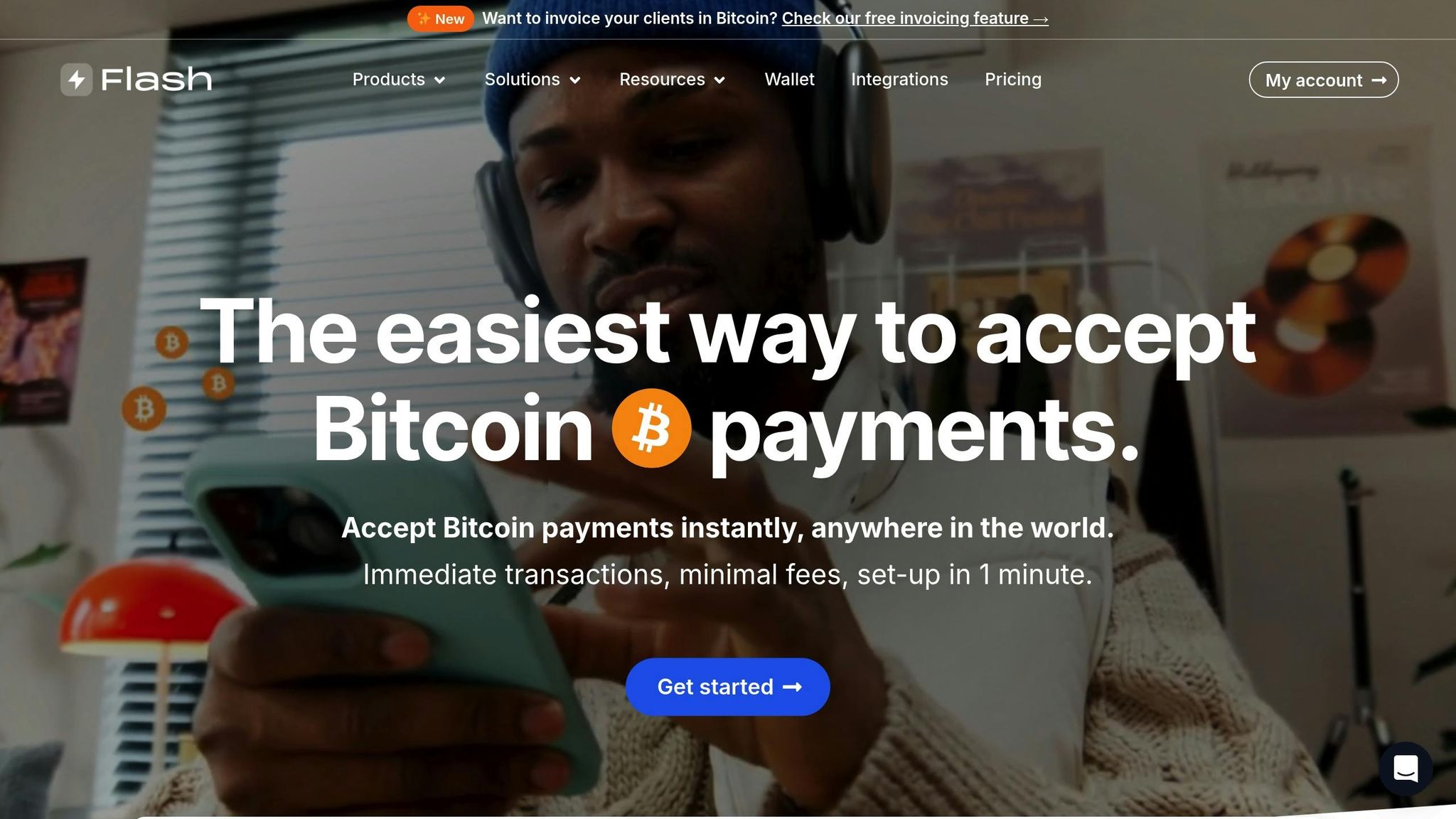
Based on these factors, Flash emerges as a top choice for businesses seeking a reliable and secure Bitcoin payment solution. Designed with enterprise needs in mind, Flash offers global payment processing capabilities and a suite of features tailored for diverse industries.
Security through non-custodial design is a cornerstone of Flash's approach. As Flash Lightning Solutions puts it:
"Flash is not a financial company, it is a payment software that connect wallets between themselves. We never touch your funds."
This model allows payments to move directly from the customer's wallet to your business wallet, cutting out intermediaries and reducing risks while giving you complete control over your Bitcoin.
Lightning Network integration ensures transactions are processed instantly and with minimal fees. This addresses two of the biggest concerns businesses have about Bitcoin payments: speed and cost.
Comprehensive enterprise tools make Flash a versatile solution. The platform includes features like payment links for quick transactions, customizable widgets for seamless website integration, subscription management for recurring billing, paywalls for content access, and point-of-sale systems for in-person transactions. Real-time analytics dashboards are also available to help you track payment performance and customer behavior.
Flexible integration options cater to businesses of all sizes and technical capabilities. Flash supports no-code and low-code setups for online stores, as well as APIs for custom implementations. Basic configurations can be up and running in just a minute, while more complex setups may require additional development time.
Simplified compliance is another advantage of Flash's non-custodial model. Since Flash doesn’t directly hold or process funds, many of the regulatory hurdles faced by traditional payment processors are avoided.
Flash serves a wide array of industries, including eCommerce, retail, SaaS, online marketplaces, travel, charities, and digital content providers. Whether you’re a startup or a large enterprise, Flash offers an efficient and secure way to integrate Bitcoin payments into your business.
sbb-itb-f81ab9b
Step-by-Step API Integration Guide
You've chosen Flash as your Bitcoin payment provider - great choice! Now it's time to bring your payment system to life. This guide walks you through the four main phases of integration, from setup to a fully operational system.
Account Setup and API Access
Start by signing up on Flash's website. Click the "Get started" button, create your account, and you're on your way. Flash keeps the setup process quick, so you can begin accepting Bitcoin payments without unnecessary delays.
Once your account is active, grab your API keys from the Flash dashboard. These keys are your gateway to connecting with Flash's payment system. Make sure to store them securely - use encrypted vaults or environment variables to keep them safe.
Flash also provides detailed API documentation. It covers everything you need: endpoint details, authentication methods, and integration examples. This makes the development process much smoother.
Payment Settings Configuration
With your account ready and API keys secured, it's time to configure your payment settings to fit US standards. The Flash dashboard gives you all the tools you need to fine-tune your setup.
- Currency and formatting: Display prices in USD (e.g., $1,234.56), with commas for thousands and periods for decimals. Flash offers tools for real-time BTC to USD conversions to keep everything accurate.
- Payment methods: Offer your customers the choice of Bitcoin or Lightning Network payments. Lightning Network is great for quick, low-fee transactions, while Bitcoin provides the security of on-chain confirmations.
- Date and time: Make sure invoices, receipts, and transaction records use the MM/DD/YYYY format and reflect US time zones. It simplifies accounting and improves the customer experience.
- Business model settings: Flash supports various models, including point-of-sale systems, subscription billing, paywalls, customizable widgets, and payment links for one-off transactions. Tailor the setup to suit your specific needs.
API Endpoint Implementation
Now that your payment settings are ready, it's time to implement Flash's API endpoints. These endpoints are the backbone of your payment system.
- Payment creation: Use the
/paymentsendpoint to create new payment requests. A POST request here generates a payment link or QR code for your customers. Include details like the payment amount in USD, a description, and any custom metadata for tracking. - Status monitoring: Check payment progress with a GET request to
/payments/{id}/status. This tells you whether a payment is completed, pending, or failed - essential for order fulfillment and customer support. - Webhook setup: Set up webhooks to get automatic updates when payments are received, confirmed, or encounter issues. Use HMAC signatures to secure these notifications and confirm their authenticity.
- Error handling: Build in error-handling mechanisms to deal with network issues, incorrect payment amounts, or duplicate transactions. Use retry logic for failed calls and log errors for troubleshooting.
Testing and Security Implementation
Before going live, test your integration thoroughly in Flash's sandbox environment. This ensures everything runs smoothly and meets high security standards.
- Test all payment scenarios: Successful payments, failed transactions, and delayed confirmations. Make sure your system handles each scenario correctly.
- Secure your APIs: Use HTTPS, rate limiting, and rotate your API keys regularly for added security.
- Log transactions: Record key details like USD amounts, timestamps (in US format), wallet addresses, and conversion rates. This helps with tax reporting and compliance with IRS cryptocurrency guidelines.
- Monitor performance: Track API response times, the ratio of successful to failed requests, and unusual activity. Flash's real-time analytics dashboard can help you stay on top of things.
Once testing is complete and your security measures are in place, your Bitcoin payment system will be ready to handle live transactions.
Bitcoin API Integration Best Practices
Once your Flash integration is live, following best practices ensures long-term security, customer satisfaction, and compliance with regulatory requirements - all while delivering a smooth customer experience.
Security and Reliability Improvements
Regularly auditing your system and conducting penetration tests can help you catch vulnerabilities before they turn into problems. Keep an eye on API activity for unusual patterns, such as repeated failed login attempts, suspicious IP addresses, or transactions that seem out of the ordinary.
For secure data handling, use TLS 1.3 for data transmission and AES-256 encryption for stored data. Protect sensitive information like API keys, customer data, and transaction logs. Additionally, follow the principle of least privilege - grant each system component only the access it truly needs.
Outdated software can leave your system open to attacks, so keep all libraries and frameworks up to date. Set up automated tools to monitor for security patches and have a plan in place to quickly apply critical updates. Be sure to revisit Flash's documentation regularly for platform-specific security recommendations.
To keep your system running smoothly, implement automated failover mechanisms. These systems can switch to backup endpoints if issues arise and provide real-time alerts for unusual API behavior. Logging API responses is another key step for identifying and resolving issues quickly.
Remember, a secure system is only part of the equation. A seamless customer experience is equally important.
User Experience Optimization
Clear and simple payment instructions can reduce confusion and cut down on support requests. When customers choose "Pay with Bitcoin", make sure they see concise steps. Clearly display the payment amount and include a scannable QR code with brief usage instructions.
Keeping customers informed during the payment process builds trust. Use Flash's notification features to provide real-time updates, such as "Payment received – waiting for blockchain confirmation" or "Payment confirmed – your order is being processed." Adding estimated confirmation times helps set realistic expectations.
Since many customers use mobile wallets, your payment interface must work flawlessly on smartphones and tablets. QR codes should be easy to scan, and buttons should be touch-friendly. Test your setup across a range of devices and screen sizes to ensure a smooth experience.
Different customers have different preferences. Some might prefer copying wallet addresses manually, while others will rely on QR codes. Flash’s widgets and payment links support both options, giving customers the flexibility they need.
While optimizing operations is vital, staying compliant with regulations is just as critical.
Compliance and Reporting Requirements
For US businesses, reporting Bitcoin payments in USD is necessary to meet IRS requirements. Record both the USD value and the equivalent Bitcoin amount, formatted according to US standards, to ensure compliance.
Maintain a complete audit trail to protect your business during tax audits or regulatory reviews. Keep detailed logs of every API call, payment request, and transaction update. Include information like customer identifiers, order numbers, and custom metadata to link payments to specific business activities.
When it comes to taxes, Bitcoin payments must be treated as taxable income based on their fair market value. Flash's USD conversion tools can simplify this process by automatically generating accurate records. Because tax laws around cryptocurrency can change, consult with professionals who specialize in this area to stay ahead of any updates at both federal and state levels.
Your data retention policies should strike a balance between compliance and customer privacy. Retain transaction records for at least seven years to meet IRS requirements, but avoid holding unnecessary personal information. Tokenization is a helpful tool for protecting customer privacy while still maintaining the necessary audit trail.
Flash’s non-custodial payment system ensures that customer funds stay in their own wallets, simplifying compliance. However, you are still responsible for accurate reporting and record-keeping for the payments your business receives.
Conclusion and Key Takeaways
API-based Bitcoin payments open the door for US enterprises to tap into a massive market of over 400 million potential customers. Alongside this, businesses can enjoy lower transaction costs and enhanced security. With the global cryptocurrency payment market predicted to hit $1.4 billion by 2027, growing at an annual rate of 16.8%, adopting this technology early could provide a significant competitive edge.
This growing market highlights the importance of choosing a dependable payment solution. Flash stands out as a top-tier non-custodial Bitcoin payment gateway for businesses. Its features - such as instant wallet-to-wallet transactions, low fees, and a variety of integration options like payment links, paywalls, subscriptions, widgets, and point-of-sale systems - offer the flexibility businesses need to scale efficiently.
Integrating Flash into your operations doesn’t have to be complicated. A well-thought-out approach that considers technical requirements, localization for the US market, and compliance with regulations ensures a smooth process.
Security is a cornerstone of any successful integration. Use strong encryption for data protection, enforce the principle of least privilege to limit system access, and securely manage API keys. Flash's non-custodial architecture already reduces risks tied to third-party custody, but maintaining detailed transaction logs further strengthens your security framework.
Compliance is another critical factor for US enterprises. Beyond technical safeguards, businesses must adhere to tax regulations and conduct regular audits to ensure accuracy and transparency in their transactions.
Finally, don’t overlook the importance of user experience. Clear instructions, real-time updates, mobile-friendly designs, and flexible payment options can make a significant difference in building customer trust and encouraging repeat transactions. By combining robust security, regulatory compliance, and a user-friendly interface, your Bitcoin payment integration can deliver both reliability and value for your business.
FAQs
What steps should businesses take to comply with US regulations when integrating Bitcoin payment APIs?
To align with US regulations when incorporating Bitcoin payment APIs, businesses must establish anti-money laundering (AML) and know-your-customer (KYC) protocols. These measures are essential for verifying user identities and curbing unlawful activities. Additionally, keeping thorough transaction records and adhering to reporting guidelines set by regulatory authorities like FinCEN is crucial.
Working closely with legal professionals and staying updated on evolving cryptocurrency laws can provide added assurance of compliance. Opting for platforms that enable secure, non-custodial transactions can also streamline the process while ensuring transparency and adherence to legal requirements.
How can I securely manage API keys and sensitive data when integrating Bitcoin payments?
When integrating Bitcoin payments, keeping your API keys and sensitive data secure is a must. Instead of embedding keys directly into your application, store them in environment variables to reduce exposure. Protect stored data with encryption, and limit access strictly to those who genuinely need it. Make it a habit to rotate your API keys regularly to reduce potential risks. Additionally, implement robust authentication and authorization protocols to control access effectively. Always rely on secure communication channels like HTTPS to ensure data is transmitted securely.
What are the security and control benefits of Flash's non-custodial payment model for businesses?
Flash's non-custodial model gives businesses complete control over their Bitcoin transactions by cutting out third-party intermediaries. Payments happen directly between wallets, offering a more secure setup and lowering the chances of external breaches.
On top of that, this system enables instant transactions with very low fees, providing an efficient and budget-friendly way for businesses to accept Bitcoin worldwide - all while maintaining a strong focus on security and independence.