In January 2026, Iran faces severe economic challenges: the Rial has plummeted to 1.445 million per U.S. dollar, losing 90% of its value since 2018. Inflation hit 48.6% in late 2025, food prices soared by 72%, and unemployment among men aged 25–40 reached 50%. Banking failures, like Ayandeh Bank's collapse, further destabilized the economy, leaving businesses struggling to maintain financial stability.
Bitcoin offers a solution. Unlike the Rial, Bitcoin's fixed supply of 21 million coins prevents devaluation. In 2025, while the Rial lost 40% of its purchasing power, Bitcoin holders in Iran saw 2,653% gains in Rial terms. Businesses can use Bitcoin for global transactions, bypassing domestic financial instability and sanctions. Its decentralized nature also protects assets from government seizure or banking failures.
By integrating Bitcoin into their treasury, businesses can:
- Hedge against inflation: Bitcoin retains value despite hyperinflation.
- Access global markets: Conduct cross-border payments without relying on failing banking systems.
- Reduce currency risk: Protect reserves from Rial volatility.
With 22% of Iran's population already using cryptocurrency, Bitcoin is becoming an essential tool for businesses to navigate economic uncertainty. Setting up a Bitcoin treasury involves secure storage, compliance with evolving regulations, and robust internal controls to manage risks.
The Building of Bitcoin Treasury Companies
How Bitcoin Treasury Protects Businesses During Currency Collapse
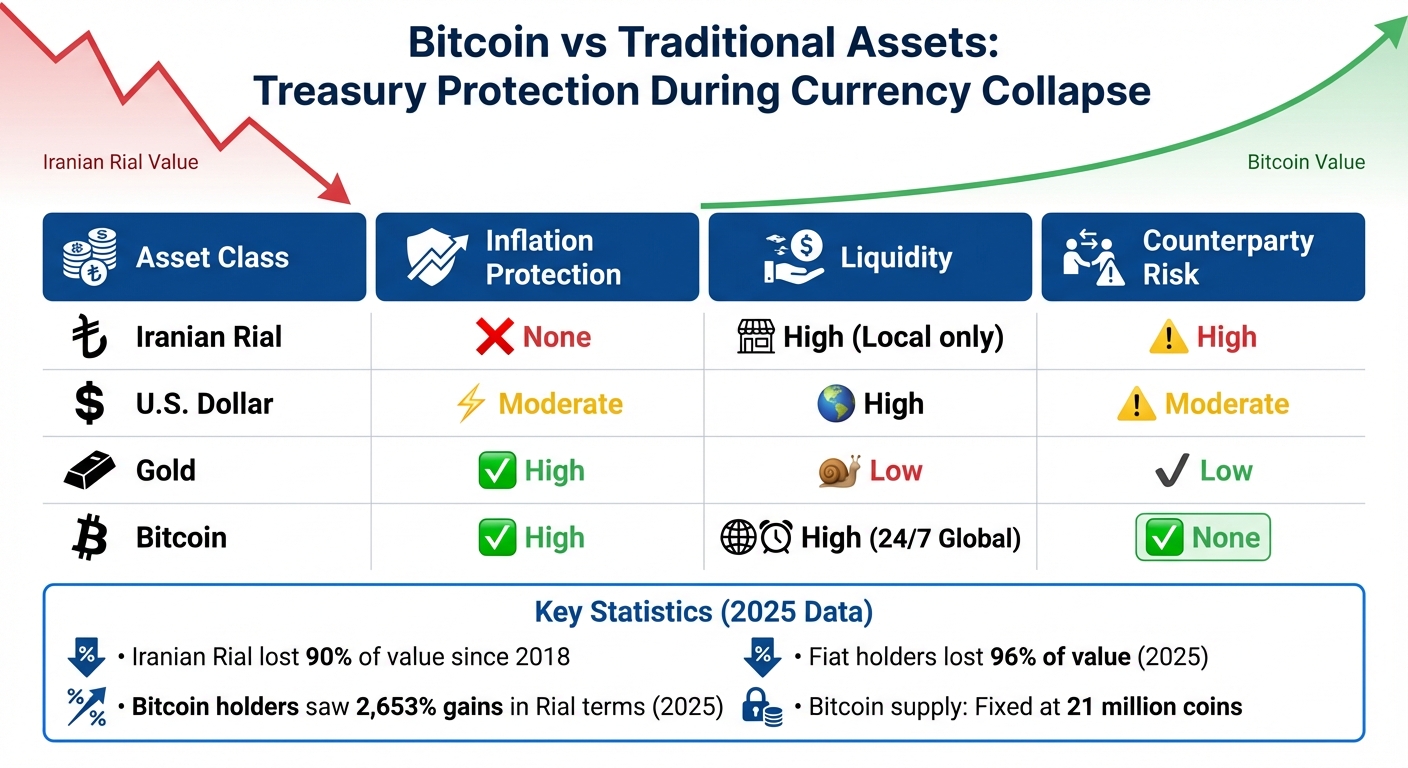
Bitcoin vs Traditional Assets: Protecting Iranian Business Treasuries During Currency Collapse
Protecting Value During Inflation
Bitcoin's hard cap of 21 million coins stands in sharp contrast to the unlimited printing of currencies like the Iranian Rial. In 2025, the Rial lost over 40% of its purchasing power in just six months, leaving those who held cash scrambling to keep up. Meanwhile, Iranians who turned to Bitcoin saw gains of 2,653% in Rial terms during the same period. Traditional treasury assets like cash and bonds often fail in such hyperinflationary environments, rapidly losing value as monetary expansion spirals out of control.
"Unlike any government-issued currency, Bitcoin is not subject to dilution through endless money-printing, enabling it to be a valuable inflation hedge and an excellent addition to our treasury."
– Chris Pavlovski, CEO, Rumble
The difference is striking: while fiat currency holders lost 96% of their value in 2025, Bitcoin's fixed supply ensured it maintained purchasing power. This scarcity positions Bitcoin as a reliable hedge against inflation, especially during economic turmoil.
Beyond preserving value, Bitcoin also provides businesses with access to global liquidity, bypassing the limitations of failing local systems.
Access to Global Markets and Liquidity
Bitcoin operates around the clock, every day of the year, offering businesses uninterrupted access to global markets. This is especially critical in countries with failing financial systems. Iran's crypto ecosystem, for example, processed over $7.78 billion in value during 2025, as businesses turned to Bitcoin to bypass domestic financial instability. By converting Bitcoin into stablecoins like USDT or other foreign currencies through international exchanges, businesses gain the flexibility to make cross-border payments even when traditional financial channels are blocked.
"Unlike traditional assets that are illiquid and often subject to government control, Bitcoin's secure, self-managed framework offers financial flexibility - particularly valuable in a situation where individuals may need to flee or operate outside government-controlled financial channels."
– Chainalysis
Bitcoin's self-custody feature allows businesses to store assets in personal wallets, safeguarding their capital from government-imposed withdrawal limits or potential seizures during political unrest. Even amid connectivity challenges, Iranian businesses have used Bitcoin to maintain operations.
This global liquidity acts as a shield, helping businesses navigate volatile local currency fluctuations and maintain stability.
Reducing Exposure to Currency Swings
By holding Bitcoin in their treasury reserves, businesses can create a buffer against the unpredictable swings of the Rial. Bitcoin's decentralized nature protects assets from domestic banking failures. Additionally, its historically low correlation with traditional treasury assets offers an opportunity to improve the risk-adjusted returns of a company's balance sheet. It also provides an alternative to state-controlled monetary systems.
| Asset Class | Inflation Protection | Liquidity | Counterparty Risk |
|---|---|---|---|
| Iranian Rial | None | High (Local only) | High |
| U.S. Dollar | Moderate | High | Moderate |
| Gold | High | Low | Low |
| Bitcoin | High | High (24/7 Global) | None |
Bitcoin's key advantage lies in financial sovereignty. It allows businesses to retain value even when local institutions face insolvency or collapse. By late 2025, approximately 22% of Iran's population - 10 million users - had already turned to cryptocurrency to safeguard their wealth. This shift toward digital treasury solutions highlights the growing recognition that traditional methods can no longer meet the demands of a volatile economic landscape.
How to Set Up a Bitcoin Treasury for Your Business
Evaluating Your Business Needs and Risk Capacity
Consider how economic challenges, such as a 90% loss in the Rial's value since 2018 and inflation rates of 40–50%, impact your cash reserves and balance sheet. Decide how Bitcoin fits into your business strategy: as a hedge against inflation, a long-term value reserve, or a tool for cross-border liquidity.
"Our $500 million in cash was a 'melting ice cube'"
– Michael Saylor, Chairman of MicroStrategy
To weigh the potential benefits, model a scenario where 1% of your treasury is allocated to Bitcoin over a five-year period. Develop a treasury policy, approved by your board, that outlines acceptable asset classes, spending limits for different roles, and dual-approval controls to prevent unauthorized transactions and ensure accountability.
Understand your risk tolerance. Bitcoin's capped supply of 21 million coins provides protection against monetary dilution, but its price can be volatile. For instance, in May 2024, Semler Scientific allocated $40 million (581 BTC) to reduce exposure to local currency risks.
Selecting the Right Platform for Bitcoin Integration
To manage Bitcoin's volatility effectively, prioritize a secure custody approach for your treasury. Choose a custody solution that matches your business's risk profile. Institutional custodians offer high-level security features like SOC-1 and SOC-2 certifications, segregated accounts, and insurance coverage of up to $250 million. On the other hand, self-custody eliminates counterparty risks but requires strong internal controls to manage private keys securely.
Adopt a three-tier wallet system for better control:
- Cold wallets: Offline storage for long-term reserves.
- Warm wallets: For regular settlements requiring quorum approvals.
- Hot wallets: For automated, low-value operational transactions.
Additionally, solutions like Flash provide businesses with tools to accept Bitcoin payments globally through links, invoices, and custom integrations. These systems enable instant transactions with low fees and non-custodial wallet-to-wallet payments, making it easier to manage Bitcoin as part of your operations.
To reduce concentration risks, spread your custody across multiple secure platforms. Incidents like the $90 million Nobitex hack in 2025 highlight the importance of diversifying custody arrangements.
Meeting Compliance Requirements and Securing Your Bitcoin
After setting up your custody solution, focus on meeting regulatory standards and securing your holdings. Iran’s regulatory environment, including the Central Bank’s September 2025 framework and potential capital gains taxes, continues to evolve. While domestic regulations may vary, aligning with international standards can offer more clarity. For example, the FASB fair value accounting guidance (effective January 2025) allows businesses to report Bitcoin at market value, giving shareholders a clearer picture of financial performance.
Use a crypto sub-ledger to track transactions and calculate cost basis. Partnering with established audit firms like Deloitte or PwC, which now provide crypto-specific reporting frameworks, can streamline compliance. Ensure your platform supports essential features like Know Your Business (KYB), Know Your Customer (KYC), sanctions screening, and the Travel Rule for virtual asset transfers.
Security is critical. Store the majority of your Bitcoin in offline cold storage to protect against cyber threats. Enforce strict access controls, such as dual-approval for large transactions, and regularly test your backup and recovery processes. Remember, losing private keys means losing access to your funds permanently. Start with small pilot transactions to test your processes before scaling up. These steps will help secure your assets and strengthen your financial position in uncertain economic times.
sbb-itb-f81ab9b
Examples: Businesses Using Bitcoin Treasury to Manage Currency Risk
Case Study: Retail Business Stabilizing Purchasing Power
In response to the rial's dramatic collapse - plummeting to 1.445 million per U.S. dollar by late 2025 - retail businesses across Iran turned to Bitcoin as a way to preserve their purchasing power. For those who held Bitcoin, the gains were staggering, with a 2,653% increase in value when measured in rial terms.
During the widespread protests of late 2025, businesses began shifting their funds from centralized exchanges to personal wallets, leading to a 236% spike in daily withdrawals under $10,000. As noted by researchers at Chainalysis:
"a rational response to the collapse of the Iranian rial, which has lost nearly all of its value, rendering it effectively worthless against major currencies like the euro"
– Chainalysis
By late 2025, approximately 22% of Iran's population - around 10 million people - had embraced cryptocurrency. For retail businesses, Bitcoin's self-custodial nature became a critical asset, offering a layer of security and flexibility that traditional bank-held assets could not provide, especially under the threat of government control or seizure. That year, Iran's crypto ecosystem surged to a value exceeding $7.78 billion, with digital asset flows contributing 1.4% to the nation's annual GDP.
Export companies also joined the crypto movement, turning to digital treasuries to navigate domestic banking challenges.
Case Study: Export Companies Making Cross-Border Payments with Bitcoin
Export companies have increasingly adopted Bitcoin to facilitate and secure international transactions, especially when traditional banking systems falter. Unlike retailers who focus on local stability, these businesses prioritize cross-border liquidity. A notable example involves an oil-export network tied to the Islamic Revolutionary Guard Corps, which used cryptocurrency to transfer $100 million for oil-related deals. This illustrates how digital assets can enable commodity trading even in the absence of conventional banking channels.
To manage their operations effectively, export companies have implemented hybrid treasury strategies. They store long-term value in Bitcoin while relying on stablecoins like USDT for short-term stability in daily transactions. The TRON blockchain has played a pivotal role in this process, handling 65% of Iran's incoming crypto volume by 2022, thanks to its efficiency in stablecoin transfers.
Even during government-imposed internet shutdowns, businesses found ways to adapt, using offline tools to continue executing transactions despite connectivity issues.
Conclusion: Building Financial Stability with Bitcoin Treasury
In times of extreme inflation and rapid currency devaluation, traditional treasury methods often fall short. While fiat currency holders suffered significant losses in purchasing power, those who turned to Bitcoin saw notable gains in rial terms by late 2025.
Bitcoin's decentralized structure and 24/7 accessibility make it a reliable alternative during banking and currency crises. This reliability not only helps preserve value but also reinforces Bitcoin's position as a strategic treasury asset, as highlighted in earlier case studies.
"Bitcoin offers a new way for people to protect themselves from systemic economic mismanagement." – Hunter Horsley, CEO, Bitwise
Currently, digital assets make up about 1.4% of Iran's GDP, with nearly 22% of the population (around 10 million people) adopting cryptocurrency. This growing shift points to a practical solution for navigating failing institutions. Real-world examples from the retail and export sectors show that Bitcoin treasury strategies are already delivering results. For CFOs, adopting Bitcoin as part of their treasury approach is becoming an urgent step to counter looming currency risks.
FAQs
How can Bitcoin help Iranian businesses survive a currency collapse?
Bitcoin provides Iranian businesses with a dependable way to shield their wealth during times of currency collapse. As a decentralized digital asset, it operates independently of any government or central authority. This independence makes it less vulnerable to issues like hyperinflation or international sanctions, offering a level of financial security when the local currency, such as the Rial, faces devaluation.
By incorporating Bitcoin into their financial strategies, businesses can protect their assets over the long term, minimize exposure to currency fluctuations, and ensure smoother operations even in turbulent economic climates. Its global reach and liquidity further enhance its appeal, offering a practical solution for managing financial instability.
What challenges should businesses consider before adopting Bitcoin as a treasury asset?
Adopting Bitcoin as a treasury asset isn’t without its hurdles, and businesses need to weigh these carefully. One of the most pressing issues is volatility. Bitcoin’s price can swing wildly, and if your company needs to sell during a downturn, it could lead to financial losses. Before diving in, it’s crucial to evaluate whether your organization can handle these unpredictable price shifts.
Regulatory uncertainty is another big factor. Governments might roll out new laws or restrictions on cryptocurrency, which could complicate compliance efforts and legal operations. On top of that, cybersecurity risks are a constant concern. Digital assets are prime targets for theft or hacking, so implementing strong security measures - like cold storage and multi-factor authentication - is non-negotiable.
There’s also the issue of liquidity, particularly in regions where access to crypto exchanges or banking services is limited. And don’t overlook reputational risks, especially in areas where geopolitical or ethical concerns around cryptocurrency might come into play. To navigate these challenges, businesses should focus on building a well-thought-out strategy and investing in solid risk management practices.
How can businesses stay compliant with regulations when using Bitcoin?
To use Bitcoin while staying on the right side of the law, businesses need to adhere to anti-money laundering (AML) and know-your-customer (KYC) rules. This means verifying customer identities, keeping an eye on transactions, and maintaining thorough records to meet legal standards. Staying compliant with the Bank Secrecy Act (BSA) and other financial regulations is critical to avoid fines and ensure operations remain lawful.
It's also wise for companies to develop clear internal policies around cryptocurrency usage, perform regular audits, and stay informed about changing regulations. Working with compliance experts can make it easier to stay current and put effective processes in place, helping to minimize risks while ensuring transparency in Bitcoin-related activities.