So, is BitPay a safe bet for your business? The short answer is yes—if you're a merchant who wants the benefits of accepting Bitcoin without the headaches of managing it yourself.
Think of BitPay as a secure bridge connecting the world of Bitcoin to your traditional bank account. It's built for businesses that see Bitcoin as just another way to get paid, like a credit card, and aren't interested in holding volatile assets on their books.
A Straightforward Answer for Merchants
For any business that wants to accept Bitcoin but never actually touch it, BitPay offers a ton of protection. It handles everything from start to finish: creating the customer invoice, managing the Bitcoin payment, converting it to your local currency, and depositing the cash right into your bank.
This completely shields you from the wild price swings of Bitcoin, which is a massive relief for anyone who's ever watched a Bitcoin chart. BitPay's entire model is designed to abstract away all that complexity.
The Trade-Off: Convenience vs. Control
But there's a catch to all this convenience, and it's a big one. To make the magic happen, BitPay uses a custodial model. For that brief window between when your customer pays and when the money hits your bank, BitPay is holding the funds on your behalf.
This custodial relationship is the absolute heart of the matter when asking, "Is BitPay safe?" You are fundamentally trusting a third party to secure your money, no different than how you trust a bank.
For most businesses, this is perfectly fine. BitPay is a U.S.-based company that has to follow financial regulations, giving it a layer of institutional credibility.
But if your business values total control and self-sovereignty over its funds, this model introduces what's known as counterparty risk—the risk that the other party in a transaction won't fulfill its obligation.
To give you a clearer picture, let's break down BitPay's safety profile into its key components.
BitPay Safety Profile at a Glance
This table sums up the core aspects of BitPay's security model from a merchant's perspective.
| Feature | How BitPay Manages It | What This Means for Merchants |
|---|---|---|
| Fund Custody | Custodial Model: Holds funds temporarily during the conversion and settlement process. | You are trusting BitPay to secure your money. This introduces third-party risk but eliminates your need for technical self-custody. |
| Price Volatility | Instant Conversion: Bitcoin is immediately converted to fiat at the time of transaction. | You are 100% protected from Bitcoin price swings. The price is locked in, guaranteeing you receive the exact invoice amount. |
| Regulatory Standing | U.S.-Regulated: Operates as a licensed Money Services Business (MSB). | Provides a strong layer of legal and financial accountability. Subject to U.S. financial laws like the Bank Secrecy Act. |
| Security Controls | Institutional Grade: Implements measures like SOC 2 compliance, multi-signature wallets, and cold storage. | Your funds are protected by industry-standard security practices designed to prevent theft and unauthorized access. |
| KYC/AML | Mandatory: Requires Know Your Customer (KYC) and Anti-Money Laundering (AML) checks for merchants. | This is a legal requirement for regulated entities. It adds a layer of compliance but means you must provide business verification documents. |
Ultimately, BitPay’s approach is geared towards mainstream business adoption. This guide will dig into every facet of its security, from the nitty-gritty of its technical controls to its regulatory compliance, so you can decide if its model is the right fit for your business.
How BitPay's Payment Process Works
Before we can really dig into whether BitPay is safe, we need to get a clear picture of how the money actually moves. The best way to think of BitPay is like a combination of a currency exchange and an armored car service, but built specifically for Bitcoin. Its entire purpose is to manage the Bitcoin payment process so you, the merchant, never have to touch it.
When a customer wants to pay with Bitcoin, your part is simple: you just show them a BitPay invoice. This invoice has a unique QR code and all the payment details. The customer scans it with their own Bitcoin wallet and sends the funds. That's when BitPay’s safety net for merchants really kicks in.
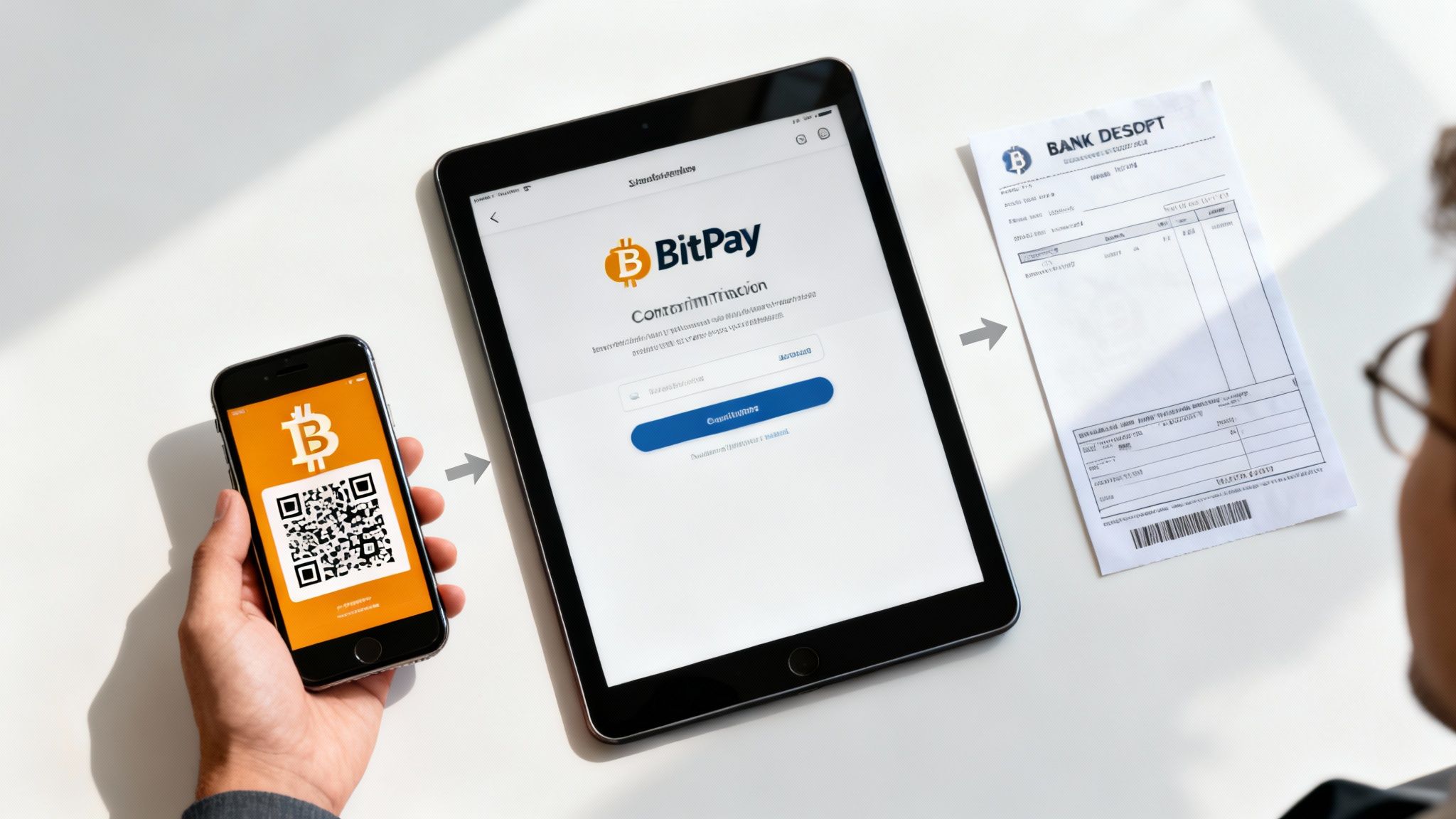
This setup is intentionally designed to insulate your business from the messy technical side of handling Bitcoin. For you and your staff, it feels just as straightforward as running a credit card.
From Bitcoin to Your Bank Account
The moment your customer sends their Bitcoin, BitPay takes the wheel. This is where the real magic happens, with a few key steps designed to shield you from risk.
First, and most importantly, BitPay immediately locks in the exchange rate. This is probably its single most valuable feature for any merchant. The second the payment is made, the value of that Bitcoin is fixed in your local currency. This means you are 100% shielded from Bitcoin's infamous price swings. If Bitcoin’s price crashes five minutes after a sale, it’s not your problem.
Next, BitPay gets to work verifying the transaction on the blockchain. It waits for the required network confirmations to make sure the payment is final and can't be reversed. This is a huge leg up over traditional payments, as it practically eliminates the risk of chargebacks.
This entire flow—from the invoice you generate to the deposit in your bank—is what we call a custodial process. BitPay temporarily takes custody of the Bitcoin to handle the conversion and settlement, taking that entire operational headache off your plate.
Once the payment is confirmed as final, BitPay converts the Bitcoin into your currency of choice, like U.S. Dollars or Euros. Finally, it bundles up your payments and sends a direct deposit straight to your business bank account, usually within one to three business days.
The Merchant's Experience Step-by-Step
From your perspective as the business owner, the whole thing is designed to be as hands-off as possible. Here’s a quick look at what you'll actually be doing:
- Generate Invoice: You create a payment request for a specific amount in your local currency (say, $100) through your BitPay integration or terminal.
- Customer Pays: Your customer uses their personal wallet to pay the invoice. The system automatically calculates the exact amount of Bitcoin they need to send based on the live exchange rate.
- BitPay Confirms: BitPay’s system watches the network, waits for the transaction to be confirmed, and ensures everything is valid.
- Receive Settlement: You get the exact invoice amount (e.g., $100) deposited into your bank account, minus BitPay's processing fee. You never once have to worry about managing a Bitcoin wallet, securing private keys, or watching market charts.
Understanding BitPay's Security and Custody Model
At the core of the "is BitPay safe" question is how they handle your money. It all comes down to their custodial model.
In simple terms, BitPay acts like a temporary vault for the Bitcoin your customers send you. For that short window of time between a customer hitting "pay" and the funds landing in your bank account, BitPay takes custody of the assets.
This is a deliberate choice designed for merchant convenience. Instead of forcing you to become a Bitcoin security expert, managing complex private keys and wallets, BitPay handles the heavy lifting. Think of it like a bank securely holding a cash deposit before it's fully processed and available in your account.
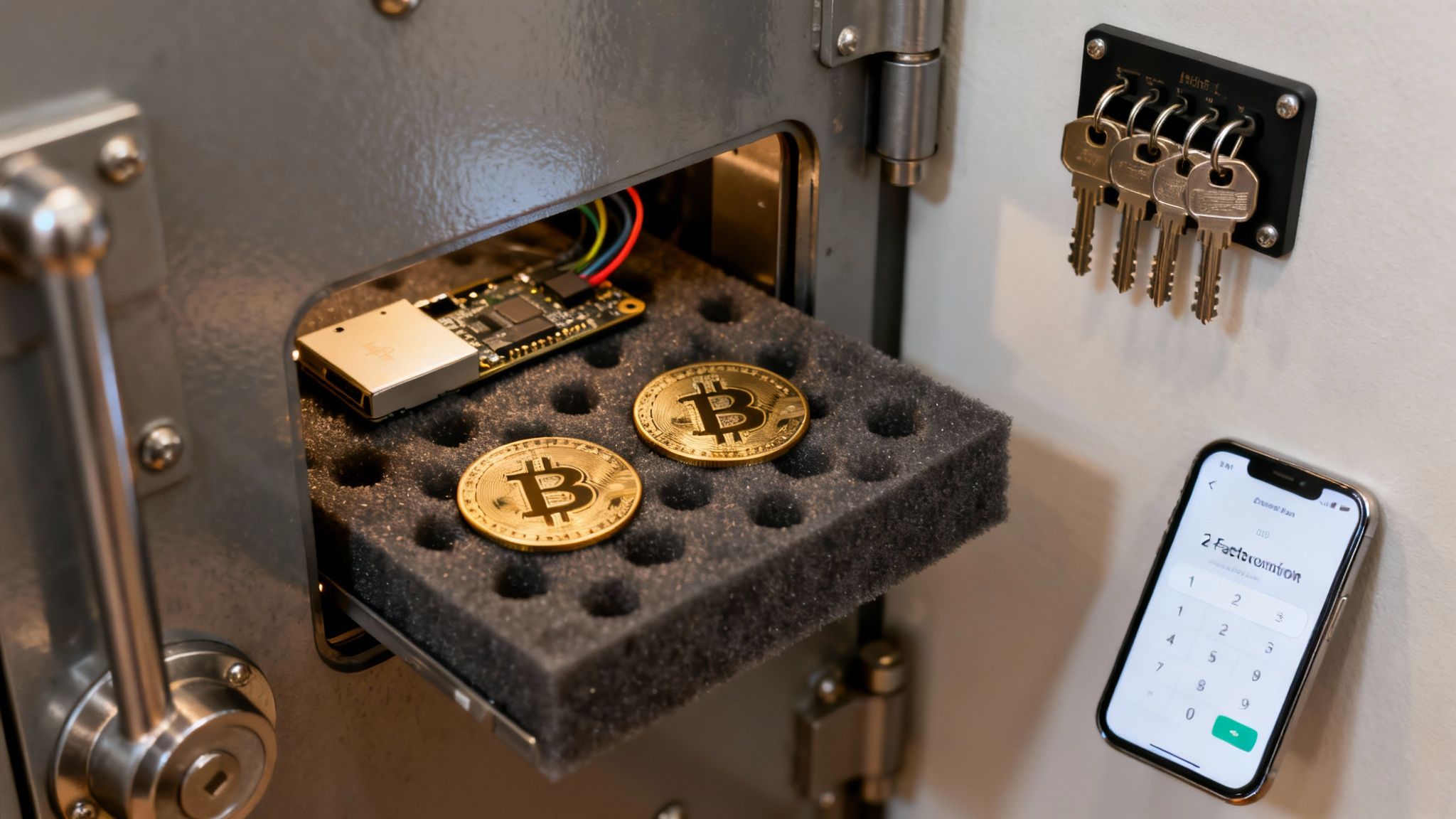
But this convenience has a trade-off, and it's a big one. When you use a custodial service, you're trusting a third party with your funds during that settlement window. This is the polar opposite of a direct wallet-to-wallet payment, where you—and only you—hold the keys to your money.
The Security Layers Protecting Your Funds
To earn that trust, BitPay doesn't just rely on a simple password. They use a multi-layered security strategy you'd expect from an institutional financial player. These aren't off-the-shelf solutions; they're robust systems built to fend off sophisticated attacks.
Their entire strategy rests on three key pillars:
- Multi-Signature Technology: Picture a bank vault that needs two different managers with separate keys to open it. That’s the basic idea behind multi-signature (or "multi-sig") wallets. They require multiple private keys to authorize a transaction, which eliminates a single point of failure and makes theft incredibly difficult.
- Cold Storage: A huge chunk of the assets BitPay manages is kept in cold storage. This just means the private keys are stored on devices completely disconnected from the internet. If it’s not online, it can’t be hacked online. Simple as that.
- Two-Factor Authentication (2FA): For your own account access, BitPay makes 2FA mandatory. This adds a critical second security check beyond your password, usually a code from an app on your phone, before you can log in or perform sensitive actions.
These measures create a pretty formidable defense. BitPay has reportedly invested heavily in its backend, boosting its cold storage capacity by a reported 40% for high-volume merchants and rolling out blockchain-based fraud detection that cut fraudulent payment attempts by around 61%. You can learn more about these security investments and how they improve payment safety.
This custodial approach, backed by institutional-grade security, is precisely why BitPay appeals to businesses. It lets them accept Bitcoin without having to become security experts overnight.
The Custodial vs. Non-Custodial Choice
Grasping this difference is crucial for any merchant. A non-custodial solution—where payments go straight to a wallet you control—gives you absolute sovereignty over your money. The downside? You're 100% responsible for securing it. If you lose the keys, the money is gone.
With BitPay's custodial model, you're delegating that security responsibility. You get the convenience of automated fiat conversion and the peace of mind that comes with their extensive security setup. Deciding which model is "safer" really comes down to your own technical know-how and how comfortable you are entrusting your funds to someone else, even temporarily.
Navigating Compliance, Privacy, and KYC Rules
True safety isn't just about preventing hacks; it's also about navigating the complicated world of financial regulations. As a U.S.-based company, BitPay operates as a Money Services Business (MSB), which puts it squarely under the watchful eye of the Financial Crimes Enforcement Network (FinCEN).
This isn't just a label. It means BitPay has to play by some very strict federal rules, mainly the Bank Secrecy Act. For you, the merchant, this boils down to two key things: mandatory Know Your Customer (KYC) and Anti-Money Laundering (AML) procedures.
The KYC Process for Merchants
When you sign up for a BitPay business account, don't expect to start accepting payments anonymously. You’ll need to go through a full verification process. This usually means handing over documents that prove who you are and confirm that your business is legitimate.
While it's an extra step during setup, this is standard practice for any regulated financial service out there. It’s designed to shut the door on fraud and other shady activities. For many businesses, this regulatory oversight is actually a good thing—it's a stamp of institutional credibility, showing that BitPay is a legitimate financial partner operating within the law.
The core trade-off with a regulated service like BitPay is clear: you gain legitimacy and fraud prevention in exchange for the privacy often associated with direct, wallet-to-wallet Bitcoin transactions.
And this verification isn't just about you. Depending on the size of a transaction, BitPay might also need to run KYC checks on your customers. For instance, a payment over a certain amount, like $3,000, can trigger a request for the customer to verify their identity before the transaction goes through.
Weighing the Privacy Trade-Off
This is where your business philosophy really comes into play. Deciding to use a service with built-in KYC isn't a simple choice, and there are two strong arguments to consider.
The Argument for Compliance: For a lot of businesses, especially in established industries, staying on the right side of regulations isn't optional. It cuts down on legal risks, helps build trust with traditional partners like banks, and weeds out potentially problematic customers from the get-go.
The Argument for Privacy: On the flip side, a huge part of Bitcoin's appeal is the privacy it can offer. A direct payment from one wallet to another doesn't need a middleman collecting customer data. Using BitPay introduces a third party that is legally required to collect and store this sensitive information.
So, is BitPay "safe" from a compliance perspective? It all depends on what you prioritize. It is a safe, regulated choice for businesses that are comfortable with standard financial verification. But for anyone who puts a premium on anonymity for themselves and their customers, its KYC requirements are a major step away from Bitcoin's peer-to-peer roots.
Evaluating Past Incidents and Industry Risks
Let's be realistic: no financial service is ever completely immune to risk. A transparent look at a company's history is always a good idea, and while BitPay has a strong track record—no major public breaches resulting in lost merchant funds—that’s not the whole story.
The real story is understanding the world BitPay operates in. The entire Bitcoin space is a massive target for sophisticated attackers. Judging a service like BitPay in a vacuum misses the bigger picture entirely. The crucial question isn't just about BitPay's past, but how its security stacks up against the constant, evolving threats that every single company in this industry faces.
The Broader Ecosystem Risk
The digital asset industry has seen a dramatic rise in security incidents over the last few years. This isn't a knock on any one company; it's a sign of the incredibly high stakes involved. Attackers are constantly inventing new ways to break in, putting immense pressure on the defenses of every exchange, wallet provider, and payment processor out there.
Using any third-party service for Bitcoin payments, including BitPay, introduces what’s known as counterparty risk. This is the unavoidable risk that the other party in an agreement could fail to meet its obligation. Robust security minimizes this risk, but it never completely eliminates it.
This context is vital. Chainalysis reports staggering figures, with over $2.17 billion stolen from various crypto services in just one mid-year report. Other security firms have documented even higher numbers, pointing out that most losses happen because of failures in access control. These figures drive home the point that no service is an impenetrable fortress and layered defenses are an absolute necessity.
BitPay's Position in a High-Stakes Environment
Understanding these industry-wide threats helps frame why BitPay's security posture is so important. Things like multi-signature wallets, extensive cold storage, and mandatory two-factor authentication aren't just buzzwords on a feature list; they are direct countermeasures against the exact types of attacks that have brought down other platforms. While these are considered best practices, they're part of an ongoing battle.
For a merchant, this means acknowledging that using a third party is a strategic choice. Protecting your business goes beyond just picking a secure payment processor. It also means having the right financial safeguards in place, like adequate ecommerce business insurance. Your own operational security, combined with BitPay’s infrastructure, creates a much stronger defense. The goal here is a vigilant, well-informed approach, recognizing that safety is a shared responsibility in this dynamic ecosystem.
Your Checklist for Choosing a Bitcoin Payment Processor
Okay, you've got the lay of the land—the risks, the rewards, and how these systems generally work. Now it's time to put any Bitcoin payment processor under the microscope. Moving beyond a simple "is BitPay safe?" requires a more structured game plan. This checklist is designed to help you ask the right questions before you commit to any provider.
Think of this as a framework for your own risk assessment, tailored to your business model and your comfort level with Bitcoin.
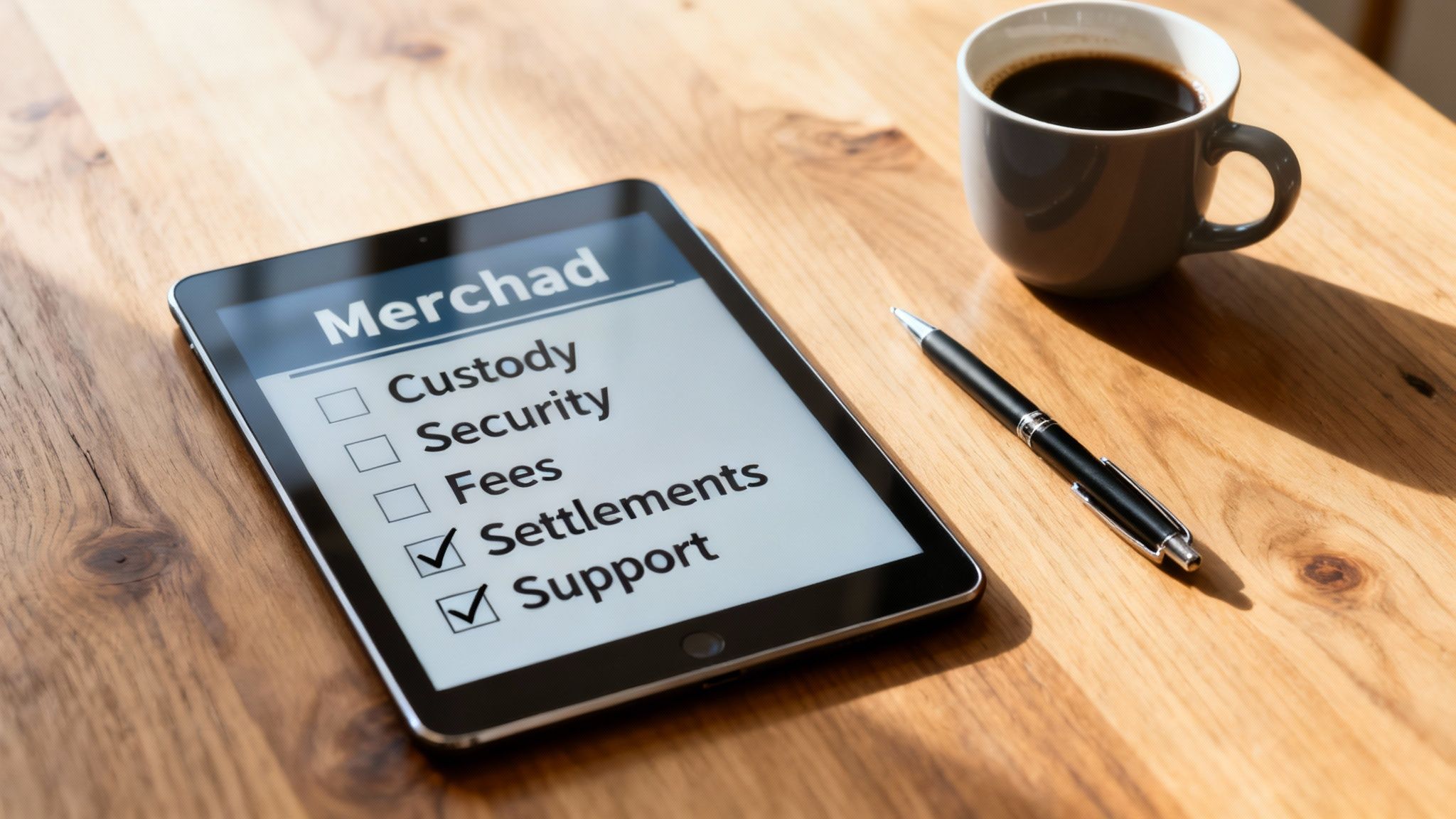
Before signing on the dotted line, every merchant should have clear answers to these questions. They get to the heart of whether a processor’s model is a good fit for your operations and risk tolerance. To make it easier, here's a table you can use to evaluate any provider you're considering.
Payment Processor Evaluation Checklist
| Evaluation Criteria | Key Questions to Ask | Why It Matters for Safety |
|---|---|---|
| Custody and Control | Who actually holds the Bitcoin when a customer pays? Is it the processor (custodial), or does it go straight to a wallet I control (non-custodial)? | This is the big one. Custodial services are convenient but add a layer of trust and third-party risk. Non-custodial gives you sovereign control but makes you fully responsible for security. |
| Security and Compliance | Is the company regulated in a reputable jurisdiction? Can they show you independent security audits, like a SOC 2 report? Is two-factor authentication (2FA) mandatory? | Regulation adds a layer of accountability. Audits and strong security controls are concrete proof that a company isn't just talking a big game about protecting your money. |
| Fees and Transparency | Are all the fees laid out clearly? Is it a flat processing fee, or are there hidden costs for network fees, currency conversion, or bank settlements? | Sneaky fees can bleed your profit margins dry. A trustworthy partner is completely upfront about every single cost involved. No surprises. |
| Settlements and Speed | How fast will funds be converted to my local currency and hit my bank account? Which currencies do they even support for settlement? | Cash flow is the lifeblood of any business. The speed and reliability of your settlements directly affect your ability to operate and plan for the future. |
Ultimately, picking a payment processor is an exercise in trust. You're looking for a partner whose security, transparency, and business model let you sleep at night. Your goal is to find a provider that empowers you to focus on running your business, not on managing a complex and unfamiliar payment system.
Frequently Asked Questions About BitPay's Safety
We’ve dug into the technical weeds and security models, but sometimes you just need a straight answer. Here are some of the most common questions we hear from merchants trying to figure out if BitPay is a safe bet for their business.
Does BitPay Hold My Bitcoin?
In short, yes—but only for a little while. BitPay is a custodial service, which means it holds onto the Bitcoin from the moment your customer pays until it’s converted and settled into your bank account.
This temporary custody is what shields you from Bitcoin's price swings. The trade-off? You're trusting BitPay to keep those funds safe during that brief window.
What Happens If BitPay Gets Hacked?
Like any company handling money, BitPay is a prime target for hackers. They know this, of course, and use heavy-duty security like cold storage and multi-signature wallets to keep attackers at bay.
But let's play out the worst-case scenario. If a breach occurred and your funds were lost during that settlement period, what happens next would be determined by BitPay's terms of service and whatever insurance policies they have in place. This is the classic counterparty risk that comes with using any third-party custodian.
The bottom line for merchants is this: while BitPay's defenses are solid, using a custodial service means you're trusting someone else with your money, even if it's just for a short time. It's a fundamental trade-off you make for convenience and protection from volatility.
Is BitPay Anonymous for Merchants or Customers?
Not at all. As a regulated financial company in the U.S., BitPay plays by the rules. All merchants are required to go through a full Know Your Customer (KYC) verification. This means you’ll be submitting business documents to prove you are who you say you are.
It doesn’t stop with you, either. For larger payments, often anything over $3,000, your customers might also have to provide identification. If you or your customers value privacy and anonymity above all else, BitPay’s regulatory obligations make it a non-starter.
Ready to accept Bitcoin payments with absolute control and no KYC? Flash provides a secure, non-custodial solution that connects your wallet directly to your customers. Eliminate intermediaries and start accepting instant, low-fee Bitcoin payments in under a minute. Learn more at Flash.