Bitcoin POS systems are transforming how businesses handle payments by leveraging blockchain technology. They offer lower fees, faster transactions, and enhanced security compared to traditional payment methods. Here's what you need to know when selecting the right system for your business:
- Fast and Secure Transactions: Instant payment processing with blockchain and advanced encryption for fraud protection.
- Multiple Payment Options: Support for Bitcoin, USD, credit cards, and mobile wallets to cater to diverse customer preferences.
- Real-Time Conversion: Automatic Bitcoin-to-USD conversion ensures stable revenue and accurate reporting.
- Scalability and Customization: Cloud-based systems with API access allow businesses to grow and integrate with existing tools.
- User-Friendly Interface: Simple design for quick employee training and faster customer checkouts.
These systems are ideal for businesses aiming to reduce costs, improve cash flow, and expand their payment options while maintaining compliance with U.S. regulations. Choose a solution that aligns with your current setup and future growth plans.
BTCPAY: Accept Bitcoin Payments TUTORIAL
1. Fast and Secure Bitcoin Payment Processing
For Bitcoin POS systems, the key lies in blending speed with security to deliver quick and protected transactions.
Real-Time Transaction Confirmation
Bitcoin POS systems process payments in just seconds, surpassing the speed of traditional card networks. This efficiency comes from blockchain technology, which eliminates the need for banks or intermediaries to approve payments.
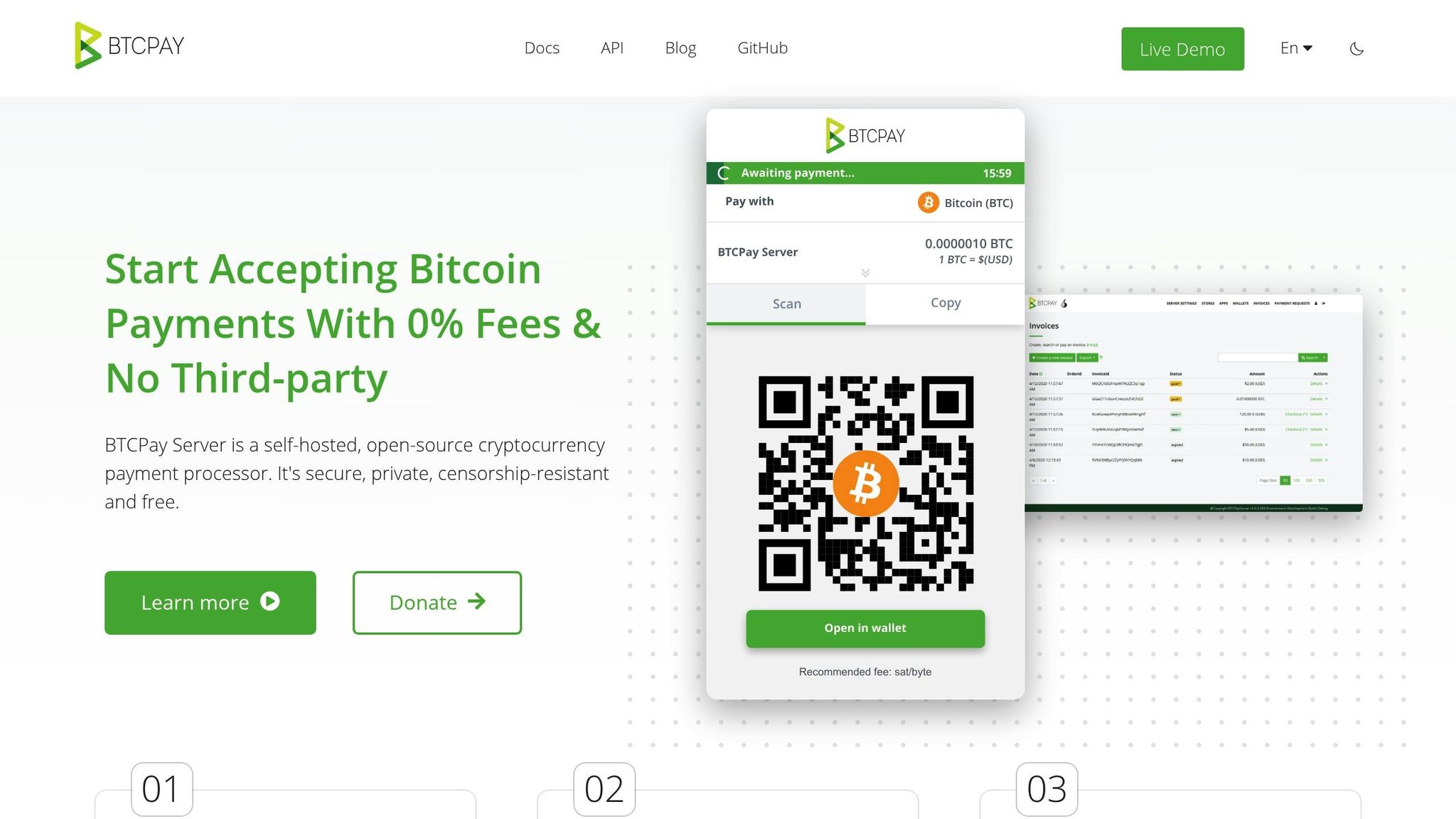
Here’s how it works: when a customer initiates a payment, the system generates a QR code for them to scan. The blockchain verifies the transaction almost instantly, providing immediate confirmation to both the customer and the business.
The Lightning Network takes this a step further, ensuring fast payment processing even during high-traffic times, like holiday shopping seasons. This rapid confirmation process is paired with strong security measures, which we’ll explore next.
Strong Security Features
Speed means little without robust security. Bitcoin POS systems come equipped with multiple layers of protection that outshine many traditional payment methods.
- End-to-end encryption safeguards transaction data as it moves between devices, making it nearly impossible for hackers to access sensitive information.
- Multi-factor authentication adds an extra layer of protection by requiring users to verify their identity through two or more methods. This step alone can cut the risk of account breaches by up to 99.9%.
- Non-custodial wallet-to-wallet payments ensure funds move directly from the customer’s wallet to the business’s wallet, bypassing any third party. This approach eliminates intermediary risks. Flash Lightning Solutions highlights this feature:
"Our non-custodial approach ensures that we never touch your funds, providing a layer of security that is crucial in today's digital payment landscape." - Flash Lightning Solutions
Blockchain technology also enhances security through transparency and immutability. Every transaction is permanently recorded and cannot be altered, making fraud harder to execute and easier to spot.
Compliance with U.S. Security Standards
In addition to encryption and authentication, compliance with U.S. security standards adds another layer of protection. Operating legally in the United States requires adherence to specific regulations, including PCI DSS, KYC/AML, FinCEN, and BSA guidelines.
Using a compliant Bitcoin POS system can significantly reduce fraud-related losses - by as much as 30%, according to businesses that have made the switch. This is achieved through a combination of blockchain technology, strong encryption, and strict regulatory compliance.
When choosing a Bitcoin POS system, always ask for compliance certifications and security audit reports. Reputable providers will have no issue sharing this information and explaining how their systems meet U.S. security requirements.
2. Multiple Payment Methods and System Integration
To reach as many customers as possible, businesses need to offer a variety of payment options. A Bitcoin POS system that exclusively supports cryptocurrency can alienate potential buyers and make the checkout process unnecessarily complicated. The best systems combine Bitcoin with traditional payment methods, creating a seamless experience that also integrates smoothly with existing systems.
Multi-Payment Support
Offering payment options like Bitcoin, USD, credit and debit cards, and mobile wallets caters to a wide range of customer preferences. A Bitcoin POS system that accommodates these methods allows you to serve both traditional shoppers and those who prefer digital currencies.
Businesses that embrace multiple payment methods often see noticeable improvements in customer satisfaction and sales. Plus, as payment trends continue to shift, this flexibility helps keep your business prepared for the future.
For example, Flash offers a Bitcoin payment gateway that supports instant, non-custodial wallet-to-wallet transactions while also handling traditional payment methods.
To address cryptocurrency price volatility, real-time conversion between Bitcoin and USD ensures stable revenue. When a customer pays with Bitcoin, the system automatically converts the payment to dollars using the current exchange rate. This feature not only stabilizes your income but also enhances the speed and security of transactions, as previously mentioned.
Hardware and Software Compatibility
Beyond offering diverse payment options, the ability to integrate smoothly with your existing hardware and software is essential for efficient operations.
Your current POS hardware is likely a significant investment, and replacing it can be costly and disruptive. With robust APIs, Bitcoin POS systems can work with your existing equipment - barcode scanners, receipt printers, cash drawers, and terminals - so you don’t have to start from scratch. This approach keeps implementation costs low and avoids unnecessary interruptions to your business.
Integration with enterprise software is equally important. A good Bitcoin POS system should connect seamlessly with tools like accounting software, inventory management systems, and customer relationship management (CRM) platforms. This kind of integration automates tasks like record-keeping and minimizes manual data entry.
Flash addresses these needs by offering custom integrations via APIs, making it simple for U.S. businesses to add Bitcoin payment options to their checkout process without needing new hardware. This solution works for both physical retail stores and online platforms.
Additionally, a cloud-based architecture adds flexibility. Cloud systems allow businesses to scale and adapt as they grow, without being tied to specific hardware setups. They can easily integrate with new tools and technologies as they become available, ensuring your system evolves alongside your business.
When choosing a Bitcoin POS system, it’s important to ask about compatibility with your current setup. Reputable providers will evaluate your existing hardware and software during the consultation process to ensure their solution integrates seamlessly into your operations without causing disruptions.
3. Clear and Real-Time Conversion Rates
The unpredictable nature of Bitcoin's value presents a unique challenge for U.S. businesses trying to maintain stable pricing and accurate records. A reliable Bitcoin POS system tackles this issue by offering real-time conversion rates, ensuring pricing stays consistent and records remain precise.
Real-Time Exchange Rate Display
When customers pay with Bitcoin, they need to see exactly how much their purchase costs in U.S. dollars. Displaying live Bitcoin-to-USD rates at checkout provides clarity, minimizing confusion and fostering trust between businesses and their customers.
Modern Bitcoin POS systems achieve this by integrating with cryptocurrency price feeds that update exchange rates in real-time. These systems show both the Bitcoin and USD amounts on receipts, making transactions transparent for customers and easier for staff to explain. Using APIs to pull live data, these systems handle the conversion process automatically.
Take Flash, for instance. This platform enables real-time conversion and transparent pricing through wallet-to-wallet payments. It not only helps merchants reduce fees but also ensures every step of the transaction is clear for both parties involved.
Automatic Accounting and Compliance Records
Beyond transparent pricing, real-time conversion rates become even more valuable when paired with automated recordkeeping. Each Bitcoin transaction generates detailed records, including the Bitcoin amount, its USD equivalent, a timestamp, and a transaction ID. These details make accounting smoother and help businesses comply with U.S. tax requirements.
Since the IRS mandates that cryptocurrency transactions be reported in USD, accurate conversion records are crucial. Automated systems remove the hassle of manually tracking exchange rates or performing post-transaction calculations. Many Bitcoin POS solutions now directly integrate with popular accounting software, simplifying bookkeeping and ensuring financial reports are accurate and compliant.
sbb-itb-f81ab9b
4. Scalability and Customization for Business Growth
When choosing a Bitcoin POS system, it's essential to find one that grows with your business and adapts to your specific needs. The ideal system should handle higher transaction volumes, accommodate new locations, and offer customizable features to align with your unique workflows.
By combining secure, integrated payment processing with scalability and customization, businesses can expand effortlessly.
Multi-Location and Multi-Terminal Support
If you operate multiple stores or checkout points, a Bitcoin POS system with centralized control can make management far simpler. With this feature, you can oversee all locations from a single dashboard, tracking sales, inventory, and transactions in real time across all terminals.
Centralized management offers a unified way to handle operations across locations. Store managers can transfer inventory between outlets, generate consolidated reports, and maintain consistent pricing - streamlining operations and reducing overhead.
The benefits extend beyond convenience. Businesses using cloud-based POS systems report a 30% boost in operational efficiency thanks to centralized management capabilities. Real-time insights into each location's performance help identify trends, optimize staffing, and make smarter decisions about growth and resource allocation.
For businesses with ambitious expansion plans, this scalability is a game-changer. Adding new terminals or opening additional locations becomes a straightforward process, avoiding the technical hurdles of separate setups and configurations.
As your business grows, integration flexibility becomes just as important as centralized control.
API Access for Custom Integrations
Application Programming Interfaces (APIs) allow you to tailor your Bitcoin POS system to meet your exact business requirements. With API access, you can connect your POS system to accounting software, customer relationship management (CRM) platforms, and enterprise resource planning (ERP) systems.
The possibilities for customization are vast. For example, you can automate data syncing between the POS and your accounting tools, reducing manual input and errors. Some businesses even incorporate Bitcoin payments into loyalty programs, creating unique experiences that set them apart from competitors.
APIs make workflows smoother and data synchronization effortless.
Platforms like Flash demonstrate this flexibility by offering robust API access, enabling businesses to create tailored solutions and automate reporting. Flash’s wallet-to-wallet payment model supports these integrations with minimal fees and instant transactions, giving businesses a competitive edge.
When paired with a cloud-based system, these integrations become even more powerful.
Cloud-Based Architecture
Cloud-based Bitcoin POS systems are the backbone of scalability and centralized management. Unlike traditional on-premise solutions, cloud-based systems let you manage multiple locations and devices from anywhere with an internet connection.
The advantages shine during expansion. Opening a new store no longer requires complex installations or dedicated IT infrastructure. New terminals connect seamlessly, inheriting all existing configurations. Cloud-based systems also automatically update all locations and back up transaction data, ensuring operational consistency.
Data security and business continuity are enhanced with cloud-based systems. Automatic backups safeguard transactions, while redundancy ensures operations continue even if a terminal goes offline.
Cloud-based systems also unlock the full potential of real-time analytics. Dashboards provide a comprehensive view of performance metrics across all locations, helping managers identify successful strategies and replicate them elsewhere. From tracking inventory to analyzing customer behavior, these insights make decision-making faster and more effective.
Additionally, APIs perform more reliably in professional cloud environments, and the scalable infrastructure ensures smooth data processing as your business grows and adds more integrations.
5. Easy-to-Use Interface and Quick Checkout
For any Bitcoin POS system to succeed, it needs to be simple for employees to use and fast for customers to complete their purchases. A complicated system not only increases training time but also slows down the checkout process, which can frustrate both staff and customers. A smooth and intuitive interface is key to keeping operations efficient and ensuring a seamless shopping experience.
Designed for Employee Ease
A well-thought-out interface with clear navigation, visual prompts, and guided steps can significantly cut down on training time. This is especially helpful for temporary or seasonal staff, who can get up to speed quickly with minimal oversight. In fact, user-friendly designs can make a big difference, allowing new employees to become confident in just a few hours.
Many Bitcoin POS systems include features like guided workflows and on-screen instructions to prevent errors and speed up transactions. For example, Flash’s one-tap payment initiation and real-time feedback make the system easy to use while reducing the chance of mistakes. Familiar layouts borrowed from traditional POS systems also help employees adapt faster, making the transition smoother.
Quick and Reliable Checkout for Customers
When it comes to customer satisfaction, speed at the checkout counter is non-negotiable. Bitcoin POS systems make this possible with QR code wallet scans and real-time payment updates, enabling transactions to be completed in just seconds. Systems integrated with the Lightning Network take it a step further, speeding up payment confirmations and cutting down wait times.
These systems are built for efficiency, reducing checkout times and ensuring reliability. With strong network connections, real-time monitoring, and automatic error handling, businesses can minimize transaction failures - even during high-traffic periods - keeping operations running smoothly.
Mobile-Ready Payment Solutions
Modern businesses need flexibility, and mobile-optimized Bitcoin POS systems deliver just that. Whether it’s a fixed retail location, a pop-up shop, a food truck, or even during deliveries, these systems allow businesses to accept payments anywhere. With mobile payment transactions projected to hit $12.06 trillion by 2025, it’s no surprise that 70% of consumers now prefer mobile payments for their convenience.
QR code transactions make the checkout process even faster, letting customers pay directly from their smartphones or tablets without requiring specialized hardware. Flash’s mobile-friendly POS interface is a great example, offering secure payment processing and consistent functionality on the go. Many mobile systems also come with extras like digital receipts and inventory management tools, giving businesses everything they need to operate efficiently, no matter where they’re located. These mobile capabilities round out what makes a Bitcoin POS system truly effective.
Conclusion: Selecting the Right Bitcoin POS System
Picking the best Bitcoin POS system means focusing on five key features: fast, secure transactions that meet U.S. compliance standards; support for multiple payment methods using your current hardware; real-time conversion to manage volatility; scalable cloud-based architecture with API access; and a user-friendly, speedy checkout process.
As your business grows, scalability and customization become even more crucial. A cloud-based system with API access allows seamless expansion, whether you're adding a few terminals or opening new locations, without expensive upgrades. Plus, an intuitive interface ensures your team can quickly adapt, minimizing training time while delivering the efficient checkout experience your customers expect.
To make the right choice, start by evaluating your current payment volume and future growth plans. For instance, a small coffee shop might prioritize simplicity and speed, while a retailer with multiple locations will need a system that offers scalability and integration options. Always request demos to test functionality and ensure the system meets your needs. Don’t underestimate the value of dependable customer support - it can make all the difference.
Data shows that crypto POS systems often come with transaction fees under 1% and settlement times measured in minutes.
Platforms like Flash demonstrate these capabilities, offering a global Bitcoin payment gateway with non-custodial transactions. Their solutions, ranging from POS systems to custom integrations, cater to U.S. enterprises seeking secure, compliant, and scalable payment options.
Carefully weigh each feature against your business goals, regulatory requirements, and customer preferences. Choose a Bitcoin POS system that simplifies your operations and grows alongside your business.
FAQs
How do Bitcoin POS systems comply with U.S. security standards and regulations?
Bitcoin POS systems are built to meet U.S. security standards and regulations by using strong encryption methods and following guidelines from agencies like the Financial Crimes Enforcement Network (FinCEN). These systems focus on protecting customer data, minimizing fraud, and supporting key requirements like anti-money laundering (AML) and know-your-customer (KYC) protocols.
Many Bitcoin POS solutions also emphasize non-custodial transactions. This means payments happen directly between wallets without involving third parties. By doing so, they lower the risk of data breaches and help businesses maintain secure and transparent payment processes while staying compliant with regulatory demands.
What are the advantages of integrating a Bitcoin POS system with your current hardware and software?
Integrating a Bitcoin POS system into your current hardware and software setup can simplify your business operations while offering added convenience to your customers. The best part? You can use your existing equipment, which means no hefty investments in new devices and a quicker setup process.
This approach also allows for smooth compatibility with tools you already rely on, like inventory management or accounting software. That means tracking sales and managing finances becomes a breeze. Plus, by accepting Bitcoin payments, you can appeal to tech-savvy customers and expand your reach to global markets - all while benefiting from lower transaction fees.
What is real-time Bitcoin-to-USD conversion in a Bitcoin POS system, and why is it essential for businesses?
Real-time Bitcoin-to-USD conversion in a Bitcoin POS system lets businesses instantly convert Bitcoin payments into US dollars based on the current exchange rate at the time of the transaction. This means businesses can see exactly how much they're receiving in USD, shielding them from the unpredictable swings in cryptocurrency prices.
This functionality is a game-changer for businesses. It simplifies accounting processes, minimizes financial risks, and ensures a steady cash flow. Plus, it makes accepting Bitcoin payments far more straightforward and feasible for companies in the United States.