Managing liquidity on the Lightning Network manually is time-intensive and error-prone. Automation solves this by ensuring channels remain functional 24/7, reducing payment failures and financial inefficiencies.
Here’s the quick breakdown:
- Manual management challenges: Constant monitoring, delays in detecting issues, high on-chain fees, and inactive channels tying up funds.
- Automation benefits: Tools like Autoloop track balances in real-time, rebalance channels automatically, and adjust fees dynamically. This ensures smooth payment processing and cost control.
- Key features:
- Real-time tracking every 10 minutes
- AI-powered rebalancing based on usage trends
- Dynamic fee adjustments to optimize channel performance
- Budget controls to prevent overspending
Automated systems minimize downtime, improve cost efficiency, and make scaling Bitcoin payments easier for businesses. Solutions like Flash integrate these tools with enterprise-focused payment systems, offering instant, secure Bitcoin transactions with low fees.
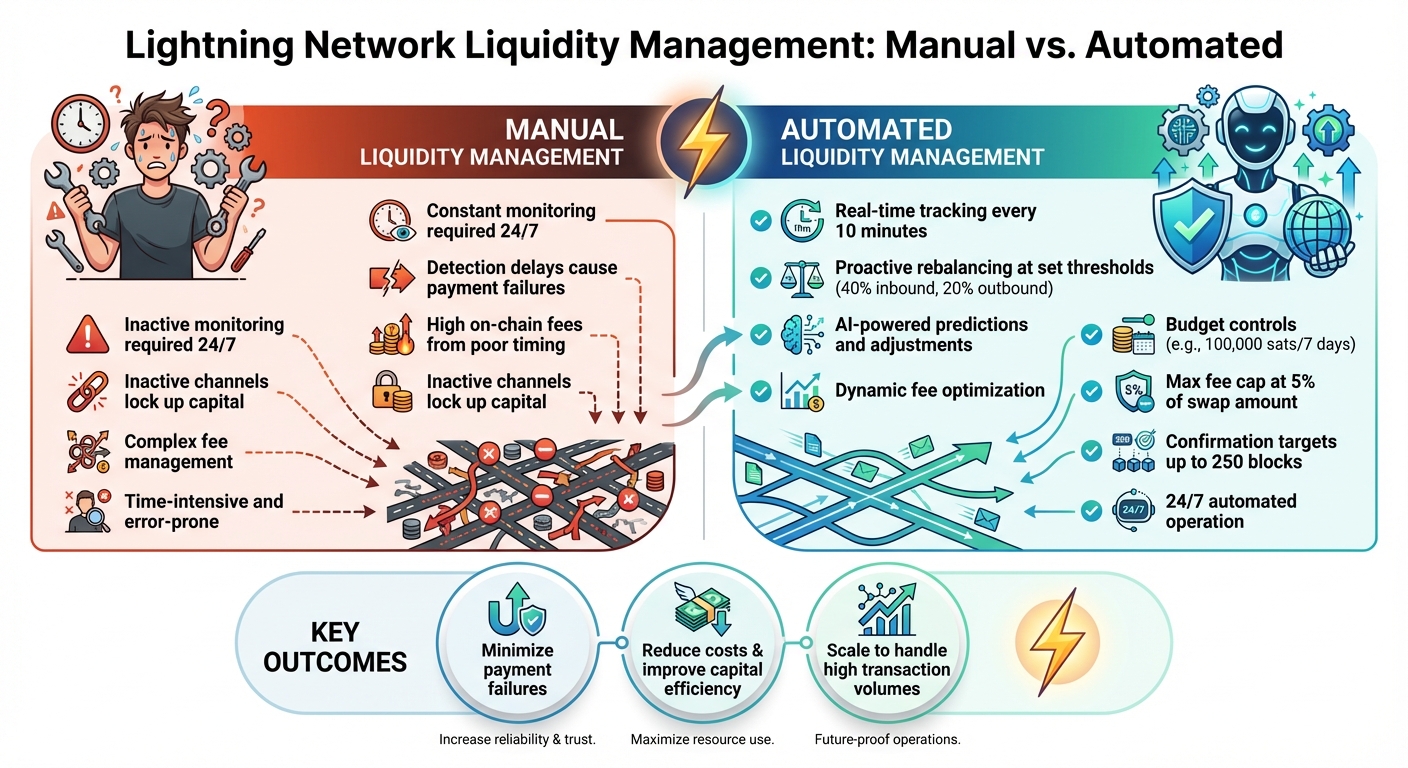
Manual vs Automated Lightning Network Liquidity Management Comparison
🤖 I Automated My Bitcoin Lightning Network Node... Here's What Happened
Problems with Manual Liquidity Management
Managing liquidity manually can feel like an endless juggling act. It requires operators to constantly monitor channel balances, assess peer reliability, and tweak fees. These tasks not only demand significant time but can also quickly spiral into a logistical headache.
One of the biggest risks is detection delays. When a channel runs out of liquidity, there’s often a lag before the issue is noticed. During this time, your business may be unable to process payments, leading to lost revenue. Worse, distinguishing between payments that failed and those that were never attempted becomes nearly impossible, adding another layer of confusion to the problem.
Then there’s the issue of capital efficiency. To receive Bitcoin payments, you need inbound liquidity, which often means purchasing channels or executing costly swaps to push funds out. Timing these swaps manually to avoid high on-chain miner fees can be both expensive and stressful, as these fees fluctuate constantly.
Inactive or disconnected channels can lock up your funds, too. When a peer disconnects or a channel stops routing traffic, your funds might sit idle. In some cases, you may need to force-close the channel, which locks your capital for a period before it becomes accessible again. This ties up resources that could otherwise be used more effectively.
Fee management adds yet another layer of complexity. Operators must keep an eye on volatile on-chain fee markets to time rebalancing swaps properly. Set fees too low, and transactions may remain unconfirmed. Set them too high, and you risk paying miner fees that far outweigh any routing revenue the channel generates. Without automation, finding the right balance is a constant challenge.
These challenges make it clear: relying on manual liquidity management not only drains time and energy but also introduces risks and inefficiencies that could otherwise be avoided.
How Automated Liquidity Management Works
Automated liquidity systems tackle the challenges of manual management by constantly monitoring and adjusting your channels without needing human input. Instead of having to manually check balances, these systems keep an eye on your channels 24/7 and rebalance them as needed. This constant vigilance prevents the delays often seen in manual management, ensuring your business doesn't miss payment opportunities due to drained channels.
At the heart of this system are several critical components, starting with real-time tracking.
Real-Time Channel Tracking
Automated systems check channel balances every 10 minutes and initiate rebalancing when set thresholds are crossed. This eliminates the lag between when a channel runs low and when you would manually notice it - a delay that could impact revenue and customer trust.
The process relies on predefined liquidity thresholds. For example, you might set a minimum of 40% inbound capacity and 20% outbound capacity. If a channel dips below these levels, the system automatically triggers a rebalancing swap to restore liquidity before payments start failing.
Real-time monitoring also identifies which channels are most efficient at routing payments. By tracking which channels deplete the fastest, the system pinpoints where to prioritize liquidity and where to scale back, helping you allocate resources more effectively across the network.
AI-Powered Rebalancing
Building on real-time data, AI-powered systems use advanced strategies to manage liquidity. Algorithms analyze historical trends to predict future needs and adjust fees based on benchmarks from top-performing peers, ensuring imbalances are addressed in advance.
For example, when a channel reaches 7/8th depletion, the system increases fees to signal scarcity. This discourages outbound payments while encouraging inbound traffic. Fee adjustments are made gradually to avoid generating excessive gossip data on the network while still responding to shifting demands.
Additionally, these systems monitor on-chain fee markets and delay swaps until miner fees are more affordable. You can set high confirmation targets - up to 250 blocks - to reduce on-chain costs, and define fee limits, such as capping fees at 5% of the swap amount, to protect profits. If a swap fails due to routing issues, the system introduces a 24-hour "failure backoff" period to avoid wasting resources on repeated attempts.
Automatic Fee Adjustments
Dynamic fee management complements AI-driven rebalancing by fine-tuning channel economics. This feature adjusts routing fees in response to demand, ensuring liquidity remains balanced. As Lightning Labs puts it:
"This feature can help to reduce the maintenance overhead of a routing node while increasing fee revenue and help balance funds on a node."
When demand spikes and liquidity becomes scarce, fees automatically increase to conserve capacity for higher-value transactions. Conversely, when demand drops, fees decrease to attract more routing traffic and keep channels active.
This system also acts as a safeguard against denial-of-service attacks. By raising fees for anyone attempting to flood your channels with spam transactions, it ensures such attacks come at a high cost. You can even choose whether to activate automatic adjustments for all peers or limit it to specific channels where pricing is harder to predict.
These automated tools work together to maintain channel stability, helping you reduce risks and improve overall performance.
sbb-itb-f81ab9b
How Automation Reduces Risk
By addressing manual delays and capital inefficiencies, automated liquidity management reshapes how businesses operate on the Lightning Network. It eliminates the need for constant human intervention, ensuring systems can proactively address issues before they affect revenue or customer satisfaction. This shift leads to improved performance, financial safeguards, and the ability to scale operations effectively.
Better Operational Performance
Manual channel management often leaves a delay between when a channel runs low and when the problem is noticed. Automation eliminates this lag entirely. It triggers rebalancing as soon as specific thresholds are reached, ensuring liquidity is maintained proactively rather than reactively. This means channels remain ready to handle transactions, even during periods of high traffic.
Stronger Financial Stability
Automated systems protect your finances by avoiding two costly errors: overpaying during fee spikes and locking up capital unnecessarily. These tools monitor fee markets and delay swaps until on-chain transaction costs drop, with confirmation targets extending up to 250 blocks (about 40 hours) to secure the best rates.
Budget controls provide an extra layer of security. For example, you can set an autobudget parameter to limit automated swaps to 100,000 sats over a seven-day period, preventing excessive spending during volatile conditions. A default maxfeepercentage of 5% ensures rebalancing only occurs within acceptable cost limits.
Automation also enhances capital efficiency by moving funds only when necessary. Liquidity tools maintain predefined inbound and outbound percentages, reallocating funds only when critical thresholds are breached. This approach preserves more capital for other business needs while ensuring smooth payment operations.
Scalability for High-Volume Enterprises
As transaction volumes increase, manual management becomes unsustainable. Automation simplifies this complexity by applying consistent rules across numerous channels simultaneously. Tools like Autopilot select optimal nodes using scoring systems that consider factors like uptime, age, and connectivity, boosting routing success rates without requiring manual intervention.
The Lightning Network can handle millions of transactions per second, far outpacing Bitcoin’s base layer limit of around seven transactions per second. However, achieving this scale depends on automated systems that can adapt to real-time changes. During peak traffic, automation reallocates liquidity as needed to keep operations running smoothly.
To further enhance security, watchtower services monitor the blockchain for unauthorized channel closures. These systems respond automatically with justice transactions to protect your funds, even when your primary systems are offline. This around-the-clock protection ensures your operations remain secure as your business grows, without requiring constant human oversight.
Enterprise Integration with Flash
Flash takes automated risk management strategies and applies them to create a Bitcoin payment solution tailored for enterprise use. By combining automated liquidity management with practical payment tools, Flash ensures businesses can accept Bitcoin globally and securely. Its system is built on principles that reduce risks, which are essential for smooth Lightning operations.
Non-Custodial, Real-Time Liquidity
Flash enables direct wallet-to-wallet transactions, eliminating risks like frozen funds, custody issues, or withdrawal delays. Using Hashed Time-Lock Contracts (HTLCs), it ensures payments are either fully completed or funds are safely returned to the sender - no partial outcomes. With real-time settlement, businesses can receive Bitcoin almost instantly, improving cash flow and capital efficiency.
Flexible Payment Tools
Flash offers a suite of tools such as payment links, paywalls, subscriptions, widgets, and point-of-sale systems. These tools integrate seamlessly with its non-custodial system and real-time liquidity features, making it easy for businesses to deploy Bitcoin payment workflows. Whether handling one-time payments or recurring subscriptions, these tools are designed for quick setup and align with enterprise needs for scalable and cost-effective solutions.
High-Volume, Low-Cost Transactions
Flash is built for enterprises managing large transaction volumes, offering minimal fees and removing intermediaries from the process. Its scaling solution supports near-instant settlements while leveraging automated rebalancing and dynamic fee adjustments to maintain liquidity and control costs. Unlike traditional payment systems that rely on percentage-based fees, Flash's fee structure ensures predictable expenses, even during periods of high network activity. This makes it an attractive option for businesses focused on managing operating costs effectively.
Conclusion
Automated liquidity management reshapes how businesses operate on the Lightning Network by reducing errors and improving capital efficiency. With real-time monitoring and automatic swaps, companies can streamline operations, lighten their workload, and ensure payment reliability.
From an operational perspective, automation minimizes fee spikes and maximizes capital use. These tools pinpoint underperforming channels, shift funds to high-traffic connections, and time swaps to take advantage of low-fee periods. This approach helps businesses safeguard their profit margins in an environment of fluctuating on-chain fees. By leveraging non-custodial submarine swaps, companies maintain complete control over their funds throughout the rebalancing process.
Automation also simplifies the complexities of channel management, allowing businesses to scale up and handle high transaction volumes with ease. Workflow-based systems use conditional logic to automate tasks, eliminating the need for advanced coding skills. This is especially critical for enterprises managing thousands of daily transactions while ensuring uninterrupted service.
Flash ties all these advantages together, offering a robust Bitcoin payment solution tailored for enterprises. With its non-custodial design, instant settlements, and low transaction costs, Flash enables seamless global Bitcoin payment acceptance. Its suite of tools - ranging from payment links to point-of-sale systems - integrates effortlessly with automated liquidity management, empowering businesses to grow without losing control over their finances or efficiency.
Automation is the backbone of scalable, reliable, and cost-efficient Bitcoin operations.
FAQs
How does automated liquidity management reduce costs and risks for businesses?
Automated liquidity management on the Lightning Network simplifies the process of handling Bitcoin payment channels, helping businesses save both time and money. By using predefined rules to automatically open and balance channels, it eliminates the need for constant manual intervention. This ensures funds are allocated where they're needed most, keeping channels well-funded and reducing the risk of payment failures caused by insufficient liquidity. Fewer failures mean fewer delays and unexpected costs.
Another advantage is the smarter balancing of inbound and outbound liquidity. This approach cuts down on the expenses tied to maintaining multiple channels and frequent rebalancing. The result? Fewer failed transactions, quicker settlements, and lower operational overhead. Businesses can manage higher transaction volumes efficiently, all while improving the scalability and dependability of Bitcoin payments.
What risks come with managing Lightning Network liquidity manually?
Managing liquidity manually on the Lightning Network comes with its fair share of challenges and risks. A key concern is liquidity constraints, which occur when there isn’t enough Bitcoin allocated to payment channels. If outbound liquidity runs low, users may struggle to make payments. On the other hand, if inbound liquidity is insufficient, receiving payments becomes problematic. To make matters more complicated, splitting larger payments across multiple routes due to limited liquidity not only increases complexity but also raises the likelihood of transaction failures.
Another issue is the operational risks tied to manual management. These include human errors, delays in adjusting channel capacities, and inaccurate assessments of liquidity needs. Such missteps can lead to higher transaction costs, failed payments, or frustrating delays - especially when the network is under heavy traffic.
Automating liquidity management offers a way to address these problems. It minimizes the risks associated with manual intervention, ensures smoother transactions, optimizes channel performance, and enhances the reliability of payment routing.
How does Flash use automated liquidity management to reduce risks for businesses?
Flash simplifies the way businesses handle liquidity by automating challenging processes within the Lightning Network. Its advanced workflows ensure that both inbound and outbound liquidity remain balanced, cutting down on the need for manual adjustments. This approach helps lower operational risks and keeps payment channels running smoothly.
With automated tools that monitor and rebalance channels, Flash enables businesses to manage real-time Bitcoin transactions effortlessly. These tools help reduce expenses and improve reliability, allowing companies to concentrate on growth while managing Lightning liquidity with ease.