A Lightning Network app is the software that lets you send and receive instant, nearly free Bitcoin payments. It’s your on-ramp to Bitcoin's "second layer," a solution that fixes the main blockchain’s slow transaction times and high fees. This is what makes Bitcoin practical for everyday stuff, like grabbing a coffee.
What Is a Lightning Network App
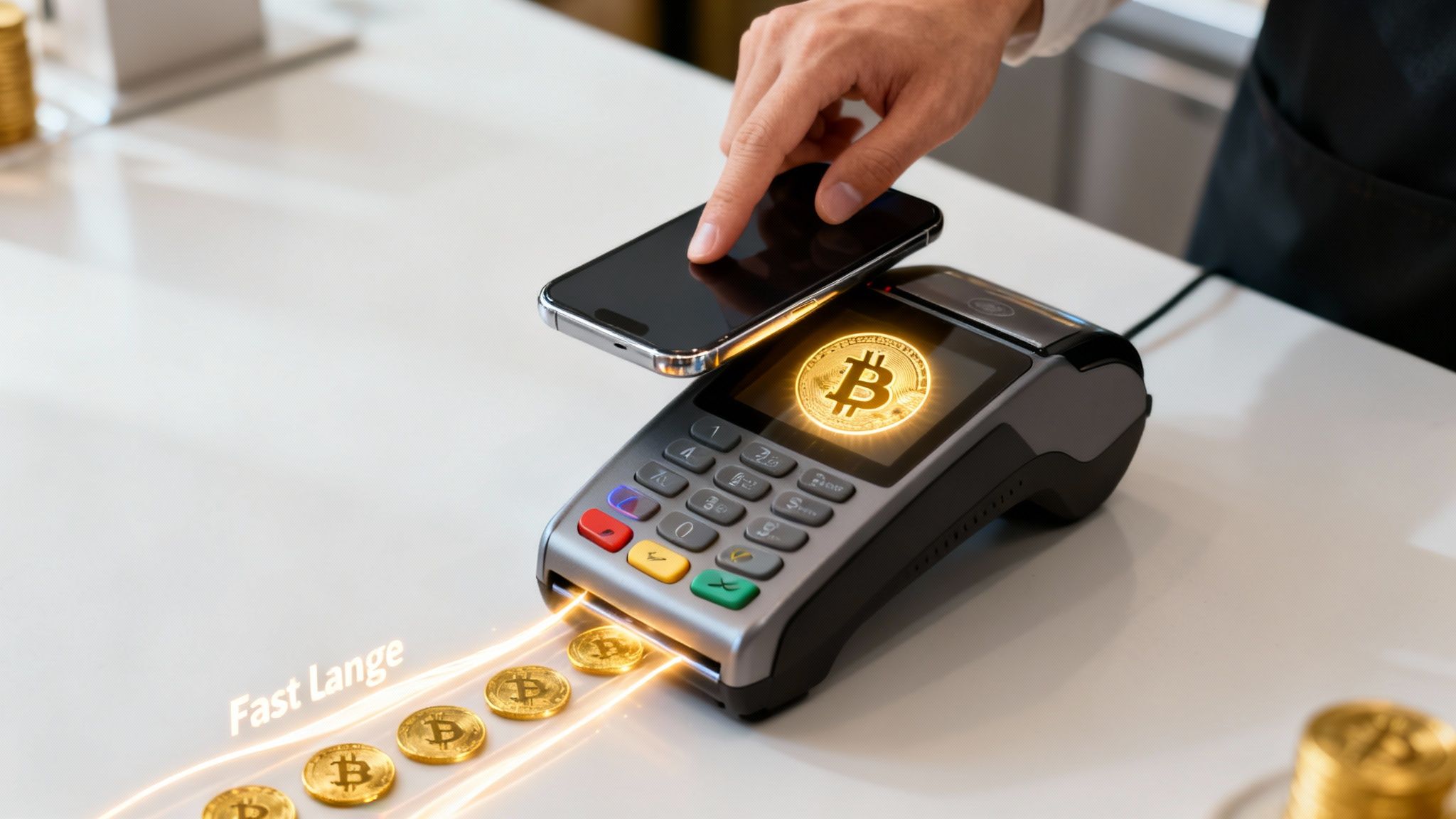
At its core, a Lightning Network app is a tool designed to make Bitcoin work like any other modern payment system—fast, cheap, and simple. We all know that standard Bitcoin transactions, which get processed on the main blockchain, can sometimes take minutes (or even hours) to confirm. The fees can also make small purchases a non-starter. This is exactly the problem the Lightning Network was built to solve.
Think of the main Bitcoin blockchain as a major highway system. It’s incredibly secure and perfect for moving large, important shipments (think high-value transactions), but it gets congested. A Lightning Network app, on the other hand, creates a private, pre-funded express lane just for you and the businesses you pay.
The Power of Payment Channels
This "express lane" is technically called a payment channel. When you open a channel with a Lightning app, you're essentially setting aside a specific amount of Bitcoin just for fast transactions. Any payments you make through this channel happen instantly because they're off the main blockchain, completely avoiding the usual traffic and fees.
You can send and receive a ton of small payments within this channel without telling the entire Bitcoin network about every single one. Only the final balance—when the channel is eventually closed—gets recorded on the main blockchain. It's a simple but powerful idea that lets a Lightning app deliver:
- Instantaneous Transactions: Payments confirm in seconds, not minutes. This gives you that smooth checkout experience you'd expect from a credit card tap.
- Drastically Lower Fees: We're talking fractions of a cent per transaction. This makes micropayments and everyday shopping actually make sense with Bitcoin.
- Enhanced Scalability: By moving the bulk of transactions off the main chain, the network can handle a much, much higher volume of payments all at once.
Why It Matters For Your Business
For any merchant, a Lightning Network app transforms Bitcoin from just a speculative asset into a real, functional currency. It completely removes the biggest hurdles—speed and cost—that have held Bitcoin back in retail and e-commerce for years.
By using a Lightning app, businesses can accept Bitcoin payments as seamlessly as they take credit cards, but without the killer processing fees, chargeback risks, or long settlement delays.
Basically, these apps provide the friendly interface needed to tap into the powerful tech running underneath. They handle all the tricky parts—opening channels, routing payments, and managing your funds—so you can just focus on your business. This makes accepting Bitcoin a practical reality, opening your doors to a global base of hundreds of millions of Bitcoin users.
How Lightning Payments Work for Your Business

So, what’s the secret sauce behind a Lightning Network app? Let’s build on the idea of a private express lane for your Bitcoin. While the main Bitcoin blockchain is incredibly secure, it's also public and can sometimes feel like rush-hour traffic. Lightning builds a second layer on top of it, designed purely for speed.
Think of it like opening a bar tab with a regular customer. You both agree to put some Bitcoin into a shared digital safe box—in Lightning terms, this is called a payment channel. This initial setup is the only time you have to deal with the main Bitcoin blockchain's pace.
Once that channel is live, your customer can pay you instantly within that "tab." They buy a coffee for a few satoshis, and the balance in your shared box just shifts. Their side goes down, yours goes up. All of this happens off-chain, meaning it's a private arrangement between the two of you, processed in seconds without waiting for miners.
Opening Payment Channels
The payment channel is the absolute bedrock of the Lightning Network. It's essentially a direct, private financial connection between two people or businesses. Here’s how it works in a nutshell:
- Funding: Two parties lock an agreed-upon amount of Bitcoin on the main blockchain to open the channel.
- Transacting: They can then make unlimited payments back and forth instantly, with fees so low they’re practically non-existent.
- Settling: The channel stays open as long as they want. Only when they decide to close it is the final balance sheet recorded back on the Bitcoin blockchain.
This is precisely what allows a lightning network app to bypass the delays and costs you see with standard on-chain transactions.
The key takeaway is this: thousands of tiny payments can fly back and forth privately within a channel, but only two transactions ever hit the main blockchain—one to open it and one to close it. That's the source of its incredible efficiency.
Routing Payments Through the Network
Okay, but what happens when a new customer walks in? You don't have a direct payment channel with them, so how do they pay you? This is where the "network" part of the Lightning Network truly shines. You don't need a direct line to everyone.
The Lightning Network is a sprawling, interconnected web of these payment channels. Your app is smart enough to find a path to route the payment through other users on the network. It’s like a GPS finding the quickest route through city streets you've never driven on.
For example, your new customer might have a channel open with their local cafe, and that cafe happens to have a channel open with you. The network automatically routes the payment from the customer, through the cafe, and straight to your wallet. This all happens in the background in a matter of seconds. The payment is seamlessly passed along the most efficient path, arriving almost instantly for a fee of just a few satoshis—mere fractions of a cent.
Real-World Business Uses for Lightning Payments
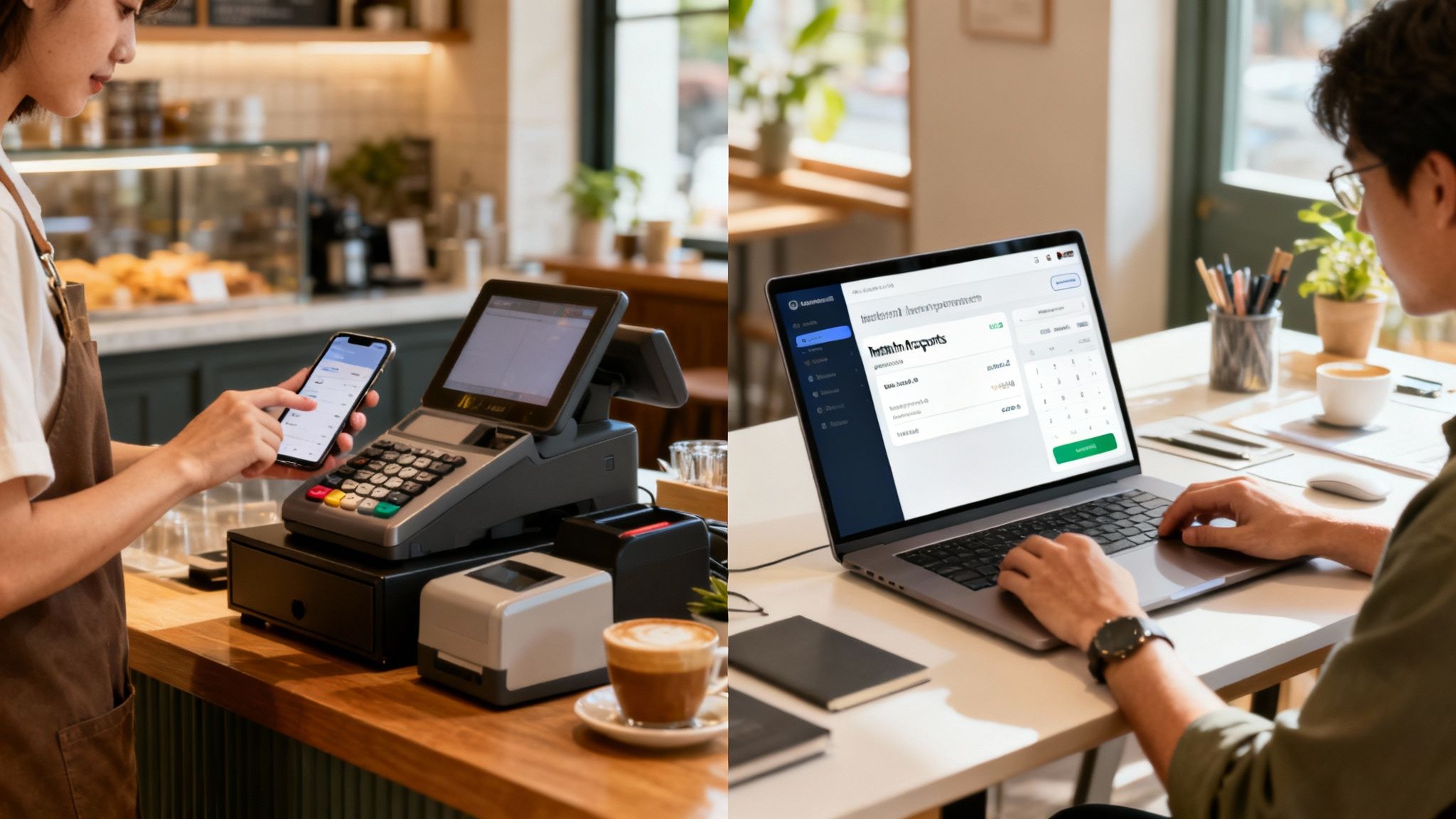
The tech behind the Lightning Network is impressive, sure, but what really matters is how it works in the real world. This is where a Lightning Network app stops being a cool experiment and becomes a powerful tool for businesses, turning Bitcoin from a speculative asset into a practical way to get paid.
The most obvious win is for retail and food service. For a local coffee shop or a small boutique, Lightning payments feel just as fast as tapping a credit card. A customer scans a QR code, the payment goes through instantly, and that's it. No more awkward waiting for on-chain confirmations, and no more getting hit with the high fees from traditional card processors.
Unlocking New Digital Business Models
Beyond the physical storefront, the Lightning Network is creating entirely new ways for online businesses and creators to make money. The secret sauce is its ability to handle micropayments—we're talking fractions of a cent—which was practically impossible before.
This completely changes the playbook for:
- Content Paywalls: Forget forcing readers into a monthly subscription. Now you can charge a few cents for a single article.
- Digital Tipping: Streamers, podcasters, and writers can get tips directly from their audience in real-time, without losing a big chunk to fees.
- In-Game Purchases: Game developers can sell small digital items or even reward players with tiny bits of Bitcoin for their achievements.
For anyone running an e-commerce store, one of the biggest headaches is chargeback fraud. With Bitcoin, that problem disappears entirely. Lightning transactions are final. They can't be reversed, protecting merchants from the costly disputes that plague credit card payments.
This finality, combined with instant settlement, also shreds the red tape around international sales. A business in one country can get paid immediately by a customer anywhere on the globe without waiting days for bank transfers or dealing with expensive currency conversions.
The Growing Volume of Lightning Transactions
This isn't just theory; the numbers show that businesses are catching on. While public network stats can be noisy, the actual value being sent through the network tells a story of serious growth.
For instance, one infrastructure provider reported its nodes had routed over two million transactions by December 2025, with daily volume jumping 38% month-over-month. That's not just hobbyists sending a few sats—it's real commerce.
Some payment processors are seeing Lightning become a huge part of their business. One reported that Lightning payments made up over 16% of its Bitcoin orders in a 2024 quarterly report. The data is clear: a Lightning Network app isn't just a niche tool anymore. It's a proven payment rail moving millions of dollars, and you can learn more about how Lightning Network transaction activity is accelerating.
Understanding the Security and Privacy of Lightning
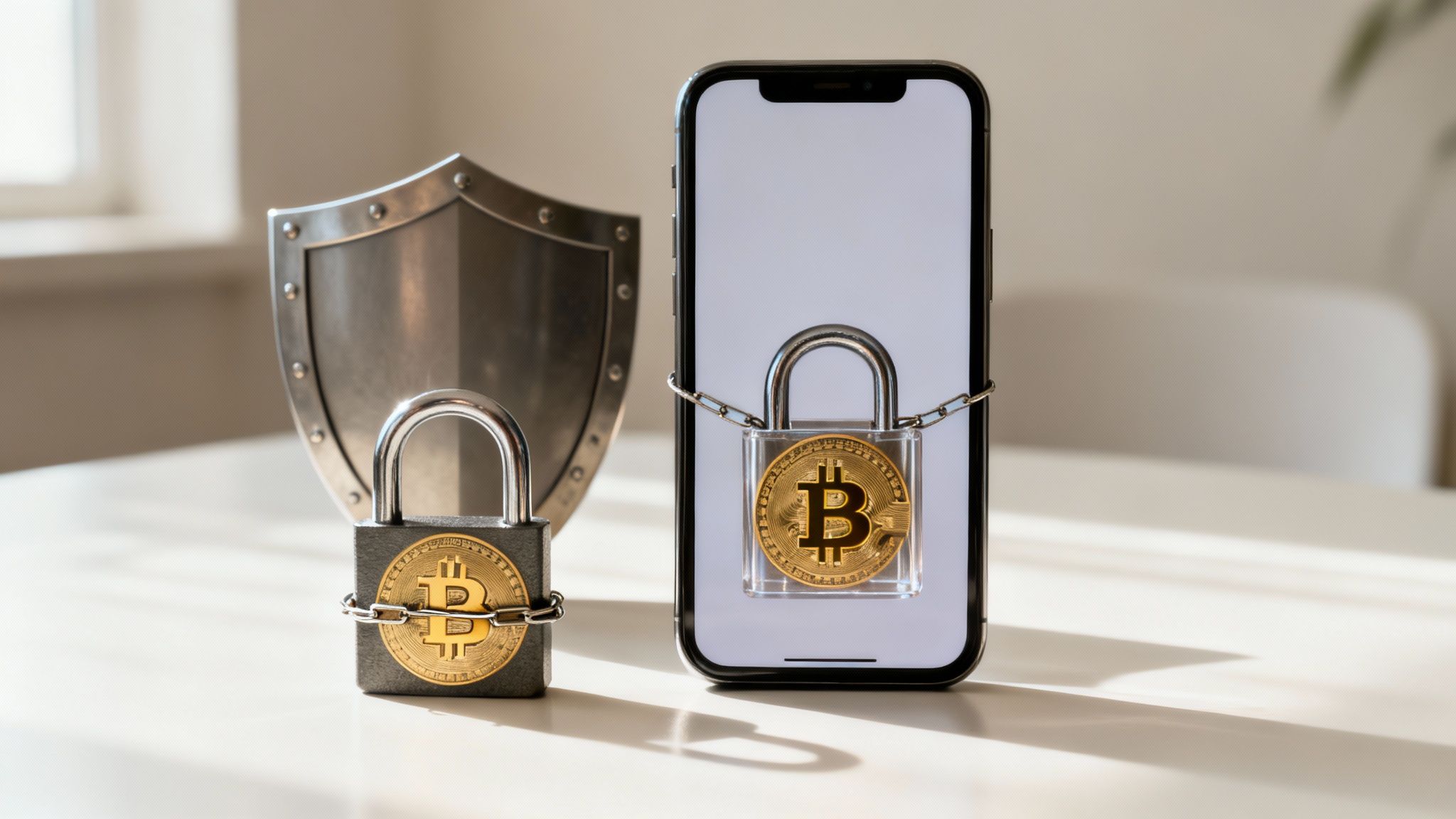
Whenever you’re thinking about a new payment technology, security is always top of mind. And for good reason. With a Lightning Network app, the security conversation starts with a core principle in the Bitcoin world: being non-custodial.
What does that mean? Simply put, you hold the keys to your own money. You are your own bank.
Unlike a traditional bank account or many financial services where a company holds your funds for you, a non-custodial Lightning app gives you total control. Your Bitcoin is your Bitcoin. This completely sidesteps the risk of a central company getting hacked or deciding to freeze your account—a foundational advantage of the Bitcoin network.
How Lightning Enhances Transaction Privacy
Beyond giving you control, the Lightning Network offers a huge leap forward in privacy compared to standard on-chain Bitcoin transactions. When you pay on the main blockchain, every single transaction is etched into a public ledger, visible to anyone who cares to look.
Lightning takes a different path. It funnels transactions into private payment channels, so your individual payments aren't broadcast to the whole world. That payment for your morning coffee or that online subscription stays between the parties involved in routing it.
This off-chain structure provides a much-needed layer of financial privacy. While it's not completely anonymous, it stops the casual observer from easily piecing together your entire spending history. It’s a massive improvement.
Practical Security for Merchants
Okay, so what does this mean for a business? Using a Lightning Network app comes with a couple of practical responsibilities to keep things running smoothly and securely. The two big ones are managing your channel liquidity and keeping good backups.
Channel Liquidity: This is just a fancy way of saying you need enough room in your channels to receive payments. If your inbound capacity is full, you can't accept new payments until you rebalance things. Think of it like a cash register drawer—if it's stuffed with bills, you can't take any more cash until you empty some out.
Secure Backups: With great power comes great responsibility. Since you control your funds, you're also responsible for securing them. Regular backups of your wallet and channel states are non-negotiable. If your phone or computer dies, those backups are your only way to get your Bitcoin back.
Thankfully, most modern Lightning apps have made this process incredibly simple. Many offer automated cloud backups or give you a simple recovery phrase to write down. By taking these straightforward steps, you can use your Lightning Network app with total confidence, knowing your funds are secure and your business is safe from preventable slip-ups.
How to Integrate a Lightning App Into Your Business
Bringing instant Bitcoin payments into your business is a lot easier than you might think. Whether you're running a local coffee shop or a global e-commerce store, there's a way to make it work for you. It all starts with figuring out your options, which can be anything from simple, off-the-shelf apps to more hands-on API connections.
For most brick-and-mortar shops, the quickest way to get started is with a standalone Lightning Network app on a phone or tablet. This basically turns your device into a point-of-sale (POS) terminal. You just generate a QR code for a sale, your customer scans it with their wallet, and the payment zips through in seconds. It’s a low-cost, no-code solution that gets you up and running in minutes.
Choosing Your Integration Path
As you get more comfortable, you can look into more deeply integrated solutions. The right path really comes down to your business model and how technical you want to get.
- Standalone POS Apps: Perfect for face-to-face sales. Think of these as your payment terminal, running right from a mobile app without needing to hook into any other software.
- E-commerce Plugins: If you're on a platform like Shopify or WooCommerce, there are plenty of plugins that can add Lightning as a payment option. It's a smooth experience for your online customers right at checkout.
- Direct API Integration: For businesses with custom-built platforms or those who want total control, an API is the way to go. This lets you build Lightning payments directly into your existing software and workflows, exactly how you want them.
A key player making all of this possible is the Lightning Service Provider (LSP). Think of an LSP as a helpful concierge for the network. They manage the tricky stuff behind the scenes—like opening payment channels and making sure you have enough liquidity to receive funds. This frees you up to focus on running your business, not the network's plumbing.
Understanding Network Growth and Capacity
The network that powers your Lightning Network app is getting more robust by the day, thanks to growing interest from both regular users and big institutions. Between 2023 and 2025, the network's public capacity saw some interesting shifts, peaking around 5,600 BTC before stabilizing closer to 4,200 BTC. Now, that might look like a drop, but it actually signals a healthy change: the network is moving toward fewer, larger, and more efficient payment channels instead of a massive number of smaller ones.
The real proof is in the pudding. Metrics like routed payments exploded by an incredible 1,212% between 2021 and 2023, showing that the network is handling more transactions than ever. This growing institutional confidence means the network is becoming more reliable for merchants every single day.
If you’re planning to build and launch your own Lightning Network app, a solid guide to app submission can be a lifesaver when it's time to get it published on the major app stores. By picking the right integration method and tapping into this growing network, you can confidently start offering your customers instant, low-cost Bitcoin payments.
Picking the Right Lightning Network App for Your Business
Choosing the best Lightning Network app for your business isn't a one-size-fits-all kind of deal. The ecosystem is buzzing with different tools, each with its own strengths. The right one for you really boils down to your technical comfort level, your business needs, and ultimately, how much control you want over your funds.
The first major fork in the road is deciding between a custodial and a non-custodial app. Just think of it like using a bank versus holding your own cash. A custodial app is like a bank—it manages your Bitcoin for you, which makes for a dead-simple, user-friendly experience. A non-custodial app is like cash in your wallet—it gives you full control over your private keys, making you the one and only owner of your funds.
The core trade-off is simple: Custodial apps prioritize convenience, while non-custodial apps prioritize sovereignty and control. For many merchants just dipping their toes in, a custodial solution is a great, low-friction starting point.
Key Factors to Consider
As you start looking at different options, you'll find that certain features matter more than others depending on your business. When you're weighing your options for an Android app, it's also worth looking at general key factors for Android app development to get a broader perspective.
Here’s a quick checklist to help guide your decision:
- User Interface (UI): Is the app actually easy to use? A clean, straightforward interface is absolutely critical for processing transactions quickly at a busy point of sale.
- Fees and Rates: Get a clear picture of the fee structure. While Lightning fees are incredibly low, some apps might charge for extra services like channel management or currency conversion.
- Security Features: Look for the essentials, like two-factor authentication (2FA) and solid backup options. If you go non-custodial, the wallet must give you a clear way to save your recovery phrase.
- Integration Options: Does the app play nicely with your existing setup? See if it offers plugins for your e-commerce platform or an API for building custom solutions.
Understanding the Evolving Network
It's also important to realize that the underlying network your lightning network app connects to has grown up a lot. Between 2020 and 2025, the network went through a big shift, moving from having tons of small channels to fewer, much larger ones.
Even though public node counts dipped from their peaks of around 21,000 in early 2022, the average capacity per channel shot up. One report noted a massive 214% increase over four years. This points to a more professional and robust infrastructure taking shape, where big players like exchanges and service providers run larger channels that concentrate liquidity to handle bigger, more reliable payments.
This "professionalization" means the network is better equipped than ever to support serious commercial activity—a huge plus when you're choosing an app to run your business on.
At the end of the day, the right app is the one that fits your business goals. A small cafe might be perfectly happy with a simple, non-custodial mobile wallet. On the other hand, an online store will likely need a custodial service with powerful e-commerce integrations to handle payment volume and liquidity automatically.
Got Questions About Lightning Apps? We’ve Got Answers.
Jumping into any new payment tech is bound to stir up a few questions. When you're thinking about using a Lightning Network app for your business, you need straight, clear answers. Let's tackle what merchants ask us most.
What Happens If My Business Goes Offline?
This is one of the first things people worry about. What if your internet cuts out or your point-of-sale device suddenly dies? The good news is, your Bitcoin is perfectly safe.
The Lightning Network was designed with this exact scenario in mind. Even if you're offline, the network has built-in safeguards to make sure no one can drain your funds from your payment channels. When you're back online, your app simply syncs up with the network, and your balances will be exactly as they should be. Your funds are secured by the core rules of the Bitcoin blockchain itself, not by a constant internet connection.
At its core, Lightning is built so that funds in a channel can only be moved with the cryptographic sign-off of both people involved. This means even when your node is offline, your money is protected by the same principles that make Bitcoin so secure.
Are Lightning Payments Anonymous?
Privacy is a huge plus when using a Lightning Network app. On-chain Bitcoin transactions are all recorded on a public ledger for the world to see, but Lightning payments work differently. They are routed privately through a web of channels.
This means your individual sales and customer transactions aren't broadcast publicly, which adds a serious layer of financial privacy. It’s not total anonymity—the nodes that help route the payment can see bits and pieces of the path—but it stops casual onlookers from tracking your business's revenue and cash flow. It hits a sweet spot between being open and keeping your business private.
How Much Does It Really Cost?
For many businesses, this is the kicker. The cost savings are dramatic. Transaction fees on the Lightning Network are ridiculously low, often just a few satoshis—we're talking fractions of a penny.
Compare that to traditional credit card fees, which gobble up anywhere from 1.5% to 3.5% of every single sale. The difference is night and day. For a business doing thousands of transactions, those savings stack up fast, letting you keep more of the money you earn. The costs are so tiny, it even opens up brand new business models like micropayments, which are simply impossible with old-school payment rails.
Ready to accept instant, low-fee Bitcoin payments and tap into a global customer base? Flash gives you the tools to get started in under a minute with zero coding. See how easy it is to integrate at .