The Bitcoin Lightning Network is transforming digital commerce by enabling instant, low-cost transactions. For merchants, developers, and creators, harnessing its power means accessing a global, censorship-resistant payment rail. However, navigating the ecosystem of wallets, payment processors, and development tools can be a significant challenge. This guide cuts through the complexity, providing a curated list of the most impactful Lightning Network applications available today.
We have compiled a comprehensive resource to help you find the right tools for your specific needs. Whether you are an eCommerce merchant looking to accept Bitcoin, a developer building a new service, or a consumer wanting to spend satoshis, this list has you covered. We move beyond simple descriptions to analyze practical use cases, dissect key features, and offer implementation insights.
Each entry includes screenshots and direct links, so you can immediately explore the platforms that catch your interest. This article is designed to be your go-to reference for integrating and utilizing the Lightning Network, helping you choose the best applications to launch a new service or add Bitcoin payments to an existing business. Let's dive into the tools shaping the future of peer-to-peer payments.
1. Flash
Flash distinguishes itself as a premier, non-custodial Bitcoin payment processing solution, meticulously engineered for merchants seeking full control over their funds. Its core architecture bypasses intermediaries entirely, facilitating direct wallet-to-wallet transactions. This design choice is fundamental, offering unparalleled security and decentralization by ensuring that merchants are the sole custodians of their Bitcoin, a critical feature for businesses prioritizing financial sovereignty.
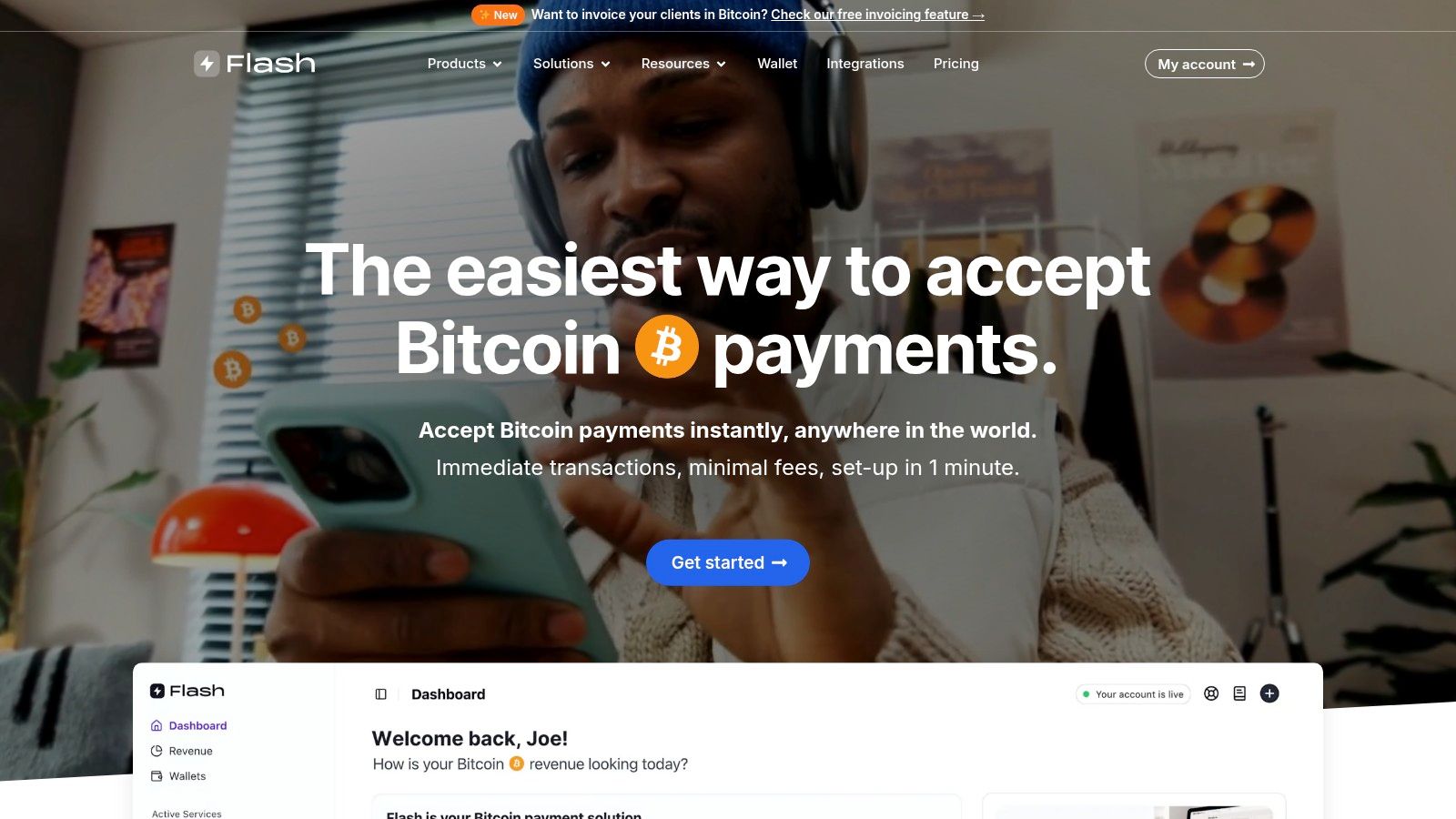
As one of the most versatile lightning network applications, Flash provides a comprehensive suite of tools that cater to a diverse range of business models. From brick-and-mortar stores to global eCommerce platforms, its flexibility is a significant competitive advantage.
Key Features and Implementation
Flash equips businesses with a robust set of no-code and low-code tools designed for rapid deployment. Key offerings include:
- Mobile Point-of-Sale (POS): Transforms any smartphone or tablet into a dedicated Bitcoin payment terminal, perfect for physical retail, cafes, and event vendors.
- Subscription & Paywall Modules: Enables automated recurring billing for SaaS companies, content creators, and subscription-based services, a standout feature not commonly found in competing platforms.
- Customizable Widgets & Links: Allows for seamless integration into existing websites, applications, and social media channels with minimal technical overhead.
Practical Use Cases and Considerations
The platform's non-custodial and no-KYC nature makes it an exceptional choice for privacy-conscious businesses and those operating in regions with complex regulatory landscapes. Onboarding is nearly instantaneous, allowing a merchant to start accepting Bitcoin in under a minute.
While Flash excels in security and ease of use, potential users should note that pricing details are not publicly listed and require direct contact. This approach may be a hurdle for businesses that prefer upfront cost analysis. However, its powerful, decentralized infrastructure and extensive feature set make it a top-tier choice for any enterprise looking to integrate secure, instant Bitcoin payments.
2. Lightning App Directory
For anyone venturing into the Bitcoin second layer, the sheer number of emerging tools can be overwhelming. The Lightning App Directory serves as an essential, centralized hub to navigate this rapidly expanding ecosystem. It’s less of an application itself and more of a curated public library, offering a comprehensive, filterable list of wallets, nodes, and other Lightning Network applications.
What makes this resource indispensable is its straightforward, no-frills approach. It’s not trying to sell you anything; its sole purpose is to organize and present the available options clearly. This makes it an invaluable starting point for merchants researching payment processors, developers looking for new Lapps to study, or new users simply trying to find the right wallet for their operating system.
Key Features and User Experience
The user experience is simple and effective. You can quickly filter applications by category (e.g., Wallet, Node, Other) and platform (e.g., iOS, Android, Web, Desktop). This direct functionality allows you to instantly narrow down the vast landscape to find precisely what you need.
Practical Tip: When using the directory, pay close attention to the project links. Always check the linked GitHub repository to gauge the project's activity and maturity level. Some listed applications may be experimental or no longer actively maintained.
Pros:
- Comprehensive: One of the most extensive, publicly available lists of Lightning apps.
- Free and Accessible: No sign-up or payment is required to access the information.
- Maintained: Regularly updated to include new and noteworthy projects.
Cons:
- Varying Quality: Includes projects in all stages, from beta to established, requiring user diligence.
- Lacks In-Depth Reviews: Functions as a directory, not a review site, so you'll need to do your own research.
Website: https://lightningappdirectory.com
3. BitcoinDev.org - Lightning Development Resources
While many resources focus on end-user applications, BitcoinDev.org carves out a niche by providing a curated hub specifically for developers and enterprises. This platform is an essential bookmark for anyone looking to build or integrate Lightning Network applications, offering a technical deep-dive into the tools that power the ecosystem. It functions as a specialized library of APIs, SDKs, and platforms designed for robust, enterprise-grade solutions.
What sets BitcoinDev.org apart is its clear focus on the builders. It moves beyond simple listings to provide detailed descriptions and links to core developer tools, dashboards, and advanced payment platforms. This makes it an invaluable resource for technical teams aiming to implement scalable Lightning payment infrastructure.
Key Features and User Experience
The site’s user experience is direct and technical, prioritizing information over aesthetics. It presents a comprehensive list of resources tailored for developers, helping them quickly identify the right tools for their project, whether they're building a new wallet or integrating payments into an existing enterprise system.
Practical Tip: For merchants evaluating platforms, the detailed descriptions on BitcoinDev.org offer insight into the technical underpinnings of various payment processors. This can help you understand the maturity and capabilities of a potential partner.
Pros:
- Developer-Focused: Provides a highly curated list of APIs, SDKs, and platforms for building on Lightning.
- Enterprise-Grade Resources: Highlights solutions suitable for scalable, commercial applications.
- Cutting-Edge Coverage: Regularly updated with new and emerging developer tools.
Cons:
- Highly Technical: The content is not intended for non-technical users or general consumers.
- Niche Focus: Lacks information on consumer-facing wallets or simpler applications.
Website: https://bitcoindev.org
4. Awesome Lightning Network
For developers and technical enthusiasts looking to dive deep into the ecosystem, the Awesome Lightning Network repository on GitHub is an unparalleled resource. This is not a polished web application but a community-curated, open-source list. It catalogues a vast array of Lightning Network applications, tools, libraries, and educational materials.
What sets this list apart is its developer-centric focus. While other directories cater to end-users, this one serves the builders. It is the go-to reference for finding a specific library in a certain programming language, exploring different node implementations, or discovering new open-source projects to contribute to. It’s an essential bookmark for anyone building on the second layer.
Key Features and User Experience
As a GitHub repository, the experience is raw and text-based, organized by categories like Wallets, Tools, and Developer Resources. Users navigate a simple Markdown file, clicking links that lead directly to project websites or code repositories. This direct, unfiltered access is its greatest strength for its target audience.
Practical Tip: Use the repository's table of contents to quickly jump to the section you need. Since the list is extensive, this is the most efficient way to find specific tools, such as payment channel management utilities or new LUDs (Lightning URL specifications).
Pros:
- Comprehensive Coverage: Features a massive, well-categorized collection of developer tools and projects.
- Community-Driven: Constantly updated by contributors, ensuring it remains current with the latest innovations.
- Open Source: Entirely free and transparent, allowing anyone to suggest additions or corrections.
Cons:
- Technical Barrier: Can be intimidating for non-developers due to its GitHub-based format.
- No Vetting: Inclusion does not equal endorsement; users must perform their own due diligence on each project.
Website: https://github.com/LN-Zap/awesome-lightning-network
5. Bitrefill
While many Lightning Network applications focus on infrastructure, Bitrefill provides a vital, consumer-facing service: living on Bitcoin. It’s an e-commerce platform that brilliantly bridges the gap between the digital currency world and everyday commerce. The premise is simple yet powerful, users can spend their satoshis on gift cards for hundreds of global brands, pay bills, or top up their mobile phone plans.
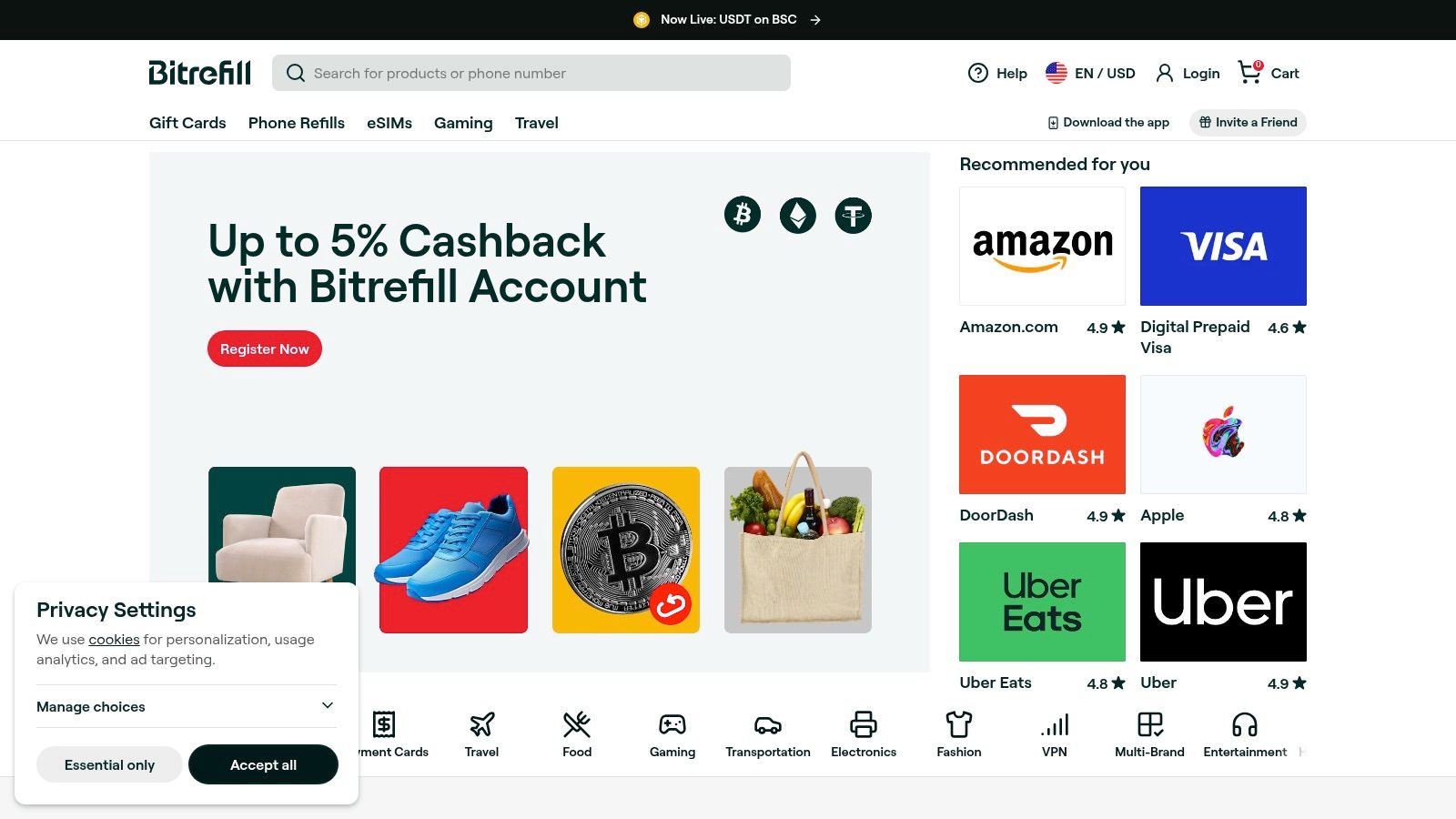
This makes Bitrefill a cornerstone for anyone looking to use the Lightning Network for practical, real-world spending. It effectively creates a circular economy where one can earn Bitcoin and spend it on necessities and wants without ever converting back to fiat currency. For merchants, it serves as a powerful proof-of-concept for consumer demand in using Bitcoin for retail purchases.
Key Features and User Experience
The platform is renowned for its smooth and intuitive user experience. Purchasing is incredibly fast, you select a product, choose to pay with Lightning, scan a QR code, and the digital code is delivered almost instantly. This near-frictionless process demonstrates the speed and efficiency of Lightning payments in a retail setting.
Practical Tip: While you can check out as a guest, creating an account unlocks a rewards program. You earn 1% back in satoshis on all purchases, which can be used for future orders, creating a nice incentive for repeat customers.
Pros:
- Practical Utility: Turns Bitcoin into a spendable currency for everyday goods and services.
- User-Friendly: Extremely simple interface that requires no technical knowledge to use.
- Global Reach: Offers a vast catalog of gift cards and mobile refills available in numerous countries.
Cons:
- Limited to Digital Goods: The platform only sells digital gift cards and refills, not physical products.
- Product Availability Varies: The selection of brands and services can differ significantly by region.
Website: https://www.bitrefill.com
6. Strike
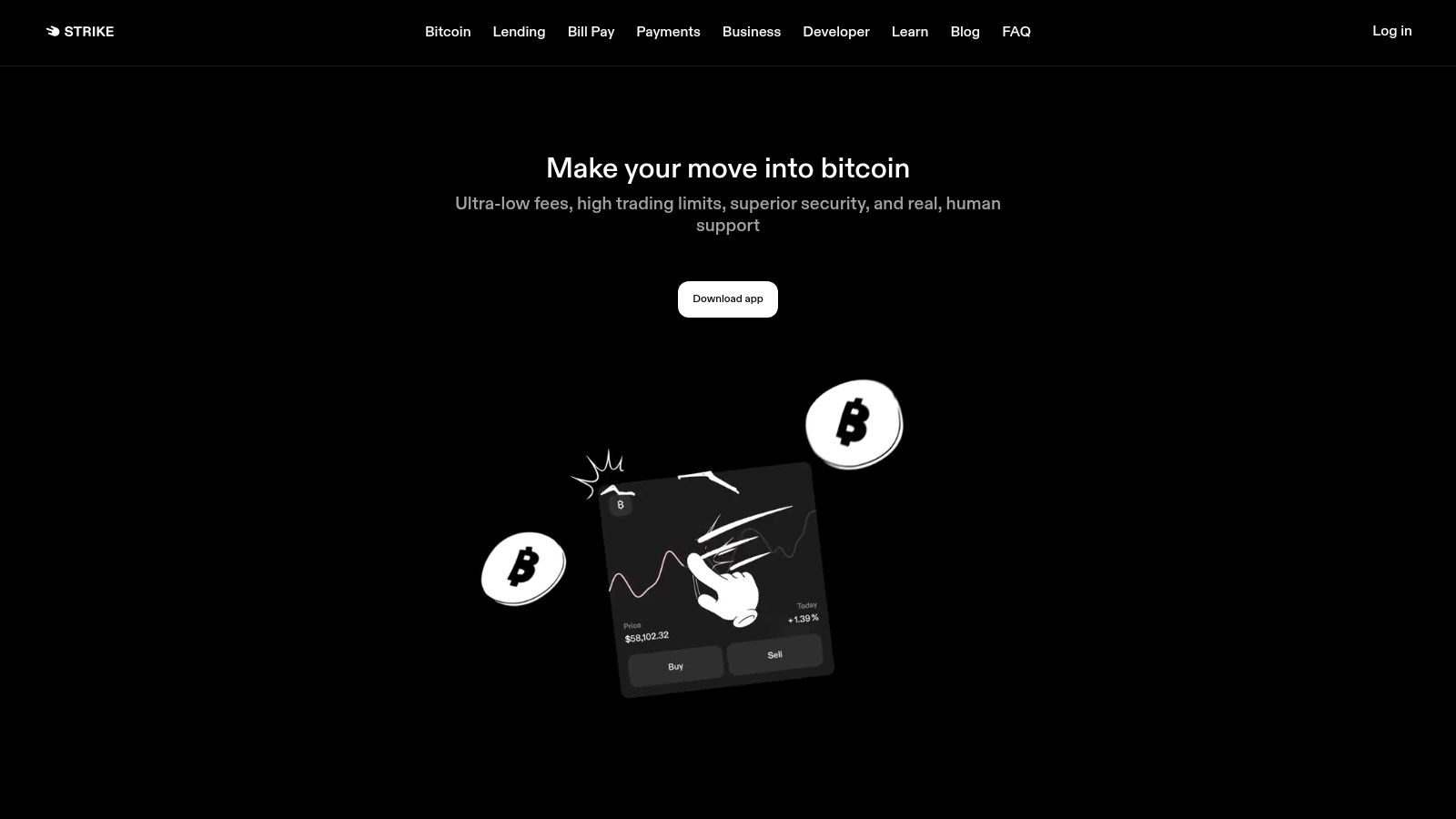
Strike positions itself as a bridge between the traditional financial world and the Bitcoin ecosystem, utilizing the Lightning Network to offer instant, near-free global payments. More than just a wallet, it functions as a comprehensive payment application that connects directly to your bank account, allowing you to send and receive both fiat currency and Bitcoin seamlessly. This direct integration makes it one of the most accessible lightning network applications for everyday users.
What makes Strike stand out is its focus on abstracting away the complexities of Bitcoin. Users can send dollars to a friend in another country, and Strike handles the conversion to Bitcoin, the Lightning Network transfer, and the final conversion back to the local currency on the recipient's end, all in a single, fluid transaction. This approach significantly lowers the barrier to entry for mainstream adoption.
Key Features and User Experience
Strike’s mobile-first interface is clean and intuitive, resembling popular payment apps like Cash App or Venmo. It supports instant Bitcoin transactions, direct bank account integration, and a feature to "Pay Me in Bitcoin," which allows users to receive a portion of their salary in BTC. The user experience is designed for simplicity and speed, making it ideal for everyday purchases and remittances.
Practical Tip: Before relying on Strike for international payments, verify its availability in both the sending and receiving countries. The list of supported regions is expanding but remains a key limitation.
Pros:
- Direct Bank Integration: Seamlessly move funds between your bank account and the app.
- User-Friendly: An exceptionally simple interface makes Bitcoin payments accessible to beginners.
- Cost-Effective: Leverages the Lightning Network for extremely low-cost transactions.
Cons:
- Limited Geographic Availability: Not yet available worldwide, restricting its use for global remittances.
- Custodial Nature: Strike holds the keys to your funds, which is a trade-off for convenience.
- Requires KYC: Users must complete a Know Your Customer verification process.
Website: https://strike.me
7. Amboss Technologies
For those running their own Lightning node, maintaining optimal performance and liquidity is a constant challenge. Amboss Technologies provides a critical suite of tools designed specifically for node operators, offering powerful analytics and data visualization to navigate the network's complexities. It acts as an intelligence layer, transforming raw network data into actionable insights for routing efficiency and capital management.
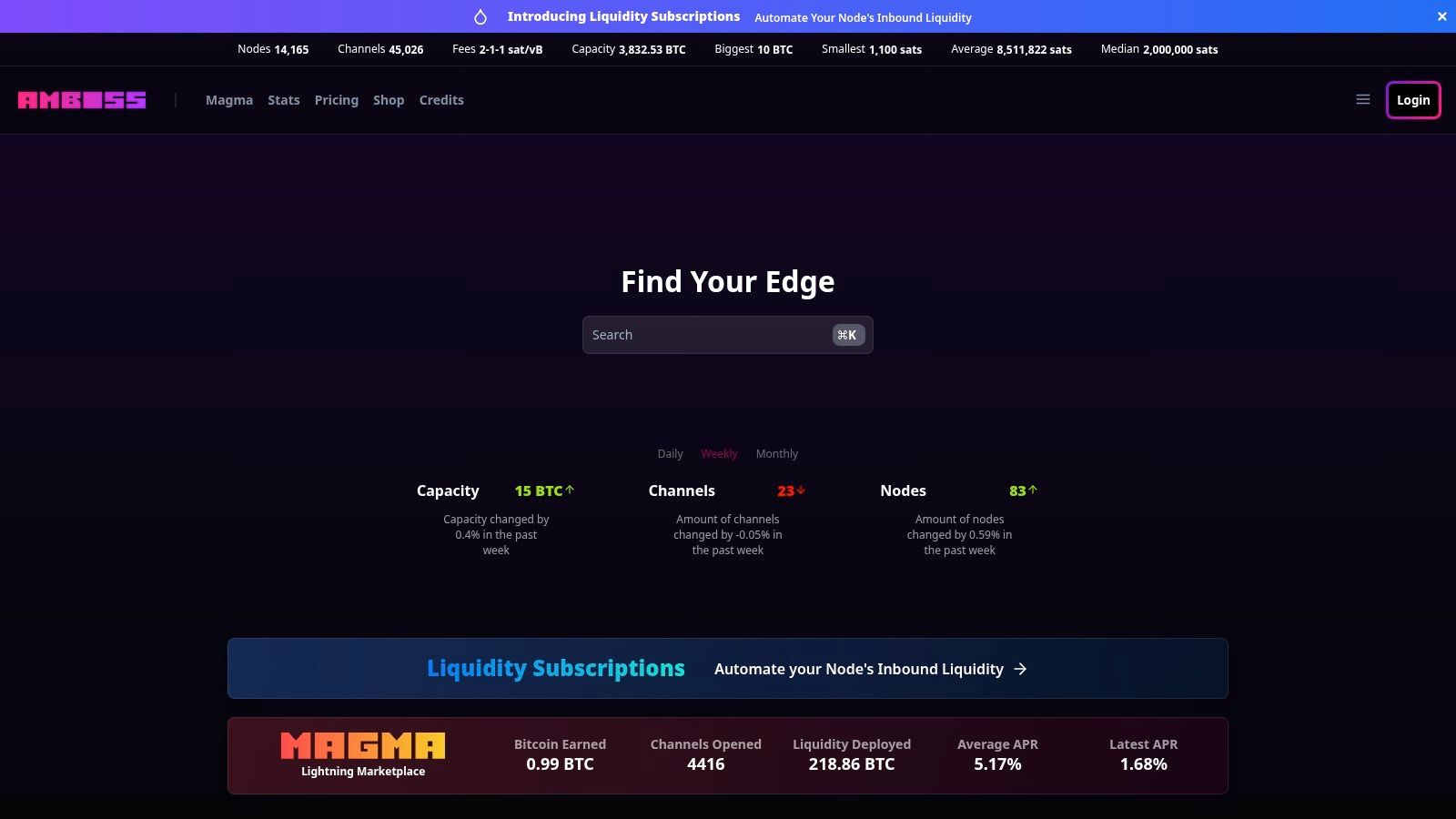
What sets Amboss apart is its focus on empowering the individual node operator. Instead of just showing statistics, it provides the tools to actively manage and improve a node's position within the network. This makes it an indispensable resource for anyone serious about contributing to the network's health and earning routing fees, turning a hobby into a more strategic endeavor.
Key Features and User Experience
The platform offers a detailed dashboard where you can monitor your node's performance, track channel peers, and visualize your connectivity. The experience is geared toward technical users but remains surprisingly intuitive. Its liquidity management tools, like Magma, allow users to buy and sell channel liquidity in an open marketplace, addressing a key operational pain point for operators.
Practical Tip: Use the "Peer Analysis" feature to vet potential channel partners. Look for nodes with a good health score and stable uptime to minimize the risk of forced channel closures and improve your routing success.
Pros:
- Comprehensive Data: Delivers deep insights and analytics essential for node management.
- Liquidity Marketplace: Offers a direct way to buy and sell channel capacity.
- User-Friendly Interface: Presents complex data in an accessible, well-designed dashboard.
Cons:
- Niche Audience: Primarily useful only to those actively running a Lightning node.
- Requires Sign-Up: Full access to personalized node management tools requires creating an account.
Website: https://amboss.space
8. Voltage
For businesses looking to integrate Bitcoin’s second layer without the operational overhead, Voltage provides enterprise-grade infrastructure. It specializes in offering fully managed, scalable Lightning Network nodes and robust APIs. This service abstracts away the immense complexity of node management, such as maintaining uptime, managing liquidity, and ensuring security, allowing companies to focus on building their Lightning Network applications.

Voltage stands out by positioning itself as a foundational infrastructure partner for serious commercial use cases. Instead of just a simple wallet, it delivers the backend power needed for large-scale payment processing, exchanges, or any service requiring a highly reliable and performant Lightning connection.
Key Features and User Experience
The platform is engineered for developers and businesses that demand high availability. Its API-first approach means integration into existing systems is streamlined, enabling rapid deployment of Lightning payment capabilities. The managed service model guarantees that nodes are always online, patched, and optimized for performance, which is a critical differentiator from self-hosting.
Practical Tip: When starting with Voltage, use their "Flow" tool to easily manage liquidity. It helps you acquire inbound capacity, a common challenge when setting up a new Lightning node, ensuring you can receive payments immediately.
Pros:
- Reduces Complexity: Eliminates the need for in-house expertise in Lightning node management.
- Enterprise-Grade: Offers high uptime, scalability, and dedicated support for businesses.
- Developer-Friendly: Provides powerful APIs for seamless integration into various platforms.
Cons:
- Cost Factor: The service is priced for businesses and may be too expensive for hobbyists or small-scale users.
- Opaque Pricing: Detailed pricing for enterprise tiers often requires direct contact with their sales team.
Website: https://voltage.cloud
9. Lightning Network Plus (LN+)
For node operators, achieving good connectivity and inbound liquidity is one of the biggest initial hurdles. Lightning Network Plus (LN+) addresses this directly by acting as a community-driven platform to coordinate the opening of Bitcoin Lightning channels. It’s a collaborative tool that helps operators find reliable peers to connect with, improving both individual node performance and overall network health.
What sets LN+ apart is its focus on reciprocal liquidity. Instead of just opening a channel to someone, the platform organizes "swaps" or "rings" where a group of users agree to open channels to each other. This creates a balanced and well-connected subgraph, making it one of the most practical lightning network applications for serious node runners who want to enhance their routing capabilities and network presence without paying for liquidity services.
Key Features and User Experience
The platform operates on a reputation-based system. Users join channel-opening "swaps," and successful participation builds their credibility. The process is straightforward: you find a swap that matches your desired channel size, join it, and follow the instructions to open a channel to your assigned peer. This community-enforced cooperation is key to its success.
Practical Tip: Start with smaller channel swaps to build your reputation on the platform. A good LN+ score makes you a more attractive peer for larger, more strategic channel openings in the future.
Pros:
- Free to Use: Facilitates channel openings without any platform fees.
- Improves Node Performance: Directly enhances your node's connectivity and potential to earn routing fees.
- Community-Driven: Leverages a reputation system to encourage reliable participants.
Cons:
- Requires Trust: You must trust other participants to reciprocate and keep channels open.
- Account Required: Registration is necessary to participate in channel swaps.
Website: https://ln.plus
10. Lightning Network Stores Directory
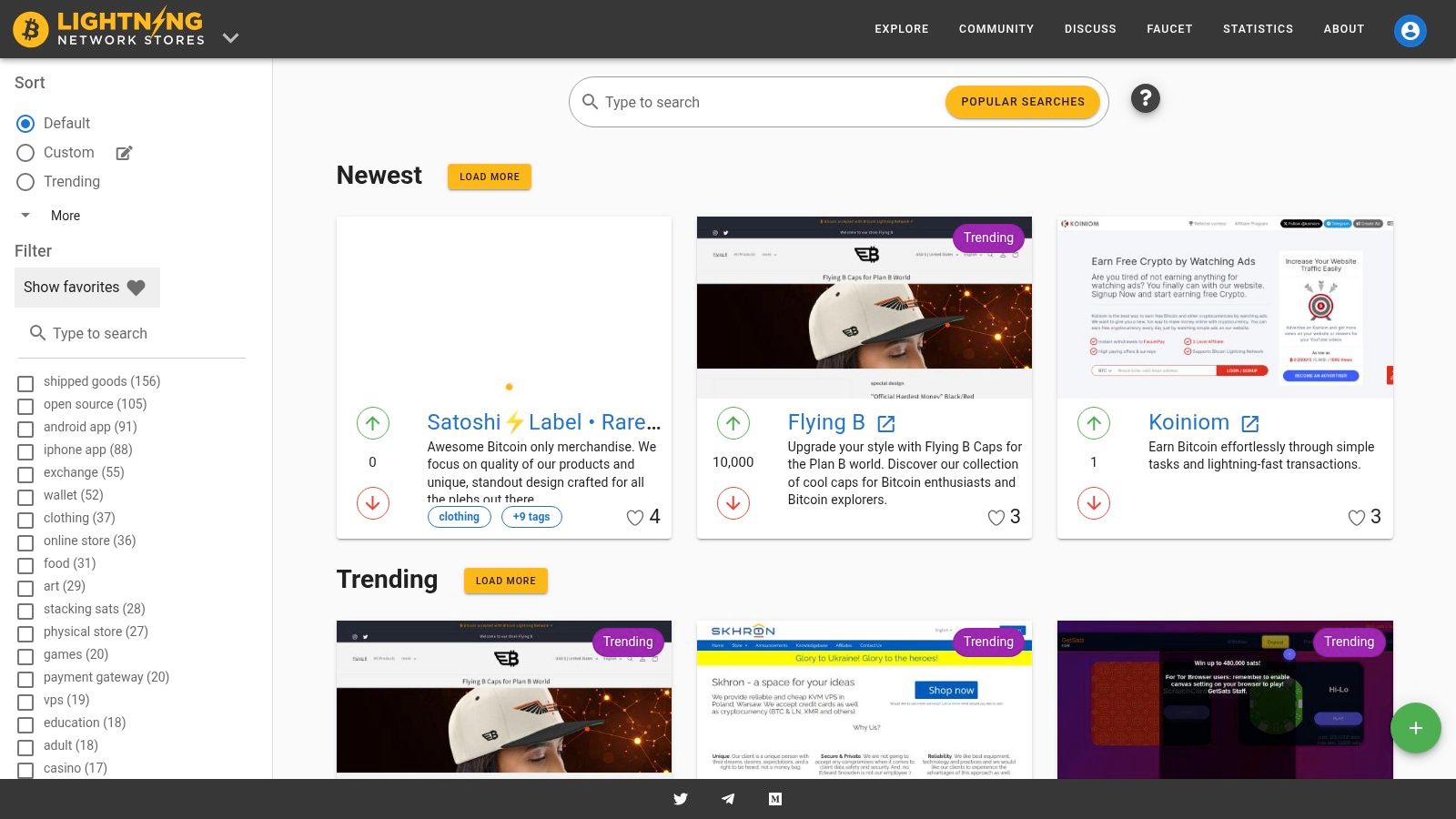
For the Lightning Network to achieve mainstream adoption, users need places to spend their bitcoin. The Lightning Network Stores Directory directly addresses this by providing a curated map of the real-world economy being built on Bitcoin’s second layer. It is an essential resource for finding both online and physical merchants that accept instant, low-fee Lightning payments.
This platform bridges the gap between holding bitcoin and using it for daily commerce. It serves as a powerful motivator for both consumers and merchants, showcasing a growing ecosystem where digital currency is a practical medium of exchange. For anyone looking to live on a Bitcoin standard, this directory is a vital tool.
Key Features and User Experience
The directory offers a clean, map-based interface that allows users to explore merchants by geographic location or browse through categories like "Food & Drinks," "Electronics," and "Services." This makes discovering new Lightning Network applications in commerce simple and intuitive. Each listing typically includes a brief description, a link to the store, and its location.
Practical Tip: Before visiting a physical store listed in the directory, it's wise to contact them or check their social media to confirm they still actively accept Lightning payments. Merchant point-of-sale systems and policies can change.
Pros:
- Drives Adoption: Directly facilitates the real-world use of Bitcoin for payments.
- Easy to Use: The map and category filters make finding merchants straightforward.
- Community-Driven: Relies on community submissions, ensuring the list stays current.
Cons:
- Regional Gaps: Merchant availability is concentrated in certain regions and may be sparse elsewhere.
- Merchant-Dependent: The directory's utility is entirely reliant on merchant participation and self-reporting.
Website: https://lightningnetworkstores.com
11. Lightning Network Explorer (1ML)
For those who want to look under the hood of Bitcoin's second layer, the Lightning Network Explorer (1ML) is an indispensable analytical tool. Rather than being a consumer-facing app, 1ML serves as a real-time dashboard and search engine for the network itself. It provides detailed statistics on network capacity, node count, and channel distribution, making it an essential resource for node operators, developers, and researchers.
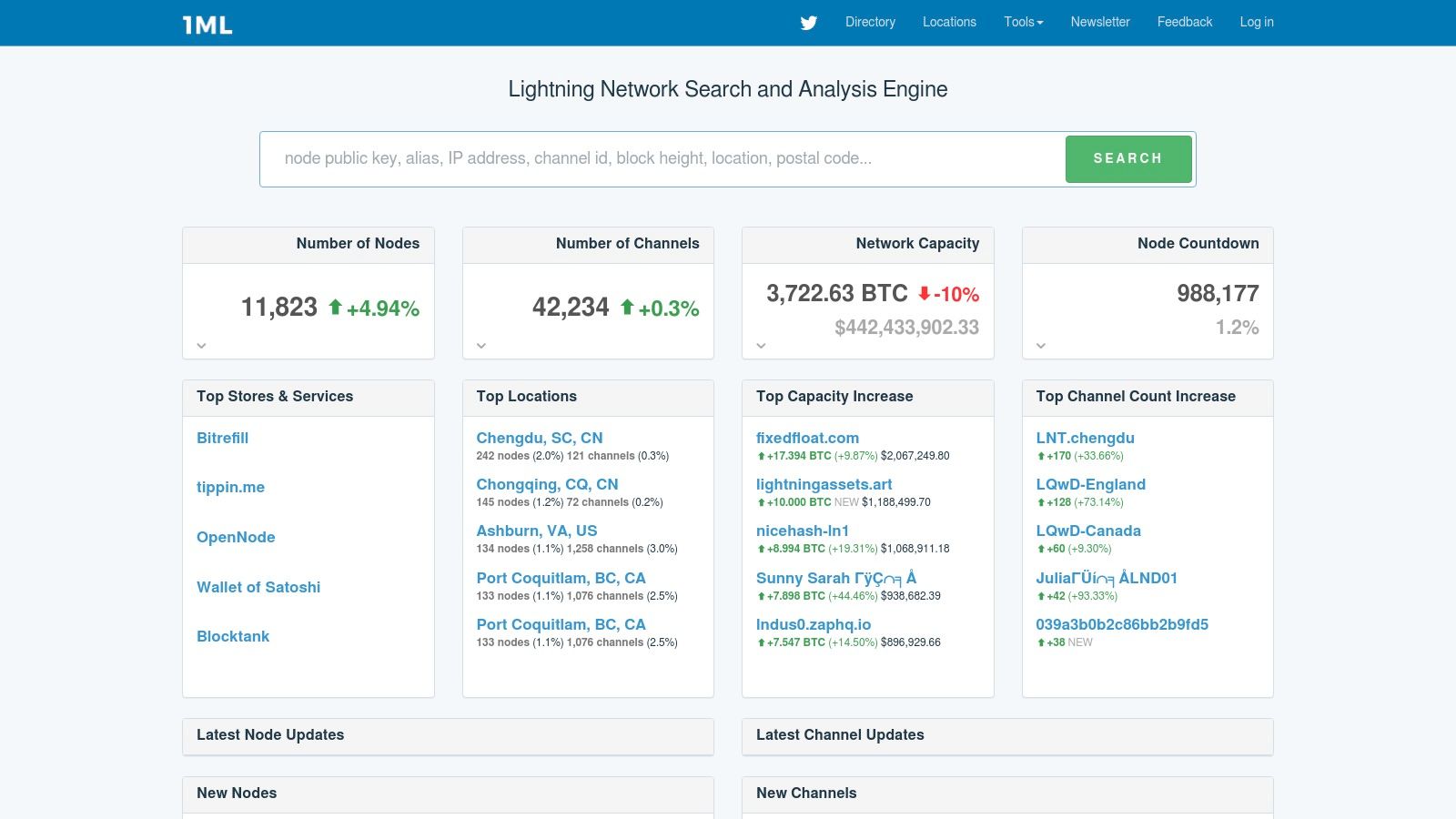
This platform stands out by transforming raw network data into accessible visualizations and searchable information. Node operators can use it to find well-connected peers to open channels with, while developers can analyze network growth and centralization trends. For anyone building Lightning Network applications, understanding the network's topology and health is crucial, and 1ML provides the necessary lens.
Key Features and User Experience
The interface is data-rich yet surprisingly easy to navigate. Users can search for specific nodes, view their channel connections, and analyze their network centrality. The main dashboard presents key metrics like total network capacity and the number of active nodes, offering a quick snapshot of the network's overall health and growth trajectory.
Practical Tip: As a node operator, use 1ML to research potential channel partners. Look for nodes with high capacity, a good number of channels, and a long uptime history to improve your own node's connectivity and routing efficiency.
Pros:
- In-depth Insights: Offers detailed, granular data for technical analysis and research.
- Real-time Statistics: Provides up-to-date metrics on network capacity, channels, and nodes.
- Free to Use: All analytical tools and data are publicly accessible without cost.
Cons:
- Niche Audience: Primarily useful for developers and node operators, not casual users.
- Can Be Overwhelming: The sheer volume of data may be intimidating for newcomers.
Website: https://1ml.com
12. Lightning Network Tech
For anyone looking to move beyond simply using the Lightning Network to actively participating in it, Lightning Network Tech is an essential educational resource. This platform is not an application but a knowledge hub dedicated to helping users set up, manage, and optimize their own Lightning nodes. It provides the deep technical guidance necessary for reliable network operation.
What sets this resource apart is its laser focus on the operational side of running a node. It demystifies complex topics like liquidity management, channel balancing, and routing fee optimization. This makes it an invaluable bookmark for aspiring node operators, developers, and merchants who want to take full control of their Lightning Network applications infrastructure and contribute to network decentralization.
Key Features and User Experience
The website is structured like a technical blog or wiki, with articles and guides organized for easy navigation. The content is presented clearly, often including code snippets and step-by-step instructions. This straightforward, tutorial-based approach empowers users to troubleshoot issues and improve their node's performance and profitability.
Practical Tip: Start with their "New Node Operator" guides. Even if you have some experience, they provide a solid foundation and often highlight common pitfalls that can be easily avoided.
Pros:
- Practical Guidance: Offers detailed, actionable tutorials for real-world node management.
- Free Knowledge Base: All content is freely accessible, supporting community learning.
- Covers Advanced Topics: Dives into complex subjects like liquidity and routing strategies.
Cons:
- Niche Focus: Highly technical content is not suitable for casual Bitcoin users.
- Requires Self-Direction: As a knowledge resource, it requires users to actively learn and apply the information.
Website: https://lightningcommunity.net
Lightning Network Applications Comparison Table
| Product | Core Features / Unique Selling Points ✨ | User Experience / Quality ★ | Value Proposition / Pricing 💰 | Target Audience 👥 | Website |
|---|---|---|---|---|---|
| Flash 🏆 | Wallet-to-wallet Bitcoin payments, POS app, subscription modules, no KYC | ★★★★★ Instant, secure, minimal fees | 💰 Custom pricing, scalable, no-/low-code setup | 👥 Merchants, startups, enterprises | paywithflash.com |
| Lightning App Directory | Extensive Lightning wallets/app listings, categorized | ★★★★ Regularly updated | 💰 Free resource | 👥 Lightning users, explorers | lightningappdirectory.com |
| BitcoinDev.org - Lightning Dev Resources | APIs, developer tools, enterprise-grade solutions | ★★★★ Detailed, technical | 💰 Free, developer-focused | 👥 Developers, enterprises | bitcoindev.org |
| Awesome Lightning Network | Community-curated Lightning projects & libs | ★★★★ Broad coverage, community | 💰 Free, open source | 👥 Developers, Lightning enthusiasts | github.com/LN-Zap/awesome-lightning-network |
| Bitrefill | Gift cards/mobile refills, instant Lightning payments | ★★★★ User-friendly | 💰 Costs vary, no account needed | 👥 Consumers, digital goods buyers | bitrefill.com |
| Strike | Instant Bitcoin payments, bank integration | ★★★★ Easy mobile use | 💰 No Bitcoin transaction fees | 👥 General users, mobile payers | strike.me |
| Amboss Technologies | Node monitoring, liquidity tools | ★★★★ Real-time insights | 💰 Some features paid, registration needed | 👥 Node operators, technical users | amboss.space |
| Voltage | Managed Lightning nodes, scalable infra, APIs | ★★★★ Enterprise support | 💰 Pricing on inquiry, possibly costly for small users | 👥 Businesses, developers | voltage.cloud |
| Lightning Network Plus (LN+) | Collaborative channel openings, community reputation system | ★★★ User-driven, network liquidity | 💰 Free | 👥 Node operators, community members | ln.plus |
| Lightning Network Stores Directory | Directory of Lightning-accepting merchants | ★★★★ Easy merchant discovery | 💰 Free | 👥 Bitcoin spenders, merchants | lightningnetworkstores.com |
| Lightning Network Explorer (1ML) | Real-time network stats, node & channel data | ★★★★ In-depth, technical | 💰 Free | 👥 Technical users, node operators | 1ml.com |
| Lightning Network Tech | Tutorials, liquidity management, monitoring | ★★★★ Educational, comprehensive | 💰 Free | 👥 Node operators, advanced users | lightningcommunity.net |
Choosing the Right Tools for Your Bitcoin Journey
Navigating the rapidly expanding ecosystem of lightning network applications can feel like exploring a new frontier. As we've seen, the landscape is rich and varied, offering powerful solutions for nearly every type of user, from individual Bitcoin enthusiasts and content creators to large-scale eCommerce merchants and enterprise-level developers. The journey through tools like the comprehensive Lightning App Directory, the analytical prowess of Amboss, and the infrastructure support from Voltage highlights a crucial takeaway: the Lightning Network is no longer a theoretical concept but a practical, high-speed reality for global commerce and finance.
The diversity of these tools is their greatest strength. A brick-and-mortar retailer might find immediate value in a simple, non-custodial payment processor to accept satoshis at the point of sale. In contrast, a SaaS provider will gravitate towards robust APIs and SDKs to seamlessly integrate recurring Bitcoin payments into their existing billing systems. The key is to move beyond a one-size-fits-all mentality and adopt a strategic approach to tool selection.
How to Select the Right Lightning Application
Your choice should be guided by a clear understanding of your specific objectives and technical comfort level. Before committing to a platform, consider these critical factors:
- Custody vs. Non-Custody: Do you prioritize convenience and simplicity (custodial), or do you value complete financial sovereignty and control over your keys (non-custodial)? This is often the most important initial decision for merchants and users alike.
- Technical Requirements: Are you a developer looking for a comprehensive SDK to build a new application from the ground up, or a non-technical business owner who needs a plug-and-play solution? Your technical expertise will heavily influence which tools are most suitable.
- Use Case Specificity: Are you focused on accepting one-time payments, managing subscriptions, facilitating cross-border remittances with a service like Strike, or simply exploring where to spend your sats with Bitrefill? Define your primary use case to narrow down the options.
- Scalability and Support: For businesses, it's vital to consider whether a tool can grow with you. Evaluate the provider's reputation, community support, and the scalability of their infrastructure to ensure it can handle your future transaction volume.
For those embarking on a more ambitious development journey, remember that the foundation of any great service is solid software architecture. Beyond specific Lightning tools, general app development frameworks are crucial. For those building from scratch, considering the best cross-platform app development tools can provide a comprehensive starting point for creating robust and user-friendly applications.
The evolution of these lightning network applications signals a pivotal moment for Bitcoin. They are the bridges connecting the network’s immense potential with real-world, everyday utility. By carefully selecting the right tools, you are not just adopting a new payment method; you are positioning yourself at the forefront of a financial revolution, ready to build, transact, and innovate on the world’s most secure and decentralized monetary network.
Ready to start accepting instant, low-cost Bitcoin payments without sacrificing control? Flash provides a non-custodial payment gateway designed for merchants who value financial sovereignty. Get started with Flash today and empower your business with the speed and freedom of the Lightning Network.