The Lightning Network offers near-instant payments at a fraction of the cost of traditional systems. With fees as low as 0.0029%, sending $1,000 costs less than $0.10 - far cheaper than the $18–$38 charged by credit card processors. It’s designed for micropayments and high-volume transactions, making it ideal for businesses looking to cut costs and improve payment efficiency.
Key points:
- Fee structure: A small base fee (often 1 satoshi) + a proportional fee rate (e.g., 0.1% of the transaction value).
- Cost comparison: Lightning Network is about 1,000 times cheaper than Visa or Mastercard.
- Speed: Payments settle almost instantly, unlike the 1–5 days required by traditional methods.
- Adoption: Bitcoin payments via Lightning grew from 6.5% in 2022 to 16.6% in 2024, with over 950 million users now accessing the network.
For businesses, managing direct channels with partners, using tools to balance liquidity, and optimizing routing paths can further reduce fees. Platforms like Flash simplify integration, allowing enterprises to benefit from Lightning's low costs without complex manual setups.
How do lightning network fees work - Bitcoin Layer 2 Breakdown
How Lightning Network Fees Work
Lightning Network fees consist of two parts: a fixed base fee and a proportional fee rate, both determined by individual node operators.
The base fee is a flat charge applied to every payment a node forwards. Often set at 1 satoshi per transaction, operators can adjust it or even reduce it to zero. On the other hand, the fee rate is tied to the transaction amount. For instance, a rate of 1,000 ppm (parts per million) translates to 0.1% of the payment value. This proportional fee compensates node operators for the liquidity they allocate when setting up channels. Interestingly, some operators may even introduce "negative fees" to promote channel rebalancing. These mechanisms are key to how the Lightning Network achieves its cost efficiencies.
Base Fee and Fee Rate Breakdown
The base fee helps cover the computational and storage costs associated with processing payments and maintaining channel states. Since it’s a flat fee, its impact is more noticeable on micropayments but becomes negligible for larger transfers.
Meanwhile, the fee rate adjusts based on the payment size. Larger transactions incur higher absolute fees, while smaller payments are charged less in proportion to their value. This scaling ensures that the fee structure remains fair across different transaction sizes.
Example of Fee Calculation
Let’s break it down with an example. Imagine a payment of 1,000 satoshis routed through a node with a base fee of 1 satoshi and a fee rate of 1,000 ppm (0.1%). The fees would look like this:
- Proportional fee: 1,000 satoshis × 0.1% = 1 satoshi
- Total fee: 1 satoshi (base fee) + 1 satoshi (proportional fee) = 2 satoshis
In this case, the sender would need to send 1,002 satoshis: 1,000 satoshis for the recipient and 2 satoshis to cover the fees. If the payment involves multiple hops, these fees accumulate at each intermediate node, increasing the total cost of the transaction.
Lightning Network Fees vs. Traditional Payment Methods
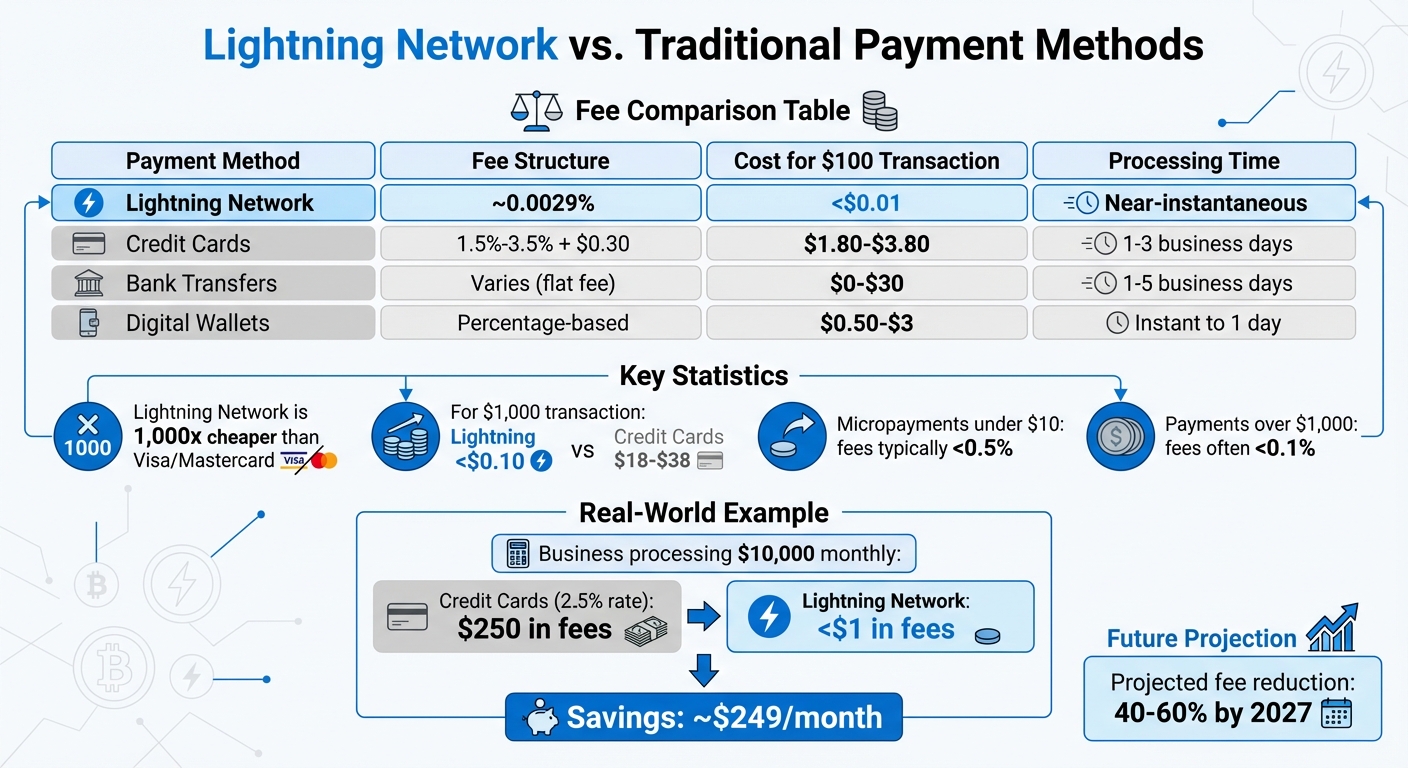
Lightning Network vs Traditional Payment Methods: Fee and Speed Comparison
For CFOs weighing payment systems, the cost difference between the Lightning Network and traditional methods is hard to ignore. Lightning Network fees are dramatically lower - about 1,000 times cheaper than those charged by Visa and Mastercard. This marks a major shift in how payments can be handled economically.
The advantage becomes even clearer with micropayments. For instance, the Lightning Network makes it possible to process small transactions, like $0.50 payments, profitably - something traditional systems struggle to achieve due to their high flat fees. For payments under $10, fees typically stay below 0.5%, while for amounts exceeding $1,000, they often drop below 0.1%.
Another key benefit is settlement speed, which directly impacts cash flow. Lightning payments settle almost instantly, compared to the 1–3 business days needed for credit card transactions or up to 5 days for international bank transfers. This immediate finality helps businesses avoid the delays associated with traditional systems.
Fee Comparison Table
Here’s a quick look at how the Lightning Network stacks up against other payment methods in terms of fees, costs, and processing times:
| Payment Method | Fee Structure | Typical Cost for $100 | Processing Time |
|---|---|---|---|
| Lightning Network | ~0.0029% | <$0.01 | Near-instantaneous |
| Credit Cards | 1.5% – 3.5% + $0.30 | $1.80 – $3.80 | 1–3 business days |
| Bank Transfers | Varies (often flat fee) | $0 – $30 | 1–5 business days |
| Digital Wallets | Varies (percentage-based) | $0.50 – $3 | Instant to 1 business day |
To put this into perspective, a business processing $10,000 monthly via credit cards at a 2.5% rate would pay around $250 in fees. Using the Lightning Network, the costs would be only a tiny fraction of that. Analysts also predict that Lightning Network fees could drop another 40–60% between 2025 and 2027 as the network grows and routing technology improves.
sbb-itb-f81ab9b
What Affects Lightning Network Fees
When it comes to Lightning Network fees, several operational factors come into play. These variables shape the overall cost structure, giving businesses insights into fine-tuning their payment systems. Unlike traditional payment methods with fixed percentages, Lightning fees are more dynamic and influenced by multiple elements.
Lightning Network fees follow a two-part structure: a base fee (usually 1 satoshi) and a proportional fee rate (measured in ppm or parts per million). For instance, if a node charges 500 ppm on a 1,000,000 satoshi payment, the proportional fee would be 500 satoshis, plus the 1 satoshi base fee - making the total 501 satoshis. Each node operator decides their own rates, which adds variability to the network.
The routing path your payment takes is a big factor in the final fee. Payments often pass through several nodes, with each node adding its own fees. For example, a payment routed through five nodes will cost more than one that only passes through two. To save on fees, businesses can establish direct channels with frequent partners, reducing the need for multi-node routing.
Liquidity management also plays a role in fee fluctuations. When a channel's liquidity becomes unbalanced, operators might increase fees to discourage further depletion or even offer negative fees (essentially discounts) to encourage traffic that rebalances the channel. As the Lightspark Team explains:
Routing fees are the economic engine of the Lightning Network, creating the financial incentive for operators to provide the liquidity that powers the system
.
Channel Opening and Closing Costs
On-chain operations, like opening and closing channels, also contribute to overall costs. These actions require Bitcoin transactions, which incur miner fees that vary depending on network congestion and transaction size.
A cooperative close, where both parties agree on terms, is the most cost-efficient option. By scheduling these transactions during low-traffic periods and using fee adjustment tools (e.g., --sat_per_vbyte or --conf_target), businesses can save significantly, and funds become available almost immediately. On the other hand, a force close is more expensive and locks funds for a set period due to pre-set, inflexible fees.
"Zombie channels" - inactive or unresponsive connections - are another source of inefficiency. These channels tie up capital that could be used elsewhere. Tools like Faraday can help identify and close these channels, freeing up liquidity for more productive routes. Timing channel transactions during low congestion can also slash setup costs by as much as 50%.
Routing Path Efficiency
The route your payment takes through the network directly impacts its cost. Around 95% of Lightning payments under $10 incur fees below 0.5%, so efficient routing is particularly important for businesses dealing with high transaction volumes.
Setting up direct channels with frequent payment partners is one way to lower costs by avoiding multi-hop fees. This strategy is especially beneficial for businesses handling regular, high-value payments.
While most wallet software automatically finds the cheapest and most reliable routes, you can take additional steps. Tools like Loop can help rebalance channels without needing to close and reopen them, maintaining efficient routing paths and avoiding extra on-chain fees. Additionally, sending payments during off-peak hours, when nodes may offer lower fees, can further reduce costs.
Node Policies and Fee Variability
Fee policies are set individually by node operators, leading to variability across the network. Lightning Engineering highlights the importance of fee settings:
setting the fee rate correctly can mean the difference between a node that routes and one that doesn't, and make and break your node's profitability
.
Operators adjust their fees based on liquidity and business priorities. High fees often indicate an attempt to prevent liquidity depletion, while low or negative fees aim to attract traffic that rebalances channels. This dynamic pricing means that costs for the same route can vary depending on network conditions.
When choosing channel partners, look for nodes with high reliability and consistent fee policies. Nodes with frequent fee changes can disrupt routing efficiency and increase costs. Keep an eye on your channel partners' performance and reallocate funds from underperforming connections to more stable, cost-effective options for better results.
How to Minimize Lightning Network Fees
Cutting down on Lightning Network fees comes down to smart management of channels, routing, and payment tools. By understanding these core areas, CFOs can keep transaction costs low without sacrificing speed or reliability. Below are actionable strategies to help reduce fees while maintaining efficient payment flows.
Optimizing Channel Management
Timing matters when it comes to opening channels. Doing so during periods of low network activity, like weekends, can reduce setup costs. Establishing direct channels with frequent payment partners is another way to avoid intermediary fees. This is especially helpful for regular transactions, as direct connections immediately cut costs. Additionally, closing inactive "zombie channels" can free up locked funds, making them available for more productive routes. Use reporting tools to identify which channels are performing well and which aren’t worth keeping open.
Balancing liquidity is equally important. Routing failures often lead to costly retries, but tools like Loop Out can help. These services allow you to move funds into cold storage without losing inbound channel capacity, avoiding repeated on-chain fees. Regularly monitoring your channels ensures that both local and remote capacities stay balanced, keeping operations smooth and cost-effective.
Using Flash for Lower Costs

Flash is a non-custodial Bitcoin payment gateway designed for enterprise use, enabling businesses to accept Bitcoin payments in under a minute. By leveraging the Lightning Network’s median fee rate of about 0.0029%, Flash allows transactions to be approximately 1,000 times cheaper than traditional credit card payments. For instance, a $1,000 transaction might cost less than $0.10 with Flash, compared to $18–$38 in credit card fees. Its wallet-to-wallet structure ensures businesses retain full control over their funds while Flash handles the complexities of channel management and routing.
Multi-Hop Routing Strategies
Multi-path payments (MPP) can help reduce fees for larger transactions by splitting them across multiple routes. This method eases the burden on individual channels and lowers overall costs, particularly for payments over $1,000, which typically incur fees below 0.1%. Enterprise wallets with route optimization features - whether manual or automatic - can identify the cheapest paths for each transaction. Additionally, sending non-urgent payments during off-peak hours can further reduce fees. Dedicated routing tools also allow businesses to monitor peer performance, helping CFOs identify reliable, cost-efficient paths while disabling underperforming channels.
Conclusion
Lightning Network fees are changing the game for payment processing, offering businesses a powerful way to cut costs and improve efficiency. By understanding the fee structure, CFOs can make smarter decisions to optimize their payment systems. With near-instant settlements and incredibly low fees, the Lightning Network is especially appealing for high-volume transactions, cross-border payments, and smaller transactions that used to be too expensive to process.
Platforms like Flash make Bitcoin integration easier than ever, allowing businesses to tap into these low fees without the hassle of managing channels manually. Solutions like this make adopting the Lightning Network a seamless process, unlocking savings right away.
Experts predict that Lightning fees could drop another 40–60% by 2027, thanks to advancements like Taproot Channels and channel factories, as well as a denser network. Businesses that adopt early can benefit from immediate savings and stay ahead as the technology improves. The growing use of Lightning-based payments signals a significant shift in global payment methods. Its combination of cost savings and fast settlements is already reshaping strategies for businesses worldwide.
For CFOs planning their payment strategies, Lightning Network fees aren’t just a technical detail - they’re a real opportunity to cut costs, boost cash flow, and tap into a streamlined global payment system without the high fees of traditional processors.
FAQs
How do Lightning Network fees compare to traditional payment methods?
The Lightning Network provides a low-cost and adaptable fee system compared to conventional payment methods. Most transactions cost less than $0.01, with fees made up of a small base charge and a routing fee, which incentivizes efficient payment routing.
By comparison, traditional payment systems - such as credit cards or international bank transfers - often impose percentage-based fees ranging from 2% to 10%, along with extra fixed charges. These minimal fees make the Lightning Network appealing to businesses aiming to cut down on transaction costs while offering quick, worldwide Bitcoin payments.
How can businesses reduce Lightning Network fees effectively?
To keep Lightning Network fees in check, businesses can focus on smart channel management. Maintaining a balanced liquidity ratio - ideally around 50-70% outgoing and 30-50% incoming - helps lower the chance of failed payments, which can rack up unnecessary costs. On top of that, setting competitive base fees and adjusting fee rates dynamically can draw in more routing traffic. This approach boosts profitability while keeping fees manageable.
Working with reliable peers who operate high-capacity channels is another way to cut costs. Larger channels tend to handle transactions more efficiently, making them a valuable asset. Regularly rebalancing channels and carefully selecting the best payment routes are also key strategies for smooth operations and avoiding excessive fees on the Lightning Network.
How do node operators influence Lightning Network fees?
The fees on the Lightning Network are shaped by the decisions of individual node operators. Each operator sets their own fee structure, which typically includes two components:
- Base fee: A flat cost applied to each transaction.
- Routing fee: A percentage of the transaction amount.
This setup creates a dynamic, market-driven system where fees can vary depending on the nodes involved in a payment's route.
Because of this variability, fees are not constant - they can shift based on factors like network demand, competition among nodes, and the specific fee policies of the nodes handling your transaction. By understanding these factors, businesses can better strategize for cost-effective use of the Lightning Network.