The Lightning Network has grown into a major solution for scaling Bitcoin payments, especially for businesses. By late 2025, its capacity hit a record 5,637 BTC, driven by adoption from exchanges and enterprises. Key players like BitGo, Voltage, LQWD, and Flash offer tailored services to simplify payment processing, improve speed, and reduce costs. Here's a quick breakdown:
- BitGo: Combines Lightning with institutional-grade security, offering custody solutions for enterprises.
- Voltage: Provides managed node infrastructure, focusing on speed, liquidity, and compliance.
- LQWD: Enhances routing efficiency and liquidity management for high-volume transactions.
- Flash: Acts as a gateway for fast, low-cost Bitcoin payments with flexible integration.
Each solution addresses specific needs, from custody and compliance to scalability and cost efficiency. Businesses can now process Bitcoin transactions almost instantly, with reduced fees and advanced liquidity tools, making Bitcoin payments practical for daily operations.
Lightning Network Explained: Bitcoin's Layer 2 Scaling Solution for Fast & Cheap Transactions
1. BitGo Lightning Custody
BitGo, now a publicly traded company since January 22, 2026, operates as a federally chartered national trust bank under the regulation of the OCC. This status enables businesses to utilize Lightning Network payments while adhering to strict custody requirements. To date, BitGo has created over 9.3 million wallets and processed transactions exceeding $3 trillion in value.
In collaboration with Voltage, BitGo streamlines Lightning operations by automating tasks like node configuration, channel management, and liquidity provisioning. This eliminates the need for dedicated Signer Nodes or manual private key handling. Mike Belshe, BitGo's CEO and Co-Founder, highlights the significance of this integration:
"By offering institutional access to Lightning directly from custody, we are allowing our clients to focus on innovation instead of infrastructure. We are combining the speed and lower transaction costs of Lightning with the trusted security of BitGo to make bitcoin practical for everyday payments."
Transaction Speed
Using the Lightning Network, BitGo transforms Bitcoin's usual 10-minute block confirmation times into near-instant settlements - often completed within milliseconds or seconds. This rapid processing is essential for applications like retail transactions, streaming payments, and micropayments, which would otherwise be impractical on Bitcoin's base layer. The system supports up to 1,000,000 transactions per second, a stark contrast to the Bitcoin mainnet's capacity of approximately 7 transactions per second.
Fees
Lightning transactions through BitGo come with significantly lower fees compared to standard on-chain Bitcoin transactions. This cost efficiency makes high-volume micropayments and retail operations more viable. BitGo's managed services model further reduces costs by eliminating the need for dedicated staff to oversee node uptime and channel liquidity. This "zero operational overhead" approach allows businesses to expand their payment operations without proportionally increasing infrastructure expenses.
Enterprise Scalability
By embedding Lightning capabilities within its institutional-grade security framework, BitGo offers enhanced scalability and security. Multi-signature and Multi-Party Computation protocols eliminate single points of failure. Enterprises can bolster security with customizable wallet policies, such as whitelisting, transaction caps, and role-based access. Additionally, BitGo and Voltage ensure seamless payment channel liquidity, removing the need for manual rebalancing. APIs enable instant transfers between on-chain and Lightning, while webhook systems provide real-time reconciliation updates. Furthermore, assets held in BitGo's custody are backed by a $250 million insurance policy against theft or loss.
Next, we’ll dive into Voltage’s role in managed node infrastructure.
2. Voltage Node Management
Voltage takes the complexity out of node management by offering "Lightning-as-a-Service", making it easier for enterprises to operate without needing a dedicated technical team. This platform handles everything from server provisioning to 24/7 monitoring and uptime, all while maintaining non-custodial security through client-side encryption. Even though Voltage is a managed service, it never accesses private keys or funds. Instead, nodes are encrypted with passwords set and controlled solely by the user. Let’s dive into how Voltage improves transaction speed and liquidity management.
Transaction Speed
Voltage enhances transaction efficiency by using a hybrid network mode that combines Tor and clearnet. This setup ensures better availability and reduces latency. By leveraging LND's bimodal pathfinding, Voltage delivers more accurate probability estimates, which leads to faster routing and higher payment success rates. On top of that, the shift to native SQL schemas like Postgres and SQLite significantly shortens node startup times - an essential feature for enterprises handling large transaction volumes.
Liquidity Handling
Managing liquidity can be a challenge, but Voltage simplifies this with a hands-on approach to monitoring and adjusting channel capacity. One standout feature is zero-confirmation channels, which allow immediate use of liquidity without waiting for on-chain confirmations. This is a game-changer for high-volume businesses, as it helps minimize payment failures. Stephen DeLorme, a key figure in Lightning Network Development at Voltage, highlights the importance of splicing for scaling:
"Splicing is key for enterprises who begin scaling Lightning payments. Businesses can remove capital where it is no longer needed, and deploy it where it is most in demand".
Another valuable tool is Terminal Web, which enables enterprises to open multiple channels in a single on-chain transaction. This feature significantly reduces transaction fees during scaling.
Enterprise Scalability
Voltage is built with enterprise needs in mind, meeting SOC 2 Type II and NMLS compliance standards. This ensures that infrastructure management is kept separate from payment operations, boosting security. To further ease operations, the platform offers Automated Static Channel Backups, which preserve channel data for fund recovery without requiring manual intervention. For businesses looking to scale programmatically, the Nodes API allows automatic provisioning and management of nodes for end-users. Additionally, Voltage provides flexible credit lines, enabling instant transactions without the need to pre-fund accounts - an essential feature for enterprises managing high transaction volumes.
3. LQWD Technologies Routing

LQWD Technologies improves enterprise Lightning routing by leveraging historical transaction data and advanced pathfinding methods. By analyzing past transactions, it avoids unreliable paths, reducing failed payment attempts and boosting transaction speed. These advancements build on the performance upgrades introduced by BitGo and Voltage, delivering a more efficient routing experience.
Transaction Speed
LQWD boosts transaction speed by using Mission Control (MC) data to track the history of node pairs, including timestamps and payment outcomes. It applies a bimodal probability estimation method, which assumes liquidity tends to be higher at channel edges, to predict success rates for different payment amounts. This combination ensures faster multi-hop payments, especially for enterprises handling high transaction volumes. Alongside speed improvements, LQWD also addresses liquidity management to ensure smooth operations.
Liquidity Handling
To maintain stable liquidity during high-demand periods, LQWD employs dynamic splicing and Autoloop automation techniques.
Enterprise Scalability
LQWD, like BitGo and Voltage, focuses on scalability and network efficiency. Enterprises benefit from SQL backends optimized for parallel I/O, enabling seamless handling of large transaction volumes. The bimodal estimator effectively manages U-shaped liquidity distributions in high-volume channels. Additionally, LQWD integrates the Validating Lightning Signer (VLS) to provide strong security without sacrificing routing efficiency.
sbb-itb-f81ab9b
4. Flash Lightning Support
Flash acts as a Bitcoin payment gateway on the Lightning Network, enabling businesses to accept Bitcoin quickly and efficiently. With its ability to handle instant off-chain transactions, Flash is ideal for companies needing fast payment processing, especially in global markets. Its standout features include speed, cost efficiency, liquidity management, and scalability.
Transaction Speed
Flash leverages off-chain ledgering to settle payments in seconds, making it perfect for point-of-sale systems and real-time payment scenarios. Businesses dealing with high transaction volumes can avoid the delays associated with traditional blockchain confirmations, all while benefiting from Bitcoin's strong security framework.
Fees
Thanks to the off-chain structure of the Lightning Network, Flash offers low transaction fees compared to conventional payment methods. Lightning routing fees are made up of two parts: a base fee (a fixed cost per payment) and a fee rate (a percentage based on the transaction amount). By cutting out traditional payment processors and their hefty fees, businesses can save on operational costs while enabling direct wallet-to-wallet payments. This fee model also makes handling micropayments cost-effective.
Liquidity Handling
Flash ensures smooth liquidity management by balancing both inbound and outbound channel capacities. Inbound liquidity allows businesses to receive payments, while outbound liquidity supports sending funds. The platform also integrates Lightning Loop, a non-custodial service that facilitates "Loop In" (adding on-chain BTC to Lightning channels) and "Loop Out" (moving Lightning funds to on-chain addresses). This flexibility ensures businesses can maintain sufficient liquidity, even during busy transaction periods.
Enterprise Scalability
Flash supports enterprise growth with tools like low-code solutions, real-time analytics, and mobile-friendly interfaces, all while keeping funds under non-custodial control. These features make it a strong option for companies looking for a scalable and efficient payment solution, paving the way for a closer look at its benefits and potential limitations.
Strengths and Weaknesses
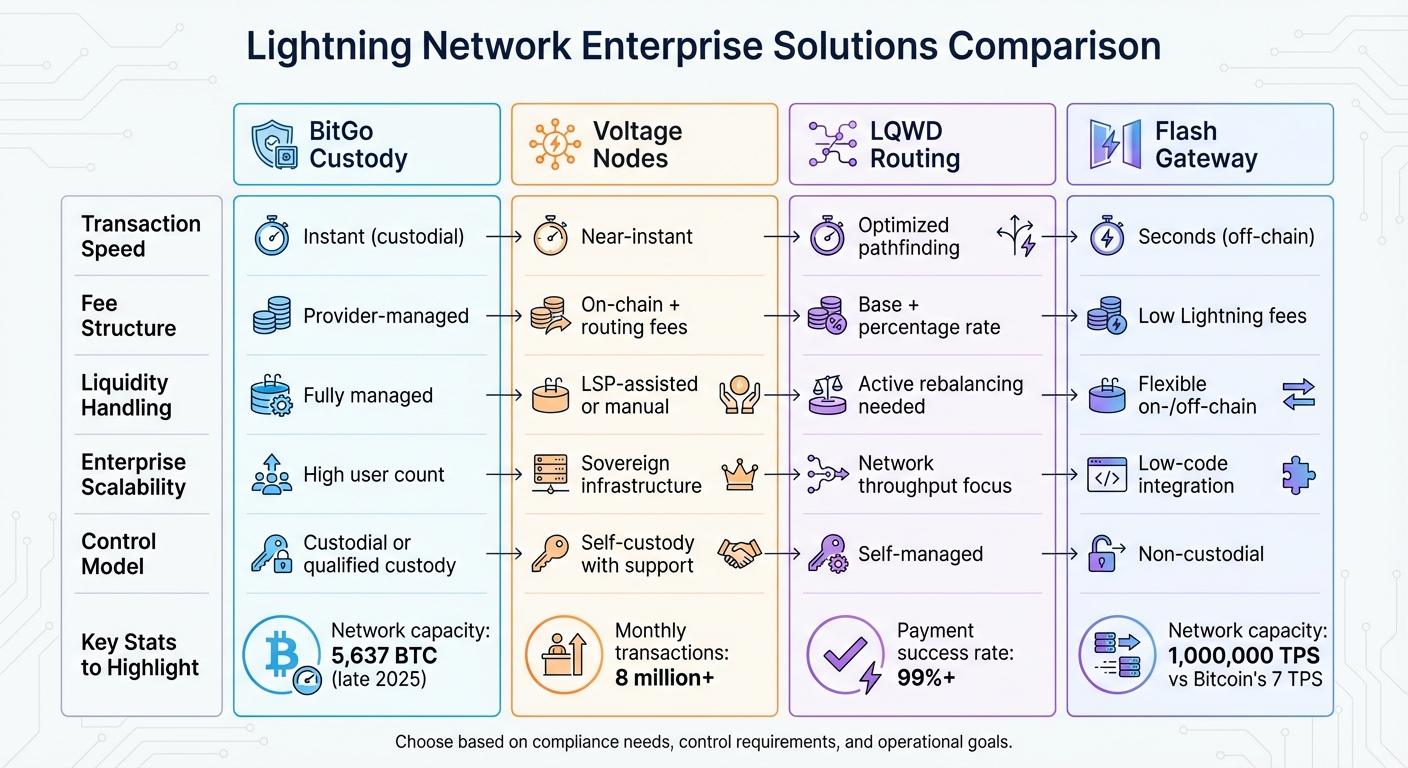
Lightning Network Enterprise Solutions Comparison: BitGo, Voltage, LQWD, and Flash
Here’s a closer look at the operational strengths and trade-offs of various Lightning Network solutions, particularly in the context of enterprise deployment.
BitGo Lightning Custody stands out for its institutional-grade security, backed by its OCC-approved national trust bank status. It integrates seamlessly with existing wallet policies through a modular API, making it highly adaptable for organizations. However, being a custodial solution, it offers minimal onboarding costs but comes with the trade-off of reduced direct control over funds.
Voltage Node Management is designed for robust infrastructure, powering major financial operations like Fidelity and national-scale wallets such as El Salvador’s Chivo. River Financial, which manages Chivo’s infrastructure, employs a dedicated team of four developers and, as of October 2022, operated the fourth-largest node by capacity. The downside? Non-custodial setups require on-chain funding for each channel, which can drive up liquidity costs.
LQWD Technologies Routing focuses on efficient payment routing and liquidity deployment across the network. Its routing nodes can even generate yield, with reports suggesting returns of approximately 9.7%. However, achieving this requires a significant upfront investment and ongoing channel rebalancing to keep payments flowing smoothly.
Flash Lightning Support offers a balance of speed and cost-effectiveness through its non-custodial architecture. Businesses benefit from flexible liquidity management, allowing funds to move easily between on-chain and Lightning channels. Its low-code integration and real-time analytics simplify enterprise adoption. That said, maintaining effective channel liquidity remains key to ensuring reliable payments.
| Feature | BitGo Custody | Voltage Nodes | LQWD Routing | Flash Gateway |
|---|---|---|---|---|
| Transaction Speed | Instant (custodial) | Near-instant | Optimized pathfinding | Seconds (off-chain) |
| Fee Structure | Provider-managed | On-chain + routing fees | Base + percentage rate | Low Lightning fees |
| Liquidity Handling | Fully managed | LSP-assisted or manual | Active rebalancing needed | Flexible on-/off-chain |
| Enterprise Scalability | High user count | Sovereign infrastructure | Network throughput focus | Low-code integration |
| Control Model | Custodial or qualified custody | Self-custody with support | Self-managed | Non-custodial |
These comparisons highlight the strategic factors enterprises must weigh when choosing a Lightning Network solution. Each option brings its own strengths and trade-offs, tailored to different operational needs.
Conclusion
The Lightning Network has evolved to meet the demands of enterprise-level operations. With over 8 million transactions processed monthly and a payment success rate of over 99%, it has shown it can handle business-scale activity with ease.
These impressive metrics highlight the effectiveness of tailored Lightning solutions. BitGo Lightning Custody provides financial institutions with a compliance-focused option that minimizes operational complexity. For enterprises needing direct control and reliable management of their high-volume Lightning nodes, Voltage Node Management is an excellent fit. Meanwhile, Flash Lightning Support delivers a fast, cost-effective, and flexible approach with its non-custodial framework, offering businesses easy liquidity management and low-code integration.
The numbers back up Lightning's growing adoption in the enterprise world. Around 15% of Bitcoin withdrawals on major exchanges now rely on Lightning, with Coinbase's integration playing a key role in this shift. Looking ahead, Block's plan to roll out Lightning payments to millions of merchants by 2026 indicates the network's trajectory.
"By offering institutional access to Lightning directly from custody, we are allowing our clients to focus on innovation instead of infrastructure." – Mike Belshe, CEO and Co-Founder, BitGo
Ultimately, scaling with the Lightning Network comes down to aligning the right solution with your operational goals - whether it's compliance, control, efficiency, or straightforward integration. With the network's capacity hitting a record 5,637 BTC in late 2025, businesses now have the tools they need to scale Bitcoin payments effectively.
FAQs
How does the Lightning Network make Bitcoin transactions faster and more affordable?
The Lightning Network improves Bitcoin transactions by allowing instant payments through off-chain channels. Instead of relying on the blockchain for every transaction, it processes payments off-chain, which helps avoid network congestion and ensures transactions happen almost immediately.
This method also cuts down transaction fees dramatically, making it perfect for micropayments and routine transactions. With these advantages, businesses and users can benefit from quicker and more affordable Bitcoin payments, all while keeping security and decentralization intact.
How does BitGo improve the security and scalability of Lightning Network payments?
BitGo enhances the security and scalability of Lightning Network payments with its institutional-grade custody solutions. It takes care of critical tasks like managing nodes, securing private keys, and overseeing channel operations, ensuring transactions remain both safe and efficient.
By handling these complex processes and offering a strong infrastructure, BitGo makes Bitcoin transactions faster and more cost-effective, while delivering the trust and reliability that businesses and enterprises need.
How does Voltage optimize liquidity and ensure reliable transactions for enterprises using the Lightning Network?
Voltage takes the hassle out of managing Lightning Network infrastructure by handling essential tasks like running nodes, overseeing channels, and ensuring liquidity is in check. This lets businesses concentrate on what they do best, while Voltage keeps payment operations running smoothly.
With automated liquidity management, Voltage addresses potential problems like channel depletion or imbalances before they become an issue. This proactive strategy ensures high transaction success rates and keeps the network stable, even when handling large transaction volumes - making it a dependable choice for enterprises looking to scale.