The Lightning Network enables fast Bitcoin payments, but routing issues like hidden channel balances and liquidity shifts create challenges. Failed transactions often stem from insufficient liquidity along a payment path. To improve success rates, businesses must monitor key metrics like Max Flow, channel stability, and historical routing data.
Here's what you need to know:
- Max Flow predicts payment success for specific amounts, offering insights beyond basic stats like node count or capacity.
- Liquidity distribution is uneven: 75% of nodes have fewer than four channels, and the median channel size is 1.07M satoshis.
- Tools like Flash optimize routing with advanced algorithms, prepay probes, and real-time data, ensuring higher success rates for payments.
1. Flash

Flash offers a non-custodial, instant payment solution built on the Lightning Network. Since the success of customer payments hinges on reliable routing, Flash's infrastructure is designed to optimize payment processing through advanced metrics and technology. Here's how Flash ensures high routing success and maintains node availability.
Routing Success Rate
Flash relies on Mission Control (MC), a key subsystem that tracks historical payment data between node pairs. By logging each payment attempt's time and value, Mission Control uses this data to avoid routes prone to failure and prioritize those with a strong success record.
To enhance routing accuracy, Flash employs pathfinding estimators like the A Priori and Bimodal models. These models analyze channel characteristics and past performance to predict the likelihood of successful routing. Additionally, Flash uses prepay probes - small test payments that check for path viability and liquidity before processing the actual transaction. This proactive approach minimizes failures and improves the overall success rate of payments.
Uptime and Node Availability
For smooth routing, nodes must remain online and channels active. Flash ensures this through automated health checks that monitor node connectivity and channel activity. These checks, often conducted via Tor, confirm that nodes are accessible and that channels have not been disabled or become inactive.
Mission Control also tracks the success and failure history of node-pair connections over time. This data helps identify unreliable nodes or frequently offline channels. By analyzing channel stability and closing inactive or underperforming channels, Flash maintains a dependable routing infrastructure, reducing disruptions for businesses relying on its payment gateway.
2. Other Bitcoin Payment Gateways
While Flash relies on its own unique methods, other Bitcoin payment gateways use similar metrics but apply different models to ensure reliable routing.
Routing Success Rate
Many Bitcoin payment gateways use probabilistic scoring to estimate the likelihood of successful payment routing. For example, the Lightning Development Kit (LDK) employs a method called "probing." This involves sending payments with invalid hashes to test channel liquidity without risking actual funds. The results from these tests are then fed into a ProbabilisticScorer, which improves its predictions over time.
Most gateways use one of two main pathfinding models:
- A Priori Estimator: This model starts with a baseline assumption of a 60% success rate for each hop. If smaller payments succeed, the probability increases to 95%.
- Bimodal Estimator: This approach assumes that liquidity tends to concentrate at the edges of channels, meaning many channels are unbalanced. It calculates success probabilities based on the size of the payment in relation to the channel's total capacity.
"A priori and bimodal estimators use distinct base probabilities, leading to varying fee-probability tradeoffs. In practice, bimodal payments are expected to be more likely to succeed, but at higher fees." - Builder's Guide, Lightning Engineering
To balance cost and reliability, gateways assign a "virtual fee" to routes based on the likelihood of failure. This "attempt cost" helps prioritize more expensive but dependable paths over cheaper, riskier ones. Interestingly, only about 10% of nodes (around 2,300) currently use fee rate adjustments to signal liquidity availability. This focus on probability naturally extends to how gateways optimize channel efficiency.
Channel Capacity Efficiency
As of April 2024, the Lightning Network included roughly 14,000 nodes and over 53,000 channels, with total capacity surpassing $370 million by October 2024. However, capacity distribution remains highly uneven. The median channel holds just 1.07 million satoshis, and 25% of nodes have a total liquidity of less than 2.64 million satoshis.
Routing success largely depends on "routable liquidity" - the availability of sufficient balances in both directions. Pathfinding algorithms calculate the probability of success based on the payment size relative to a channel's capacity. As payments approach a channel's maximum capacity, the likelihood of success drops significantly. Gateways often monitor metrics like lnd_channels_bandwidth_incoming_sat and lnd_channels_bandwidth_outgoing_sat to evaluate available bandwidth in both directions.
Uptime and Node Availability
Many nodes operate with limited channel connections, which makes the network heavily reliant on well-connected hubs for reliable routing. If a node goes offline during a transaction, it can cause an immediate failure or result in a "stuck payment", where funds remain locked until the timeout period ends.
"Lack of knowledge about node balances is the primary reason that payments fail." - Builder's Guide, Lightning Engineering
To minimize such issues, gateways prioritize nodes with high uptime and older, more stable channels. The age of a channel often indicates its profitability and reliability, as operators are less likely to close channels that consistently generate income. Gateways also perform regular health checks on nodes and adjust their routing preferences based on real-time performance data to maintain reliable routing.
sbb-itb-f81ab9b
Pros and Cons
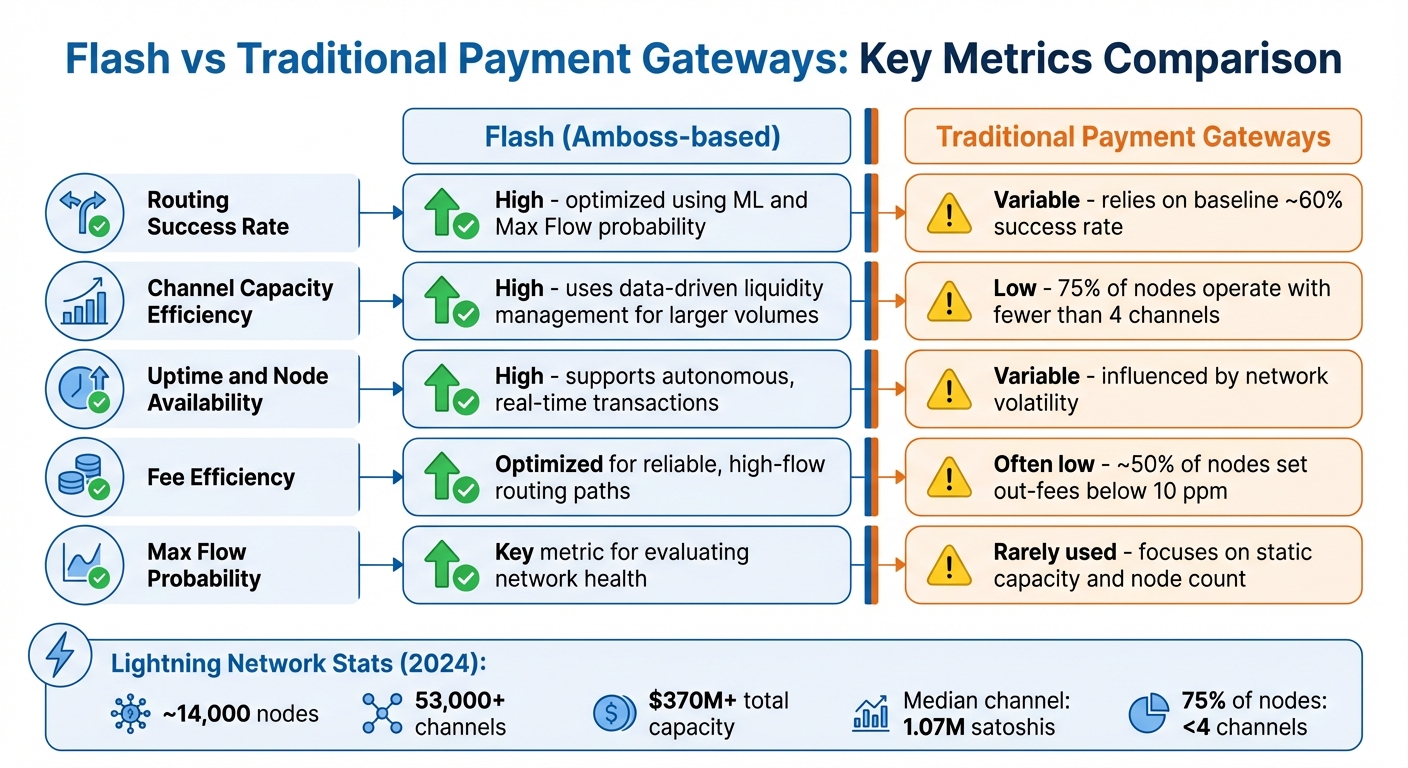
Flash vs Traditional Lightning Network Payment Gateways Comparison
Flash leverages machine learning (ML) and Max Flow metrics to enhance routing success rates, ensuring efficient liquidity distribution and addressing bottlenecks in real time. This makes it particularly effective for handling large-scale transactions. By using Max Flow probability, Flash evaluates network health and payment feasibility, making it ideal for autonomous operations. Additionally, Flash benefits from Bitcoin's price fluctuations; for instance, a 0.1 BTC channel automatically doubles its routing capacity when Bitcoin's value increases from $50,000 to $100,000 - without requiring any infrastructure updates.
On the other hand, traditional gateways rely on more static systems. Around 75% of Lightning Network nodes operate with fewer than four channels, creating dependency on central hubs and increasing the likelihood of routing bottlenecks. With a median node capacity of just 10.55 million satoshis, most nodes struggle to process larger payments without splitting transactions. Moreover, hidden channel balances force these gateways into trial-and-error processes, which can slow down transactions and reduce efficiency. Unlike Flash, traditional gateways require manual adjustments to channel configurations as market conditions evolve, lacking the automatic scalability that Flash offers.
| Metric | Flash (Amboss-based) | Traditional Payment Gateways |
|---|---|---|
| Routing Success Rate | High; optimized using ML and Max Flow probability | Variable; often relies on a baseline success rate of ~60% |
| Channel Capacity Efficiency | High; uses data-driven liquidity management for larger volumes | Low; 75% of nodes operate with fewer than four channels |
| Uptime and Node Availability | High; supports autonomous, real-time transactions | Variable; influenced by network volatility |
| Fee Efficiency | Optimized for reliable, high-flow routing paths | Often low; ~50% of nodes set out-fees below 10 ppm to attract traffic |
| Max Flow Probability | Key metric for evaluating network health | Rarely used; focuses instead on static capacity and node count |
Conclusion
Keeping track of essential metrics is a key part of ensuring smooth Lightning Network transactions. Among these, Max Flow emerges as a standout metric that businesses should focus on. Unlike traditional metrics - such as node count, channel count, or total capacity - Max Flow provides a clearer picture by evaluating the likelihood of payment success for specific transaction amounts. It measures the probability of routing success, offering insights beyond just value movement.
By adopting liquidity flow metrics, businesses can identify bottlenecks and better predict payment outcomes. For example, a channel with 0.1 BTC can handle a $5,000 payment when Bitcoin is priced at $50,000 and $10,000 when the price rises to $100,000. This data-driven approach helps businesses make informed decisions about channel management and assess payment success probabilities before initiating transactions.
Tools like Flash take this a step further by using advanced routing algorithms to optimize liquidity distribution in real time. This not only simplifies the management of larger transactions but also reduces the need for manual intervention, making it easier to scale Bitcoin payment systems efficiently.
These strategies highlight the importance of proactive liquidity management. Instead of waiting for routing failures to occur, businesses should regularly monitor inbound capacity, use prepay probes to test transaction routes, and ensure high node uptime. Together, these practices create a strong foundation for handling Bitcoin payments at scale. By adopting this streamlined approach, businesses can build a reliable and scalable Bitcoin payment infrastructure.
FAQs
What is Max Flow, and why does it matter for the Lightning Network?
Max Flow represents the highest volume of Bitcoin that can move through the Lightning Network, taking into account the capacity of channels and available liquidity. It’s a key metric for gauging how effectively the network can handle transactions and the chances of those transactions being completed successfully.
Keeping an eye on Max Flow helps businesses streamline Bitcoin payments, fine-tune their routing methods, and ensure transactions are quick, dependable, and cost-efficient.
How does Flash achieve reliable Bitcoin transaction routing?
Flash uses advanced probabilistic pathfinding methods to make Bitcoin transaction routing more reliable. These methods assess channel liquidity and calculate the chances of successful payments, helping to pick the fastest and most reliable routes.
By constantly refining routing paths, Flash reduces delays, keeps fees low, and delivers a seamless experience for users, enabling quick and hassle-free payments.
Why is managing liquidity on the Lightning Network so challenging?
Managing liquidity on the Lightning Network can feel like navigating a maze. Payment channels don’t offer full transparency about how funds are split between parties, adding a layer of complexity. On top of that, liquidity is in constant flux as transactions happen, making it tricky to predict whether a channel will successfully route payments.
Because of this unpredictability, businesses need to keep a close eye on their liquidity and fine-tune their channel strategies regularly. This helps ensure smooth transaction routing and minimizes the risk of payment failures.