Lightning payments transform how businesses handle transactions by enabling instant settlements, reducing fees, and improving cash flow. Built on Bitcoin's blockchain, the Lightning Network creates secure, off-chain payment channels that bypass delays and high costs associated with current systems. Here's what you need to know:
- Instant Access to Funds: Lightning payments eliminate the 1–3 business day delays of traditional systems, improving cash flow and reducing reliance on short-term loans.
- Lower Costs: While credit card fees range from 2.9% to 3.5%, Lightning transactions cost only fractions of a cent, saving businesses thousands annually.
- Enhanced Security: Advanced cryptographic protocols reduce risks of data breaches and ensure compliance with privacy regulations.
- Global Reach: Cross-border transactions are faster and cheaper, solving issues like high remittance fees and long settlement times.
- Flexible Integrations: Lightning payments support invoicing, point-of-sale systems, e-commerce, and payroll, making them suitable for diverse business needs.
Platforms like Flash simplify adoption by offering tools like payment links, subscription management, and real-time analytics without requiring technical expertise. By adopting Lightning payments, businesses can process transactions faster, cut costs, and gain better control over their finances.
Bitcoin + Lightning Network: The Most Efficient Payment System In The World
Main Benefits of Lightning Payments for Enterprises
The Lightning Network isn't just about faster payments - it’s a game-changer for businesses aiming to improve efficiency and cut costs. By addressing key operational challenges, it provides enterprises with tools to thrive in today’s demanding market.
Instant Settlements and Improved Cash Flow
For businesses managing large-scale operations, the ability to settle payments instantly is invaluable. With Lightning payments, funds are available immediately, which means better cash flow management. This immediate access to funds supports critical areas like inventory restocking, payroll, and strategic investments. It also allows CFOs to plan cash positions more effectively, reducing the need for costly short-term financing.
Lower Costs with Minimal Fees
Enterprises focused on reducing expenses will appreciate the cost efficiency of Lightning payments. While traditional credit card processors charge between 2.9% and 3.5% per transaction, Lightning transactions cost only a fraction of a cent. For businesses handling high transaction volumes, these savings add up quickly.
In the remittance sector, banks can cut transaction costs by up to 80% using the Lightning Network. Traditional remittance fees often range from 6% to 10% of the transaction value, sometimes even higher in certain regions. By eliminating intermediaries, Lightning significantly reduces these fees. Its atomic settlement process also simplifies reconciliation, further decreasing operational costs.
Enhanced Security and Privacy
Lightning payments offer robust security through advanced cryptographic protocols, reducing the risk of data breaches that are common in older payment systems. Since the network minimizes the storage of sensitive customer data, businesses can better comply with privacy regulations and lower their liability risks.
Comparing Standard Bitcoin Transactions and Lightning Payments
| Feature | Standard Bitcoin Transactions | Lightning Payments |
|---|---|---|
| Settlement Time | Minutes to hours (requires confirmations) | Instant, real-time |
| Transaction Fees | Typically higher and variable | Usually a fraction of a cent |
| Chargeback Risk | Can be subject to disputes | Final and irreversible |
| Operational Overhead | Complex due to delayed settlements | Simplified with atomic settlements |
These benefits highlight how Lightning payments are becoming a vital tool for businesses looking to modernize their financial operations.
Source: RAG documentation detailing comparative remittance fees and cost reductions.
Real Uses of Lightning Payments
Lightning payments are reshaping how businesses manage transactions, offering fast, efficient, and cost-effective solutions across various industries. From simplifying invoicing to streamlining retail and enterprise operations, the practical applications of Lightning are expanding rapidly.
Invoicing and Subscription Solutions
For businesses relying on recurring payments - like software-as-a-service providers, membership organizations, and subscription-based services - Lightning simplifies the process. It automates recurring transactions, ensuring predictable cash flow and reducing administrative burdens.
With Lightning invoicing, funds are transferred instantly, improving working capital management and cutting down on delays. These invoices integrate seamlessly with digital wallets, making the billing process smoother for both businesses and their customers.
When it comes to international B2B transactions, Lightning eliminates the usual headaches of wire transfers, such as high fees and long wait times. Payments are settled in seconds, offering a faster, more efficient alternative that naturally extends to retail and online payment systems.
Point-of-Sale and E-commerce Integrations
Retailers are turning to Lightning for its speed and low transaction costs. Whether it’s a coffee shop, restaurant, or retail store, businesses can accept payments instantly without worrying about credit card fees or chargebacks. Customers simply scan a QR code, confirm the payment, and the transaction is completed in seconds.
E-commerce platforms also benefit from Lightning’s efficiency. By reducing processing costs and meeting the demand for instant transactions, Lightning is especially useful for selling digital goods and services, where customers expect immediate delivery.
Mobile commerce is another area where Lightning shines. Food delivery services, ride-sharing apps, and other mobile-first businesses can process payments directly between wallets, bypassing traditional payment gateways. This reduces complexity, eliminates intermediaries, and lowers transaction costs.
Custom Enterprise Integrations
Lightning’s flexibility allows enterprises to integrate its payment capabilities into their existing systems. API-based solutions enable businesses to embed Lightning payments into customer relationship management tools, accounting software, or custom applications. This means companies can enhance their payment processes without disrupting their established workflows.
For large enterprises, Lightning aids in treasury management. Instant settlements, multi-signature wallets for added security, and custom reporting dashboards allow finance teams to track payments in real-time and make better cash flow decisions.
Another key application is supply chain payments. Manufacturers can pay suppliers immediately upon delivery confirmation, improving relationships and potentially securing better terms. Lightning’s transparency also simplifies audit trails and compliance requirements.
Payroll processing becomes a breeze for companies with global teams. Businesses can pay remote employees instantly, avoiding the challenges of international banking systems. This is particularly valuable for companies in the digital economy that hire talent across borders.
Thanks to no-code and low-code integration options, businesses without extensive technical expertise can still adopt Lightning payments. Simple tools like widgets, payment links, and pre-built integrations make it easy to implement these solutions with minimal effort.
sbb-itb-f81ab9b
Streamlining Payments with Flash
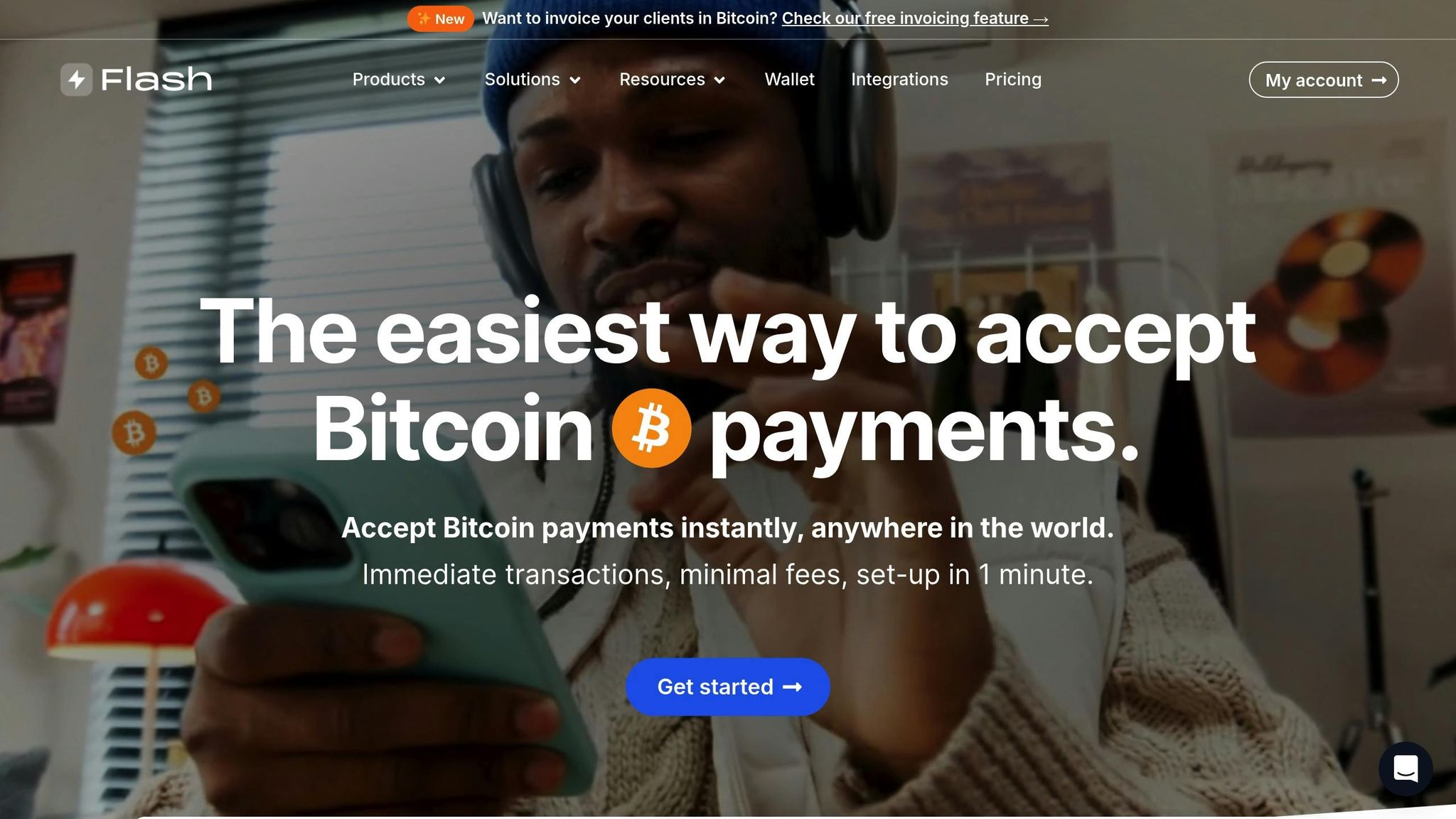
Flash simplifies Bitcoin payments for businesses with its SaaS platform, allowing them to accept payments instantly without the need to build or manage their own Lightning infrastructure. By removing the technical hurdles, Flash makes it easy to integrate Bitcoin payments into existing systems. Let’s dive into the features that make Flash stand out.
Key Features of Flash
Flash provides a variety of tools to help businesses manage Bitcoin payments efficiently:
- Payment Links: Quickly create payment requests that can be shared via email, text, or embedded on websites.
- Subscription Management: Set up recurring Bitcoin payments with flexible billing cycles, creating steady revenue streams.
- Customizable Widgets: Add payment interfaces directly to websites or apps while keeping your brand identity intact.
- Point-of-Sale Solutions: Allow store associates to generate QR codes instantly, enabling customers to pay with any Lightning-compatible wallet.
- Real-Time Analytics: Access immediate insights into payment activity to fine-tune your payment strategies.
- Custom Integrations: Use APIs to connect Flash with existing business systems, streamlining your operations.
How Flash Simplifies Lightning Payment Adoption
Flash goes beyond features to make adopting Lightning payments straightforward and user-friendly. By enabling non-custodial wallet-to-wallet payments, businesses maintain full control over funds while benefiting from instant settlements. With no-code tools like widgets and pre-built payment forms, businesses can start accepting Lightning payments in just minutes.
The platform also supports brand consistency with customizable payment interfaces, ensuring a seamless experience across customer touchpoints. Its mobile-optimized design guarantees smooth transactions, whether customers are paying through a desktop, mobile app, or in person.
Comparison Table: Flash Features vs. General Lightning Attributes
| Feature | General Lightning Network | Flash Platform |
|---|---|---|
| Setup Complexity | Requires technical expertise, node management, and channel liquidity | No-code integration, instant setup, fully managed platform |
| Payment Processing | Manual invoice generation and basic QR codes | Automated payment links, customizable widgets, branded interfaces |
| Business Integration | Custom development typically needed | Pre-built APIs and custom integrations |
| Analytics & Reporting | Limited transaction visibility | Real-time dashboards and analytics |
| Customer Experience | Basic payment interface | Customizable payment pages and mobile optimization |
Managing Risks and Improving Financial Operations with Lightning
Adopting Lightning payments successfully requires thoughtful financial strategies to both maximize their benefits and address potential risks. Below are some practical approaches to managing market volatility and optimizing accounting processes.
Treasury and Liquidity Management
To keep Lightning payment channels running smoothly, businesses need to plan liquidity carefully. This means balancing the capacity of payment channels with transaction demand. Ensuring enough liquidity is available during peak payment times is essential to avoid interruptions in operations.
Reducing Volatility and Compliance Risks
Bitcoin's price fluctuations can be a concern for businesses. Using real-time data and automation to lock in exchange rates during transactions can help reduce exposure to volatility while ensuring accurate reporting. Additionally, there’s been a noticeable shift in how regulatory bodies like the SEC and Federal Reserve view digital assets, signaling growing institutional interest.
Accounting and Reporting Considerations
Managing risks doesn’t stop at volatility; integrating Lightning payment data into accounting systems is just as important. This integration provides visibility into financial operations and ensures compliance with reporting standards. By connecting Lightning payment data with ERP systems or specialized crypto accounting tools, businesses can simplify their financial workflows.
For example, one enterprise saw a 75% reduction in accounting overhead after adopting TaxBit's digital asset accounting solution. Automated systems that capture real-time data streamline tasks like recording exchange rates for each transaction, making financial reporting more accurate and aligned with accounting standards.
To ensure thorough tax reporting, keep detailed records for every transaction, including the USD value, Bitcoin-to-USD conversions, and proper categorization. A complete audit trail - tracking payment amounts, timestamps, and exchange rates - supports both internal reviews and external audits effectively.
The Future of Business Payments with Lightning
Lightning payments are reshaping how businesses handle transactions, offering instant settlements, lower fees, and improved security. These advantages are already making a noticeable impact, and future advancements are set to bring even more efficiency to operations.
Flash is at the forefront of this movement, providing businesses with an easy way to adopt Lightning payments. With tools like payment links, subscription management, and point-of-sale solutions, Flash allows companies to integrate Lightning without overhauling their existing payment systems.
What sets Flash apart is its non-custodial approach, which ensures businesses retain full control over their funds. Combined with instant settlements and real-time analytics, this setup gives companies clear visibility into their payment flows, enabling smarter financial decisions.
More enterprises are recognizing the benefits of Lightning payments, whether it's simplifying international transactions, supporting subscription-based services, or handling high volumes of microtransactions. Lightning's speed, cost-effectiveness, and global reach make it an ideal solution for these scenarios.
As the technology progresses, Lightning payments are poised to become a cornerstone of digital commerce. Platforms like Flash, with their user-friendly designs, are making it easier for businesses to adopt these tools. Companies that embrace Lightning now are positioning themselves to lead in the evolving world of business payments.
But Lightning is about more than just transactions. It opens doors to new business models, enhances customer experiences, and boosts operational efficiency - key factors for long-term growth. For forward-thinking businesses, the question is no longer if they should adopt Lightning payments, but how quickly they can integrate this game-changing technology into their strategies.
FAQs
How does the Lightning Network ensure secure and private payments compared to traditional systems?
The Lightning Network boosts security and privacy by relying on off-chain payment channels. This approach limits the number of transactions recorded directly on the blockchain, which not only speeds things up but also keeps sensitive transaction details more private.
Compared to traditional payment systems, Lightning payments are quicker and less expensive since they avoid the delays caused by blockchain confirmations. These qualities make it a strong option for businesses looking for payment solutions that are secure, private, and efficient.
What challenges might businesses face when adopting Lightning payments?
Integrating Lightning payments comes with its own set of challenges that businesses need to navigate. One of the primary obstacles is technical complexity. Setting up the Lightning Network demands a solid understanding of how payment channels work and how to maintain liquidity effectively. Without this expertise, businesses may struggle to implement the system smoothly.
Another potential issue is payment reliability. While the Lightning Network is designed for fast and efficient transactions, certain conditions can cause payments to fail, which might impact user confidence. Additionally, unlike traditional payment methods, users must stay online to send or receive payments, adding a layer of inconvenience for some.
There's also the matter of Bitcoin's price volatility, which can make pricing and financial planning more challenging. Businesses must develop strategies to manage these fluctuations to avoid financial instability. On top of that, the regulatory landscape for cryptocurrencies remains uncertain and continues to evolve. This lack of clarity can create hesitation for companies considering adoption.
However, with thoughtful preparation and the right tools, these challenges can be addressed, allowing businesses to integrate Lightning payments into their operations effectively.
How can businesses handle Bitcoin's price fluctuations when using Lightning payments?
Businesses can tackle Bitcoin's price volatility by adopting strategies that help reduce its impact on their operations. Since Bitcoin's value often shifts due to market trends, regulatory changes, and broader economic factors, having a plan in place is key to maintaining stability.
One practical approach is to convert Bitcoin payments into USD or other fiat currencies as soon as they’re received. This method minimizes exposure to sudden price changes. Another option is leveraging tools that provide real-time currency conversion or hedging features to secure exchange rates. These steps allow businesses to benefit from the advantages of Lightning payments - such as instant settlements - while effectively managing the challenges tied to Bitcoin's unpredictable value.