A lightning wallet app is your key to unlocking instant, nearly-free Bitcoin payments. It's a special kind of app built to work with the Lightning Network, a technology layer that makes Bitcoin fast enough for everyday things, like grabbing a coffee or paying for an online article.
What Is a Lightning Wallet App and Why Should You Care?

To really get what a lightning wallet app does, you first have to picture Bitcoin's main network. Think of it as a super-secure highway, perfect for moving large, valuable shipments. It's incredibly reliable for big transactions, but it wasn't designed for the constant stop-and-go of city traffic. During busy times, it can get congested, making payments slow and expensive.
This is where the Lightning Network comes in. It's like a network of express lanes built right on top of the main Bitcoin highway. A lightning wallet app is the car that gets you onto these express lanes, letting you zip past the traffic and transact in a flash.
Unlocking Bitcoin for Daily Commerce
This isn't just a small tweak; it completely changes how you can use Bitcoin. For both businesses and regular folks, the advantages are huge and immediate. A lightning wallet app makes Bitcoin payments faster than a credit card swipe and cuts transaction fees down to almost nothing.
This has massive implications for how we buy and sell things:
- For Merchants: Businesses can accept payments that settle in seconds, not days. This means better cash flow and no more painful processing fees from credit cards, which can eat up 2-3% of every sale.
- For Users: You can finally use Bitcoin for small, everyday purchases without a second thought. The tiny fees make micropayments practical, creating whole new possibilities for content creators, gamers, and anyone offering digital services.
The whole point of a lightning wallet app is to make Bitcoin transactions fast, cheap, and scalable. It closes the gap between Bitcoin as a long-term store of value and its potential as a global currency for everyday life.
The Foundation for Modern Bitcoin Payments
At its core, a lightning wallet app is the tool that connects you to this powerful payment network. It handles all the complicated tech stuff in the background, giving you a simple way to send and receive Bitcoin instantly. This simplicity is crucial for bringing Bitcoin to the masses, as it removes the technical hurdles that used to scare people away. If you're curious about what goes into creating tools like this, understanding how to build a mobile app can give you a peek behind the curtain.
By making peer-to-peer commerce so smooth, these apps are essential for unleashing Bitcoin's full potential. They're setting the stage for a future where digital money is a normal part of our daily lives, whether you're at the corner store or buying from someone across the globe.
How the Lightning Network Makes Bitcoin Instant
To really get what a lightning wallet app does, we have to pull back the curtain on the tech that makes it all possible. Bitcoin’s main network—the blockchain—is an absolute fortress of security. But that security comes at a price: speed. It can only handle a few transactions per second, which is a major roadblock for the kind of small, quick payments we make every day.
Enter the Lightning Network. It’s a brilliant solution built on top of Bitcoin, what folks in the space call a "second-layer" protocol. It doesn't try to replace the blockchain; it just gives it a massive upgrade for everyday payments by moving all the small, frequent transactions off the main chain. The result is a dramatic boost in speed and a huge drop in costs.
The Power of Payment Channels
The secret sauce behind the Lightning Network is something called a payment channel. Instead of shouting every single transaction out to the entire Bitcoin network, two people can open a private channel just between themselves.
Picture it like starting a running tab at your local bar.
You and the bartender agree to lock some bitcoin into this shared channel. Every time you order a drink, you just update the balance on the tab. No one else needs to know. You're just keeping a private tally of who owes what. This all happens instantly and costs next to nothing.
A payment channel acts like a private ledger between two people. Thousands of transactions can happen inside this channel without ever touching the main blockchain, making payments immediate and incredibly cheap.
You could buy a drink every day for a year, and the only times you’d ever need to interact with the main Bitcoin network are when you first open the tab and when you finally decide to close it out and settle the final balance.
Creating a Web of Instant Payments
Where this gets really powerful is when thousands of these individual channels connect to form a massive, interconnected network. You don’t need to open a direct channel with every single shop you want to pay. As long as there’s a path of connected channels between you and your destination, your payment can hop across the network in seconds.
This creates a web of liquidity that makes global, nearly-instant payments a reality. Here’s how it completely changes the game for using Bitcoin in the real world:
- Immediate Settlement: Transactions are done in a flash—seconds, not the 10-60 minutes you might wait for on the main blockchain. This is absolutely critical for buying things in a store, online, or anywhere you can't just stand around waiting.
- Micropayments Become Possible: With fees often as low as a fraction of a cent, sending tiny amounts of bitcoin finally makes sense. This opens up entirely new possibilities, like tipping a creator for a post you liked, paying for API calls, or buying a single news article.
- Enhanced Scalability: By taking millions of transactions "off-chain," the Lightning Network frees up the main Bitcoin blockchain to do what it does best: secure large-value transfers. This allows the whole system to scale to a global audience without getting bogged down.
Your lightning wallet app is your personal remote control for this entire second layer. It handles all the complicated stuff—opening channels, finding payment routes, and closing things out—behind a simple, clean interface. The app does all the heavy lifting so you can just scan a QR code and go. That's the magic that makes Bitcoin truly practical for everyone.
Choosing Your Wallet: Custodial vs. Non-Custodial
Alright, you've got the basics of the Lightning Network down. Now comes the most important decision you'll make: choosing the right lightning wallet app. This choice directly shapes your control, security, and day-to-day experience. The fundamental fork in the road is custodial versus non-custodial.
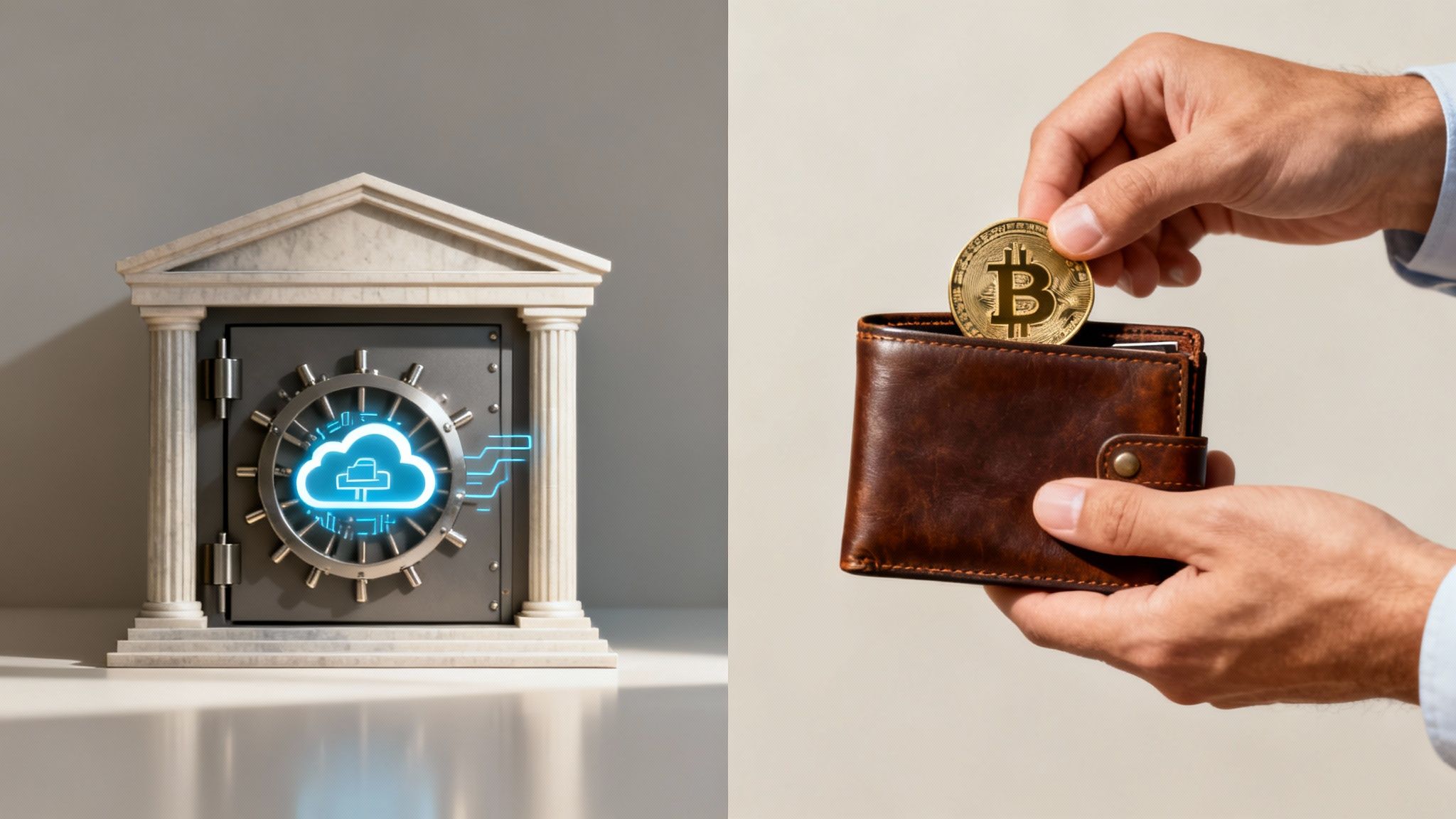
Let's break it down with a simple metaphor. A custodial wallet is like your bank account. You give your bitcoin to a third-party company, and they manage all the technical heavy lifting. In contrast, a non-custodial wallet is like carrying cash in your own physical wallet. You, and only you, have full control over your funds—which also means you're entirely responsible for keeping it safe.
Both paths have real trade-offs. The best fit for you boils down to your personal priorities, how comfortable you are with the tech, and what you plan to do with your Bitcoin.
Understanding Custodial Wallets
For anyone just dipping their toes into Bitcoin, custodial wallets are often the starting point. Why? Because they feel familiar and incredibly easy to use. The company behind the service handles all the tricky parts, like managing private keys and payment channels. This makes sending and receiving payments a breeze, often as simple as using a username or email.
The main draws of a custodial lightning wallet app are:
- Ease of Use: Getting started is fast and feels just like a modern banking app. No need to worry about channel management or backups.
- Convenience: Forgot your password? No problem. Most services offer recovery options, so you won't lose access to your funds.
- Lower Fees (Sometimes): Payments between users on the same platform can be instant and free since they're just updates in the company's internal ledger.
But this simplicity comes at a price. When you use a custodial service, you're placing your trust in that company to protect your funds and act honorably. You don't truly own your bitcoin in the way you do with a non-custodial wallet. This is where the famous Bitcoin mantra comes from: "not your keys, not your coins."
Embracing Non-Custodial Wallets
Non-custodial wallets are the embodiment of Bitcoin's core idea: self-sovereignty. When you use a non-custodial lightning wallet app, you are your own bank. You generate and hold the private keys that unlock your bitcoin, meaning no third party can ever freeze your account or stop you from making a transaction.
This route gives you unparalleled financial freedom and control. You have the final say over every single satoshi you own, no permission required. In the Bitcoin world, this is the gold standard for security and privacy.
The fundamental difference lies in who holds the keys. With a non-custodial wallet, you hold them, granting you complete ownership. With a custodial wallet, a third party holds them on your behalf, offering convenience in exchange for trust.
Of course, with great power comes great responsibility. If you lose your private keys or your 12-word seed phrase, your funds are gone. Forever. There's no customer support line to call for a password reset. You are solely responsible for securing your money. Thankfully, modern apps have made this process much more user-friendly, but it still demands a careful and organized mindset.
Making the Right Choice for You
So, how do you pick? It really comes down to a personal choice between convenience and control. To help you weigh the options, here's a quick side-by-side comparison.
Custodial vs Non-Custodial Wallets at a Glance
This table provides a simple comparison to help you quickly understand the key differences between custodial and non-custodial Lightning wallet apps.
| Feature | Custodial Wallet (Like a Bank Account) | Non-Custodial Wallet (Like a Physical Wallet) |
|---|---|---|
| Control | A third party holds and controls your private keys. | You have exclusive control over your private keys. |
| Security | Depends on the security practices of the provider. | Depends entirely on your own security measures. |
| Recovery | Often allows for account recovery through email or phone. | Requires you to securely back up a seed phrase. No recovery if lost. |
| Ease of Use | Generally very simple and beginner-friendly. | Requires more personal responsibility and technical understanding. |
| Privacy | The provider has visibility into your transaction history. | Offers a much higher degree of privacy. |
Ultimately, choosing a lightning wallet app comes down to what you value most. If you want simplicity above all else and are comfortable trusting a reputable company, a custodial wallet is an excellent way to get started. But if you're a firm believer in self-sovereignty and are ready to take full responsibility for your own security, a non-custodial wallet is the clear winner.
Exploring Different Types of Lightning Wallet Apps
Once you’ve got a handle on custodial versus non-custodial wallets, the next layer to peel back is the different forms a lightning wallet app can take. Think of it like a toolbox—you wouldn't use a sledgehammer to hang a picture frame. The right wallet depends entirely on the job at hand.
The two most common flavors you'll run into are mobile and desktop apps. Each is built for a specific context, whether it's for personal spending or running a full-fledged business.
After all, the needs of someone grabbing a coffee are worlds apart from an online merchant processing hundreds of sales a day. Let’s break down how these wallet types play out in the real world.
Mobile Lightning Wallet Apps
There's a good reason mobile wallets are the most popular choice: they put instant Bitcoin payments right in your pocket. Built for smartphones and tablets, these apps are all about convenience and speed for when you're on the move. The user interface is usually clean and simple, designed for one main purpose—scanning QR codes and paying in a couple of taps.
This grab-and-go nature makes them perfect for brick-and-mortar shops. They're the ideal tool for both the customer buying a snack and the shopkeeper taking the payment.
Real-World Scenario: The Local Cafe
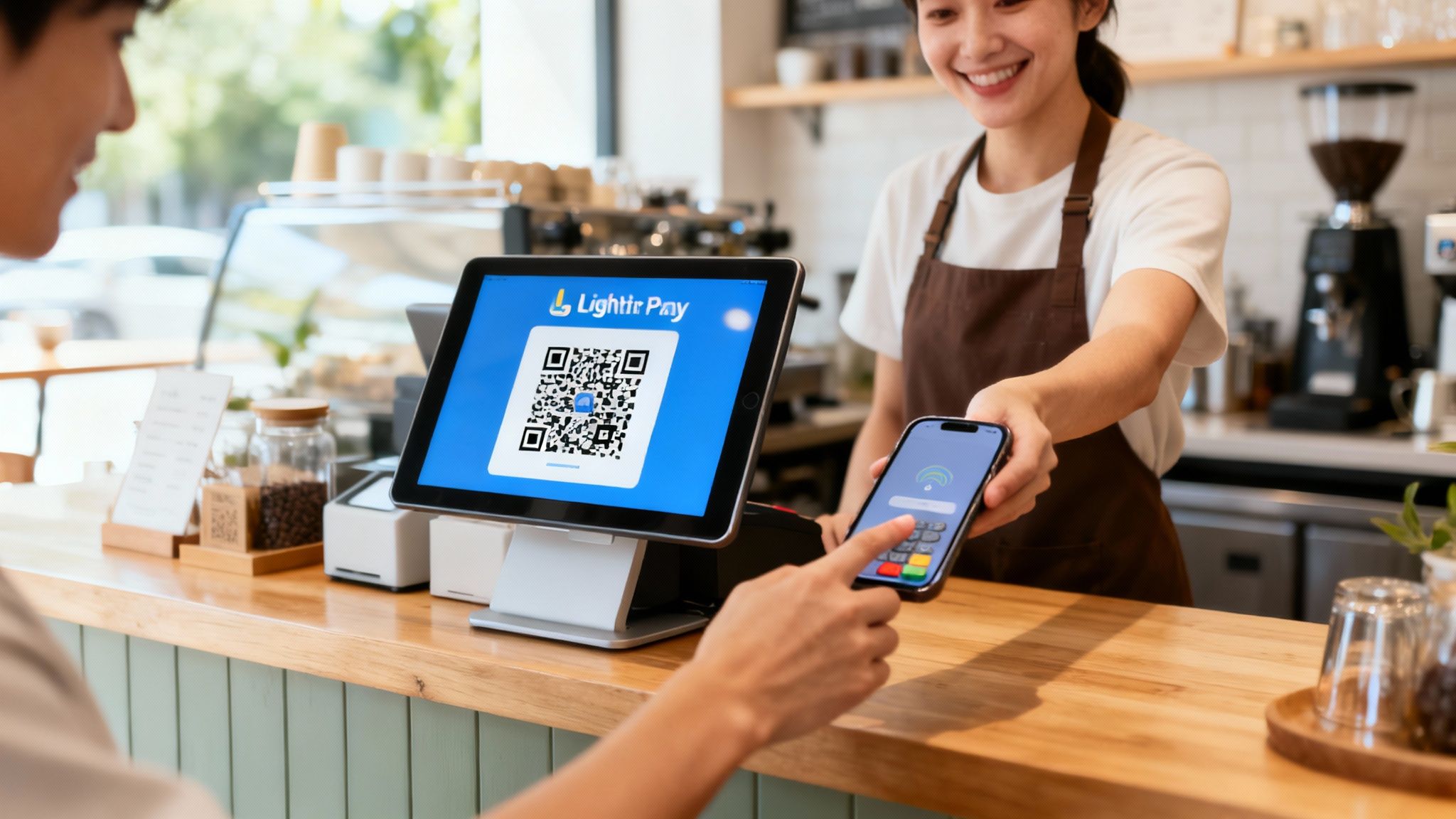
Imagine a local coffee shop wants to start accepting Bitcoin. Instead of shelling out for clunky, specialized hardware, the owner can just download a lightning wallet app onto a tablet and instantly have a point-of-sale (POS) terminal.
- When a customer is ready to pay, the barista simply types the amount into the app, which spits out a unique QR code on the screen.
- The customer opens their own mobile wallet, scans the code, and confirms the payment.
- The transaction clears in seconds—often faster than a credit card machine can even connect—and the barista gets a confirmation.
This whole setup is incredibly cheap and easy to manage. The cafe sidesteps high credit card processing fees, gets rid of chargeback risk entirely, and can even pull in a new crowd of tech-savvy customers.
Desktop Lightning Wallet Apps
While mobile apps win on portability, desktop applications bring out the heavy-duty features. These are the go-to for online merchants, developers, and power users who need more control over their funds, channels, and invoicing.
A desktop wallet gives you a much bigger canvas to work with, which is better suited for detailed financial management. They're built to handle a higher volume of transactions and often pack in advanced tools that just wouldn't be practical on a tiny mobile screen.
While mobile wallets prioritize speed and convenience for everyday spending, desktop wallets provide the control and features needed for more complex financial management and business operations.
Real-World Scenario: The Online Content Creator
Think of a freelance graphic designer who sells digital art packs on their website. They need a bulletproof way to get paid by anyone, anywhere, without wrestling with regional payment systems or losing a cut to high fees. By plugging a desktop lightning wallet app into their online store, they can put the whole process on autopilot.
Here’s the breakdown:
- Integration: The designer uses a simple e-commerce plugin that talks directly to their desktop wallet.
- Payment Generation: When a customer hits "buy," the website pings the designer's wallet and asks for an invoice on the fly.
- Instant Settlement: The customer pays the invoice, and the funds land directly in the designer’s wallet. The website then automatically releases the digital files for download.
The system is airtight, secure, and gives the creator 100% control over their money. They can track their income in real-time and skip the typical 3-5 day waiting game for payouts from traditional gateways. For any online business, a desktop wallet acts as a powerful command center.
Putting Lightning to Work for Your Business
Moving beyond personal use, a lightning wallet app can be a powerful engine for any business. For merchants, this isn't just some tech novelty; it's a practical toolkit for streamlining operations, slashing costs, and tapping into a new global customer base. It basically turns any smartphone or tablet into a full-featured payment terminal, ready to accept Bitcoin from anywhere in the world.
The real beauty is its simplicity and efficiency. Businesses can generate invoices, manage payments, and set up a point-of-sale (POS) system without shelling out for expensive, proprietary hardware. This unlocks a whole new level of financial agility, putting sophisticated payment tools directly into the hands of businesses, big or small.
The Strategic Business Advantages
Adopting a lightning wallet app is more than just adding another payment option at checkout. It's a strategic move that tackles several core business headaches, giving you a clear competitive edge in a crowded market.
The most immediate benefit? A dramatic cut in operational costs. Traditional credit card processors hit you with fees of 2-3% plus a fixed amount per transaction. Those fees add up fast, eating directly into your profit margins. Lightning payments, on the other hand, cost a fraction of a cent. You get to keep nearly all of your revenue.
Another huge win is the complete elimination of chargeback fraud. Bitcoin transactions are final and irreversible. Once a payment is confirmed, the funds are yours—no more disputes, frozen accounts, or revenue getting clawed back weeks after a sale.
For a business, accepting Bitcoin via a lightning wallet app means instant settlement, negligible fees, and zero chargeback risk. This trio of benefits directly impacts cash flow, profitability, and financial security.
Practical Tools for Modern Merchants
A modern lightning wallet app designed for business comes loaded with a suite of tools that make accepting Bitcoin totally seamless. These features are built to slide right into your existing workflows, whether you run a physical store or a website.
- Point-of-Sale (POS) Functionality: Instantly turn any phone or tablet into a payment terminal. Just punch in the sale amount, and the app spits out a QR code for the customer to scan. Simple.
- Dynamic Invoicing: Create and send detailed invoices with unique payment addresses. This is perfect for service providers, freelancers, and B2B transactions, providing a crystal-clear record of payment requests.
- Website Integration: Easily add payment buttons or widgets to your e-commerce site. This allows for an automated checkout where payments are confirmed instantly, triggering order fulfillment without you having to lift a finger.
For businesses, plugging in a lightning wallet often involves similar thinking to a traditional payment provider integration project. The key difference is the direct, peer-to-peer nature of the transaction, which cuts out the middlemen and simplifies the entire process.
Tapping into a Growing Global Economy
Integrating Bitcoin payments isn't just about saving money; it's about expanding your reach. The Lightning Network is experiencing explosive growth, connecting hundreds of millions of users worldwide. The momentum is undeniable. Voltage data reveals a 200% jump in payment volumes from 2023 to 2024 and an incredible 2,424% increase since 2022. This organic growth points to a massive, expanding market of potential customers who prefer to pay with Bitcoin.
By accepting Bitcoin, you're opening your doors to this tech-savvy, global audience. You can take payments from anyone, anywhere on the planet, without sweating currency conversions, cross-border settlement delays, or high international transaction fees. This opens up entirely new markets and positions your business as a forward-thinking leader. For any merchant, a lightning wallet app is the simplest gateway to this new frontier of commerce.
Your Top Lightning Wallet Questions, Answered
Jumping into Bitcoin's Lightning Network is exciting, but it's natural to have a few questions. Let's run through some of the most common things people ask when they first explore using a lightning wallet app. Getting these sorted will help you get started with confidence.
Lots of newcomers are skeptical—are Lightning payments really that fast? The short answer: absolutely.
Are Lightning Wallet App Payments Really Instant?
For all intents and purposes, yes, they are. A standard on-chain Bitcoin transaction can take a few minutes to get its first confirmation. A payment on the Lightning Network, however, settles in just a couple of seconds.
This is the magic that makes a lightning wallet app perfect for the real world. Think about it: it’s ideal for a retail checkout, an online purchase, or any time when waiting around for a confirmation just isn’t going to fly. You get the rock-solid security of Bitcoin, just without the wait time.
Okay, so it's fast. But what about the cost? On-chain fees can spike, so how does Lightning stack up?
The core value of the Lightning Network is its ability to deliver near-instant settlement with incredibly low fees, making Bitcoin practical for everyday, high-frequency transactions.
What Are the Typical Fees for a Lightning Transaction?
Fees on a lightning wallet app are astonishingly low. We're often talking about just a fraction of a cent per payment. It's a world away from both traditional payment networks like credit cards, which can skim 2-3% off the top, and standard Bitcoin transaction fees.
This tiny cost structure is what finally makes Bitcoin practical for small, daily purchases. It unlocks the world of micropayments, letting you buy a coffee or tip a creator online without worrying about fees eating up half the transaction.
That brings us to the most practical question: how do I actually get started, especially if I have a business?
How Do I Start Accepting Bitcoin Payments?
Getting set up is way simpler than you might think. Your first step is to download a lightning wallet app that fits what you need, whether it's for your personal spending or your business operations.
Once you've got the app, the flow is super simple:
- Generate a Payment Request: Your app will create an invoice or a unique QR code in seconds.
- Customer Scans to Pay: Your customer just scans that code with their own wallet, and the payment is on its way.
- Receive Instant Confirmation: The funds land in your wallet almost immediately.
For businesses, plenty of services offer slick point-of-sale interfaces you can run on a tablet or simple tools to integrate payment buttons right onto your website. It makes the whole transition a breeze.
Ready to bring instant, low-fee Bitcoin payments to your business? With Flash, you can accept wallet-to-wallet payments directly from your customers, eliminating middlemen and high fees. Set up your business to accept Bitcoin in under a minute and join the future of commerce. Get started with Flash today.