When we talk about a "low-fee cryptocurrency wallet," we're not just talking about another app on your phone. It’s a specific tool designed to keep the costs of sending Bitcoin as low as humanly possible.
Unlike your bank, where fees are often a simple percentage, Bitcoin fees are a different beast altogether. They're driven by network demand and how complex your transaction is. This means that without the right approach, even a tiny payment can get slapped with a surprisingly high fee. For any merchant, finding the right wallet isn't just a tech choice—it's a core business strategy to protect your hard-earned profit margins.
Why Low Fee Wallets Are Essential for Merchants
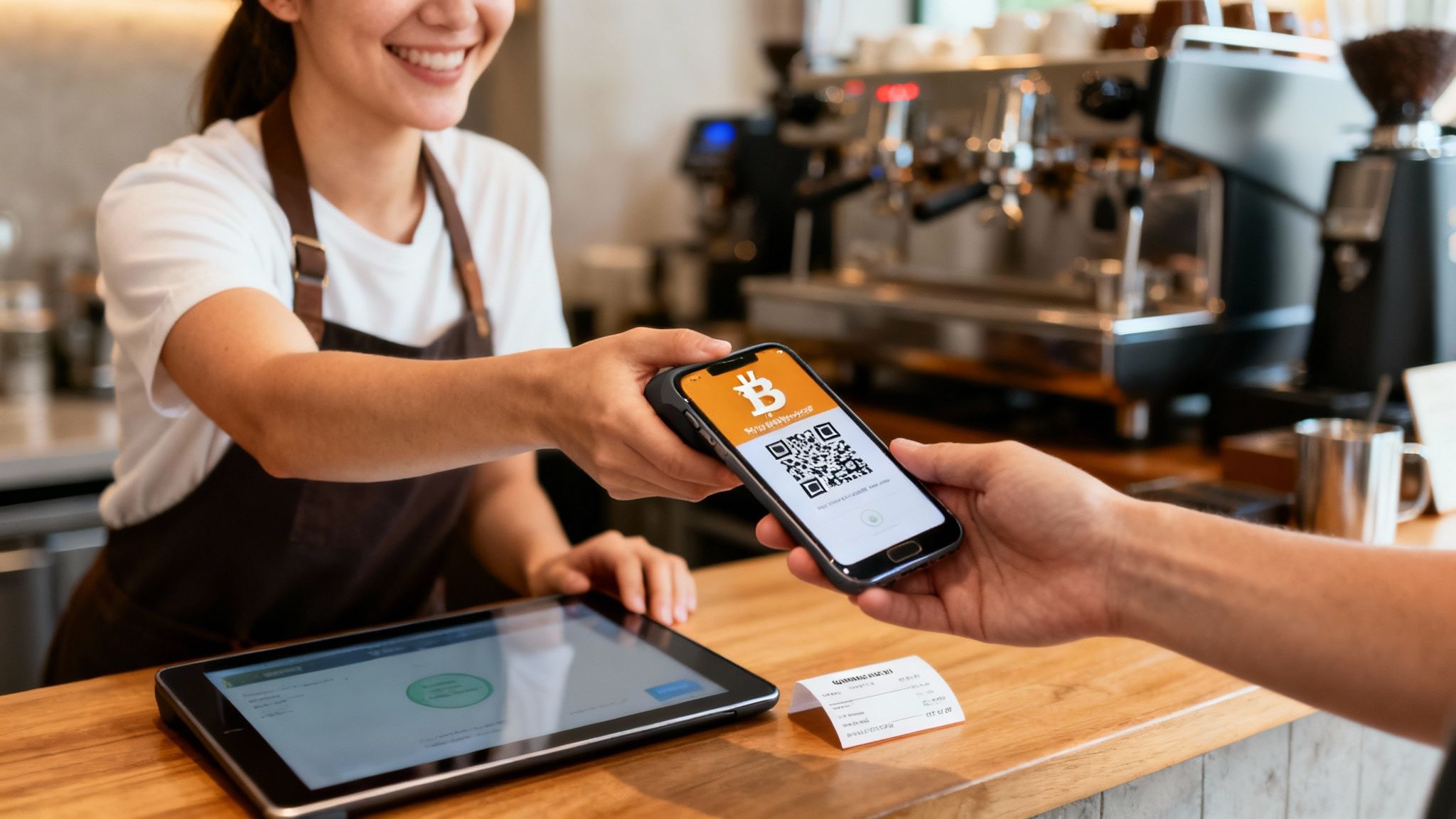
If you're a business accepting Bitcoin, transaction fees are more than a line item on a spreadsheet; they're a direct hit to your bottom line. High, unpredictable fees can wipe out the profit on small sales and leave customers with a bad taste in their mouths. A low-fee cryptocurrency wallet puts you back in the driver's seat.
Think of it like choosing a shipping service for your online store. You wouldn't pay for overnight shipping on a cheap, non-urgent item, right? A smart Bitcoin wallet works the same way. It lets you adjust your "shipping speed"—or transaction priority—to fit the situation, making sure you never overpay for space on the blockchain.
Connecting Fees to Real Business Benefits
Slashing transaction costs delivers tangible advantages that ripple through your entire operation. It's not just about saving a few cents here and there. By choosing a wallet built for efficiency, you unlock some serious perks for your business and your customers.
- Protect Your Profit Margins: Lower fees mean you keep more from every single sale. This is an absolute game-changer for businesses with high sales volume or tight margins.
- Keep Your Customers Happy: You can pass savings on to your customers or simply offer them clearer, more reliable payment estimates. That transparency builds trust and makes for a much smoother checkout.
- Unlock Micropayments: Selling digital art, articles, or in-game items? Near-zero fees make it profitable to accept tiny payments that would be completely erased by fees from traditional on-chain transactions.
The hunger for these solutions is fueling explosive growth in the crypto wallet market. It's currently valued at USD 5.43 billion and is projected to skyrocket to USD 56.74 billion by 2035. Software wallets, which are famous for offering the lowest fees, are leading the charge with around 60% of global adoption. It's no wonder they're the top pick for merchants trying to cut costs. You can dive deeper into the crypto wallet market growth for more insights.
The core challenge for any merchant is finding that sweet spot between speed, security, and cost. A low-fee cryptocurrency wallet is the tool that helps you solve that puzzle, giving you the power to optimize fees without ever compromising the integrity of your payments.
This is where modern solutions like the Lightning Network really shine. By enabling instant transactions for next to nothing, Lightning makes Bitcoin practical for everyday purchases—from a cup of coffee to a monthly subscription. This technology turns Bitcoin from a simple store of value into a powerful, incredibly cheap payment network, letting you tap into a global customer base without giving up your revenue to fees.
What Actually Determines Bitcoin Transaction Fees
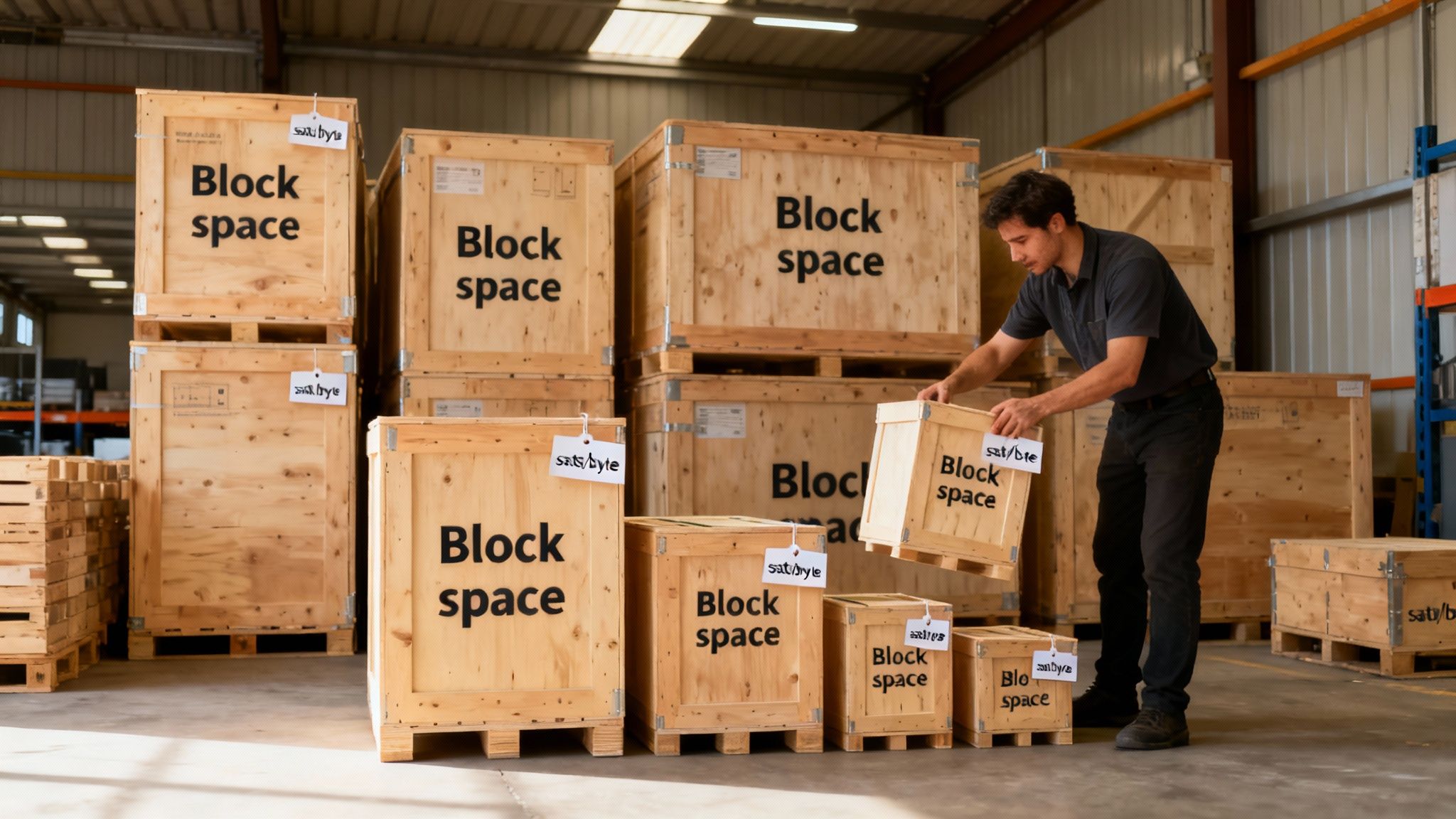
If you want to find a truly low-fee cryptocurrency wallet, you first have to understand what you're actually paying for. It's a common mistake to think Bitcoin fees work like credit card processing, where you pay a percentage of the total. They don't.
With Bitcoin, you’re not paying for value—you’re paying for space.
Think of the Bitcoin network as a massive, global shipping service. Every ten minutes or so, a "shipping container" (a block) gets loaded and sent out. To get your transaction on that container, you have to bid for a spot inside it. Your fee is that bid.
This simple fact creates a wild reality: a $10,000 transaction can actually cost less in fees than a tiny $10 one. It all boils down to how much room your transaction takes up in that digital container and how many other people are trying to ship something at the exact same time.
The Marketplace for Block Space
The space inside each block is finite. So when a ton of people all try to send transactions at once, you get a competitive marketplace. It’s like rush hour traffic for data.
During these peak times, the network gets congested. Senders have to bid higher fees to get the attention of miners—the workers who load the containers—and make sure their transaction gets prioritized. If your bid is too low when things are busy, your transaction gets left on the digital dock, waiting for a later, less crowded shipment.
This bidding process is measured in satoshis per virtual byte (sats/vB). A satoshi is the smallest fraction of a Bitcoin, and a byte is just a unit of data. Your total fee is calculated by multiplying your transaction's size (in bytes) by the rate you're willing to pay (in sats/vB).
A transaction's fee isn't based on its dollar value but on its data size and the current demand for block space. This is the single most important concept for minimizing costs.
A great wallet gives you direct control over this sats/vB rate. It lets you be strategic, paying less for transactions that aren't urgent by setting a lower bid and simply waiting for the network traffic to die down.
Why Transaction Size Matters More Than Value
So, what makes a transaction "big" in terms of data? It’s not the dollar amount, but its complexity. A simple transaction is like sending a single, neatly packed box. A complex one is like shipping a bunch of oddly-shaped items that need a ton of packaging.
- Simple Transaction: Sending Bitcoin that you received in one lump sum is clean and takes up very little space.
- Complex Transaction: If you’re trying to send Bitcoin that you received from dozens of tiny payments (like tips or multiple small sales), your transaction data becomes much larger. It has to list every single one of those little "inputs," which bloats its byte size and jacks up the fee.
This is a huge deal for merchants. A business that collects tons of small Bitcoin payments will face surprisingly high fees when they try to consolidate and send that money out in one go. Understanding this is the key to using smart strategies like transaction batching, which we’ll get into later.
For anyone using popular payment apps that handle Bitcoin, knowing how these costs add up is vital. You can get a feel for how different platforms structure their fees by using tools like Cash App's fee calculator. Ultimately, a proper low-fee cryptocurrency wallet will give you the tools to estimate these costs and adjust them before you hit send, putting you firmly in control of your expenses. This is the foundation for mastering Bitcoin payments and protecting your bottom line.
How Your Wallet Choice Impacts Transaction Costs
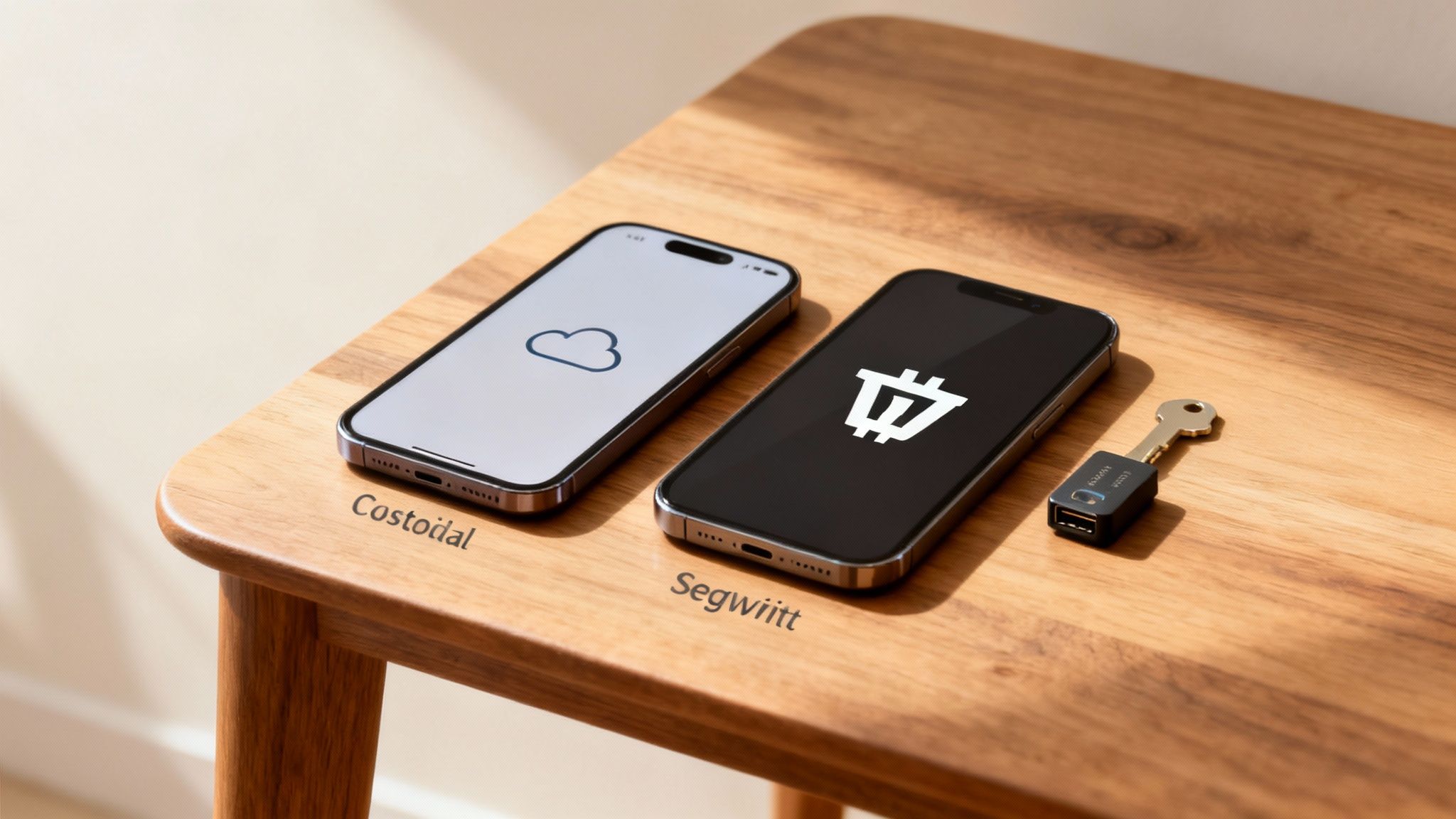
The Bitcoin wallet you choose is one of the biggest levers you can pull to control your transaction costs. It's a common misconception that all wallets are created equal. In reality, their underlying design directly dictates how much say you have over fees.
The most important fork in the road is the choice between custodial and non-custodial wallets.
Think of it like this: a custodial wallet is like keeping your money in a bank. The bank holds your funds, and while it's convenient, you're trusting them to handle everything. A non-custodial wallet, on the other hand, is like having cash in your own personal safe—you, and only you, have the keys.
This difference isn't just about security; it’s about control. Your choice here determines whether you're a passenger or the pilot when it comes to setting transaction fees.
Custodial Wallets: The Trade-Off for Simplicity
You’ll typically find custodial wallets on large exchanges or inside payment apps that offer Bitcoin services. They’re popular because getting started is incredibly simple. You don't have to worry about the nerve-wracking responsibility of managing your own private keys.
But that simplicity comes with a hidden price tag. When you hand over custody, you also hand over control of the technical details. The provider usually sets the transaction fee for you, often baking their own service charge into the final cost without you even realizing it.
A custodial wallet might have a slick interface, but it often obscures the true cost of a transaction. You lose the ability to set your own fee rate, which means you could be overpaying, especially for payments that aren't time-sensitive.
Worse, you’re introducing counterparty risk. If the company holding your Bitcoin gets hacked or goes bust, your funds could be gone for good. While convenient, the custodial model puts a middleman between you and your money, ultimately blocking you from finding the cheapest way to transact.
Non-Custodial Wallets: Putting You in Control
For anyone serious about slashing transaction fees, a non-custodial wallet is the essential tool. By giving you sole control over your private keys, it puts you in the driver's seat for every single transaction. This is where the real fee-saving strategies come into play.
A good non-custodial wallet gives you a powerful set of tools:
- Custom Fee Selection: You can manually set your
sats/vBrate. Got a payment that isn't urgent? Set a low fee and just wait for the network to calm down. The savings can be huge. - SegWit Support: Modern wallets that support Segregated Witness (SegWit) create smaller, more efficient transactions. Since fees are based on size, smaller transactions directly translate to lower costs.
- Advanced Features: Many non-custodial options come packed with features like transaction batching or integrations with the Lightning Network—tools designed from the ground up to minimize costs.
This level of control is what truly defines a low fee cryptocurrency wallet. It flips the script, turning you from a passive user into an active manager of your own costs.
For merchants, software-based non-custodial wallets (often called "hot wallets") are a game-changer. They’re accessible, cheap to run, and have become a dominant force, capturing a 56.0% revenue share of the global crypto wallet market. These wallets are perfect for eCommerce, enabling direct wallet-to-wallet payments with tiny costs—often under 0.1% per transaction. You can read the complete research on the crypto wallet market to see the full picture.
So, while custodial wallets offer a gentle on-ramp to Bitcoin, a non-custodial wallet gives you the keys to the kingdom, ensuring you never pay a satoshi more than you have to.
Using the Lightning Network for Near-Zero Fees
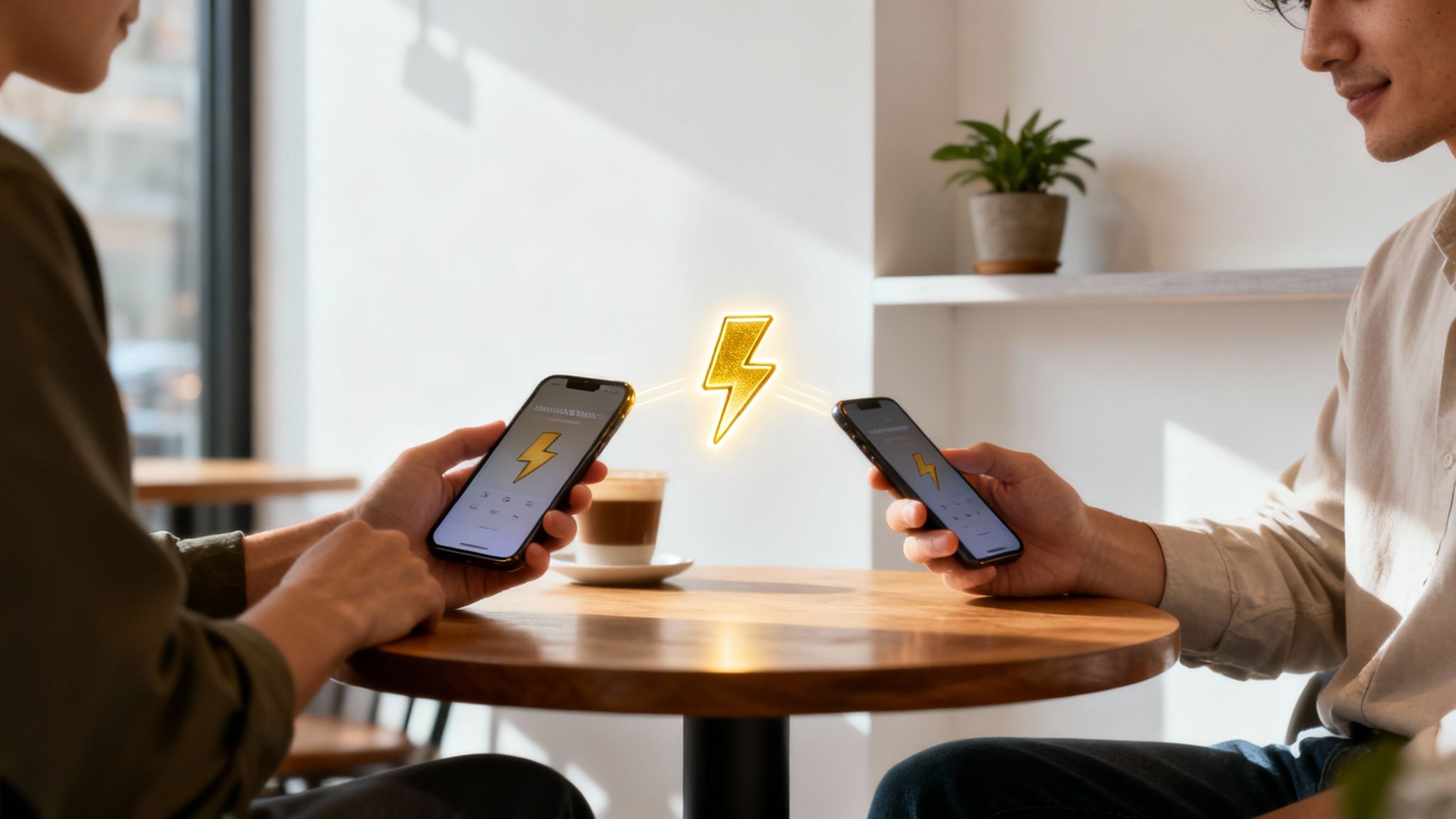
So far, we’ve talked about Bitcoin’s on-chain fees being tied to block space—a limited resource you have to bid on. Non-custodial wallets give you the tools to bid smarter, but what if you could sidestep that whole auction for most of your transactions?
This is where the Lightning Network comes in. It’s not a different coin; it’s a “Layer 2” solution built right on top of Bitcoin. Think of it as an express lane built over the main highway, designed specifically for instant, ridiculously cheap payments.
For any business dealing with frequent or small transactions, getting to know the Lightning Network is the key to unlocking a truly low-fee cryptocurrency wallet. It’s the most powerful tool we have for making Bitcoin practical for everyday commerce, from selling digital goods to accepting tips.
How Lightning Bypasses High Fees
The easiest way to wrap your head around the Lightning Network is with a simple analogy: a bar tab.
Imagine you and a friend hit the same coffee shop every day. Instead of swiping a card for each coffee (an on-chain transaction), you open a tab with the shop. You grab a coffee on Monday, Tuesday, Wednesday—each time, the barista just adds it to your tab. At the end of the week, you settle the total with one single payment.
The Lightning Network operates on a similar principle. Two parties can open a private payment channel between them. Inside this channel, they can send Bitcoin back and forth an unlimited number of times, instantly, and for almost nothing. These transactions happen "off-chain," so they never have to compete for a spot in a Bitcoin block.
The only transactions that actually hit the main Bitcoin blockchain are the ones that open and close the channel. Everything in between is a private, lightning-fast settlement that costs a fraction of a cent.
This structure is a game-changer for merchants. It transforms Bitcoin from a system best suited for large, infrequent transfers into a nimble network that can handle the high volume of a busy online store or café.
Practical Benefits for Merchants
When you integrate a Lightning-enabled wallet into your business, the advantages are immediate and powerful. And the benefits go way beyond just saving money; they completely change the payment experience for you and your customers.
- Instant Settlement: Lightning payments clear in seconds, not minutes or hours. This gets rid of the frustrating wait times of on-chain transactions, creating a checkout experience that feels as fast as a traditional card tap.
- Dramatically Lower Fees: We’re not talking slightly lower fees. We’re talking costs that are often less than a single satoshi. This makes it profitable to accept micropayments for things like articles, songs, or in-game items—markets that are totally inaccessible with high on-chain fees.
- Scalability for High Volume: Since transactions don’t clog up the main network, you can process thousands of payments without worrying about congestion. This is a must for any business looking to grow, from SaaS platforms to online retailers.
The demand for these capabilities is pushing the whole market forward. The shift toward low-fee crypto wallets is being driven by skyrocketing user numbers and regional trends, with software solutions leading the charge due to their cost advantages over hardware. The market is projected to hit USD 77.17 billion by 2033, growing at a 24.8% compound annual growth rate, with software wallets holding the biggest share.
For SaaS, charities, and content creators, these wallets enable automated Bitcoin subscriptions without middlemen, cutting costs by up to 90% compared to cards. You can dive into the full analysis on the drivers of the crypto wallet market.
Ultimately, the Lightning Network solves Bitcoin's biggest challenge for retail and e-commerce. It makes small, everyday purchases not just possible, but cheap and efficient. By choosing a wallet that supports this technology, you’re not just saving on fees—you’re future-proofing your business for the next wave of digital payments.
Practical Strategies to Minimize Your Bitcoin Fees
Knowing how Bitcoin fees work is one thing, but actually doing something about them is where the real savings happen. Let's move from theory to practice. You can use several hands-on tactics to take control of your transaction costs, and a well-designed low fee cryptocurrency wallet is your command center for all of it.
Implementing effective cost reduction strategies is just smart business, and the same thinking applies perfectly to managing Bitcoin fees. Instead of just accepting whatever fee your wallet suggests, you can get proactive and make sure you never overpay for block space again. This isn't about becoming a technical wizard; it’s just about using the right tools at the right time.
By adopting a few key habits, you can consistently chip away at your operational costs and protect your profit margins.
Choose a SegWit Native Wallet
First things first: your wallet absolutely must support Segregated Witness (SegWit). Think of SegWit as an efficiency upgrade for Bitcoin. It cleverly restructures transaction data, making each one smaller. Since Bitcoin fees are based on data size (measured in sats/vB), a smaller transaction automatically means a smaller fee.
Choosing a wallet that is SegWit-native is the easiest, most passive way to save money on every single on-chain transaction you make. It’s a set-it-and-forget-it move that immediately boosts your efficiency, often trimming fees by 20-30% or more compared to older, legacy wallets.
Use Custom Fee Settings
Many wallets, especially the custodial kind, try to be helpful by suggesting a fee for you. While convenient, this almost always leads to overpaying. They typically recommend a rate that guarantees a fast confirmation, even if your payment isn't urgent. A true low-fee cryptocurrency wallet puts you in the driver's seat with manual fee controls.
Got a payment that isn't time-sensitive, like moving funds to cold storage at the end of the day? Just set a much lower fee rate. Your transaction will hang out in the mempool—the network's digital waiting room—until the traffic dies down and miners start scooping up cheaper transactions. This one tactic alone can slash your fees by over 50%, if you have a little patience.
By decoupling transaction urgency from fee rates, you turn patience into profit. Adjusting your fee to match your needs—not the network's peak demand—is the essence of smart fee management.
Time Your Transactions Strategically
The Bitcoin network has a rhythm. Transaction traffic isn't constant; it has predictable peaks and valleys. Things usually get busy during weekday business hours in North America and Europe, but they quiet down significantly overnight and on weekends. Sending non-urgent transactions during these lulls can save you a bundle.
- Peak Times (Higher Fees): Weekday business hours (roughly 9 AM - 5 PM EST).
- Off-Peak Times (Lower Fees): Late nights, weekends, and holidays.
Keep an eye on a mempool visualization tool to spot these quiet periods. When the mempool is less crowded, miners are happy to include transactions with lower sats/vB rates. You get your payment confirmed without having to outbid everyone else.
Batch Your Payouts
For any business making multiple payments—think paying suppliers, affiliates, or employees—transaction batching is a game-changer. Instead of sending ten individual transactions, you create one single transaction that pays out to ten different addresses.
Sure, the batched transaction is a bit larger than a single-payment one, but it's vastly smaller and cheaper than the sum of all ten individual transactions put together. Why? Because the fixed data overhead of a transaction gets shared across all the recipients. Batching can easily slash your total fee spending by 70-80% or more. It's a non-negotiable strategy for any merchant looking to scale their Bitcoin operations efficiently.
Alright, you've made it this far. You understand what drives Bitcoin fees up and the tech that brings them down. Now comes the final, most important part: picking the right tool for your business. This is where you move past all the marketing fluff and choose a wallet based on what’s actually under the hood.
The goal isn't for me to point you to a specific brand. Instead, I'm going to give you a framework to judge any wallet for yourself. Think of this as choosing a partner for growth, not just downloading an app. The right wallet gives you control, slashes your costs, and prepares your business to handle Bitcoin payments like a pro.
The Essential Evaluation Checklist
When you're comparing wallets, it's easy to get sidetracked by a slick design or a fancy logo. Ignore all that. You need to focus on the core technology that directly impacts your bank account. A wallet that saves you money on every single sale isn't just a nice-to-have; it's a real competitive advantage.
Here are the absolute non-negotiables:
- Non-Custodial Control: Does this wallet give you—and only you—the private keys? This is the big one. It means you have total authority over your funds and can set your own fees. No middlemen, no counterparty risk.
- Full SegWit Support: Make sure the wallet is SegWit-native, not just "SegWit compatible." This simple feature makes every single one of your on-chain transactions smaller and cheaper by default. It’s your baseline for savings.
- Lightning Network Capability: Let's be blunt: a wallet without Lightning isn't a serious contender for most merchants today. If you handle frequent sales or small ticket items, you need the ability to send and receive payments that are instant and cost next to nothing.
Putting It All Together for a Smart Decision
These three pillars—non-custodial control, SegWit support, and Lightning capability—are the foundation of a solid, low-cost payment setup. They work in tandem, giving you the flexibility to save money no matter the situation.
The ideal low-fee crypto wallet is a hybrid tool. It should let you manage on-chain funds for big, less-urgent transfers and Lightning funds for daily commerce, all from one secure place where you hold the keys.
It’s like having two tools in your workshop. You’ve got the heavy-duty freight truck (on-chain) for moving bulk inventory, and you've got the nimble local courier (Lightning) for quick, individual customer deliveries. You wouldn't use a freight truck to deliver a pizza, right? By mastering both, you turn unpredictable transaction fees into a manageable business cost.
Ultimately, once you grasp the basics of how Bitcoin fees work, you can pick a wallet that puts you firmly in the driver's seat. This knowledge helps you cut expenses, lock down your security, and really unlock what accepting Bitcoin can do for your business. This is the foundation that platforms like Flash build on, making it simple for any merchant to set up these direct wallet-to-wallet flows without needing to be a tech wizard.
Frequently Asked Questions
Jumping into the world of Bitcoin payments for the first time? It's natural to have a few questions. Here are some straightforward answers to the common things merchants wonder about when getting set up.
Is It Secure to Accept Bitcoin for My Business?
Absolutely, as long as you do it right. The key is using a non-custodial wallet, which puts you in exclusive control of your private keys. Think of these keys as the combination to your own digital safe.
When you hold the keys, you remove the middleman. There's no third party that can get hacked or mismanage your funds. As long as you keep your keys safe and follow good security habits, your Bitcoin is protected by the same powerful cryptography that secures the entire network. You're in charge.
How Do I Set Up a Low Fee Wallet?
Getting started is probably faster than you think. It really just boils down to a few simple steps:
- Choose a Wallet: Look for a non-custodial wallet that explicitly supports both SegWit and the Lightning Network. These two features are your ticket to lower fees.
- Download and Install: Get the wallet app onto your business phone or tablet.
- Back Up Your Seed Phrase: This is the most important step. Don't skip it. Your wallet will show you a 12 or 24-word "seed phrase." Write it down on paper and store it somewhere safe and offline. This is the master key to get your funds back if you ever lose your device.
- Start Receiving Payments: That's it. Your wallet can now generate QR codes for customers to scan and pay you instantly.
Your seed phrase is your ultimate safety net. Never, ever store it digitally—not in a photo, not in a text file. And never share it. Anyone who has this phrase has your Bitcoin.
Will My Customers Know How to Pay with Bitcoin?
While there's a small learning curve for total beginners, the process is getting simpler by the day. Most customers who use Bitcoin will already have a mobile wallet and know exactly what to do: they just scan the QR code you show them. It's a lot like using Apple Pay or other payment apps.
To make things even smoother, you can put up a simple sign at your point of sale, like: "Scan the QR code to pay with your Bitcoin wallet." Many modern wallets, especially those on the Lightning Network, make paying as quick and easy as tapping a credit card.
Ready to unlock instant, low-cost Bitcoin payments for your business? With Flash, you can start accepting wallet-to-wallet payments in under a minute. Our tools are built for merchants, offering a simple setup, no intermediaries, and access to a global customer base. Get started with Flash today and see how easy it is to protect your profits from high fees.