Mining pools face ongoing challenges with on-chain payouts: high fees, delays, and scalability limits. The Lightning Network offers an efficient solution by enabling instant, low-cost payouts with no minimum thresholds. Pools like Braiins and OCEAN have already implemented Lightning-based systems, reducing costs, improving payout speed, and minimizing blockchain congestion. Here's why this matters:
- Fees: On-chain payouts often incur high costs, especially for small transactions. Lightning eliminates these fees.
- Speed: On-chain payouts can take hours or days. Lightning transactions settle instantly.
- Scalability: Frequent small payouts create blockchain clutter. Lightning avoids this by routing payments off-chain.
- Privacy: Lightning transactions are not recorded on the public ledger, enhancing miner privacy.
Early adopters like Braiins saw 20% monthly growth in Lightning payouts, with miners withdrawing 13.78 BTC in one year. OCEAN’s BOLT12 system further simplifies payouts while protecting miner privacy. Tools like Flash make integration easier, offering non-custodial setups, real-time analytics, and liquidity management.
Mining pools that switch to Lightning Network payouts can cut costs, speed up transactions, and improve miner satisfaction - all while reducing strain on the Bitcoin blockchain.
Lightning Network Bitcoin Pool Mining Payout Setup - No Fee Bitcoin Mining Withdrawal Setup Guide
Problems with On-Chain Reward Distribution
On-chain reward distribution comes with three major hurdles that impact both efficiency and miner satisfaction. These challenges create additional pressure on mining pools, making operations more demanding.
High Transaction Fees
When network traffic surges, transaction fees can skyrocket without warning. During these periods, mining pools face a tough choice: either absorb the higher costs themselves or pass them on to miners. For smaller payouts, these fees can eat up a large chunk of the reward, leaving miners with significantly less than expected. The Bitcoin network's capacity to process only 3.3 to 7 transactions per second globally adds to the problem. Limited block space during peak times pushes fees even higher, creating a persistent obstacle that chips away at profitability for both pools and individual miners.
Delayed Payouts
Bitcoin's average block time of 10 minutes inherently slows transaction processing. Under normal conditions, payouts require 1–2 hours to confirm. However, during periods of heavy congestion, confirmations can stretch out for days. This delay can be a serious issue for miners who depend on timely payouts to cover essential costs like electricity and equipment maintenance. As one industry expert explained:
"This bottleneck can result in increasing transaction fees and delayed processing of transactions that cannot be fit into a block."
When combined with fee volatility, these delays make scalability an even bigger challenge.
Scalability Limits
The blockchain’s design imposes strict limits on throughput, with a 1MB block size and a fixed block creation schedule. Mining pools that frequently distribute small rewards end up generating numerous tiny UTXOs, often referred to as "dust." These small outputs take up valuable blockchain space and make future transactions more expensive. This inefficiency highlights a fundamental issue: the blockchain was never built to handle high volumes of low-value transactions efficiently.
How the Lightning Network Solves Distribution Problems
The Lightning Network acts as a second-layer solution built on top of Bitcoin, designed to handle frequent transactions without overloading the main blockchain. Instead of logging every payout directly on-chain, the network requires just two on-chain transactions: one to open a channel and another to close it. In between, transactions happen off-chain, allowing mining pools to manage payouts efficiently without straining the blockchain's capacity. This setup paves the way for faster and more cost-effective transactions, as explained below.
Instant and Low-Cost Transactions
With the Lightning Network, payouts are completed in seconds or minutes, a dramatic improvement compared to the 1–2 hours (or even longer) it often takes during periods of congestion. Mining pools can offer these payouts with no fees and extremely low minimum thresholds - sometimes as little as 1 satoshi (0.00000001 BTC).
In February 2024, Braiins partnered with Voltage to become the first major mining pool to introduce Lightning payouts. By March 2025, the initiative had achieved 1,000 daily Lightning payouts, distributing a total of 13.78 BTC in just one year. During this time, the pool saw nearly 20% month-over-month growth in Lightning transaction volume from mid-2024 into early 2025. Braiins CEO Eli Nagar highlighted the impact of this approach:
"Rather than waiting for on-chain transactions to confirm and paying high fees, our miners are now getting instant, frictionless payouts - every single day."
This combination of speed and cost-efficiency naturally enhances the scalability of the network, as discussed next.
Better Scalability and Less On-Chain Congestion
Bitcoin’s base layer can only process about 7 transactions per second due to its 1-megabyte block size limit. The Lightning Network bypasses this bottleneck by routing payments through interconnected channels, avoiding direct interaction with the blockchain for each transaction. Mining pools can also bundle multiple channel openings into a single on-chain transaction, which significantly reduces the buildup of unspent transaction outputs (UTXOs).
This method prevents the blockchain from becoming overwhelmed with countless small payout records, a concern frequently raised by experts about maintaining blockchain efficiency and health.
But the benefits don’t stop there - Lightning also improves transaction privacy and security.
Better Privacy and Security
Because Lightning transactions occur off-chain, individual payouts aren’t permanently recorded on Bitcoin’s public ledger. This eliminates the need for miners to reuse the same addresses for frequent, small payments, which helps protect their privacy. Additionally, non-custodial payment channels secured by Bitcoin contracts ensure that miners maintain full control over their funds.
Lightning also reduces custodial risk by enabling instant payouts with no minimum thresholds, which minimizes the amount of time funds are held by third parties. Graham Krizek, CEO of Voltage, underscored the importance of this breakthrough:
"This milestone demonstrates how Lightning enables real-world, high-volume transactions at an unprecedented scale."
Benefits of Lightning Network for Mining Pools
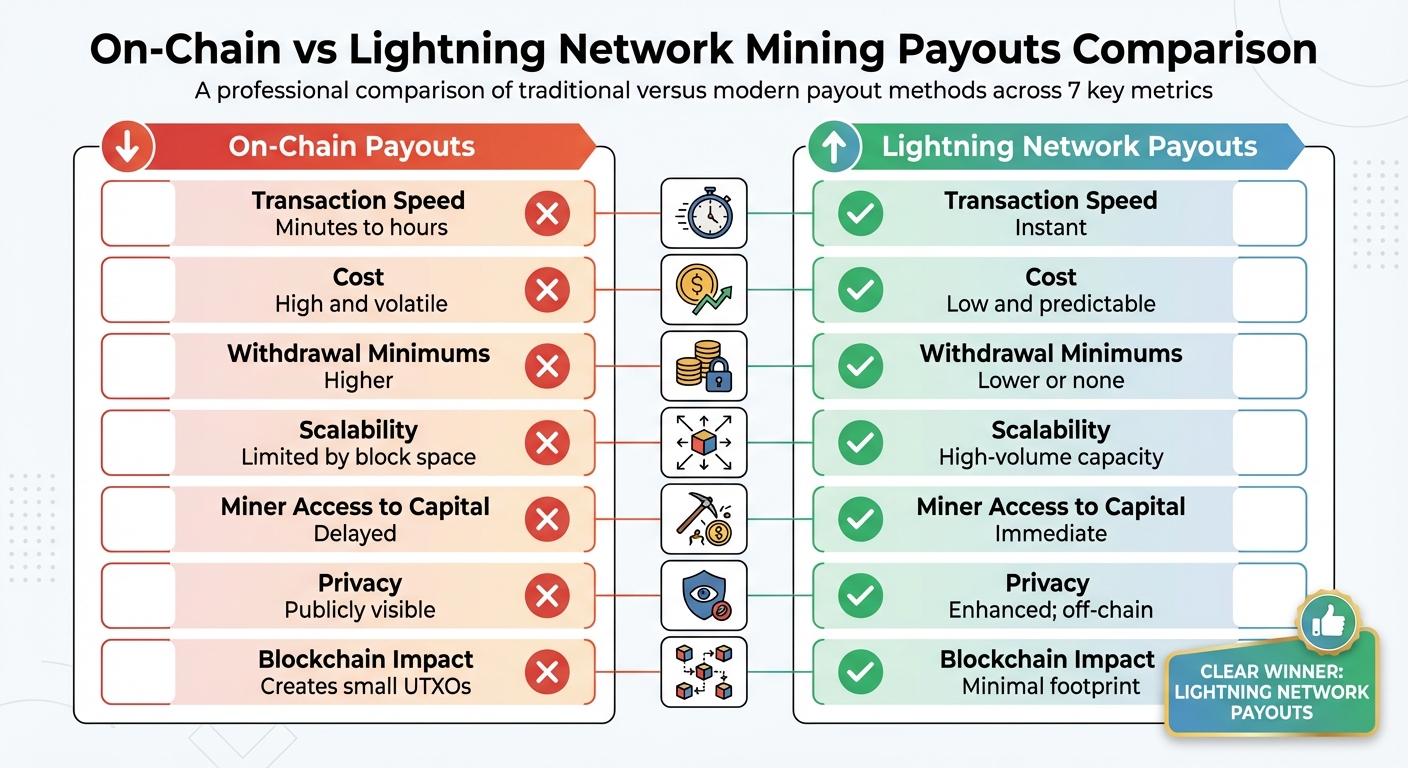
On-Chain vs Lightning Network Mining Payouts Comparison
The Lightning Network isn't just a technological upgrade - it directly improves how mining pools operate, offering several clear advantages.
Lower Transaction Costs
Mining pools using traditional methods often face fees ranging from 1% to 3%, along with unpredictable on-chain transaction costs during network congestion. The Lightning Network sidesteps these issues by removing the need for costly on-chain settlements. This allows pools to provide payouts with nearly zero fees.
For smaller, at-home miners, this is a game-changer. Pools can distribute rewards daily - or even multiple times a day - without racking up the costs associated with repeated on-chain transactions. Additionally, transaction batching within the Lightning Network further reduces expenses, with liquidity fees typically falling between just 5 and 25 basis points per user.
Lower fees don’t just save money - they also pave the way for quicker, more efficient reward distribution.
Faster Reward Delivery
Speed is another major advantage. With Lightning payouts, miners can receive their rewards in seconds, significantly improving operational efficiency. The removal of minimum payout thresholds means even the smallest miners can access their earnings without delay. This instant access reshapes the financial dynamics of mining, making payouts faster and more accessible than ever.
On-Chain vs. Lightning Payouts Comparison
| Metric | On-Chain Payouts | Lightning Network Payouts |
|---|---|---|
| Transaction Speed | Minutes to hours | Instant |
| Cost | High and volatile | Low and predictable |
| Withdrawal Minimums | Higher | Lower or none |
| Scalability | Limited by block space | High-volume capacity |
| Miner Access to Capital | Delayed | Immediate |
| Privacy | Publicly visible | Enhanced; off-chain |
| Blockchain Impact | Creates small UTXOs | Minimal footprint |
This side-by-side comparison highlights how the Lightning Network outshines traditional on-chain payouts in every key area. From speed and cost to scalability and privacy, it offers mining pools and their participants a more efficient and effective solution.
sbb-itb-f81ab9b
Mining Pools Using the Lightning Network
Mining pools that integrate the Lightning Network benefit from reduced fees, quicker payouts, and greater satisfaction among miners. Let’s look at two standout examples that highlight these advantages.
Braiins Pool and Voltage Partnership
In February 2024, Braiins Pool teamed up with Voltage to become the first major mining pool to implement Lightning Network payouts. This collaboration, spearheaded by CEOs Eli Nagar and Graham Krizek, aimed to provide miners with instant, low-cost payouts, addressing the burden of high on-chain fees.
By March 2025, the partnership had achieved notable success, with miners withdrawing an impressive 13.78 BTC in under a year. The pool offers two payout options: daily Lightning Address payouts at 9:00 UTC or manual invoice withdrawals. The minimum payout threshold was lowered to just 1 satoshi (0.00000001 BTC), a stark contrast to the 0.0002 BTC required for on-chain transactions. Lightning payouts are completely free, while on-chain withdrawals below 0.005 BTC come with a 0.0001 BTC fee.
"Rather than waiting for on-chain transactions to confirm and paying high fees, our miners are now getting instant, frictionless payouts - every single day." - Eli Nagar, CEO of Braiins
OCEAN Pool's BOLT12 System
OCEAN Pool has taken a different but equally innovative approach. Co-founded by Luke Dashjr and supported by Jack Dorsey, OCEAN introduced BOLT12 in May 2024, revolutionizing the way miners receive payments with reusable and privacy-enhanced payment requests.
Using BOLT12, miners rely on a single static payment address for all rewards. To set this up, miners sign a message with their Bitcoin private key, linking their on-chain address to a BOLT12 offer. This ensures non-custodial security. The system also includes a fallback: if a Lightning payment fails, it automatically retries with every new block until the miner’s balance reaches 0.01048576 BTC, at which point the payout settles on-chain.
BOLT12 is compatible with several Lightning nodes, including Alby Hub, Core Lightning, and Eclair. This setup not only enhances privacy through blinded paths but also reduces blockchain congestion, reinforcing the efficiency and speed benefits of Lightning Network adoption.
"For small miners, the problem is exacerbated since in some cases the cost of the transaction fee is higher than the reward that they earn... OCEAN helps overcome this risk using Lightning." - Luke Dashjr, Co-founder of OCEAN
Using Flash for Lightning Network Integration
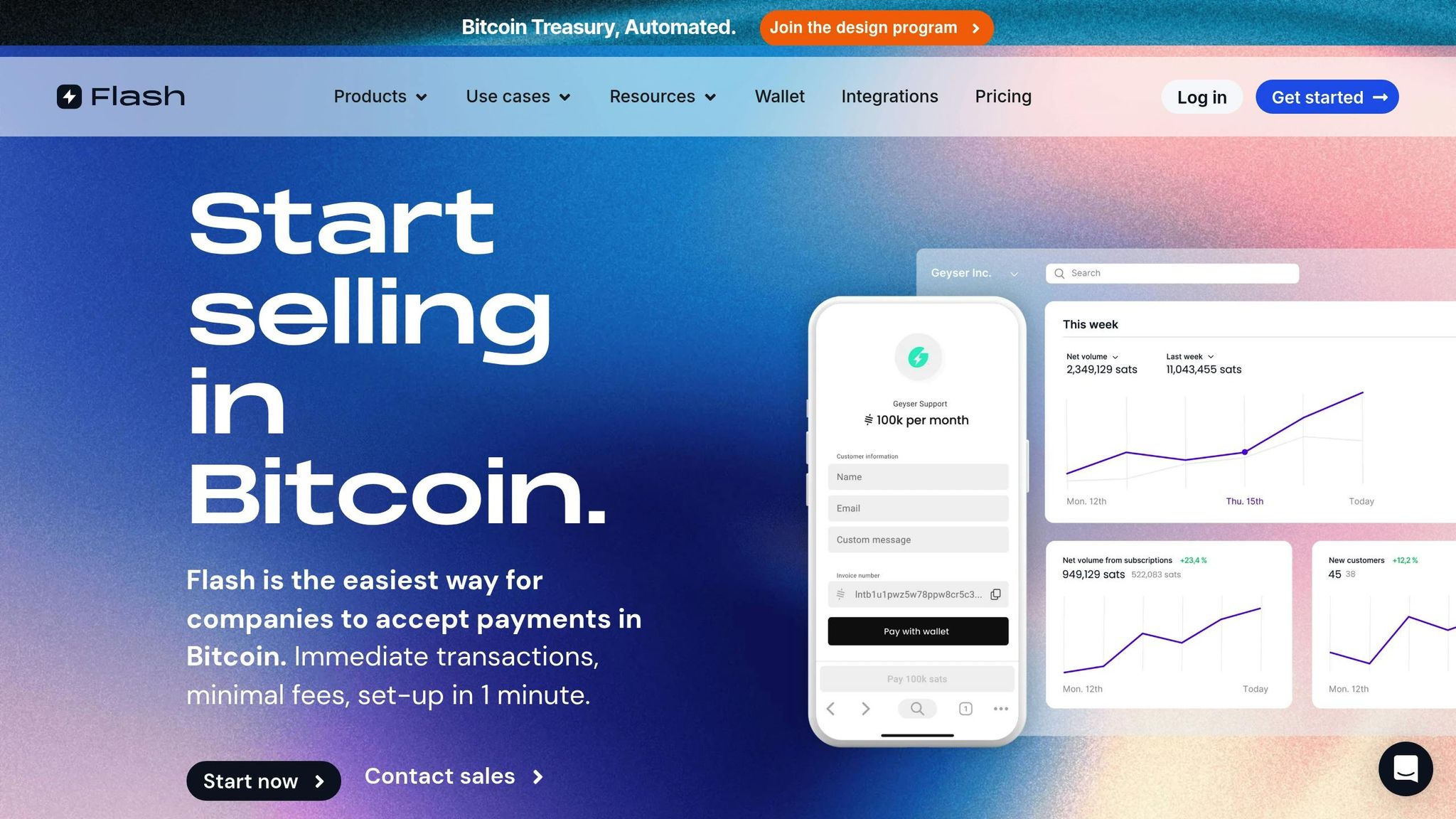
Mining pools aiming to integrate Lightning Network payouts can simplify the process by using Flash's infrastructure. This platform enhances mining pool operations by building on Lightning Network's efficiency and low costs. Flash provides enterprise-level, non-custodial payment solutions, allowing pools to distribute rewards without dealing with the complexities of managing node configurations.
Flash's Non-Custodial Payment Solutions
Flash employs a time-locked 2-of-2 multisig setup on Bitcoin, ensuring pools maintain full control over their funds. To authenticate, pools purchase a Lightning Service Authentication Token (LSAT) for 1,000 satoshis. These funds become accessible after three confirmations. Pools can further reduce costs by opting for longer lock-up periods and slower confirmation targets.
Custom Integrations and Real-Time Analytics
Flash offers flexible tools that seamlessly integrate with existing mining pool systems. Pools can operate Flash as a standalone daemon (poold) or through the Lightning Terminal (litd), ensuring secure connections by copying the tls.cert and admin.macaroon files. Real-time analytics provide insights into payout performance, helping pools optimize their distribution schedules. With consistently low transaction fees, pools can manage costs effectively by capping maximum chain fees using the --max_batch_fee_rate argument. These tools enable mining pools to achieve a higher level of operational efficiency.
Enterprise Tools for Implementation
Flash also supports high-volume operations with features like payment links, widgets, and tailored integrations. Its batched transaction execution consolidates completed orders and channel openings into a single on-chain transaction, significantly reducing individual chain fees. For technical setup, pools must ensure their lnd node runs version v0.13.3-beta or later. If installing from source, the node should be compiled with specific sub-server build flags: signrpc, walletrpc, chainrpc, and invoicesrpc. Additionally, Flash offers automated liquidity management through a batched clearing-price auction system. This system purchases liquidity in 100,000-satoshi increments, with auctions occurring once per block and orders collected every ten minutes.
Conclusion
The Lightning Network is reshaping how mining pools handle payouts by addressing challenges like high fees, delays, and network congestion. Pools relying solely on on-chain transactions may find themselves at a disadvantage as miners increasingly seek faster and more cost-effective payment methods.
Take Braiins, for example. They've shown how Lightning payouts enable instant, seamless, and low-cost transactions on a large scale. Building on these successes, tools like Flash are stepping in to make integration even easier. Flash’s non-custodial infrastructure simplifies the process by handling the technical side of Lightning nodes while giving pools complete control over funds. Features like batched transactions, real-time analytics, and automated liquidity management make the transition smoother than ever.
The benefits are clear: faster transactions, lower costs, and a better experience for miners. Mining pools that embrace Lightning payouts now can stay ahead of the curve, reduce operational costs, and contribute to a healthier Bitcoin network. With proven tools like Flash, integrating Lightning payouts has never been more accessible. Now’s the time to make the move.
FAQs
How does the Lightning Network help mining pools lower transaction fees?
The Lightning Network allows mining pools to handle payouts off-chain, enabling them to send quick, small payments without depending on Bitcoin's on-chain transactions. This approach bypasses standard miner fees, cutting costs significantly for both the pool and its participants.
With the Lightning Network in place, mining pools can provide fast and low-cost payouts that remain efficient, even during periods of heavy network traffic. This improves the financial efficiency of mining pools while offering a smoother, more reliable experience for miners.
What privacy advantages does the Lightning Network offer to miners?
The article doesn't dive into privacy benefits for miners specifically when using the Lightning Network. However, the Lightning Network is widely recognized for facilitating off-chain transactions. These transactions reduce the transparency of individual payments on the blockchain, offering a layer of discretion. For miners, this could mean more private payout options compared to the traditional on-chain methods.
Why are Lightning Network payouts more efficient than on-chain payouts?
When it comes to on-chain payouts, delays are a common issue. These delays happen because blockchain transactions require confirmations, which can take longer during times of heavy network congestion. On top of that, transaction fees for on-chain payouts can be quite steep, and over time, those costs can really add up.
The Lightning Network offers a much quicker alternative. Payouts through this network are almost instantaneous and come with little to no fees. This makes it a faster and far more cost-efficient option. For mining pools, this means rewards can be distributed more efficiently, all while easing the load on the Bitcoin network.