Making Sense of Mobile Payment Solutions in Real Life
Imagine yourself at a bustling farmer's market, arms overflowing with fresh produce. Instead of digging for cash, you simply tap your phone on a small reader and you're done. That seemingly small action represents a big shift in how we handle money. Mobile payment solutions are changing the face of commerce, making buying and selling easier and more accessible for millions.
This section breaks down what these solutions actually mean, moving beyond the technical jargon. We’ll explore how they work in the real world, why they've become so common, and what sets them apart from traditional payment methods. Think of it as a conversation with a colleague, exploring these ideas together through real-world examples and user stories that show both the benefits and the hurdles.
The screenshot above shows a variety of mobile payment methods, highlighting the different technologies involved. From contactless NFC to QR codes, these solutions offer different functions and levels of convenience. The important takeaway? The sheer range of options available to suit different user preferences and business needs.
Beyond the Tap: Real-World Applications
Mobile payment solutions aren't limited to buying groceries. They're empowering small businesses, boosting financial inclusion in developing economies, and even giving rise to entirely new business models. For instance, street vendors in many countries now accept mobile payments, eliminating the need for traditional banking. This access is vital for economic growth and individual empowerment.
Mobile payments also create a smoother experience for subscription services. Rather than manually entering card details every month, users can automate recurring payments directly through their phones. This streamlined process reduces hassle and improves customer loyalty.
The Flash Advantage: Decentralized Bitcoin Payments
Flash’s decentralized Bitcoin offering takes mobile payments a step further. By connecting directly to Bitcoin wallets, Flash enables secure and instant transactions without holding user funds. This allows merchants to accept Bitcoin with minimal fees and simplified integration.
No KYC requirements make the process even smoother, making Bitcoin payments as easy as tapping your phone, similar to other mobile payment methods. This aligns with the increasing demand for secure and diverse payment options, allowing businesses to tap into the growing cryptocurrency market. This is especially useful for merchants looking for secure, low-cost alternatives to traditional payment options. In short, mobile payment solutions aren’t just about convenience; they’re about access, security, and financial empowerment.
The Remarkable Rise: How Mobile Payments Went Mainstream
Just a few years ago, paying with your phone felt like something out of a sci-fi movie. Now, it's as normal as buying a coffee. This rapid shift has changed how businesses operate and how we interact with money. But what drove this change? It wasn't just one single factor, but a combination of events that pushed mobile payments into the everyday.
Global Disruptions and Changing Habits
The COVID-19 pandemic was a major catalyst. Suddenly, contactless payments weren't just convenient, they were necessary. This accelerated the adoption of mobile payments worldwide. People who were once hesitant quickly embraced tapping their phones for safety and ease. This shift, driven by a global disruption, cemented mobile payments as a regular part of life.
The increasing use of smartphones also played a vital role. As smartphone ownership grew, more people had the tools they needed to use mobile payment apps and services. This created a perfect environment for mobile payment solutions to thrive.
This growth shows no sign of slowing down. The global mobile payment market has seen significant expansion in recent years. In 2021, the market was valued at USD 43.11 billion, and by 2022, it reached USD 55.34 billion. This rapid growth is thanks to factors like increased smartphone adoption and the preference for contactless transactions, especially after the COVID-19 pandemic. Discover more insights into the mobile payments market.
Regional Differences and Adoption Rates
Interestingly, mobile payment adoption hasn't been the same everywhere. Some regions, especially in Asia and Africa, embraced these solutions much faster. This is due to things like existing infrastructure limitations and the quick growth of mobile technology in these areas. In some cases, mobile payments provided a way to skip traditional banking altogether.
Winners and Losers: Why Some Solutions Thrive
The rise of mobile payments has created both success stories and failures. Some solutions thrived, while others disappeared. A key difference was the user experience. Solutions with smooth integration, intuitive interfaces, and strong security became popular, while clunky or complicated systems struggled to find users. This highlights how important user-centric design is for any mobile payment solution. Flash, for instance, focuses on simplifying Bitcoin payments for both merchants and consumers, making it a strong competitor. By offering a user-friendly experience, Flash is well-placed to benefit from the rising demand for cryptocurrency payment options.
Behind the Tap: How Mobile Payment Technology Really Works
What happens between tapping your phone and hearing that satisfying beep confirming your purchase? It's a silent, intricate dance of technology, mostly hidden from view. Let's pull back the curtain and explore the inner workings of mobile payment solutions, using real-world examples to make these complex systems easy to understand.
Near-Field Communication: The Heart of the Tap
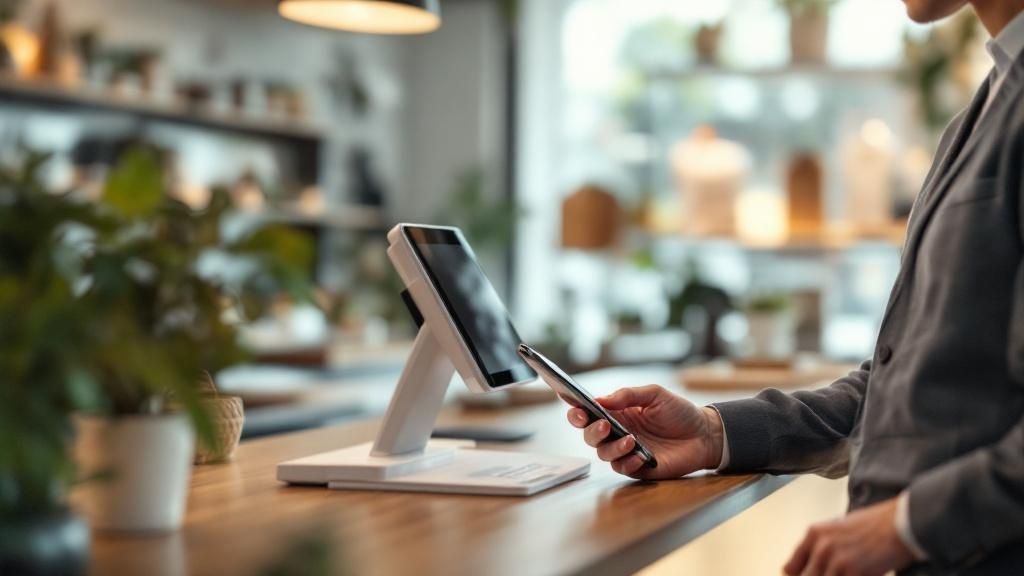
Imagine two magnets communicating without actually touching – that's similar to how Near-Field Communication (NFC) works. This short-range wireless technology allows devices to exchange information when they're close together, usually within a few centimeters. Your phone’s NFC chip transmits encrypted payment information to the payment terminal, starting the transaction. No need to fumble with physical cards; payments become quick and effortless.
This diagram shows the communication field between an NFC reader and tag, illustrating the technology’s short range. This close proximity is a key security feature, making it harder for unauthorized devices to intercept your data.
The Secure Journey of Your Data
Think of your payment information as a VIP passenger traveling with an encrypted passport. Once sent via NFC, the data travels through secure networks, guarded at every point in its journey. Tokenization adds another layer of security. This process replaces your real card number with a unique, temporary token. Like a disposable boarding pass, even if intercepted, the token is useless to thieves. This happens silently in the background, keeping your sensitive information safe.
Beyond NFC: Other Mobile Payment Methods
NFC is popular, but it's not the only game in town. QR codes, those square barcodes you see everywhere, offer a different approach. They store payment information, and scanning the code with your phone’s camera initiates the transaction. This method is particularly useful in areas where NFC technology isn't widely adopted. Biometric authentication, like fingerprint or facial recognition, adds another security layer by confirming your identity before authorizing payments. These diverse technologies highlight the range of mobile payment options available.
To help illustrate the differences, let's look at a comparison of these technologies:
Mobile Payment Technologies Comparison
| Technology | How It Works | Security Level | User Experience | Common Applications |
|---|---|---|---|---|
| NFC | Short-range wireless communication between devices | High, due to close proximity and encryption | Seamless and fast | Contactless payments in stores, public transport |
| QR Codes | Scanning a code with a smartphone camera to initiate payment | Moderate, depends on the security of the QR code system | Simple, but requires a camera | Restaurant bills, online payments, ticketing |
| SMS | Payment information sent via text message | Low, susceptible to phishing and interception | Can be convenient for feature phones | Mobile top-ups, small payments in developing regions |
| Biometric Authentication (Fingerprint/Facial Recognition) | Uses unique biological traits to authorize payments | High, difficult to forge | Convenient and secure | Mobile banking, in-app purchases, device unlocking |
This table highlights the strengths and weaknesses of each technology, revealing how security and user experience are balanced in different ways.
The Ecosystem of Mobile Payments
Mobile payments involve a whole network of players working behind the scenes. From payment processors like Stripe or Square who handle transaction details to app developers creating user-friendly interfaces, these different components need to work together flawlessly. This complex ecosystem explains why some mobile payment solutions feel seamless, while others can be cumbersome. Understanding this ecosystem is crucial for businesses choosing the right solution. Flash, for example, streamlines this by directly connecting Bitcoin wallets, cutting out some of the traditional middlemen. This leads to faster, cheaper transactions and a smoother experience for users.
Security That Actually Protects: Beyond Fear and Hype
Is your payment information safer on your phone than in your wallet? It's a question many of us ponder. The answer isn't a simple "yes" or "no," but rather a journey into the complex world of mobile payment security. Let's unpack how these systems work, separating fact from fiction.
Tokenization: Your Secret Payment Code
Imagine paying for your coffee with a secret code instead of your actual credit card number. That's the magic of tokenization. This process replaces your sensitive card details with a unique, temporary token.
Think of it like a single-use boarding pass for your purchase. Even if someone intercepts this token, it's useless to them. They can't use it to make other purchases because it's tied specifically to that one transaction. This all happens behind the scenes, adding a powerful layer of security without you even noticing.
Fraud Detection: The Silent Guardian
Mobile payment solutions employ sophisticated fraud detection algorithms. These algorithms are like tireless security guards, constantly monitoring transaction data for anything suspicious.
They can spot unusual patterns in milliseconds, often stopping fraudulent activity before you even realize something's amiss. This proactive approach is a key advantage of mobile payments over traditional cards.
To understand the various security measures at play, let's look at the following table:
Mobile Payment Security Features
| Security Feature | How It Protects Users | Implementation Level | User Impact |
|---|---|---|---|
| Tokenization | Replaces sensitive card data with unique tokens, preventing unauthorized use if intercepted. | Industry Standard | Seamless; users don't notice the process. |
| Fraud Detection | Algorithms analyze transactions for suspicious patterns and stop fraud in real-time. | Platform Specific; varies in complexity. | Proactive protection; potential for occasional false positives. |
| Biometric Authentication (Fingerprint/Facial Recognition) | Adds an extra layer of security, ensuring only the authorized user can make payments. | Device Dependent | Increased security; slight increase in transaction time. |
| Two-Factor Authentication | Requires a second verification step (e.g., OTP) for high-value transactions, preventing unauthorized access. | Optional; User configurable | Enhanced security; adds an extra step to the payment process. |
| Encryption | Scrambles data during transmission, making it unreadable to hackers. | Industry Standard | Invisible to the user; fundamental for secure communication. |
This table highlights the various security measures that work together to protect your mobile payments. From tokenization to encryption, these features create a robust defense against potential threats.
Why Experts Trust Mobile Payments
Security professionals often recommend mobile payments over traditional cards. This isn't just hype. The multiple layers of security, from tokenization to real-time fraud detection, offer a significantly stronger defense against theft.
Plus, mobile payments often require additional authentication, like your fingerprint or a PIN. This makes it much harder for someone to use your phone to make unauthorized purchases, even if they have physical access to it.
Taking Control of Your Security
While mobile payment systems offer robust protection, you can take additional steps to fortify your security. Using strong, unique passwords and keeping your phone's software up-to-date are fundamental practices.
Be cautious of suspicious emails or text messages requesting payment information. Legitimate companies rarely ask for such sensitive details through these channels.
Staying Alert: Spotting the Red Flags
Even with strong security measures in place, vigilance is key. Regularly review your transaction history for any unfamiliar charges.
If your phone is lost or stolen, immediately contact your bank and payment provider to suspend your mobile payment services. This swift action can prevent unauthorized access and protect your funds.
By understanding how mobile payment security works and taking a few simple precautions, you can confidently enjoy the convenience and added protection these systems provide. Flash, for example, builds upon the security of the Bitcoin blockchain, adding yet another layer of protection to its mobile payment solution. This dedication to security is essential for building trust and driving wider adoption of Bitcoin payments.
Where Mobile Payments Shine: Real Applications That Matter
Mobile payments aren't just about grabbing a quick coffee. They're reshaping how businesses operate and how we all interact with money. Think bigger than that tap-and-go transaction. Mobile payments are changing entire industries, from helping small businesses compete with larger corporations to providing financial access in developing economies.
Empowering Small Businesses
Imagine a small food truck parked next to a well-established restaurant. Mobile payments level the playing field. They give smaller businesses the same smooth payment options as their larger competitors without needing pricey POS systems like Square. These businesses can accept payments quickly and easily, boosting efficiency and improving the customer experience. This accessibility is essential for small businesses trying to succeed in a competitive market.
Financial Inclusion in Developing Economies
In many parts of the world, traditional banks are scarce. Mobile payments provide a vital alternative, giving financial power to those who've never had it before. Think of a street vendor in a remote village, now able to accept digital payments. This unlocks new chances for economic growth and individual empowerment. Mobile payment solutions become a bridge to financial inclusion, connecting people to the global economy.
Transforming Retail Experiences
Picture this: you walk into a store, pick up what you need, and just walk out. No checkout lines, no scanning. Mobile payments can create this frictionless retail experience. Stores like Amazon Go are already doing this, showing the potential of mobile payments to redefine shopping. This streamlined experience removes hassle, makes customers happy, and creates new possibilities for retail innovation.
Mobile payment adoption is increasing across all ages, but particularly among younger people. As of 2025, the 18-45 age group is more likely to use mobile payment apps than other groups. In 2020, mobile payments represented 44.5% of all e-commerce transactions globally. Find more statistics on global mobile payment adoption here. These numbers highlight the growing influence of mobile payments on how we buy and sell.
Peer-to-Peer Transfers and Subscription Services
Beyond retail, mobile payments are changing how we manage our money. Peer-to-peer (P2P) transfers between friends are now simple, whether splitting a bill or sending money instantly. Subscription services also benefit, adapting to usage patterns and providing flexible payment options directly through mobile apps. This adaptability and personalized control enhance the user experience, simplifying financial management.
The Practical Impact: Challenges and Outcomes
While mobile payments hold tremendous potential, successful implementation requires careful planning. Each example we've discussed has its own challenges. From integrating with existing systems to guaranteeing security and encouraging user adoption, understanding these challenges is crucial. By measuring results and learning from real-world experiences, we can figure out what truly works, not just what sounds good in theory. This practical approach is key to unlocking the full potential of mobile payments, creating real value for both businesses and consumers.
What's Coming Next: The Evolving Mobile Payment Landscape
The world of mobile payments is constantly changing. What's considered advanced today might be old news tomorrow. This section explores the exciting technologies shaping the future of how we pay, from the potential of blockchain to the impact of augmented reality.
Blockchain: Cutting Out the Middleman
Imagine sending money to anyone, anywhere, instantly, without involving a bank. That's the potential of blockchain, the technology behind cryptocurrencies like Bitcoin. Blockchain-based mobile payments eliminate the need for traditional intermediaries, resulting in faster transactions and lower fees. This decentralized structure also improves security, as there’s no single point of vulnerability for hackers to target. Flash, for instance, uses Bitcoin's blockchain for direct wallet-to-wallet transactions, offering a glimpse into the future of decentralized finance.
AI: Your Personalized Financial Assistant
Artificial intelligence (AI) is changing industries across the board, and mobile payments are no exception. AI can personalize your financial life by providing custom recommendations and automating tasks like budgeting and saving. Think of an app that automatically adjusts your investments based on your spending habits and financial goals. This personalized approach empowers you to make smarter financial decisions.
5G and the Internet of Things: Payments Everywhere
The rise of 5G networks opens up exciting possibilities for mobile payments. Faster speeds and lower latency allow for seamless transactions even in crowded places and enable new experiences like augmented reality shopping. The Internet of Things (IoT), where everyday devices connect to the internet, also plays a vital role. Picture paying for groceries simply by walking out of the store, with your smart fridge automatically deducting the cost from your account. To learn more about the communication networks that boost mobile payments, check out various SMS messaging platforms. These interconnected technologies create a world of "ambient payments," where transactions happen seamlessly in the background.
Augmented Reality: A New Way to Interact With Money
Augmented reality (AR) overlays digital information onto the real world. This technology has the potential to change how we interact with money. Imagine trying on clothes virtually and buying them with a single tap, the payment processed instantly through your AR glasses. This immersive experience could revolutionize retail, creating entirely new ways to shop and spend.
Navigating the Regulatory Landscape
As mobile payments change, so must the rules governing them. Governments worldwide are working out how to support innovation while protecting consumers. Finding the right balance is crucial for growth and ensuring the security and stability of mobile payments. The global mobile payment market is predicted to experience strong growth. In 2024, it was valued at USD 1.25 trillion, and projections anticipate a CAGR of 12.4% from 2025 to 2034. Another forecast expects the market to expand from USD 4.97 trillion in 2025 to USD 26.53 trillion by 2032. You can find more information about the growth of mobile payment solutions.
Separating Hype from Reality
Not every new technology will be successful. Some trends are truly transformative, while others are simply hype. Analyzing pilot programs and real-world adoption will be crucial for distinguishing the actual breakthroughs from passing fads. Understanding these dynamics is essential for businesses and consumers navigating the ever-changing world of mobile payments.
Your Path Forward: Practical Steps for Mobile Payment Success

So, we've covered a lot of ground on mobile payments. Now, how do you actually use this information? This section offers practical steps for navigating mobile payments, whether you're managing your own money or running a business.
Building Your Mobile Payment Strategy
First things first: figure out what you need. Are you a small business owner looking to simplify checkout? Are you just trying to find an easier way to pay for your morning coffee? Defining your goals is the first step to finding the right mobile payment solution.
Once you know what you're looking for, explore the options. Think about things like transaction fees, security features, and how well the solution fits with your current systems. Research different providers and compare what they offer. Thinking about future trends? Explore topics like digital transformation in healthcare: digital transformation in healthcare.
Implementation and Optimization
You've chosen a solution – great! Now, make sure the rollout is smooth. This could mean training your staff, updating your software, or showing your customers how the new payment method works. Create realistic timelines based on the complexity of the integration. Setting up a simple QR code system, for instance, is much faster than implementing a full Near-Field Communication (NFC) payment infrastructure.
After you launch, ongoing optimization is essential. Keep track of important metrics like transaction volume, customer satisfaction, and any security incidents. Regularly review your processes and adjust based on user feedback and industry best practices. This iterative approach will keep your mobile payment strategy effective and aligned with your goals.
Troubleshooting and Future-Proofing
Even with the best planning, bumps in the road can happen. Be prepared for common issues like technical glitches, security concerns, or customer service questions. Having a troubleshooting plan in place can minimize disruptions and ensure a good user experience.
Finally, keep an eye on the future. Mobile payments are constantly evolving. Stay up-to-date on emerging trends like blockchain technology and the increasing use of cryptocurrencies like Bitcoin. This forward-thinking approach will help you adapt to new opportunities and keep your mobile payment strategy current. Ready to simplify Bitcoin payments for your business? Flash can help you tap into the future of finance. Learn more about Flash and start accepting Bitcoin today.