MSCI's decision to include Bitcoin treasury companies in its indices marks a major shift in corporate finance.
Here’s what you need to know:
- By June 2025, 61 public companies outside the crypto sector adopted Bitcoin as part of their treasury strategies.
- MSCI reversed a proposal to exclude firms with over 50% of assets in digital currencies after industry feedback, ensuring these companies remain index-eligible.
- This decision prevents potential forced liquidations of $10–$15 billion and maintains access to $2 trillion in ETF investments tied to MSCI indices.
- Companies like Strategy (formerly MicroStrategy) use Bitcoin for capital preservation, alongside USD reserves to manage short-term obligations.
Why it matters: Bitcoin is no longer just a speculative asset. It’s now a key tool for corporate treasury management, offering liquidity, transparency, and global accessibility. MSCI’s move solidifies its role in modern finance while protecting passive investment flows.
Why MSCI Is Adding Bitcoin Treasury Companies In Its Index
The Consultation Process and Industry Feedback
Between October and December 2025, MSCI proposed excluding companies with over 50% of their assets in digital assets from its Global Investable Market Indexes. This sparked strong opposition within the industry.
In response, the Bitcoin for Corporations coalition rallied over 1,500 signatures opposing the exclusion. Executive Director George Mekhail argued that the proposal unfairly labeled operating companies as passive asset holders. Meanwhile, Strategy's Chairman Michael Saylor submitted a formal letter, calling the 50% threshold "arbitrary and unworkable". The central argument? These companies aren't passive investment funds - they're businesses actively operating while holding Bitcoin.
"I think a lot of this just really has to do with a lack of education and understanding of Bitcoin itself, as well as these Bitcoin treasury companies and the significance of their operating businesses." - George Mekhail, Executive Director, Bitcoin for Corporations
On January 6, 2026, MSCI decided to reverse its proposal. It acknowledged that distinguishing between investment companies and businesses holding digital assets as part of their core operations required more research and industry input. The reversal affected 39 companies with a combined float-adjusted market capitalization of roughly $113 billion. This shift highlights how feedback shaped MSCI's updated inclusion criteria.
Criteria for MSCI Index Inclusion
MSCI’s revised approach treats Bitcoin treasury companies as operating businesses rather than investment funds. For instance, Strategy continues to run its core software analytics business while using Bitcoin as a tool for capital preservation.
MSCI also noted that Bitcoin operates differently from traditional intangibles like goodwill, which makes up a significant part of MSCI's own balance sheet. Bitcoin offers real-time, 24/7 global trading transparency, setting it apart.
To address concerns around Bitcoin’s price volatility, some companies have adopted hybrid treasury strategies. For example, Strategy created a $2.19 billion reserve in early 2026 to manage short-term obligations and debt payments. This demonstrates how firms are adapting their financial strategies to align with MSCI’s inclusion standards while maintaining Bitcoin holdings.
Impact on Passive Investment Flows
The updated criteria, which differentiate operational use from passive holding, have had a notable impact on passive investment flows. Analysts estimated that excluding Bitcoin treasury companies could have triggered $10 billion to $15 billion in forced liquidations. For Strategy alone, this could have meant $2.8 billion in MSCI-linked outflows, potentially climbing to $8.8 billion across indices.
MSCI’s decision to reverse its stance on January 6, 2026, removed these barriers, leading to a 7% after-hours rise in Strategy’s share price. This move ensured continued automatic exposure for pension funds and institutional investors tracking MSCI benchmarks.
The ripple effects extend beyond the U.S., with companies in Japan, Germany, and Europe also advancing Bitcoin treasury strategies. MSCI’s decision underscores an international shift, offering passive investors access to firms embracing digital asset treasuries across global markets.
Benefits of Bitcoin Treasuries for Enterprises
Risk Diversification and Inflation Protection
Enterprises are increasingly viewing Bitcoin as a form of digital capital to diversify their holdings beyond traditional assets like cash, gold, or sovereign reserves. As of January 23, 2026, public companies collectively hold 1,080,504 BTC - equivalent to 5.145% of Bitcoin's total 21 million supply - with a combined value of $96.34 billion.
Bitcoin serves as a globally traded reserve asset with transparent price discovery, offering both diversification and liquidity advantages. While some companies regard it as a hedge against inflation, historical data from 2021–2022 revealed that Bitcoin's performance did not consistently align with rising inflation rates. Advocates, however, emphasize its superior liquidity compared to most corporate treasury assets.
The trend of integrating Bitcoin into financial strategies is gaining traction worldwide. Companies in Japan (Metaplanet), Germany (Aifinyo), and North America have begun incorporating Bitcoin into their balance sheets. Beyond diversification, Bitcoin provides unparalleled liquidity and the ability to settle transactions quickly.
Global Liquidity and Instant Settlements
Bitcoin's around-the-clock trading offers a level of liquidity that traditional assets simply cannot match. For instance, Strategy (formerly MicroStrategy) reported trading volumes exceeding $1 trillion in 2025, showcasing the substantial liquidity available for companies holding Bitcoin in their treasuries.
In December 2025, Strategy established a $1.44 billion USD reserve to manage dividend payments and debt interest. By January 2026, this reserve had grown to $2.19 billion, complementing its significant Bitcoin holdings. This dual approach - combining Bitcoin with USD reserves - enables companies to mitigate short-term volatility while maintaining exposure to a highly liquid digital asset.
"Establishing a USD Reserve to complement our BTC Reserve marks the next step in our evolution, and we believe it will better position us to navigate short-term market volatility while delivering on our vision of being the world's leading issuer of Digital Credit." - Michael Saylor, Founder and Executive Chairman, Strategy
Better Financial Transparency and Control
Bitcoin also enhances financial transparency. Its fully auditable, on-chain nature allows for real-time, mark-to-market valuation. Unlike traditional intangible assets, Bitcoin's on-chain auditability enables immediate and verifiable ownership tracking.
This level of transparency offers corporate treasurers a degree of financial visibility that traditional accounting methods cannot match. Reflecting this shift, in January 2026, the New York Stock Exchange announced it was seeking regulatory approval to launch a digital platform for tokenized shares, featuring 24/7 trading and instant settlements (T+0).
Strategy CEO Phong Le Explains Why Bitcoin Companies Matter | COIN STORIES CLIPS

sbb-itb-f81ab9b
What Corporate Leaders Need to Know
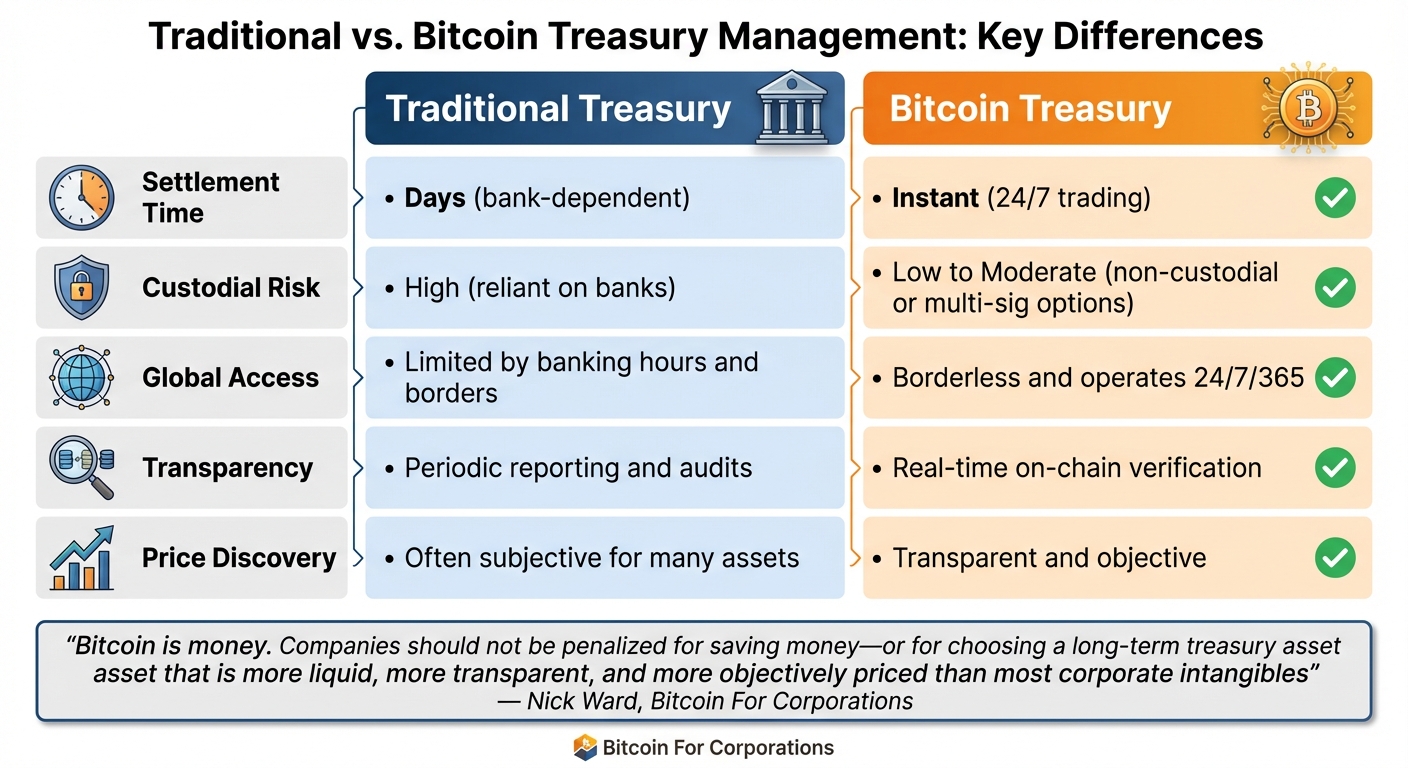
Traditional vs Bitcoin Treasury Management Comparison
Adding Bitcoin Payment Solutions
For CFOs and CEOs, integrating Bitcoin into treasury operations requires a clear strategy. Consider treating Bitcoin as a long-term asset for preserving capital while maintaining enough flexibility for operational needs. Additionally, focus on building treasury resilience through effective reserve management.
A dual-reserve strategy works well: maintain a USD reserve to cover immediate obligations while holding Bitcoin to balance any short-term market fluctuations. This approach strengthens both financial stability and operational continuity.
"Establishing a USD Reserve to complement our BTC Reserve marks the next step in our evolution, and we believe it will better position us to navigate short-term market volatility." - Michael Saylor, Founder and Executive Chairman, Strategy
Beyond holding Bitcoin, businesses can actively integrate it into operations by adopting Bitcoin payment systems. For instance, Flash provides tools for accepting Bitcoin payments worldwide, including invoicing, payment links, and Lightning Network support. This shift turns Bitcoin from a passive treasury asset into an active revenue driver, ensuring businesses retain their operational identity rather than being classified as investment funds.
Corporate leaders should also keep an eye on the 50% asset threshold used by index providers like MSCI for company classification. Staying below this ratio - or generating clear revenue streams - ensures continued eligibility for passive investment flows. For context, MSCI oversees over $18.3 trillion in assets, making index inclusion a crucial factor for publicly traded companies.
Traditional vs. Bitcoin Treasuries: A Comparison
When it comes to treasury management, understanding the differences between traditional systems and Bitcoin-based approaches is essential for making informed decisions.
| Aspect | Traditional | Bitcoin |
|---|---|---|
| Settlement Time | Days (bank-dependent) | Instant (24/7 trading) |
| Custodial Risk | High (reliant on banks) | Low to Moderate (non-custodial or multi-sig options) |
| Global Access | Limited by banking hours and borders | Borderless and operates 24/7/365 |
| Transparency | Periodic reporting and audits | Real-time on-chain verification |
| Price Discovery | Often subjective for many assets | Transparent and objective |
One of Bitcoin's standout advantages is its transparency. Nick Ward of Bitcoin For Corporations highlights this point:
"Bitcoin is money. Companies should not be penalized for saving money - or for choosing a long-term treasury asset that is more liquid, more transparent, and more objectively priced than most corporate intangibles".
These contrasts reflect a broader evolution in treasury management. Leaders need to engage with index providers and adopt standardized digital asset reporting practices to align their strategies with market expectations.
Conclusion: Bitcoin's Future in Corporate Finance
MSCI's decision in January 2026 to retain Bitcoin treasury companies in its index marks a pivotal moment for corporate finance. By avoiding forced liquidations, this move solidifies Bitcoin's position as a legitimate treasury asset, directly influencing key companies within the index.
Bitcoin brings unique advantages to the table: 24/7 trading, transparent pricing, and instant settlements. These features highlight its liquidity and transparency, setting it apart from more traditional assets.
This development underscores Bitcoin's growing acceptance in institutional finance as more than just a speculative asset. It signals a shift in how corporate treasuries operate, paving the way for new financial strategies. Incorporating Bitcoin isn't just about safeguarding capital - it's about improving operational efficiency and staying competitive.
Key Takeaways for Decision-Makers
For corporate leaders, this shift presents clear strategic priorities:
- Protect your operational identity: Maintain verifiable revenue streams and active business operations. Doing so ensures your company remains eligible for index inclusion and retains access to passive investment flows.
- Adopt a hybrid reserve strategy: Combine Bitcoin's long-term appreciation potential with assets that ensure short-term liquidity. For example, Strategy's $2.19 billion USD reserve paired with 672,497 BTC holdings demonstrates how to balance market volatility while preserving capital. This approach provides flexibility without compromising the advantages of Bitcoin as a treasury asset.
- Integrate Bitcoin into active operations: Accepting Bitcoin as a payment option can transform it from a passive reserve into an active revenue generator. This not only strengthens your status as an operating business but also broadens your global market reach. Keep a close eye on MSCI's upcoming consultations on non-operating companies, as future changes to their methodology may further shape Bitcoin treasury strategies.
FAQs
What factors does MSCI consider when adding Bitcoin treasury companies to its index?
MSCI examines companies to determine if their digital asset holdings account for 50% or more of their total assets. They also consider whether a company is primarily involved in Bitcoin or digital asset treasury activities. This includes evaluating if the company identifies as a digital asset treasury business or raises funds specifically for digital asset-related purposes.
By applying these standards, MSCI ensures that the companies they include are deeply involved in the Bitcoin treasury sector, showcasing the increasing role of digital assets in corporate financial planning.
What are the benefits of holding Bitcoin for corporate treasury management?
Holding Bitcoin can bring several benefits to corporate treasury management. It serves as a strategic reserve, offering financial flexibility while potentially acting as a safeguard against inflation or currency devaluation - especially in times of economic uncertainty.
Take MicroStrategy as an example. The company has demonstrated how integrating Bitcoin into its financial strategy can boost shareholder value, with its stock performance reaping the rewards of this approach. Beyond that, Bitcoin provides businesses with an opportunity to diversify their assets, tapping into a growing digital asset class that’s increasingly recognized as both a store of value and a potential investment for future growth.
As institutional interest in Bitcoin grows and its market becomes more stable, an increasing number of companies are considering it a practical addition to their treasury management strategies.
How will MSCI’s inclusion of Bitcoin treasury companies impact global investments?
MSCI's move to include companies with Bitcoin holdings in its indices could have a notable impact on global investment patterns. By acknowledging Bitcoin's growing role in corporate treasury strategies, this decision has the potential to attract more institutional investors to businesses with significant digital asset reserves, offering a boost to Bitcoin-linked equities.
This step could also lend greater credibility to companies incorporating Bitcoin into their financial plans, possibly encouraging increased capital investment in digital assets. On the flip side, leaving such companies out of these indices might prompt investors to rethink their strategies and shift allocations. Ultimately, MSCI's choice is poised to influence investor confidence, risk assessment methods, and the broader distribution of assets toward Bitcoin-centric firms.