Ever wondered how you can sell to someone in Paris, London, or Tokyo as easily as you sell to someone in your own city? The secret is multi-currency payment processing.
Think of it as a universal translator for money. It's the tech that lets an online business show prices and take payments in a customer's local currency, but get the funds deposited in their own. It’s all about removing the confusion and surprise fees that often come with international transactions.
Unlocking Global Sales With Local Currencies
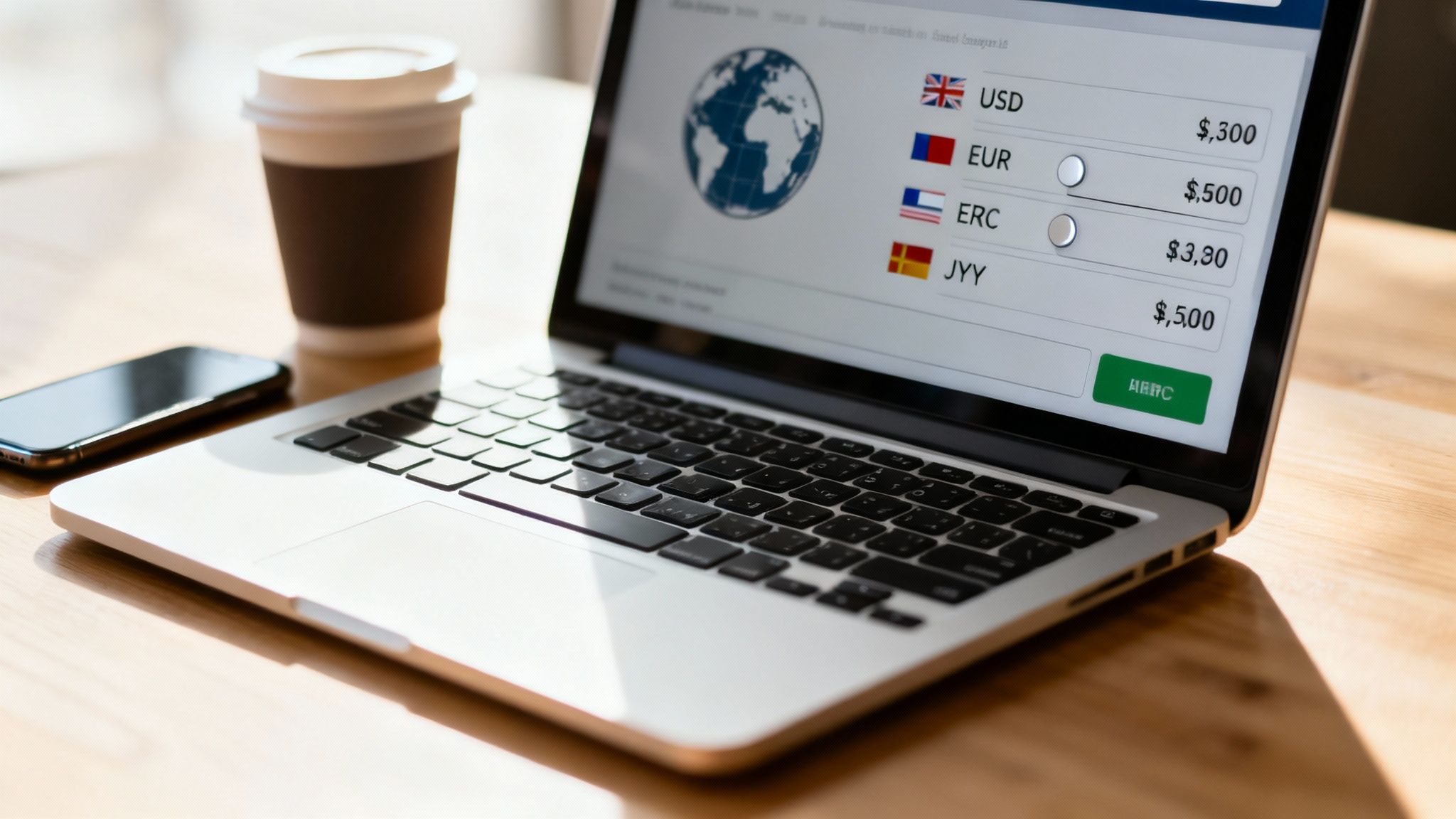
Imagine a customer from Japan lands on your US-based online store. Without a multi-currency setup, they see everything in U.S. dollars. Now they have to pull out a calculator, mentally convert the price to Japanese yen, and try to guess what their bank might charge in extra fees.
That uncertainty? It’s a huge reason why international shoppers abandon their carts.
Multi-currency payment processing tackles this head-on. It’s a system built to create a familiar and localized shopping experience for buyers anywhere in the world—and that’s an absolute game-changer for growth.
The Core Components of Global Payments
At its heart, this process relies on two key things working together. First, your site needs to show prices in different currencies, usually by automatically detecting where your customer is browsing from. Second, the backend system needs to accept that foreign currency and handle all the conversion work for you.
For instance, your business in the United States might list a product for $100 USD. But a shopper in Europe sees it as roughly €92 EUR, and someone in the UK sees it as about £79 GBP. They pay in the currency they know and trust, and your payment processor sorts out the conversion, making sure $100 lands in your bank account.
This smooth experience is made possible by a few key players working behind the scenes:
- Payment Gateway: This is the secure front door that captures your customer's payment details on your site.
- Payment Processor: Think of this as the messenger. It shuttles transaction details between your business, the customer's bank, and your own bank.
- Acquiring Bank: This is your business bank, the final destination for the funds once the transaction is approved and converted.
By removing currency as a barrier, you instantly make your products more accessible and appealing to a global audience, building trust from the very first interaction.
To see just how different the experience is, let's break it down side-by-side.
Single Currency vs Multi Currency At a Glance
Here’s a quick comparison highlighting the core differences in customer experience and business operations when adopting a multi-currency approach.
| Feature | Traditional Single-Currency Checkout | Multi Currency Checkout Experience |
|---|---|---|
| Pricing Display | Shows one currency only (e.g., USD). | Automatically displays prices in the customer's local currency. |
| Customer Certainty | Low. Customer guesses final cost after bank fees. | High. Customer sees the exact amount they will be charged. |
| Conversion Fees | Hidden fees charged by the customer's bank. | Transparent. Conversion is handled by the processor, often at better rates. |
| Cart Abandonment | Higher rate due to price uncertainty and friction. | Lower rate, as the checkout feels familiar and trustworthy. |
| Global Reach | Limited. Appears foreign and less trustworthy to international buyers. | Expansive. Creates a local feel, boosting confidence and sales. |
The difference is clear: one path creates friction and doubt, while the other paves the way for a smooth, trust-building transaction.
Why This Matters for Modern Business
Offering local payment options isn't just a nice-to-have feature anymore; it's what customers expect in a connected world. The global payment processing industry was valued at around $61.1 billion in 2023 and is on track to hit an estimated $147 billion by 2032.
What’s driving that massive growth? Cross-border eCommerce. An incredible 93% of global consumers say that seeing prices in their local currency influences their decision to buy. If you want to dive deeper into these trends, check out the analysis of the payment processing industry's growth on Airwallex.com.
For any business, especially those looking to accept global payments like Bitcoin, a localized checkout is no longer a luxury. It’s essential for competing on a global stage. It turns a potentially confusing and frustrating process into something simple, transparent, and secure for everyone. That foundation of trust is the first step to building a loyal international customer base.
How a Global Transaction Actually Works
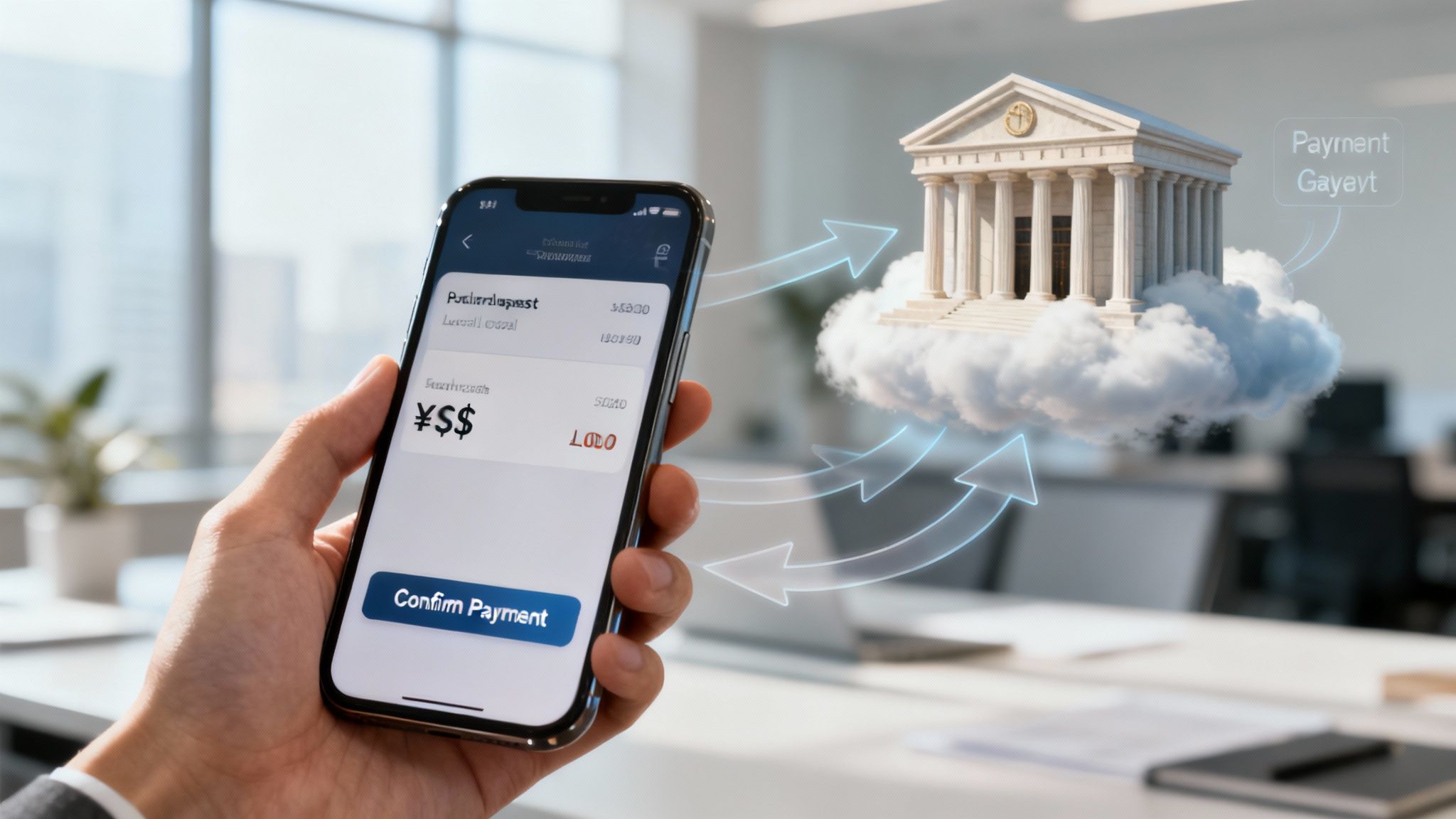
So, what really happens when a customer across the world clicks "buy" on your site? It kicks off a lightning-fast chain reaction that feels seamless to them but involves several key players working in perfect harmony.
Let's pull back the curtain and trace the journey of a single payment, from their screen to your bank account.
The whole thing starts—and ends—with the customer's experience. From the moment they land on your site, a smart payment system detects their location and instantly flips your prices into their local currency. This isn't just a neat trick; it's the first step in earning their trust by getting rid of any pricing guesswork.
The Initial Click and Authorization Request
When the customer is ready to pull the trigger, they punch in their payment details. This is where your payment gateway steps into the spotlight, grabbing that sensitive info, encrypting it, and firing off an authorization request to the customer's bank.
At its core, the request asks a simple question: "Does this person have enough money for this?" The customer's bank gives the account a quick look and sends back a "yes" or "no." This entire back-and-forth happens in just a few seconds.
This is a critical moment where multi currency payment processing truly shines. The request is sent in the customer's local currency, making sure the bank greenlights the exact amount the customer just saw on your checkout page. No surprises.
Currency Conversion The Processor’s Role
Once the transaction gets the thumbs-up, the payment processor takes over to handle the heavy lifting: the currency conversion. Using real-time foreign exchange rates, the processor converts the payment from the customer's currency (say, Euros) into the currency you actually want to receive (like U.S. Dollars).
Modern processors can offer way better rates than what a customer would get from their own bank. This brings us to a massively important point for any business selling internationally.
When you let the customer's bank do the conversion (a process called Dynamic Currency Conversion), they often get hit with terrible exchange rates and surprise fees. A proper multi-currency processor, on the other hand, keeps things transparent and fair, which goes a long way in building customer loyalty.
This conversion all happens behind the scenes, shielding both you and your customer from the wild swings of the currency markets. For larger international deals, this kind of clarity is even more vital. Understanding the crucial DDU and DDP Incoterms becomes essential to know who pays for duties and taxes, which directly affects the final numbers on both sides.
Settlement and Final Payout
With the money converted, the last step is settlement. Your payment processor bundles these converted funds with your other sales and drops them right into your business bank account. The timing can differ, but most processors get your money to you within a few business days.
This whole smooth operation is what makes global ecommerce work. It means your customer gets a simple, familiar shopping experience while you get the right amount of money in your own currency, all without having to become a foreign exchange expert yourself. The system is built to make a sale from halfway around the globe feel just as easy as one from down the street.
The Strategic Benefits of Accepting Local Currencies
Switching to multi-currency payment processing isn't just a technical tweak—it's a massive strategic shift that can genuinely fuel your global growth. Sure, the mechanics are interesting, but the real magic is in why it works so well. It all comes down to tapping into the simple psychology of customer trust and familiarity.
When customers see prices in a currency they actually use every day, a huge mental barrier just vanishes. There’s no frantic searching for a currency converter, no guessing what hidden bank fees might pop up later, and no feeling of being a foreigner on your own storefront. That sense of clarity and comfort is exactly what turns a hesitant visitor from another country into a confident buyer.
Boosting Conversions by Building Trust
The biggest and most immediate win you'll see from showing local currencies is the direct impact on your conversion rate. An unfamiliar currency creates friction, and friction is the number one killer of online sales, leading straight to abandoned carts. The moment a potential customer has to leave your site to check an exchange rate, you've probably lost them for good.
A localized checkout experience does the complete opposite. It sends a clear signal to customers that you've thought about them and their local market. This builds an instant feeling of trust, making them far more likely to click "buy." Think of it as a digital handshake that says, "We get you, and we value your business."
A transparent checkout process is the foundation of customer loyalty. By showing customers the exact amount they will be charged in their own currency, you eliminate surprise fees and build the confidence needed to turn a one-time sale into a long-term relationship.
This trust doesn't just stop at the first sale. Customers who have a smooth, transparent buying experience are way more likely to come back because they know they won't get hit with mysterious charges on their bank statement a week later.
Unlocking New Markets and Slashing Costs
Beyond just making customers happier, multi-currency processing literally opens the door to untapped international markets. There are millions of potential buyers in emerging economies who might not have access to traditional credit cards that favor major currencies like the US dollar. By offering local payment options, you suddenly make your products accessible to a whole new world of customers.
The demand for cross-border shopping is absolutely massive and growing fast. Daily cross-border payment transactions are already topping $10 trillion across 200 countries and 120 different currencies. The entire market is projected to rocket from $194.6 trillion in 2024 to an eye-watering $320 trillion by 2032. This isn't just a trend; it's a fundamental shift in global commerce. You can dig deeper into these numbers with these insights on the future of cross-border payments on JPMorgan.com.
This strategy also brings some serious operational perks. When you partner with a good payment processor, you can often lock in much better exchange rates than your customers could ever get from their own banks. This not only saves them money but can also trim your own overhead by cutting down on complex conversion fees and making your accounting a whole lot simpler.
So, when you break it down, a smart multi-currency setup delivers wins from every angle:
- Higher Conversion Rates: Kills cart abandonment by getting rid of price confusion.
- Increased Customer Loyalty: Builds solid trust with a checkout experience that feels familiar and honest.
- Expanded Market Reach: Puts your products in front of a global audience ready to buy.
- Lower Operational Costs: Slashes currency conversion fees and simplifies your financial workflow.
At the end of the day, setting up a multi-currency payment processing system is a strategic investment that pays for itself. For any business that's serious about growing beyond its borders, it's no longer a "nice-to-have"—it's a must-have.
Integrating Bitcoin Into Your Payment Strategy
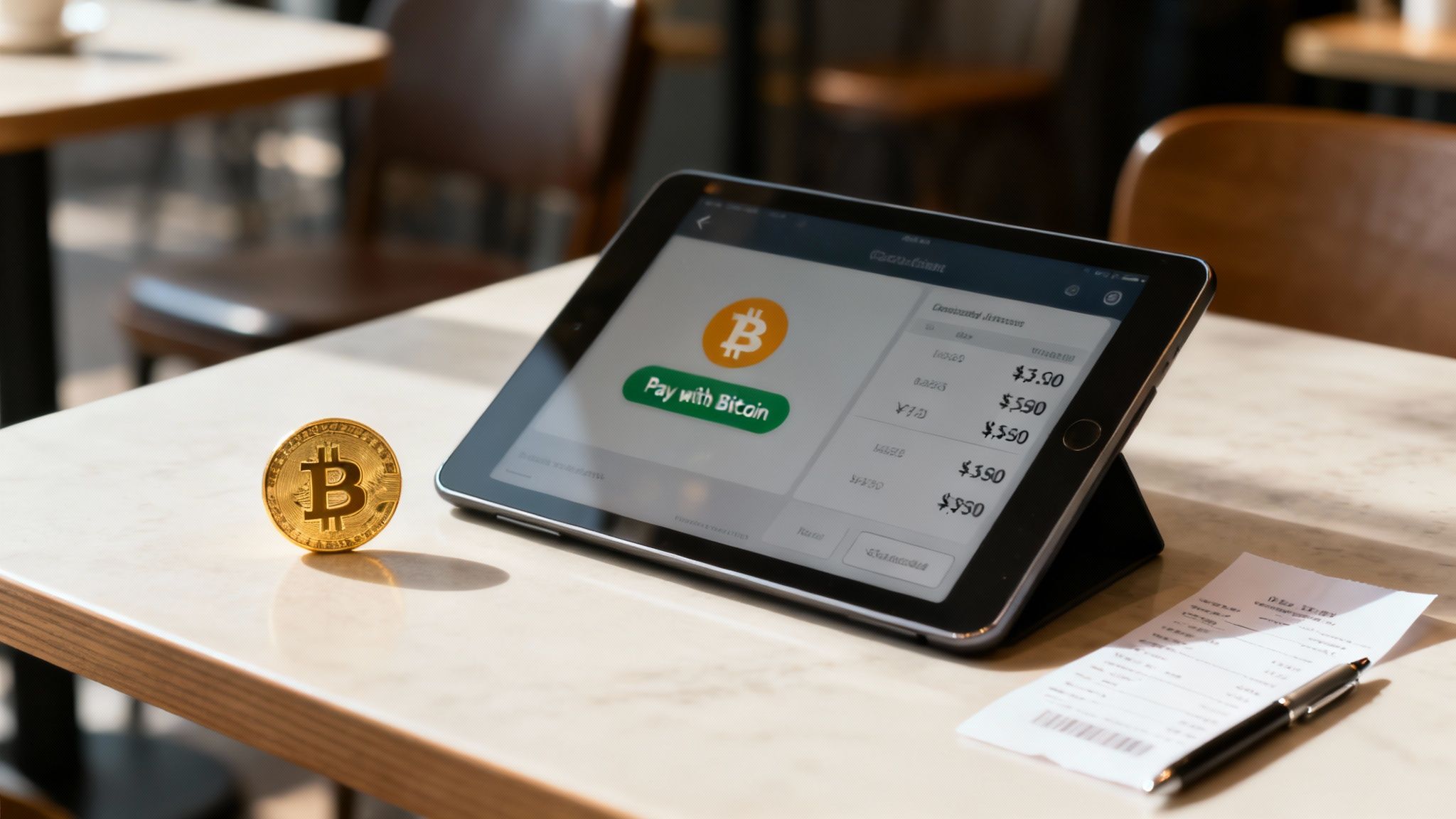
While traditional multi currency payment processing gets the job done for localizing fiat currencies, a whole new layer of efficiency is starting to take shape. Bitcoin is stepping up as a powerful tool for cross-border transactions, acting less like a foreign currency and more like a global settlement network. This opens up a unique chance to simplify international sales and connect with customers who might be locked out of the conventional banking system.
Bringing Bitcoin into the mix doesn't mean you have to ditch familiar pricing or suddenly become a crypto guru. The smartest approach lets you keep pricing your products in stable, local currencies like USD, EUR, or GBP. Your customers, however, get a new option: they can pay the real-time Bitcoin equivalent at checkout, opening up a frictionless new way to buy from you.
How Bitcoin Payments Work in Practice
The whole process is designed to be dead simple, shielding you from ever having to touch a digital asset directly. A customer anywhere in the world can just select "Pay with Bitcoin," and your payment processor handles everything behind the scenes.
The workflow is as straightforward as it is powerful:
- Price Display: Your product is listed for $100 USD. The customer sees this price, so the value is clear and familiar.
- Payment Selection: At checkout, they choose the Bitcoin option.
- Real-Time Conversion: The payment gateway instantly calculates the exact amount of Bitcoin needed to equal $100 USD at that precise moment.
- Customer Payment: The customer sends that specific amount of Bitcoin from their wallet to the address provided.
- Instant Settlement: Your processor gets the Bitcoin, immediately converts it back to USD, and settles the $100 straight into your bank account.
This all happens automatically. You get the exact fiat amount you asked for, completely insulated from Bitcoin's price swings. You get all the benefits of a global currency without any of the volatility risk.
Bypassing Traditional Banking Hurdles
One of the most compelling reasons to accept Bitcoin is its knack for sidestepping the friction baked into the legacy financial system. Traditional cross-border payments often bounce between multiple intermediary banks, each one adding delays and skimming fees that chip away at your margins. This problem is even worse for customers in places with shaky banking infrastructure or tight capital controls.
Bitcoin runs on a decentralized, peer-to-peer network. That means transactions can zip directly from the customer to your payment processor without all those middlemen.
By functioning as a universal payment rail, Bitcoin can significantly reduce settlement times and transaction costs. It provides a vital financial bridge for customers in markets that are difficult to serve through conventional banking channels.
This creates a far more inclusive payment environment, unlocking access to millions of potential buyers who were previously unable to purchase from you. For them, Bitcoin isn't just a cool tech feature; it's an essential tool for participating in the global economy.
The Strategic Value for Your Business
Adding Bitcoin to your payment options is more than just another button at checkout—it's a strategic move that aligns your business with the future of global commerce. It paints your brand as forward-thinking and accessible, which resonates with a growing demographic of tech-savvy consumers.
The core benefits are clear and easy to measure:
- Lower Transaction Fees: Bitcoin network fees can be significantly lower than the percentage-based fees that come with international credit card payments.
- Faster Settlements: Funds can land in your account in minutes or hours, not the days it often takes for international wires to clear.
- No Chargebacks: Bitcoin transactions are final. This completely eliminates the risk of fraudulent chargebacks, a massive headache for online merchants.
- Expanded Market Access: You can instantly sell to customers in any country with an internet connection, no matter what their local banking situation looks like.
Ultimately, integrating Bitcoin is the perfect complement to your existing multi currency payment processing strategy. It gives you a parallel system that’s often faster, cheaper, and more accessible, ensuring you can cater to every kind of global customer and capture sales you might otherwise miss.
Choosing The Right Global Payment Partner
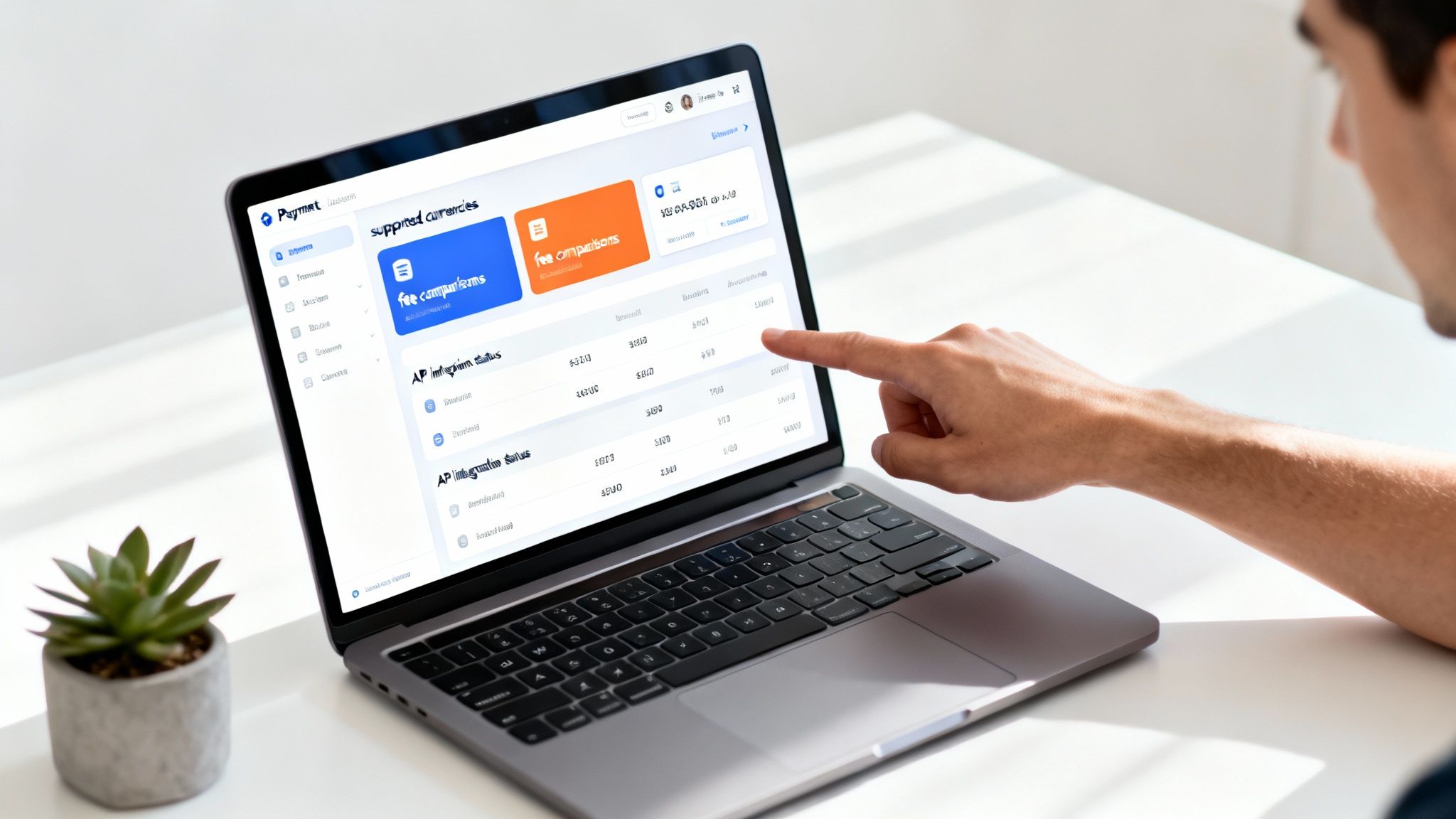
Picking a partner for your multi-currency payment processing is easily one of the most important decisions you'll make when going global. This isn't just about hunting for the lowest transaction fee; it's about building a rock-solid financial backbone that can actually support your international ambitions.
Get it right, and your payment partner works like a silent engine, humming along in the background. Get it wrong, and you're stuck with constant friction that can stall your growth before you even get started.
This choice demands a careful look at a few key areas. You're looking for a provider whose services line up perfectly with your target markets, your tech stack, and your long-term vision. Nail this, and you're in for fewer headaches, happier customers, and a much healthier bottom line.
Aligning Currency and Regional Support
First things first: does this provider even operate where your customers live? This is the fundamental starting point. You need to map out your key international markets and check them against a potential partner’s list of supported currencies and regions.
And don't just glance for the big ones like the Euro or British Pound. If your growth plan includes emerging markets in Southeast Asia or Latin America, you have to confirm that your partner supports those specific local currencies and, just as importantly, their preferred local payment methods.
A provider offering a mile-wide but inch-deep list of countries might not be as useful as one with deep, specialized expertise in the regions you’re actually targeting. It's also smart to check out the top international payment gateway options that are known to work well with your specific e-commerce platform. This step alone can save you from a world of technical pain.
Understanding the True Cost of Service
Payment provider fee structures are notoriously tricky, and the rate they advertise upfront is almost never the full story. To avoid nasty surprises on your monthly statement, you have to dig into every single potential cost.
Look past the simple per-transaction percentage and start asking sharp questions about the total cost of ownership.
Here are the key cost components you need to get clarity on:
- Transaction Fees: The basic percentage or flat fee for each successful payment.
- Currency Conversion Markups: This is often the hidden killer. It's the margin a provider quietly adds to the real-time exchange rate, which can eat away at your revenue.
- Cross-Border Fees: Extra charges tacked on simply because a transaction crosses a border.
- Setup and Monthly Fees: Any recurring charges you have to pay, regardless of your sales volume.
- Chargeback Fees: The penalties you'll face when a customer disputes a charge.
A truly transparent partner will have no problem breaking all of this down for you. The provider that looks cheapest on paper can quickly become the most expensive once all the hidden markups and fees come to light.
Choosing a payment partner is like hiring a key employee who will manage your international revenue. You need someone trustworthy, transparent, and technically proficient who can grow with your company.
Evaluating Technical and Security Frameworks
A powerful payment solution is completely useless if it’s a nightmare to integrate with your existing systems. A well-documented API isn't a "nice-to-have"—it's a non-negotiable for connecting smoothly with your e-commerce platform, accounting software, and other critical tools. Keep an eye out for pre-built plugins for platforms like Shopify or WooCommerce, as they can slash your implementation time.
Just as critical is the provider’s approach to security. Your partner will be handling sensitive customer data, so their security has to be ironclad. Make sure they are fully compliant with PCI DSS (Payment Card Industry Data Security Standard). You should also look for modern fraud detection tools, end-to-end data encryption, and multi-factor authentication to shield both your business and your customers.
Finally, never underestimate the value of good technical support. When things go wrong—and they eventually will—you need a direct line to a responsive and knowledgeable support team that can help you fix problems fast. A partner who invests in great support is showing you they're truly invested in your success.
To help you organize your search, here's a simple checklist you can use when comparing different providers.
Provider Evaluation Checklist
Use this table to ask the right questions and compare potential partners side-by-side. It will help you see beyond the marketing pitch and focus on what truly matters for your business.
| Evaluation Criteria | Key Question to Ask | Importance (High/Medium/Low) |
|---|---|---|
| Regional Coverage | Does the provider support the specific currencies and local payment methods in my target countries? | High |
| Transaction Fees | What is the exact percentage and/or flat fee per transaction for both domestic and international sales? | High |
| FX Conversion Rates | What is your markup on the mid-market exchange rate? Can I see a transparent breakdown? | High |
| Hidden Costs | Are there any setup fees, monthly minimums, cross-border fees, or chargeback penalties I should know about? | High |
| Integration Quality | Do you have a well-documented API or pre-built plugins for my e-commerce platform (e.g., Shopify, Magento)? | High |
| Security & Compliance | Are you fully PCI DSS compliant? What advanced fraud prevention tools do you offer? | High |
| Settlement Time | How long does it take for funds to be settled into my bank account after a transaction? | Medium |
| Technical Support | What are your support hours and channels (phone, email, chat)? Is support handled by experts? | Medium |
| Reporting & Analytics | What kind of dashboard and reporting tools do you provide for tracking sales and fees? | Medium |
| Scalability | Can your platform handle our projected transaction volume as we grow over the next 3-5 years? | Low |
By systematically working through these points, you'll be in a much stronger position to choose a partner that not only meets your needs today but can also scale with you into the future.
Common Questions About Global Payments
Jumping into the world of multi currency payment processing can definitely spark a few questions. Let's tackle some of the most common ones head-on to build a solid, practical understanding of how it all works.
We'll cover everything from the nuts and bolts of currency conversion to how different financial tools fit together, giving you the clarity you need to handle international transactions like a pro.
How Are Currency Exchange Rates Determined?
Payment processors aren't just pulling numbers out of thin air. They plug directly into live data feeds from the global foreign exchange (forex) markets, giving them the most current, up-to-the-minute rates for currency pairs across the world.
To cover their service, they typically add a small, transparent margin to this "mid-market" rate. The key thing to remember is that this markup is almost always way better—and more predictable—than the often-brutal rates and hidden fees your customer’s personal bank would charge for the same conversion.
What Is the Difference Between Processing and an Account?
It's a great question, and the distinction is simple. Think of them as two different tools that work together perfectly. One is for the action of getting paid, and the other is for the storage of that money.
- Multi-Currency Processing is the engine running your checkout. It's the system that lets you show prices in local currencies and accept payments from customers in their native currency.
- A Multi-Currency Account is basically a bank account where you can hold, manage, and send funds in various currencies without being forced to convert them back to your home currency right away.
Processing gets the international money in the door. An account gives you a strategic place to keep it.
The real magic happens when you use them together. You can accept a payment in euros through your processor, let those euros sit in your multi-currency account, and then use them to pay a supplier in Europe. You completely skip conversion fees on both sides of the deal.
Can I Accept Bitcoin Without Being an Expert?
Absolutely. This is probably one of the biggest myths holding businesses back from tapping into the Bitcoin market. Modern payment processors are built to handle the entire process for you, wiping away all the complexity.
Here’s how it works: your customer pays the Bitcoin equivalent of your product's price. Your processor instantly converts it into your preferred currency, like dollars or euros, and settles that final amount directly into your bank account.
You never have to touch, hold, or lose sleep over the volatility of Bitcoin. You get all the upside of reaching a global, tech-savvy audience without needing any specialized knowledge.
Ready to unlock a global market and simplify your payments? Flash provides a secure, decentralized way to accept Bitcoin payments directly from your customers' wallets to yours. Get started in under a minute and tap into a worldwide network of users with instant settlements and minimal fees. Learn more at .