A multi-signature wallet, or "multisig" as it's often called, is a major security upgrade for your Bitcoin. It works by requiring more than one key to sign off on any transaction. This simple change completely eliminates the single biggest weakness of a standard wallet, where one lost or stolen key means your funds are gone for good.
What Makes a Multi Signature Wallet Different?
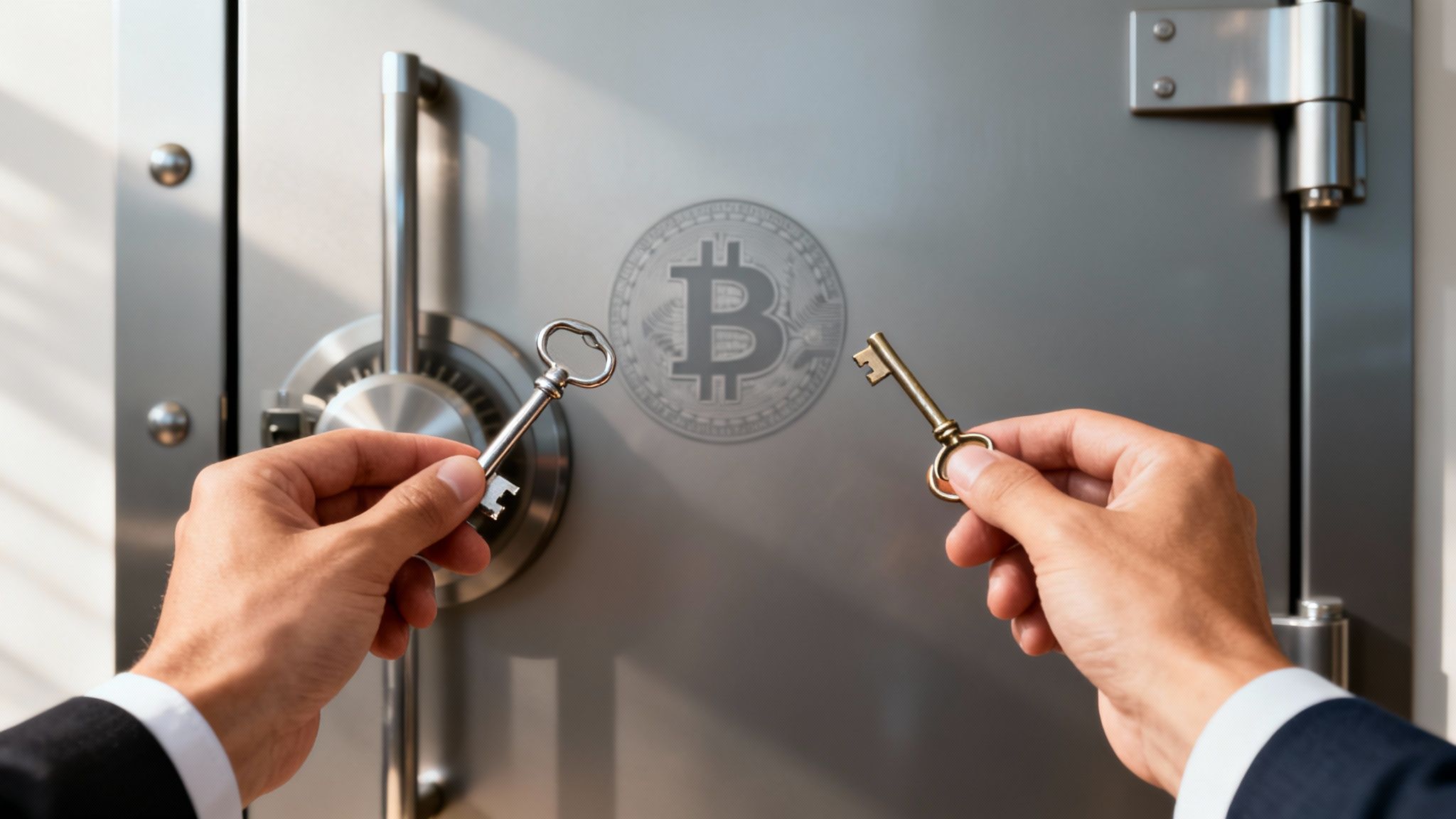
Think of a normal Bitcoin wallet like a home safe with just one key. Whoever has that key has total control. Lose it or have it stolen, and everything inside is at risk. It's a classic single point of failure—a huge gamble when you're dealing with serious assets.
A multi-signature wallet completely flips that model on its head. It’s less like a home safe and more like a bank's vault door, needing two or more keys turned at the same time to open. No single person can just walk in and take what's inside. It creates a powerful system of shared control.
This idea of distributed authority is what makes multisig so powerful. Instead of one person holding all the cards, control is split among several keyholders, providing a robust defense against all sorts of threats.
Core Security Principles
At its heart, a multisig wallet is built on a few foundational security concepts that are game-changers for protecting digital assets.
- No Single Point of Failure: This is the big one. If one of your keys is compromised, lost, or stolen, your funds are still safe. An attacker can't do anything without the other required keys.
- Serious Theft Protection: Multisig puts up a massive wall for hackers. They would need to breach multiple, separately secured people or devices to get the keys they need—a far tougher challenge than just grabbing a single private key.
- Built-in Redundancy: The setup naturally creates a safety net. If one keyholder loses their key, the other authorized parties can still work together to access the funds and move them to a new, secure wallet.
The principle here is similar to another security tool you probably already use. Understanding two-factor authentication (2FA) helps explain the concept. Just as 2FA requires a second piece of information (like a code from your phone) to log in, multisig requires a second key to spend. Both rely on the same idea: multiple independent factors create a much stronger defense than any single one.
How Multi-Signature Wallets Secure Bitcoin
The real power of a multi-signature wallet lies in its design, which is a world away from a standard, single-key setup. Instead of a single point of failure, it smartly distributes control across multiple keys. Think of it as a system of checks and balances baked right into the Bitcoin network. This whole structure boils down to a simple but potent concept known as an "M-of-N" scheme.
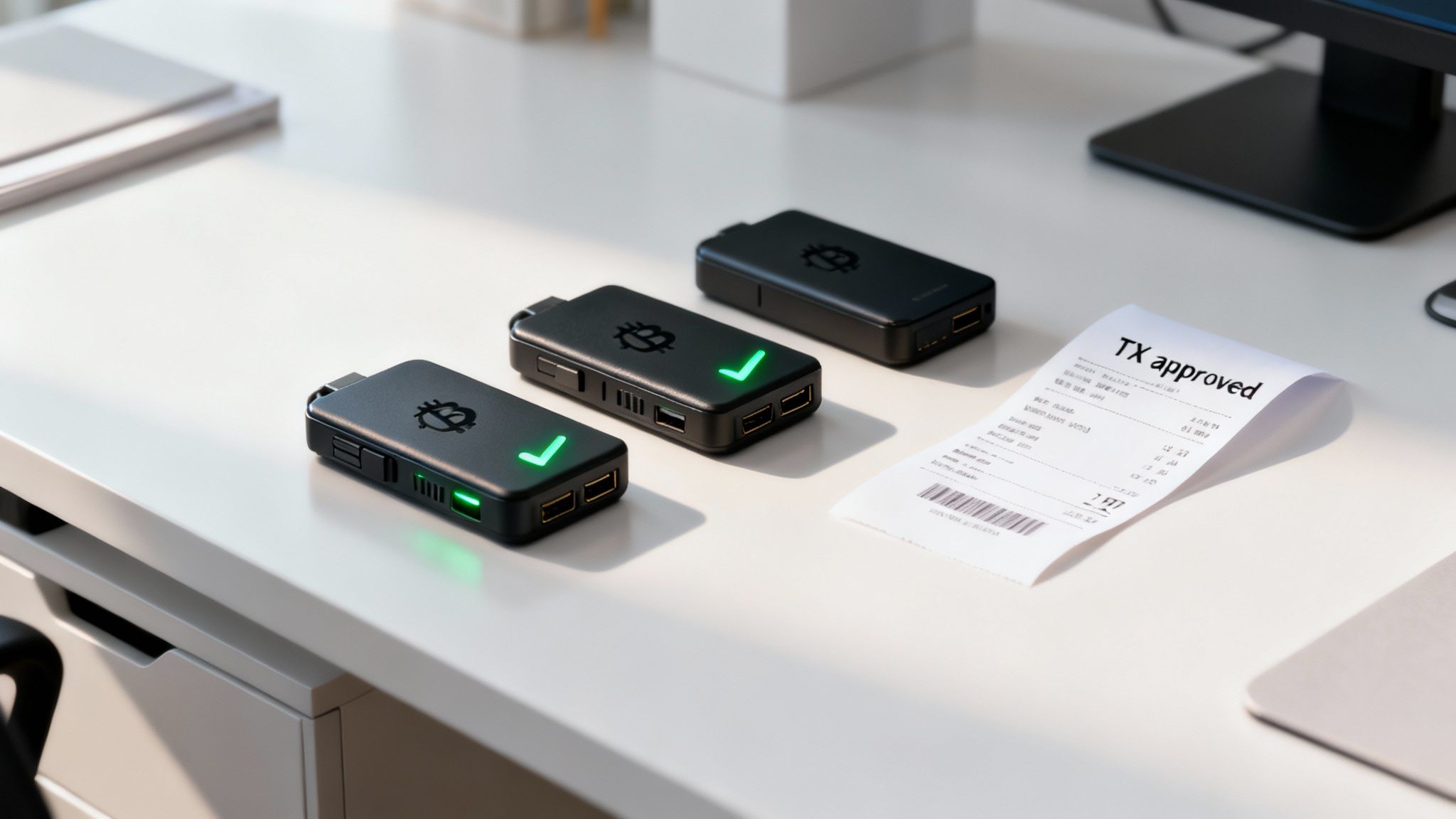
In this setup, 'N' is the total number of private keys associated with the wallet, and 'M' is the minimum number of those keys needed to sign off on a transaction. This creates incredible flexibility, allowing for arrangements like 2-of-3, 3-of-5, or even 2-of-2, all tailored to specific security needs.
It's no surprise that this technology is catching on. The global multi-signature wallet market was recently valued at roughly USD 1.2–1.5 billion, a number expected to climb sharply. This isn't just a niche tool; it's becoming a critical piece of infrastructure for securing digital assets. You can dig into more data on the multisignature wallet market growth on MarketReportAnalytics.com.
The 2-of-3 Setup: A Practical Example
To really get a feel for how this works, let's look at the most common configuration out there: a 2-of-3 setup. Picture a small business with three partners trying to secure their company’s Bitcoin.
- Key Generation: Three distinct private keys are created. Each partner takes one and stores it securely, maybe on a separate hardware wallet.
- Shared Wallet Address: Those three keys are then used to generate a single, shared Bitcoin address. Any funds sent here are now protected by the 2-of-3 rules.
- Transaction Requirement: Now, to spend any Bitcoin from this wallet, at least two of the three partners must use their private key to sign the transaction.
This built-in collaboration means no single partner can go rogue and spend funds alone, preventing both theft and costly mistakes. It also doubles as a fantastic backup plan—if one partner loses their key, the other two can still get together to access and move the funds.
The Transaction Lifecycle
Sending a transaction from a multi-sig wallet isn't a one-click affair. It’s a deliberate, coordinated process that layers security at every stage, moving from a simple proposal to a permanent record on the blockchain.
It starts when one keyholder initiates a transaction. They create a proposal, but at this point, it's just an unsigned, invalid draft. This proposal is then passed along to the other keyholders.
Next, a second keyholder reviews all the critical details—the amount, the destination address, the transaction fee. If everything looks right, they add their digital signature using their own private key.
Once the required number of signatures is met (in our 2-of-3 example, that’s two), the transaction is officially valid. From there, any of the keyholders can broadcast it to the Bitcoin network. Miners then pick it up, confirm the multiple signatures are legitimate, and lock it into a block, finalizing the transfer for good. This multi-step process turns what could be a risky payment into a secure, verifiable group agreement.
Exploring the Security and Privacy Tradeoffs
A multi-sig wallet offers a massive security upgrade over a standard, single-key setup, but this added protection brings a new set of things to think about. The biggest win? You practically eliminate single points of failure. Your Bitcoin is safe even if one key gets lost, stolen, or swiped by a hacker.
This distributed defense is a game-changer for anyone securing serious funds. An attacker can't just compromise one device or trick one person anymore. They have to break through multiple, independently secured keys, making a successful theft exponentially harder. This "no single point of failure" model is the core promise of multi-sig.
But, this fortress-like security does come with a notable privacy tradeoff.
The On-Chain Footprint
Every transaction on the Bitcoin network is public, but multi-sig transactions have a distinct signature. They simply look different from standard single-key transactions on the blockchain. This unique "footprint" makes them easier for blockchain analysis firms to spot and track.
If you're an individual who values maximum privacy above all else, this is a big deal. The on-chain data essentially announces that a specific address is controlled by multiple keys, which could attract unwanted attention or analysis.
For many businesses and organizations, however, this transparency is a powerful feature, not a bug. It provides a crystal-clear, auditable trail of financial controls, proving that funds are managed with a high degree of security and accountability.
This public proof of shared control is invaluable for corporate treasuries, exchanges, and escrow services where showing your work is key to building trust with clients and partners.
Balancing Security and Privacy Needs
Ultimately, the choice between different wallet types boils down to your specific situation and what you're trying to protect against. A multi-sig wallet is built from the ground up for maximum asset protection and operational integrity, and that sometimes comes at the cost of being less private.
To help you figure out what makes the most sense for you, let's break down how these different wallet types stack up.
Comparing Wallet Security and Privacy Models
This table lays out the core differences in security and privacy for the main types of Bitcoin wallets. It's a quick guide to help you match the right tool to your specific needs, whether you're managing a company treasury or just your personal stack.
| Wallet Type | Security Level | Privacy Level | Best For |
|---|---|---|---|
| Single-Signature | Lower (Single point of failure) | Higher (Standard transaction footprint) | Everyday spending, smaller balances |
| Multi-Signature | Higher (No single point of failure) | Lower (Distinct on-chain footprint) | Securing large funds, business treasuries, shared assets |
| Custodial | Varies (Trust in a third party) | Lower (Provider has transaction data) | Beginners, convenience over control |
For anyone managing substantial Bitcoin holdings, the security guarantees of a multi-sig wallet almost always outweigh the privacy considerations. The ability to prevent a catastrophic loss from a single mistake or attack provides a level of peace of mind that you just can't get with a standard wallet.
How Businesses Use Multi-Signature Wallets
This is where the real power of a multi-signature wallet clicks into place—when it moves from a cool concept to a practical tool for business. For any organization handling serious amounts of Bitcoin, this technology delivers the kind of robust financial controls needed to operate securely and transparently. It fundamentally shifts security from a fragile single point of failure to a sturdy system of shared, auditable responsibility.
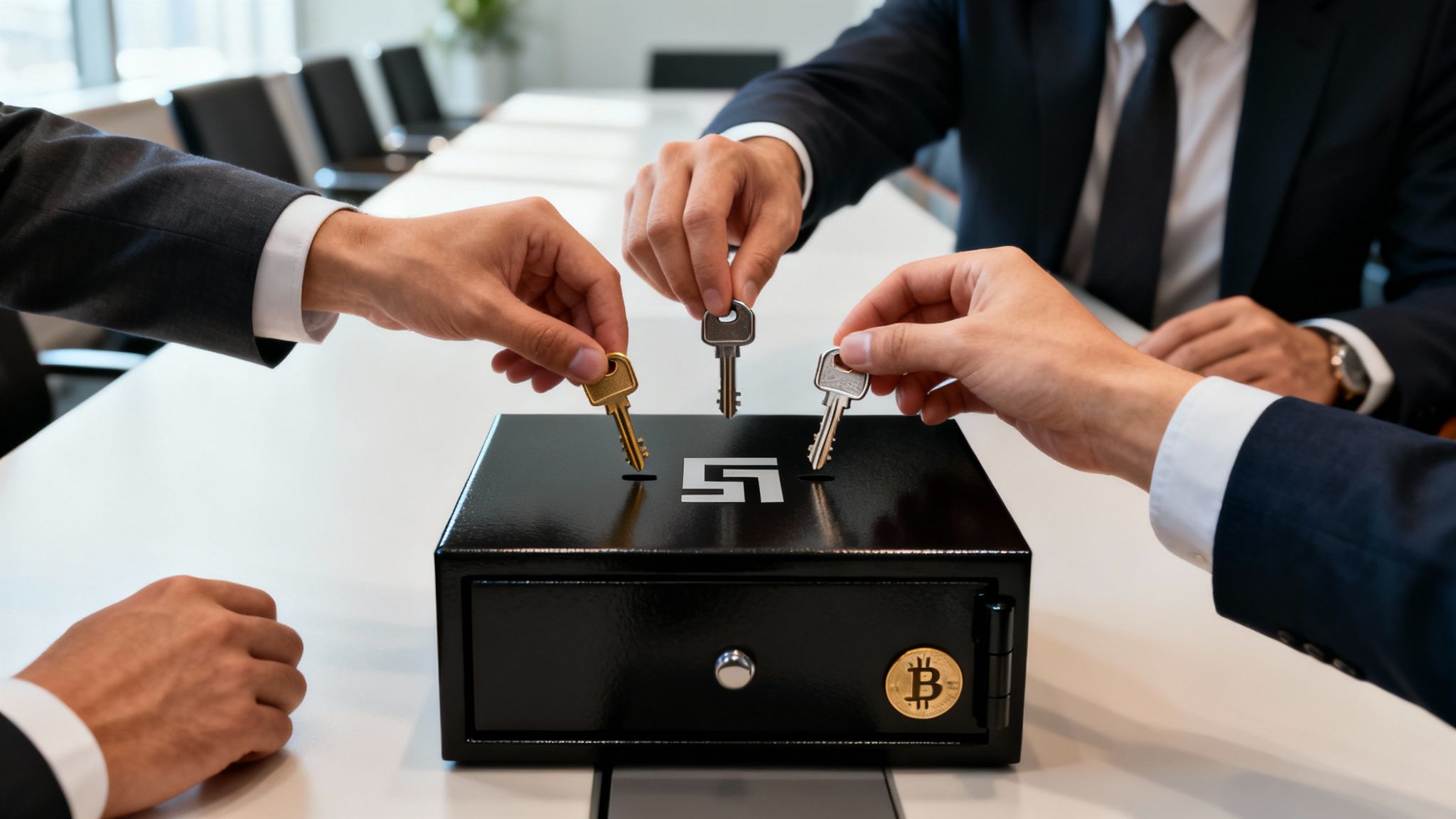
Instead of crossing your fingers and hoping a single individual’s security practices are perfect, businesses can enforce collaborative approvals for any movement of funds. It’s a powerful deterrent against both outside attackers and internal risks like a simple mistake or a rogue employee. This structure builds a framework where financial decisions demand consensus, not just a single password.
Fortifying Corporate Treasuries
One of the most common—and compelling—use cases for a multi-signature wallet is managing a corporate treasury. Picture a company holding a chunk of its reserves in Bitcoin. Sticking those funds in a standard, single-key wallet would be a huge gamble, putting the entire treasury at the mercy of one person or one compromised device.
A multisig setup offers a far smarter alternative.
- A 3-of-5 Scheme: The company could create a wallet with five keys. These might be held by the CEO, CFO, COO, and two trusted board members.
- Required Signatures: To move any funds, a transaction would need signatures from at least three of the five keyholders.
- Resulting Security: This setup ensures no single executive can act alone. Even if two keys were somehow lost or stolen, the funds would remain completely secure.
This approach transforms treasury management from a high-stakes liability into a structured, accountable process.
Enabling Trustless Escrow Services
Another killer application is creating secure escrow services. Think about transactions between two parties who don't fully trust each other. Usually, you’d need a neutral third party to hold the funds until everyone is happy. A multi-signature wallet automates this whole dance without giving any single entity total control over the money.
By distributing control among the buyer, seller, and a trusted arbiter, a multi-signature wallet creates a fair and transparent system. Funds can only be moved when the required parties agree, effectively locking them until the terms of a deal are satisfied.
Let's look at a classic 2-of-3 escrow setup:
- Buyer: Holds one private key.
- Seller: Holds a second private key.
- Arbiter: Holds the third private key.
If the deal goes smoothly, the buyer and seller can use their two keys together to release the funds to the seller. Simple. But if there’s a dispute, the arbiter can step in. They can use their key, along with either the buyer's or the seller's, to resolve the situation and send the funds where they rightfully belong.
This distributed control mechanism has made the multi-signature wallet an essential tool in the digital asset world. Its growing adoption for secure treasury management and custodial services is a key reason for the market’s expansion, which you can read more about in a report from Business Research Insights. Ultimately, these examples show how multisig provides the financial guardrails businesses need to operate confidently.
Best Practices for Setup and Management
Operating a multi-signature wallet isn't just a one-and-done setup; it requires a disciplined approach to security and recovery for the long haul. Getting this right ensures your Bitcoin is safe from both digital thieves and real-world mishaps. The old saying fits perfectly here: with great power comes great responsibility.
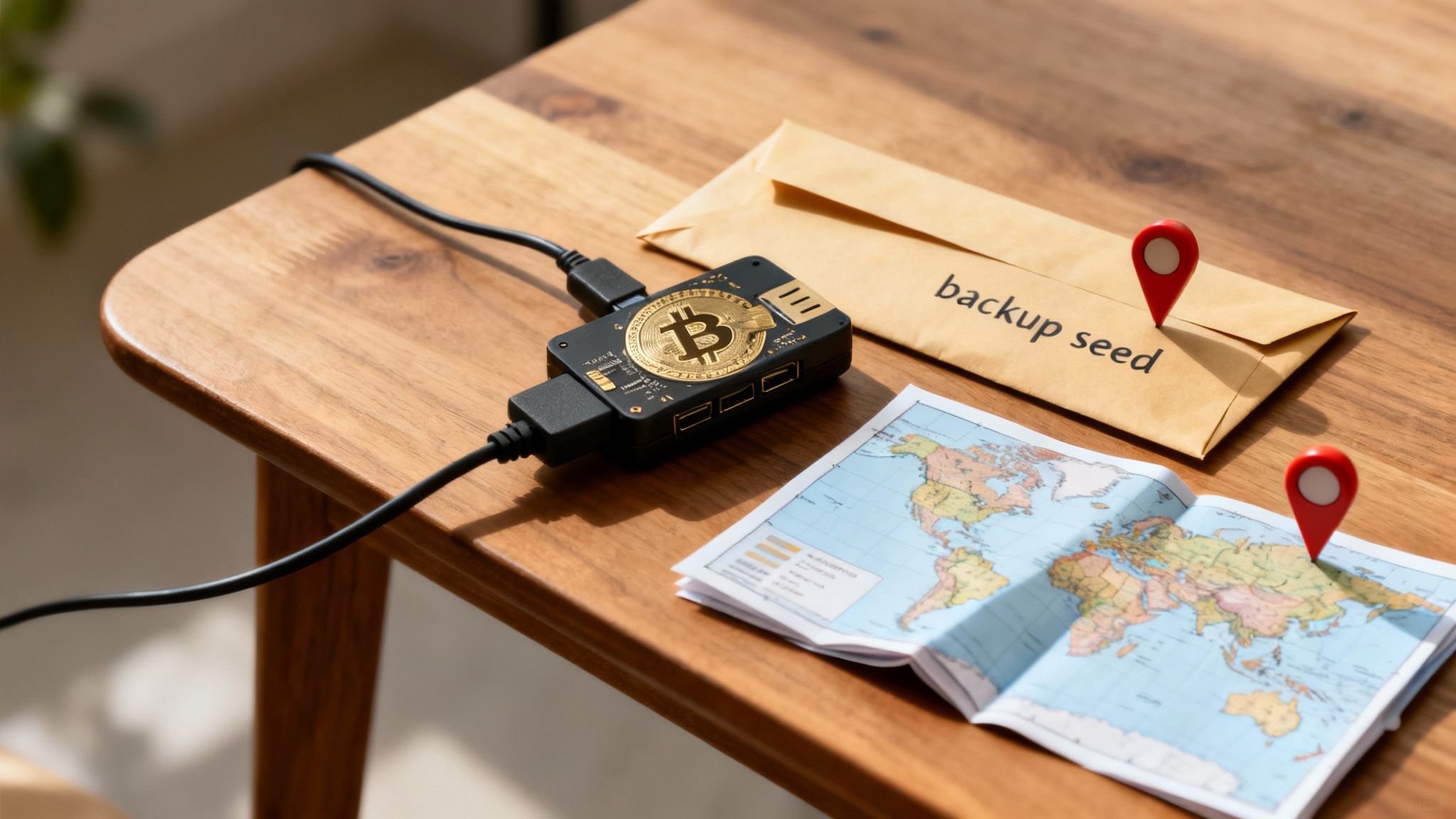
It all starts with secure key generation. Every private key needs to be created in a completely offline, air-gapped environment. A reputable hardware wallet is your best friend for this, as it keeps the key isolated from malware and network attacks right from the start.
Crucially, you should never generate all your keys on the same device or at the same time. The whole point is to create independent security silos, so each key needs its own separate origin story. This compartmentalization is the bedrock of a solid multi-sig defense.
Creating Resilient Backup and Recovery Plans
A multi-sig wallet is only as strong as its backup plan. If you lose enough keys to fall below your threshold, those funds are gone forever. This is why a durable and accessible recovery plan isn't just a good idea—it's absolutely essential.
For every key you create, you'll get a recovery seed phrase, which is usually a list of 12 or 24 words. This phrase is the master key for that specific key. You need to treat each one with extreme care:
- Write It Down: Get the phrase off the screen and onto a physical medium. Think high-quality paper or, even better, a steel plate that can survive a fire.
- Store It Securely: Each backup needs its own safe spot. We're talking fireproof safes, bank safety deposit boxes, or the homes of trusted family members.
- Distribute Geographically: Never keep all your backups in one location. Spreading them across different cities or even countries protects you from localized disasters like a fire, flood, or burglary.
A well-designed M-of-N scheme has built-in redundancy. In a 2-of-3 setup, for instance, losing one key or its backup isn't a catastrophe. The other two keys can still sign a transaction to move your Bitcoin to a new, secure wallet.
Operational Security and Key Management
The work doesn't stop after the initial setup. Ongoing management is just as critical. The principle of shared control has to apply to how you store and access your keys day-to-day. Storing multiple keys together is a huge mistake, as it just recreates the single point of failure you worked so hard to eliminate.
It’s also smart to run periodic "fire drills" to test your recovery process. Actually practicing the recovery of a single key ensures the plan works and that everyone involved knows exactly what to do in a real emergency.
And if any of your keys are managed through mobile devices, it's wise to adopt broader mobile app security best practices. This layered approach gives you the confidence that your procedures are sound and your Bitcoin is protected for the long run.
Multi-Signature Wallets in Non-Custodial Payments
Beyond just locking down stored funds, the multi-signature wallet has become a cornerstone of modern non-custodial payment systems for Bitcoin. It’s the technology that lets merchants accept direct Bitcoin payments without ever handing control of their funds over to a third party.
For any business serious about maintaining full ownership of their Bitcoin, this is a game-changer. It elevates multisig from a simple security tool into a fundamental piece of commercial infrastructure.
The 2-of-2 Payment Model
A popular real-world setup involves a 2-of-2 multi-signature arrangement between a merchant and their payment processor, like the solutions offered by Flash. Here’s a look at how it works for every new invoice:
- Unique Address Generation: The payment processor generates a fresh 2-of-2 multisig Bitcoin address for the invoice.
- Key Distribution: The merchant holds one private key, and the processor holds the other. Think of it like a digital safe deposit box requiring two keys.
- Payment and Verification: When a customer pays the invoice, the processor uses its key to instantly confirm the transaction is complete and for the right amount.
- Merchant Control: Crucially, the processor’s key cannot be used to spend the funds. Only the merchant, who holds the other required key, can actually move the Bitcoin out of that address.
This design creates a trust-minimized environment. The processor handles the heavy lifting of verification and invoicing, but they never actually take custody of the merchant’s money. You get the best of both worlds: smooth, automated payment processing combined with complete merchant control over the funds.
Evolving from Security Tool to Financial Infrastructure
This application really shows how far the technology has come. Multi-signature wallets are undergoing a major shift, both technically and in the market. New interoperability initiatives are plugging multisig wallets into the broader financial ecosystem, breaking them out of their silo and making them far more useful.
As this integration with mainstream services continues, the multi-signature wallet is transforming from a niche security tool into a core component of our future digital financial infrastructure. You can discover more insights about these transformative shifts on 360iResearch.com.
Ultimately, by enabling secure, non-custodial commerce, multi-signature wallets give businesses the tools they need to operate with confidence and efficiency in the Bitcoin economy.
Common Questions About Multisig Wallets
Let's tackle some of the most common questions that come up when people start exploring multi-signature wallets for their Bitcoin.
What Happens If I Lose One of My Keys?
This is where multisig really shines. If you've set up a 2-of-3 wallet and misplace one key, it's not a disaster. You can still access and move your funds because you have the two keys required to meet the signing threshold. This built-in redundancy is a huge step up from a standard single-key wallet, where losing one key means losing everything.
That said, you should act immediately. The best practice is to set up a brand-new multi-signature wallet and transfer your funds over as soon as possible. Your security is technically weaker until you replace that lost key's function in a fresh setup.
Are Multi-Signature Wallets Completely Hacker-Proof?
While multisig wallets offer a massive security boost, no system connected to the internet can ever be called completely bulletproof. Their core strength is in neutralizing the threat of a single point of failure. A hacker can't drain your funds just by compromising one device or one key.
However, if a sophisticated attacker manages to get their hands on the required threshold of keys—say, two keys in that 2-of-3 wallet—they can authorize transactions. This is precisely why it's so critical to store each of your private keys in physically separate and secure locations.
Is Multisig a Good Idea for Daily Spending?
Honestly, probably not. For small, everyday payments like buying a coffee, a multi-signature wallet is overkill. The process of getting multiple signatures for a single transaction adds friction and slows things down, which is the last thing you want in a checkout line.
Multi-signature wallets are built for a different purpose: securing large holdings, managing a company treasury, or handling funds that require shared control, like in an escrow arrangement. For your daily spending, a separate single-signature "hot wallet" with a small amount of bitcoin is a much more practical and convenient choice.
Ready to bring the security of multi-signature technology to your business payments, but without the headache? Flash offers a non-custodial payment solution that lets you accept Bitcoin directly, so you're always in control of your funds. Find out more and get started in under a minute.