Using multiple crypto wallets just means creating separate, dedicated Bitcoin wallets for different parts of your business, instead of lumping all your funds into a single account. It’s the difference between treating your Bitcoin like a single cash drawer and managing it like a professional business with distinct accounts for sales, savings, and expenses.
This simple shift in approach dramatically improves security and simplifies accounting.
Why Your Business Needs More Than One Bitcoin Wallet
Relying on a single Bitcoin wallet is one of the riskiest and most inefficient ways to manage your business's digital assets.
Think of it this way: you wouldn't run your entire company’s finances from one physical cash register, right? Doing so would mix your daily revenue with long-term savings, expose all your capital to theft if the register was compromised, and make bookkeeping an absolute nightmare. This exact same logic applies to your crypto wallets.
By adopting a multi-wallet strategy, you're just applying proven, traditional financial discipline to your Bitcoin operations. This method isn't just for Bitcoin pros; it's a foundational practice for any merchant who's serious about security, privacy, and operational clarity.
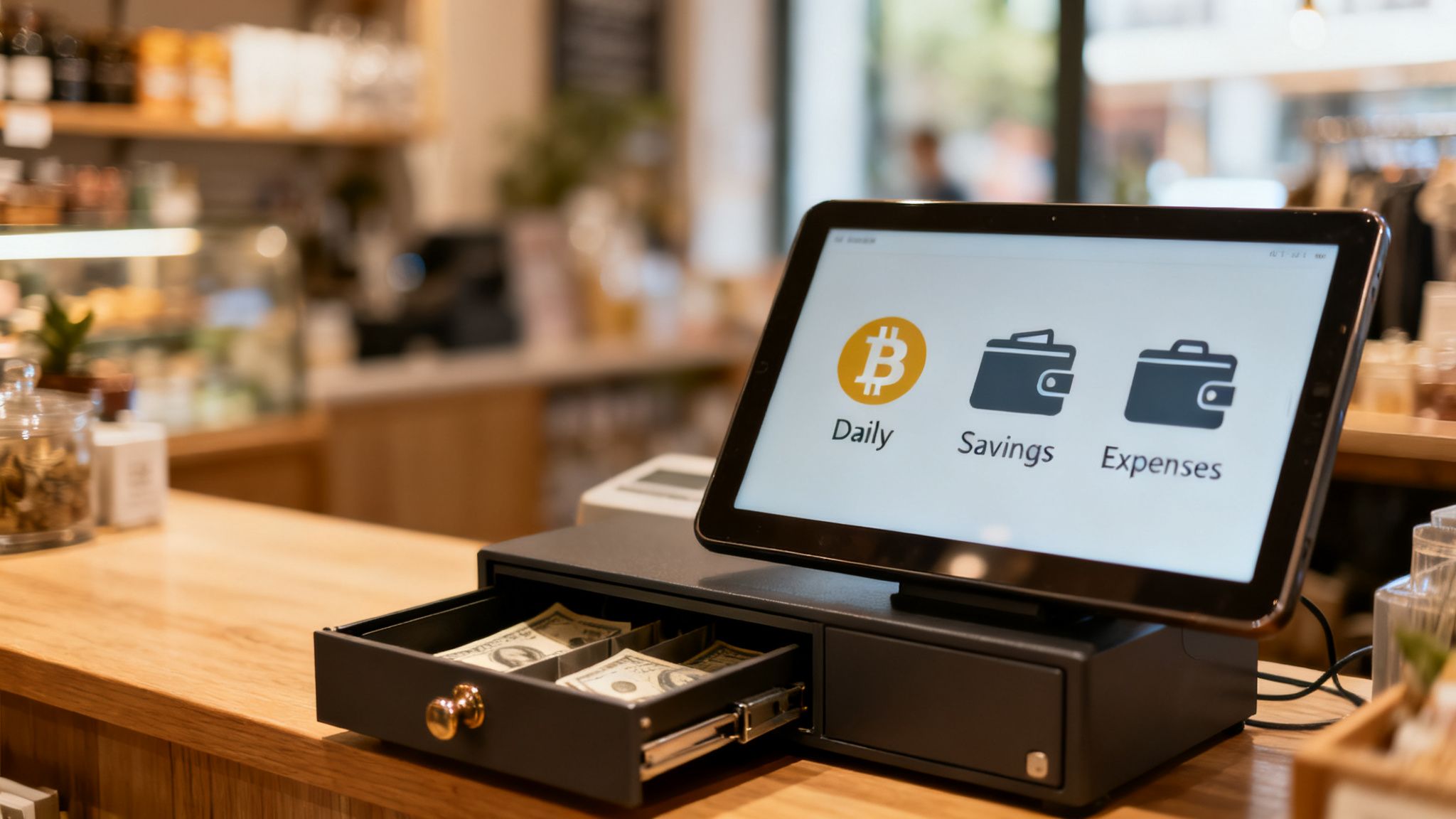
The Core Benefits of a Multi-Wallet System
Segregating your funds provides immediate, tangible benefits that protect your business and streamline your workflow. It lets you create a structured system where each wallet has a specific job, much like having separate bank accounts for payroll and operations.
To get a clearer picture, here's a quick rundown of what a multi-wallet strategy brings to the table.
Key Reasons for a Multi-Wallet Strategy
| Benefit | What It Means For Your Business |
|---|---|
| Enhanced Security | Isolate your daily sales funds from your main reserves. An attack on your "hot" wallet won't drain your entire business. |
| Improved Privacy | Using different wallets makes it much harder for outsiders to trace your entire transaction history and analyze your cash flow. |
| Simplified Accounting | Assigning specific wallets to income streams (online vs. in-store) or expenses makes financial tracking ridiculously easy and accurate. |
This small change in how you organize your funds makes a massive difference in how protected and efficient your business is.
This strategic separation transforms your Bitcoin management from a simple holding pattern into a professional treasury operation. It’s about building a resilient financial framework that scales right alongside your business.
Modern payment tools, like Flash, make this multi-wallet strategy practical for any merchant. They enable direct, wallet-to-wallet payments without ever taking custody of your funds, ensuring you always remain in complete control.
This guide will walk you through exactly how to implement this system to manage your Bitcoin with the confidence and professionalism it deserves.
Building Your Fortress with Wallet Segregation
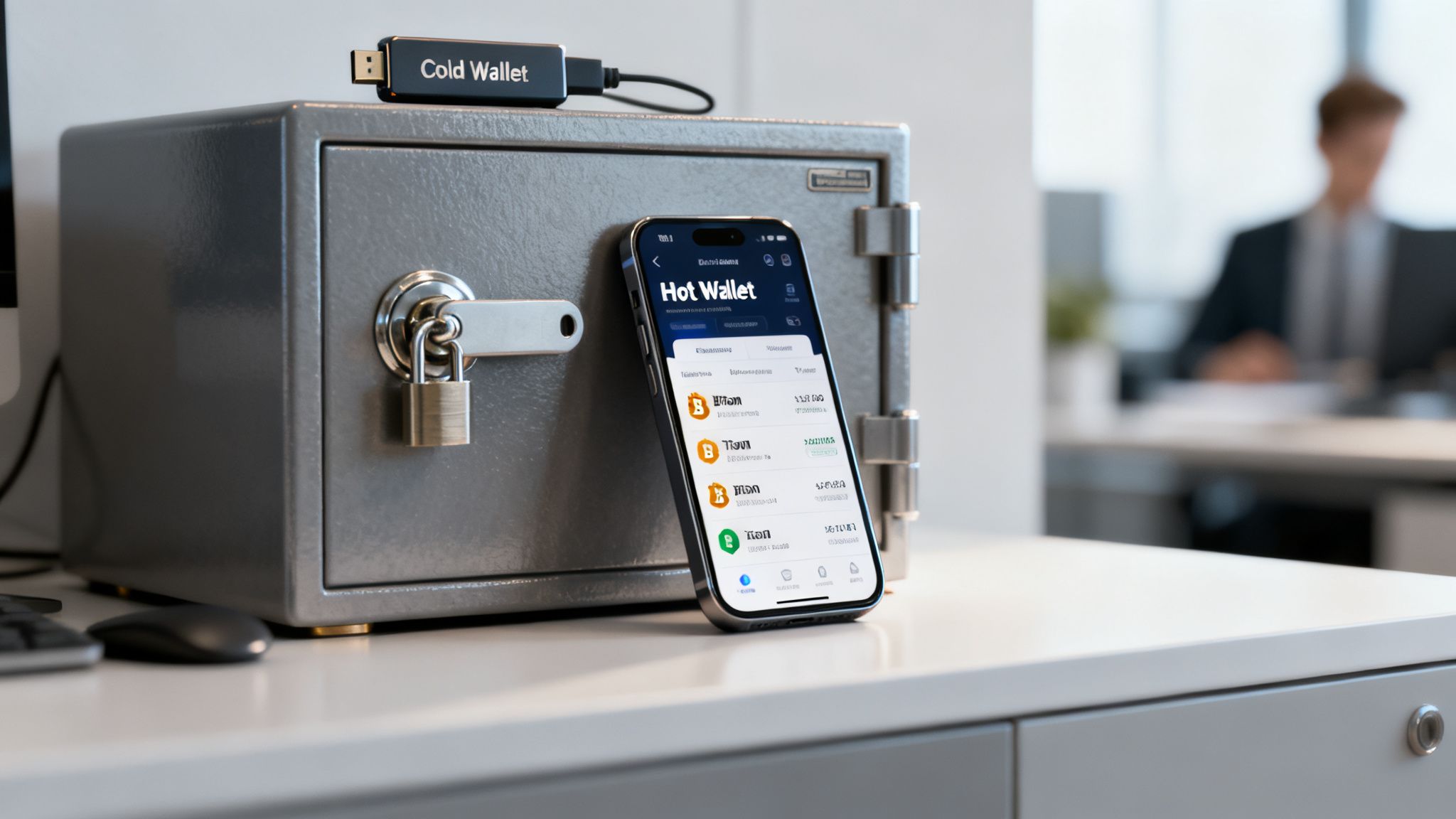
The single most important reason to use multiple crypto wallets is to build an ironclad security system around your Bitcoin. By separating your funds, you dramatically reduce your risk, applying a time-tested asset protection strategy to your digital operations.
Think of it like running a retail store. You’d never keep all your cash in the register up front, right? You keep a small, necessary amount for daily transactions, but the bulk of your earnings is locked away securely in a vault. This simple act ensures that a robbery at the counter doesn't wipe out your entire business.
This exact same logic is the foundation of a strong multi-wallet Bitcoin strategy. You create a digital "cash register" and a digital "vault," each with its own purpose and security profile.
Your Digital Cash Register: The Hot Wallet
A hot wallet is any Bitcoin wallet connected to the internet, usually an app on your phone or computer. Its biggest advantage is convenience. It’s perfect for handling the constant flow of smaller transactions, like daily customer payments.
But that always-on connection is also its biggest weakness. It exposes the wallet to online threats like malware and hacking attempts. This is exactly why your hot wallet should only ever hold enough Bitcoin to cover immediate operational needs—just like a cash register.
Your Digital Vault: The Cold Wallet
In stark contrast, a cold wallet is a physical hardware device that stores your Bitcoin completely offline. This "air-gapped" approach makes it virtually immune to remote cyberattacks, creating the safest possible environment for your long-term savings.
This is your business's digital vault. A critical operational habit is to regularly transfer profits from your hot wallet to your cold wallet, sweeping the vast majority of your funds away from online risks.
By adopting a hot and cold wallet system, you build layers of defense around your assets. A compromise of your daily-use wallet is contained, leaving your main financial reserves untouched and secure.
This separation of duties is the core of a professional security posture. It protects your business not only from external attackers but also from internal threats like employee mistakes or the theft of a device. The goal is to minimize the potential damage from any single point of failure.
- Hot Wallet (Daily Use)
- Purpose: Receiving customer payments and handling small, daily transactions.
- Security: Convenient but exposed to online risks. Should hold minimal funds.
- Cold Wallet (Long-Term Storage)
- Purpose: Securing the bulk of your business revenue and long-term savings.
- Security: Maximum protection from online threats. Holds the majority of your assets.
Implementing this strategy provides genuine peace of mind. It allows you to accept Bitcoin with the confidence that your earnings are protected by a robust and logical security framework.
Enhancing Privacy and Streamlining Your Bookkeeping

While a rock-solid security setup is a great start, the perks of using multiple crypto wallets go way beyond just protecting your funds. This strategy is also a fantastic tool for beefing up your financial privacy and turning your bookkeeping from a dreaded chore into a clear, manageable process.
Let's not forget, all transactions on the Bitcoin network are public. If a customer—or worse, a competitor—knows one of your business addresses, they could potentially trace your entire payment history. They could analyze your cash flow, transaction volumes, and get a pretty clear picture of your operations. This is why using a fresh Bitcoin address for every single transaction is a baseline privacy practice. It makes that kind of financial snooping next to impossible.
Modern wallet software handles this for you automatically, but a multi-wallet system takes things to a whole new level by creating separate financial silos for different parts of your business. This is where the real organizational magic happens.
Organizing Your Finances with Purpose-Driven Wallets
Think about it: would you run a company where all your revenue, expenses, and payroll flow through a single bank account? It’d be absolute chaos. The exact same logic applies to Bitcoin. When you assign different wallets to specific business functions, you create instant clarity.
It's a lot like setting up departmental budgets. Each wallet gets a clear, defined role, which makes tracking your funds ridiculously easy and keeps your financial records squeaky clean. This kind of organization isn't just good practice—it's essential for accurate reporting and a stress-free tax season.
Here’s a simple but powerful structure to consider:
- Online Sales Wallet: All the revenue from your eCommerce store flows directly here.
- In-Store Sales Wallet: This wallet is dedicated to collecting payments from your physical point-of-sale.
- Operational Expenses Wallet: Use this one exclusively for paying suppliers, covering utilities, or handling other day-to-day business costs.
By separating your funds right at the source, you completely sidestep the headache of manually untangling a messy web of transactions down the road. Your financial records become clean, logical, and easy to read, mirroring the best practices of traditional accounting.
This organized approach is becoming more important every day. The global crypto wallet market is expected to balloon to USD 98.57 billion by 2034, fueled by the demand for secure and versatile solutions. For merchants, this trend underscores the growing need for smart wallet strategies to manage funds effectively.
Of course, good bookkeeping also means generating clear financial records for every transaction. Knowing how to create flawless itemized receipt templates can seriously streamline your financial management. Adopting a multi-wallet system simply brings a professional level of clarity to your Bitcoin finances, making sure you’re always in control.
Practical Rules for Managing Your Wallets Safely
Running a multi-wallet setup is a seriously smart move, but its strength is entirely dependent on how you manage it. Without a disciplined approach, you can easily introduce new risks instead of reducing them. Let's walk through the non-negotiable rules for running your multi-wallet system like a pro.
The absolute foundation of Bitcoin security is the seed phrase, sometimes called a recovery phrase. This is the list of 12 to 24 words your wallet gives you during setup. Think of it as the master key to your digital vault; it can restore your wallet and all your funds on any compatible device, anywhere in the world.
Because of this immense power, your seed phrase is the single most important secret you'll ever keep. If you lose it, your funds are gone—forever. If someone else gets their hands on it, your funds will be drained in an instant.
Guarding Your Master Key
The number one rule for handling your seed phrase is simple but absolute: never store it digitally.
That means no screenshots, no text files, no notes app, and definitely no saving it in a password manager or cloud drive. Any device connected to the internet is a potential target for hackers, making digital storage a massive vulnerability.
Your backups must be physical and kept completely offline.
- Make Redundant Physical Copies: Write your seed phrase down on paper. For much better durability, consider etching it onto metal plates. Fireproof and waterproof storage is the gold standard for long-term peace of mind.
- Store Backups in Different Locations: Don't put all your eggs in one basket. Keeping backups in two or more geographically separate, secure locations protects you against disaster, whether it's a fire, flood, or theft.
- Never Say It Out Loud: Treat your seed phrase like a national secret. Avoid speaking the words, especially where smart devices with microphones could potentially record them.
A huge part of securing your wallets involves learning how to protect against phishing attacks, which is a favorite trick criminals use to fool you into giving up your keys.
Building Smart Operational Habits
Beyond just securing your seed phrase, your daily habits are what truly prevent costly mistakes. Simple organizational routines can make all the difference when you're juggling multiple wallets.
First, label every wallet clearly. Give each one a specific, descriptive name based on its job, like "Daily In-Store Sales" or "Long-Term Business Savings." This basic step is a lifesaver, helping you avoid sending funds from the wrong wallet—an easy mistake to make when moving Bitcoin between your hot and cold storage.
Having a documented recovery plan isn't just a good idea; it's an essential part of a professional Bitcoin treasury strategy. You need to have this plan ready before you ever need it, ensuring a calm and methodical recovery process in a crisis.
Finally, get into the habit of performing small test transactions. Before you move a large amount of Bitcoin to a new wallet for the first time, send a tiny, insignificant amount first. Wait for it to confirm in the destination wallet before sending the rest. This tiny action verifies you’ve got the address right and prevents a potentially catastrophic mistake. It's these disciplined habits that turn a powerful setup into a truly secure one.
How to Accept Payments Directly to Your Wallets
A slick multi-wallet strategy is great for security and organization, but it has to work in the real world—at the point of sale. The trick is to plug this setup right into your checkout flow without making things complicated for your customers. Thankfully, modern payment tools make it incredibly simple to accept Bitcoin directly into whichever wallet you’ve earmarked for daily transactions.
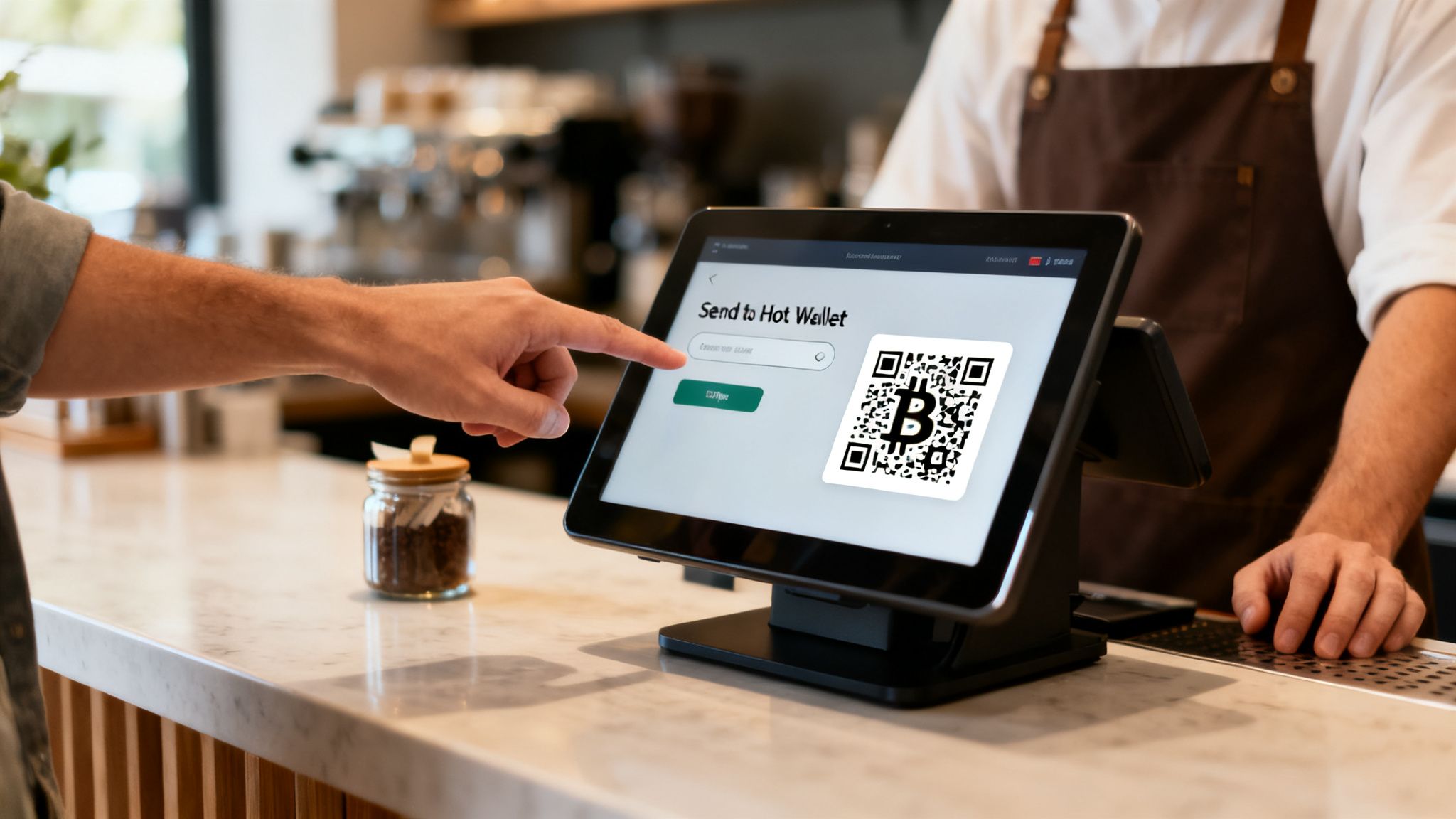
This is all made possible by non-custodial payment solutions. Unlike the old guard of payment processors that take custody of your funds, these tools are just a direct bridge between your customer's wallet and yours. You generate a payment request, and the Bitcoin flies straight to your designated wallet. You have full control from the second the transaction is made.
This approach keeps your operations secure and efficient. You can set up your point-of-sale device, website, or payment links to funnel all incoming payments into a single "hot wallet." This keeps the customer experience totally smooth while your multi-wallet system hums along quietly in the background.
The Daily Operational Workflow
Putting a multi-wallet strategy into action isn't rocket science. It boils down to a simple, disciplined cycle designed to keep your online exposure low while making sure your long-term funds are locked down tight. This is how you turn abstract security theory into concrete daily actions for your business.
A typical day-to-day flow looks like this:
- Receive Payments: All customer transactions for the day go straight to your designated hot wallet. This wallet, often just an app on a company tablet or phone, is used only for incoming sales.
- Monitor Activity: You can watch the transactions confirm in real-time, knowing the funds are settling directly into an account you control. No middlemen, no waiting periods.
- Sweep to Cold Storage: At a set time—maybe at the end of each day or once a week—you manually transfer the accumulated funds from your hot wallet to your secure hardware wallet (cold storage).
This "sweep" is the most important step in the entire process. Think of it as the digital version of a manager moving cash from the register to the safe at the end of a shift. It drastically minimizes the amount of funds at risk from online threats.
This simple routine cleanly separates your daily sales from your long-term treasury.
Simplicity Meets Top-Tier Security
This two-step process is proof that a professional-grade security setup doesn't have to be a headache. By using a hot wallet as a temporary pass-through for daily sales, you get all the convenience you need for a fast-paced environment.
At the same time, regularly moving those funds to cold storage ensures the vast majority of your Bitcoin is protected by what is essentially an offline fortress. It’s a simple, repeatable process that puts you in complete control, giving you all the benefits of multiple wallets—better security, clean accounting, and peace of mind—without getting in the way of business.
Your Blueprint for Secure Bitcoin Commerce
Let's bring it all together. Running a multi-wallet system isn't some complex tactic reserved for the Bitcoin elite—it's the professional standard for any merchant serious about accepting Bitcoin. This approach takes you from simply holding Bitcoin to actively managing a secure and resilient financial operation.
This guide has walked you through how this strategy gives you far superior security by separating your funds, keeping the vast majority of your revenue tucked away safely in offline cold storage. It also shields both your and your customers' privacy by breaking up transactions into different wallets, making it incredibly difficult for outsiders to connect the dots and analyze your cash flow. And maybe most importantly for your sanity, it cleans up your accounting, turning a potential nightmare into a straightforward, auditable process.
By putting this into practice, you’re not just accepting Bitcoin—you’re building a professional Bitcoin operation designed to last. This is all about moving past basic acceptance and stepping into strategic asset management.
Paving the Way for Growth
The real goal here is to give you the confidence to manage your digital assets securely and efficiently. Once you have a solid multi-wallet system humming along, you can get back to what you do best: growing your business.
This blueprint boils down to a few key principles:
- Segregate Your Funds: Use separate hot and cold wallets. It's the simplest and most effective way to protect your revenue.
- Organize for Clarity: Give each wallet a specific job—one for sales, one for expenses, another for payroll. Keep it clean.
- Maintain Discipline: Get serious about backing up your seed phrases and performing regular sweeps from your hot wallet to your cold storage. Don't get lazy.
Mastering these fundamentals is what sets you up for sustainable growth in the Bitcoin economy. You can operate knowing your digital treasury is built on a solid foundation of security, privacy, and smart financial organization, putting you in a prime position to thrive as Bitcoin adoption continues to grow.
Got Questions? We've Got Answers
Jumping into a multi-wallet strategy for your business can feel like a big step, and it's natural to have a few questions. We see the same ones pop up all the time, so let's clear the air and give you the confidence to get it right.
Isn't Setting Up Multiple Bitcoin Wallets a Huge Hassle?
Honestly? Not at all. The setup itself is a one-time thing and surprisingly quick. You're basically just installing a wallet app on your phone for daily payments and getting a separate hardware wallet for your long-term savings.
The real key is just a little bit of organization. Label everything clearly—think "Daily Sales" or "Business Savings"—so you never have to guess where your funds are. Modern payment tools are built for this kind of setup, letting you route payments exactly where you want them without bogging down your checkout. A few minutes of planning upfront saves you from major headaches later and gives you a huge boost in security and clarity.
Okay, So How Many Wallets Do I Actually Need?
There’s no magic number, but a three-wallet system is a fantastic, robust starting point for just about any business. It cleanly separates your funds and covers all the essential bases: security, operations, and accounting.
Here’s what that looks like in practice:
- A hot wallet on your phone to catch all the daily payments from customers.
- A cold wallet (that little hardware device) to stash the bulk of your profits safely offline.
- A separate wallet just for paying business expenses, which makes bookkeeping a breeze.
This trio is incredibly effective at keeping things organized. As your business grows, you can always add more specialized wallets, but this is the perfect foundation to build on.
Won't this cost my customers more in fees? Nope. Your customers pay the same standard Bitcoin network fee at checkout, regardless of how many wallets you use. The only time you pay a network fee is when you move funds between your own wallets—like sweeping profits from your daily hot wallet over to your secure cold storage. Just think of it as a tiny operational cost for a massive security upgrade.
Ready to pair your multi-wallet strategy with a professional, non-custodial payment system? With Flash, you can start accepting Bitcoin payments directly to any of your wallets in under a minute. Get started today at paywithflash.com.