When someone says you have a "non-custodial" wallet, it means one simple thing: you, and only you, hold the keys to your Bitcoin.
Think of it like a physical safe in your house. You're the only one with the combination. This is the bedrock concept of financial self-sovereignty, putting you in the driver's seat with total, direct control over your own money.
What Does Non-Custodial Wallet Really Mean?
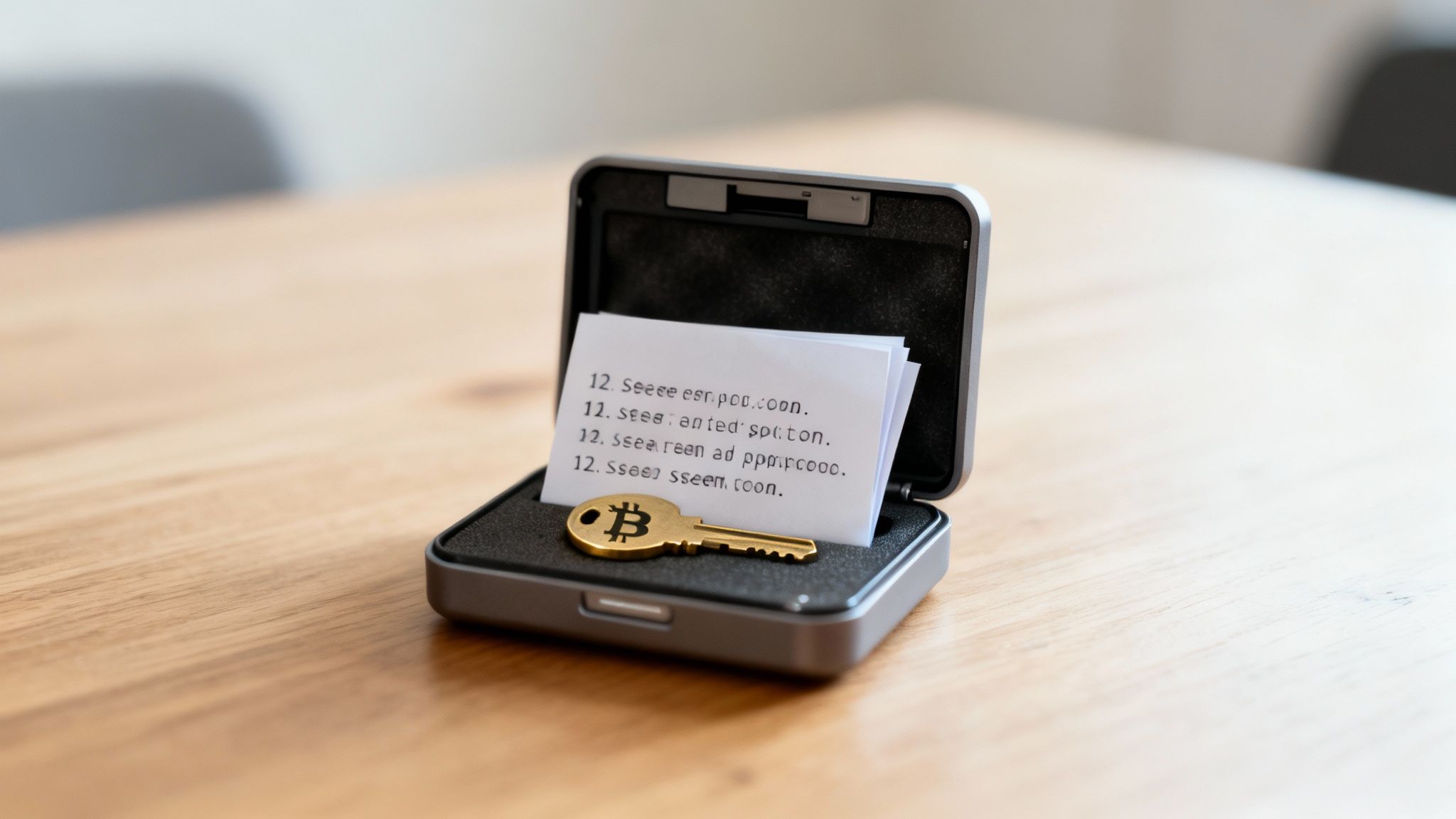
There’s a popular mantra in the Bitcoin world that nails the idea perfectly: "Not your keys, not your coins."
Unlike a traditional bank account or a Bitcoin exchange where some company is holding your money for you, a non-custodial wallet cuts out the middleman completely. You are your own bank.
This setup gives you sole possession of your private keys—the secret codes needed to sign off on transactions and prove you own your Bitcoin. No company, government, or third party can freeze your account, block a transfer, or take your assets.
The Foundation of Self-Sovereignty
Getting your head around the non-custodial wallet meaning is the single most important step for anyone serious about owning and protecting their Bitcoin for the long haul. The benefits are clear and powerful:
- Complete Control: You have the final word on every transaction. Forget about withdrawal limits, frozen accounts, or waiting for someone else's approval.
- Enhanced Security: By holding your own keys, you sidestep the massive risk of a centralized exchange getting hacked—a story that has played out time and again, costing users their fortunes.
- Greater Privacy: You don’t need to hand over personal information (KYC) just to create or use the wallet. This offers a much higher degree of privacy for your financial life.
A non-custodial wallet gives users complete control over their private keys. In other words, they are the sole custodians of their assets, aligning with the core philosophy of self-sovereignty.
To really appreciate why this matters so much, it helps to understand the wider world of blockchain development, which is the technology that makes this kind of direct ownership possible in the first place. A non-custodial wallet isn't just a piece of software; it's a commitment to managing your own digital wealth.
How Non-Custodial Wallets Work
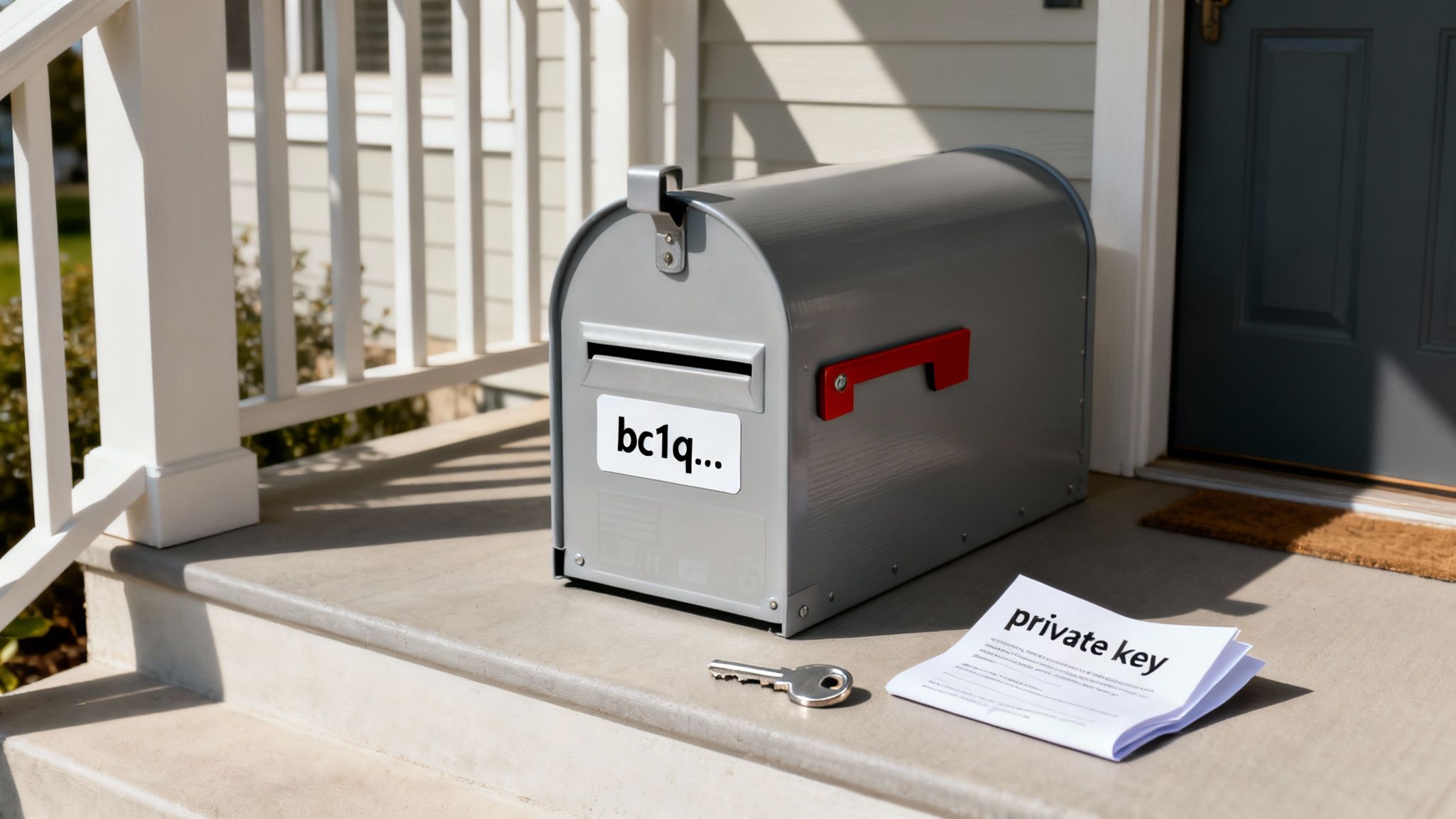
The control a non-custodial wallet gives you isn't magic; it all comes down to a clever bit of cryptography. To really get a handle on how these wallets work, it helps to understand a little about the underlying blockchain technology. At the heart of it all, every Bitcoin wallet operates with a pair of keys that are mathematically tied together.
A simple analogy is a personal mailbox.
Your public key is used to generate a receiving address, which is like a mailbox address you can share with anyone, anywhere. People use this address to send Bitcoin to you. It's public knowledge, and that’s perfectly fine.
The private key, however, is the only thing that can unlock that mailbox and access the Bitcoin inside. You use this key to "sign" or approve any transactions you want to send out, proving you own the funds without ever having to show the key itself.
Your Master Key: The Seed Phrase
So, what happens if your phone breaks or your laptop gets stolen? This is where your master key—the seed phrase—saves the day.
When you first set up a non-custodial wallet, it gives you a list of 12 to 24 random words. This isn't just a password; it's much more powerful.
This seed phrase is your ultimate backup. It can regenerate all of your private keys and completely restore your wallet on any new compatible device, giving you instant access back to all your Bitcoin.
This permissionless design is what truly separates a non-custodial wallet from everything else, putting you in the driver's seat. The entire system hinges on this seed phrase, which is why keeping it safe—and offline—is your most important job.
Make no mistake: guarding this phrase is the single most critical responsibility you have as a non-custodial wallet owner. Anyone who gets their hands on your seed phrase gets your Bitcoin. Period.
Non-Custodial vs Custodial: A Clear Comparison
To really get what a non-custodial wallet is, the best way is to put it side-by-side with its counterpart.
Think of it like this: you have a bar of gold. A custodial wallet is like keeping that gold in a bank vault. The bank looks after it, but they also hold the keys. They ultimately control when and how you can access it.
A non-custodial wallet, on the other hand, is like keeping that gold in a personal safe at home. Only you know the combination. You have total control, but you're also totally responsible for keeping it safe.
This all boils down to one simple but critical question: who holds the private keys? With a custodial service—like a big Bitcoin exchange—they hold your keys for you. For a beginner, this can feel familiar and convenient, a lot like using an online bank account.
But that convenience comes with some serious strings attached. You're placing your trust in a third party to protect your Bitcoin. If their servers get hacked, if they go bankrupt, or if they just decide to freeze your account for some reason, your funds could be gone. With a non-custodial wallet, you and only you hold the keys. This puts you in the driver's seat and cuts out that third-party risk entirely.
Control and Responsibility
This isn't just a niche preference; the move toward self-custody is a massive trend. The global crypto wallet user base has shot past 820 million active wallets, and a clear majority—around 59%—are choosing non-custodial options.
Why the shift? People are waking up to the risks of leaving their assets on custodial platforms and are demanding more privacy and direct control. For a deeper dive into these numbers, you can explore the full wallet usage statistics.
Ultimately, it’s a trade-off between convenience and control. A non-custodial wallet empowers you to be your own bank. That’s a powerful thing, but it also means security is 100% on you. There’s no "forgot my password" link or customer support line to call if you lose your seed phrase.
The Bottom Line: Custodial wallets manage your keys for convenience, but you lose control and take on counterparty risk. Non-custodial wallets give you complete sovereignty over your Bitcoin, but with the absolute responsibility to secure your own keys.
Key Differences: Custodial vs Non-Custodial Bitcoin Wallets
To help you figure out which path is right for you, let’s break down the core differences in a simple table. This comparison lays out exactly what you gain and what you give up with each model.
| Feature | Non-Custodial Wallet (Self-Custody) | Custodial Wallet (Third-Party) |
|---|---|---|
| Private Key Control | You hold and control your private keys. | A third party (like an exchange) holds the keys. |
| Security | Security is entirely your responsibility. | The third party is responsible for securing funds. |
| Access to Funds | Unrestricted, direct access at all times. | Can be frozen, limited, or delayed by the provider. |
| Privacy | Higher. No personal info (KYC) needed to create it. | Lower. Often requires identity verification (KYC). |
| Account Recovery | Possible only if you have your seed phrase. | Password resets and support are typically available. |
Looking at them side-by-side makes the choice clearer. It’s not about which is universally "better," but which one aligns with your goals for owning and using Bitcoin.
The Responsibility of True Bitcoin Ownership
Stepping into the world of non-custodial wallets means accepting a powerful new reality: you are the bank. It’s an incredible level of freedom, but it comes with the absolute duty to guard your own wealth. If something goes wrong—if you lose your keys or get tricked—there’s no customer service hotline to call for a reset.
This isn't just theory; it’s a practical, real-world security challenge. Your first and most critical job is to protect your seed phrase. Think of it as the master key to your vault. Securing it properly isn't just a recommendation; it's a non-negotiable rule for anyone serious about self-custody.
Securing Your Seed Phrase
Your seed phrase should never, ever live in a digital format. Don't screenshot it. Don't save it in a text file or tuck it away in a password manager. Any digital copy is a potential target for hackers and malware just waiting to find it. The only proven methods are physical and completely offline.
A couple of battle-tested techniques are surprisingly simple:
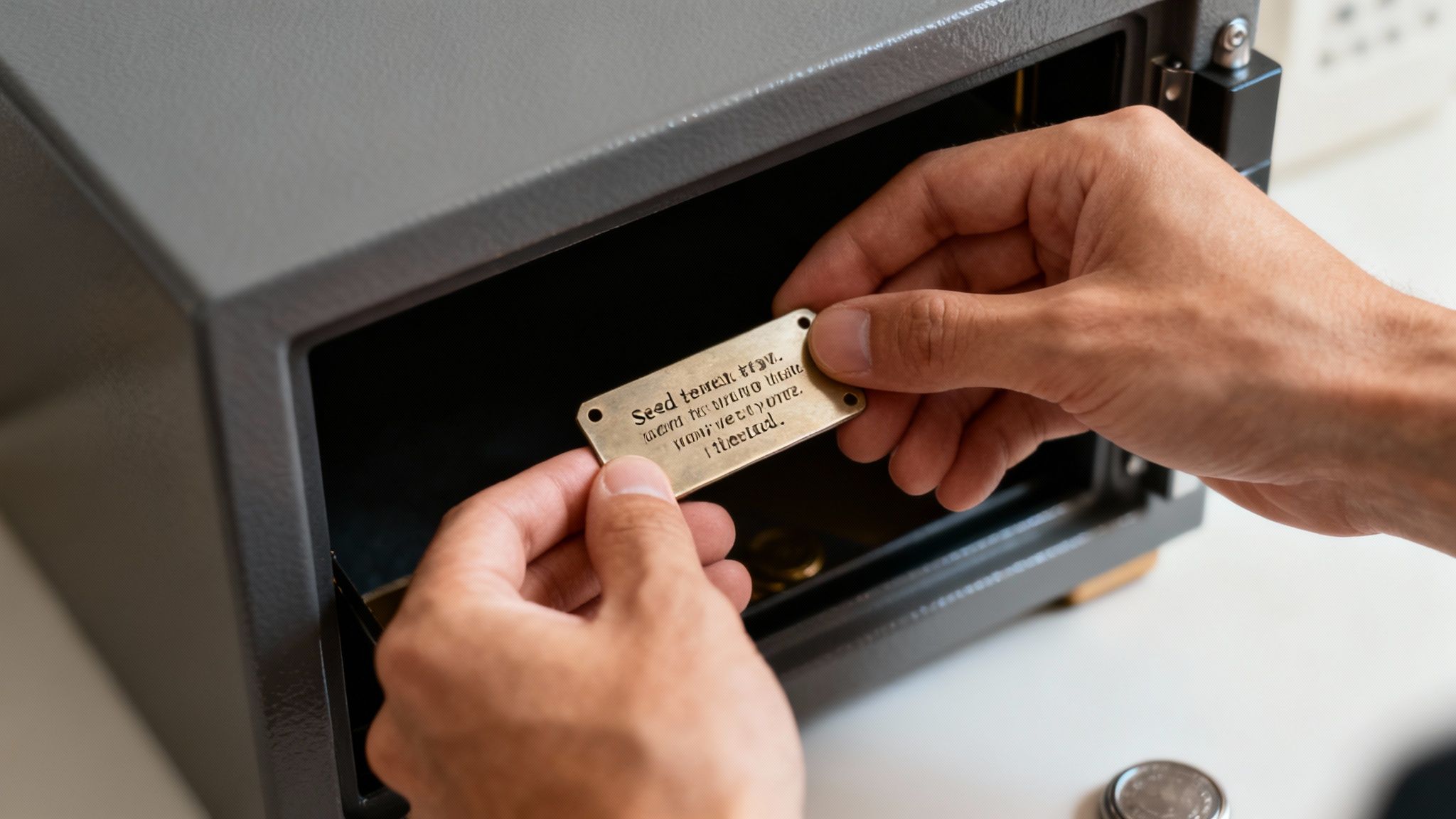
- Writing it on paper: It’s low-tech but highly effective. The trick is to make multiple copies and store them in different, secure, and private locations. This way, a single disaster like a fire or flood won't wipe out your only backup.
- Etching it into metal: For ultimate peace of mind, you can engrave your phrase onto a metal plate. These are built to resist fire, water, and corrosion, ensuring your backup can survive just about anything you throw at it.
The core principle is simple: your master backup must be completely disconnected from the internet and any digital device. Your Bitcoin's security hinges entirely on how well you hide and protect this phrase from both digital thieves and physical threats.
Avoiding Common Threats
With total control comes the responsibility to spot and sidestep the scams aimed at Bitcoin owners. Attackers know you’re the sole guardian of your keys, and they’ll use every trick in the book to deceive you into revealing them.
Stay vigilant against common threats like phishing scams. These often come as fraudulent emails or websites disguised as legitimate services, all designed to trick you into typing in your seed phrase. Likewise, malware can infect your computer or phone to secretly log your keystrokes or scan your files for sensitive information.
Mastering these straightforward security practices is the key to protecting your Bitcoin with confidence. It’s not about becoming a cybersecurity expert overnight. It's about building simple, robust habits that shut down the most common risks and ensure your assets remain exactly where they belong: with you.
Choosing the Right Type of Non-Custodial Wallet
So, you're ready to take the reins and control your own Bitcoin. That's a huge step. The next move is picking the right tool for the job, because not all wallets are created equal. They're built for different purposes, striking a unique balance between iron-clad security and everyday convenience.
And you're not alone in making this choice. The global market for non-custodial wallets has ballooned to roughly $3 billion and has been growing at a clip of about 25% a year for the past five years. This isn't just a niche trend; it's a clear signal that people want more control over their money. You can dive deeper into the numbers with various market reports analyzing wallet growth.
Ultimately, the best wallet for you comes down to your personal strategy and how much risk you're comfortable with.
Cold Storage for Maximum Security
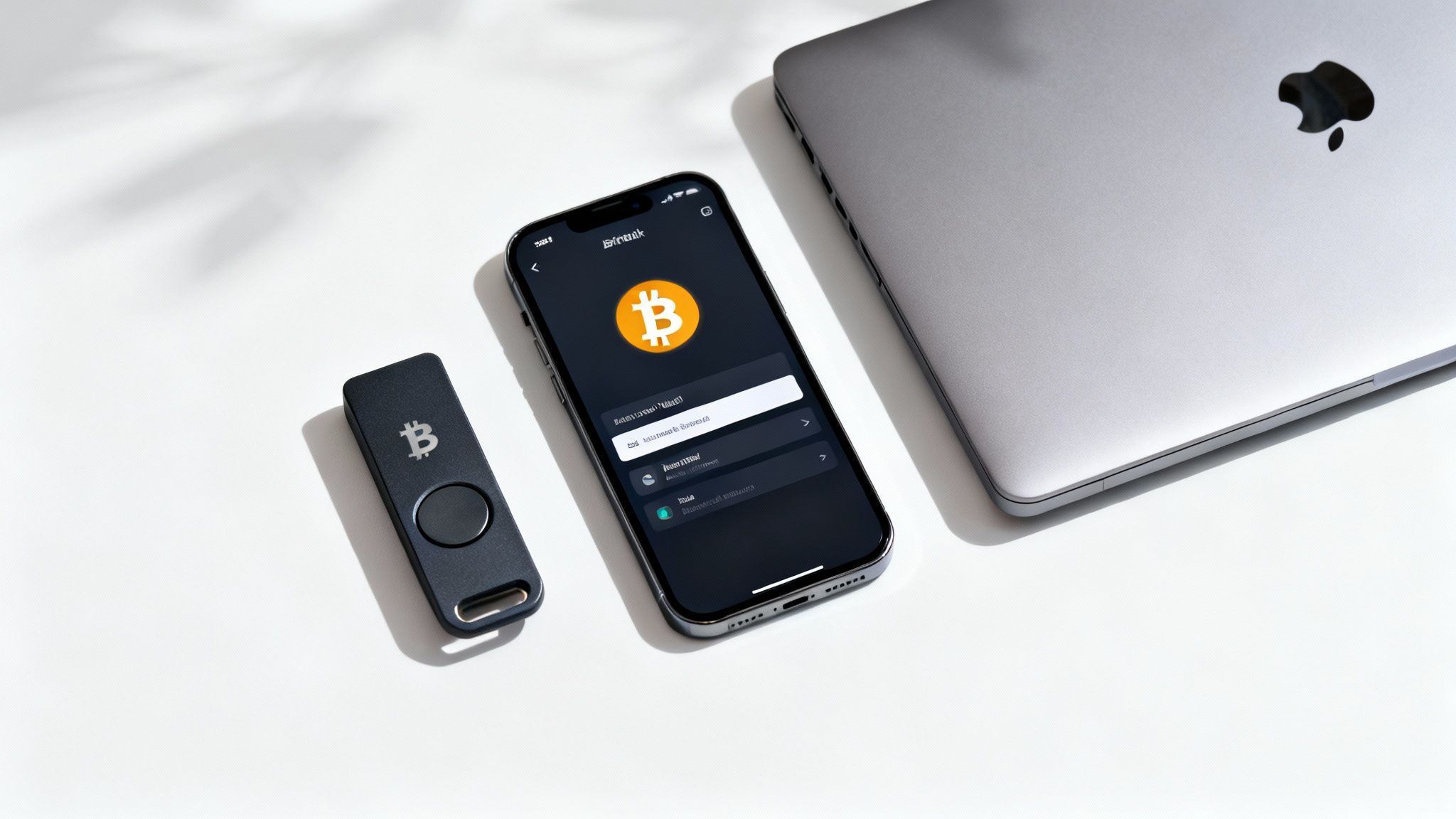
If you're in it for the long haul—holding significant amounts of Bitcoin as a serious investment—then nothing beats a hardware wallet. These are small physical devices that keep your private keys completely offline in what's known as "cold storage."
Think of it like a fortified vault for your digital assets. Because your keys never touch an internet-connected computer, they're safe from online threats like malware, hackers, and phishing scams. It's the highest level of security you can get.
A hardware wallet signs transactions internally on the secure device itself. This means you can safely interact with an infected computer without ever exposing your private keys, making it the gold standard for security.
Hot Wallets for Everyday Use
On the other end of the spectrum, you have "hot wallets." These are software-based wallets that are always connected to the internet, making them incredibly convenient for daily use. The two most common types are mobile and desktop wallets.
- Mobile Wallets: These are apps on your smartphone, perfect for sending and receiving smaller amounts of Bitcoin when you're out and about. Think of it as your digital pocket money for paying a merchant or sending some sats to a friend.
- Desktop Wallets: This is software you install on your laptop or home computer. They often come packed with more advanced features than mobile versions, making them a solid choice for power users who transact frequently from their desk.
The smartest approach is to use both. Keep your life savings secure on a hardware wallet and use a mobile or desktop wallet for your day-to-day spending. This layered strategy gives you the best of both worlds: top-tier security for your savings and practical convenience for your walking-around money.
Got Questions About Non-Custodial Wallets?
Even after you get the hang of what a non-custodial wallet is, a few practical questions always seem to pop up. It's totally normal. Let's walk through the most common ones so you can feel more confident about taking the reins of your own Bitcoin.
What Happens If I Lose My Device?
This is the number one fear for newcomers, but the answer is surprisingly reassuring. If your phone gets stolen or your laptop gives up the ghost, your Bitcoin is perfectly safe—as long as you have your seed phrase.
Think of the seed phrase as the master key to your entire Bitcoin life. You can simply grab a new device, download your wallet software again, and use that phrase to restore full access to your funds. This is exactly why keeping a physical, offline copy of your seed phrase is the golden rule of self-custody.
Are Non-Custodial Wallets Anonymous?
They offer a world of privacy compared to custodial options, but they are pseudonymous, not completely anonymous.
Here’s what that means: your transaction history is publicly visible on the Bitcoin blockchain, but your real name and address aren't attached to it. However, a determined analyst could potentially connect the dots and trace activity back to an individual.
The key difference is that your identity isn't automatically tied to your wallet. This is a huge shift from custodial exchanges, which almost always require you to submit personal identification (KYC) just to open an account.
Can My Bitcoin Be Stolen From a Non-Custodial Wallet?
Yes, but it's not the wallet or the Bitcoin network that's vulnerable—it's the human element. The only way an attacker can get your funds is if they trick you into giving them your private keys or, more likely, your seed phrase.
The Bitcoin network itself has never been hacked. The real risks come from simple user mistakes.
Watch out for these common traps:
- Storing your seed phrase anywhere on a digital device (a screenshot, a text file, an email draft).
- Falling for a phishing scam that asks you to enter your seed phrase on a sketchy website.
- Getting malware on your computer that secretly records what you type or see.
Using a dedicated hardware wallet and storing your seed phrase offline makes this kind of theft incredibly difficult.
Do I Need an Internet Connection?
You do need to be online to send or receive a Bitcoin transaction. Your wallet has to broadcast that information to the network, after all.
But here’s the clever part: the most secure non-custodial wallets—known as hardware wallets—keep your private keys completely offline, 100% of the time. They sign transactions on the device itself without ever letting your keys touch an internet-connected computer. It's the best of both worlds: iron-clad security and the ability to transact when you need to.
Ready to accept Bitcoin payments directly, wallet-to-wallet, with no middlemen taking a cut? Flash gives merchants the tools to launch Bitcoin payments in under a minute, putting you in complete control of your money. Get started today at paywithflash.com.