In an increasingly digital world, the way congregations give is evolving. Traditional offering plates are being supplemented, and often replaced, by seamless online transactions. For church leaders, selecting the right digital tools isn't just about modernizing; it's about stewardship, accessibility, and meeting your community where they are. The challenge lies in navigating a crowded market of online giving platforms for churches, each with its own set of features, fee structures, and philosophies. This guide cuts through the noise.
We will provide a comprehensive roundup of the top 7 platforms designed for ministries, offering a detailed, side-by-side comparison to help you make an informed decision. For each platform, you will find:
- Key Feature Breakdowns: An overview of what makes each service unique.
- Transparent Pricing Tables: Clear comparisons of transaction fees and monthly costs.
- Pros and Cons: Honest assessments to streamline your evaluation.
- Visual Screenshots and Direct Links: See the platform in action and explore it yourself.
We'll explore everything from traditional credit card processing and text-to-give functionalities to innovative options like accepting Bitcoin donations via platforms such as Flash. Our goal is to equip you with the specific information needed to find a solution that aligns perfectly with your ministry's vision and your congregation's needs.
1. Flash
Flash positions itself as a forward-thinking and highly secure choice for churches ready to embrace the future of digital donations. It is not a traditional online giving platform; instead, it is a specialized Bitcoin payment processor that leverages the Lightning Network. This focus makes it a uniquely powerful tool for ministries aiming to attract a global, tech-savvy congregation and reduce transaction costs significantly.
What sets Flash apart is its non-custodial, wallet-to-wallet architecture. Unlike conventional platforms where donations are held by a third-party processor before being settled, Flash facilitates direct transfers from a donor's Bitcoin wallet to the church's wallet. This decentralized model eliminates intermediaries, providing unparalleled security and ensuring the church retains full and immediate control over its funds.
Key Features Analysis
Flash provides a comprehensive suite of tools designed for seamless integration and ease of use, making it one of the most versatile online giving platforms for churches venturing into cryptocurrency.
- Instant, Low-Cost Transactions: By using the Bitcoin Lightning Network, donations are processed almost instantly, with fees that are a fraction of what traditional credit card processors charge. This means more of every dollar given goes directly to the ministry.
- No-KYC (Know Your Customer) Process: Flash simplifies the giving process by removing mandatory KYC requirements. This protects donor privacy and eliminates a significant barrier to entry, encouraging spontaneous and hassle-free giving from a global audience.
- Flexible Giving Tools: Churches can implement Bitcoin giving in multiple ways:
- Customizable Donation Widgets: Easily embed a sleek, modern donation button directly on your church website.
- Payment Links: Generate a unique link for specific campaigns, fundraisers, or mission trips. Share it via email, social media, or even in a weekly bulletin QR code.
- Point-of-Sale (POS) App: Transform any smartphone or tablet into a Bitcoin giving kiosk for in-person events, services, or conferences.
- Recurring Donations: Flash supports subscription billing, allowing congregants to set up automated, recurring tithes and offerings directly in Bitcoin.
Practical Implementation for Churches
Integrating Flash is designed to be straightforward, even for teams with limited technical expertise. A church can set up a basic donation button on its website in minutes with a simple copy-paste code snippet. For a capital campaign, a dedicated payment link can be created and shared across all communication channels, streamlining the fundraising effort.
Expert Insight: The non-custodial nature of Flash is its most significant advantage for nonprofits. It aligns with principles of stewardship and financial autonomy, as the church never relinquishes control of its assets to a third party. This is a critical distinction from nearly all other online giving solutions.
Pros and Cons
| Strengths | Weaknesses |
|---|---|
| Non-Custodial Security: The church maintains 100% control over its funds at all times. | Niche Focus: Primarily for Bitcoin; lacks support for traditional fiat payment methods. |
| Extremely Low Fees: Lightning Network transactions dramatically reduce processing costs. | Potential Learning Curve: Adopting cryptocurrency may require education for staff and donors. |
| Rapid Setup & Integration: Go live with Bitcoin donations in minutes using no-code tools. | Pricing Transparency: Pricing details require a direct inquiry, which may slow decision-making. |
| Enhanced Donor Privacy: No KYC requirements make giving simpler and more private for donors. | |
| Versatile Donation Options: Supports one-time, recurring, in-person, and online giving scenarios. |
Final Verdict
Flash is an exceptional and innovative choice for churches looking to future-proof their fundraising and expand their donor base. While it requires a willingness to adopt Bitcoin, its robust security, minimal fees, and user-friendly tools provide a compelling and modern alternative to traditional online giving platforms for churches. It empowers ministries to operate with greater financial efficiency and connect with a new generation of givers on a global scale.
2. Tithe.ly
Tithe.ly presents a comprehensive digital giving solution that extends far beyond a simple donation button. Designed as an all-in-one engagement platform, it equips churches with a suite of tools to manage tithing, member communication, and overall church administration. This platform is a strong contender among online giving platforms for churches because it centralizes multiple functions into a single, cohesive system.
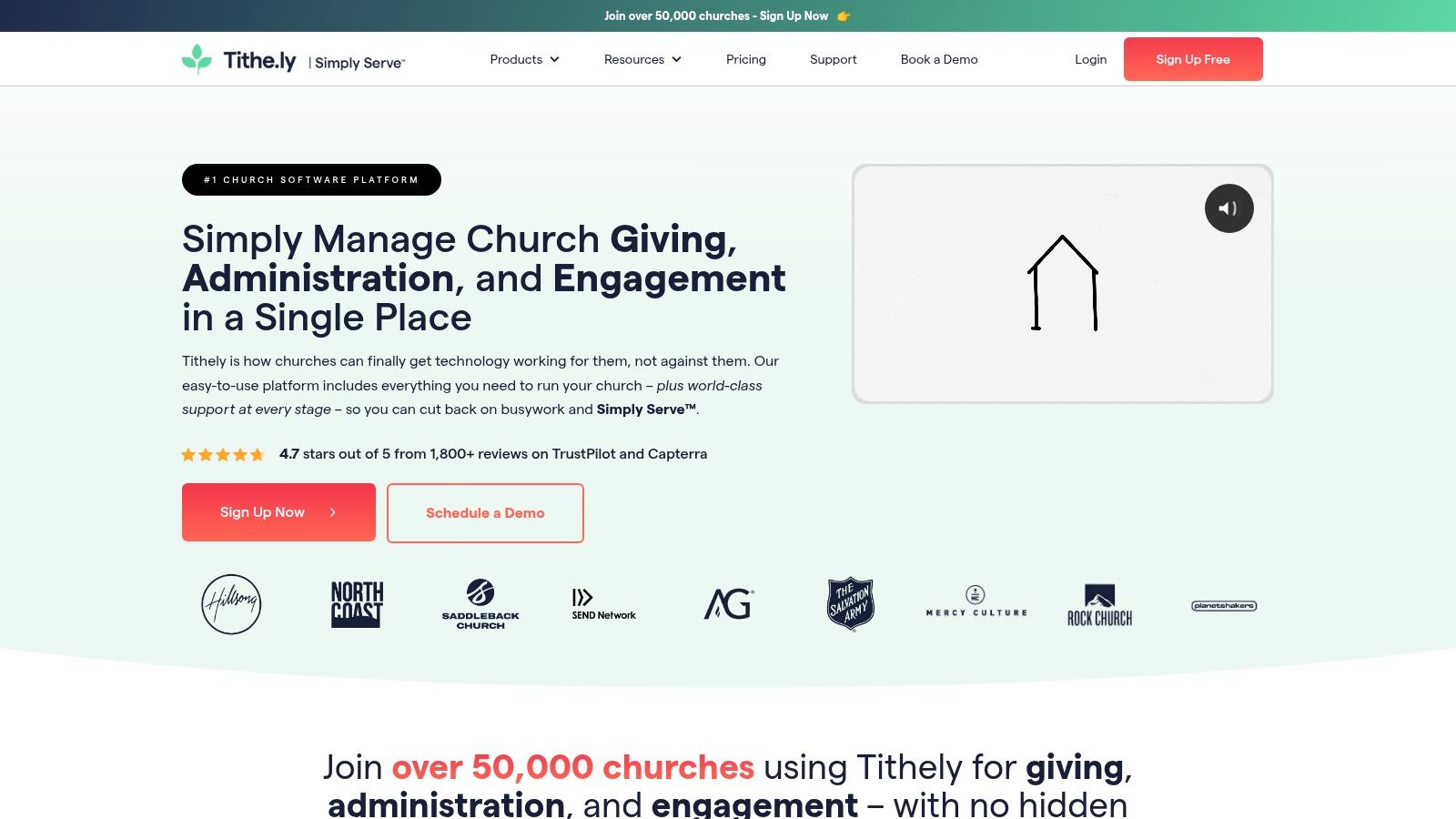
What makes Tithe.ly unique is its focus on creating a complete digital ecosystem for a church. Beyond standard online giving, it offers features like a custom church app and seamless integration with major church management systems (ChMS). This allows for a unified experience where members can give, register for events, and stay connected through one primary hub.
Key Features & Offerings
Tithe.ly's strength lies in its diverse and flexible giving options, ensuring every member can contribute in the way that is most convenient for them.
- Multiple Giving Channels: Donors can give via your website, a dedicated mobile app, text-to-give, or even physical kiosks set up in your church.
- Recurring Donations: Members can easily set up automated, recurring gifts (weekly, bi-weekly, monthly), providing your church with a predictable and stable stream of income.
- Customizable Giving Forms: You can tailor the look and feel of your online giving pages to match your church’s branding, creating a consistent and trustworthy experience for donors.
- "Cover the Fees" Option: A popular feature that allows donors to voluntarily add the transaction processing fee to their donation, ensuring the church receives the full intended amount.
Pricing Structure
Tithe.ly operates on a model that is accessible for churches of all sizes. The basic giving platform has no setup fees or monthly subscription costs. Instead, they charge a standard transaction fee per donation. However, advanced features like text-to-give and a custom church app are available through the "Tithe.ly All Access" plan, which comes with a monthly subscription fee.
Practical Tip: Promote the "Cover the Fees" option heavily to your congregation. A simple announcement explaining that this small addition helps maximize every dollar for ministry work can significantly increase its adoption and boost your overall received donations.
Pros & Cons
- Pro: No monthly fees for the core giving product makes it a risk-free starting point.
- Pro: The all-in-one platform can replace multiple other software subscriptions, saving money and administrative time.
- Con: Transaction fees, while standard, still apply to every donation on the basic plan.
- Con: Accessing the full suite of powerful tools, such as text giving and the church app, requires a paid monthly subscription.
Learn more at the official website: https://get.tithe.ly/
3. Givelify
Givelify champions a mobile-first philosophy, building its entire experience around making donations as quick and seamless as possible directly from a smartphone. It’s designed for simplicity, allowing donors to give in just three taps, which is a major draw for congregations looking to capture spontaneous generosity. This platform is a top choice among online giving platforms for churches that want to prioritize ease of use and appeal to a mobile-savvy audience without the complexity of a multi-faceted system.
What makes Givelify unique is its unwavering focus on the speed and simplicity of the giving act itself. While other platforms bundle giving with church management, Givelify isolates and perfects the donation moment. This makes it incredibly intuitive for donors of all ages, removing barriers and reducing the time from decision to donation to mere seconds.
Key Features & Offerings
Givelify's features are centered on creating an effortless and accessible giving experience, primarily through its highly-rated mobile app.
- Intuitive Mobile App: The core of the platform is a dedicated app where users can find your church by name or location and give almost instantly.
- Real-time Donation Tracking: The Givelify dashboard provides church administrators with immediate access to donation data, making it easy to monitor giving trends and campaign success.
- Customizable Church Profile: Churches can create a branded profile with their logo, a cover photo, and a welcome message to build trust and recognition.
- Social Media Integration: Easily share your Givelify giving link on platforms like Facebook and Twitter to broaden your fundraising reach beyond Sunday services.
Pricing Structure
Givelify operates with a transparent, pay-as-you-go pricing model with no contracts, setup fees, or monthly subscriptions. They charge a flat transaction fee of 2.9% + $0.30 for each donation processed through their platform. This straightforward approach makes it an accessible option for any church, as there are no upfront costs or ongoing financial commitments.
Practical Tip: During your welcome announcements, encourage new guests and members to download the Givelify app right then and there. Frame it as the "easiest way to partner with our ministry," and consider having a QR code on screen that links directly to your church's profile in the app.
Pros & Cons
- Pro: The user-friendly interface is exceptionally easy for all age groups to navigate.
- Pro: Zero upfront costs or monthly fees make it a risk-free choice for any budget.
- Con: Transaction fees are slightly higher than some other platforms on the market.
- Con: The platform has fewer customization options and lacks the all-in-one ChMS features found in more comprehensive systems.
Learn more at the official website: https://www.givelify.com/
4. Pushpay
Pushpay positions itself as a premium digital engagement suite, primarily catering to medium and large-sized churches that require robust tools to manage and grow their communities. It goes beyond simple online tithing to provide an integrated platform that includes a custom-branded mobile app, comprehensive donor analytics, and deep engagement features. For churches looking to invest in a powerful, all-encompassing digital strategy, Pushpay is one of the most sophisticated online giving platforms for churches available.
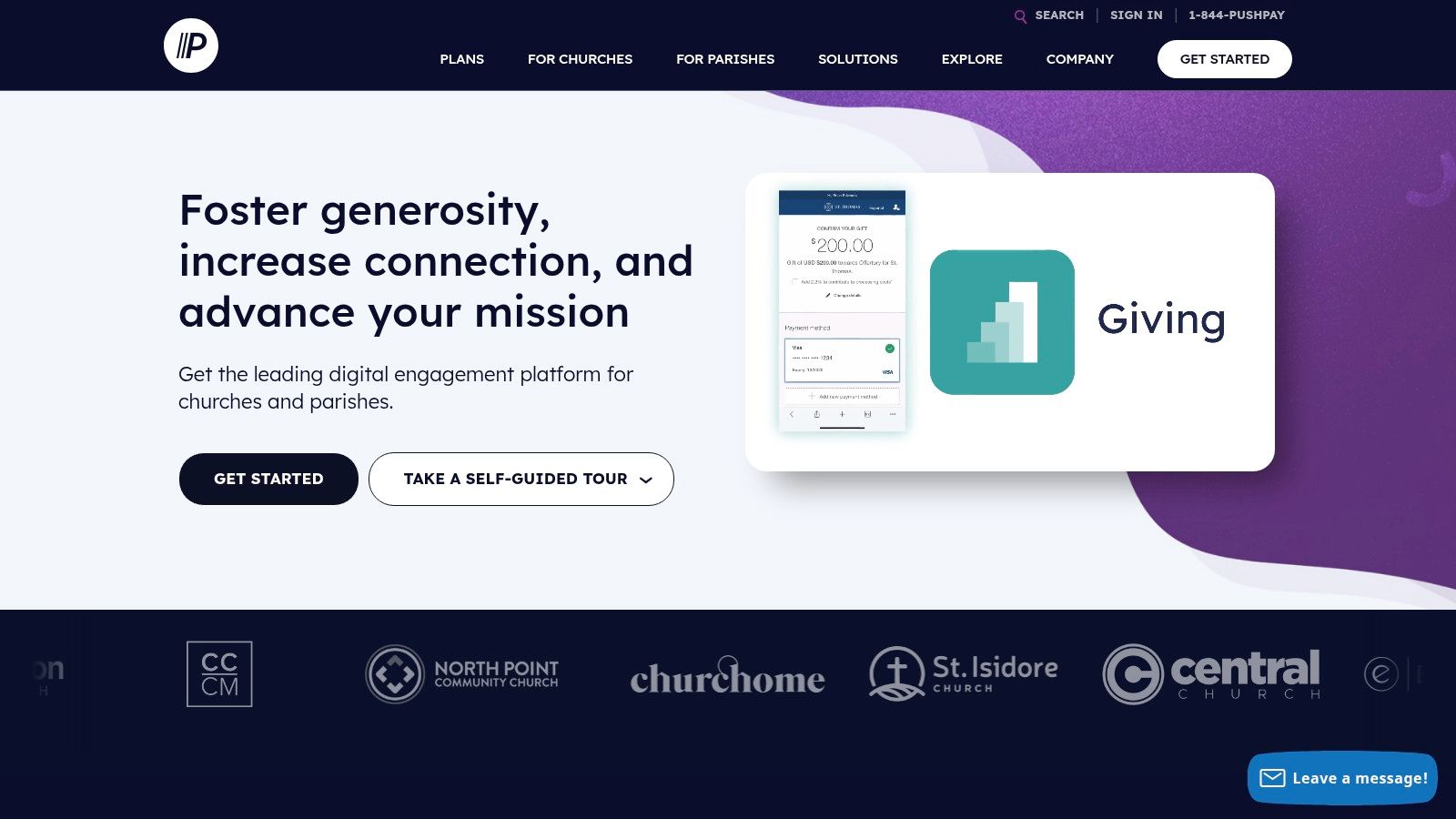
What makes Pushpay unique is its emphasis on a premium, highly intuitive user experience for both the church administration and the congregation. The platform is designed to make giving incredibly simple, often cited for its 10-second donation process, which helps reduce friction and increase generosity. This focus on ease of use is paired with powerful backend tools for tracking giving trends and managing donor relationships.
Key Features & Offerings
Pushpay’s feature set is built to foster a fully integrated digital church experience, encouraging engagement well beyond the Sunday service.
- Multiple Giving Methods: Donors can give seamlessly through a mobile app, text-to-give functionality, online giving forms, and physical kiosks.
- Automated Recurring Giving: The platform makes it exceptionally easy for members to set up and manage recurring donations, which is vital for budget stability.
- Custom-Branded Church App: More than just a giving portal, the app can become a central hub for sermon notes, event calendars, small group sign-ups, and push notifications.
- Detailed Donor Analytics: Church leaders gain access to powerful dashboards and reports that provide insights into giving patterns, helping to inform stewardship campaigns and ministry planning.
Pricing Structure
Pushpay operates on a subscription-based model, and its pricing is generally higher than entry-level platforms. The costs are tailored to the church's size and the specific package of features required. Prospective clients must contact Pushpay directly for a custom quote, as pricing is not publicly listed on their website. This approach allows them to build a solution that fits the specific needs of a larger ministry.
Practical Tip: Leverage the custom app's engagement features to drive giving. Use push notifications to remind the congregation about a special offering or to share a story about the impact of their generosity. This turns the app from a utility into a powerful ministry tool.
Pros & Cons
- Pro: A highly polished and intuitive user experience for donors, which can increase giving.
- Pro: The comprehensive feature set and custom app can unify a church's entire digital presence.
- Con: The premium nature of the platform comes with higher monthly costs, making it less accessible for smaller churches.
- Con: Pricing is not transparent and requires a direct sales consultation to get a quote.
Learn more at the official website: https://pushpay.com/
5. SecureGive
SecureGive stands out as a pioneering force among online giving platforms for churches, with a strong emphasis on providing a truly omnichannel donation experience. It is designed for churches that want to meet their congregation wherever they are, offering a robust suite of tools that cover every conceivable method of digital and physical giving. The platform’s core philosophy is built on security, reliability, and versatility.
What makes SecureGive unique is its comprehensive approach that bridges the gap between digital and in-person donations. While many platforms excel at online giving, SecureGive extends its ecosystem to include physical giving kiosks and advanced check scanning technology, making it a powerful, integrated solution for churches managing diverse revenue streams.
Key Features & Offerings
SecureGive’s strength lies in its five distinct giving channels, ensuring no member is left behind due to technological preference or comfort level.
- Five Giving Methods: The platform supports donations through a website portal, a dedicated mobile app, text-to-give functionality, physical giving kiosks for your lobby, and even check scanning software.
- Recurring Donations: Members can easily schedule and automate their tithes and offerings, which helps stabilize the church's budget and improve financial forecasting.
- Customizable Interfaces: Both the online giving pages and the physical kiosk interfaces can be branded to match your church’s identity, creating a seamless and trusted user experience.
- Comprehensive Reporting: Access detailed analytics and reporting tools that provide deep insights into giving trends, donor behavior, and campaign effectiveness, helping you make data-driven decisions.
Pricing Structure
SecureGive operates on a subscription-based model with various tiers tailored to a church's size and needs. The pricing structure involves a monthly fee, which can be higher compared to platforms with a free entry point. Additionally, the physical giving kiosks and check scanning hardware represent a separate, upfront investment for the church.
Practical Tip: If you invest in a giving kiosk, place it in a high-traffic area like the main lobby or near the coffee bar. Promote it as a quick, secure alternative to cash or checks, especially for guests or members who may have forgotten their checkbook.
Pros & Cons
- Pro: Exceptionally diverse giving options accommodate every demographic in your congregation.
- Pro: Strong focus on security, compliance, and dedicated customer support provides peace of mind.
- Con: The monthly subscription fees may be a barrier for smaller churches with tight budgets.
- Con: The initial hardware cost for kiosks and scanners requires a significant upfront investment.
Learn more at the official website: https://www.securegive.com/
6. Donorbox
Donorbox is a powerful and versatile fundraising platform recognized for its user-friendly interface and seamless integration capabilities. While not exclusively designed for faith-based organizations, its robust feature set and affordable pricing make it an excellent choice among online giving platforms for churches, particularly those looking to embed a sophisticated giving experience directly into their existing website.
What makes Donorbox unique is its focus on creating a streamlined and optimized donation process. The platform specializes in embeddable, customizable donation forms that can be placed on any page of your church website. This approach keeps donors on your site, reinforcing trust and brand consistency, rather than redirecting them to a third-party page.
Key Features & Offerings
Donorbox provides a suite of tools designed to maximize generosity and simplify the administrative process for your church staff.
- Customizable Donation Forms: Create beautiful, responsive forms with suggested giving amounts, recurring donation options (weekly, monthly, quarterly), and fields to designate funds for specific ministries.
- Multiple Payment Options: Accept donations via credit/debit cards, ACH bank transfers, PayPal, Google Pay, and Apple Pay, giving your congregation modern and convenient ways to give.
- Text-to-Give: Engage your members with a simple text-to-give feature that allows them to donate quickly from their smartphones during services or events.
- Donor Management: The platform includes a backend system to track donors, manage recurring plans, and send automated year-end tax receipts, saving valuable administrative time.
Pricing Structure
Donorbox offers a very accessible pricing model, especially for smaller organizations. There are no setup fees or monthly contracts. Instead, they charge a 1.75% platform fee on donations, plus standard payment processing fees from Stripe or PayPal. Nonprofits can apply to receive a discounted processing rate. They also provide an option for donors to cover the fees.
Practical Tip: Use the "Donation Designation" feature to connect giving directly to tangible ministry outcomes. Instead of just "Tithe," offer options like "Youth Camp Scholarship," "Community Food Pantry," or "Missions Fund" to show donors the direct impact of their generosity.
Pros & Cons
- Pro: Very easy to integrate with existing church websites, especially WordPress, without needing technical expertise.
- Pro: The affordable, percentage-based pricing model is low-risk and scales with your church’s growth.
- Con: The platform fee is slightly higher than some competitors unless you upgrade to a premium plan.
- Con: As a general fundraising tool, it lacks some of the integrated church-specific features like member databases or event management found in all-in-one ChMS platforms.
Learn more at the official website: https://donorbox.org/
7. easyTithe
easyTithe positions itself as a streamlined and accessible giving solution, focusing on providing essential digital tithing tools that are easy for both church administrators and members to use. It offers a balanced approach, delivering powerful features without overwhelming smaller churches with unnecessary complexity. As one of the dedicated online giving platforms for churches, it prioritizes a user-friendly experience to encourage consistent generosity.
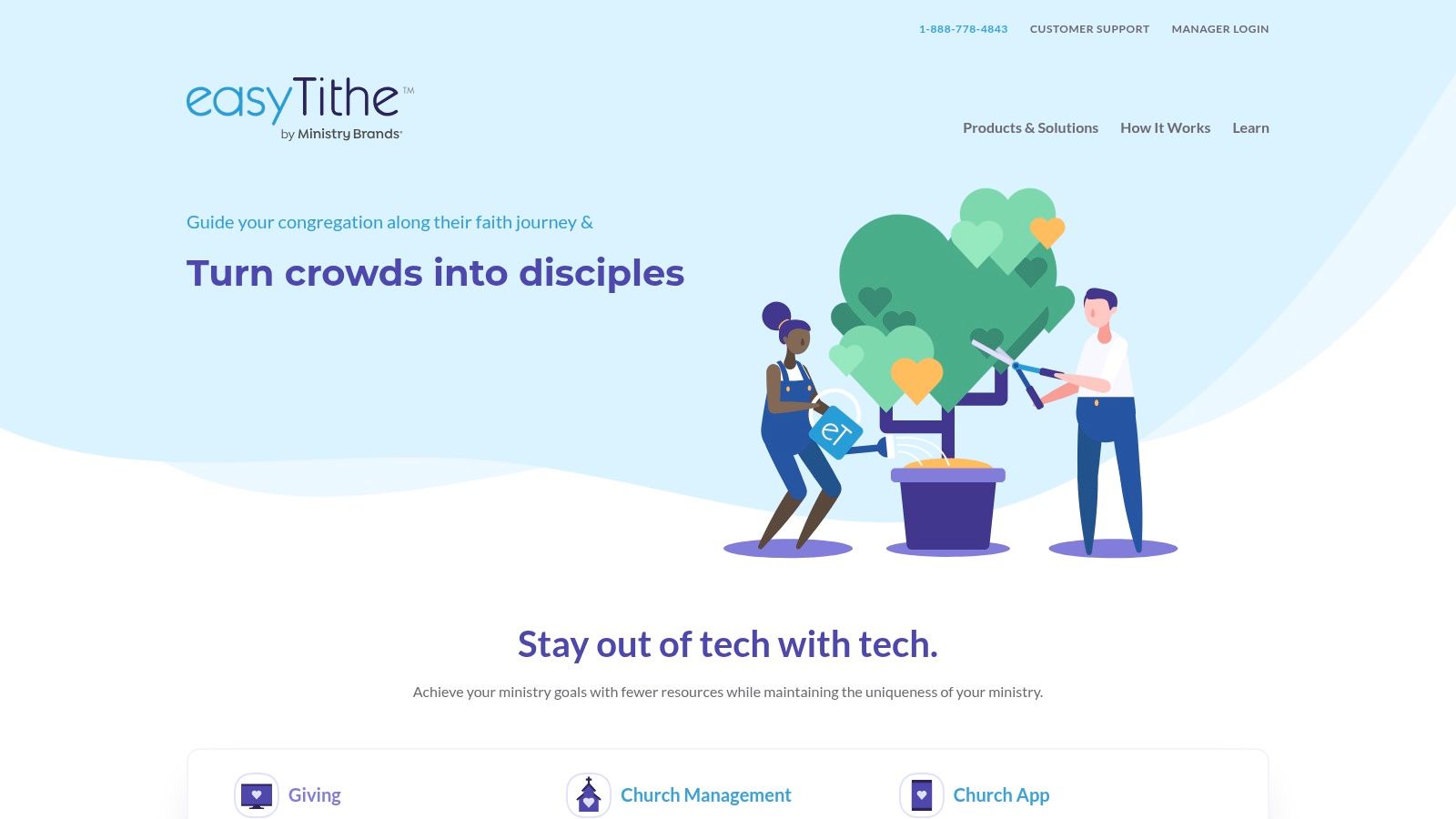
What makes easyTithe unique is its commitment to flexibility through various pricing plans, allowing a church to select a package that directly matches its size and budget. This model ensures that even small, growing congregations can access high-quality digital giving tools. The platform also emphasizes strong support, providing resources and coaching to help churches maximize their online fundraising efforts.
Key Features & Offerings
easyTithe provides a robust set of tools designed to cover all primary avenues of modern church giving, making it simple for the congregation to contribute anytime, anywhere.
- Multiple Giving Options: The platform supports donations through a church's website, a branded mobile app, text-to-give functionality, and physical kiosks for in-person giving.
- Recurring Donation Setup: Members can schedule recurring gifts with customizable frequencies (weekly, monthly, etc.), which helps stabilize church budgets and improve financial forecasting.
- Event Registration: Beyond simple donations, easyTithe includes forms for event registration and payment, centralizing sign-ups for VBS, conferences, or retreats.
- Detailed Reporting: Administrators gain access to a comprehensive dashboard with detailed analytics and reporting tools to track giving trends and manage donor data effectively.
Pricing Structure
easyTithe offers several tiered pricing plans, making it adaptable for different church needs. Plans range from a free option with higher transaction fees to premium monthly subscriptions that offer lower rates and more advanced features. This structure allows a church to start small and upgrade as its digital giving program grows. Some advanced features, like a fully custom mobile app, may require a higher-tier plan or an additional fee.
Practical Tip: Use the event registration feature to streamline more than just giving. By managing free event sign-ups alongside paid ones, you can centralize all your church's registrations in one place, simplifying administration and making it easier for members to participate.
Pros & Cons
- Pro: Affordable and scalable plans are suitable for small to mid-sized churches.
- Pro: The user-friendly interface for both donors and administrators lowers the barrier to adoption.
- Con: Some key features, such as text-to-give, may be locked behind higher-priced subscription plans.
- Con: Transaction fees, especially on the free plan, can accumulate and impact the total funds received from large donation volumes.
Learn more at the official website: https://www.easytithe.com/
Top 7 Church Online Giving Platforms Comparison
| Product | Implementation Complexity 🔄 | Resource Requirements ⚡ | Expected Outcomes 📊 | Ideal Use Cases 💡 | Key Advantages ⭐ |
|---|---|---|---|---|---|
| Flash | Low to Medium (quick setup, minimal coding) | Low (no intermediaries, wallet-to-wallet) | High (instant payments, low fees, privacy) | Businesses accepting Bitcoin payments globally | Non-custodial, instant Lightning payments, no KYC |
| Tithe.ly | Low (easy to implement/manage) | Low to Medium (some features paid) | Medium (steady donations, increased engagement) | Churches needing multi-channel giving | No setup fee basic plan, multiple giving methods |
| Givelify | Low (quick setup, mobile-first) | Low (no monthly fees) | Medium (mobile engagement, real-time tracking) | Churches focusing on mobile giving | User-friendly, no contracts, mobile-centric |
| Pushpay | Medium to High (custom apps, integrations) | Medium to High (higher monthly costs) | High (comprehensive engagement and analytics) | Mid-to-large churches requiring full solutions | Intuitive UX, detailed donor management |
| SecureGive | Medium (diverse methods require setup) | Medium to High (kiosk hardware investment) | High (security, compliance focus) | Churches needing varied donation options | Diverse giving methods, strong security |
| Donorbox | Low (easy website embed) | Low (affordable for small churches) | Medium (streamlined giving, donor tracking) | Smaller churches wanting customizable forms | Affordable, integrates well with websites |
| easyTithe | Low to Medium (varied plans & tools) | Low to Medium (some fees apply) | Medium (flexible giving, event management) | Small to mid-sized churches | Flexible plans, event registration, support |
From Options to Action: Finalizing Your Church's Giving Strategy
Choosing from the many available online giving platforms for churches is more than a technical decision; it's a ministry-defining choice that impacts your congregation's ability to support your vision. We've journeyed through a landscape of powerful tools, each offering a distinct path toward simplifying generosity and strengthening your church’s financial foundation.
From the comprehensive, all-in-one church management systems offered by platforms like Pushpay and Tithe.ly to the streamlined, donor-centric experiences of Givelify and SecureGive, the options are robust. We also saw how versatile tools like Donorbox can serve churches of all sizes with flexible, campaign-focused features.
Synthesizing Your Decision: Key Takeaways
The central theme is clear: the best platform is the one that aligns seamlessly with your specific context. A small church plant might prioritize the low startup costs and straightforward features of easyTithe, while a large, multi-campus church may require the deep analytics and custom app development available through Pushpay.
A critical, forward-thinking consideration is the adoption of alternative payment methods. The inclusion of Flash in our list highlights a significant shift towards decentralized, non-custodial Bitcoin payments. This isn't just a niche feature; it represents an opportunity to engage a growing demographic of tech-savvy givers, reduce transaction costs dramatically, and offer a secure, modern giving channel.
A Practical Framework for Choosing Your Platform
To move from consideration to a confident decision, follow these actionable steps:
- Assemble Your Team: Involve your financial secretary, a pastor, and a tech-savvy church member. Diverse perspectives will help you evaluate platforms from all necessary angles, from administrative ease to the donor’s user experience.
- Define Your Non-Negotiables: Create a checklist based on your ministry's most critical needs. Is a custom-branded mobile app essential? Do you require text-to-give functionality? Is integrating with your existing Church Management Software (ChMS) a top priority?
- Request Live Demos: Move beyond feature lists. Schedule demonstrations with your top two or three contenders. Use these sessions to ask specific questions about your unique scenarios and see how the platform handles real-world administrative tasks.
- Consider Your Entire Funding Ecosystem: While online giving is a cornerstone of modern church finance, it's wise to diversify your funding streams. Many ministries successfully supplement congregational giving with other financial support. To that end, exploring how to secure grants for 501(c)(3) religious organizations can unlock new opportunities for major projects, community outreach, and facility improvements.
Ultimately, the goal is to make giving an act of worship that is simple, secure, and accessible. The right platform will feel less like a tool and more like a partner in your ministry, empowering your community to give joyfully and consistently. By thoughtfully evaluating your options and involving key stakeholders, you can implement a solution that serves your church today and scales with your vision for tomorrow.
Ready to embrace the future of giving with unparalleled security and minimal fees? Explore Flash to see how its non-custodial Bitcoin payment solution can empower your ministry. Offer your congregation a modern, efficient, and cost-effective way to support your mission by visiting Flash today.