Think of most payment systems as a sealed black box you rent from a provider. You put money in one end, it comes out the other, but you have no idea what happens inside. An open source payment gateway is the exact opposite. It's like getting the complete blueprints and all the tools for that box.
You can look inside, see how it works, change parts, and build your own payment infrastructure from the ground up. This transparency is the core idea—it gives you, the merchant, total control.
What Does This Mean in Practice?
At its heart, an open source gateway lets you cut out the traditional middlemen. Instead of your customer's payment getting routed through a third party that takes a slice of the pie, you can build a direct financial highway between your business and your customers. To really get why this matters, it helps to understand how typical payment gateways work in the first place.
This direct model is a game-changer for Bitcoin. It makes a true wallet-to-wallet payment system possible, where money moves straight from your customer's Bitcoin wallet into yours. No detours, no gatekeepers.
The Defining Traits of Open Source Gateways
This whole approach is built on a few simple but powerful principles that give you far more financial freedom than you'd get with a traditional, closed system.
- Radical Transparency: The code is out in the open for anyone to see. This means a global community of developers can spot and fix security holes, making the entire system stronger and more trustworthy over time.
- Total Control and Ownership: You're not stuck in a vendor's world, playing by their rules. You own the software, you design the customer experience, and most importantly, you control the flow of your money.
- Community-Powered Progress: Development isn't driven by one company's roadmap. It's a team effort from developers all over the world, which often means faster updates, cooler features, and more creative solutions.
A non-custodial open source gateway for Bitcoin is the embodiment of financial sovereignty. It ensures that no third party can freeze, hold, or censor your transactions, giving you the same control over your digital revenue as you have with physical cash.
This isn't just a niche idea anymore; it's catching on fast. The global payment gateway market is expected to hit a staggering USD 194.46 billion by 2032, and open source solutions are on track to grab 15-20% of that. Why? Because businesses are tired of paying integration fees that are 60-70% higher with proprietary systems. They want a better way to connect with the 500 million-plus Bitcoin users worldwide without the usual intermediaries and invasive KYC checks.
Comparing Open Source and Traditional Gateways
Let's break down the key differences. This table gives you a quick snapshot of what you gain—and what you leave behind—when moving from a conventional payment processor to an open source Bitcoin solution.
| Feature | Open Source Gateway for Bitcoin | Traditional Proprietary Gateway |
|---|---|---|
| Cost Structure | Lower transaction fees; potential self-hosting costs. | Higher transaction fees (1.5-3.5%+), monthly fees. |
| Control & Ownership | Full control over software, funds, and user experience. | Limited control; dependent on the provider's rules. |
| Custody of Funds | Non-custodial; funds go directly to your wallet. | Custodial; provider holds funds before settlement. |
| Customization | Highly customizable to fit specific business needs. | Limited customization options within a fixed framework. |
| Transparency | Code is public, verifiable, and community-audited. | "Black box" system; code is proprietary and hidden. |
| Innovation Speed | Rapid, community-driven development. | Slower, corporate-driven updates. |
| Security Responsibility | You are responsible for securing your implementation. | Provider manages security, but is a larger target. |
| Compliance (KYC/AML) | Often bypasses mandatory KYC for wallet-to-wallet payments. | Strict KYC/AML compliance is required for merchant accounts. |
| Global Reach | Natively global; accepts payments from any Bitcoin wallet. | Often restricted by geography and banking partnerships. |
As you can see, the choice isn't just about technology—it's about business philosophy. Open source puts the power and responsibility squarely in your hands, while traditional gateways offer convenience in exchange for control and higher costs.
The Real Business Case for Open Source Bitcoin Payments
Okay, let's move past the technical side of things. The real magic of an open source payment gateway isn't just in the code; it's in what it does for your business. For any merchant dipping their toes into Bitcoin, this isn't just another payment option—it's a fundamental shift that pads your bottom line and sets you up for the future. The whole argument for making the switch really boils down to four powerful pillars.
Radical Cost Reduction
The first and most obvious win is cutting out the parasitic fees. Traditional payment processors are notorious for nickel-and-diming you with percentage-based transaction fees, monthly charges, and a whole menu of hidden costs. An open source solution built for Bitcoin simply cuts out the middlemen.
Forget about giving away 1.5% to 3.5% of every sale. With a direct wallet-to-wallet setup, you keep the whole thing. That means more of your hard-earned cash stays right where it belongs: in your business. It's an instant boost to your profitability on every single transaction.
Full Control Over Your Brand
Your checkout page is one of the most critical moments in the customer journey. Proprietary gateways often box you into their generic, one-size-fits-all payment page, which can feel jarring and disconnected from your brand. That little bit of friction is sometimes all it takes to lose a customer's trust and a sale.
With an open source gateway, you're back in the driver's seat. You get total creative control to customize the entire payment flow—the colors, the logos, the messaging—to create a completely seamless, branded experience. It keeps things consistent and professional right up to the final click.
By taking ownership of your payment infrastructure, you transform the checkout process from a simple transaction into an integrated part of your brand experience. It ensures consistency and professionalism from start to finish.
Bulletproof Security and Trust
Security is everything in payments, and this is where the open source model really shines. Because the code is public, it's constantly being poked, prodded, and tested by a global community of developers. This "many eyes" approach makes it incredibly difficult for vulnerabilities to hide, resulting in software that's just plain tougher and more reliable.
Better yet, a non-custodial, wallet-to-wallet approach insulates you from some of the biggest third-party headaches:
- No Frozen Funds: A provider never actually holds your money, so they can't freeze your account or hold your settlements hostage.
- Censorship Resistance: Your ability to do business can't be shut down by a centralized company that doesn't like what you sell.
- No Single Point of Failure: You aren't betting your entire payment operation on a single company's servers or their financial stability.
Borderless Commerce
At its core, Bitcoin is a global, permissionless currency. An open source gateway unlocks that power completely, letting you accept payments from anyone, anywhere in the world, instantly. No more cross-border fees, frustrating currency conversion delays, or bank restrictions getting in the way.
This flings the doors open to entirely new markets and customer bases, allowing you to run a truly global business with almost zero friction.
Choosing Your Path to Bitcoin Payments
When you decide to accept Bitcoin, you’ll quickly find yourself at a fork in the road. One path leads to a hosted, or custodial, payment gateway. The other, far more aligned with Bitcoin's core principles, leads to an open source payment gateway. This isn't just a technical choice—it fundamentally defines the trade-off between convenience and control, directly impacting your costs, security, and financial freedom.
Hosted gateways can seem like the easy on-ramp. A third party handles all the tricky technical bits, giving you a plug-and-play solution to get started quickly. While that initial simplicity is tempting, it comes with a bundle of hidden costs and risks that completely undermine why you'd want to use Bitcoin in the first place.
These providers are custodians, which is a fancy way of saying they take possession of your customers' payments before passing them on to you. This brings a dangerous middleman right back into the picture—one who can, and often does, charge higher fees, freeze your funds without warning, or shut down your account entirely. You're back to trusting someone else with your money, which is the very problem Bitcoin was created to solve.
The Clear Advantage of Financial Sovereignty
This is where the open source model really shines, especially for any business that values self-reliance. An open source solution is built to facilitate direct, peer-to-peer transactions—from your customer’s wallet straight to yours. The software provider, like Flash, never touches or holds your funds.
This non-custodial approach isn't just a technical detail; it's a strategic business decision. By holding your own keys and receiving Bitcoin directly, you reclaim the financial sovereignty that is rightfully yours.
With Bitcoin, the entire point is to be your own bank. Using a custodial service is like depositing your gold with a third party who promises to give it back later—it defeats the purpose and reintroduces the exact risks you sought to avoid.
Comparing the Two Models
To make the decision clearer, let's break down the real differences between these two paths. One is a rented service where you play by someone else's rules; the other is a tool you own and control completely.
| Aspect | Open Source Gateway (Non-Custodial) | Hosted Gateway (Custodial) |
|---|---|---|
| Fund Control | You maintain 100% control over your funds at all times. | The provider holds your funds before settlement. |
| Censorship Risk | Extremely low. No central party can stop your transactions. | High. Your account can be frozen or closed at will. |
| Fees | Minimal to none. Primarily network fees, not percentages. | Higher fees, including percentage-based transaction costs. |
| Privacy | Enhanced. No third party collects sensitive customer data. | The provider often requires extensive KYC/AML checks. |
| Flexibility | High. You can customize the checkout to match your brand. | Limited by the provider's templates and features. |
This shift towards direct, open systems is gaining serious momentum. The embedded finance market, which leans heavily on open-source solutions, is projected to hit USD 588 billion by 2030. These gateways are thriving as Bitcoin adoption has climbed 35% in tech-focused sectors since 2023.
By borrowing principles from open banking—a system now used by over 132 million people—they enable direct wallet-to-wallet transfers that can slash merchant costs by up to 30%. You can discover more about these open banking trends and see how they're reshaping digital payments.
Ultimately, choosing an open source payment gateway is a commitment to the foundational values of Bitcoin itself: decentralization, security, and complete ownership.
Key Factors for a Successful Deployment
Making the switch to an open source payment gateway is a big step, but a successful launch comes down to getting a few key things right from the start. Before you flip the switch, you need to think about the tech involved, your system's ability to grow, and the fundamental principle of non-custodial Bitcoin payments. Nailing these factors will make for a smooth transition and set you up for long-term success.
First, let's look at your technical needs. The words "open source" can sound a bit daunting, but modern solutions are built for everyone, not just developers. Many providers now offer pre-built tools that do the heavy lifting for you, like plug-and-play website widgets or intuitive point-of-sale (POS) apps that can turn any smartphone into a Bitcoin terminal.
Ensuring Scalability and Performance
Think about your busiest day—a holiday sale, a weekend rush. Can your payment system handle it? It has to. A well-designed open source gateway is built to scale, ensuring your checkout stays lightning-fast and reliable no matter how many customers are trying to pay at once.
This isn't just a "nice-to-have." It's about preventing lost sales from slow or failed transactions. The goal is to deliver a checkout experience that’s every bit as quick and dependable as a traditional card payment. That’s how you keep customers happy and revenue flowing without a hitch.
The Non-Custodial Imperative
This is the most important part of your deployment: committing to a non-custodial model. It’s a simple but powerful idea. Funds move directly from your customer’s Bitcoin wallet to yours. The payment software provider never touches your money. This direct, peer-to-peer approach is what financial sovereignty is all about.
By choosing a non-custodial path, you eliminate the single greatest risk associated with third-party processors—the possibility of frozen funds or seized accounts. You are always in complete control of your Bitcoin.
This model also radically simplifies compliance. Since there's no intermediary holding funds, the need for invasive Know Your Customer (KYC) checks on your shoppers often disappears. This protects your customers' privacy, reduces friction at checkout, and gets rid of the regulatory headaches that come with third-party fund management.
This direct payment model is part of a much bigger trend in finance. Account-to-account (A2A) payments—the core idea behind wallet-to-wallet Bitcoin transactions—are on track to hit USD 3.8 trillion globally by 2030, offering cost savings of up to 30% over card networks. This shift is even supported by infrastructure like the US FedNow system, which mirrors the instant settlement that solutions like Flash bring to Bitcoin. You can learn more about these top payment industry trends and see how they're reshaping commerce.
Your Roadmap to Accepting Bitcoin Payments
Making the switch to an open source payment gateway is a big move, but it doesn't have to be complicated. Forget thinking of it as a massive technical project; it's more like a simple, powerful business upgrade.
This roadmap breaks the whole process down into five clear, manageable steps. It’s designed for any merchant, whether you're running a local coffee shop or a global e-commerce store, to get you accepting Bitcoin smoothly.
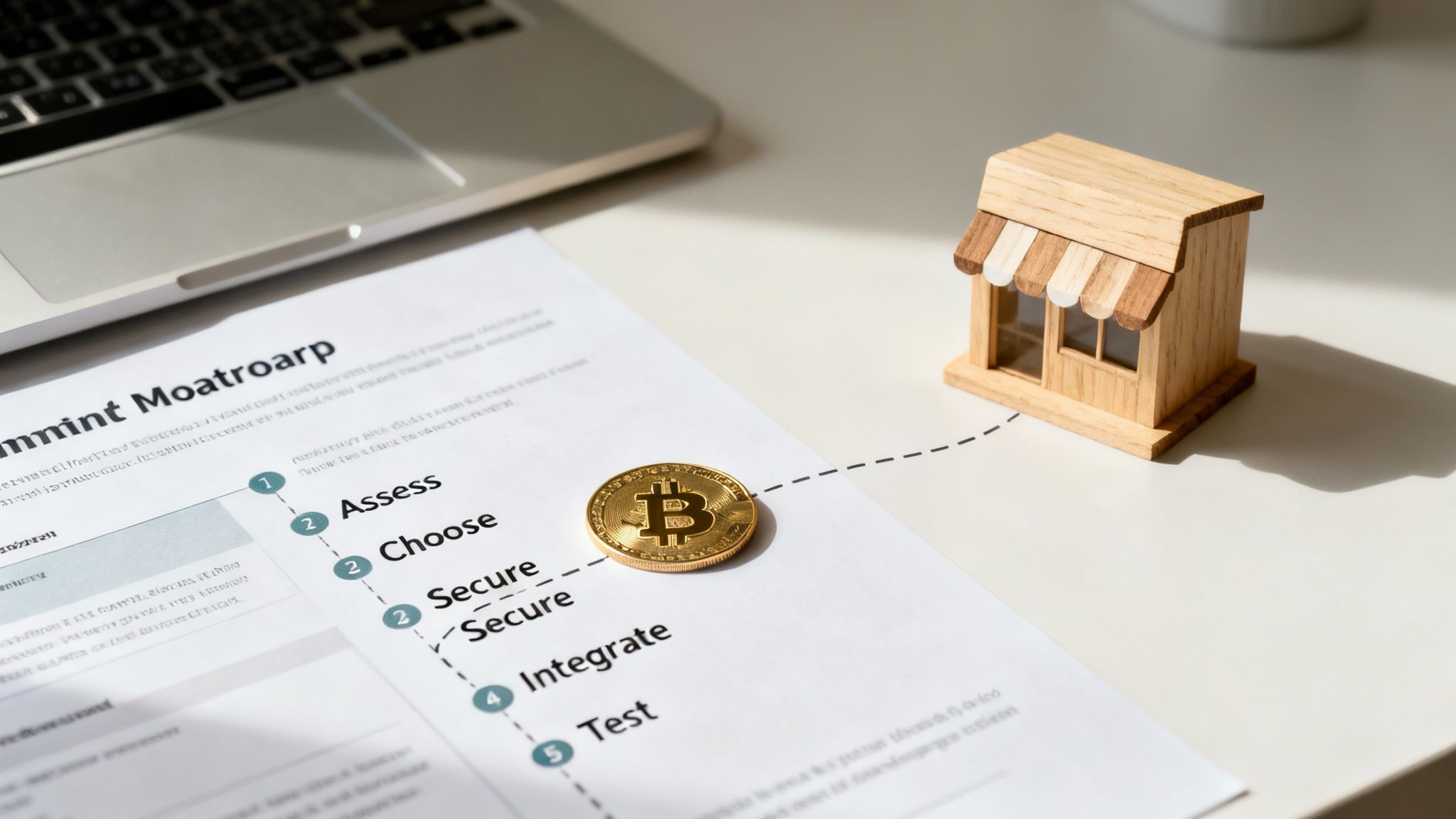
Follow this plan, and you'll be set up to accept Bitcoin securely and efficiently, giving you total control over your money from day one.
Step 1: Assess Your Needs
First things first, take a hard look at what your business actually needs. Are you a high-volume online store, or a physical shop that might see a few Bitcoin users now and then? The right tool for the job depends entirely on your situation.
Think about the checkout experience you want to offer. Is a simple payment button enough? Or do you need a full point-of-sale (POS) app for your tablet? Maybe you just need shareable payment links for sending invoices. Nailing this down will help you filter out the noise and pick software that fits right into your daily operations.
Step 2: Select Your Software
Once you know what you need, it's time to pick your open source Bitcoin payment software. The absolute most important thing here is to choose a solution that is non-custodial. This is your guarantee that payments go straight to your wallet, with no middleman ever touching your funds.
Look for solutions like Flash that offer a whole suite of easy-to-use tools. A solid platform will give you everything from POS apps to website widgets you can just embed, making it easy to get going without hiring a developer. Software with a strong community and clear documentation is always a good sign.
As you map this out, it's smart to consider how an open source gateway fits with your current e-commerce setup. For instance, understanding different platform features, like the various Wix Ecommerce capabilities, can make the integration process much smoother.
Step 3: Secure Your Bitcoin Wallet
Your Bitcoin wallet is the core of this whole system. It’s where you store your private keys—think of them as the digital keys to your company's vault. Keeping them safe is priority number one.
Securing your private keys is non-negotiable. With a non-custodial gateway, you are your own bank, which means you have both the freedom and the responsibility to protect your funds.
Stick to the proven best practices for managing your private keys. Use a reputable wallet, set strong and unique passwords, and—most critically—store your seed phrase (your recovery phrase) offline in a safe, private place. Never, ever share your seed phrase with anyone.
Step 4: Integrate the Gateway
Alright, time to connect the pieces. For most businesses, this part is surprisingly painless. Modern open source tools often give you simple copy-and-paste code snippets to add payment buttons right to your website.
If you have a more custom setup, like a mobile app or a heavily modified e-commerce site, you'll use the provider’s API (Application Programming Interface). A well-documented API gives your developers everything they need to build a polished, on-brand checkout experience for your customers.
Step 5: Test and Go Live
Finally, before you flip the switch, run a few test transactions. Almost all Bitcoin wallets and gateways have a "testnet" environment that lets you mimic real payments without using actual funds. This is your chance to make sure everything works perfectly and to get your team comfortable with the new process.
Once you’re confident that it’s all running smoothly, you're ready to go live. Let your customers know you're now accepting Bitcoin and make sure your team is prepped to handle any questions. That's it—you’re now ready to accept secure, direct Bitcoin payments from anyone, anywhere in the world.
Answering Your Questions About Bitcoin Gateways
Diving into a new technology like an open source payment gateway for Bitcoin always brings up a few questions. It's only natural. Merchants I talk to are usually curious about the practical side of things—what skills do you need? How safe is it, really?
Let's tackle the most common concerns head-on. My goal is to give you clear, straightforward answers so you can make a decision with confidence.
Do I Need to Be a Developer to Use This Technology?
Not at all. This is a common misconception. While the "open source" part means developers can dive in and customize the code, most modern solutions are built for everyone. They come with simple, user-friendly tools that make getting started a breeze, no matter your technical background.
For instance, many platforms give you things like:
- Point-of-Sale (POS) Apps: Turn any phone or tablet into a Bitcoin terminal. Perfect for retail shops or market stalls.
- Simple Payment Links: You can generate these in a click and share them in an email, a text message, or on social media for easy invoicing.
- Embeddable Buttons: Often, this is just a little snippet of code you copy and paste onto your website. That's it. You're ready to accept payments.
With tools like these, merchants who have never written a line of code can be up and running in minutes.
Is an Open Source Gateway Actually Secure?
Yes, and its public nature is a huge part of why it's so secure. Think about it: because the code is out in the open, it’s constantly being reviewed and tested by security experts all over the world. This "many eyes" approach means vulnerabilities get spotted and fixed fast, leading to incredibly robust software.
But the real security game-changer is that a non-custodial gateway enables direct wallet-to-wallet payments.
This is the critical point. The software provider never touches or holds your funds. This completely removes the risk of your money being frozen, seized, or lost if that company goes under. You, and only you, have full, sovereign custody of your Bitcoin.
How Do I Manage Bitcoin Price Volatility?
This is probably the number one question on every merchant's mind, and for good reason. The good news is there's a simple, elegant solution built right into most modern gateways.
You always have the option to hold the Bitcoin you receive, but you absolutely don't have to expose your business to price swings.
Most gateways can be set up to instantly convert your Bitcoin into your local currency at the exact moment of the transaction. This locks in the sale price on the spot. You get all the benefits of accepting a global, digital currency without taking on the volatility risk, ensuring you receive the exact amount you charged, every single time.
What Are the Compliance and KYC Requirements?
Here’s one of the biggest wins of using a non-custodial, peer-to-peer Bitcoin gateway: massively simplified compliance. When you receive a payment directly from a customer's wallet to yours, it’s just like someone handing you digital cash. There is no third-party intermediary taking custody of the funds.
This direct payment model often sidesteps the need for the most invasive regulatory hurdles, like performing Know Your Customer (KYC) checks on your shoppers. For you, this means protecting customer privacy, reducing friction at checkout, and eliminating a major administrative headache.
Of course, you’re still responsible for following all the local tax and business laws that apply to your company. But the payment process itself becomes much cleaner.
Ready to embrace financial sovereignty and offer your customers a better way to pay? Flash provides all the tools you need to accept Bitcoin directly, with zero fees and no middlemen. Start accepting Bitcoin in under a minute at .