Paying your bills with crypto is way simpler than you might think. By using a specialized service, you can pay your credit card, utilities, and phone bills directly from your Bitcoin wallet, finally bridging the gap between digital currency and traditional finance.
It’s a surprisingly straightforward way to start using your Bitcoin for everyday expenses.
Why Pay Your Everyday Bills with Bitcoin
The idea to pay a bill with crypto—specifically Bitcoin—has gone from being a niche concept to a practical financial strategy for a growing number of people. It's a real shift in mindset. Instead of just holding Bitcoin as an investment, people are now using it as a medium of exchange to manage their daily financial lives.
What's driving this? A big part of it is the desire for more control and efficiency.
When you pay bills through your bank, you're always relying on an intermediary. Using Bitcoin, especially through direct wallet-to-wallet platforms, cuts down on that reliance. You're the one initiating transactions directly from your wallet, which means you keep control over your funds throughout the entire process. This approach gets right back to the core principles of Bitcoin—giving you greater financial sovereignty.
The Core Advantages of Bitcoin Payments
The real appeal is the independence from the old-school banking system.
Think about it: for anyone who holds a significant portion of their assets in Bitcoin, this method completely avoids the slow, clunky process of selling crypto, transferring the money to a bank, waiting for it to settle, and then finally making the payment. It’s a multi-step headache.
Instead, you can settle your obligations directly. You only convert your Bitcoin to cash at the exact moment the bill is due.
This isn't just a futuristic idea anymore; it's happening now. By 2025, using crypto for payments has become a significant part of the global financial scene. The United States is actually leading this trend, accounting for a massive 23.2% of all global crypto payment orders. And Bitcoin is still the king, making up 30% of the total volume and proving its dominance in practical, everyday use cases. You can dig into these global crypto payment trends to see the bigger picture for yourself.
The real advantage is simplifying your financial life. If Bitcoin is your primary asset, using it for bills removes unnecessary steps, fees, and delays associated with converting back and forth between fiat currency and digital assets.
This growing adoption makes it easier than ever to integrate Bitcoin into your regular budget. Let’s break down how it stacks up against the traditional way of doing things.
Bitcoin Bill Payments At a Glance
Here’s a quick look at how paying with Bitcoin compares to using a traditional bank for your bills. The differences in control, privacy, and accessibility are pretty stark.
| Feature | Bitcoin Payments | Traditional Bank Payments |
|---|---|---|
| Control | You maintain full control of your funds until the exact moment of payment. | Funds are held and processed by a third-party financial institution. |
| Privacy | Transactions are pseudonymous, giving you more privacy than a bank statement ever could. | Transactions are directly tied to your personal identity and financial records. |
| Accessibility | Accessible globally with just an internet connection, no bank hours to worry about. | Limited by banking hours, national borders, and institutional policies. |
| Fees | Transaction fees are set by network demand, not arbitrary percentages. | Often involves fixed fees, percentage-based charges, or other hidden costs. |
As you can see, using Bitcoin offers a level of financial autonomy that traditional systems just can't match. You're not just moving money; you're taking back control over it.
Choosing and Securing Your Bitcoin Wallet
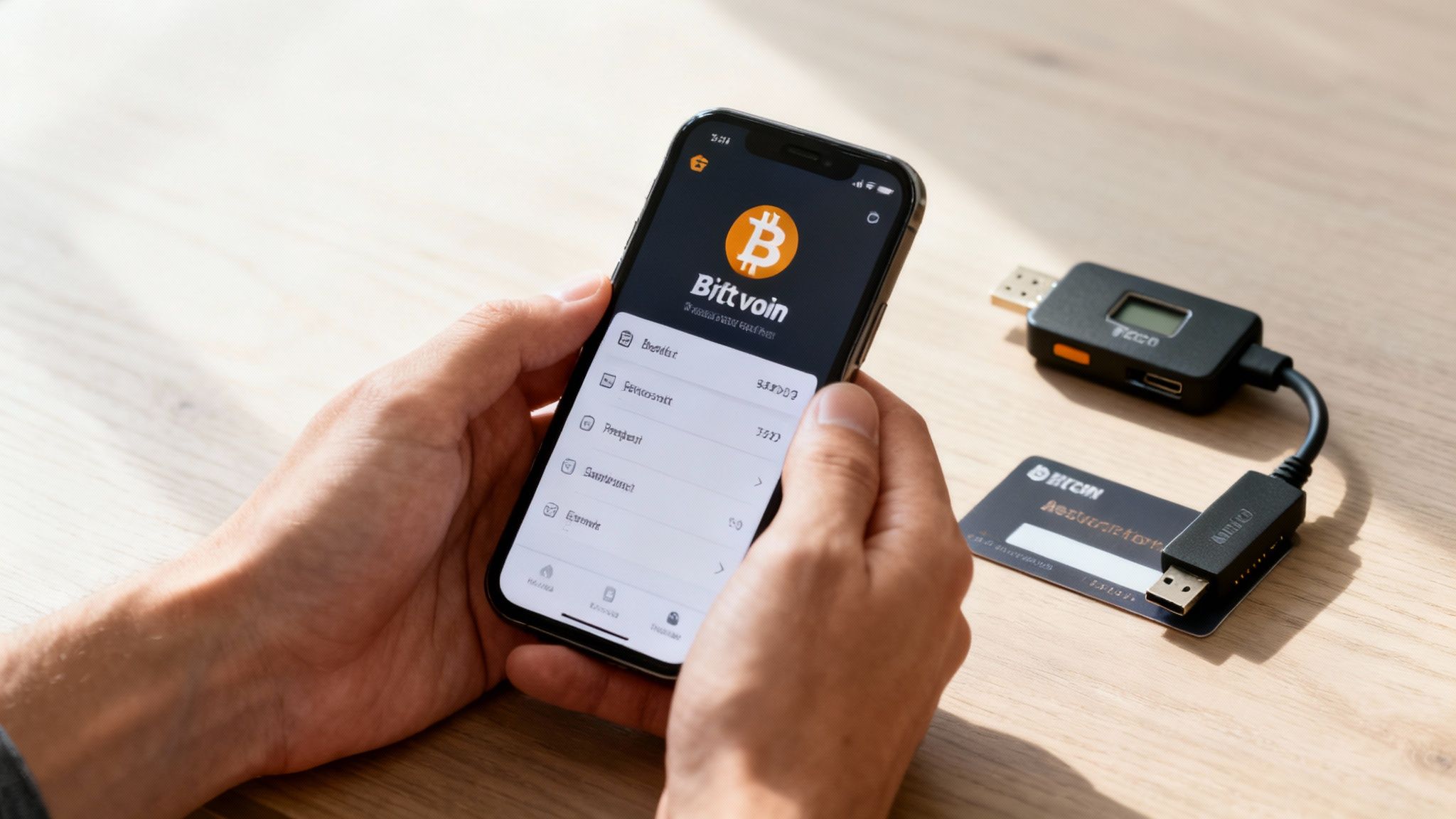
Before you can pay a single bill with crypto, your Bitcoin needs a secure place to live. Think of a Bitcoin wallet less like the leather one in your pocket and more like a personal banking app that you alone control. This is ground zero for managing your funds and authorizing payments, making it the most critical first step you'll take.
For the kind of everyday spending you’ll do with bill payments, a software wallet—either on your phone or desktop—is the way to go. It strikes the perfect balance between convenience and security. These apps are built for frequent, small transactions, letting you send and receive Bitcoin without jumping through hoops. Mobile or desktop? That’s really just a matter of taste. A mobile wallet is perfect for on-the-go access, while a desktop version can give you a more detailed overview of your activity.
Your Wallet’s Core Components
When you first set up your wallet, you'll bump into a few key terms. Don't let them intimidate you; they're simpler than they sound. Getting a handle on them is non-negotiable for keeping your funds safe. Remember, in the Bitcoin world, you are your own bank.
- Private Key: This is the master key to your kingdom. It's a secret, alphanumeric code that gives you—and anyone who has it—complete access to your Bitcoin. You guard this with your life. Never, ever share your private key with anyone.
- Public Address: Think of this as your bank account number. It’s the address you share with people who need to send you Bitcoin. It’s perfectly safe to give this out.
- Seed Phrase: This is a list of 12 to 24 random words your wallet gives you during setup. It's the ultimate backup for everything. If your phone gets stolen or your laptop dies, this phrase is the only thing that can bring your funds back.
Your seed phrase is your ultimate safety net. Write it down on paper and store it somewhere safe and offline—maybe even in a couple of different places. Never save it as a digital file on your computer or phone. Seriously.
Securing Your Funds for Peace of Mind
With this kind of control comes great responsibility. Securing your wallet isn’t just a friendly suggestion; it’s an absolute must before you even think about paying bills with crypto. Your first line of defense is a strong, unique password for the wallet app itself.
Next up, enable two-factor authentication (2FA). This adds a crucial layer of security, requiring a second code (usually from an authenticator app) before you can send a transaction. It makes it incredibly difficult for someone to access your funds, even if they somehow crack your password.
And one last pro tip: before you pay your first real bill, do a small test run. Send a tiny amount of Bitcoin—we’re talking a few dollars' worth—to a friend or even another wallet you control. This simple move builds confidence and makes sure you've got the hang of the process before there’s real money on the line.
Of course, choosing a wallet is just the start. To consistently pay bills, you need to manage your crypto assets effectively, and the best investment portfolio management tools can help ensure you always have the funds you need, right when you need them.
Finding the Right Crypto Bill Pay Service
So, you've got your Bitcoin wallet set up and ready to go. What's next? You need to pick a platform that can connect your wallet to your billers.
Think of these specialized crypto bill pay services as the essential bridge between two different worlds. They take your Bitcoin and translate it into a payment your utility company or credit card issuer can actually understand and accept. They do all the heavy lifting with the conversion so you don't have to.
The key is finding a service that actually works for you. They're not all the same, and the best fit depends on a few things: where you live, who you're trying to pay, and what you're willing to pay in fees. A little homework now will save you a ton of headaches later and ensure a smooth process every time you need to pay a bill with crypto.
Evaluating Your Options
As you start comparing services, you'll want to zoom in on a few core features.
The most obvious one is the fee structure. Some platforms will hit you with a flat fee for every transaction, while others skim a small percentage off the total payment. If you're paying smaller, regular bills, a percentage-based fee is probably your best bet. But for those big, one-off payments like a mortgage or car loan, a flat fee could save you a decent chunk of change.
Next, you absolutely have to verify their coverage. This breaks down into two simple checks:
- Geographic Support: First and foremost, does the service even operate in your country? This is a non-negotiable first step. Regulations are different everywhere, so platforms are limited to specific regions.
- Biller Directory: Spend some time digging through their list of supported billers. Can you actually pay your specific internet provider, local utility, or that one credit card? A deep and comprehensive directory is a great sign of a mature, useful service.
Finally, reputation and security are everything in this space. Hunt down reviews and see what real users are saying about reliability and customer support. A platform's history and security protocols give you a pretty clear picture of how well they protect your data and handle your money.
A Practical Example: Paying Your Internet Bill
Let's walk through what this looks like in the real world. Say you need to pay your $75 monthly internet bill using the Bitcoin from the wallet you just set up.
First, you'd log into the bill pay service you chose. From there, you'll find their bill payment section and search for your internet provider. Once you've found them, you'll need to plug in your account number and the exact payment amount—in this case, $75.00.
The service then spits out a payment request. This screen is critical. It will show you the exact amount of Bitcoin to send, calculated at the current exchange rate, plus any fees. It will also give you a unique Bitcoin address just for this one transaction.
The most crucial step is to be meticulous here. Use the 'copy' button for both the Bitcoin amount and the destination address. This simple action prevents typos that could lead to lost funds, as Bitcoin transactions are irreversible.
From there, you just open your own Bitcoin wallet, paste in the address and the BTC amount, give it one final look-over, and send the transaction. The bill pay service takes care of the rest—it detects the payment, converts the Bitcoin to dollars, and gets the money to your internet provider. Most services will even send you a confirmation once the bill is marked as paid.
Using crypto for everyday bills isn't just a niche idea anymore; its adoption has skyrocketed alongside the global growth in crypto users. By 2025, it's projected that over 659 million people—that's roughly 1 in every 13 people on the planet—will be actively using crypto.
In response, over 90% of crypto payment gateways have seriously beefed up their security and compliance, rolling out AI-powered fraud detection and multi-signature approvals to build trust. You can dig into more of these security and compliance trends in crypto payments to see just how much the industry has matured. This growing legitimacy and security make it a more reliable option than ever.
Managing Bitcoin Fees and Transaction Times
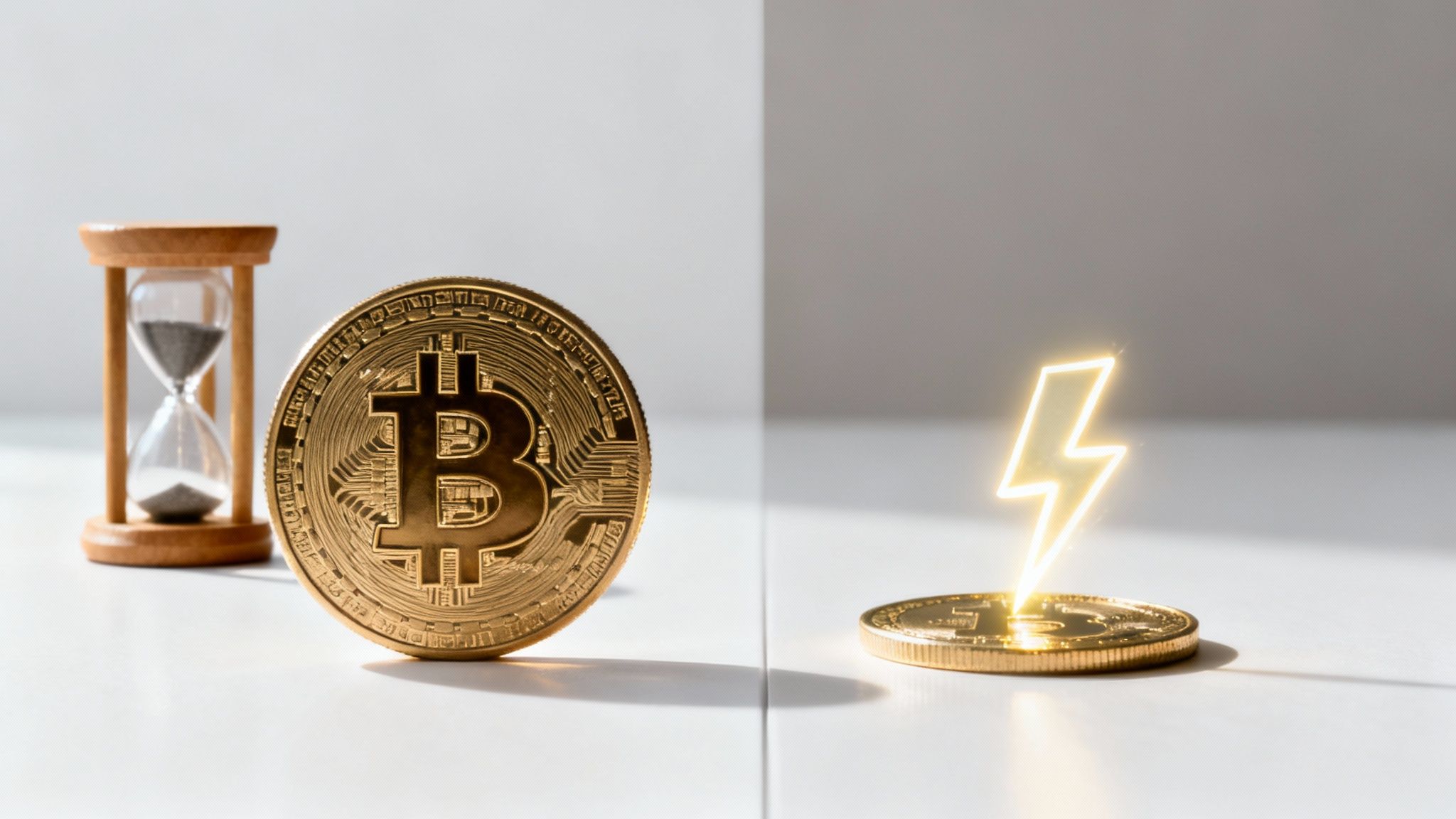
When you first start to pay a bill with crypto, the whole idea of network fees can feel a little foreign. Unlike a bank’s fixed charge, Bitcoin transaction fees—what we call "miner fees"—aren't static. They aren't set by a company or a bank; they're driven entirely by how busy the network is at that exact moment.
Think of it like rush hour traffic on a toll road. When everyone is trying to get through at once (sending transactions), the toll (the fee) goes up. Miners, the people running computers that process and confirm all the transactions, will naturally prioritize the ones offering a higher fee. This creates a fascinating little marketplace where you're essentially bidding to get your payment included in the next "block" of transactions on the blockchain.
What this really means is you have direct control over both the cost and the speed of your payment. Thankfully, most modern Bitcoin wallets make this dead simple by offering presets like "low," "medium," or "high" priority.
Choosing the Right Fee for Your Payment
Picking the right fee is always a balancing act between how much you want to spend and how quickly you need it to arrive. The choice really boils down to how urgent your bill payment is.
- High Priority Fee: Got a bill due tomorrow? You’ll want to select a higher fee. This effectively puts your transaction in the express lane, ensuring it gets confirmed fast—usually within 10-20 minutes.
- Standard Fee: For most day-to-day payments that aren't down to the wire, a medium or standard fee is the perfect sweet spot. It gets your payment there reliably without you having to overpay.
- Low Priority Fee: If you’re paying something that isn’t due for another week, you can save a bit of money by choosing a low fee. Your transaction will just hang back and wait for a quiet moment on the network to get processed. It might take a few hours, but it’ll get there.
The key takeaway is to match your fee to your urgency. Paying a little extra ensures a time-sensitive payment goes through without a hitch, while a bit of patience can save you money on less critical transactions.
The Lightning Network for Small, Fast Payments
For those smaller, recurring bills—like a monthly streaming subscription or a utility payment—using the main Bitcoin network isn't always the most practical option. That's exactly why the Lightning Network was created.
Lightning is what’s known as a "layer 2" solution. It's built on top of Bitcoin and is specifically designed for instant, nearly-free transactions.
Imagine you need to pay a $20 subscription. On the main network, the transaction fee might feel disproportionately high for such a small amount. But with a Lightning-enabled wallet, you can send that same $20 payment in a split second, and the fee is often less than a single cent.
This makes the Lightning Network the perfect tool for all those small, frequent payments that make up a big chunk of our monthly expenses. It beautifully complements the main Bitcoin chain, which remains the go-to for larger, less frequent transactions where the rock-solid security of an on-chain settlement is what matters most.
Essential Security Habits for Every Transaction
When you start paying bills with crypto, you're stepping into a world where you are your own bank. It’s an empowering feeling, but that freedom comes with a critical responsibility: you are the sole protector of your funds.
Unlike traditional banking, there’s no customer service line to call if you send funds to the wrong place. Bitcoin transactions are final and irreversible.
This isn't a bug; it's a core feature. It's what makes Bitcoin so powerful, but it also means you absolutely must adopt a few non-negotiable security habits. The good news? These practices are simple to learn and will quickly become second nature, giving you the confidence to transact securely every time.
The most common—and costly—errors come from simple carelessness. You have to, without exception, double-check the receiving wallet address before you hit send. A single wrong character means your Bitcoin is gone forever, sent to an address you can't access.
Treat every transaction with the same care you would when handling a large amount of cash. A moment of verification can prevent a permanent loss. Bitcoin doesn't have an 'undo' button, so precision is your best defense.
Protecting Your Digital Environment
Your security posture starts long before you even initiate a payment. The digital environment you transact in is just as important as the transaction details themselves.
Making payments on public Wi-Fi—think coffee shops or airports—is an open invitation for trouble. These networks are notoriously insecure, making it far too easy for bad actors to intercept your data.
Stick to trusted networks you control, like your home or office Wi-Fi. If you're on the go, using your phone's cellular data is a much safer bet. This one habit drastically reduces your exposure to potential threats.
Another huge area of focus should be phishing scams. These are getting more sophisticated, designed to trick you into revealing sensitive information. Here are some common red flags to watch for:
- Urgent Emails or Texts: Scammers love creating a false sense of panic, claiming your account is compromised and you must act now.
- Suspicious Links: Always hover over links before clicking to see the actual destination URL. Phishers use look-alike domains to fool you.
- Requests for Your Seed Phrase: This is the big one. No legitimate service will ever ask for your seed phrase or private keys. Treat it like the keys to your entire financial kingdom.
While Bitcoin remains the king of direct, peer-to-peer value, the broader crypto payment scene has exploded. The market has grown significantly, showing an increasing role for digital assets in practical uses like bill payments.
This isn't just a niche market anymore. You can dive into the full 2025 State of Crypto Report to really grasp the scale of this shift. That massive volume highlights the increasing trust and real-world utility of digital assets for everyday financial tasks.
Alright, let's tackle some of the questions that usually pop up when people start thinking about paying bills with Bitcoin. It's totally normal to want to get the details straight before you dive in. Getting comfortable with a new way of managing your money is key, so let's clear up a few common points.
Are My Bitcoin Bill Payments Anonymous?
One of the biggest myths about Bitcoin is that it's completely anonymous. The reality is a bit more nuanced—it’s pseudonymous.
Think of it this way: your real name isn't directly stamped onto your public wallet address on the blockchain. However, the transaction itself is public and recorded forever. Anyone can see it.
On top of that, any reputable bill pay service you use is going to require some form of identity verification. You'll often see this called KYC, or "Know Your Customer." This step links your real-world identity to your crypto transactions. So while it definitely offers more privacy than a bank statement that lists every purchase you make, it's not a completely untraceable system. It’s always a good idea to skim a service's privacy policy to see exactly how they handle your data.
What Happens if I Send the Wrong Amount of Bitcoin?
This is a big one, because Bitcoin transactions are irreversible. Once you send it, it's gone. There’s no "undo" button and no customer service hotline to call for a chargeback like you would with a credit card.
If you send too little, your payment will probably just fail. The bill pay service won't recognize it, and you might even risk losing those funds or having to pay a fee to get them back. If you send too much, well, getting a refund is pretty much a lost cause unless the person on the other end is honest and able to send it back.
The golden rule here is simple: always, always use the 'copy' function. Both the bill pay service and your wallet will have one. This guarantees you're sending the exact amount to the exact right address, completely avoiding any risk of a costly typo.
How Do I Handle Taxes on Crypto Bill Payments?
This is probably the most critical part to get right. In many places, including the United States, when you pay a bill with crypto, the tax authorities treat it as if you sold your Bitcoin at that very moment.
What does that mean for you? If the value of your Bitcoin has gone up since you bought it, that profit is considered a taxable capital gain. You absolutely have to keep detailed records of every single transaction—the date, the amount, and the Bitcoin-to-fiat exchange rate when you made the payment.
Seriously, to make sure you're staying on the right side of the law, your best bet is to talk to a tax professional who actually has experience with cryptocurrency. It can save you a world of headaches down the line.
Ready to offer your customers a secure, direct way to pay with Bitcoin? Flash provides merchants with the tools to accept wallet-to-wallet payments instantly, with minimal fees and no intermediaries. Start accepting Bitcoin in under a minute and tap into a global user base. Get started with Flash today.