So, you're thinking about letting customers pay with bitcoin. It's more than just a trendy move; it's a solid business decision that can seriously future-proof your operations. You're not just adding another payment button—you're opening up your business to a global, tech-forward audience while cutting down on pesky fees and kissing chargeback fraud goodbye.
This isn't about chasing hype. It's about a direct, wallet-to-wallet system that boosts your cash flow and lets you tap into new markets without getting tangled up in banking bureaucracy.
Why Your Business Should Accept Bitcoin Payments
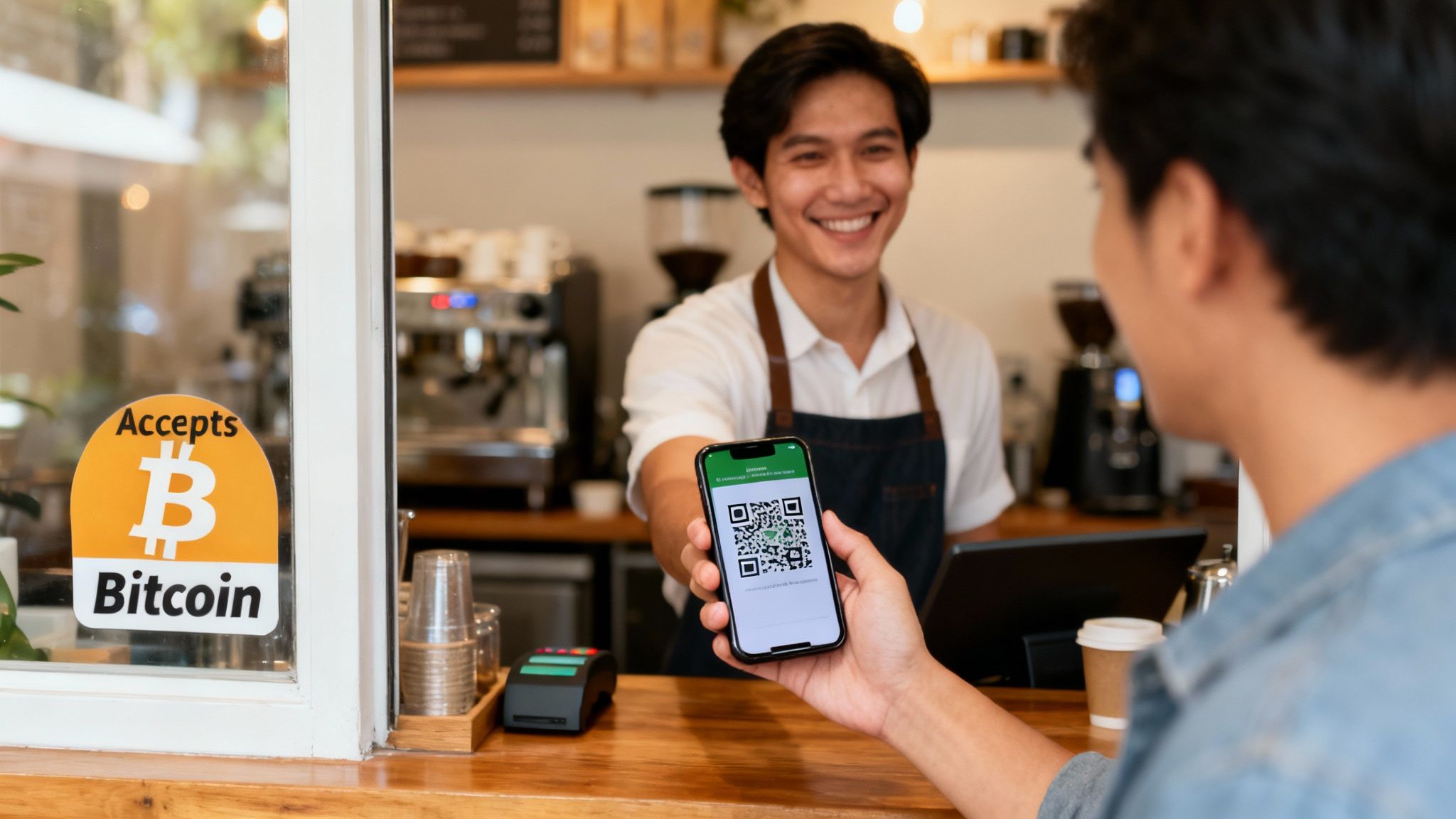
Let's be real, traditional payment processors can be a nightmare. They come loaded with high fees, frustrating delays, and the ever-present threat of chargebacks. Integrating Bitcoin, especially with a non-custodial tool like Flash, lets you sidestep all of that.
When a customer pays you in Bitcoin, that transaction is final. Done. This simple fact makes chargeback fraud—a massive headache and expense for so many merchants—completely impossible. The money moves directly from their wallet to yours, cutting out the middlemen and their cut.
Unlock a Global Customer Base
One of the biggest wins here is the instant access you get to a massive, growing international market. You're no longer boxed in by the sluggish, restrictive world of traditional banking when it comes to cross-border sales.
Bitcoin doesn't care about borders. It lets you sell to anyone, anywhere, just as easily as you'd sell to someone down the street. This is a game-changer, especially for:
- eCommerce Stores: Finally reach new markets without wrestling with complex international payment gateways.
- Digital Creators: Sell your art, courses, or content to a global fanbase without losing money on currency conversions.
- SaaS Companies: Onboard international clients with slick, automated recurring payments that just work.
This isn't just a hypothetical benefit. The Bitcoin user base is exploding, and it's full of early adopters with real spending power.
Improve Your Bottom Line and Cash Flow
The financial perks of accepting Bitcoin are immediate. You know those 2-3% fees that credit card processors skim off every single sale? They vanish. That money goes straight back into your pocket.
With a direct Bitcoin system like Flash, the only real cost is the standard Bitcoin network fee, and that's paid by the customer to get their transaction confirmed on the blockchain. You keep more of every sale.
And forget waiting days for funds to clear. Bitcoin payments land in your wallet in minutes, giving your cash flow a serious shot in the arm. You get access to your working capital almost instantly.
This isn't a niche trend anymore. In 2025, Bitcoin payment volumes through top providers jumped 12% year-over-year. The average transaction hit $800, proving it's being used for real, substantial commerce. This growth is tapping into a global network of over 500 million wallets.
Want to dig deeper into the numbers? Check out the full report on Bitcoin's commercial growth from BitPay.
Choosing the Right Bitcoin Payment Solution
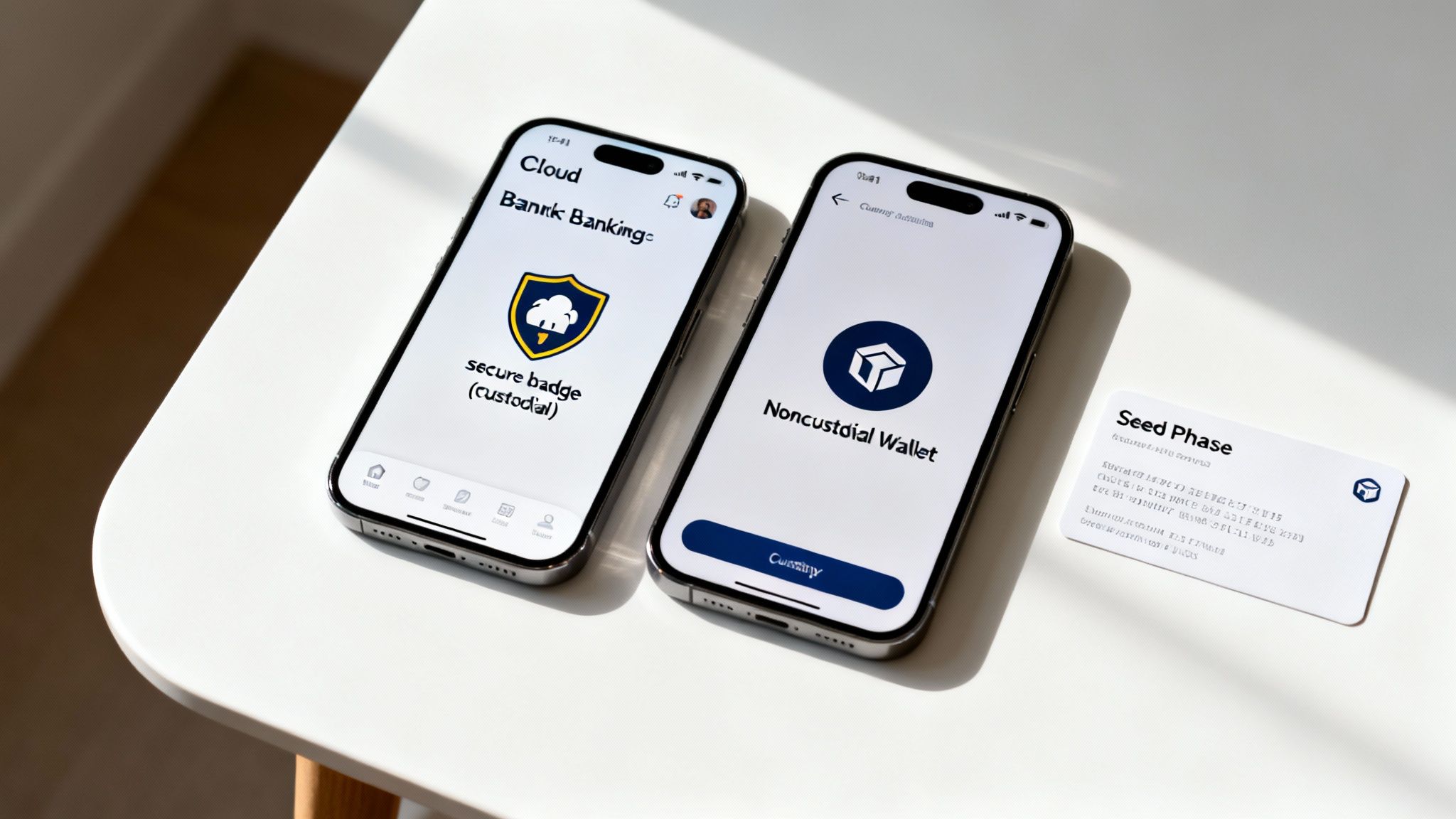
Alright, you see the massive upside to accepting Bitcoin. The next logical step is picking the right tool for the job. This is where a lot of merchants get tripped up, because not all payment solutions are created equal.
Your choice here directly impacts your security, your control over your own money, and how smoothly your day-to-day operations run. The single most important concept to wrap your head around is the difference between custodial and non-custodial services.
A custodial service is essentially a Bitcoin bank. When a customer pays you, the Bitcoin lands in a wallet controlled by a third party. They hold your funds for you, managing the private keys on your behalf. While this might feel simpler for absolute beginners, it reintroduces a middleman and a layer of trust you were probably hoping to escape by using Bitcoin in the first place.
On the other hand, a non-custodial solution like Flash puts you firmly back in the driver's seat. Payments go directly from your customer’s wallet to a wallet where only you hold the private keys. This is the entire point. It’s what makes Bitcoin such a powerful tool for merchants: true financial sovereignty.
Custodial vs. Non-Custodial: What Really Matters
The whole idea behind Bitcoin is peer-to-peer value transfer. A non-custodial platform respects and enables this core principle. A custodial one, well, it just slots a new middleman into the equation. For a business owner, that distinction is everything.
With a non-custodial system, you get:
- Total Control of Your Money: Your Bitcoin is yours. Full stop. No third party can freeze your funds or deny you access to your account.
- A Huge Security Upgrade: By holding your own keys, you eliminate the single biggest point of failure—a custodial provider getting hacked and losing your money along with everyone else's.
- Better Privacy: Transactions are direct between you and your customer, which means less of your business data is being passed around to intermediaries.
Custodial services often come with baggage like extensive KYC (Know Your Customer) processes, withdrawal limits, and extra fees for their "management" services. They're asking you to trust them with your assets.
The fundamental question is simple: Do I want to truly own the Bitcoin my business earns, or do I want another company to hold it for me? For any business serious about harnessing the real benefits of decentralization, going non-custodial is the obvious choice.
To make this crystal clear, here’s a breakdown of how a non-custodial solution like Flash stacks up against traditional custodial processors.
Bitcoin Payment Solutions Comparison: Flash vs. Custodial Processors
This table cuts through the noise and shows you the practical differences.
| Feature | Flash (Non-Custodial) | Custodial Processors |
|---|---|---|
| Asset Control | Merchant holds their own keys; funds are 100% yours | Processor holds keys; funds are in their custody |
| Security Risk | You control your security; no third-party breach risk | Your funds are at risk if the processor is hacked or insolvent |
| Settlement Speed | Instant and final settlement directly to your wallet | Funds held by processor; subject to their withdrawal schedules |
| Censorship Risk | Zero. No one can freeze your account or block transactions | High. Accounts can be frozen or closed without warning |
| Privacy | High. Direct peer-to-peer transactions | Low. Requires sharing extensive business & customer data |
| Fees | No processing fees | Often includes hidden fees, withdrawal fees, and higher rates |
| Setup & KYC | Minimal. Get started in minutes without invasive checks | Extensive KYC/AML process, often taking days or weeks |
As you can see, the non-custodial model isn't just a philosophical preference; it delivers tangible business advantages in security, speed, and cost.
Key Features to Look For in a Bitcoin Solution
Beyond the custody debate, you need a platform with practical tools that actually fit your business model. It's not enough to just generate a QR code. You need a system that slots seamlessly into your existing workflow.
Look for a solution that offers a complete toolkit built for real-world commerce. The goal is to make accepting Bitcoin just as easy—or even easier—than taking a credit card payment.
A truly powerful solution should include:
- A Mobile POS App: For any brick-and-mortar shop, cafe, or market stall, the ability to turn a phone or tablet into a point-of-sale terminal is a must-have for handling in-person payments on the fly.
- Shareable Payment Links: Incredibly useful for freelancers, service providers, or anyone selling on social media. These links let you request a specific amount from anyone, anywhere, just by sending them a URL.
- Subscription and Paywall Tools: If you run a SaaS business, a newsletter, or sell digital content, you need automated recurring billing in Bitcoin. It's a game-changer for managing subscriptions without relying on the old financial rails.
- Simple eCommerce Integration: You shouldn't need to hire a developer to start accepting Bitcoin online. Look for easy-to-install widgets or plugins that plug right into your online store for a smooth checkout experience.
Choosing a platform with this kind of versatility ensures you’re ready for any sales scenario. It’s what allows you to fully capitalize on the opportunity to let customers pay with bitcoin and grow your business on your own terms.
How to Set Up Your Bitcoin Payment System
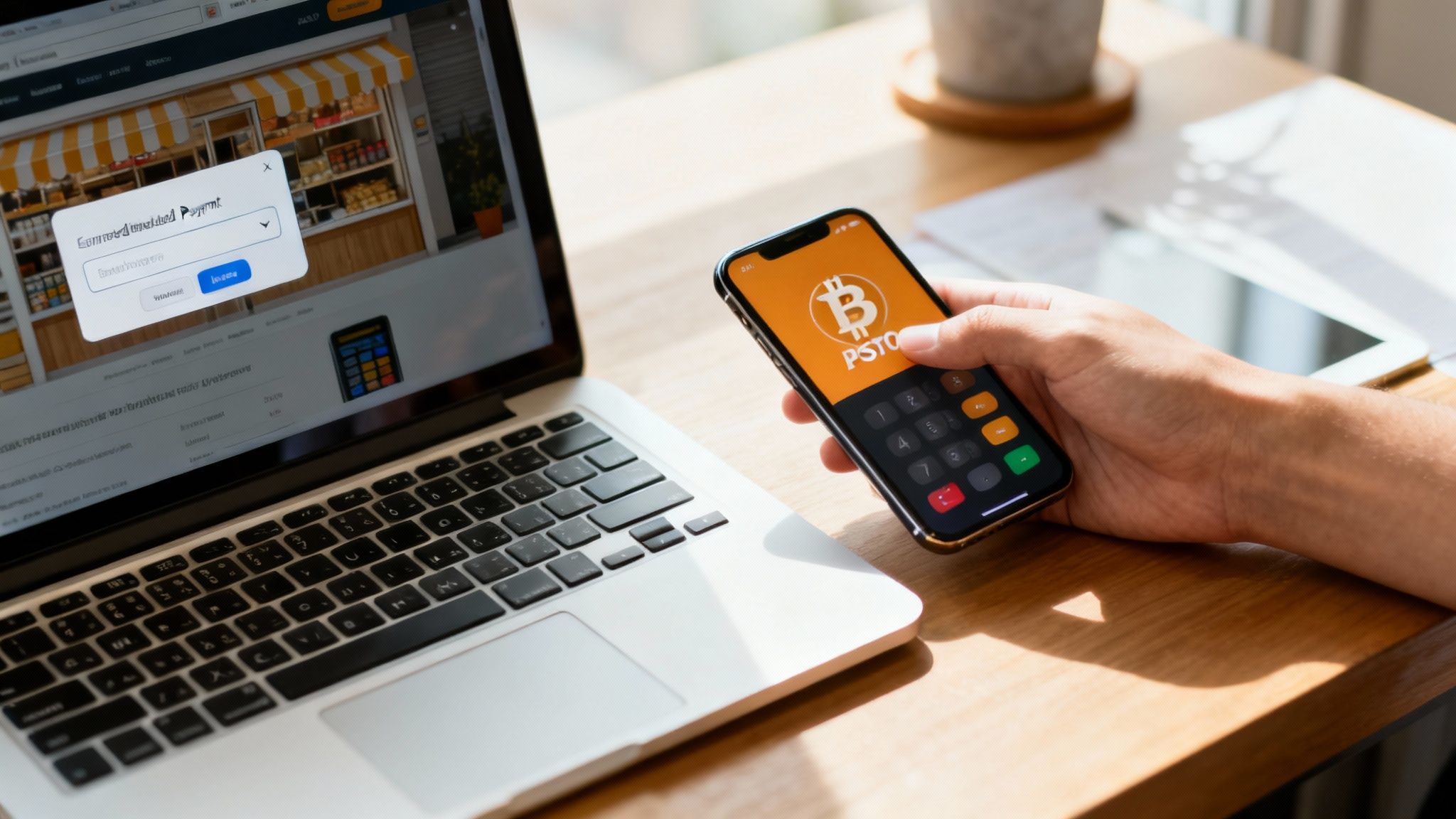
Alright, let's get down to brass tacks. Moving from just thinking about Bitcoin to actually accepting it is where the magic happens. The best part? Getting set up to pay with bitcoin is surprisingly simple. You can forget about the nightmares of complex code or drawn-out verification processes; today's tools are built for merchants who need to get moving quickly.
When a platform like Flash says you can be up and running in under a minute, it’s not just a catchy slogan—it’s the new standard. Whether you’re pouring lattes in a busy café, managing a global online shop, or running a members-only content site, the right setup will slide right into your existing operations. Let's break down how you can flip the switch for your specific business.
For Brick-and-Mortar Shops: The Point-of-Sale App
If you have a physical storefront, the device you're probably holding right now—your smartphone or tablet—is all the hardware you need. The Flash Point-of-Sale (POS) app essentially turns your device into a dedicated Bitcoin terminal. It’s a perfect fit for retail shops, market stalls, cafes, or any business where you’re interacting with customers in person.
The flow is incredibly smooth:
- Enter the Sale Amount: You punch in the total price in your local currency, just like you would on any other card reader.
- Generate a QR Code: The app does the heavy lifting, instantly converting the total to Bitcoin at the live exchange rate and displaying a unique QR code.
- Customer Scans and Pays: Your customer simply opens their Bitcoin wallet, scans the code, and confirms the payment.
Within seconds, the transaction hits the Bitcoin network, and you get a confirmation right there in your app. It’s a clean, direct process that completely sidesteps the traditional banking system. Not only does this cut down on hardware costs, but it also offers a slick, modern payment experience that customers remember.
For eCommerce Stores and Online Sales
Selling online is a different ballgame, but the tools are just as straightforward. The name of the game is reducing friction at checkout. You’ve got a couple of great, low-code options for bringing Bitcoin payments to your online business.
- Payment Widgets: Think of these as little plug-and-play components you can drop right onto your website's checkout page. Customers will see a "Pay with Bitcoin" button next to PayPal or credit card options. When they click it, the widget shows them the QR code and payment info without ever leaving the page.
- Payment Links: This is probably the most flexible tool in the shed. You can create a unique link for a specific product or a custom invoice amount. Share it anywhere—email, social media, a DM, or even link it to a "Buy Now" button on your site. The customer clicks the link and is taken to a secure, hosted page to pay. Simple as that.
The beauty of a non-custodial system is that every satoshi from these sales flows directly into a wallet that you control. There’s no third party holding your funds for days. Settlement is practically instant, and you have complete sovereignty over your money.
For Creators and Subscription Services
If your business runs on recurring revenue—think SaaS platforms, paid newsletters, or exclusive communities—then automating your Bitcoin billing is a must. Sending manual invoices every month just isn't scalable.
Tools like Flash are built for this. You can set up recurring payment plans and even digital paywalls with ease.
Configure your billing cycles (monthly, yearly), offer trial periods, and automatically charge your subscribers' wallets on schedule. This lets you build a dependable, automated revenue stream on a pure Bitcoin standard, free from the exorbitant fees and cross-border headaches that plague traditional subscription platforms. You can finally open your doors to a truly global audience without the usual financial friction.
Bitcoin Payments in Action: Real Business Scenarios
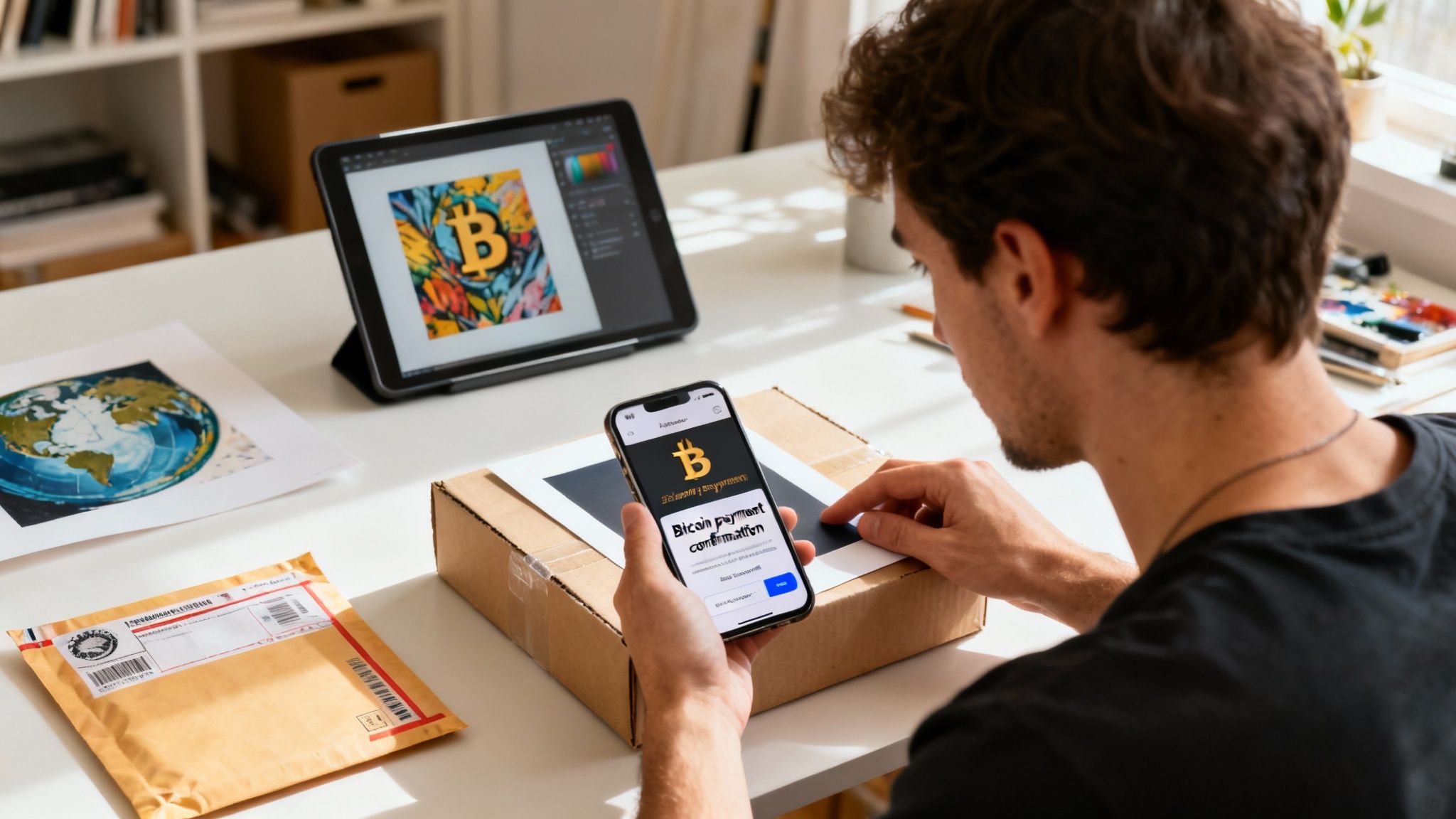
Theory is one thing, but seeing how real businesses pay with bitcoin and actually grow from it is where the rubber meets the road. Let's get practical and look at how actual merchants are solving everyday problems with these tools.
Each of these examples tackles a specific pain point—from crippling fees to global payment friction—and shows how Bitcoin offers a straightforward solution. These aren't just ideas; they're blueprints you can use. You’ll see how a local coffee shop, a global digital artist, and a growing SaaS startup all leverage different features of Flash to their advantage.
The Local Coffee Shop: Instant POS Payments
Picture a busy neighborhood café, slinging lattes and pastries from morning till night. They're processing hundreds of small-ticket sales every single day. While each transaction is small, those 2-3% credit card fees nibble away at their profits, adding up to a massive chunk of revenue by the end of the month. On top of that, they get hit with the occasional chargeback—a costly headache for any small business.
So, they set up the Flash POS app on a tablet by the register. It completely changed their game.
- How It Works: When a customer orders, the barista just taps the amount into the app in their local currency. A QR code instantly pops up with the Bitcoin equivalent. The customer scans it with their phone's wallet, and boom—payment confirmed.
- The Result: The café waves goodbye to credit card processing fees. Chargebacks? A thing of the past, since Bitcoin transactions are final. This one simple switch puts hundreds, if not thousands, of dollars back into their pocket every year.
The Digital Artist: Global Payment Links
Now, let's think about a digital artist based in Southeast Asia with a massive social media following. Her fans are everywhere—North America, Europe, Australia. Selling prints used to be a nightmare of juggling different payment platforms, each one taking a cut with high conversion fees and putting annoying holds on her money.
A simple payment link fixed all of it.
Now, for every new piece of art, she creates a unique payment link with a set price and drops it right into her social media posts. A fan in Germany can click the link, pay with Bitcoin from their wallet, and the funds land directly in her wallet. Instantly. No cross-border drama, no middlemen. It’s a direct-to-creator model that unlocks a truly global marketplace.
This shift is part of a much bigger trend. In 2025, Bitcoin inflows shot past $1.2 trillion, a clear sign of its growing dominance as regions like Europe and the Middle East embraced on-chain payments. For creators and online stores, this means tapping into a worldwide customer base that’s ready to pay directly. You can find more on this in the global adoption of crypto payments report.
The SaaS Startup: Automated Subscriptions
Finally, let’s look at a SaaS startup with a monthly subscription for its software. Their customers are developers and small businesses scattered all over the globe. Their old payment system was a constant source of frustration, with international credit cards frequently declining and currency issues causing customers to churn.
Integrating Bitcoin for recurring billing streamlined everything.
They used Flash's tools to set up subscription plans, letting customers authorize automatic monthly payments directly from their Bitcoin wallets. This creates a rock-solid, predictable revenue stream built on a global standard. It puts an end to involuntary churn from failed card payments and makes accounting way simpler since they're dealing with a single, borderless asset. Now, onboarding a customer from Japan is just as easy as signing up someone from down the street.
Managing Your Bitcoin Securely and Effectively
Getting paid in Bitcoin is one thing; keeping it safe is the real game. When you use a non-custodial tool like Flash, you're the one in the driver's seat. Your funds, your control. This is the entire point of decentralization, but it also means the buck stops with you when it comes to security.
The financial bedrock of your business boils down to a single, critical element: your private keys. You need to think of a private key as the master key to your digital vault. If anyone else gets their hands on it, they have complete, unrestricted access to your Bitcoin.
Never, ever store your private keys digitally on a device connected to the internet. That means no text files, no email drafts, no cloud storage. The gold standard is to write them down on paper or, even better, engrave them on metal and stash them in multiple secure, offline locations.
Properly securing your funds isn't just about dodging thieves; it's about building a sustainable, long-term operational model around this new way of getting paid.
Wallet Management and Transaction Monitoring
Once a customer pays you, the transaction gets broadcast to the Bitcoin network. But it's not truly "final" until it has racked up a few confirmations. A confirmation happens every time a new block of transactions is added to the blockchain after yours.
Most businesses will wait for at least one to three confirmations before they consider a payment complete. This usually takes anywhere from 10 to 30 minutes. Waiting for confirmations is your best defense against issues like double-spending and gives you the peace of mind that the funds are irreversibly yours. You can easily keep an eye on this process using any public Bitcoin block explorer.
A crucial, often overlooked step is securing the transaction on your end. It's vital to understand how to install an SSL certificate to encrypt your website's traffic. This protects customer data during the entire checkout process and is just as fundamental for Bitcoin payments as it is for any other online transaction.
Handling Customer Questions and Global Adoption
As soon as you start accepting Bitcoin, get ready for questions. You'll hear a lot about transaction times, network fees, and the basics of how to use a Bitcoin wallet. Having simple, clear answers ready to go will make the whole payment process smoother and keep your customers happy.
This kind of preparation is becoming more important by the day. Global adoption is picking up serious steam. South Asia, for example, has seen an 80% surge in adoption, with India leading the pack worldwide. This is all part of a massive trend that experts predict will see the cross-border market swell to $290 trillion by 2030. Bitcoin's privacy features are a huge draw for a growing number of merchants, and by managing your Bitcoin securely, you're putting your business in a prime position to tap into this expanding international market.
Diving into Your Bitcoin Questions
Jumping into Bitcoin payments for the first time? It's totally normal to have a few questions swirling around. Most merchants I talk to are curious about the technical side of things, how to deal with price swings, and what it really costs.
Let's unpack these common concerns. The great news is that modern tools have completely changed the game, making it simpler than ever to get started.
"Do I Need to Be a Tech Whiz to Set This Up?"
Not at all. Seriously. Platforms like Flash are designed for business owners, not developers. The entire point is to get you up and running and accepting Bitcoin in less than a minute.
You won’t need a single line of code to use the mobile POS app or to whip up a payment link you can share anywhere. Our guides are visual and straightforward, so you can get going without any headaches.
"But What About Bitcoin's Price Volatility?"
This is probably the biggest question on everyone's mind, and it's a fair one. The way direct Bitcoin payments work is your best shield against this. When a customer hits ‘pay with bitcoin’, that transaction is priced at the exact market rate at that moment, and the funds land directly in your wallet.
With Flash, every transaction is instant and wallet-to-wallet. This means the Bitcoin you receive is valued at the moment of sale, effectively locking in that value and minimizing your risk from any short-term price moves on that specific payment.
From there, you have options. Many merchants I know hold a portion of their earnings in Bitcoin as a long-term asset. Others use services to convert their Bitcoin to local currency on a regular schedule that works for them.
"Okay, So What Are the Fees?"
This is where things get really interesting. One of the biggest wins of accepting Bitcoin is the massive cost savings. Your typical credit card processor is quietly skimming 2-3% off every single sale you make. It adds up fast.
When you take a direct Bitcoin payment, you just sidestep all of that. The only cost involved is the standard Bitcoin network fee, which your customer pays to the miners who process the transaction on the blockchain. Flash charges zero processing fees. That means more of every sale stays right where it belongs: with you.
Ready to say goodbye to processing fees and open your doors to a global customer base? Get started with Flash and you can be accepting Bitcoin in under 60 seconds. Explore Flash's merchant tools today.